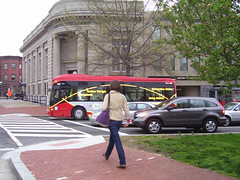
Salt Lake City TRAX light rail is kind of both "monocentric" and "polycentric"
In Cities in Full, Steve Belmont argues for center city centralization and in his discussion about transit, he contrasts the SF MUNI system, which is completely within the city, but complemented by the subway-commuter rail BART, which serves the Greater Bay Area, and the WMATA Metrorail system in Greater DC.
What I figured out that he didn't is that the Metrorail system functions as two different systems, a polycentric commuter rail system reaching out as far as 32 miles into the suburbs (Metro Center to Ashburn on the Silver Line), and a monocentric heavy rail subway system in the core of DC proper.


Most every station catchment area in the DC core has revitalized, while many out-city station areas remain poorly developed ("Transit oriented development station typology revisited," "Welcome to the loneliest Metro stop," Washington Post).

I was arguing with New Urbanists about a "new urban development" in the Daybreak community of South Jordan ("Downtown Daybreak opens, a mixed-use city core," CNU), stating that an itty bit of urbanism, 200 acres, in the midst of hundreds of miles of sprawl is but a wee bit forward.
One of the counter points was that Daybreak "has light rail." It will, but at 20 miles from the core of Salt Lake City, it's almost exurban ("Transit oriented development station typology revisited"), and research finds that the best ROI from transit is within the first 10 miles of the system.
TRAX came about because of the 2002 Winter Olympics and I think it functions pretty well within its transit shed ("Updating the mobilityshed / mobility shed concept" and "Manhattan Institute misses the point about the value of light rail transit connections to airports | Utility and the network effect: the transit network as a platform"). It's just that the State Legislature has been more focused on far suburban extensions of the system, rather than more intensive additions in the core of the system.
I wouldn't say TRAX in the core is exactly monocentric, but complemented by a decent enough bus system, if you live within one half mile to one mile of a station, it works pretty well. The main core line, on 400 South in Salt Lake, hasn't seen the kind of more intense development and urban re-design that is necessary to adequately leverage the transit infrastructure, but for a city of its size--210,000 people--it does reasonably well.
I was skeptical of the proposal for the new Orange Line ("Utah Agency Picks Preferred Route for $400M Salt Lake City Light Rail Expansion," Engineering News-Record), because it is mostly duplicative of the existing transit shed, but it does add some stations in the Central Business-Residential District as well as a couple on or near the University of Utah campus, and proposes TOD at one of the stations on the campus also.

Interestingly, this would move TRAX a couple stations towards Foothill Avenue, which is the main arterial in my neighborhood, leading to I-215.


To my way of thinking, the best intensification effort would be to have a line on I-215, either light rail or commuter rail to the University campus and research park (the Frontrunner train is also decent, a single line though, within its catchment area).
And then separately with a light rail along Foothill and down to Sugar House to connect to the S-Line streetcar and back to the light rail, in an orbital route.

Of course, such line extensions could happen but beyond my life time.
Labels: fixed rail transit service, mobility shed, real estate development, transit infrastructure, transit oriented development/TOD, transit shed, urban vs. suburban vs. rural
posted by Richard Layman @ 8:00 AM&Permanent Link
Follow this blog
0 comments