Rebuilding Place in the Urban Space

"A community’s physical form, rather than its land uses, is its most intrinsic and enduring characteristic." [Katz, EPA] This blog focuses on place and placemaking and all that makes it work--historic preservation, urban design, transportation, asset-based community development, arts & cultural development, commercial district revitalization, tourism & destination development, and quality of life advocacy--along with doses of civic engagement and good governance watchdogging.

Friday, February 06, 2026

San Francisco is not Santa Clara: How Santa Clara/San Jose are poorly represented by Super Bowl programming, even though it's home to the event

Yes, we're familiar with how many professional teams labeled after "their city" are no longer based in the city, but in the suburbs, e.g., the New York Giants and New York Jets play in New Jersey, the Arizona Cardinals play in Glendale, not Phoenix, and the San Francisco Giants moved from the city to the suburbs of San Jose in return for lots of subsidy--$80 million directly and hundreds of millions in bonds ("7 Things to Know About the Complicated Relationship Between Santa Clara and the 49ers," KQED/NPR).

Levi’s Stadium in Santa Clara has the game but most of the sanctioned events leading up to it are in San Francisco. Kirby Lee/Imagn Images/Reuters

This is a problem when it comes to "economic benefits of the Super Bowl to the local economy," when the NFL will hold activities in "the big city"--New York City not suburban New Jersey, Phoenix not Glendale, and in the case of Sunday's Super Bowl, LV, in San Francisco not Santa Clara or San Jose ("Big game, big bill: Santa Clara mayor flags Super Bowl costs to the city," NBC, "Congrats, Your City Gets to Host the Super Bowl. The Party’s 40 Miles Away," Wall Street Journal, "Super Bowl LX week will once again be centered in San Francisco, but San Jose will kick off the fanfare," San Jose Mercury News).

From the WSJ:

San Jose got one sanctioned event—Super Bowl Opening Night. Mayor Matt Mahan opted to not get mad, but get even. He helped raise $5 million from businesses to field a competing roster of events, including a three-day block party called Super Fest, watch parties, drone shows and sold-out outdoor performances by the R&B singer Kehlani and DJ Dom Dolla.

I doubt the San Jose programs, scheduled against NFL sanctioned events held elsewhere, will have a significant effect in drawing fans to San Jose, especially if people are staying in hotels in SF.

The last Super Bowl in Santa Clara, in 2026, earned the city less than $1 million.  From "‘We’ll be on the center stage’: San Jose pulls out all the stops for 2026 sports bonanza," Local News Matters:

When Levi’s Stadium hosted Super Bowl 50 in 2016, reports found the Bay Area saw a $240 million boost to the local economy — San Jose, however, only saw 12% of those economic benefits, while 57% went to San Francisco. Santa Clara, where the stadium is located, only saw 7% of the benefits.

It's rare for a sports economic impact study to be so fine-grained.  They also subtracted out negative effects, and separately accounted for in kind project donations to area nonprofits.

Usually, small businesses don't benefit much from these events, as most of the money patrons spend is on travel, lodging, car rental, and food and beverage, and many of these firms are not locally owned.  From "Super Bowl LX preps spotlight local sourcing as NFL targets $360M economic impact," Silicon Valley Business Journal.

The NFL is also trying to keep the economic impact local, according to the NFL's Vice President of Global Events, Nicki Ewell. She said the league used a local-first sourcing strategy, sourcing from regional restaurants, vendors and local labor for stadium build-out and events so spending stays in the Bay Area.

Previous Silicon Valley Business Journal reporting shows that Super Bowl LX is projected to bring 90,000 people to the Bay Area in addition to a projected $360 million to $630 million in economic impact.

"This is huge," said Jayne Ancheta, owner of Santa Clara-based Macaron De Jayne and Source LX participant. "I secured multiple contracts for the Super Bowl events, and I had catering opportunities outside of the Super Bowl." The Super Bowl also marks an opportunity to spotlight the Bay Area, Ewell noted.

Note the same kinds of issues are present with "All Star Games" in baseball and basketball, etc.

-- "Musing on the economic impact of cultural and sports events," 2019
-- "Not enough time for a 2024 DC-Baltimore Olympic Bid (to make sense)," 2014
-- "Big sporting events (World Cup/Olympics), economic development and trickle down economics," 2014
-- "Super Bowl," 2016
-- "More need for economic revitalization planning/linkage with sports stadiums: Las Vegas (+ Houston and the Super Bowl)," 2017
-- "Minneapolis Super Bowl: Urban Revitalization and Transformational Projects Action Planning," 2018

-- "NBA All Star Game in Salt Lake, economic development hype | Pittsburgh Post-Gazette on the Pirates baseball team economics," 2023

The Urban Land Institute disagrees ("Inglewood’s Transformation: How an NFL Stadium Brought the City Back from the Brink of Bankruptcy").  But not the Washington Post ("A home Super Bowl is good for the Rams. But is SoFi Stadium good for Inglewood?").

Special labor.  One point of difference that I failed to account for in the past in terms of economic impact is what we might call "special events labor"--the people who run lights, sound, etc. for the event.  There definitely is an impact here, where people might get paid for a couple week long temporary gig associated with the Super Bowl.

NFL Draft economic impact.  More recently, the NFL has made an event out of the Draft, which is now held each year in different cities across the country. Economic impact is claimed to be as much as one half of the economic impact of a Super Bowl, which seems outlandish to me ("NFL Draft Expected to Have Huge Economic Impact for Detroit," Corp!), but apparently many tens of thousands of people are attending. 

"NFL Draft: Fans flock to second day of NFL Draft as Detroit nears attendance record," CNN.

In 2024, it was estimated that 300,000 fans would come to Detroit for the Draft, more than double a typical Super Bowl.  

It makes no sense that these projections are accurate.  But this photograph from Detroit's Draft Days tells another story.

-- Economic Impact of the NFL Draft Event in Detroit, Andersen Economic Group.  AEG differentiates between direct and indirect impact, indirect has to do with the multiplier effect of money recirculating within the economy.  WRT sports event, indirect impact is somewhat reduced because some of the major beneficiaries are firms located elsewhere (like airlines, hotels, rental cars) and the money repatriates to those headquarter facilities.

I like this infographic on the economic impact, produced by the City of Detroit by Octane Design, in the Sports Travel Magazine article, "2024 NFL Draft Brings Detroit $213.6 Million in Estimated Economic Impact," Sports Travel Magazine.  


Labels: , , , , , ,

Wednesday, August 28, 2019

Economic benefits of restaurants: Buffalo Billiards, Dupont Circle, Washington, DC

Economic benefits of restaurants: Buffalo Billiards, Dupont Circle, Washington, DC

Apparently, the building on New Hampshire Avenue in Dupont Circle where Buffalo Billiards and the Front Page restaurants are located was sold to WeWork, and WeWork didn't renew the leases of the resident restaurants.

Buffalo Billiards was there for 25years; the Front Page 32 years (Disclosure: I worked at the Front Page in the past).  (Given that I love newspapers, the fact that the Front Page had many newspaper front pages posted on the walls was a cool feature.)

Buffalo Billiards was a basement-located billiard parlor and bar.

It impressed me because they figured out how to make an otherwise marginal space--how many successful restaurants are below grade in major cities?--quite successful, and they probably were able to do it at a rent rate much less than what businesses pay for ground level space.

As part of their closing events, they produced a banner which among other things listed how much rent they paid; how much sales taxes; and how much was earned in tips.

They could have also included how much wages paid out; income taxes; and property taxes if they paid towards that.

(That being said, I still don't think bar crawls are necessarily a good thing from a public space management perspective.)


Value
Rent $8,034,563.90
Sales Taxes $8,364,339.59
Tips (wages) $13,083,784.00

Labels: , , ,

Friday, January 23, 2015

Economic impact study on the Colorado River

Rivers and transportation.  Historically, rivers were major transportation corridors for passengers and freight, although as railroads and the national road network were created, their role in passenger travel diminished, but certain rivers still have important freight functions (such as the Mississippi River and barges).

Rivers were a source of industrial power before electricity (look up mill towns) and today some rivers play a role in hydroelectricity production.

In cities, riverfronts served port functions, warehousing, and industry.  As those functions declined or moved to other locations, these waterfronts have often been central to urban revitalization effort,s, keeping marinas in place, but shifting to tourist-related activities.  Some even serve as ports for cruise travel.

Water drawn from rivers is the primary source of drinking water in the United States.

I don't think I've ever seen an economic impact study for a river in its entirety, although I have seen studies of the economic impact of lake-based recreation and for marinas.

The Colorado River flows through six states--Arizona, California, Colorado, Nevada, Utah and Wyoming and part of Mexico.  The Colorado River Basin also includes New Mexico.

In the context of drought and reductions in available water, Arizona State University conducted an economic impact study, which found that the river is vital to the economies of the states in the Colorado River basin, generating $1.4 trillion of economic activity and supporting 16 million jobs.

-- The Economic Importance of the Colorado River to the Basin Region, Carey School of Business, Arizona State University
-- Protect the Flows is a business advocacy group focused on Colorado River matters. The website has additional resources and reports on various River-related matters
-- Mission 2012 Clean Water webpage on the Colorado River
-- "Sucking the River Dry," Denver Post, 2012

Obviously the Colorado River is a significant source of water for local consumption and agriculture in all of the states it flows through.   "Rights" to draw water from the river are contentious, because the rules are based on consumption in earlier times.

As metropolitan areas have grown in states like Arizona and Nevada, there is more competition between urban and agricultural interests for access.

Demand is greater than supply, and that doesn't even take into account the current drought. As the Southwest continues to add population, questions about access to water in general, and to the Colorado River in particular will become even more contentious.

Water-related advocacy groups believe that the Colorado River is in great crisis, one of the nation's most endangered, and American Rivers called in the nation's the most endangered river of 2013.

Then, there is the issue of water for conservation and wildlife and ecosystem issues other than related to consumption by humans.

Image from High County News.

Labels: , , ,

Thursday, November 20, 2014

A point about the investment priorities of local governments, stadiums, etc.

Rendering of a possible soccer stadium in Sacramento.

With regard to DC's machinations about funding a soccer stadium ("Muriel Bowser says she will remove Reeves Center sale from DC United stadium deal," Post; "The Incredible Shrinking Stadium-Deal Benefits," Washington City Paper), it's interesting to keep up with and compare media coverage about similar ongoing negotiations now in other cities such as Boston ("Soccer stadium could create an urban opportunity, if done right," Globe), Sacramento ("Mayor: MLS meeting productive, no timeline for expansion decision," Sacramento Bee), and South Florida, where David Beckham will be an owner ("David Beckham's Miami soccer gamble: If they build the stadium will the fans come?," Miami Herald).

The same goes for the Olympics.  Other cities besides Washington ("USOC meets privately with Washington 2024 about Olympic bid," Washington Business Journal; "Washington's Olympic team: The A-list sports fans vying for the 2024 Games," Post) that are vying for the event in 2024 include San Francisco ("San Francisco puts in chips for 2024 Olympics" and "Bay Area’s Olympic dreams focused on landfill near Candlestick," SF Chronicle), Boston, and Los Angeles.

Aaron Renn of the Urbanophile also writes for Governing Magazine and his latest is an interesting story "(Lessons from Kokomo on How to Spend Responsibly") about this small town located north of Indianapolis known for large scale manufacturing that raised most of its revenue from property taxes on factories.  When Chrysler stopped paying property taxes when the company entered bankruptcy--eventually closing the plant entirely--the city was on the ropes.

According to Aaron, to recover, the city adopted innovative practices to save money, cut staff, and annexed adjoining lands from the county where there was significant development activity, making the city larger and increasing tax revenues.

He avers that this allowed the city to generate capital to do "pay as you go" capital investment (I am okay with debt financing myself...), including a parking garage + housing development, a new YMCA downtown, and two new fire stations.

He contrasts this with Los Angeles, which because of its high cost of personnel including escalating pensions, can't invest in much of anything.  Separately, the LA Times has an article, "Angelenos could tax themselves to fix roads under City Hall proposal," about the potential creation of neighborhood "beautification districts" that will allow neighborhoods to tax themselves additionally in order to fix damaged roads.  It's pretty incredible that cities are driven to such an action.  But that's what lack of funds will do.
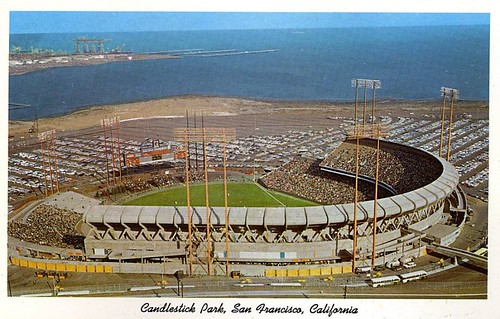
Candlestick Park postcard
So on the perennial argument of is it better to "invest" in sports stadiums and arenas or other projects, I was struck by a brief article (Lennar, Macerich Team Up on Mall," Wall Street Journal) on the redevelopment of SF's Candlestick Park stadium and abutting parking lots.  The stadium, once used by the local baseball and football teams, so it had about 92 events/year, will be replaced by a mixed use development that will include:
  • 6,225 housing units
  • 500,000 s.f. shopping mall, done in conjunction with one of the nation's leading shopping center companies, Macerich
  • 100,000 s.f. of additional retail space
  • 220 room hotel.
Property taxes at the local level tend to be split between a city, county, and a school district, and sometimes other taxing entities--special services districts of various types--claim a portion as well.

(San Francisco, Philadelphia, and Baltimore are city-counties (technically, Baltimore County exists as a separate entity while the city is treated as a county for governance purposes).  Washington is a city-state, with even more taxing power compared to the typical city--although the city is forbidden from taxing nonresidents.)

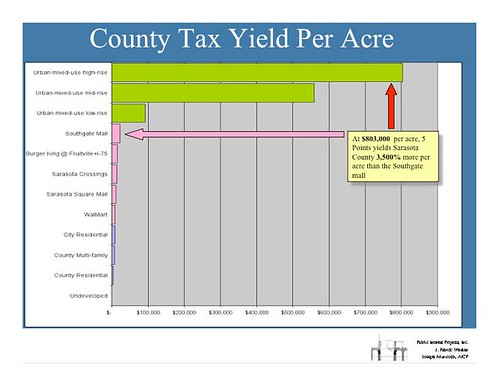
In the lines of the economic impact studies of the revenue potential to localities from different types of development, I bet that the economic value of this development will be greater than from the stadium.  DC would benefit even more from a comparable development, because the city collects 100% of the "state" income tax, which no other city in America can do.Slide, Smart Growth: Making the Financial Case, County Tax Yield Per Acre, Sarasota presentation
Tax yield per acre, Sarasota County, Florida

Labels: , , , , , ,

Monday, February 04, 2013

Historic preservation economic benefits

The reason that people like economist Ed Glaeser and writer Matt Yglesias rail against historic preservation is because in strong real estate markets like the central business district in Downtown DC or in many neighborhoods in Manhattan, Brooklyn, and Queens in New York City, historic preservation protections generally prevent land use intensification--replacement of small buildings with typically much larger ones, or the replacement of residential building stock with commercial buildings.

Residents of those communities would counter that their houses, commercial buildings and neighborhoods that are designated as historic contribute to the quality of life, diversity, and economic success of their respective cities.

The reality is that there are but a handful of areas across the US where this is an issue.  Mostly, neighborhoods and commercial districts are desperate for investment, and demand for intensification is non-existent.

In weaker real estate markets (which included much of Washington, DC up til about 2003), historic preservation designation is a revitalization tool which helps to reposition and stabilize neighborhoods and commercial districts and town centers when ordinarily, real estate trends in the metropolitan area normally passes these places by.

Recently, a couple of reports have been released that discuss the economic value of historic preservation in what I would call weaker real estate markets.  (There are many such reports on this topic, so many that I wonder why we still find it necessary to produce them, except for the fact that elected officials and many other stakeholders appear to remain unconvinced.)

Pennsylvania

The report, Economic Benefits of Historic Preservation Activities in Pennsylvania  produced for the Bureau of Historic Preservation of the State of Pennsylvania, details the economic benefits of heritage tourism, stabilization and property value increases in historically designated neighborhoods, and the economic value of commercial district revitalization.

Interestingly, Preservation Pennsylvania, the statewide preservation advocacy group, produced a complementary report, Policy Recommendations to Strengthen the Power of Preservation, outlying their recommendations for policy and program changes, to further the economic benefits of preservation, including continued support of existing programs, the creation of a state tax credit program (which was done in 2012), and better coordination of tourism promotion programs.

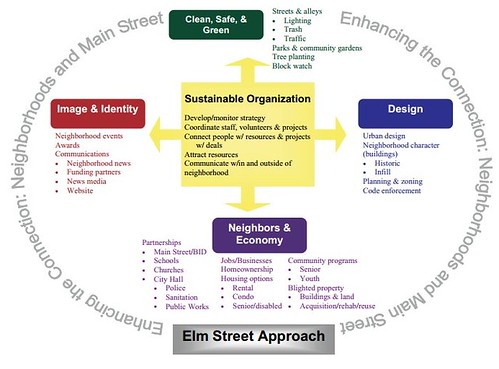
Elm Street neighborhood revitalization program diagram,  PennsylvaniaPennsylvania also has a neighborhood/residential revitalization program based on the Main Street commercial district revitalization program model, but modified to be fully focused on residential improvement, called Elm Street.

Iowa

The Main Street Iowa program commissioned a study of the economic impact of the state program, now operating in almost 40 communities, over the 26 year existence of the program.  See "Main Street Iowa coming back to life: Small towns restore historic downtowns with program's aid" from the Des Moines Register (which also has a link to the report summary but the full study doesn't seem to be online). From the article:

Main Street Iowa already had tallied a cumulative 11,000 net new jobs created, 3,800 net new businesses and nearly $1.2 billion in private investment in its downtown districts. ...

• $71.93 has been invested back into Main Street communities for every dollar it takes to run the program. (In recent years that ratio has soared as high as $130 for every dollar.)

• $43 million in sales tax from net new businesses has been collected annually.

• The increased assessed value of Main Street properties has provided the state $10.8 million over the life of the program “to pay cops and fix potholes.”

• Main Street communities have enjoyed net job growth in 25 out of 26 years. Iowa overall, meanwhile, suffered net job loss in seven years.

The various economic studies over the years of the economic return from various historic preservation activities, commercial district revitalization, cultural heritage tourism promotion and programming, neighborhood revitalization, and building rehabilitation demonstrate an extremely high rate of return, from $5 to $100+ back for every dollar invested.

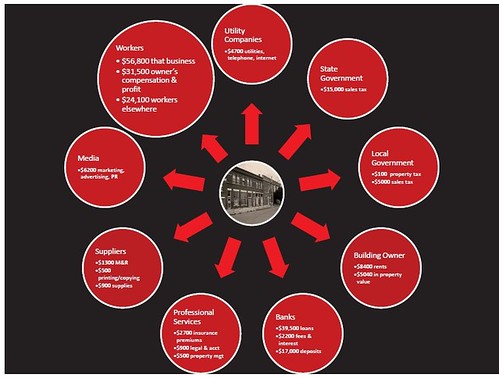
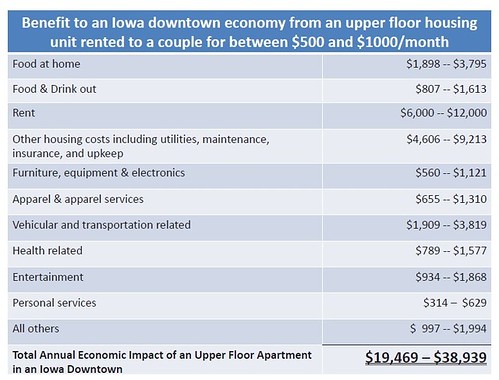
I liked a couple of the slides from the Iowa presentation because they show two important things.  One was a good illustration of what is called the economic multiplier effect of commercial district revitalization and from the money that businesses spend on services--and how it makes such a difference to spend "local."

Economic multiplier benefit of investment in commercial district revitalization
Economic multiplier from commercial district revitalization, Iowa

Economic value of the addition of housing to neighborhoods and commercial districts
Economic value of upper story housing in commercial districts, Iowa
 While the slide is focused on adding housing to commercial districts, the reality is that this slide communicates a broader truth, about how the addition of new households to communities--not just "downtown"--contributes to the economic health of the neighborhood and city more broadly.

This is in fact what is happening with the population influx that DC is experiencing now.

New residents spend money, and more residents spend more money than fewer residents and some of it (more if there are more places to spend it that are local) is spent locally.

New spending allows for the revitalization of neighborhood commercial districts, places like 11th Street NW in Columbia Heights or Barracks Row on 8th Street SE in Capitol Hill or Upshur Street and Georgia Avenue in the area served by the Petworth Metro Station (which has been stoked by the addition of multiunit housing to the area), or 14th Street between Thomas Circle and U Street (in response to the Whole Foods Supermarket and the addition of a goodly amount of multiunit housing), etc.

And it is just in the last couple of years where these changes have become truly visible, having reached a kind of "critical mass" or "tipping point," coincident with escalation in the number of people moving into the city (about 1,000 people per month over the last two years).

DC doesn't offer a "state historic tax credit": and that's just fine

So the director of the DC Preservation League has a piece, "D.C. lags in incentives for historic preservation: Virginia and Maryland provide tax breaks missing in the District to rehab commercial properties," in the Washington Business Journal lamenting that DC lacks a local tax credit to spur historic rehabilitation.  One of the two benefits of federal designation is the eligibility for the use of a tax credit for up to 20% of the cost of rehabilitating the property to historic standards.

Often this tax credit is used in association with other tax credit programs, such as the New Markets Tax Credit, or state tax credits--many states offer such, including Maryland and Virginia--and economic value imputed from easements.

The reason that many projects use these variety of tax credits is that in weak real estate markets, you need additional sources of capital in order to make the project work financially.  Plus the projects usually have to be big, in order to be worthwhile to go through the project costs associated with getting the credits.  I don't know the exact rule of thumb, but it's probably at least $5 million to $10 million.

That's why tax credit projects are big in cities like Baltimore, Cleveland, Milwaukee, St. Louis, Pittsburgh, and Philadelphia, among other places.  They have many big buildings, that are tough to redevelop--so-called "white elephants"--and they are weaker markets.  That's the right combination that justifies tax credit usage.

DC isn't a weak real estate market and for the most part, doesn't have the large buildings and old manufacturing plants that can be hundreds of acres in size possessed by the other cities.

Do we really need to give up property tax revenues to properties that are going to be rehabilitated anyway?

Currently, there is a method (too ad hoc for me, but...) where DC property owners can request tax abatement to assist them in the redevelopment of problem properties, I think that works just fine for those cases where extraordinary circumstances justify such assistance.

But giving away money to properties that will be rehabilitated anyway should be off the table.

406 H StreetOne local DC historic preservation tax credit program that would make sense

The federal tax credit program, and probably most state programs, make the most sense for large buildings and projects, where the value is many millions.

But someone owning a small building isn't placed to be able to participate in that program, even if the cost to rehabilitate a property that has mouldered for many years can be many hundreds of thousands of dollars.

Creating a "small projects" state historic tax credit program, to assist this kind of rehabilitation, is definitely in order.

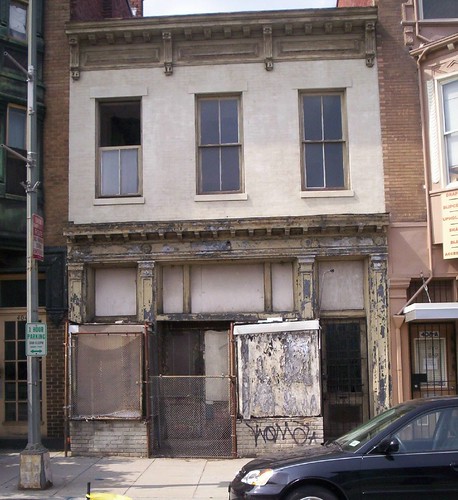
The building at right has been vacant for every day of the 25+ years that I have lived in DC.  (It's since been boarded up better and painted a bit since this picture was taken.)  Likely it will need a lot of money to be able to be used, more than would normally be able to recouped back in normal rents.  Although given that a supermarket is opening on the next block later this year will change the economics for this particular building.  Still, leaving a building empty for upwards of 30 years doesn't help the commercial district, the neighborhood, or the city.

A targeted tax break for commercial properties like these makes much more sense than an untargeted tax credit program that would assist large property owners who don't realy need the inducements.

Labels: , , , , , , ,

Monday, December 10, 2012

One of the stupidest ideas of all time: "trading" the Washington Redskins for the FBI headquarters

----------------
Note: in comments, Alex B. makes the point that this concept hasn't been floated by the Executive Branch but by Councilman Jack Evans, who has a big h*** o* for the Redskins, e.g., how he, Mayor Gray, and CM Michael Brown were trying to recruit the Redskins practice facility to DC ("Gray Admin Mum on Tampa" from the City Paper), although fortunately they're going to Richmond instead.  See "Redskins camp, Bon Secours expansion part of $40 million deal from the Richmond Times-Dispatch.

Alex B. cites this article, "Jack Evans wants to swap the FBI for the Redskins," from the Washington Post.
___________

NBC4 reports that DC Government economic development officials
football-obsessed City Councilman Jack Evans has approached Prince George's County economic development officials, offering the FBI headquarters in return for the Washington Redskins football team.  See "D.C. Would Swap FBI Headquarters for Redskins."

Now despite all the excitement around new quarterback Robert Griffin III, who if he stays healthy, likely will lead the Redskins to prominence after many years of mediocrity, the reality is that professional football as an economic development generator is pretty much proven to not be all that successful.

I can't remember the number, but Prince George's County generates very little income from the Redskins, something like $6 million/year, and that's only because they assess an admissions tax on tickets.

This is yet another demonstration that DC's executive branch doesn't really understand what economic development is supposed to be about, which is building and growing the local economy, and generating the most financial return possible and increasing economic returns, from the actions involved.  See the past blog entry, "Unstrategy for economic development in DC."

I won't argue the branding value of professional sports.  I will argue that because football stadiums cost so damn much (e.g., the new stadium for the Dallas Cowboys cost a lot, see "The cost of Cowboys Stadium has escalated to $1.2 billion" from the Dallas Morning News, and a new stadium in Los Angeles for professional football would cost the same according to "L.A. football stadium plan still faces major hurdles" from the Los Angeles Times)), and are used so little--8 games/year, and maybe a couple more times for playoff games, and at least in the first 5-7 years of existence, as a Super Bowl location--it's almost impossible to generate significant positive economic return (I won't say "return on investment") from public monies spent.  (Also see "In Stadium Building Spree, US Taxpayers Lose $4 Billion" from Bloomberg Businessweek.)

Figuring that if real estate developers were spending this money on other types of development, they'd be aiming for a 7% to 12% return (or more, ideally), you'd need a lot of financial return to make any sense for doing something so stupid.

_______
I haven't written a review yet of DC's new "economic development strategy" because I want to write it as a kind of review essay looking at some other writings about what cities should do in economic development.

I make the point that there is a difference betwen doing "economic development" which is often focused on helping new entrants into a city rather than growing your own, which I call "building a local economy" (Gov. Rick Snyder of Michigan calls it "economic gardening," see "Rick Snyder Takes a Venture Capitalist’s Approach to Governing Michigan" from Governing Magazine). 

Building a local economy as an approach is focused on maximizing return on investment, looking at all the costs and revenue streams of projects, and making hard choices.

It's also more focused on building the infrastructure that supports economic development, such as transit, utilities, higher education, the ability to organize business, support of research and financing networks, business development, maintaining the existence of lower cost space, etc.

I have to admit that Verizon Center is an important anchor downtown--although I am correct in arguing that it hasn't been the reason that the area improved, but it has definitely been a key factor--and I have to admit that the baseball stadium is a key element in the repositioning of the "Capital Riverfront" district.

In both cases though I argue that there are a lot of problems with the general argument and that if there weren't also residential and retail (not yet present to a great extent in Capital Riverfront but that's changing) the areas would suck, just like how the area around Tiger Stadium didn't contribute all that much to that part of Detroit, how Cap Centre didn't do much of anything for Landover, how stadiums in Philadelphia and Atlanta don't really contribute all that much to local economic improvement--but Wrigley Field does, because it's integrated into the community fabric of its neighborhood in Chicago, and LoDo does and doesn't--it's integrated into the community fabric, but the neighborhood had been revitalizing long before the stadium came along... note that I also argue that Camden Yards hasn't been as effective as the Verizon Center in spurring revitalization in Baltimore, even though it has contributed to branding and other objectives--partly this is due to DC's possession of a robust transit network, which can move lots of people to games/events without increasing motor vehicle traffic on the street.

.... anyway.

NO NO NO.

Interestingly, the New York Times has an article, "An N.F.L. Team at the Rose Bowl?," about how the Rose Bowl in Pasadena could be used as an interim stadium for a new football team in LA, while a new stadium is built, but that residents have already said they didn't want a professional football team in the city--through a referendum.

From the article:

Pasadena, pressed for money to cover overruns on its $150 million renovation of the Rose Bowl, has offered the 90,000-seat stadium as a temporary home for a team until a final home is built.

That move has set off a storm of protest — with threats of legal action and a recall drive against a City Council member who supported it — reflecting this community’s ambivalent relationship with an iconic stadium that has long defined it, but at a price.

For up to 12 weekends a year designated for big events, like U.C.L.A. football games and the actual Rose Bowl extravaganza, the fields, parking lots and golf course that surround the stadium in the Arroyo Seco are overrun with parked cars, tailgaters, party tents and rowdy celebrators. ...

The City Council voted to move ahead with the plan — approving an environmental impact report and expanding the permitted number of so-called displacement events to 25, from 12, to accommodate 13 N.F.L. home games — after a raucous four-hour debate that has rolled on even after the last gavel was dropped. The measure was described by supporters as a critical, but not binding, step to position the city to take advantage of badly needed revenues. ...

As much as Pasadena might be identified with football — the Rose Bowl game is played there every January, and it has been the host of five Super Bowls — there has always been a limit to just how much football it wants. Residents voted overwhelmingly in 2006 against a referendum to court an N.F.L. team.  (It was 9,992 in favor and 25,662 against.)

For a variety of reasons, DC's Home Rule Charter doesn't give much authority to citizen referendums and says that any referendums concerning finance of the city are illegal.  While I think such provisions should be changed, I certainly see the value in doing a referendum on this...

Labels: , , , ,

Wednesday, October 24, 2012

More research on the economic impact of Walmart

From the Economic Development Quarterly:

New WalMart stores put large retailers out of business, mom-and-pop stores less affected: Focus issue of economic development quarterly reveals economic and social impact of WalMart stores

Los Angeles, CA (October 23, 2012) Ranked as one of America's largest corporations and the largest private employer in the United States, some say that WalMart stores are catalysts for economic growth in U.S. communities, while others claim that they can have damaging effects on local shops. However, a new study finds that it is the larger retailers such as Ames Department Stores, Sears, and Kmart that lose business with the arrival of a new WalMart store, while smaller retailers are not affected to the same extent. This study is published today in a new Focus Issue of Economic Development Quarterly (a SAGE journal) that describes the economic development impact of Wal-Mart stores. 

"Wal-Mart predominantly might be replacing stores already characterized by nonlocal management," wrote the authors. "This seems to contradict a widely held belief that Wal-Mart hurts locally owned subsidiary business establishments." 

Using Indiana as a case study, researchers Michael Hicks, Stanley Keil, and Lee Spector studied the financial impact of new WalMart stores on establishments nearby. They found that competing stores with 49 or fewer employees were affected very little after a Wal-Mart was opened in the county and competing stores with 50 to 99 employees received a very small negative impact, while stores with 100 to 249 workers closed at a rate of about .5 stores per year, and competing stores with over 250 workers closed at a rate of 1.5 stores per year. 

This Focus Issue of Economic Development Quarterly, out today, includes four articles that detail the economic impact of WalMart stores across the nation. These articles include: 

• "Walmart and Local Economic Development: A Survey," by Alessandro Bonanno and Stephan J. Goetz 
"The Impact of an Urban WalMart Store on Area Businesses: The Chicago Case," by David Merriman, Joseph Persky, Julie Davis, and Ron Baiman 
"Revisiting WalMart's Impact on Iowa Small-Town Retail: 25 Years Later," by Georfeanne M. Artz and Kenneth E. Stone 
"Mom-and Pops or Big-Box Stores: Some Evidence of WalMart's Impact on Retail Trade," by Michael Hicks, Stanley Keil, and Lee Spector  

"Where an auto plant or a high-tech research park brings a range of economic development benefits to a community, the economic development benefits generated by a new big-box retailer are far less obvious," wrote the issue editors. "While these articles do not focus on policy implications, the research results reported here suggest great caution in subsidizing WalMart retail locations."


----

One of my hypotheses relating to the economic impact of Walmart, in talking with the professor (David Merriam) at Loyola who has done studies of the impact of the first Walmart store in chicago--and they have access to sales tax data by zip code--is that some of the job loss impacts of locally owned stores that close are "mitigated" by the opening of other chains (banks, autoparts stores, etc.) attracted to locating stores in proximity to Walmart, and some aren't retailers (like banks). 

And that a significant (negative) impact in part the coming of Walmart to communities concerns the   reshaping of "local" commercial districts away from being comprised of "local" businesses.  In short local businesses close, chains open. 

But that wasn't something the Loyola study really looked into (and presumably the others did not either).  But you can suss that out kind of impact from the competing positive study that Walmart commissioned from Mari Gallagher Associates.

And because the positives from the economic multiplier effect are less for monies spent at chain stores as opposed to locally-owned stores, this ends up having a significant negative economic impact.  (See "Independent Businesses Deliver Bigger Economic Benefit, Study Finds" from the Institute for Local Self-Reliance.)

I haven't read any of the papers yet, and I do wonder if any of the EDQ studies considered any changes to the composition of the type of retail present in local commercial districts and communities after the entry of Walmart.

Probably more independent stores selling "useful" goods--selling stuff people use (food, hardware, pharmacy, etc.) close and the independents that remain open sell stuff people don't really need--beads, gifts, etc.--or used goods like clothing.

Also see the past blog entry "Lessons from Walmart's foray into Washington, DC."

Labels: , , , , , ,

Friday, March 02, 2012

National economic impact of National Parks

While many people think of National Parks as only being in "rural" and exurban settings, there are many National Park installations in major cities including Washington, DC, Philadelphia, St. Louis, New York City, and elsewhere.

From the National Park Service, Chesapeake Bay Gateways and Watertrails Network:

National Economic Impact Report

On February 28, the National Park Service released its national report on the effects of visitor spending in national parks and communities surrounding those parks. Bottom line: visitors to the National Park System contributed more than $31 billion to local economies and supported more than 258,000 jobs in 2010. To download the national report, click on "Economic Benefits to Local Communities from national Park Visitation and Payroll, 2010."

Gateways Network Economic Impact Study Completed

The National Park Service Chesapeake Bay Office has released the report "Economic Contribution of the Chesapeake Bay Gateways and Watertrails Network to Local Economies". The economic assessment was sponsored in partnership with the Chesapeake Conservancy. The principal investigator was Dr. Daniel Stynes of Michigan State University. The report estimates the overall contribution of tourism activity to the Chesapeake Bay region using an analysis of statewide tourism studies. In addition, Dr. Stynes used modeling to estimate the local economic impacts of visitor spending for thirteen case study sites in the Gateways Network.

The report shows that tourists spent $25.7 billion in the study region in 2009, supporting 273,000 direct jobs and $6.6 million in direct payroll income. Dr. Stynes did find that economic estimates were limited by the lack of good visitor information at Gateway partner sites. As a service to Gateway partners, we asked that the full report include recommendations for collecting visitor data along with a sample questionnaire for gathering visitor segment, spending, and "visit conversion" data. There are many reasons to collect high quality visitor statistics -- to serve as a baseline, to encourage funding, to better serve and better understand your customers. If you'd like to launch a study before the high season kicks in, contact us if you'd like some help.

Download a pdf of the report's Executive Summary or the full-length Technical Report.

Labels: , , , , ,