Rebuilding Place in the Urban Space

"A community’s physical form, rather than its land uses, is its most intrinsic and enduring characteristic." [Katz, EPA] This blog focuses on place and placemaking and all that makes it work--historic preservation, urban design, transportation, asset-based community development, arts & cultural development, commercial district revitalization, tourism & destination development, and quality of life advocacy--along with doses of civic engagement and good governance watchdogging.

Thursday, February 06, 2025

Church and social spaces: grant opportunity

Holy Trinity Roman Catholic Church in Duquesne, Pennsylvania. Photo: Matthew Christopher, Abandoned America.  From "Why Are There So Many Abandoned Churches?," Atlas Obscura.

My writings on churches have been somewhat negative, shaped by my agnosticism-atheism, and my experience in DC, where many churches built large property portfolios that they didn't take care of, bought buildings to tear them down for parking, and the phenomenon of urban church closure, abetted by the high cost of maintenance and repair, alongside neighborhood change and suburban outmigration, etc.  

-- "Churches, community, religion and change," 2012/2015

Note that Washington Post columnist Perry Bacon Jr. lamented not wanting the religious part of church but still wanting the connection ("I left the church — and now long for a ‘church for the nones’" and letters to the editor, "Perry Bacon is not alone in his search for connection without church").

I am not religious, but I definitely respect the social justice strain of Christianity.  In DC, there is the Sojourners group, and also Luther Place Memorial Church (Evangelical Lutheran), which in the 1980s started leveraging their property portfolio on Thomas Circle to house people in need. There are probably more positive examples than I realize, and that's the case in many cities across the country.

Sign on what is mutual aid at the Steinbruck Center for Social Justicer at Luther Place.

I've written about third spaces ("Third Place Issues," 2024), including how church social halls helped the nascent DC punk music scene develop in the 1970s and 1980s, where social halls were the venue for all ages concerts.

Last year, Eerdman's published Gone for Good: Negotiating the Coming Wave of Church Property Transition. It asks the very good question about what do you do with church spaces, especially those serving community purposes, when a church closes?  Who picks up the slack, if anyone? (Interview)

Note that there is the phenomenon of the "non church" ex-religious building still used for community events, like the 6th and I Synagogue in DC ("Born Again," Washingtonian).  This, the Atlanta Freethought Society ("Smyrna Atheist Helps Revive 140-Year-Old Primitive Baptist Church," Patch), and the Washington Ethical Society, an offshoot of the Unitarian-Universalist Church, is probably what Perry Bacon is looking for.

That's a provocative question, making me more aware of my previous bias.  

I realized that my thinking about "the church in the city" was too narrow, and at the same time, how to translate the idea or concept of social infrastructure as laid out by Eric Klinenberg in Palaces for the People: How Social Infrastructure Can Help Fight Inequality, Polarization, and the Decline of Civic Life could use examples of religious facilities as part of the exploration into facilities and programming that could make social infrastructure real.  This is a long term writing project.

The idea of facilities and programming isn't different from my writings on how to support the development and maintenance of a local arts ecosystem.

-- "Reprinting with a slight update, 'Arts, culture districts and revitalization'," 2009/2019

Church Brew Works, Pittsburgh.

Note that one trend in church recapture in the face of abandonment has been conversion to housing ("These old Maine churches are being transformed into homes," Bangor Daily News, although DC has had instances of this since the 1980s) or other types of for profit development ("As Hundreds of Churches Sit Empty, Some Become Hotels and Restaurants," New York Times).

Like the Church Brew Works in Pittsburgh (which is pretty cool--but its creation led the Cardinal of the Milwaukee diocese to put strict restrictions on what could go into sold off church property, "What to do with a closed church? Why, you sell it, of course," AP); and we stayed in an airbnb in a converted church in Savannah once, as well).  Also see "What should we do with all of those empty churches?," BigThink.

=============

Because time is of the essence, I thought it would be worth bringing this up even though I'm nowhere near the stage of a review because the National Fund for Sacred Places has a small grant fund:

Apply by Mar 15, 2025 

to provid[e] technical and financial support for congregations to repair or improve the functionality of their community spaces. To apply for the grant, the space must have been originally built to be a house of worship and owned by a faith community; the congregation must be at least three years old; the property must possess historical, cultural, or architectural significance; and the congregation must be community-minded and serve nonmembers, among a few other considerations.

Labels: , , , , , , , ,

Friday, February 24, 2017

Tricky issues: the zoning case of the mosque in Sterling Heights, Michigan

The City of Sterling Heights, Michigan is in the news ("Sterling Heights mosque deal cheered as 'win for religious liberty'," Detroit Free Press) because it just settled a case where a mosque had been denied an application to create a church on a lot zoned residential.

I can't claim to know the ins and outs of their zoning classifications, but I do know that in many cities, like DC, a church usually is a standard "matter of right" exception within zoning in that churches are allowed to be built across residential zones with few limitations.

Debbie Rosi, center, leads a protest of the construction of a mosque on 15 Mile Road in Sterling Heights, Michigan. They said they were concerned about traffic congestion and lowered property values.  Photo: John M. Galloway, Detroit News.

So it's hard to say if community opposition is because it was a mosque--feeding narratives about anti-Islam sentiments, and which has come up in other zoning matters elsewhere across the country, even in Northern Virginia ("In battle over proposed Prince William, some see Islamophobia" and "A smokescreen for bigotry: Disguising anti-Muslim bias with land use objections," Washington Post)--or because it is a residentially-zoned lot, in a community where religious uses aren't "matter of right."

The only way to answer the question is whether or not the community would have opposed a similar application by a religious institution practicing a Judeo-Christian faith (cf. "Zoning and religion," 2010).  According to the DFP article, the area is home to a Chaldean Christian community, which has expressed some opposition.

Photo: Niraj Warikoo, Detroit Free Press.

I will say that I do believe that there should be restrictions on churches in terms of eliminating "blanket" matter of right use within residential zones.

Instead of blanket approval, I think that church uses should be zoned in a manner where they are placed on arterials and collector streets, rather than neighborhood streets, so that traffic impacts can be mitigated.

On that basis, the Mosque is proposed for 15 Mile Road, a major arterial that should have few problems in terms of accommodating additional traffic.

Basically, the point is that this would be a matter of right use, but with conditions.

Another condition would be a requirement to practice transportation demand management planning, and to discourage "mothballing" of properties ("Losing my religion: Shiloh Baptist Church and Neighborhood Destabilization," 2005) and to discourage the conversion of other residential properties to parking.

Traffic congestion is one of the points raised by opponents to the mosque.

=======
Yesterday, the Post had an article, "A new crop of DC churches has discovered the secret of appealing to millennials," about trends in urban church practice, although I would say that my 2012 piece, "Sunday morning: Churches, religion, community and change," is far superior.

Labels: , , , , , , ,

Friday, October 23, 2015

Reprint: Churches, community, religion and change

This piece originally ran on October 14th, 2012.

Churches and bike lanes.  It's being reprinted in honor of how some DC churches are claiming religious freedom violations because of plans to put bike lanes in front of their churches ("Pastors: 6th Street Bike Lanes A ‘Cancer’ That Will Destroy Church," Washington City Paper; "Can some big D.C. churches fight off a bike lane?," Washington Post.

Note in the past DDOT didn't put a bike lane on the 1500 block of M Street NW because of complaints by the Metropolitan African Methodist Episcopal Church on that block ("How a downtown bike lane has become a political headache," Washington Post, 2013).

The reality is that there are plenty of churches in the city located next to bike lanes and plenty of churches in other cities located along streetcar and light rail lines.

Only by believing that your place in the city is completely unique and exceptional and incomparable to any other place in the city or the world can these anti-change positions be sustained.

I am not happy when I ride by New Southern Rock Baptist Church on Kansas Avenue NW and they have cars parked in the bike lane on a Sunday or during a funeral. But it's a lot better to divert around the parked cars than to not have access to it the other 160 or so hours in a week, when the church building is mostly empty.

Churches and homeless services/property warehousing.  The comment thread on the original post has some interesting points.  Charlie wrote:
What I found interesting about the Atlantic article, and a lot of DC talk about black churches, is how much it replicates how settlers in the west talked about the Indians and the need for removal. The existence of the churches is a real threat for the search for authenticity.

One thing you left out is the tendency of churches to offer homeless services in the city, and how that really manages to shit on the local neighborhood. That needs to be regulated and banned.

As I see it, the real problem is the warehousing aspect. Churches want to expand, and use their tax exempt status to do so. (Others are using it as a way to turn themselves into real estate developers). This isn't an isolated issue: The Cleveland Clinic ran down its local neighborhood in order to have cheap real estate to expand.
Churches and historic preservation: graven images and RLUIPA.  And in the intervening years there was an interesting holding by the Mayor's Agent concerning a church that bought an existing church in the Capitol Hill Historic District, but because their brand of religion doesn't hold for graven images, they wanted to remove the stained glass windows.

I figured they'd win based on the RLUIPA law, but in another example of the fact that I don't have legal training, the holding stated that the purchasers knew going in that the building was in a historic district and therefore that the changes they proposed were likely not to be approved.  That out of the doctrine "all citizens are presumed to know the law," that they had no reasonable expectation that their religious position in and of itself would otherwise trump existing law.

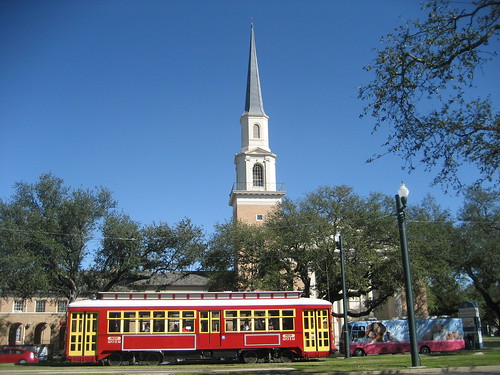
Inekon-built streetcar in Portland, Oregon, USA, on the Portland Streetcar system.  Train is stopped at SW 11th and Clay with The Old Church on the right.

Churches and streetcars.  And speaking of churches and anti-urban attitudes toward transportation, not that long ago a church at 11th and K Streets NW claimed that building a streetcar line next to the church would impinge on their religious practice also.

I wrote about that in December 2014, "The co-existence of streetcars and churches elsewhere ought to counter anti-streetcar arguments by churches in DC today."

Like with churches and bike lanes, there are probably thousands of examples of churches around the world located next to streetcar or light rail lines.

Valorizing property value in new church-mixed use construction projects.  In Dupont Circle, residents have been fighting a church's proposal to rebuild their church and pay for it partly by having part of the site developed for market rate housing ("New Design Released for Dupont Circle Church Development," UrbanTurf).

While I don't think the new building as proposed is particularly attractive, I can't criticize the church for being focused on how to remain relevant in the 21st century and how to pay for their operations going forward, given the fact that many urban denominations find that their membership is shrinking, members are increasingly not located within the neighborhood, social and community service demands are increasing, revenues are decreasing, and costs are rising.

On the 900 block of F Street NW and at the intersection of Wayne Avenue and Fenton Street in Silver Spring ("First Baptist Church Demolition Underway in Silver Spring," Bethesda Magazine), church sites have been or are being redeveloped as mixed use office or residential buildings, but in each case the church function has been or will be maintained on the site, as a part of the new building.

I will say it can be a shame to lose the distinctive architecture style and aesthetic qualities of church buildings that were constructed long ago which are replaced by the homogeneous building designs of today.

============
Churches, community, religion and change

I do love church architecture and stained glass windows (not exclusively religious of course), but because I am somewhere between agnostic and atheist, perhaps too often I discount the role of religion in society generally as well as locally.

Of course, religious communities and their churches and related institutions (charities, monasteries, convents, colleges, etc.) are involved in many aspects of communities, urban and suburban and rural, which make them worth paying attention to, including such issues as:

• their roles in community and building community;

• their participation, directly or indirectly, in ocal politics (ministers and churches can be the backbone of support for particular politicians);

• the issue of the church and society, the First Amendment, separation of church and state, and the pernicious rise of  the application of religion to all sorts of public activities (e.g., "Putnam courthouse could display 'In God We Trust'" from the Nashville Tennessean);

• their participation in community stabilization and redevelopment--some churches such as Abyssinian Baptist Church in Harlem and Bethel New Life in Chicago, and the Catholic Church affiliated Famicos Foundation housing development organization in Cleveland, among others, have very well respected community development arms (although some once well-respected church community development arms have also degraded, see "Floyd Flake ripped over condition of buildings run by his church" from the New York Post);

• and in community destabilization, by warehousing urban properties (Shiloh Baptist Church in Shaw is well known for amassing properties and letting them moulder but they are hardly the only church that does so, see ""Losing my religion: Shiloh Baptist Church and Neighborhood Destabilization" from 2005)--I argue that churches may believe that improving a neighborhood is a bad thing, because by improving property values, it becomes more difficult to continue to acquire nearby properties;

• the parking issue--because as church membership becomes disconnected from the neighborhood where the church is located, people drive in to worship and need somewhere to leave their cars--actually I am fine with Sunday double-parking as opposed to demolishing buildings and converting the land to parking lots used a handful of hours/week and believe that churches should have to create transportation demand management plans (see the blog entries, "Even a church can do transportation demand management planning" and "Megachurch parking ministries set standard for church transportation demand management");

• church-related historic preservation and land use issues and the RLUIPA Act (see "Building regulations (including historic preservation), religious freedom, and local and federal laws" and "Be careful what you wish for/religious freedom/RLUIPA"), which many churches use in an attempt to privilege the way they wish to use property and avoid local regulations--in DC, there are frequent calls to give churches an exception from historic preservation laws, which is ironic because it was a church's demolition of houses for parking in Capitol Hill that spurred the creation of local historic preservation law;

• including the opposition by people with more traditional beliefs to the establishment of new faith communities, especially in the post-9/11 environment, to Islamic churches (e.g., "Planned Mosque Inches Along, but Critics Remain" from the New York Times);

• and vice versa, the belief by some faith traditions, usually the most orthodox, that freedom of speech provisions should not be applicable to the interpretation of their religion by others;

• church closure, relocation, and the counter-response of the creation of new types of religious communities that are a-denominational (although for a First World country, the US has the highest rates in the world of people who declare a religious faith).

Church closure and relocation in the face of demographic change

It is the latter to which the rest of this blog entry is directed, in response to an article in The Atlantic blog, "In Changing Neighborhoods, Black Churches Face an Identity Crisis," in part about the H Street neighborhood.

The article is interesting only because it employs an incredibly limited, a-historical time frame that ignores the last 100+ years of urban history.

Church location used to be tightly linked to ethnic/racial communities living in particular neighborhoods

Historically, particular churches and faiths were tightly associated with particular ethnic and racial groups, and people of the same ethnicity and/or race tended to live in the same places and neighborhoods, for various reasons including income, immigration patterns, segregation, or other forms of discrimination.

As a result, churches were very tightly linked to particular communities, and a "Little Italy" was likely to be dominated by the Catholic Church, Jewish neighborhoods by synagogues, German communities had Lutheran churches, etc.
 
Today's black churches in changing inner city neighborhoods are not the first churches to be buffeted by demographic change.

And in DC at least, "black" churches have been responding, for better or worse, to black middle class outmigration from the center city for decades anyway (for example, the Nineteenth Baptist Church is located on 16th Street NW, as it moved to follow and better serve its relocating members, as Ward 4 became home to the city's largest concentration of middle-class African Americans), and many of the city's black churches have relocated to the suburbs, generally Prince George's County, following their parishioners, not unlike how at one time, retailers left the city for the suburbs, in pursuit of their relocating customers.

Relocation to where members live makes sense too, if you want to play a prominent role in civic affairs and local elections.

Chromolithograph of the St. Stanislaus Kostka (Polish Catholic) Church, 1891.  

Yet, these kinds of issues cross racial, ethnic, neighborhood, and denominational boundaries, and have for decades.

For example, declining membership has led Catholic dioceses to close churches (and their associated schools), in the face of significant opposition ("Church and School Cuts Anger Catholics in Philadelphia" from the New York Times), in cities across the country including DC, Baltimore, Philadelphia, Pittsburgh, Detroit, and Milwaukee.

For example, when Pittsburgh's steel mills were booming and immigration was high, the Strip District had four very large Catholic churches, each serving different ethnicities and languages, such as Polish or Czech.  Today, one of these churches, St. Stanislaus Kostka Church, once supported by over 7,000 families, now has fewer than 500 families as members, and has merged in part with St. Patrick's, sharing a priest and other functions, while other churches have closed.

Urban demographic change has often meant change to the buildings where people prayed


As neighborhoods changed in the cities--and the first form of "outmigration" from cities was from the core of the city to neighborhoods still in the city but outside of the core, typically neighborhoods developed and served by streetcar companies--their churches and temples followed them into new buildings in their new neighborhoods, and the old churches were sold to different religious faiths.

For example the church at 8th and I Streets NW in Downtown DC was once a synagogue--and before it was a synagogue, the building was a Methodist Church, although eventually the Washington Hebrew Congregation demolished it and built the religious building that still stands today.  To make the former Methodist church more "Jewish" they "add[ed] a depiction of the Ten Commandments and Stars of David to the apex."

This process continues.  Recently a church in Orange County, California converted to a mosque.  See "Catholic church converts to Islamic mosque" from the Orange County Register.  And the once closed synagogue at 6th and I Streets NW was converted into a church of another faith, and a few years ago was reopened as a facility to serve the community and people of the Jewish faith both, but not as a traditional temple ("Sixth & I Historic Synagogue" from Washington Jewish Week), and a conservative church bought a church on Capitol Hill and wants to rip out its stained glass windows because the church doesn't believe in "graven images" ("Broken Windows Theory" from the Washington City Paper), etc.

Suburban out-migration and center city population loss significantly impacted traditional churches

As long as cities maintained population and as long as religion was important to people in the way they organized their lives, there was enough demand so that old church buildings could be sold to different religious faiths more in tune with new populations.

 As population dropped in center cities, churches lost membership, some to the point where they had to close, leaving buildings empty without demand for purchase from other church organizations. (Of course, this is now a problem in rural communities as well.  See the webpage "Educating Ourselves About Rural Church Preservation" from Sacred Places.)

This church building at 9th and D Streets SE on Capitol Hill was converted into 18 condominium units in 1989.

It wasn't until after World War II when housing choice (and incomes) expanded greatly and in forming new, mostly suburban, neighborhoods and choosing where to live, people bought houses without considering ethnic and religious ties (although there is no question that in certain faiths, such as Judaism in both Baltimore and Detroit, there is a religiously influenced geographic pattern to the migration outward from the center city that is clearly discernible).

And of course the parking issue is related to the fact that churches no longer primarily serve members in the neighborhood who walk to services.  (Orthodox Jews are an exception of course.  Religious laws restrict the use of mechanical equipment, including cars, on the Sabbath, so adherents tend to cluster in particular neighborhoods close to their temples, within walking distance.) 

 
Image of Pittsburgh's former St. John the Baptist Catholic Church, now the Church Brew Works, from the Pittsburgh Eats blog.

But as population shrunk, incomes dropped, and even as religious practices changed (the rise of Pentecostalism and storefront churches), the demand for large, grand (and expensive to maintain) church buildings declined. 

Besides reuse of the buildings for other types of institutions and agency, or as housing, churches have been converted into night clubs or brew pubs (the creation of the Church Brew Works in Pittsburgh led the Archdiocese of Milwaukee to put a clause in its sales agreements for church buildings to forbid certain uses).

Changing communities: some churches reposition and maintain their position, space, and place

Sojourners Magazine serves the Christian social justice movement.

Churches changing in response to changing communities is not new, especially in relationship to the increased prominence of social justice concerns as more people turned their spiritual focus outwards.

One example (and hardly the only one) is how in Washington, DC, Luther Place Memorial Church on Thomas Circle at 14th Street NW refocused their programs on inner city, poverty and other social justice concerns, in turn attracting new members who supported the church in its efforts to refocus its mission outwards toward active, engaged community service (the Church now has multiple programs, including housing, that are probably amongst the best in the city).

As immigrant populations change urban neighborhoods, other churches have changed as well, adding services in different languages, such as Spanish, and adapting outreach and community service programs to be responsive to new demands. Certainly this has been the case in the Columbia Heights neighborhood, which is the center of DC's Latino population.

And the increase in the number of Unitarian-Universalist Churches in urban locations in the 1960s and 1970s was another response to people looking to join with others in worship, community service, and fellowship, without necessarily being bound in the same way with ethnicities and neighborhoods.  For example, DC's Washington Ethical Society, Unitarian-Universalist affiliated:

is a humanistic religious community, without formal creed or dogma, united in the belief that the greatest moral and spiritual values are to be found through raising the quality of human relationships.

Certainly, rise of progressive and social justice practices in the Catholic Church (liberation theology, Nuns on the Bus, etc.) and the Episcopal Church (such as the appointment of women and gays as priests and bishops) continues to spark tensions between conservative and liberal factions, even to the point where some churches are breaking off and leaving the mother church.

Another response by churches has been to organize across religions through the creation of ecumenical organizations that link churches and their missions towards working together on a variety of social justice goals.

DC's Downtown Cluster of Congregations and the Capitol Hill Group Ministries are local examples.  (Although I will argue that these kinds of organizations can also devolve into typical special interest groups focused on their own needs to the exclusion of others, at least when it comes to church parking matters...)

The rise of the new church: non-denominational churches as a new response to serve diverse communities

While we can't ignore the reality that churches and organizations espousing traditional religious interpretations continue to open in the city to serve audiences new to the city, often using non-church buildings (storefronts, other buildings), in part because such buildings are much less expensive than a large traditional church building, social and community changes concomitant with the continued development of the post-industrial society, mean that traditional definitions of ethnicity are no longer the dominant way many people to choose to define themselves, leading to weak religious ties with traditional forms of religious practices.

In response, religious practice and organization has been changing and adapting to serve these new communities.  And, there are many organizations and a growing body of literature that addresses the issue of how churches and religious denominations need to change to serve new and different populations.

Plus, considering how much I write about civil society, community building, civic engagement, etc., it would be a mistake to ignore church community building as an element of this and community organizing more generally, especially in terms of the success of the megachurch and other forms of non-denominational churches in creating racially and economically diverse congregations that connect people over broad geographies.

New age spirituality.   New age spiritualism and offshoots of traditional religion (kabbalah) and older practices (Wiccan) has been one response, but typically that hasn't been associated with in-city practices.  Instead it is more likely to be associated with the out-of-doors, communes, and in natural landscapes ("The New Age in Sedona, Arizona" from the New York Times travel section).

Megachurches.  While we think of megachurches as "suburban," it's probably more accurate to think of them as churches that operate on a metropolitan scale where their membership base isn't circumscribed by or limited to a particular neighborhood or geography.

Left: Houston's 16,800-seat Lakewood Church Central Campus, home to four English language services and two Spanish language services per week, is located at the former Compaq Center.  Wikipedia image.

The car allows the megachurch to create spiritual communities in places where people otherwise feel disconnected and where traditional religious denominations may not be adequately serving their needs, by drawing upon the automobile-enabled across an entire metropolitan area rather than limiting themselves to a particular neighborhood or district or single jurisdiction. 

See "Megachurches As Minitowns" and "Megachurches Add Local Economy to Their Mission" from the New York Times.   Megachurches serve metropolitan communities connected by the car.

Televangelism.  While we may think of megachurches as a recent phenomenon, I think it's more accurate to think of it as the second generation of this phenomenon, which started first with the rise of the televised ministry ("televangelism") in the 1960s and 1970s and the teleministry's associated church and related facilities (Jim and Tammie Lee Baker, Pat Robertson and the 700 Club, Oral Roberts, Robert Schuller in Orange County).

(Then again, you had the radio ministers in the 1930s and 1940s, people like Father Coughlin of the Shrine of the Little Flower Parish in suburban Detroit's Royal Oak--Father Coughlin was the scourge of FDR and was only suppressed through a deal that FDR made with the Vatican to recognize the Church as a city-state and appoint an ambassador to the Vatican.)

MCC serving the LGBT community.  The Metropolitan Community Church formed in the late 1960s to serve lesbians and gays in response to the rejection of homosexuality by most traditional religious denominations.

LGBT status by definition transcends race or ethnicity and so MCC churches, like Unitarian churches, tend to have more diverse memberships compared to ethnically- and race-bound traditional churches.  Because MCC adherents came out of traditional faiths, the Church tends to be more formal in their religious traditions, while being more expansive and unbiased in terms of membership and to whom services and rites are provided.

Non-denominational churches.  Like megachurches, but not nearly as large as the arena-sized congregations that exist in Dallas and Atlanta, non-denominational churches have been created in center cities to serve populations that are younger and newer to the community, connecting diverse peoples looking for spiritual connection, and who are less interested in worshiping within more traditional ethnic and/or racial boundaries or their neighborhoods, instead creating racially and/or ethnically diverse faith communities that cross neighborhood and sector boundaries, drawing its membership from across an entire city (and beyond).

DC's National Community Church as a multi-site urban-sized megachurch.  DC has a good example in the "Theater Church," now called the National Community Church, which first started by holding worship services on Sunday mornings when the theaters at Union Station weren't showing movies.
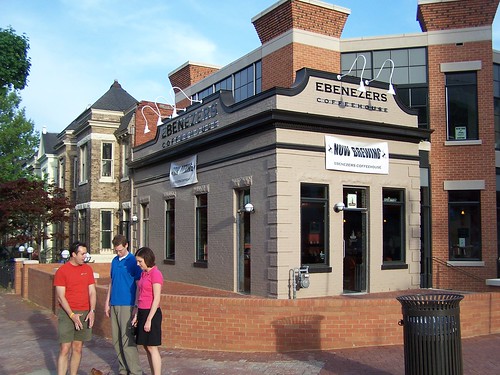
Ebenezer's Coffee Shop, 2nd & F 
Streets NE, DCI have long thought this church was interesting, because they didn't have a building.  (See "Building a churchless megachurch" from the Washington Post).

And you could argue that it was a form of "mixed primary use," by using a "hall," in this case a cinema, in a nontraditional and time- and space-efficient manner.

But I just wasn't looking at their operations as closely as I could have, because likely, physical manifest destiny was always part of the plan.

Just like how food trucks can be a way to "build up" to a bricks and mortar location, the same kind of path was forged by the National Community Church--they are not a "megachurch" in one location but a "multi-site" church serving multiple communities with favorable economic demographics.

First, they expanded services from Union Station in DC to other theater locations in the metropolitan area, not limiting their operation or "service area" to DC proper.
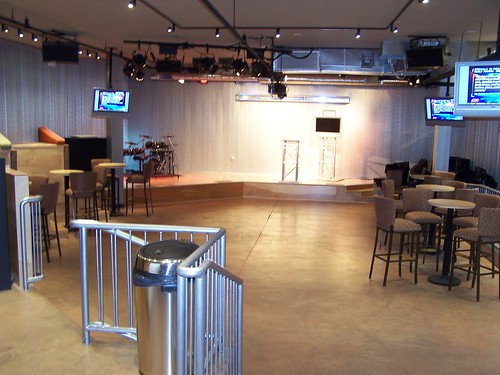
Ebenezer's Coffee Shop, 2nd & F Streets NE, DCSecond, they created the Ebenezer's Coffee House on 2nd Street NE near Union Station--with a hall suitable for religious services in the basement and offices on the second floor above the coffee house, although with a bit of puffery (see the past blog entry "Ebenezer's Coffee Shop and a bit of truth stretching") as they claimed the building they had rehabilitated had been a drug house, which was not the case.

Right: the basement hall at Ebenezers Coffee House.

This gave them offices, space that they controlled, and a way to have physical presence outside of the Sunday morning hours. 

And currently they have expanded into a building, (I don't want to call it "third" because I imagine that they will continue to expand into physical buildings, most likely not typical church buildings), through the acquisition of the old People's Church on 8th Street SE in the Barracks Row neighborhood of Capitol Hill ("National Community Church Pouring Serious Money into Barracks Row" from the Washington City Paper  and "Century-old movie theater in Capitol Hill to reopen as the Miracle" from the Washington Post).

They are restoring the theater function of the building, and will show movies and such outside of church hours.

Interestingly, the restoration of these buildings does illustrate an interesting element of nonprofit business activity.  I don't know if the buildings are exempt from local property taxes, because they are owned by a church.

In any case, the income from the cafe or operations as a movie theater would be taxable (it's unrelated business income from the standpoint of a church.  But not having to operate the businesses strictly on a for profit revenue basis allows them to spend more money and create "grander" facilities than is likely for a tax paying business.

Conclusion

There is a lot more going on in the city with regard to religion, religious practices, and community and spiritual development than you would ever imagine if all you do is limit your consideration of religion and the city to the last couple of years of demographic change.

Labels: , , , , , , , ,

Thursday, December 04, 2014

The co-existence of streetcars and churches elsewhere ought to counter anti-streetcar arguments by churches in DC today


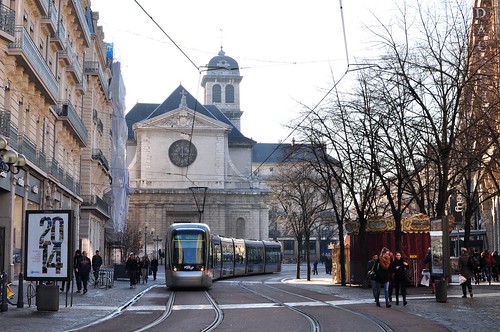
This photo of the St. Andrews Latvian Lutheran Church in Toronto (Panoramio photo by AK Jones) indicates that religious buildings, services and streetcar service appear to co-exist just fine.

Probably the element of streetcar discussions today that I find most frustrating is that they tend to occur in a vacuum that ignores:

(1) the reality that new and old streetcar systems of various sorts function in cities in North America and elsewhere in Europe, Asia, and Australia

(2) that streetcars operated in Washington DC for about 100 years, and

(3) that DC or any other American city is not particularly exceptional so that it is fair to assume that historical or present-day experience with streetcar service elsewhere can provide extendable lessons relevant to DC.

Saint Reinoldi's Church with tramRight:  Saint Reinold's Church with tram, Dortmund, Germany, by James Havisham, on Flickr.

This comes up "again" because of a Washington Post article, "With D.C. streetcar's future unclear, this church raises concerns of K Street NW line," including remonstrations from members of Asbury United Methodist Church at 11th and K Streets NW, that having streetcar service on K Street, which would impact street parking or a taking of a portion of "their yard" (which legally is public space--on other blocks of K Street the equivalent space functions as a service drive with parking)--even though streetcar service operated on 11th Street NW next to the church for many decades.

From the article:
Now Nero, who turned 82 on Thanksgiving, is worried that the stone sanctuary in downtown Washington that has been so central to so much of his life will be undercut — spiritually and structurally — by the city’s plan to stretch a streetcar line down K Street NW. 
“You are just knocking out the . . . togetherness of the congregation,” Nero said, standing under the church’s soaring, century-old Gothic bell tower just a block from the massive new CityCenterDC development that typifies the type of growth that D.C. officials say demands investment in a far-reaching streetcar system.
From "Asbury UM Church to Fight Streetcar Line;" in the Washington Afro-American:
Tawanna Jackson, a church member, viewed the displays and said she supports progress but is wary of the city’s plans. “Streetcars are so large,” she said, voicing concern about church damage and parking. “Church members will have to park somewhere else and that will affect other cars and public transit.”
-- Asbury Statement on Proposed Streetcar Line

Eglise St Louis, rue Félix Poulat et le tramwayEglise St Louis, rue Félix Poulat et le tramway, Grenoble, France, by Frédérique Voisin-Demery on Flickr.

As a correspondent wrote:
I wish the members of the church opposing transit improvements in our city were as concerned about air pollution (including from their own cars), climate change, childhood asthma, dependence on foreign oil, noise pollution from cars and buses, etc. as they are about what appear to be overblown, indeed probably imaginary, impacts on their church.

Wikipedia photo:  Inekon-built streetcar in Portland, Oregon, USA, on the Portland Streetcar system.  Train is stopped at SW 11th and Clay with The Old Church on the right.

Note that separately, I don't have a problem with accommodating church parking on Sundays, provided that churches do transportation demand management planning, which DC churches tend not to do.

This is important as the residences of parishioners tend to become spatially disconnected from the churches they attend.  See "SF leaders search for ways to blend car-reliant worshippers with transit-first policies," from the SF Examiner.

Red Church and tram in Brno, Czech Republic.  Photo from the New Railway Report blog.

As the correspondent pointed out, it is not unusual for urban churches to be dominated by suburban members and this creates problems when attempting to mediate pro-urban policies for the built environment and transportation policy.

See the past blog entries, "Megachurch parking ministries set standard for church transportation demand management" and "Losing my religion: Shiloh Baptist Church and Neighborhood Destabilization."

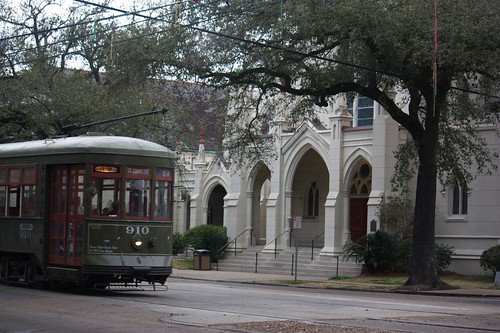
First Grace Canal Street Redcar
First Grace Canal Street, New Orleans, and the Redcar streetcar.  Flickr photo by Infrogmation of New Orleans.

Something I realized in the early 2000s was that it was not in the "best interest" of a church to improve a neighborhood if their primary interest was in acquiring property around the church, because an improving neighborhood experiences raising property prices, which made property acquisition more difficult and more expensive.

IMG_9708New Orleans streetcar + church. Flickr photo by thedillybar.  Note that modern streetcars are much quieter than the historic streetcars in New Orleans.

Labels: , , ,

Sunday, October 14, 2012

Sunday morning: Churches, religion, community and change

I do love church architecture and stained glass windows (not exclusively religious of course), but because I am somewhere between agnostic and atheist, perhaps too often I discount the role of religion in society generally as well as locally.

Of course, religious communities and their churches and related institutions (charities, monasteries, convents, colleges, etc.) are involved in many aspects of communities, urban and suburban and rural, which make them worth paying attention to, including such issues as:

• their roles in community and building community;

• their participation, directly or indirectly, in ocal politics (ministers and churches can be the backbone of support for particular politicians);

• the issue of the church and society, the First Amendment, separation of church and state, and the pernicious rise of  the application of religion to all sorts of public activities (e.g., "Putnam courthouse could display 'In God We Trust'" from the Nashville Tennessean);

• their participation in community stabilization and redevelopment--some churches such as Abyssinian Baptist Church in Harlem and Bethel New Life in Chicago, and the Catholic Church affiliated Famicos Foundation housing development organization in Cleveland, among others, have very well respected community development arms (although some once well-respected church community development arms have also degraded, see "Floyd Flake ripped over condition of buildings run by his church" from the New York Post);

• and in community destabilization, by warehousing urban properties (Shiloh Baptist Church in Shaw is well known for amassing properties and letting them moulder but they are hardly the only church that does so, see ""Losing my religion: Shiloh Baptist Church and Neighborhood Destabilization" from 2005)--I argue that churches may believe that improving a neighborhood is a bad thing, because by improving property values, it becomes more difficult to continue to acquire nearby properties;

• the parking issue--because as church membership becomes disconnected from the neighborhood where the church is located, people drive in to worship and need somewhere to leave their cars--actually I am fine with Sunday double-parking as opposed to demolishing buildings and converting the land to parking lots used a handful of hours/week and believe that churches should have to create transportation demand management plans (see the blog entries, "Even a church can do transportation demand management planning" and "Megachurch parking ministries set standard for church transportation demand management");

• church-related historic preservation and land use issues and the RLUIPA Act (see "Building regulations (including historic preservation), religious freedom, and local and federal laws" and "Be careful what you wish for/religious freedom/RLUIPA"), which many churches use in an attempt to privilege the way they wish to use property and avoid local regulations--in DC, there are frequent calls to give churches an exception from historic preservation laws, which is ironic because it was a church's demolition of houses for parking in Capitol Hill that spurred the creation of local historic preservation law;

• including the opposition by people with more traditional beliefs to the establishment of new faith communities, especially in the post-9/11 environment, to Islamic churches (e.g., "Planned Mosque Inches Along, but Critics Remain" from the New York Times);

• and vice versa, the belief by some faith traditions, usually the most orthodox, that freedom of speech provisions should not be applicable to the interpretation of their religion by others;

• church closure, relocation, and the counter-response of the creation of new types of religious communities that are a-denominational (although for a First World country, the US has the highest rates in the world of people who declare a religious faith).

Church closure and relocation in the face of demographic change

It is the latter to which the rest of this blog entry is directed, in response to an article in The Atlantic blog, "In Changing Neighborhoods, Black Churches Face an Identity Crisis," in part about the H Street neighborhood.

The article is interesting only because it employs an incredibly limited, a-historical time frame that ignores the last 100+ years of urban history.

Church location used to be tightly linked to ethnic/racial communities living in particular neighborhoods

Historically, particular churches and faiths were tightly associated with particular ethnic and racial groups, and people of the same ethnicity and/or race tended to live in the same places and neighborhoods, for various reasons including income, immigration patterns, segregation, or other forms of discrimination. 

As a result, churches were very tightly linked to particular communities, and a "Little Italy" was likely to be dominated by the Catholic Church, Jewish neighborhoods by synagogues, German communities had Lutheran churches, etc.
 
Today's black churches in changing inner city neighborhoods are not the first churches to be buffeted by demographic change.

And in DC at least, "black" churches have been responding, for better or worse, to black middle class outmigration from the center city for decades anyway (for example, the Nineteenth Baptist Church is located on 16th Street NW, as it moved to follow and better serve its relocating members, as Ward 4 became home to the city's largest concentration of middle-class African Americans), and many of the city's black churches have relocated to the suburbs, generally Prince George's County, following their parishioners, not unlike how at one time, retailers left the city for the suburbs, in pursuit of their relocating customers.

Relocation to where members live makes sense too, if you want to play a prominent role in civic affairs and local elections.

Chromolithograph of the St. Stanislaus Kostka (Polish Catholic) Church, 1891.  

Yet, these kinds of issues cross racial, ethnic, neighborhood, and denominational boundaries, and have for decades.

For example, declining membership has led Catholic dioceses to close churches (and their associated schools), in the face of significant opposition ("Church and School Cuts Anger Catholics in Philadelphia" from the New York Times), in cities across the country including DC, Baltimore, Philadelphia, Pittsburgh, Detroit, and Milwaukee.

For example, when Pittsburgh's steel mills were booming and immigration was high, the Strip District had four very large Catholic churches, each serving different ethnicities and languages, such as Polish or Czech.  Today, one of these churches, St. Stanislaus Kostka Church, once supported by over 7,000 families, now has fewer than 500 families as members, and has merged in part with St. Patrick's, sharing a priest and other functions, while other churches have closed.

Urban demographic change has often meant change to the buildings where people prayed

As neighborhoods changed in the cities--and the first form of "outmigration" from cities was from the core of the city to neighborhoods still in the city but outside of the core, typically neighborhoods developed and served by streetcar companies--their churches and temples followed them into new buildings in their new neighborhoods, and the old churches were sold to different religious faiths.

For example the church at 8th and I Streets NW in Downtown DC was once a synagogue--and before it was a synagogue, the building was a Methodist Church, although eventually the Washington Hebrew Congregation demolished it and built the religious building that still stands today.  To make the former Methodist church more "Jewish" they "add[ed] a depiction of the Ten Commandments and Stars of David to the apex."

This process continues.  Recently a church in Orange County, California converted to a mosque.  See "Catholic church converts to Islamic mosque" from the Orange County Register.  And the once closed synagogue at 6th and I Streets NW was converted into a church of another faith, and a few years ago was reopened as a facility to serve the community and people of the Jewish faith both, but not as a traditional temple ("Sixth & I Historic Synagogue" from Washington Jewish Week), and a conservative church bought a church on Capitol Hill and wants to rip out its stained glass windows because the church doesn't believe in "graven images" ("Broken Windows Theory" from the Washington City Paper), etc.

Suburban out-migration and center city population loss significantly impacted traditional churches

As long as cities maintained population and as long as religion was important to people in the way they organized their lives, there was enough demand so that old church buildings could be sold to different religious faiths more in tune with new populations.

 As population dropped in center cities, churches lost membership, some to the point where they had to close, leaving buildings empty without demand for purchase from other church organizations. (Of course, this is now a problem in rural communities as well.  See the webpage "Educating Ourselves About Rural Church Preservation" from Sacred Places.)

This church building at 9th and D Streets SE on Capitol Hill was converted into 18 condominium units in 1989.

It wasn't until after World War II when housing choice (and incomes) expanded greatly and in forming new, mostly suburban, neighborhoods and choosing where to live, people bought houses without considering ethnic and religious ties (although there is no question that in certain faiths, such as Judaism in both Baltimore and Detroit, there is a religiously influenced geographic pattern to the migration outward from the center city that is clearly discernible).

And of course the parking issue is related to the fact that churches no longer primarily serve members in the neighborhood who walk to services.  (Orthodox Jews are an exception of course.  Religious laws restrict the use of mechanical equipment, including cars, on the Sabbath, so adherents tend to cluster in particular neighborhoods close to their temples, within walking distance.) 

 
Image of Pittsburgh's former St. John the Baptist Catholic Church, now the Church Brew Works, from the Pittsburgh Eats blog.

But as population shrunk, incomes dropped, and even as religious practices changed (the rise of Pentecostalism and storefront churches), the demand for large, grand (and expensive to maintain) church buildings declined. 

Besides reuse of the buildings for other types of institutions and agency, or as housing, churches have been converted into night clubs or brew pubs (the creation of the Church Brew Works in Pittsburgh led the Archdiocese of Milwaukee to put a clause in its sales agreements for church buildings to forbid certain uses).

Changing communities: some churches reposition and maintain their position, space, and place

Sojourners Magazine serves the Christian social justice movement.

Churches changing in response to changing communities is not new, especially in relationship to the increased prominence of social justice concerns as more people turned their spiritual focus outwards.

One example (and hardly the only one) is how in Washington, DC, Luther Place Memorial Church on Thomas Circle at 14th Street NW refocused their programs on inner city, poverty and other social justice concerns, in turn attracting new members who supported the church in its efforts to refocus its mission outwards toward active, engaged community service (the Church now has multiple programs, including housing, that are probably amongst the best in the city).

As immigrant populations change urban neighborhoods, other churches have changed as well, adding services in different languages, such as Spanish, and adapting outreach and community service programs to be responsive to new demands. Certainly this has been the case in the Columbia Heights neighborhood, which is the center of DC's Latino population.

And the increase in the number of Unitarian-Universalist Churches in urban locations in the 1960s and 1970s was another response to people looking to join with others in worship, community service, and fellowship, without necessarily being bound in the same way with ethnicities and neighborhoods.  For example, DC's Washington Ethical Society, Unitarian-Universalist affiliated:

is a humanistic religious community, without formal creed or dogma, united in the belief that the greatest moral and spiritual values are to be found through raising the quality of human relationships.

Certainly, rise of progressive and social justice practices in the Catholic Church (liberation theology, Nuns on the Bus, etc.) and the Episcopal Church (such as the appointment of women and gays as priests and bishops) continues to spark tensions between conservative and liberal factions, even to the point where some churches are breaking off and leaving the mother church.

Another response by churches has been to organize across religions through the creation of ecumenical organizations that link churches and their missions towards working together on a variety of social justice goals.

DC's Downtown Cluster of Congregations and the Capitol Hill Group Ministries are local examples.  (Although I will argue that these kinds of organizations can also devolve into typical special interest groups focused on their own needs to the exclusion of others, at least when it comes to church parking matters...)

The rise of the new church: non-denominational churches as a new response to serve diverse communities

While we can't ignore the reality that churches and organizations espousing traditional religious interpretations continue to open in the city to serve audiences new to the city, often using non-church buildings (storefronts, other buildings), in part because such buildings are much less expensive than a large traditional church building, social and community changes concomitant with the continued development of the post-industrial society, mean that traditional definitions of ethnicity are no longer the dominant way many people to choose to define themselves, leading to weak religious ties with traditional forms of religious practices.

In response, religious practice and organization has been changing and adapting to serve these new communities.  And, there are many organizations and a growing body of literature that addresses the issue of how churches and religious denominations need to change to serve new and different populations.

Plus, considering how much I write about civil society, community building, civic engagement, etc., it would be a mistake to ignore church community building as an element of this and community organizing more generally, especially in terms of the success of the megachurch and other forms of non-denominational churches in creating racially and economically diverse congregations that connect people over broad geographies.

New age spirituality.   New age spiritualism and offshoots of traditional religion (kabbalah) and older practices (Wiccan) has been one response, but typically that hasn't been associated with in-city practices.  Instead it is more likely to be associated with the out-of-doors, communes, and in natural landscapes ("The New Age in Sedona, Arizona" from the New York Times travel section).

Megachurches.  While we think of megachurches as "suburban," it's probably more accurate to think of them as churches that operate on a metropolitan scale.

Left: Houston's 16,800-seat Lakewood Church Central Campus, home to four English language services and two Spanish language services per week, is located at the former Compaq Center.  Wikipedia image.

The car allows the megachurch to create spiritual communities in places where people otherwise feel disconnected and where traditional religious denominations may not be adequately serving their needs, by drawing upon the automobile-enabled across an entire metropolitan area rather than limiting themselves to a particular neighborhood or district or single jurisdiction. 

See "Megachurches As Minitowns" and "Megachurches Add Local Economy to Their Mission" from the New York Times.   Megachurches serve metropolitan communities connected by the car.

Televangelism.  While we may think of megachurches as a recent phenomenon, I think it's more accurate to think of it as the second generation of this phenomenon, which started first with the rise of the televised ministry ("televangelism") in the 1960s and 1970s and the teleministry's associated church and related facilities (Jim and Tammie Lee Baker, Pat Robertson and the 700 Club, Oral Roberts, Robert Schuller in Orange County). 

(Then again, you had the radio ministers in the 1930s and 1940s, people like Father Coughlin of the Shrine of the Little Flower Parish in suburban Detroit's Royal Oak--Father Coughlin was the scourge of FDR and was only suppressed through a deal that FDR made with the Vatican to recognize the Church as a city-state and appoint an ambassador to the Vatican.)

MCC serving the LGBT community.  The Metropolitan Community Church formed in the late 1960s to serve lesbians and gays in response to the rejection of homosexuality by most traditional religious denominations.

LGBT status by definition transcends race or ethnicity and so MCC churches, like Unitarian churches, tend to have more diverse memberships compared to ethnically- and race-bound traditional churches.  Because MCC adherents came out of traditional faiths, the Church tends to be more formal in their religious traditions, while being more expansive and unbiased in terms of membership and to whom services and rites are provided.

Non-denominational churches.  Like megachurches, but not nearly as large as the arena-sized congregations that exist in Dallas and Atlanta, non-denominational churches have been created in center cities to serve populations that are younger and newer to the community, connecting diverse peoples looking for spiritual connection, and who are less interested in worshiping within more traditional ethnic and/or racial boundaries or their neighborhoods, instead creating racially and/or ethnically diverse faith communities that cross neighborhood and sector boundaries, drawing its membership from across an entire city (and beyond).

DC's National Community Church as a multi-site urban-sized megachurch.  DC has a good example in the "Theater Church," now called the National Community Church, which first started by holding worship services on Sunday mornings when the theaters at Union Station weren't showing movies.

Ebenezer's Coffee Shop, 2nd & F 
Streets NE, DCI have long thought this church was interesting, because they didn't have a building.  (See "Building a churchless megachurch" from the Washington Post).

And you could argue that it was a form of "mixed primary use," by using a "hall," in this case a cinema, in a nontraditional and time- and space-efficient manner.

But I just wasn't looking at their operations as closely as I could have, because likely, physical manifest destiny was always part of the plan.

Just like how food trucks can be a way to "build up" to a bricks and mortar location, the same kind of path was forged by the National Community Church--they are not a "megachurch" in one location but a "multi-site" church serving multiple communities with favorable economic demographics.

First, they expanded services from Union Station in DC to other theater locations in the metropolitan area, not limiting their operation or "service area" to DC proper.

Ebenezer's Coffee Shop, 2nd & F Streets NE, DCSecond, they created the Ebenezer's Coffee House on 2nd Street NE near Union Station--with a hall suitable for religious services in the basement and offices on the second floor above the coffee house, although with a bit of puffery (see the past blog entry "Ebenezer's Coffee Shop and a bit of truth stretching") as they claimed the building they had rehabilitated had been a drug house, which was not the case.

Right: the basement hall at Ebenezers Coffee House.

This gave them offices, space that they controlled, and a way to have physical presence outside of the Sunday morning hours. 

And currently they have expanded into a building, (I don't want to call it "third" because I imagine that they will continue to expand into physical buildings, most likely not typical church buildings), through the acquisition of the old People's Church on 8th Street SE in the Barracks Row neighborhood of Capitol Hill ("National Community Church Pouring Serious Money into Barracks Row" from the Washington City Paper  and "Century-old movie theater in Capitol Hill to reopen as the Miracle" from the Washington Post).

They are restoring the theater function of the building, and will show movies and such outside of church hours.

Interestingly, the restoration of these buildings does illustrate an interesting element of nonprofit business activity.  I don't know if the buildings are exempt from local property taxes, because they are owned by a church.

In any case, the income from the cafe or operations as a movie theater would be taxable (it's unrelated business income from the standpoint of a church.  But not having to operate the businesses strictly on a for profit revenue basis allows them to spend more money and create "grander" facilities than is likely for a tax paying business.

Conclusion

There is a lot more going on in the city with regard to religion, religious practices, and community and spiritual development than you would ever imagine if all you do is limit your consideration of religion and the city to the last couple of years of demographic change.

Labels: , , , , , ,

Saturday, August 14, 2010

Zoning and religion

bill_of_rights_page
Something that my best friend in college used to say that really totally pissed me off was "what's mine is mine and what's yours is negotiable."

You hear all the arguments that conservatives assert about liberals as being "relativistic" thinkers, but the reality is that relativistic thinking is a method, that people develop commitments. (See the writings of William Perry on cognitive development.)

So commitment to the U.S. Bill of Rights, the first ten amendments to the Constitution of the United States, ought to be "relatively" (a joke) absolute by all Americans, regardless of your political persuasion.

Amendment I

Congress shall make no law respecting an establishment of religion, or prohibiting the free exercise thereof; or abridging the freedom of speech, or of the press; or the right of the people peaceably to assemble, and to petition the government for a redress of grievances.

I think that the First Amendment is interesting, because it is a direct result of "problems" that resulted during the period in which the U.S. colonies were under British rule, and laws were more arbitrary--at least they seemed arbitrary if you didn't follow the official religion, or questioned the King or Parliament.

There are many examples of why the First Amendment has the freedom of religion clause, but one of those examples is from the Brookland area of what is now DC.

Last year, the Post ran a real estate feature, "Where We Live: Queens Chapel Terrace," on a neighborhood in DC that borders Prince Georges County, and is bounded on one side by Queens Chapel Road, speculating on the origin of the name of the road:

The origin of the name "Queens Chapel," also the name of the main street through the neighborhood, is unclear. Some think "Queen" must have been the surname of a land owner, others think it's connected to the Queens Chapel United Methodist Church in Beltsville or Queens Chapel Road in Hyattsville. Still others think it may have been inspired by the nearby monasteries.

Given that the neighborhood is also just minutes away from Trinity University and Catholic University, it would be understandable if the name originated from one of those institutions.

Regardless of how it got its name, residents say it's a friendly place. "It's about as safe as you could get in a city this size," he said.

I laughed while reading the article, because it showed how so many of us don't know our history.

In 1714, grandchildren of Richard Marsham, children with the last name Queen, received his land when he died. This land covered much of the area of Brookland, which was then part of Maryland. The family practiced Catholicism, but by this time, the Anglican religion had been deemed the official religion of the colony, even though the Colony of Maryland originally did not designate an official religion. The Queen family maintained a private, likely somewhat surreptitious chapel in one of their homes, where they could freely practice their Catholic faith. Hence the road in DC and Prince George's County that is named "Queens Chapel."

To me, this is one of the many stories of how people's experiences, real people with connections to us still (one of the Queen descendents is part of the Ruppert family that owns the Warehouse Theater), shaped the Constitution of the United States, and how its provisions reflect real needs and concerns.

Over the past 30 years, religion has become an increasing part of politics at the national and local and state levels (I was in Tennessee on business a couple weeks ago, in advance of their primary elections, and I was struck/shocked by one set of ads for one candidate for Governor, and how he emphasized the role of God and Judeo-Christian beliefs--even though a road or a library or a school or business development is far more about the here and now rather than the afterlife).

This has influenced zoning and historic preservation matters, because churches ask for exceptions from these rules based on the freedom of religion clause, when the law generally holds that building regulations are a matter of universal public safety and interest that are not related to the practice of religion.

Even so the Religious Land Use and Institutionalized Persons Act of 2000 was passed by the U.S. Congress to give "equal rights" to religious claims vis-a-vis local laws including building regulations. (Resource)

That wasn't true. The law was passed to give religious claims a superiority over local laws, and depending on the evenhandedness of the local federal circuit (DC is under a conservative judiciary at the federal level, especially at the Court of Appeals level), churches often have the upper hand.

I am agnostic at best, but attracted to religious architecture and elements (especially stained glass windows).

But my experiences as an involved urban revitalization activist have turned me off to many churches, because many have deliberate practices with regard to real estate that are deleterious to community improvement--although I recognize that this isn't the case with every religious institution. In fact, one of the keywords I use is "churchly blight."
Some examples are:

- churches buying abutting residences and letting them rot, which keeps a neighborhood down, and real estate prices down, which because prices remain depressed, allows the church to buy up more property, further crowding out more positive uses.

- churches tearing down properties for parking lots used a couple hours per week, but creating a hole in the street fabric and neighborhood that persists 24/7/365

- calls for exemptions from historic preservation regulations with regard to the maintenance of their properties

- plus "faux churches," usually storefront churches that are churches in name only--at least I can point to some where for years I have seen absolutely no activity--but because they are churches they are exempt from property taxes.

Note that there are many exceptions, many examples of churches doing good things in their communities and with regard to property management. But my focus is on the bad.

And interestingly, DC's local historic preservation laws derived in large part as a response to how the Capitol Hill Baptist Church tore down historic buildings they owned because they wanted more parking, and activists realized that just because a neighborhood was designated on the National Register of Historic Places, this meant nothing, that there were no protections against deleterious acts by non-federal government property owners or other entities.

My favorite Amendment to the Constitution is the 14th Amendment, and in particular the second sentence from Section 1 of the amendment:

No state shall make or enforce any law which shall abridge the privileges or immunities of citizens of the United States; nor shall any state deprive any person of life, liberty, or property, without due process of law; nor deny to any person within its jurisdiction the equal protection of the laws.

The laws of the land are supposed to treat all of us equally. Churches should have no more rights than anyone else. But that goes both ways.

If a church, in this case Islamic related, wants to build a facility close to the site of the World Trade Center, which was destroyed by Islamic extremists, so be it. There is nothing in the law that supports a particular religion from being banned from a particular location, no matter how badly wacked out conservatives ranging from Sarah Palin to Washington Post columnist Charles Krauthammer want to make it so ("Sacrilege at Ground Zero").

President Obama ("Obama backs mosque near ground zero" from the Post via AP) is right to say so--and this has nothing to do with his Islamic background.

And Mayor Bloomberg, while right to say that the Islamic church should not be restricted, is also right to reject the use of taxpayer funds (this is the flipside of the clause about the separation of church and state) to help the church locate somewhere else, as suggested by the Governor of New York State, David Paterson ("Bloomberg Brushes Aside Paterson Proposal for Mosque" from the NYT City Room blog.)

I hate how for so many people, the law is not "absolute" and supposed to treat everybody the same, but is something to be manipulated.

(Note that this predilection for manipulation of the law is the reason that the national and local are so "flawed." -- flawed is the other f word)

Martin Niemöller, a German Protestant pastor who emerged as an outspoken public foe of Adolf Hitler and spent the last 7 years of Nazi rule in concentration camp is perhaps best remembered for the quotation:

First they came for the Socialists, and I did not speak out --
Because I was not a Socialist.

Then they came for the Trade Unionists, and I did not speak out --
Because I was not a Trade Unionist.

Then they came for the Jews, and I did not speak out --
Because I was not a Jew.

Then they came for me -- and there was no one left to speak for me.

Labels: , , , , ,