Rebuilding Place in the Urban Space

"A community’s physical form, rather than its land uses, is its most intrinsic and enduring characteristic." [Katz, EPA] This blog focuses on place and placemaking and all that makes it work--historic preservation, urban design, transportation, asset-based community development, arts & cultural development, commercial district revitalization, tourism & destination development, and quality of life advocacy--along with doses of civic engagement and good governance watchdogging.

Tuesday, April 14, 2026

Dead mall in Gaithersburg finally getting demolished

Gaithersburg Mayor Jud Ashman speaks in front of the partially demolished Lakeforest Mall. Credit: Jacqueline Kalil.

Lakeforest Mall has languished for at least 18 years, since the Great Financial Crisis in 2008 if not before.  It went through various iterations of foreclosure and debtor in possession and special servicing and finally shut for good in 2023.

In 2013 and probably before the special servicer was Hines Interests, one of the nation's largest property firms.

I was at a conference out west and the guy in charge of the mall for Hines was talking to one of the presenters, a guy who did night markets in Australia, about the opportunity to do that to try to enliven and activate the property.

I said, just tear it down and redevelop it.  Now they are ("Lakeforest Mall demolition ushers in start of $1.2B redevelopment project," Bethesda Magazine).  15 years later.  From the article:

Opened in 1978, the mall once served as a central shopping and social hub for Montgomery County, featuring major department stores, an ice rink and later a movie theater and food court. For many residents, it was a place of first jobs, first dates and holiday shopping traditions.

To me it was one of Montgomery County's weak malls, declining even before the GFC, so it had a 30 year or less good run.  Montgomery Mall is somewhat upscale and still successful.  The Westfield Mall in Wheaton is successful as a middle income mall targeting Latinos and other segments.

Interior commercial district malls in Silver Spring and Rockville have never been successful.  While the White Flint Mall declined, interestingly at the time, the connected department stores did okay regardless.  Lord & Taylor (now defunct) even sued to keep the property owner.

The Curlicue sculpture by Chris Byars has been moved from Lakeforest Mall in Gaithersburg to the streets of Olney, Maryland.

But I don't think Lake Forest Mall was ever a particularly high performer.  

It was notable for public art ("Lakeforest Sculptures Relocated to Olney Hot Spots") and the ice rink, among other things.  

Montgomery County DOT booth at the Agriculture Fair.

I was only exposed to it because it was the staging point for parking used to support the Montgomery County Agriculture Fair at the nearby Fairgrounds.  Montgomery County RideOn bus transit did a very good system of shuttle buses back and forth.

It's going to be replaced with a mixed use development including residential, office space, and some retail-entertainment space.

Labels: ,

Thursday, March 07, 2024

Department stores are an "urban technology" built for walking not driving

State Street Shopping District, Chicago, 1984, Chicago Sun Times photo.

There is a letter to the editor in the Post "Save an endangered species: The American department store,"  responding to the article "Macy's and other department stores are an endangered species," opining about the difference between department stores in European cities like London and Paris.  

It completely misses the point.  Those are walking cities.  For the most part we don't have walking cities in the US.  We have car cities.

-- "Responding to retail decay in Friendship Heights (DC/Montgomery County, Maryland)," 2023
-- "Friendship Heights and the production of retail decay," 2020
-- "Urban decay and sprawl: one community's gain at the expense of another's," 2011
 -- "A brief lesson in "incentivizing" supermarkets and department stores," 2007 
 -- "Why it's okay to give tax increment financing to department stores but you still need to think long and hard about where you put your money," 2007 
-- "Turnabout is fair play: why Topher Matthews/GGW is wrong about TIF incentives for a departmentun store in Georgetown," 2012

Plus center city downtowns in the US aren't the same kind of shopping draw as they were 50+ years ago, at least for larger cities--lots of smaller cities in the US and Europe are seeing their retail districts decimated.  For the most part, suburbanites are content shopping near home.

But what a difference between a downtown store and suburban mall location in terms of quality store offering.  

The DC Downtown Hecht's was a grand store.  And it paled by comparison to Macy's in Herald Square in Manhattan or in Union Square in San Francisco or in Downtown Chicago.  Or the city-based stores, like Hudson's in Detroit, from our youth.

Suburban mall stores tend to be dingy.

====

From the San Francisco Chronicle, "Union Square once was the center of San Francisco. Now it’s off the map," 

The terrain in the retail zone centered on the actual Union Square, an area that, for decades, was the busiest downtown retail district outside New York and Chicago, is in sorry shape.

... There’s been ample attention to the empty spaces within the no-longer-Westfield shopping mall, from the former Nordstrom on down, and the numbing procession of “for rent” signs along Powell Street that offer a bleak welcome to cable car riders. To me, though, the 200 block of Sutter Street tells a story even more grim. 

Of the 15 retail spaces on the block, 12 are vacant. Two “store closing sale” signs are taped near the door of one shop front, and judging from the emptiness within, they’ve been there awhile. Across the way, there’s a “support small business” sign in the window of a falafel shop with the slogan “Where food takes flight.” Indeed it has; the space sits empty. 

.. The numbers downplay the sense of desolation. One vacant space that Banana Republic occupied from 1997 until last year stretches for nearly half a block. This isn’t a precarious fringe block, either. Nearly all the buildings are gorgeous masonry, built in the aftermath of the 1906 earthquake. Banana Republic’s former flagship with its arched grandeur began life as the White House, a department store that opened in 1908 with a design by architect Albert Pissis and closed in 1965. 

... San Francisco has changed immeasurably since “everyone” visited Union Square on a semi-regular basis, whether they were looking for a night on the town or a place to buy the basics. Now the happening neighborhoods are Hayes Valley or Dogpatch or the Mission, depending on your inclination. Tourists are as likely to visit Haight-Ashbury or the Castro as Fisherman’s Wharf. 

Presidio Tunnel Tops and Crane Cove Park offer connections to the bay that would have been inconceivable in the 1990s — when the arrival of Yerba Buena Gardens, the San Francisco Museum of Modern Art and an expanded convention center prompted another planner to comment to the Chronicle how the changes along Mission Street and directly south “will really shift the center of gravity.”

Also see "Behind the Macy’s closure: ‘This is a Union Square problem. Not a San Francisco problem’

“Union Square doesn’t need to exist in the modern framework of local consumer demand,” said Christopher Thornberg, an economist and founder of Beacon Economics. He said with fewer people going downtown for work in San Francisco’s urban core, big shopping centers like Union Square don’t make economic sense. 

“This is a Union Square problem. Not a San Francisco problem,” Thornberg said. He said San Francisco’s low unemployment rate, and hyperactive venture capital sector, mean “it’s a great economy. It’s just that this economy doesn’t need a Union Square.” 

More broadly, he said, the same market forces that brought down Sears and JCPenney were now converging on Macy’s bottom line, delayed only by the “crazy surge in post-pandemic spending” once social distancing and other restrictions were lifted.

Labels: , , , , ,

Friday, March 03, 2023

Responding to retail decay in Friendship Heights (DC/Montgomery County, Maryland)

 I've written about the decline of this once thriving commercial district:

-- "Friendship Heights and the production of retail decay," 2020

The retail killer Ashkenasy (they wrecked a couple locations in Baltimore including Harborplace, and haven't been great managers of Union Station's retail) owned Mazza Gallerie for awhile, it went into foreclosure.  Once home to a Neiman-Marcus department store, now closed, it's going to be torn down and redeveloped into retail and housing.

WTOP reports that DC and MoCo are working to create a business improvement district to help improve the area ("Friendship Heights BID? DC and Montgomery Co. are working on it").

In the beginning of my Main Street days (2002) districts like Dupont Circle pushed for being included. 

I scoffed, saying that they had plenty of resources, and neighborhood commercial districts didn't.  The reality is that then successful districts like Friendship Heights and Georgetown still faced voracious competition, but from the suburbs ("Turnabout is fair play: why Topher Matthews/GGW is wrong about TIF incentives for a department store in Georgetown," 2012).

So I was missing the point. The lesson from Main Street and BIDs and the original Downtown management program in Corning New York in the early 1960s, is that _all_ such districts need ongoing management so they can be their best, compete with other districts, recruit, stay on top of possible negative changes, etc.

So now that FH is super duper languishing they are considering creating a business improvement district. Obviously this should have been done years ago, especially as department stores began to falter and DC invested in other areas, as did Montgomery County.

Labels: , , , , , ,

Monday, September 28, 2020

Friendship Heights and the production of retail decay

The Washington Post has a story, "Friendship Heights, once known as a hub for high-end shopping, is struggling as the pandemic accelerates an exodus of retailers," about the decline of Friendship Heights, a suburban shopping district on the border of DC and Montgomery County, Maryland.  

Two of the department stores on the DC side are closing--one chain, Lord & Taylor, is going out of business altogether and the Mazza Gallerie shopping center was in foreclosure ("Ashkenazy's Mazza Gallerie mall sold at auction," Washington Business Journal).

Friendship Heights in 1983.  Woodward & Lothrop in the middle, the GEICO parking deck to its rear, and Mazza Gallerie above, with Lord & Taylor to the upper right.

It had been anchored by four department stores--Neiman-Marcus, located in the Mazza Gallerie shopping mall and Lord & Taylor on the DC side, and Woodward & Lothrop (succeeded by Hechts, now Bloomingdales) and Saks Fifth Avenue on the Maryland side, complemented by a large number of retail stores from high end to more recently discount, restaurants, movie theaters, and supermarkets.

The area is also home to the Geico insurance company headquarters (a very early example of a corporation leaving a downtown location for the suburbs, which they did in 1959), has a number of multiunit residential buildings, a hotel, and is close to upscale residential areas in both DC and Maryland.

It was relatively unique in that three of the four department stores are free standing, not part of a single consolidated shopping mall. (Although this form was typical of how "town shopping districts" were organized before the 1960s.)

Urban decay as a planning concept.  The California planning regulation system has a term called "urban decay" which takes into account the impact of new development on existing places and retail districts:

-- "Urban decay and sprawl: one community's gain at the expense of another's," 2011

This comes out of the recognition that the development of suburban shopping malls and the relocating of city-based firms to suburban locations came at the expense of center city and town locations in the core of a metropolitan area, that while the overall pie of development may have grown, certain areas ended up suffering and losing significant economic activity.

Built in 1954, Northland Shopping Center was one of the nation's first suburban shopping centers.  Created by JL Hudson Department Store believing that Detroit's residents were going to move out to the suburbs, the company built malls north, east (Eastland), west (Westland), and south (Southland) and Dowtown Detroit.  It shouldn't be a surprise that Detroit's Downtown shopping district declined to nothingness.

Approvals vis a vis urban decay in California may include mitigation steps.

Government facilitation of retail decay.  I raise this because the article points out the decline was facilitated and accelerated by the DC Government investment in the CityCenterDC project, to where many high end smaller retailers (not department stores) moved, as the project was developed in the last 10 years.

(City Center is built on the site of the former DC Convention Center and is located Downtown.)

It was recognizing that the city government's facilitation of new retail and mixed use development in places like CityCenterDC, The Wharf (southwest waterfront), and Navy Yard (southeast waterfront) comes at the expense of existing commercial areas (Capitol Hill, Georgetown, Golden Triangle, Friendship Heights, etc.) that I realized that simultaneously there should be planning and economic development supports to the existing areas, in order to maintain their competitiveness in the face of the subsidized development of new destinations.

For the most part this hasn't happened, except when instigated by a particular property owner or new development.

I wrote about this a couple times, in part using the example of Georgetown, because Georgetown's centrality as a regional shopping destination has declined in the face of new competition within and outside of the city: 

 -- "A brief lesson in "incentivizing" supermarkets and department stores," 2007 

 -- "Why it's okay to give tax increment financing to department stores but you still need to think long and hard about where you put your money," 2007 

-- "Turnabout is fair play: why Topher Matthews/GGW is wrong about TIF incentives for a department store in Georgetown," 2012

Plus, Georgetown Park shopping "mall" has had all of the same problems as Friendship Heights, for decades, accentuated by the fact that it was an internally focused retail property in a shopping district that is outdoors focused.

There is a limit to how much retail a local economy can support.  The fact is that there is only so much development capacity within a place, which is a function of commercial and residential demand, and spending decisions of the existing consumer base (residents and office workers + tourists).

1.  Office workers mostly spend money in limited ways on convenience retail and food, mostly quick service.  So even if there are many workers, they don't shop much at specialty stores, department stores, etc.

The rule of thumb I learned was that office workers support 2 s.f. of retail and 5 s.f. of restaurant.  Tot that up for a proposed project and you'll see that mostly the amount of retail supported by office workers is smaller than you might think.  Although some organizations may take steps to support retail by not creating on-site cafeterias, etc., which is the case with Amazon in Seattle, etc.

And it's mostly a myth that nonresident workers will "stop at a city-located store on the commute trip home."  Instead, mostly people shop in their own communities.

2.  Residents support up to 7.5 s.f. of retail, distributed across a range of shopping types from neighborhood retail (pharmacy, supermarket, dry cleaners, restaurants) to intra-city regional, providing options like Downtown's department store or other shopping destinations like Friendship Heights or the Target and other big box stores at DC/USA in Columbia Heights.

Even with 720,000 or so residents that's support for about 5,400,000 s.f., and the city has much more retail space than that, and it continues to add to this supply as "new or renewed intra-city destinations" are created such as Union Market, H Street, or Ivy City.

3.  Suburban residents don't have much call to shop in DC, they have all the retail present within DC and more in Montgomery and Fairfax Counties especially, but also in other jurisdictions (although Prince George's residents complain that they are under-served and must go to other places to meet their full range of shopping needs).  ... even though the Downtown Macy's Department Store is significantly better than suburban stores.

4.  Tourists spend money yes, but not in ways that support a wide range of retail.  The tourists who come to DC may stay in DC or in suburban locations.  Lodging revenues are mostly captured by nonresident corporations based elsewhere.  Depending on the income level of the tourist, they are most likely to spend their money on food, lodging, and entrance fees, and not on other retail.

International tourists tend to stay in the city and spend more on retail ("Impact of Shopping Tourism for the Retail Trade as a Strategy for the Local Development of Cities," Frontiers in Psychology), but this stream of visitors can be negatively impacted by US public diplomacy.  For example, before the pandemic, one of the largest origin countries for tourism was China.  When your nation's president is stoking a trade war with China, that reduces tourism.

Intra-city sprawl and retail decay.  Sprawl is not merely a suburban phenomenon.  Intra city sprawl is created by supporting new development and districts without fully taking into account overall demand as well as the impact on existing places--for example, providing tax incentives to shopping centers anchored by Home Depot or Lowes, but not providing any supports to neighborhood-based hardware stores.

Note that this isn't unique to DC.  New York City has facilitated intra-city sprawl and retail decay through the fostering of the development of Hudson Yards ("What Is the Impact of Hudson Yards on the Manhattan Office Market," National Real Estate Investor; "Hudson Yards shifting New York center of gravity," JLL; "Hudson Yards Is Manhattan's Biggest, Newest, Slickest Gated Community," New York Times).  

Montgomery County Maryland's massive investment in Silver Spring comes at the expense of communities like Takoma Park.  The redevelopment of the White Flint district has contributed to the "decay" in Friendship Heights and to some extent Montgomery Mall.  

Fairfax County's focus on Tysons and the Silver Line subway has reshaped the development pattern in the county, making traditional suburban office developments much less successful ("Silver line reshaping commercial office market in Fairfax County"). Etc.

Conclusion.  I don't know what the solution is exactly.  (1) I do think that redevelopment planning needs to be more robust and extend to places like Georgetown or Friendship Heights, even if people think because those districts are in upscale areas, they don't need help.  (I sure didn't think that c. 2000, when I first got heavily involved in this kind of community revitalization.)

(2) The concept of urban/retail decay needs to be incorporated more widely into planning and development approval processes.

(3) Such planning efforts may need to cross borders, involving both City and County officials in a place like Friendship Heights.

(4) These efforts need to coincide with the development of renewed areas, rather than occur after the fact.

(5) There needs to be a program to mitigate negative impacts.  This could include the imposition of impact fees to provide a funding stream.  

Although with the pandemic, jurisdictions are unlikely to want to do this, for fear of pushing the possibility of new development away.  New development will be rare for quite some time in the face of the pandemic.

(6) Entrepreneurship development should be an element of the program.  The Downtown LA Retail Project and the Second Street initiative in Austin, Texas ("New Second Street district stores bringing occupancy to record 92 percent," Austin American-Statesman; "Austin Second St. district thriving," Austin Business Journal) are good examples of what can be done.)

Of course, even before the pandemic, retail has been on a significant downward slide because of the impact of e-commerce, and the pandemic has only accelerated this trend.

Shift from shopping to consume experiences.  One thing that is changing too is that people are less interested in buying and consuming stuff, and more interested in consuming "experiences."  Districts like the Wharf and Navy Yard are more about eating and drinking, doing things, and walking along the water, and less about buying stuff.  Long term, this has impact on retail as well.

Of course, the pandemic doubly impacts this because many of these experiences are indoors (concerts, restaurants, bars, events), which are currently unsafe.

Labels: , , , , , ,

Wednesday, September 25, 2019

An indicator that shopping malls are becoming marginal real estate: churches are going into them

In declining community commercial districts, one indicator of decline was the leasing up of buildings by (mostly independent) churches.

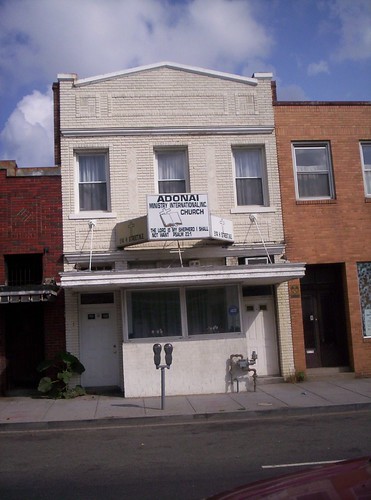
"Church"? at 514 H Street NEIn the 32 years I lived in Washington, I can count on one hand the number of times I saw people go in or out of this building.  And for half that time, I lived about one block away.

Not only did they not use the building for most of the week, but rules that may exist about proximity of restaurant liquor sales can get triggered, plus the building shifts off the tax rolls because churches don't pay property taxes.

Retail Dive reports ("Lease of faith: Why churches are going into malls") that churches are leasing up old department stores and other spaces in still operating shopping malls, granted in malls that are on the spiral of decline.

Also see:

-- "Reprint: Churches, community, religion and change," 2012, revised 2015

Labels: , , ,

Tuesday, June 26, 2018

Learning from Essen and Liverpool and applying it to Miami: Shopping "malls" in the city center

The US shopping mall typology had five components.  They are:
  • built in the suburbs
  • and therefore are car-oriented with plenty of parking
  • very large
  • inwardly focused
  • exclusively retail oriented.
This is changing on the last element, because as various players in the retail industry fail or consolidate, such as department stores, shopping centers are repurposing the space, including fitness centers, offices, medical clinics, etc., to utilize the space.

While the centers are becoming more "mixed use" ("Malls try to reinvent themselves as stores close," USA Today) they aren't necessarily becoming more successful for retail sales, because many of the new uses aren't congruent with people also buying stuff.

The enclosed Mall at Steamtown (a railroad museum in Scranton) is about 560,000 square feet.

Center city malls as a revitalization attempt.  While malls have mostly been a suburban phenomenon, there have been a few instances where inwardly focused behemoth shopping malls have been constructed in distressed places such as Scranton, Pennsylvania ("Auction of two downtown Scranton buildings holds promise for revitalization," and "Artists add a splash of color to Marketplace at Steamtown's darkened storefronts," Scranton Times-Tribune), as an attempt at revitalization.

Inward vs. outward malls: center cities need an outward focused design typology.  But as I have written in the past about Georgetown Park Mall in DC, and its relative failure as a "shopping mall," because it attempts to draw in customers off from "the street," into their controlled mall environment, and keep them there, when it is the life and vitality on the street and outside that is Georgetown's greatest attraction, inwardly focused shopping malls aren't very good for city centers because they are too big and they don't want to share their customers with the rest of the district.

Most of these efforts have fallen on hard times, and many of the malls have since been closed and demolished.

Note that one exception is Westfield San Francisco Centre in San Francisco, which was built in the city center about 10 years ago, in the city's most successful open air shopping district, Union Square.  Arguably, you could say the same about Time Warner Center at Columbus Circle in New York City.

Shopping malls in European pedestrianized city centers.  Something I noticed in Essen and a couple weeks ago in Liverpool, is that in those two European cities and presumably in many others, in their pedestrianized areas, they have "mall" buildings, typically much smaller than the old style American Mall, but full of shops, in an enclosed multi-story building.  They don't have department stores.

While even these shopping centers aren't necessarily outwardly focused, they are in the city center which helps keep the district economically successful and militates against sprawl.

These malls are smaller than American counterparts and don't overpower the rest of the district.  In short, these shopping complexes were designed to contribute positively to the continued strength of the city core as a shopping destination.

Europa Passage shopping arcade in Hamburg.

Another similar form that is still present in the downtown districts of European cities like Hamburg is the shopping arcade, connecting the opposing sides of a block with a shopping gallery.

(For the most part, US shopping arcades are long gone, with some notable exceptions in Cleveland and Ann Arbor.)

Lifestyle centers. "Lifestyle centers" were a response starting in the late 1990s to a decline in the power of the shopping mall because of a decline in interest in shopping at traditional department stores.

Lifestyle centers are more oriented to shops and restaurants and outside spaces ("Lifestyle Centers vs. Traditional Commercial Districts," 2006), although here and there, department stores may be an element of the mix.

But the anchor wasn't a store per se but the "experience" in terms of the quality of the space and the focus on being outside rather than ensconced within an enclosed mall (cf. "Reeves Center and Georgetown Park are two sides of the same coin," 2007).

Photo: Charles Fox, Philadelphia Inquirer.  Bryn Mawr Village was constructed in part from an old bus transit garage.

Lifestyling as the next generation of small shopping center development.  An article in the Philadelphia Inquirer ("How Bryn Mawr Village found its Main Line shopping niche") discusses the evolution of this type of center, calling it "lifestyling," with a mix of fitness centers and other services complementing retail.

The article is interesting in terms of the recognition that retail developers will continue to respond to changes in the market in order to remain successful. 

It keys on a developing change, that the property owners are less focused on attracting chain tenants that are ubiquitous, instead aiming for stores and services that aren't widely available elsewhere.  I was surprised to see that the development has a number of independent apparel shops.

But too, this particular center has the ability to be successful because it's in a high income area, and complements other destination retail centers like the King of Prussia Mall, one of the most successful in the US.

Liverpool One is a lifestyle center not an enclosed mall.  Lifestyle centers may incorporate non-selling more civic functions and usually have open space and programming.  (Liverpool One has superior bike parking, a retail store focusing on disabled mobility, and even a package pick up point for Amazon.)

While "shopping malls" aim to capture and keep customers to themselves, that is absolutely not the case for Liverpool One, the large shopping center in Liverpool, which connects to the city's pedestrianized area and further connects the pedestrianized center to the Waterfront.

It's the equivalent of an open air shopping mall, not unlike how Northland Center, one of the nation's first suburban shopping centers built just north of Detroit--but has since been demolished--was constructed, a bunch of open air shopping sections around a department store at the center.

Liverpool One has two big department stores--John Lewis and Debenhams--and a bunch of stores, but they are organized like shopping arcades but with no roof.

It's designed to capture customers from the pedestrianized center, just like the shopping center buildings in Essen, but even better than the typical shopping malls inserted into pedestrian centers as self-contained buildings, they use the open air shopping center design, so that they are outside- rather than inwardly focused, and the end result is that the "shopping mall" strengthens the adjacent shopping districts rather than diminishes them.

It's connective rather than disconnective.

This did come at some cost as John Lewis moved its store from a traditional center city building and that site has been difficult to redevelop ("Revealed: Developer's Circus plans for Lewis's and expanded Liverpool Central," Liverpool Echo).  But the net impact has been overwhelmingly positive.

Other US examples of conurbation focused open air lifestyle centers.  There are other examples of this form, in the US.  A close to home example is "Downtown Silver Spring" in Montgomery County, although it works from the standpoint of pedestrians and more active places, the retail offer waxes and wanes, because they don't have enough anchors and the main "shopping mall" that is part of the district remains inwardly focused.

Although I will say it's one commercial district that I could see being successful by adding a department store.  (More about department stores and city center locations later.)

Another example is The Grove, next to the open air Los Angeles Farmers Market ("Main Street of Dreams," Vanity Fair; The Grove Los Angeles, California, ULI Case Studies, Urban Land Institute).  I imagine there are others.

Miami-Dade County.  This comes up because the Triple Five Group, known for their behemoth internally focused gargantuan malls in Edmonton and Bloomington Minnesota (Mall of America) have received approvals for a similar mall in South Florida, ("American Dream Miami, the nation's biggest mall, wins final OK," Ft. Lauderdale Sun-Sentinel; The largest mall in the US is coming to Miami, and it will have a massive indoor water park and ice rink," Business Insider). (Their construction of a similar mall in New Jersey is a morass, "Hey, Miami, we hear you're getting an American Dream mega-mall, too. Good luck with that!." Newark Star-Ledger.)

South Florida's unique selling proposition is about being outdoors.

And while they have plenty of inwardly focused shopping malls, one of the country's most successful shopping districts is the open air Bal Harbour Shops elsewhere in Miami-Dade County.  It even has department stores, Saks Fifth Avenue and Neiman-Marcus.

In any case, the location of the mall in the northern section of the county far away from the county's most urban districts means the opportunity to strengthen existing commercial districts is lost, and it's probably not a good example for a treatment comparable to Liverpool One.

It's not well connected in terms of transit, although bus service from both Miami-Dade County and Broward County will be provided.  From the South Florida Business Journal article, "North America’s biggest mall and entertainment center coming: American Dream Miami approved":
Miami-Dade Commissioner Daniella Levine Cava said she voted against the project because the traffic is not adequately mitigated, it undermines the plan for public transportation, and she wants to focus on creating skilled jobs.

Triple Five Group agreed to a series of roadway improvements, including four highway interchanges, that must be completed before the project opens. Attorney Miguel Diaz de la Portilla, who represents the developer, said this would cost about $210 million, and the developer would be responsible for paying. There would be an additional $58 million in impact fees for American Dream Miami.
But it is instructive that while increasingly there are alternatives to traditional mall type shopping centers, local governments tend to be focused on older less flexible "property types." Although this mall is much more than a shopping center and will include a theme park with rides, a year round ice skating rink, etc.

Graphic from the Miami Herald, "In Miami-Dade, making the Mall of America look small."

I'd say the best thing for Miami would be to learn from the Liverpool One example, and make the new shopping center open air.

And connect it to high capacity transit--Liverpool One is part of the Liverpool downtown which is well served by rail and bus transit. In fact, the city's inter-city bus terminal is next to the shopping center, while multiple train stations are close by.

Instead this is a very traditional suburban, automobile-centric project.  That being said, given its South Florida location, it is likely to be successful.

P.S.  I know that the time has "long passed the station" to be able to do intra-core right-sized shopping malls and open-air centers in the US, except for particular situations, such as the previously mentioned Downtown Silver Spring initiative in Maryland or The Grove in Los Angeles.

Still, as an example of "what could have been," it's interesting to think about.

Labels: , , ,