Rebuilding Place in the Urban Space

"A community’s physical form, rather than its land uses, is its most intrinsic and enduring characteristic." [Katz, EPA] This blog focuses on place and placemaking and all that makes it work--historic preservation, urban design, transportation, asset-based community development, arts & cultural development, commercial district revitalization, tourism & destination development, and quality of life advocacy--along with doses of civic engagement and good governance watchdogging.

Monday, January 06, 2014

Slumlording isn't always so simple

Right:  A house being rehabilitated in Detroit by DIY Network's Nicole Curtis.  Caption: Curtis also bought the charred remains and lot of the house next door to the house on Campbell Street. It was destroyed in a fire. It took two days with a Bobcat to clear the lot, Curtis said on Facebook. "We were here for a week and half outside before we ever made it inside," says Sykes. (Nicole Curtis/Facebook)

There is coverage about an activist's campaign in Baltimore to call attention to vacant, abandoned, and poorly maintained buildings in the city--focused mostly on residential properties.  See "Foes of Urban Blight Take Aim at Landlords" from the Wall Street Journal.

Not that I want to defend a slumlord (and I have accused people of being such from time to time when they deserve to be so labeled), but as discussed in the entry on "abandominiums" in Anacostia DC ("Deeper Thinking, Programming Needed for Weak Residential Markets") property abandonment is most often the result of it being more expensive to maintain a property than it yields in rental income or the problems in successfully renting and managing the property exceed the skills, time, and financial capacity of the owner.

This is an especial problem in weak real estate markets and submarkets, with more supply of potential housing than there is demand.

I have discussed from time to time the book Building neighborhood confidence: A humanistic strategy for urban housing by Rolf Goetze, which was published in the mid-1970s, to which I was introduced in 2003.  Goetze was the director of research for the Boston Redevelopment Authority, and the basic point that he makes--discussing all these issues in far greater detail than I--that in such situations the government can and should step in and help in rebuilding confidence in a neighborhood through a property improvement strategy, but that the point of the investment is to rebuild the confidence of property owners in the neighborhood and in investing on their own, that the point isn't to create dependence, but to provide the necessary support.
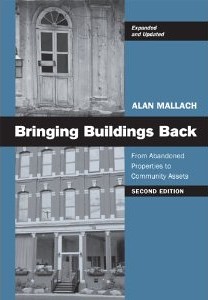
Bringing Buildings Back by Alan MallachNote that a more current book on the same topic is Bringing Buildings Back by Alan Mallach.  See the past blog entry "Pushing the rehabilitation of vacant buildings/nuisance properties" for a more detailed discussion of this topic.

In cities like Baltimore or Detroit or Cleveland or St. Louis with tens of thousands of vacant buildings typically the city is so overwhelmed by the problem that it is unable to focus on the hard reality of addressing nuisance and vacant properties one site at a time.

This piece suggests creating neighborhood by neighborhood plans with detailed inventories of properties and thumbnail strategies and tactics for addressing the problems.

But the biggest problem is lack of demand and the reality that the cost of rehabilitating a property is far greater than the market value of residential properties in the area.

I have been thinking about this in terms of the tv show "Rehab Addict" on DIY/HGTV, which recently did a rehab of a duplex in Detroit ("Where others see blight, Detroit native Nicole Curtis sees a diamond in the rough" Detroit News).  According to Trulia, the value of the property is about $70,000.  And it probably cost around that much--except that tv shows end up getting donated services which cuts costs--to fix.

I am not saying don't fix the properties, just that yelling at someone that they are a slumlord ends up not helping very much.

And because "used houses" sell for so cheap, it's too expensive to build new single family housing for sale to owner-occupants, because the cost of new construction is greater than the cost to buy existing housing--and so properties won't appraise at the price necessary to get a conventional mortgage.

This is why to right the markets in such neighborhoods, public sector intervention is usually required.  At the same time, it's difficult for the public sector to choose winners and losers--saying that there are only so many resources to go around and that it's best to focus on neighborhoods with greater potential for improvement--so usually money is spread around to multiple neighborhoods but not at the level necessary to bring about critical mass improvement.

That being said, the neighborhood that Nicole Curtis picked does seem to be reasonably stable as opposed to many other Detroit neighborhoods, so that the project won't go for nought.

Labels: , , , , , ,

Saturday, May 12, 2012

Pushing the rehabilitation of vacant buildings/nuisance properties

400 K Street NE
400 K Street NE, now undergoing renovation, after at least 24 years of being vacant.

In weak real estate markets, disinvestment is a real problem, and you have few tools at your disposal to turn places around, because investments in reconstruction of properties, and extranormal investments in multi-decade disinvested properties, don't necessarily come back in significantly increased property value.

This is something that I didn't really appreciate for a long time.  E.g., you can invest $100,000 or more in a "historic" (designated or not) house in many DC neighborhoods and the property value will increase by two or more times the cost.

In a place like Cleveland or Cincinnati or Rochester, NY, you can spend $100,000 for a house that would cost 5-7 times more than that in DC, but the investment in fixing it up, say $100,000 to $200,000, could take decades to come back in terms of increased value of the property ("return on investment").  So from the standpoint of economics, it doesn't make sense to make such an investment.  When it's done, it's done for "noneconomic" reasons.

That's why organizations like the Cleveland Restoration Society or the Landmark Society of Western New York have extensive rehabilitation, support, and financing programs, because to revitalize neighborhoods, they have to employ non-market solutions, because at the neighborhood level, the economies are broken.

This is hard for many people to understand with regard to DC, because they are relatively new to the city.  (But even in the bad years, the DC preservation community never really developed an array of tools and programs designed to assist homeowners in rehabilitating properties.  Here it's mostly been a ground-up effort.  Only in the past few years, has a tax credit program for homeowners been put in place, targeting certain disinvested neighborhoods.)

Up into the middle part of the last decade, many neighborhoods, especially commercial districts, suffered significantly from vacant properties.  Of course, much of this was generated by the riots after the assassination of Martin Luther King and the abandonment that resulted.

For example, in my old H St. neighborhood, which I moved into first in September 1987, I can think of three of my favorite buildings--one is still vacant since then, and the other two have only been started to be rehabilitated in the last 18 months--and who knows how long the buildings were vacant before 1987.

The City Paper Housing Complex blog has a great piece, "No vacancies: how nuisance properties turn around," on Reuben Pemberton, who runs the Vacant Buildings Unit for the Dept. of Consumer and Regulatory Affairs.  Mr. Pemberton appears to be an "odd duck" as far as DCRA is concerned, because according to the article, his focus is on using the vacant buildings tax penalties (in DC, vacant buildings are taxed at a much higher rate) as a fulcrum to get buildings back into productive use.

In my experience, other units of DCRA haven't focused on maintaining qualities of place so much as they have been on "immediate eradication of the nuisance," which for the most part, just creates a new nuisance.  E.g., a nuisance building that gets demolished then just becomes a nuisance lot, but that much harder and more expensive to redevelop.

I used to testify about this quite a bit, from around 2002 to 2006 (e.g., "Why I hate DC" or the appropriate tactical strategy to apply to nuisance properties/ disinvestment is investment, not demolition"). Now, as the city continues to attract new residents ("Census: DC adds 16,000 new people" from the Post), this problem seems to be working its way out.

It's much harder in weak market cities, much harder, which is why programs from organizations like the Center for Community Progress are so important.  (Their national conference is next month.)

Bringing Buildings Back by Alan Mallach covers the process very well also.  As Alan points out, the issue really comes down to making locations valuable again, so that there is demand for what are otherwise vacant buildings.  According to Rolf Goetze, buildings in the center city became vacant through overproduction of suburban housing, and outmigration from the cities to those properties.
Bringing Buildings Back by Alan Mallach

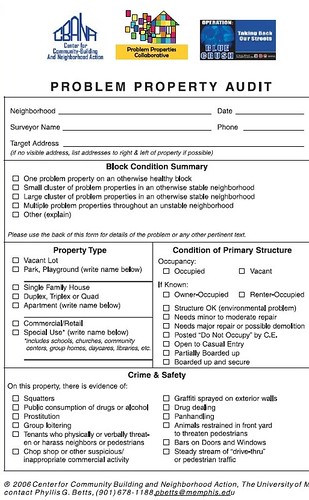
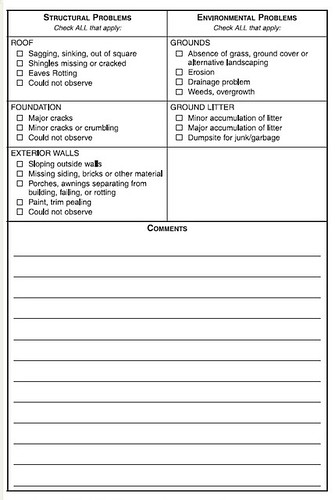
One thing that cities can do, is provide more tools to neighborhoods so that they can get a handle on vacant properties languishing within their communities.  For example, I am fond of the Problem Property Audit survey form from the University of Memphis.  I don't think that this kind of information is made available on a neighborhood by neighborhood basis in DC or in most cities.

Getting the tax policy right is really important.  In other places, like Ontario ("Guelph forum to investigate demolition-by-neglect" from the Guelph Mercury; note that the article is very good in describing the general problem of vacant properties and how to rehabilitate them) and in the UK, if a property is empty, the property taxes can be reduced.  This seems to me to be a nonsensical policy, as it is a disincentive to improving neighborhoods, even though the opposite is claimed by landlords.  On the other hand, in weak markets, it can reduce the pressure to demolish otherwise "worthless" buildings, preserving the option and opportunity for renovation at some point in the future.

-- Toronto Property Tax Rebate Program for Vacant Commercial and Industrial Buildings (it's actually a Ontario provincial law)

Another strategy, "receivership," is discussed in the testimony cited above.


Problem Property Audit, page 1 - University of Memphis
Problem Property Audit, page 2 - University of Memphis

Labels: , , , , , ,

Tuesday, July 12, 2011

Oak Park Michigan cites person for front yard vegetable garden

Another example of how the Detroit region is behind the times. See "Oak Park Woman Faces 93-Days in Jail For Planting Vegetable Garden" from WJBK TV. Image from the station.

(For those of us Detroiters old enough to remember Bob McBride, here's the obituary from the Washington Post, "Bob McBride, early D.C. newscaster and former Channel 4 anchor." He was the general manager of WJBK and did on air editorials that always ended with the line "what do you think? I'm Bob McBride." I can't help but think of that when I ask or answer the same question.)

Labels: , ,