Rebuilding Place in the Urban Space

"A community’s physical form, rather than its land uses, is its most intrinsic and enduring characteristic." [Katz, EPA] This blog focuses on place and placemaking and all that makes it work--historic preservation, urban design, transportation, asset-based community development, arts & cultural development, commercial district revitalization, tourism & destination development, and quality of life advocacy--along with doses of civic engagement and good governance watchdogging.

Sunday, May 10, 2026

Today's commercial building facade updates versus the 1950s/1960s


A historic corner retail building "improved" with wood accents, like how buildings in the 1950s and 1960s were covered up with panels, NE intersection of 400 East and 2100 South, Salt Lake City.

Corvin Palace Department Store, Budapest, Hungary, with 1950s remodel shown at top, and a return to the classical facade on the bottom.


Store for lease on Kalamazoo Pedestrian Mall in the 1980s, after the JC Penney closed and before.


This building, c. 2005, Mo Pitkins House of Satisfaction bar, storefront, carrara glass, 
34 Avenue A, Manhattan, New York City.  
The business closed and the building sold ("Old Mo Pitkin’s Digs Sold for $4 Million," Observer).

The carerra glass redoing of facades actually started in the 1930s as part of the Art Deco period, and often are attractive.  Sometimes they're kept even as part of historic preservation, to demonstrate the "layering of historic styles."

Illinois Historic Preservation Agency 

Sometimes carrara glass was used only for the business sign, not the entire storefront facade.

Market Avenue Woolworth, McCrory and Kresge Stores, Canton, Ohio. 1950s postcard

Labels: , , ,

Saturday, May 09, 2026

An illustration of house transmogrification that is a neighborhood character deadener


Decades ago I was at one of my first conferences, and a speaker made the point that the primary reason that people oppose development is because the new is generally worse than the old.  And that in past eras, when something old was replaced, it was more likely to be better.

After 25 years of experience, I'd say that the speaker is right in terms of attitudes but wrong in practice, because most people oppose everything regardless of design and building material quality.

But there is no question that design and building material quality "stick out" positively and will last decades, contributing positively to the "architecture of the ensemble."

The building facade on the left diminishes the ensemble.

2.  While people "oppose everything" they always advocate "for parks." That's because they want placid spaces.  The default after "no development" is "park/greenspace", not development.

But what if we open pickleball courts instead ("Shattered Nerves, Sleepless Nights: Pickleball Noise Is Driving Everyone Nuts," New York Times).

Given various experiences in DC, I always recommend against tearing down a development, and while the process to build something new goes forward, creating a "temporary use of a park." By the time the project is ready to get its approvals and permits, any agreement about temporary use goes out the window.  The park created an advocacy group by existing, and they will fight the next phase of the project ("Park View Residents Continue To Oppose Redevelopment at Bruce Monroe Park," Washington City Paper).

This happened with the Capital Crescent Trail and the Purple Line light rail project in Suburban Montgomery County.  The railroad there was used to shuttle coal to a power plant in Georgetown DC.  That facility closed in 1987.  The County stepped in and bought the line, "banking it for future transit" while putting in a multi use path, the CCT, in the interim.

Note the shirt.

Caption: President of the Capital Crescent Trail Ajay Bhatt speaks during a final walk at the Georgetown Branch trail, which will close due to construction of the Purple Line. Mike Murillo/WTOP.

Well in the mid 2010s, people fought the Purple Line, ostensibly because of the Trail but really because they didn't want to give up what had become extended backyards ("Friends of Capital Crescent Trail Take Purple Line Fight to U.S. Transportation Secretary," Bethesda Magazine, "Purple Line opponents hope for last-minute stop to Montgomery Co. trail closure," WTOP Radio).  

The service will open in 2027, so 40 years after the concept was first developed. Construction and other delays created by Republican Governor Larry Hogan delayed the project by 5.5 years ("The last bit of track, finally, is laid for the Purple Line," Washington Post).

FWIW, a memo I wrote about creating an "irresistible biking environment for DC" was distributed to the Maryland State Highway planning staff when I was a bike planner in Baltimore County, during the beginnings of planning for the Purple Line.  It influenced their making a commitment to have a trail parallel the entire line.

Labels: , , , ,

Monday, October 13, 2025

It turns out that Diane Keaton was a historic preservationist

While it's hard to top the movie "Annie Hall"--I think I first saw it on a double bill with Harold and Maude at the Royal Oak Music Theater for like $3 in 1978 or 1979--it turns out Diane Keaton was a committed historic preservationist ("Opinion: The Ambassador Hotel lesson," Los Angeles Times, "Diane Keaton’s quiet activism helped preserve these Los Angeles landmarks," Fortune).

She bought, rehabilitated and sold historic residences ("Actress Keaton lists Tucson house for $1.1 million more than she paid in 2018," Arizona Daily Star, "Diane Keaton indulges her ‘impractical’ side by buying older Spanish-style homes to redo," Los Angeles Times), including a Frank Lloyd Wright house in Los Angeles.

Backyard with pool.  FLW house once owned by Diane Keaton.

She was a board member of the Los Angeles Conservancy for two decades ("How Diane Keaton Tirelessly Campaigned to Preserve Los Angeles’ Architectural History," Variety) and for a time served as a trustee for the National Trust for Historic Preservation.

Labels: , ,

Monday, September 15, 2025

Heritage Open Days in the UK: September 12-21 | California Open Days: September


I've written about the Heritage Open Day program a bunch over the years.  

In England for awhile, the program first began in France in the 1980s ("celebrating open heritage through heritage open days," Town and Country Planning).  

Wales and Scotland have separate programs.

Since then, many cities in North America such as Toronto, New York City, Boston, and Pittsburgh have taken up the idea, usually for a weekend or a week.  Convening groups include preservation, architecture, and/or city tourism offices.

I think most cities should do this as a way to promote the breadth of cultural resources they have, and as a a marketing tool.

====== From a 2019 blog entry:

22.  Create an annual city-wide "Doors Open" event for DC's local cultural institutions.  

"Doors Open" events were pioneered in Europe, and are when a community's culture organizations band together to provide a coordinated schedule of events, usually over a weekend, where people get free access to various cultural sites and events, many of which are not normally open to the public.

In North America, Doors Open Toronto is probably the biggest.  The Toronto Star even publishes an event guide. (2011 Doors Open Toronto Guide)

But Open House New York Weekend  is increasingly a big deal.  Pittsburgh created one, Doors Open Pittsburgh.

In DC the Dupont-Kalorama Museums Consortium has had a district-specific Doors Open event for many years, as do the art galleries on Upper Wisconsin Avenue in Georgetown, but including the participation of AU's Katzen Center for the Arts and the Kreeger Museum.  It's not exactly the same, but Georgetown Glow, an outdoor sculpture walk in December and January is growing into a great event.

Let's do this for the whole city.
=====

This page from the Beverley brochure discusses the use of brick in what are now historic buildings (in the UK they call this heritage preservation or conservation).

This week is Heritage Open Days in the UK.  Events include infrastructure, museums, gardens, estates, and a wide range of other types of buildings including house tours and sites that are not normally open to the public, like the Athenaeum in Liverpool, and arts and crafts studio tours.

I haven't delved into the website that much, but the Beverley Civic Society (a historic preservation group started in 1961) has been a long time participant.

Their 44-page brochure for the events is quite informative.  A model of great information provision.

California.  Held on weekends, California also has a statewide Open Doors event sponsored by the state historic preservation group.  It's not free.  A $20 pass is offered, providing entrance to 75 different sites.

====

They're big on evaluation and continuous improvement.  From "Norwich Heritage Open Days Event Evaluation Report" (Norwich Economic and Regeneration Trust):


Labels: , , ,

Monday, August 04, 2025

The success of urban neighborhoods versus Downtown as a laggard

A man crosses a bustling Dorchester Avenue in Fields Corner at midday. (Photo: Jesse Costa/WBUR/NPR.)

The Boston Globe has a bunch of articles ("Boston’s neighborhoods are thriving. Downtown, not so much," "Boston's residential neighborhoods are thriving while Downtown struggles") about how the city's neighborhoods and commercial districts are doing much better than Downtown Boston ("Why how Downtown Boston is recovering depends on which Downtown you're talking about")..  

That's because Downtowns haven't and may never recover from work from home (WFH) practices accelerated by the response to covid.  Mayors in plenty of cities and Trump wrt the federal workforce are calling for RTO--return to the office, to support occupied office space, Central Business District centric transit systems, and retail and restaurants.

-- "What is the competitive advantage for the post-covid city? Doubling down on place values" (2022)

WRT the latter, reports from Boston and Chicago find lunch business in the CBD is down as much as 50% pre-covid.  Most heavy rail transit systems are moving half of the number of people to CBDs compared to pre-covid times.  

There is massive vacancy in office space and commercial office building valuations are cratering ("One of Boston’s skyline-defining towers is on the auction block — and expected to sell at a big discount," Boston Globe, "Does assessor Fritz Kaegi appreciate the true horrors of downtown Chicago’s commercial real estate market?," Chicago Tribune), "The brutal reality of plunging office values is here," Crain's New York Business).

This is a serious problem because local government revenue streams typically include great amounts of revenue from commercial property taxes.

By contrast neighborhoods still have people in them, and in dense neighborhoods like those of Boston and its inner ring suburbs, people walk places, do things, and patronize local business.

According to the Globe, vacancy rates are minimal in Boston's successful neighborhood districts.  Part of that is that while there might be fewer patrons overall, there are more than in the CBD, and neighborhood properties have much lower rental rates.  In Downtowns, property owners find it difficult to lower rents because of mortgage responsibilities, hence a lot of vacant storefronts.

Bristol's Clifton Village, number five in Knight Frank’s top 150 high streets © Robert Harding/Alamy

In this vein the Financial Times has a story "How bougie is your high street?," about the gentrification of commercial districts, mostly referring to neighborhood-centric ones.

A curated mix of chichi cafés, artisan bakers and premium gyms is changing the tenor of neighbourhoods in an era of clicking ‘add to basket’ 

... does the “Waitrose effect” identified nearly a decade ago by Lloyds Bank (how living close to the upmarket supermarket could add as much as 10 per cent to property prices), still up the kudos of an area?

“Yes,” says Tom Bill, Knight Frank’s head of UK residential research. “The quality of the local high street is one of the important factors for those looking for homes.” It’s why the estate agency undertook research to identify the top 150 premium high streets in the UK. “In the context of growing scrutiny around the composition and future of the high street, we wanted to analyse the most popular amenities that might increase the chances of people buying or staying in a particular location. That, of course, can become a virtuous circle for retail and residential markets.”

Pavilion Road, Chelsea, is a cobbled mews offering a village-like counterpoint 
to the grandeur of Sloane Square’s thoroughfare © Harry Mitchell

... It’s a sentiment that resonates internationally. The Rue Sainte-Catherine in Bordeaux, Europe’s longest shopping street, mixes international brands, uniquely French names and small independents in a soft-stone 18th-century backdrop that draws both local residents and visiting tourists — no one wants an identikit high street you can find back home. Coconut Grove, Miami’s oldest neighbourhood, is leafy and filled with cafés and small boutiques. Why trek to Collins Avenue when you have this on your doorstep? But if the mix is no longer about life’s essentials, and instead a new wave of chichi cafés, artisan bakers and fancy nail bars — are we right to ask, not how useful is your high street, but how bougie?

... “A high street sets the tone for a neighbourhood. We’re not saying there’s necessarily an uplift in property prices in the best areas, but home buyers are often choosing a way of life, and the ‘right’ blend of shops and facilities can add value, both for the character of the area and house prices.”

-- High Streets: Life beyond Retail?, 2024 House of Lords report, response

The idea of mixing a small number of premium chains with locally owned businesses was identified by Kennedy Smith, former head of the National Main Street Center, as an indicator of success, in part because consumers see the upscale shops as an endorsement of the neighborhood.

The one problem still, is selling convenience goods.  While these business districts often have home hardware stores and pharmacies--often chains--there aren't good options for well priced supermarket foods, at least in the US, because that industry isn't set up to operate at a small scale.  By contrast, there are supermarkets in UK districts, but definitely smaller than the typical US supermarket of 65,000 sf.

The large number of Marks & Spencer stores across the UK aren't department stores, but food halls, based on the conpany's tradition of knock your socks off prepared food offerings  in their London based flagship department store.

The other problem from "bougie" is that the price point trends upward.  The chi-chi cafes aren't pricing food comparable to the old time diner or other type of neighborhood-based restaurant.   ("A wealthy Calif. town is about to lose both of its dive bars Inbox," San Francisco Chronicle).  Etc.
“At the top end of the market, the high street is increasingly being curated,” says Michele Galli, chief executive of branding specialist The One Atelier. Bougie breeds bougie. “[People] want to step out of their doors and feel instantly immersed in a world that reflects their values in terms of wellness, craft and culture. Even in the era of delivery and convenience, physical quality of the streetscape still counts. It’s not just about access to services but a sense of place.”

The European districts share characteristics with those districts highlighted in Boston.  Tighter building stock in that buildings aren't spread out, walkable community, and a relatively dense population.  In the great book Cities in Full--and these numbers pre-date e-commerce--the author posits that you need 10,000 residents within a half mile to have a successful commercial district.

You see this in urban neighborhoods in the East, Middle Atlantic, and Midwest, where secondary business districts in cities had great form.  Usually anchored by regional department stores--which have closed or consolidated into Macy's--many of these districts, like Germantown Philadelphia are somewhat decrepit but with great bones.

Downtown Royal Oak, Michigan.

Certainly in automobile-centric suburbia this doesn't exist.  However, extent older towns like Royal Oak Michigan or Phoenixville, Pennsylvania outside of Philadelphia provide such an option even if people mostly drive  Certain districts in Montgomery County, like Bethesda, although they've long since lost the original town architectural antecedents (Bethesda Row case study, Urban Land Institute), function similarly.

Shopping centers have managers and headquarters personnel working on issues of retail recruitment with an eye to the mix.  

In 1964, the retail owners in Downtown Corning, New York figured this out and hired its first "manager."  It took 14 years, but the Main Street commercial district revitalization program was created by the National Trust for Historic Preservation to bring residents, institutions, the local government, property owners, and retailers together to improve the commercial district through management, and the addition of volunteers.

Later, people were reaching out to the National Trust for Historic Preservation for help in saving historic buildings in town business districts that became empty because of chaining up of retail, consolidation, a move to a much larger physical footprint, the next generation of national chains, like Walmart, and a shifting of retail to suburban shopping malls.  

The Trust figured out that the issue wasn't so much preservation and "saving the buildings," as it was rebuilding the micro-economy of the commercial district.  Hence a multi-faceted program for revitalization that was less focused on preservation--although still present--and more on business and district economic success.

In England, where many properties in independent commercial districts are owned by the equivalent of real estate investment trusts, they have the same idea, but more from the realm of corporate realty:

“We’re the stage managers. The retailers and restaurateurs are the performers who put on the show,“ says Hugh Seaborn, Cadogan’s chief executive. “Our goal is to provide public and private spaces that give exceptional experiences and encourage community connections, exactly what is lost in online transactions.” 

In the US, this doesn't work as well.  REITs are more focused on return from simple investments, so they shy away from traditional commercial district properties in favor of single use properties run by chains.  Companies specialize say in the real estate of pharmacies or quick service restaurants. 

-- "Problematic outcomes as real estate investment trusts buy more "high street" retail real estate" (2015)
-- "Further evidence of DC being an international/national real estate market," (2018)

Separately, I've mentioned how Edens, originally a Carolinas-based shopping center owner, was able to pivot to curated retail, when it bought property in DC's wholesale food market, Union Market("Two years in, Union Market thrives," Post, "Vendor's Game: Meet the Chef Behind Union Market," Washington City Paper).

This is still a rare occurrence, outside of traditional commercial shopping centers--malls, lifestyle centers, and strip shopping centers.  Although the lifestyle center is based on the old model of a mixed use town center.

====

This piece is about a couple of local commercial districts in DC and Salt Lake, both micro.  By contrast Salt Lake's 9th and 9th District ("Visiting Salt Lake," Washington Post) is more like the successful ones discussed above, albeit smaller.

-- "Thinking about the opportunities for success with neighborhood commercial districts: comparing Manor Park in DC to 15th and 15th in Salt Lake" (2021)

Labels: , , , , ,

Monday, July 28, 2025

Is historic preservation becoming a conservative movement?

 Bloomberg CityLab reports that the concepts of the value of historically designed and architectually attractive buildings are being criticized because hard right leaders like Donald Trump ("Trump Architecture Memo Promises to Change How the US Government Builds") and Viktor Orban of Hungary ("A Rogue Leader’s Plan for the Heart of Budapest") are mandating this type of design for new government buildings.

Interestingly, wrt Orban, there are 100s of high quality projects across Europe that rebuild lost buildings the way there were built in the past.  These are featured on the Reddit thread ArchitecturalRevivals.  To be fair, this argument is well articulated in today's Bloomberg article, "Budapest's Most Historic Site Gets a Controversial Rebuild."

This is one of those issues where like a broken clock being right twice a day, amongst the voluminous decrees by Trump, there can be a couple that make sense.

I don't see historic architectural design as being appropriated by the right.  The right, despite Trump's Executive Orders, primarily focused on property rights with zero regulation ("Why Historic Preservation Districts Should Be a Thing of the Past," Bloomberg) still disfavors preservation.

CityLab also has another article seemingly on the same topic, "An Underrated Upside to YIMBY Ideas? Better-Looking Buildings." 

But in my experience YIMBYs don't care about quality design whatsoever.  They are in favor of what I call 21st Century Urban Renewal, tearing down attractive albeit small scale buildings often historically designated, in favor of new denser construction ("The Escalating Argument Over Historic Preservation," Governing Magazine). 

Although repudiation of historic preservation policies can be seen as a progressive one by people who see the movement today as one of anti-change, even racist ("Unfinished New York," Places Journal).

Second + Second, designed by Snow Kreilich Architects for Minneapolis, elevates the style of the typically mundane 5-over-1 apartment building format. Peter VonDeLinde

Note that it is possible for newly constructed buildings to be attractive, using historical precedents, but it is so rare.  

This is illustrated by the article itself, which claims the new unattractive building on the left is superior to the design of the building on the right.

=====

Also see, "A little bit of knowledge is a dangerous thing: GGW criticism of consulting team retained to write the next iteration of the city's preservation plan (helped me to articulate the 21st century narrative in favor of historic preservation)," [2025].

Articles critical of current preservation practice:

-- "What We Build Is More Important Than What We Save," American Conservative
-- "What Historic Preservation Is Doing to American Cities" Atlantic

Labels: , , , ,

Saturday, July 19, 2025

A little bit of knowledge is a dangerous thing: GGW criticism of consulting team retained to write the next iteration of the city's preservation plan (helped me to articulate the 21st century narrative in favor of historic preservation)

The Greater Greater Washington blog has an article, "OP privatizes historic district study, puts it in the hands of preservation cheerleaders," criticizing the city's selection of a pro-preservation consulting firm, which has done some work for the DC Preservation League, as a bag job.  I wonder what GGW thinks about groups like the Washington Area Bicyclists Association getting city grants.

The Economics of Uniqueness: Investing in Historic City Cores and Cultural Heritage Assets for Sustainable Development

Ironically, the article demonstrates the lack of knowledge of the author and his own neoliberal biases, because Place Economics is internationally recognized for its work, one item of which is the World Bank book, The Economics of Uniqueness.

The principal of the firm, Donovan Rypkema, was one of the first people to study the economic value of historic preservation to cities, more than four decades ago.  He moved into preservation consulting from real estate appraisal--it was real estate appraisal that was his entry into the field.

-- Historic Preservation and Affordable Housing: The Missed Connection (2003)
-- "The Economics of Historic Preservation
-- Measuring the Economic Impact of Historic Preservation, Advisory Council for Historic Preservation
-- "Culture, Historic Preservation and Economic Development in the 21st Century"

And I don't agree with all of PE's work, such as their triage of properties worth saving in Detroit (Historic Preservation and Rightsizing: Current Practices and Resources Survey).

The new new urban pioneers.  The problem is that post-2000 migrants to the city, especially those of the GGW demographic--younger, under 40, believe that they saved the city. 

This ignores the reality that they are merely the latest generation of "urban pioneers" which have been moving into the city since the 1950s, especially in the period from 1950 to 2000, when household choice trends did not favor urban living ("Blazing a Trail: Urban Pioneer Neighborhoods," HGTV). 

I was one of those migrants in the late 1980s--it took until about 2000 for in-migration to hit critical mass, independent of the change in housing preferences, which were spurred in part by TV shows like Friends and Seinfeld showing positive images of the city.

Note like with institutions acknowledging that we are on lands taken from Native Americans, I am now cool on the term "urban pioneer" because yes, there were residents already. Although out-migration trends were driven by fear of integration it was also about suburban living as a bucolic alternative.  It's better to think of the in-migrants from those decades as people interested in investing in the city, while the out-migrants were engaged in disinvestment.

From "Urban pioneers in the making: Recontextualization and the emergence of the engaged resident in redeveloping communities," Journal of Sociolinguistics:

... The analysis highlights how despite a common thematic focus on resident engagement, personal commentaries and stories of resident activism steer away from the institutional ideal of positive problem solving toward conflict and acts of removal. I identify links between circulated metasemiotic descriptions of the ‘engaged urban resident’ and market-led urban redevelopment and argue that individual reframings and enactments of the institutionally-mandated urban persona can foster socially exclusive and spatially-purified urban neighborhoods.

From the blog entry "70th anniversary of the DC Capitol Hill Restoration Society":

In 2000, I first got involved in urban revitalization through the prism of historic preservation, when a preservationist reached out to me about the H Street neighborhood north of the Capitol Hill Historic District (from F Street NE to Florida Avenue NE).

I'd argue the disinvested historic building is more pleasing than the house next door, although for post-modernism it isn't so bad.

I remain an ardent preservationist today, mostly because the architecture and urban design is so much more humanist and aesthetically pleasing than that of today's post-modernism.  Good books on the subject include Changing Places (out of print) and Cities: Back from the Edge.

It was also a great strategy for neighborhood stabilization during the many decades that center city living was disfavored and populations shrunk.  

Preservation was cheap for cities because the property owners bore the bulk of the cost of compliance--although some argue that put undue hardship on lower income households.  For the most part, cities merely paid for the regulatory function, and brick sidewalks and historically appropriate streetlighting.

It is difficult to separate out the effects of preservation and stabilization versus "gentrification."  I'd argue that gentrification results from architectural attractiveness (mostly, there are plenty examples of tear downs and McMansionization of designate-able properties) and that preservation shouldn't be criticized for its success.  "Inward investment" by preservationists shouldn't be criticized as gentrification but as reinvesting in a city where capital for housing was often unavailable.

Rowhouse neighborhoods have a lot of density as this aerial photo of Capitol Hill by Al Drago shows.

Another criticism is that it has focused on building preservation over intangible heritage ("New York City’s Historic Preservation Movement Is Having a Midlife Crisis," Bloomberg). That by selecting certain areas to preserve, it says others aren't worth preserving, part of the argument of the book History of Urban Places.

In any case, with the rise of property rights sentiments, now at least pre-covid, the trend of city revival and the need for "more housing" amidst constrained land resources, preservation has come into attack by prominent economists and the like ("Idiocracy concerning historic preservation from both Yglesias and Glaeser," 2011), and Binyamin Applebaum in the New York Times ("Historic Preservation Is Hurting Cities," letters, "Preserving Historic Buildings," and "I Want a City, Not a Museum," letters, "Should Historic Buildings Give Way to New Housing?").

=====

A 21st century argument/narrative for the value of historic preservation.  Elsewhere I have argued that historic preservation had a great narrative in the days of the shrinking city--but it hasn't developed a new narrative for opportunities for HP in a growing or rebounding city.

I argue that unlike the demolition arguments of those like GGW, Glaeser, and Yglesias, that it's important to retain place distinctive qualities that make the city unique as opposed to merely a space in which to live.

In terms of theory and practice, I argue that this means respecting the "architectural ensemble of historic districts" (New Buildings Among Old: Historicism and the Search for an Architecture of Our Time"), basically the arguments of University of Notre Dame professor Stephen Semes. 

Along side a surgical insertion of new buildings, more dense, where appropriate.  Like many cities Salt Lake has lots of small apartment buildings in its core.  DC has some of this in older neighborhoods like Capitol Hill and Dupont Circle.  Such buildings are models for what we might call "sensitive densification" within pre-1930 neighborhoods.


Kennedy-Warren building, Connecticut Avenue NW, Washington DC.

DC has examples of large apartment buildings of historically-pleasing design as well.

Where Salt Lake is unusual is that it also has a pattern of duplexes, triplexes, quads, and courtyard housing.  

I argue both types of housing can be admirable additions to historic districts, provided they utilize historic preservation relevant design--which most newly constructed housing does not.


Duplexes and similar types are often but not limited to corner properties and on neighborhood arterials.  SLC's buildings of this type are worthy of a dissertation.

WRT larger apartment buildings, London offers a good typology of historic building design for newly constructed housing, the concept of which is rare in the US, with some exceptions (the works of Robert A.M Stern in NYC,  "Vintage Appeal: Why A-Listers Love New York’s Vintage Residential Buildings," Variety, older rowhouse developments in DC by EYA, BF Saul's expansion of the Kennedy Warren apartment building, etc.).

Interestingly, unlike the people profiled in the Variety article, even though they share the same demographic as the post-2000 urban pioneers and YIMBYs, they have a very different attitude towards place value versus space value.

Typical design of a post-modern apartment building across the US, this building is in Salt Lake.  Developers argue that their market research says people want design like this.  I bet they aren't showing them alternatives.

An addition to the 21st century narrative includes that of protecting intangible heritage and small businesses ("Why Historic Preservation Needs a New Approach," Bloomberg), related in the previous entry on Chinatowns.

When I first started being interested in preservation, I didn't think so much about the intangible.  Of course, it's essential to the definition of place value.

There are many things that Toronto residents generally need or want, just not on their own street: mid-rise housing, convenience stores, high-rise housing, homeless shelters, low-rise multiplex housing, bars. When one of these things is proposed anywhere in the city, you can rely on hearing one of two contradictory objections.

The first is: we don’t have that kind of thing here, and introducing it would ruin the neighbourhood. The second is: we have plenty of that kind of thing here already, and adding more of it would ruin the neighbourhood.

In either case, the concern invariably revolves around “neighbourhood character,” a quality that always seems to be on the verge of destruction whenever the city evolves. Introduce something uncommon, and it’s ruined. Add more of something common, and it’s also ruined.
Compromises necessary for both preservationists and yimbys.  The shortest way to summarize the 21st century narrative is that preservations have to compromise on the addition of new buildings and density, while YIMBYs have to compromise on design appropriateness--old versus new, and drop their blindness to the negative impacts of mass demolition of historic character.  And the Star article makes this point:
In a way, the kinds of objections that have been making headlines lately serve as an indicator species for a healthy neighbourhood. But letting the objectors get their way all the time can sometimes do more to ruin a neighbourhood’s character than any proposed change.
OTOH,we could call the Glaesers, Applebaums, and Yglesias' promoters of a 21st century urban renewal program, equally heinous to that of the 20th century, because of their arguments that historic neighborhoods don't deserve protection from significant architectural change, and that the value of land is valueless in terms of place considerations.

Labels: , , , , , , , ,

Tuesday, May 06, 2025

West Canfield Historic District, Detroit, and the West Garfield Park neighborhood in Chicago: Opportunities for demonstration projects on wide-scale neighborhood improvement and quality infill architecture | May is National Historic Preservation Month

-- "63 things to do during National Historic Preservation Month"

-- "May is National Historic Preservation Month: The future of historic preservation"

========

West Canfield Historic District, Detroit.  A Reddit thread showed photos of houses in the West Canfield Historic District in Detroit.  The impetus for the district was an antiques dealer, Beulah Groehn, "How One Woman Gave Rise to Detroit's Historic Preservation Movement" NTHP

[In 1965,] an antiques collector and retired executive secretary named Beulah Groehn drove into the city from Franklin to shop at an estate sale. The house, at 627 Canfield, was a beautiful but decrepit Victorian in the gritty Cass Corridor. The neighborhood was built for well-heeled Detroiters of the late 19th-century, but over the course of 90-some years, the mansions of Canfield Street had become boarding houses, bohemian crash-pads, and drug dens. There was no newness on West Canfield. But Beulah Groehn had discovered something she loved. Instead of buying antiques at that estate sale, she bought the house.

For the rest of her life, at a time when many of Detroit's planners and politicians felt that the city's past stood in the way of urban progress, Beulah fought to save places like West Canfield -- not simply because they were old, but because she believed that saving old places would attract residents, create jobs, and make neighborhoods safer, stronger, and more beautiful. Her legacy includes not only stately, brick-paved West Canfield Street -- today one of Detroit's most desirable blocks -- the city's local historic preservation ordinance, and along with it, the Historic Designation Advisory Board and Historic District Commission, the legal mechanisms and governing bodies that help make saving Detroit's old places possible.

West Garfield, Chicago. An article caught my attention awhile back, "This homebuilder wants to revitalize his West Garfield Park neighborhood. He just had his first sale," in Crain's Chicago Business about the development and sale of decidedly modern rowhouses in the West Garfield district of Chicago.  

West Garfield is a neighborhood that's seen better days.  It has a lot of historic building stock in various states of repair, including both healthy and distressed, and it has a number of infill buildings, like these rowhouses that represent modern design.  It has clusters of high performing physical assets that can be built upon once again.

3806 W Washington Boulevard, West Garfield Park, Chicago.

I was thinking that the West Garfield neighborhood would be a great place to do a test on a massive scale, not unlike Germany's IBA, a wide ranging revitalization initiative operating at the scale of multi-districts, that does a bunch of projects, and about ten years shows them, with others still in the pipeline.  

-- IBA - Hamburg

Or again, Germany's International Garden Festival ("DC has a big "Garden Festival" opportunity in the Anacostia River," 2014), which works similarly.  Historic equivalent architecture or new stuff.

Although I guess the neighborhood isn't the safest according to the Chicago Sun-Times, "Voices from Chicago's most violent neighborhood."

-- West Garfield Park, Encyclopedia of Chicago

Too bad I'm not in Chicago because there is a foundation that would fund something like this, albeit they'd need a lot of money and have to work with others.  The Knight Foundation is built on the profits from various newspapers owned by two brothers (Once upon a time I delivered the Detroit Free Press).

The Foundation pretty much only invests in places where they had a newspaper.  Chicago Daily News was their paper in Chicago--even though they sold the paper to Marshall Field, they still make grants in Chicago.

And the Foundation funded a short term preservation initiative called the Preservation Development Initiative, which applied Main Street and other historic preservation approaches to cities and neighborhoods in a bunch of cities in the early 2000s.  One impressive example was working with Mercer University in Macon, Georgia ("Beall’s Hill Neighborhood Revitalization Project," MU, Neighborhood Revitalization Guide, Historic Macon Foundation, "Historic Macon Foundation will expand revitalization efforts in Macon’s Beall’s Hill neighborhood with $3 million from Knight Foundation," Knight Foundation).

-- Investing In Revitalization Efforts: Case Studies from Knight Cities, Knight Foundation

Revitalization lessons from the Knight grants:

Local Context 

  • Think beyond the central business district: 
  • Build broad coalitions to ensure longevity: 
  • Proactively mitigate displacement risk:
Accelerators of Impact
  • Cluster investments: 
  • Support multiple organizations working toward shared goals: In communities with an array of fiscally healthy and high-capacity organizations, 
  • Cultivate relationships with educational anchors
Concentration of investment
  • Embrace flexibility and innovation: 
  • Achieve long-term impacts by investing in programming, arts, the public realm and infrastructure: 
  • Investing in multiple avenues to revitalization:  

One of the neighborhood's assets is the Garfield Conservancy.  

Pair a PDI like initiative with a community safety partnership approach ("Creating 'community safety partnership neighborhood management programs as a management and mitigation strategy for public nuisances: Part 3 (like homeless shelters)") and it could be quite successful ("Chicago needs a homebuilding revolution," Crain's Chicago Business).

In fact, it'd be a good place to test my concept of an ideal neighborhood revitalization program.

-- "The need for a "national" neighborhood stabilization program comparable to the Main Street program for commercial districts: Part I (Overall)"
-- "To be successful, local neighborhood stabilization programs need a packaged set of robust remedies: Part 2"
-- "Creating 'community safety partnership neighborhood management programs as a management and mitigation strategy for public nuisance programs: Part 3 (like homeless shelters)"
-- "A case in Gloucester, Massachusetts as an illustration of the need for systematic neighborhood monitoring and stabilization initiatives: Part 4 (the Curcuru Family)"
-- "Local neighborhood stabilization programs: Part 5 | Adding energy conservation programs, with the PUSH Buffalo Green Development Zone as a model," 2021

Although a specific point on deep crime would probably need to be added.

Labels: , , , , ,

Thursday, May 01, 2025

63 things to do during National Historic Preservation Month

Over the years, originally inspired by a "what you can do" list by Preservation Action Council of San Jose, I've developed a four-part series on what people can do to "celebrate" National Preservation Month.  There are 60 items across the posts, ranging from visiting a historic district to watching a film in a historic theater.

Rather than reprint them in full--recognize that some of the links in previous pieces may be out of date--here are the entries.

-- "May is Historic Preservation Month: 60 ways to celebrate | Part 1: Cultural Heritage Tourism (1-19)," (2019)

1.  Resources for Cultural Heritage Tourism Travel. Magazines like Southern Living, Yankee and Sunset.  Bookstores.  Visitor Centers.  Historic preservation organizations.  Local chapters of the American Institute of Architects, and sometimes the American Society of Landscape Architects.  When traveling, library special collections.

2. Stay at a historic hotel in the city or a bed and breakfast located in a historic district. For example, the Tabard Inn in the Dupont Circle Historic District is one of the most romantic places in the city to have weekend brunch--out on the patio, during the spring, summer, and fall.

3.  When you visit other places, check out how they deal with historic preservation matters, and share that learning when you come back. For example, every fall, Pasadena Heritage sponsors Craftsman Weekend, in honor of its bungalow heritage.

4. Don't forget to check out traditional commercial districts, antique shops, other stores, cinemas, theaters, concert halls, restaurants, historic cemeteries, etc. as a regular part of your travel itinerary.

5. Check out a historic library building/Central Library.  Another great place to learn about a community when you're traveling is the main library.  Some of the buildings are historic, others more recently are majestic new construction buildings very much worth visiting.  .

6. Visit historic sites.  Many people visit historic sites when traveling.  Across the United States, ("The shortest route to America's 49603 historic sites," Washington Post) there are almost 90,000 places listed on the National Register of Historic Places.

7. Go see a museum exhibit relevant to urban history, even if it's on a seemingly broader topic. When people travel, and "consume" locally available museums, usually people's trips start and end with the local arts museum.

8.  Walking and building tours.  Many communities have organized walking tours for historic areas. Some print booklets for self-guided tours, many places have smartphone tour apps, and cities often have historic marker and trails programs.

9. Bicycle touring.  Bikes are a great way to cover a lot of ground more quickly.  And it's less tiring to bike than it is to walk.  Many cities have bike rental operations (there is a loosely affiliated group called "Bike and Roll" operating in many cities).  And some hotels and B&Bs make bicycles available to their guests.  (There are even apps for renting bikes directly from individuals, like Spinlister, which can be cheaper than the bike rental places.)

10.  Transit as a way to get around.  While not many cities in the US do this, many European cities set up or promote specific transit services as a way to tour parts of the city, usually a set of tourist-oriented attractions in the core ("Travel around the city by tram," Visit Helsinki).

If you're already familiar with how to use transit, it usually isn't hard to figure out how to use another transit system.  If you don't regularly ride transit, likely people will be happy to help you.

11.  When we travel, we like to visit house museums.  For example, the Woodford Mansion in Philadelphia is really cool, and Savannah has many different house museums that you can visit, the most notorious being the Mercer-Williams House.  Most cities have at least one.  Los Angeles has just reopened the Hollyhock House.

12. Arguably, "antiquing" which for me includes ephemera, can be a form of historical/historic preservation-related research and is deserving of a separate entry.

While traveling, you may wish to check out reclaimed building materials stores too.  You'll probably have to do some digging to find such organizations, but offhand I know there are such places in New York City, DC (Suburban Maryland), Baltimore, Pittsburgh, Minneapolis, Detroit, York and Scranton, Pennsylvania, etc., plus the various Re:stores run by local affiliates of Habitat for Humanity.

13.  Visit a historic railroad station, bus terminal and/or a transportation museum.   There are many fabulous extant railroad stations, many no longer in use, in so many cities.2013 was the 100th anniversary of Grand Central Station in New York City, and in Chicago, Denver, and Los Angeles new master planning and/or construction improvement projects for stations in those cities are underway.

14. Visit a streetcar museum.   Many communities have streetcar/transit museums such as the Baltimore Streetcar Museum and the National Capital Trolley Museum  in Montgomery County, Maryland in this area.  So try to ride a historic streetcar as well.

15.  Ride a streetcar system in active service. Some places run heritage streetcars in active service.  Everyone knows about the streetcars in New Orleans (and that system continues to expand in bits and pieces).

16. Tour a historic trail, road, railroad, canal, park network, or parkway/greenway.

17.  Garden Tourism. Garden tourism has two different strands.

18. Ride a passenger rail train.  Ride a passenger railroad (commuter) train.  In the DC region, that means MARC or VRE.  In Greater New York, New Jersey, Philadelphia (SEPTA), Chicago, and Boston (as well as Toronto and Montreal), Southern California, Northern California and elsewhere commuter railroads provide passenger rail services once provided by private railroad companies.

19. Visit a national or state park. DC, for obvious reasons, has many nationally owned parks, the system of Fort Circle Parks works to preserve the forts built during the Civil War to protect the city from Confederate invasion. Fort Stevens, hidden behind a church on Georgia Avenue, around Quackenbos Street NW, was attacked by Confederate forces, and President Lincoln was up there and watched. Up Georgia Avenue a bit, close to Walter Reed Hospital, is a somewhat forlorn and neglected battlefield cemetery and monument honoring soldiers who died at the battle at Fort Stevens.

20. Take a boat trip on a local river.  Many cities have water-based tours or smaller scale water taxi systems.  Boston, Seattle, New York City, and San Francisco have working passenger ferry systems. The Staten Island Ferry is working transit that's free.

-- "May is Historic Preservation Month: 60 ways to celebrate | Part 2: Explore your community (20-36)," (2019)

21. Explore an older area of your community that you don't know. Go on a neighborhood or building tour. Check out a talk (not all of them cost money) at the National Building Museum.

Or just walk around a neighborhood with housing built before 1930.  Walking here and there around the core of Takoma Park, Maryland, we always come across attractive and unique houses.

22.  Many preservation groups sponsor neighborhood house tours.  On the first Sunday of May, Historic Takoma Park (DC and Maryland) has their annual house tour.

23.  Follow the path of a Heritage Trail such as one of the many "produced" by CulturalTourismDC in DC.

24. Shop at stores in commercial districts that are historically designated: i.e., Cleveland Park; Georgetown; Capitol Hill; Dupont Circle in DC, but there are so many across the country.
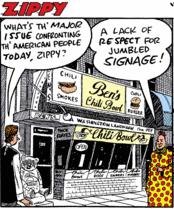
Frame, Zippy the Pinhead by Bill Griffith, Ben's Chili Bowl25. Eat in a restaurant in a historic building/historic district. Now 60+ years old, Ben's Chili Bowl is one of the few remaining restaurants in the city that is many decades old.  .. Readers have pointed out that Martin's Tavern in Georgetown and Cafe Mozart, a German restaurant downtown, are much older.

26. See a movie in a historic cinema building. There aren't many historic cinemas in DC proper any more, but the Uptown Theater in Cleveland Park is one.

27.  See a production in a "legitimate" historic theatre or concert hall.  You have many choices in the DC area such as the Warner, the National, the Studio Theatre, the Lincoln Theatre, the Shakespeare Theatre at the Landsburgh, the Atlas Performing Arts Center (which utilized federal historic preservation tax credits to pay for a portion of the building's rehabilitation), or the DAR Concert Hall.

28.  Even if you're an atheist, it can be fun to visit a historic church building, including checking out their stained glass windows (I am a big fan of stained glass).

29. Shop at a historic public food market. Eastern Market is DC's last remaining public food market building, built in 1873.  (Union Market is privately owned, and was constructed in the 1970s.)

30. Visit a historic cemetery. In DC, we have the Congressional Cemetery or the Rock Creek Church Cemetery at St. Paul's Episcopal Church, among others.  Brooklyn's Greenwood Cemetery is a standout.  Some cemeteries offer tours.

31. Check out an exhibit at a local history museum or historic site, such as at the Anacostia Community Museum or the Historical Society of Washington or one of the other house museums and historic sites in the city and region.

32. Walk the historic grounds of a local college or university.  In DC, Catholic University, Trinity, Georgetown, Howard, and Gallaudet have beautiful grounds and buildings.  Kendall Green at Gallaudet was designed by Frederick Law Olmsted.

33. Check out a monument or memorial in your community and learn more about it. We can't preserve what we don't understand or appreciate.

34. Visit a historic railroad or bus station, such as DC's Union Station. Designed by Daniel Burnham, it's an incredible example of the City Beautiful architectural movement. Check out chapters from Bill Wright's dissertation on Union Station. He's a great writer!

Railroad stations tend to be grand while older bus stations tend to be gnarly, which is an interesting commentary on the place of these respective modes in transportation history and practice.

35. Check out a historic library building.  Many cities have great library buildings that now qualify as historic.  A number of DC's libraries were built with support from the Carnegie Foundation (Northeast, Southeast, the old Carnegie Library downtown, Takoma, and Mount Pleasant, which is particularly gorgeous) as were more than 2,000 other libraries elsewhere in the US.

36. Take a boat trip on a local river.  The pontoon boat tours of the Anacostia River leaving from the Bladensburg Waterfront Park (in Prince George's County) dip into DC.  Many cities have water-based tours or smaller scale water taxi systems as well.

37. Explore historic preservation matters in your region, beyond the borders of your community.

-- "May is Historic Preservation Month: 60 ways to celebrate | Part 3: Learn and Get Involved (37-52)," (2019)

38. Learn about the history of your community. For example, for DC, read Dream City: Race, Power, and the Decline of Washington, D.C., 1964 -1994 and Between Justice and Beauty, and more.

39. Become a member of your citywide/countywide/regional preservation organizations such as the DC Preservation League, the Municipal Arts Society in New York City, Baltimore Preservation, Historic Districts Council in New York City, Cleveland Restoration Society, Preservation Resource Center of New Orleans, Landmark Society of Western New York (which serves Rochester, among other places), etc.  I am a big fan of the Chicago Bungalow Association.

40.  Before you get too involved, you might want to take the time to read your city, county, or state historic preservation plan.  This will educate you about preservation issues in your area.  (Although generally such plans are pretty positive, and don't go into enough detail about the "threats" nor do they outline ways to address "opportunities" in a process design approach.)

41. Learn about why historic preservation is important, in and of itself, as well as a urban revitalization strategy. The reason I am a strong supporter of preservation is that I have come to believe that it is the only approach to economically sustainable neighborhood and commercial district revitalization that works for the long haul.


42. Join a neighborhood/local preservation group, such as in DC the Capitol Hill Restoration SocietyHistoric Takoma, or Historic Mount Pleasant).

43.  Nationally, you can join the National Trust for Historic Preservation while you're at it. If you join, you can visit NT owned sites and affiliate organization museums at a discount/free, get discounts at Historic Hotels, and discounts on products you purchase.

44.  Preservation Action is a 501(c)4 advocacy group that advocates for specific legislation and is also a membership group.  Their "Preservation Advocacy Week" is held in March, where members lobby Members of Congress for legislation favorable to preservation.

45.  At the state level, most states have statewide preservation organizations.  In the DC-VA-MD area, that means Preservation Maryland and Preservation Virginia/Association for the Preservation of Virginia Antiquities, as well as the DC Preservation League.  Many sponsor annual or bi-annual conferences, journals, and other provide other resources.

46. Volunteer/1. Get involved in a preservation issue in your neighborhood or the city-county at large, which could include attending meetings of your local historic district/preservation commission, which in DC is the Historic Preservation Review Board, or working on a particular project affecting your neighborhood or city.

47. Volunteer/2, in a traditional commercial district revitalization initiative, at a history museum, or for a historic site.  A "division of the preservation movement" is the Main Street commercial district revitalization program, which links economic development with historic preservation focused on the revival of local commercial districts and downtowns in smaller communities.

48.  Volunteer/3, at a history museum, a historic park or at a historic site.  Museums and historic sites are always looking for volunteers, as our most park systems, including the National Park Service.  Many docents at sites and museums are volunteers.

-- Volunteer in Parks program, National Park Service

49. Work to preserve historic schools as schools.  The DC Public School system has an archives and museum that is also a meeting center, Sumner School, at 17th and M Streets NW.

50. Another way to learn a lot but very quickly is to attend a preservation conference such as the annual meeting of the National Trust for Historic Preservation (this year it's in Denver starting October 10th) and the National Main Street conference, which was held in Seattle in March, some sessions materials are available).

51. Check out the history resources at your local library or a specialized collection such as in DC at the Washingtoniana Collection at the Martin Luther King Central Library or the Peabody collection at the Georgetown Branch, the Kiplinger Library at the Historical Society of Washington, the Jewish Historical Society, or the Moorland-Spingarn Collection at Howard University.  Many city libraries have history collections.

52. Read a historic district brochure (or historic building or district nomination form).  In DC, they are available online or in hard copy at the Historic Preservation Office.  Many communities produce and publish these kinds of publications.  Two of the best I've ever read is one on Jefferson County Indiana including Madison (One of the first Main Street communities) and Hanover, and the other on the Kansas City public market, called City Market.  Both lay out their respective histories chronologically but thematically.

53.  I am a big fan of reading the design guidelines publications produced for cities or neighborhood historic districts, which describe local historic districts, such as those from Montgomery County MarylandRichmond, VirginiaRoanoke, Virginia, and the Philadelphia Rowhouse Manual.  The Roanoke Virginia Residential Pattern Book is a stand out!

54.  Listen to a preservation focused podcast.  Podcasts--"radio shows" are a new addition to preservation-based media.  Preservation Maryland produces a great series, PreserveCast, which is worth checking out.

-- "May is Historic Preservation Month: 60 ways to celebrate | Part 4: Preservation At Home (53-60)," (2019)

55. If you own "an old house," and want to learn more about historically sympathetic renovation, why not subscribe to relevant magazines such as Old House JournalOld House InteriorsAmerican BungalowThis Old HouseFine Homebuilding, etc.

56.  Publications on maintenance of historic houses.  

57.  Books to guide renovation.  

58.  Parts and appliance resources.  There are companies that specialize in "historic" parts.  For example, DEA Bathroom Machineries specialize in bathrooms, especially historic sinks.

59.  Most big cities have architectural salvage stores, for example in the DC area, it's Community Forklift.  In Baltimore, Loading Dock is a non-profit while Second Chance is a for profit.

60.  Workshops and expos.  It would be logical to have "Preservation Expos" during Preservation Month but it doesn't seem to be the case.  Historic Chicago Bungalow Association holds workshops most months, and has building expos too, from time to time.

61.  Activities for and with children.  If you have children in your life, how about doing an activity with them that is architecture-preservation related?

62. Television programming.  There are some HGTV/DIY network shows that are sympathetic to historic preservation, although the bulk of the shows are not.  Even the heralded "Fixer Upper," even if they renovate vacant houses, tends to homogenize the interior of a house into a gargantuan "open concept" house with a massive kitchen. 

But shows like "Rehab Attic," to some extent "Stone House Revival," and "American Rehab: Charleston" generally are pretty empathetic on historic preservation and can be a great source of ideas.  Lately I've been enamored by "Restored," featuring Brett Waterman working on houses in Riverside County, California.

Obviously, "This Old House," on PBS is the grand-daddy of all shows.  In my opinion, it's great for historic architecture and detailing, but the program tends to be more about supersizing houses, but doing a great job while you're doing so.  And they seem to let it slide when homeowners make decisions that somewhat cavalierly rip out historic elements in favor of modernization.

63.  Researching the history of your house.  There are people who will research this for you, but many city libraries have usable information and even may offer seminars on how to go about this.  Census records are one place, but more current records aren't accessible.

-- How to Research the History of Your House | This Old House
-- Internet Public LibraryResearch the History of Your House
-- Houses - The National Archives

Labels: , , , , , ,




