Rebuilding Place in the Urban Space

"A community’s physical form, rather than its land uses, is its most intrinsic and enduring characteristic." [Katz, EPA] This blog focuses on place and placemaking and all that makes it work--historic preservation, urban design, transportation, asset-based community development, arts & cultural development, commercial district revitalization, tourism & destination development, and quality of life advocacy--along with doses of civic engagement and good governance watchdogging.

Wednesday, July 16, 2025

National Ice Cream Day is Sunday/ice cream shops as attractors for neighborhood commercial districts

 Reprinted from August 2018 -- "Ice cream shops as commercial district activation devices"

Check out stores and news coverage in your community for possible promotions ("Free ice cream, discounts and more for National Ice Cream Day," Good Morning America).

In car-oriented places, drive ins still have their appeal, like Neilsen's Frozen Custard in the Salt Lake area.

There's also a rise in the number of independently owned ice cream shops and chainlets ("Artisanal Ice Cream Segment Leads Growth in the Global Ice Cream Parlor Market, Offering Unique Flavors and Premium Experiences," PR Newswire, "Once an NYC summer staple, Mister Softee ice cream trucks are slowly disappearing from the streets," ABC7, "From Mexico To Chicago, The Story Behind “La Michoacana” Ice Cream Shops," WBEZ/NPR).

================

Nancy's Ice Cream in Colonial Beach, Virginia.

The previous entry mentions how in Everett, Massachusetts, planners are thinking about trying to get a ice cream shop to take space in their downtown, as a way to attract patrons.

For a few years, Dolci Gelato had a well-placed corner shop in Takoma Park, Maryland, which was jammed on summer evenings and during the Sunday Farmers Market, and likely was a great attractor and activator.

But this year, the organization converted the space to a bar as part of their adjoining Trattoria restaurant.  Old Town Takoma no longer has that very visible attractor as they've moved the gelato operation around the corner to an old no longer used bank teller drive up window.

More recently, on the Upshur commercial strip in Petworth, Lulabelle's has opened.  It's not on a corner but serves very popular ice cream and during the day--coffee beverages--helping to draw people to the district, especially kids attracted by the parallel display of candy including home-made marshmallows and other treats.

Mason's Creamery, Bridge Avenue and 44th Street, Cleveland, Ohio.

Of course, there are tons of places like this, such as Dolcetti Gelati in the 9th and 9th district in Salt Lake City or the Mason Creamery ice cream shop in Cleveland, which has been featured recently in newspaper ads by Google.

Mason's started as a food truck and selling ice cream at farmers markets, according to this article on the Cleveland Rocks, Cleveland Eats blog.

There is the down-side of the winter months however.

There are limited "solutions" to revenues dropping significantly during that time.  Lulabelle's has food, the aforementioned coffee drinks and candy, along with some gifts, to stoke sales during the months when ice cream is a slow seller.

Google video about Mason's Creamery and the use of various Google analytics and small business support services.


Planning by daypart and season.  The way to think about this, from the standpoint of commercial district revitalization planning, is planning the retail and entertainment (and programming/activation mix) by day of the week, month, season, and "daypart" ("breakfast/lunch/dinner/late-night," morning/afternoon/early evening/late evening," etc.).

Stoking the patronage of the district, at all times is a worthy endeavor.  Ice cream, frozen yogurt, and gelato shops are a way to do this starting in the spring and in the evenings.

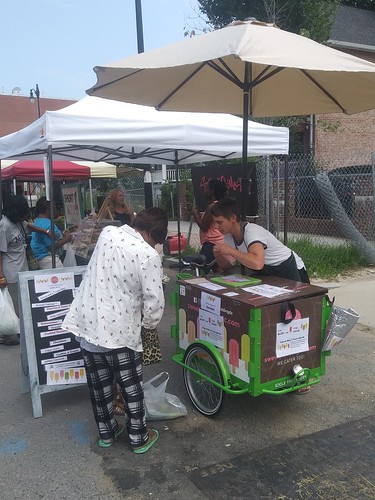
A locally made popsicle vendor at the Petworth Farmers MarketArtisan popsicles being sold at the Petworth Farmers Market.

Where availability of space is an issue, even ice cream food trucks and vending carts may be worth considering as an alternative to no such provision at all.

Labels: , , , ,

Friday, February 07, 2025

An interesting public space development project in Downtown Pittsburgh: extends the range of after-work activities to keep office workers engaged

Pittsburgh Cultural Trust is developing a multi-faceted public space-park in Downtown Pittsburgh ("'Asset for the people:' Pittsburgh Cultural Trust unveils name, more details of Eighth Street block overhaul Downtown").  This is interesting for a couple reasons.  

First, it involves other public organizations focused on Downtown improvement, creating public spaces where consumption of food and drink is not necessarily a primary activity.  Second it looks to be addressing multiple demographics, including kids, when planning for children was never a priority before.  

Third, it takes daypart and attraction management to new levels (Planning programming by daypart, month, season: and Boston Winter Garden, DC's Holiday Market, etc.") whereas spaces like these were never really a priority, at least in terms of planning and programming--sometimes such spaces were created as part of development agreements, but then left to languish.

-- "The layering effect: how the building blocks of an integrated public realm set the stage for community building and Silver Spring, Maryland as an example," (2012)

It's a different way of staying Downtown compared to consumption of alcohol indoors after work, and is responsive to declines in alcohol consumption by younger demographics ("Why Gen Z Is Drinking Less," TIME)..  Although public beer gardens are a method chosen by Philadelphia Horticultural Society and later the Parks Department, alongside Milwaukee to activate spaces ("Cities Want Young Families to Play and Stay: New Features Include Parks, Playgrounds and Beer Gardens," Wall Street Journal, 2014).

Fourth, it reminds me of a point made in Learning from Bryant Park, that commercial district revitalization organizations should take a more active role in developing unique spaces that extend the range of activities available to patrons. 

Fifth, it extends the range of third places ("Third place issues") where consumer consumption isn't a requirement.  And it's close to the Allegheny River.

Pittsburgh, meet Arts Landing. That’s the name for the new $31 million Downtown gathering and play space being proposed by the Pittsburgh Cultural Trust on Eighth Street bordering Penn Avenue and Fort Duquesne Boulevard.

On Thursday, officials from the Cultural Trust, county and city dropped the name and more details about the four-acre spot, which will include a great lawn, a bandshell for concerts, a play area, a garden walk, pickleball courts and a small running track. “This will be a place for co-workers to meet after work, for families to bring their kids down to play — for people to go out on their first dates,” Allegheny County Executive Sara Innamorato said. “It’s really going to become an incredible asset for the people of Pittsburgh for generations to come.”

... “This is not a short-term fix or an incremental improvement to an existing space,” Mr. Holmberg said Thursday. “This is reimagining and building an entirely new destination that will delight and benefit our community.” The centerpiece of Arts Landing will be the “great lawn,” a one-acre green space along the Allegheny River and between the Andy Warhol and Rachel Carson bridges. A bandshell will be located in the northwest corner of the gathering spot near Fort Duquesne Boulevard. It will be used for concerts and performances.

... “It’s really meant to be a people-first focused space,” said Lisa Tziona Switkin, a partner at Field Operations, the architecture firm designing the project. Other Arts Landing features include a play area for children and families — designed with the help of a focus group of 8-year-olds, Mr. Holmberg said. A new visitor center will also be located on the ground floors of two Cultural Trust-owned buildings at 819 and 821 Penn near the Ninth Street intersection. The center will include public restrooms.

Note that past blog entries have referenced Pittsburgh Cultural Trust as national best practice.

-- "The Howard and Lincoln Theatres: run them like the Pittsburgh Cultural Trust/Playhouse Square Cleveland model" (2012)

Labels: , , , , ,

Saturday, April 06, 2024

Gaps in Parks Master Planning, Part Six | Art(s) in the Park(s) as a comprehensive program

 =====

Republished due to misdating

=====

Gaps in park master planning frameworks


But while I have written a bunch about parks and transportational access, I didn't think to include that as another topic in the series.  The challenge is to ensure that as many parks as possible are accessible by transit.  This, and other forms of accessibility, should be covered in a parks master plan.

Art of parks and natural spaces.  Art has shaped our perception of landscapes, parks, and other public spaces for 200+ years in the United States alone, and longer in Europe ("‘Nature’s Nation’: How American art shaped our environmental perspectives," Princeton University Art Museum).  

There is a nice National Park Service brochure for the Hudson River Valley National Heritage Area on 19th Century Painters: The Hudson River School about their focus on painting landscapes and nature and how this influenced painting practice.  

We recently saw an exhibit on Maynard Dixon at the BYU Museum of Art and were blown away.

Maynard Dixon (1875-1946), 'Mesas in Shadow,' 1926, oil on canvas, 30 1/4 x 40 inches. 
Brigham Young University Museum of Art, 1937

Impressionist painter (Frederick) Childe Hassam (1859-1935) painted 
a number of works of Central Park.  This dates to 1892.

But rather than the "high art" paintings of yesterday, the range of arts programming in parks is much wider than it was then.   

Gene Harris Bandshell (amphitheater), Julia Davis Park, Boise, Idaho.

Art in parks today.  Despite papers like "How cities use parks for arts and cultural programs" (APA) and "Using art to define our parks" (NRPA), I was surprised to find that there isn't much written about how to structure and offer systematic "arts in the park" programs. 

Some parks might have an amphitheater for music and theater presentations.  Lunch time concerts are typical at Downtown parks and squares.  Some parks or recreation centers might have arts production facilities like a kiln for ceramics and arts education programs.

Many parks have museums or other cultural facilities within their parks.  The Chicago lakefront is renowned for its lakeshore being a continuous park, with 10 museums and cultural facilities including the Art Institute of Chicago, Museum of Science and Industry and the Shedd Aquarium.  In Salt Lake's Liberty Park, the mansion of the park's donor remains, and is used to display regionally-relevant cultural artifacts and presents temporary exhibits.

Programming offered is a wide range, can be music, theater, dance, children's activities, etc.  Mostly, parks might do one or two art related initiatives.  

Silverwood Park, north of Minneapolis, displays the work of regional artists and poets on trails and in the park's gallery. The Arts in California Parks program has Native American recognition, health and diversity objectives as part of their program.  Art in the Park in Northeast Los Angeles offers a wide range, including sponsoring a community band.  The Multnomah Arts Center is an initiative of the Portland Parks Department and offers programs for youth and adults.

Most typical is a focus on public art.  That's the case with NYC's "Art in the Parks" program.  Its webpage focuses on public art, even though there are many other arts-related programs in the city's parks, they have the Arsenal Gallery in Central Park, etc.
Arsenal Gallery, Central Park, New York City

Lack of budget.  A big problem is that park departments have budgets that are inadequate to meet the demand for services, so programming tends to be an after thought, maybe funded by special grants, or offered in association with other agencies to share the cost, but mostly doesn't exist.  

Programming tends to be provided in parks and public spaces that are managed by conservancies or business improvements districts--organizations that have separate funding sources, and with the luxury of only managing a few spaces, not many dozens.

Types of programs.  Music and cinema are probably the most common.  So arts as consumption or presentation. But there are myriad opportunities.

Dance.  The Queensboro Dance Festival presents across the borough of Queens in New York City.  

Members of Montana Shakespeare in the Parks perform 12th Night Wednesday evening at the Libby Elementary School Amphitheater. Montana Shakespeare in the Parks, which is celebrating its 50th anniversary, is an outreach program of Montana State University serving 61 rural communities in over 10 weeks across five states. (Scott Shindledecker/The Western News)

Theater.  Montana Shakespeare in the Parks travels around that state and pops into abutting states too (we saw a play they put on in Pocatello, Iowa).  

There are also play festivals held outdoors for a summer, like the Stratford Festival in Ontario or the Utah Shakespeare Festival in Cedar City.  Those are destination events, not events in a local park.

Artist in residence programs
 such as at the National Parks or the Bureau of Land Management or at the Madrona Marsh Preserve sponsored by the Torrance Art Museum in Southern California, offer opportunities to develop site-related projects and share more contemporary arts activities.  

-- Program by Katie Wendt at Madrona, "Warp and Weft," 2023

The Southern Utah National Parks also have a "Community Artist in the Parks" program where an area artist is selected to make and present art within the parks.

Music
.  Celebrate Brooklyn is an annual free concert series at the Lena Horne Bandshell in Prospect Park.  

Many downtown promotion organizations sponsor daytime music.  (Parks will also do ticketed events or rent out their space to big music festivals like Lollapalooza in Grant Park in Chicago.)

A number of symphony orchestras do summer residencies in parks.  The Los Angeles Symphony plays in the Hollywood Bowl.  These too tend to be destination events.

Music in the American Wild (webpage, Eastman School of Music) was a program where new music compositions were commissioned to play in 12 National Parks, in honor of the park system's 100th anniversary.

Temporary and permanent public art.  As mentioned in the previous entry in this series ("Gaps in Parks Master Planning: Part Five | Planning for Public Art as an element of park facilities"), annual sculpture presentations like the Sioux Falls Sculpture Walk in their Downtown, the annual billboard for the High Line Park in New York City, the Georgetown Glow lit sculptures in Washington, DC, are examples of temporary public art exhibits.

And there are plenty of examples of permanent public art, from statues to murals. 

And in public spaces, such as bus shelters ("Watching for the Bus Stop Gallery," New York Times).

Felipe Baeza, "Unruly Forms," bus shelter art in the US and Mexico

Traditional paintings presented in parks.  This has been done in many places.  In Maine, Maryland and others.

A reproduction of "Dark Harbor Fishermen" by N.C. Wyeth is posted along a trail in Wolfe's Neck Woods State Park in Freeport. The Portland Museum of Art has partnered with L.L. Bean and the state parks bureau to install reproductions of works of art from at five outdoor sites this summer. (Staff photo by Ben McCanna, "See Famous Paintings," Portland Press-Herald.)

Artist Kathy Wipfler gives a demonstration in Grand Teton National Park.

Plein Air events
.  
Painting in public.  Maybe as part of a competition.  Many programs.  For example, the Hockaday Museum of Art in Kalispell, Montana sponsors an event in Glacier National Park.  Plein Air for the Park is a fundraiser for Grand Teton National Park, where professional artists paint a park scene, and the paintings are sold ("Plein Air in Grand Teton National Park," Homestead Magazine).

There are plenty of local plein air events in parks    There is even a magazine, Plein Air, devoted to the subject and it lists events.

Galleries.  
As mentioned.  There is one at the Manhattan Project National Historical Park, the Dyer Building.

Movies in the park.  Happens all over.

Special lighting events.  Exhibits.  Site installations.  Educational programs.

Arts and crafts fairs/Festivals.  The one sponsored by the Boise Museum of Art, Art in the Park, held in the adjacent Julia Dawson Park, is pretty cool (artist guidelines).  They are all over  And some can be pretty  bad.  

For artists, the best ones are where people actually buy, so they attract better quality artists ("Guide to the Top Art Fairs Across the U.S.," Artwork Archive).  After the last one I went to, I joked "we don't need to do one in Sugar House Park.

The event features more than 250 artists offering varied fare, from glass and metalwork, to pottery and textiles, jewelry and toys! Shoppers will find a wide selection of arts and crafts for all tastes. Enjoy a variety of food and beverages from more than 30 food vendors, relax while listening to local musicians at the Gene Harris Bandshell and grab a drink in the Sculpture Garden Pub. Children are encouraged to get creative with an arts and crafts project in the Children’s Art Tent.

Artscape in Baltimore is one of my favorite festivals, not just with arts and crafts vendors, but the participation of programs at the Maryland Institute of Contemporary Art, students presenting their work and projects, nonprofits, and arts organizations, along with music stages.

Book festivals are another variant.

Etc.

Destination events and problems.  

Photo of Lollapalooza 2022.  Brian Cassella, Chicago Tribune.

There are two types of cultural destination events that are parks related.  The first is spaces organized around the discipline such as park like spaces for theater or music, but the facility isn't open as a park otherwise.

The other is having ticketed or private events in regular public parks like Grant Park in Chicago, home to the Lollapalooza music festival.

There is a tension in holding ticketed/exclusive events in regular parks between the revenue they generate for the park system versus damage and other costs ("Lollapalooza producers to pay $410,000 to clean up Grant Park after this year’s music festival," Chicago Tribune, "The Tough Mudder run ripped up our London park, and residents are paying the price," Guardian), "One-third of Central Park's Great Lawn 'fully destroyed' after damage from Global Citizen Festival, rains," Fox News) and access restrictions ("A New Home for New York Fashion Week," New York Times).

WRT music festivals, the Philadelphia Inquirer offers an observation that multi-day music festivals do better when they aren't generic, have a distinctive identity and a focus on community building ("How has the Roots Picnic continued to thrive while Made in America has been canceled again?").

Art and controversy in public spaces.  Note that given that it's a public facility, a park setting isn't likely to always support the presentation of "cutting edge" works, e.g., challenging political works may be controversial ("A Story of Arab Loss Comes to Life at a Kibbutz in Israel," New York Times), or fire as part of performance art.  Those would be hard for an average administrator to approve.  

Note that in retrospect I should have published this piece before the public art piece, "Gaps in Parks Master Planning: Part Five | Planning for Public Art as an element of park facilities," because that blog entry does not address controversy.

That being said, there are some public art programs, like Portland's Tri-Met transit agency, that have presented on a permanent basis some incredibly challenging works, such as a nearby site of a Japanese-American internment camp and the anti-Asian racism of local newspapers at the time.

There is the related issue of presenting art in spaces of controversy ("Harsh is truth," National Parks Magazine).  Tri-Met did that, acknowledging two stations Exposition (Japanese internment) and Vanport (where the Kaiser flood killed dozens of people) serve areas where controversy occurred.  

Nina Berman, Homeland Security Advisory Billboard, Country Club Hills, IL, 2008, from the Homeland series.

The National Parks article discusses presentation of potentially controversial contemporary art in parks (also see "Home Land Security" art certain to spark dialogue in uncertain times," Golden Gate Conservancy).  From the article:
“Home Land Security” opened a few months after the Brexit vote and ran through the U.S. presidential election. In the chilling installation, “2487,” the artist, Luz Maria Sanchez, reads the names of the 2,487 people known to have lost their lives crossing the U.S.-Mexico border between 1993 and 2006. Other works included “Some/One,” a larger-than-life suit of armor that Do Ho Suh crafted out of thousands of military identification tags representing individual soldiers; “Encirclement,” Michele Pred’s sculpture made of objects confiscated by the Transportation Security Administration such as scissors, pocket knives and lighters; and “34,000 Pillows,” which two artists collectively known as Diaz Lewis created in response to the congressional mandate that every day, Immigration and Customs Enforcement fill 34,000 beds in their facilities with immigrant detainees. More than 200 visitors participated in pillow-making.
Antediluvian, an abandoned gas station, sculpture, by Canadian artist Mia Feuer, a resident of DC.

This work proposed for the Anacostia River in Washington, DC didn't get installed, because people said it implied the residents mistreated the river.  

It was rejected on environmental grounds ("D.C. Sinks an Artist's Plan to Build a Sunken Gas Station in the Anacostia River," Bloomberg).  

In response, the DC Commission on the Arts and Humanities attempted to suppress certain forms of expression ("After outcry, D.C. commission backs down on censoring art," Washington Post).

Anti-Semitic vandalism on Anish Kapoor’s Dirty Corner, Versailles, France, 2015.

Sometimes people aren't upset by political ramifications of the work, but don't understand it, think it's dumb, poorly designed ("Martin Luther King Jr. statue in Boston gets mixed reception," NPR) or complain about the expense.


The Black Lives Matter mural on 16th Street NW in DC was partly an "in your face" act vis a vis President Trump during the George Floyd demonstrations.

Developing policies for response in advance of such controversies is advised.

Monuments that are controversial.  This has been a big issue for a number of years, monuments that memorialize the Civil War Lost Cause, slavery, etc. ("Controversies over Confederate monuments and memorials are part of an overdue racial reckoning for America, says Stanford historian," Stanford University, "White contractors wouldn’t remove Confederate statues. So a Black man did," Washington Post).  

Parks have been caught in the middle between interests that want to keep the monuments up and those that don't.  This is less of an issue as parks are removing statues, military bases, and university buildings, schools, streets, etc. are being renamed, although there is still opposition to the change.

And there were alternatives.  E.g., I thought it would be cool to reinterpret the Robert E. Lee statue with a revisionist exhibit placed around it ("Monuments, historiography, and change," 2020).

Robert E. Lee statue, covered in graffiti, on Monument Avenue, Richmond, before removal.


Security and public art.  There is also the issue of security and art works placed in parks.  As mentioned above, this is an issue at times with controversial public art.  But it's also an issue with vandalism in general.  Plus, metal works may get stolen for the value of the metal ("Art removed from International Peace Gardens after attempted theft," Fox 13 Salt Lake).  Advance security planning is advised.

Creating a typology.  Like the "wheel" of event types created for the Salt Lake City Reimagine Nature plan, or the planning for seasonality approach created by Balmori and Associates, there needs to be a typology for arts in the parks programming.

While researching for this article, I did come across one that could function that way, in "Why is landscape design the greatest art form" by the firm LandARCH Concepts.  While below I offer a more comprehensive listing of the artistic disciplines, the format of this chart, which doesn't just list the disciplines, but also the senses that are engaged by each, is quite interesting.


Outlining the potential for a comprehensive approach.  The point of outlining a more complete framework of the disciplines and ways of presenting is to set the stage for a more comprehensive approach to arts in the parks program.  

Doing all of it is beyond the capacity of the average park or park system.  But it's helpful to have a such a framework to be able to make structured decisions and choices for what to do, how to do it, how to position it, etc.  

Note also that not every potential discipline is likely to apply/work in park settings.

Organizing Principles

Comprehensive approach: This framework outlines a comprehensive approach to arts in the park programs and programming.  

Park system versus a particular park.  Some park systems may organize events across their system such as Orange County, California ("OC Parks’ free Sunset Cinema announces 2024 summer series lineup" and "OC Parks announces lineup for its free 2024 Summer Concert Series," Orange County Register) while heavy schedules at one park happens usually in Downtown spaces (Calendar, Madison Square Conservancy) and large parks with conservancies (Central Park Conservancy, Spring Guide, Calendar).

Equity: access and participation shouldn't be limited by income.  Parks should develop programs to assist people of lesser means in enabling their participation.  Montgomery County Maryland Recreation has a program that does this.  The national Museums for All program provides free access to more than 1,200 museums, for people on food assistance.

Support Producing Artists: in arts programming much of the focus ends up being on the consumer, what I call the difference between arts as production and arts presentation.  Support of artists should be a forefront of planning for arts programs in parks ("Seattle launches New Deal-inspired income program for artists," Crosscut).

Disciplines
Note that this "complete" list doesn't mean that parks should do all of these.  Just that this is a good list of the possibilities.  

Visual Arts: including painting, sculpture, drawing, photography, architecture, multimedia, installation, video art and projection, lighting, new genres, craft (ceramics, metalwork, glass, textiles, woodworking, etc.), and socially engaged, and/or sustainable visual art-based practices, and in a park setting, manipulation of park equipment and facilities

Performing Arts: including dance, theater (new theatrical work, playwriting), music (popular, jazz, opera, classical, etc.) performance and composition, performance art, puppetry, acrobatics and circus arts, and socially engaged and/or sustainable performing arts-based practices 

The artist JR's "Giant Picnic" across the US-Mexican border.

Film/Moving Image: including experimental film, short film, animation, documentary film, narrative film, and socially engaged and/or sustainable film/moving image-based practices, and presentation.

Movie night in Laird Park, a neighborhood park in Salt Lake City.

Technology: including augmented reality/virtual reality, bio art, data visualization, hardware, software, digital media, internet art, and socially engaged and/or sustainable technology-based practices 

Literature/Words/Language: including poetry, fiction, nonfiction, graphic novels, spoken word, translation, book arts, and socially engaged and/or sustainable literature-based practices.

StoryWalk isn't high art, but does present opportunities to promote reading within parks

Design: graphic design, illustration, murals/street art, and socially engaged and/or sustainable design-based practices

Landscape Architecture and Horticulture: manipulation of the landscape, environmental art, creative display and manipulation of plants and plantings, programs, and socially engaged based practices. ("A word for landscape architecture," Harvard Design Magazine, "Why is landscape design the greatest art form" LandARCH Concepts, "Environmental Art: Changing Our Habits Or Just Illustrating What We Already Know?," Artland, "Michael Singer, Sculptor Who Used Nature as His Medium, Dies at 78," New York Times).

Agnes Denes, Wheatfield – A Confrontation, 1982, Battery Park Landfill, Downtown Manhattan, 
photo: John McGrall

Besides the fact that public gardens including botanical gardens are a form of park, in Europe on a large scale, with revitalization objects, there is the Garden Festival, often termed "International" such as in Germany, with a wide variety of installations ("European Garden Festivals as a model urban planning initiative for Detroit and other US cities," and "DC has a big "Garden Festival" opportunity in the Anacostia River," blog, "International Garden Festivals to Visit," Gardens Illustrated).

Wall art, Dig the City.

Flower shows like Chelsea Flower Show, and Chelsea Fringe guerilla exhibition as a response to traditional flower shows ("Top 10 Chelsea Fringe events," Daily Telegraph, "Chelsea Fringe Festival and the rise of guerrilla gardening," Financial Times), there are many examples.

From the FT:
“New gardening” has leapt over the garden fence to beautify streets, parks and roundabouts of towns and cities worldwide. There is a generation of gardeners out there who do not look upon horticulture solely as a “back-garden” activity. They achieve beautification in various ways: by creating a community garden; planting flowers in the “tree pits” that surround street trees; or even engaging in “guerrilla gardening”, the practice whereby squads of horticulturists take to the streets at night to plant shrubs and flowers in places that may have been neglected by the local authorities. 

In this vision, gardening becomes a benign form of environmental activism and a way of creating “social cohesion” — which in practice means making friends through gardening; it is certainly true that the activity recognises no social boundaries.
Another great model that seems to be on hiatus was the Dig The City Garden Festival in Manchester ("Dig the city? Then you’ll LOVE these ultra urban garden ideas for Manchester" Manchester Evening News).  It ran for a week in the city's center, with demonstrations and presentations and had many thousands of patrons.


The Bilbao Garden, Balmori & Associates, 2011, International Garden Competition (article).

Exhibit: The Landscape Architecture Legacy of Dan Kiley.  Cultural Landscape Foundation

International Garden Show, Hamburg, 2013

Landscapes and Gardens in the Hudson River Valley, National Park Service brochure, page 1

Food: food as art ("Food in Art") and as craft, programs, presentations, and socially engaged and/or sustainable food-based practices ("Food as an art form," "The Relationship between Art and Food: Food as the Ultimate Comprehensive Art," Medium, "Connecting Cultural Foodways within my Artistic Practice," "The interconnections of art and food," Cincinnati Art Museum).


Wasatch Community Gardens sponsors "Sabores de me Patria" which has arts elements in the way it presents Latin American foodways.

Organized community meals with specific objectives for outcomes can be a form of performance art (or community building).

This installation in Tel Aviv is not set up as a meal, but could easily do so.


Programs

Art centers:  Typically multidisciplinary arts centers are not part of park systems.  But there may be art-related centers/buildings located within parks.  

Arts as part of other events:  e.g. art cars at a festival, music in a parade

Artist in residence: The intent is that artists create site-specific artwork on the property based generally on the artist proposal and the artist’s previous works.  Artists then deliver an experience at the property through which the local community can engage with the artist and the residency such as a workshop, talk, open studio, exhibition or tour. 

Arts production: having equipment for the production of art and craft such as ceramics kilns, furnaces for glass, etc.

Children's experiences:  Often as part of events, there will be art participation tables set up for children as a way for them to participate in the event.  A lot of face painting and balloon animal making.  The events might set up children's areas with bounce castles, etc.


Destination events:  This article focuses on arts programs in city, county, state, and theoretically federal parks.  It doesn't focus on destination events like theater festivals in park like spaces, ticketed music festivals in parks, and Fashion Week at Lincoln Center, etc.  

Educational programs: K-12 ("How cities use parks to help children learn," APA, NYC Arts in Education Roundtable, "National Parks as Learning Spaces – Ideas for Park-Focused Art and Literature Projects," Teacher Camp).  Seattle's Art Corps travels to various parks in the summer providing arts workshops ("Arts Corps Breaks Down Barriers in Arts Education," NEA).  Weber State University does something similar in Ogden, Utah, in association with summer feeding programs.  Offender support programs ("Woodworking providing mentorship through craftsmanship," Boston Globe).

Adults and the community ("Arts in the Parks: An East Greenbush community experience," Empire State University, Art in the park community cultural programs grant program, California Arts Council

Exhibits, Curation and Presentation

Exhibit:  Forest of Dreams: Contemporary Tree Sculpture (Autumn, 2023 Seasons). 
Fredrik Meijer Gardens and Sculpture Park, Grand Rapids Michigan

Festivals: arts and craft fairs, community festivals, etc.  Note that arts walks tend to be productions of business districts, not involving parks much unless public spaces are used for music presentation.

Galleries:  Presentation of art in park buildings.

Museums and cultural facilities in parks.

Public Art: Discussed in the previous entry in this series at great length, "Gaps in Parks Master Planning: Part Five | Planning for Public Art as an element of facilities."

Studios and rehearsal spaces: spaces for visual and performing artists to work, allocated on a short or long term basis, or as part of artist in residence programs.

Studio tour programs.  Not usually park specific.  But areas, such as neighborhoods, will organize tour events, like an art walk, featuring access to studios by working artists in the community.  New England Conservancy Open Studios.

Conclusion.  I offer this entry as an introductory attempt to provide a comprehensive programming framework for presenting arts in the parks programs in park systems and individual parks, squares, plazas, etc.

Labels: , , , , , ,

Tuesday, March 26, 2024

Gaps in Parks Master Planning: Part Four | Planning Programming, for Seasonality and Activation

 Gaps in park master planning frameworks


But while I have written a bunch about parks and transportational access, I didn't think to include that as another topic in the series.  The challenge is to ensure that as many parks as possible are accessible by transit.  This, and other forms of accessibility, should be covered in a parks master plan.


Some park systems do seasonality and activation within their plans and programs.   

For example the Salt Lake City park master plan, ReImagine Nature, does discuss programming and activation.   

Still, a majority of parks master plans don't address these items in a systematic enough way.

And definitely not in terms of actively providing programming.

Types of park spaces.  Image: Integrated Public Realm, Glatting Jackson.


Flexible spaces allow for flexible uses.  This Boston Globe article, "‘Sticky’ places are urban planning lifelines Shared spaces build community and are key to alleviating America’s loneliness epidemic. Here’s how to create them.," discusses the design of spaces like parks in ways that foster interaction and connection.  This concept extends to the organization and delivery of programming.

Rosemary Square, West Palm Beach, Florida

-- "What makes a successful place?," Project for Public Spaces
-- "High-Performance Public Spaces: A Tool For Building Great Communities," David Barth

The Project for Public Spaces book How to Turn a Place Around is good for thinking about these issues.  And Learning from Bryant Park: Revitalizing Cities, Towns and Public Spaces too.  

PPS Place diagram, extended version.

Programming.  Programming can be as simple as facilitating groups, organizing play at playgrounds, reading time at playgrounds, making sports equipment available so people can play without having to have equipment, organizing biking training, facilitating "drop in" play time without permits, etc.

-- Activating Parks for Stronger, Healthier Cities, City Parks Alliance
-- "Programming parks. How do organized events and activities affect the inclusivity of urban green spaces?," Journal of Leisure Research (2023)
-- "The layering effect: how the building blocks of an integrated public realm set the stage for community building and Silver Spring, Maryland as an example" (2012)

Plan for all age segments and demographics.  When planning for programming it's important to be systematic and address all ages and demographic types (e.g., households with dogs, families, etc.).  Design Workshop, in discussing their Branch Park project in Austin, Texas, expresses this very clearly:

Accommodating All Generations: When people think of parks, they think of children as the main users, but in reality, people of all age ranges benefit from using outdoor spaces. Today’s parks need to be multi-generational and multi-functional, requiring designs and plans that create spaces that accommodate all ages. We must balance the diverse needs of empty nesters seeking outdoor space in which to relax, young adults seeking a space for an evening kickball game, teenagers who want to hang out with friends, and young kids who want to play. At Branch Park, the design team took these various experiences into account, incorporating seating options, shaded areas, viewing gardens, open spaces conducive to informal games, and a playground. The park allows all community members to enjoy the space simultaneously.

Seasonality.  My writings on daypart planning ("Planning programming by daypart, month, season: and Boston Winter Garden, DC's Holiday Market, etc.," 2016) are relevant to parks planning.  

Sugar House Park, Salt Lake City.

Plan for time of day and day of the week sure.  But plan for four seasons of activity, depending on the park and its location.  Make accommodations as needed, from lighting when it's dark to snow clearance in winter--provided your park is used in winter.

In a study for the Bridge Park project in Washington, DC, one team came up with a nice hierarchy for programming for seasonality:

-- Season
-- Month (July 4th, Christmas, New Year's, etc.)
-- National Events (Public Lands Day, Earth Day, etc.) -- not included but should be]
-- DC/city events (e.g., Cherry Blossom Festival in April)
-- Events or programming related to the geographic interest area (neighborhood street festival, etc.)

and then what it calls
-- Private Events
-- Special Events
-- Extended Events (like a farmers market)
-- Festivals.

But this is more about programming around major events, not simple things like reading group at a playground.

Reading to children at Riverside Park, New York City, 1962.  Photo: Neal Boenzi, New York Times

More parks systems are developing outdoor winter programming guidance (Denver Outdoor Adventure and Alternative Sports Strategic Plan), when before use of parks in winter wasn't considered a priority.   


WRT winter and children:

-- "New Survey: Majority of U.S. Adults are Less Active During the Winter," National Recreation and Park Association 
-- "Seasonal Variation in Children’s Physical Activity and Sedentary Time," Medicine & Science in Exercise & Sport, 2016 

The researchers found that physical activity was lower in autumn and winter compared to spring; average activity levels across the group peaked in April at 65.3 min/day and reached their lowest levels in February at 47.8 min/day. Physical activity was at its lowest at weekends during winter. Children were at their most active during early summer, particularly at weekends.

Summer is very hot...

NYC Summer Streets, 2017

Activation.  There has always been tension in park management over active versus passive use.  Active use tends to focus on heavy duty physical activity, especially team sports.  A lot of time, except at recreation centers, parks aren't actively programmed. 

By default, park users are the programmers, but how they program is determined by the facilities made available to them.  But active use doesn't have to mean team sports, it can just be stuff to do, from the presentation of a movie to a group walk or yoga.  And I think it's important to facilitate this kind of variety when typically parks and recreation departments have focused on sport/athletic uses.

From Salt Lake City's ReImagine Nature park vision plan.  

Salt Lake City's park plan outlines programming opportunities by the month, in terms of different activities in two categories, culture and entertainment, and community and recreation.  

The "wheel" diagram, organized by month, then indicates the months that the various activities, such as yoga, movie nights, pop up events, sledding, outdoor education and dining, are likely to be conducted.

Canada's Park People published a set of short manuals on how to organize various kinds of activities within a park:

-- How to host a picnic in the park
-- How to host a campfire in the park 
-- How to host a movie in the park 
-- How-to connect with nature in the park
-- Adopt a park tree manual

Montgomery County Maryland has an initiative to do more activation, especially of smaller spaces in more urban areas, as are more parks systems elsewhere.

-- Energized Public Places Functional Master Plan

Types of park spaces. 

Laird Park's Movie Night is sponsored by local realty company Niche Homes.

Neighborhood Parks.  Laird Park, a neighborhood park in one of Salt Lake's most historic neighborhoods, has a lot of activity going on, although it's more sponsored by local businesses and community groups, but without the creation of a formal Friends group.  It's a great example of ground up park activation.

They have movie nights with food trucks, kids toys left out in the playground for communal use, music events, a huge Easter Egg Hunt, and a Fourth of July parade.  

Neighborhood streets.  Not a park function per se, but parklets, "streeteries"--parklets used by restaurants, dining in the street, public space treatments and initiatives may involve parks departments as partners.

Parklet

Regional Parks.  In park categorization systems, large multi-faceted parks tend to be called regional parks, and can have an array of activities.  There are many examples.  In Salt Lake, Liberty Park is like New York City's Central Park, and Pioneer Park serves downtown, and is a hub of activity such as during the Saturday Farmers Market.   

Toronto and some other communities also have a tradition of community brick ovens in parks, run by volunteers which supports bread baking, community potlucks, etc.

-- How To Start A Community Wood-Fired Oven Project
-- "Wolfville community oven serves up meals with side of neighbourly connection," CBC TV
-- Cooking with fire in the public space (pdf)
-- "A Wood-fired Communal Oven In A Park: Why Bother?," PPS (excerpt from Cooking with fire)

Berczy Park Fountain, Toronto.

Plazas, squares, central park spaces, streets and parking lots in neighborhoods and districts, like in Berczy Park in Toronto or Sundance Square Plaza in Fort Worth ("Sundance Square turns 5," Fort Worth Business Press) are other examples of signature parks at a smaller scale.  

Parking lots and streets can become vibrant spaces when repurposed temporarily for farmers markets and other activities.  

Like the Waverly/32nd Street Market in Baltimore ("The Magic of the Waverly Farmers Market," JHU News-Letter, "Finding my way at the Waverly farmers market," Baltimore Sun).

Waverly Market

Pete Seeger tribute singalong, Columbia Heights Plaza, Washington, DC, 2/1/2014
Movable table and chairs, 1100 block East Market.  Tom Gralish, Philadelphia Inquirer
tr
Armenian Heritage Park, Boston Greenway.  Photo: John Tllumacki, Boston Globe.

People kneel in the park at Logan Circle during a vigil as protests over the death of George Floyd continue on June 9, 2020, in D.C.  Photo: Brendan Smialowski, AFP.

Noe Valley is the only neighborhood in San Francisco with a town square.
It was created by buying a parking lot
San Francisco Chronicle


Sundance Square Plaza, Fort Worth, Texas

Sometimes plazas are poorly placed, like Freedom Plaza in Washington, DC, so they go unused most of the time.  DC's Franklin Square is more centrally located, but wasn't designed for such a function.  Although more recently the National Park Service and the city changed the park so it can serve a more "gathering" function ("D.C. Mayor Bowser cuts ribbon on newly renovated Franklin Square," Washington Post).

Franklin Square, Daniel Slim/AFP via Getty Images

Freedom Plaza, DC

Interior versus exterior plazas.  While most plazas and squares are what we might call exterior spaces, which are open blocks, sometimes these spaces are interior spaces, bounded by buildings, like courtyards but large.  

One example is the Gallivan Center in Downtown Salt Lake.  This space is managed by the Downtown Alliance and includes programmed events like concert series and special events, and when there aren't events, the space is open, and includes facilities, like painted pickleball courts, usable by patrons.  A disadvantage of interior spaces is many people may not know they exist.  Interior spaces are often deployed in more private spaces, like office campuses.

Gallivan Center

Signature Parks/Central Gathering Spaces.  More cities are developing what we might call "signature parks" usually in their downtowns, but not limited to downtowns.  In downtowns, these spaces tend to have leadership from business improvement districts and real estate interests.

-- The Case for Open Space: Why the Real Estate Industry Should Invest in Parks and Open Spaces, ULI

In parks typologies these might be called Regional Parks or Central Gathering Space (squares, plazas).  Depending on their size, activities and programming I would re-term them and call them Signature Parks.

Levy Park, Houston

Guthrie Green, Tulsa

Bryant Park, New York

Discovery Green Park, Houston

Examples include Campus Martius in Detroit ("The Beach at Campus Martius," Project for Public Spaces), Levy Park in Houston (Levy Park, OJB Architecture), also Discovery Green Park in Houston ("History"), Guthrie Green in Tulsa ("Land for you and me: Guthrie Green at 10," Tulsa People Magazine), the expanded Grand Park in Los Angeles ("Take a Tour Around the Civic Center's Huge New Grand Park," Curbed LA), of course Bryant Park ("Inside the transformation of Bryant Park," New York Daily News, "A Place Is Better Than a Plan: Revitalizing urban areas is best done through small improvements, not grand designs," City Journal) in Manhattan, and many more. 

Bentway.  Photo: Bernard Well, Toronto Star.

The Bentway in Toronto ("The Bentway makes magic in a hostile urban space," Toronto Star) and the Underline in Miami are parks created under freeways, and the Bentway especially is actively programmed, especially with its winter ice ribbon.

Campus Martius beach.

These parks are designed to be actively and heavily programmed throughout the day and throughout the year.

They are often strongly branded and marketed.

Operationally, usually they are run by nonprofits separate from a city parks department, may be organized as parks conservancies ("Creating a Park Conservancy that Fits," NRPA) have financial support philanthropically or from the equivalent of a special service/tax district.  In business districts, often parks are managed by business improvement districts ("A business improvement district for a park? Hey, it just might work," amNY).

The way that the South Park Library in Seattle incorporates outdoor space into the library program, as Pavement Park, which was the street in front of the library, is creative.

Waterfront parks.  Are comparable to Signature Parks/Central Gathering Spaces but located along rivers. They may or may not be super accessible, depending on the river. Hudson River Greenway in NYC, comparable parks on the New Jersey side of the river, in Grand Rapids, Michigan ("Riverfront park in Grand Rapids to be transformed with $7.5M renovation," Grand Rapids Press), Memphis (Tom Lee Park on the Mississippi River), Tulsa (Gathering Place along the Arkansas River), and Vancouver, Washington (Waterfront Park on the Columbia River) are a few of the many examples.

But not all waterfront parks aim to be signature parks.

Trails.  Some trails projects like Waterloo Greenway in Austin ("Waterloo Greenway gets $9M federal grant for second phase of parks system," Austin Monitor) and the Great Rivers Greenways in St. Louis ("Great Rivers Greenway Added More Greenways in 2023 Than Ever," Riverfront Times) are designed similarly, to be active and even if linear focused on connecting and enhancing cultural and other civic assets along the route.

Other examples include the Cynwyd Heritage Trail in Lower Merion Township outside of Philadelphia (this was one of the first plans I read that actively intended to connect various neighborhood, community, and commercial district assets together), the East Side Greenways in Belfast, and the National Capital trails in Ottawa.

Iowa, building on the 50+ year old Register Annual Great Bike Ride Around Iowa event each summer has expanded its trail network greatly, with signature trails including the High Trestle Trail and the Raccoon Valley Trail.  Recreational cycling has become a significant contributor to local economies ("Iowa's bike trails, tourism ambitions, grow along with RAGBRAI," Des Moines Register).

High Trestle Bridge at night.

Open Streets.  Another popular activity is what is called Open Streets, where streets are closed for the day (sometimes in a park like Rock Creek in DC/Maryland, for the weekend) in favor of sustainable mobility and other activities.  This doesn't necessarily happen in a park but could.

Open Streets Minneapolis

Ciclavia, Los Angeles Times photo.


Champs Élysées, Paris

-- Open Streets Design Guide
-- Open Streets Project
-- "Summer Streets NYC 2023: everything you need to know," TimeOut New York
-- "Summer Streets Begins This Weekend, Kicking off for the First Time in All Five Boroughs," press release
-- CicLavia, Los Angeles


Photo of Lollapalooza 2022.  Brian Cassella, Chicago Tribune.

There are two types of cultural destination events that are parks related.  The first is spaces organized around the discipline such as park like spaces for theater or music, but the facility isn't open as a park otherwise.

The other is having ticketed or private events in regular public parks like Grant Park in Chicago, home to the Lollapalooza music festival.

There is a tension in holding ticketed/exclusive events in regular parks between the revenue they generate for the park system versus damage and other costs ("Lollapalooza producers to pay $410,000 to clean up Grant Park after this year’s music festival," Chicago Tribune, "The Tough Mudder run ripped up our London park, and residents are paying the price," Guardian), "One-third of Central Park's Great Lawn 'fully destroyed' after damage from Global Citizen Festival, rains," Fox News) and access restrictions ("A New Home for New York Fashion Week," New York Times).

WRT music festivals, the Philadelphia Inquirer offers an observation that multi-day music festivals do better when they aren't generic, have a distinctive identity and a focus on community building ("How has the Roots Picnic continued to thrive while Made in America has been canceled again?").

Retail space and office building activation.  Shopping centers and other retail districts often use the same activation strategies as parks, libraries, and business districts as a way to attract patrons and keep them in their spaces longer ("Lifestyle centers: the mall is about the city," Interni, "Lifestyle centers: reinvented communities or dressed-up shopping malls?," The Conaversation, "What is a Retail Activation?," Bridgewater Studio, "Malls have transformed themselves into mixed-use lifestyle centers," Modern Retail).   

-- "Retailers are investing in lifestyle activations and experiential spaces because they offer unique and immersive experiences that attract and engage customers. These spaces go beyond traditional shopping environments, creating a sense of community and excitement around their brand, products, or services. By providing memorable experiences, retailers can build stronger connections with customers, increase foot traffic, and foster brand loyalty, ultimately driving sales and enhancing their overall market position in a competitive landscape". -- Adetutu Adeshina.
This is also happening in office districts in the post-covid WFH environment.  

People have to be induced to come back to the office ("How downtown Boston is trying to transform to attract new businesses — and customers," WBUR/NPR).  

Some firms are responding by redesigning spaces and adding amenities  ("Amenities That Encourage Employees to Return to the Office," Facilities.net, "How to Attract Workers Back to the Office in 2023," SVN Northco).

Scheduling/creating, promoting, and distributing events calendars.  I think it's important to create a set of anchor events for a park, and a schedule for the year, so that these events can be promoted in an ongoing, regularized fashion.  It should be done both digitally and analog, aiming to maximize communication and awareness ("Park City crafts special-event calendar loaded with festivals, sports," Park Record).


Labels: , , , , ,