Rebuilding Place in the Urban Space

"A community’s physical form, rather than its land uses, is its most intrinsic and enduring characteristic." [Katz, EPA] This blog focuses on place and placemaking and all that makes it work--historic preservation, urban design, transportation, asset-based community development, arts & cultural development, commercial district revitalization, tourism & destination development, and quality of life advocacy--along with doses of civic engagement and good governance watchdogging.

Wednesday, December 19, 2018

Top energy stories

1. Oil.  It's cheap and will remain so.  A few years ago that wasn't what was predicted.

The US is now a big exporter.  OPEC is on decline.  But fracking-produced oil wells generate most of their production in the first two years, so for oil production to remain high, wells will need to be continually drilled.  But since firms aren't really making money, is this sustainable?

-- "The Petro States of America," Bloomberg Businessweek, 2014
-- "The Dark Side of America's Rise to Oil Superpower," Bloomberg Businessweek, 2018

2.  Coal.  Since it's cheaper to fuel electricity generation with natural gas, coal production continues to decline, despite calls for increased use by the Trump Administration.  Another impact of natural gas as fuel for electricity generation is reduced labor.  NG electricity production requires a lot less labor than coal.

3.  Electric cars.  Are a way to reduce demand for oil, which hurts Saudi Arabia and Russia.  And reduces the "need" for the US to be involved in Mideast affairs as a way to ensure a continuous supply of oil to support the US's sprawl economy.

It's had an effect on those countries, clearly.  But the Trump Administration isn't interested in leveraging that economic effect to change the way those countries act.

But cheap oil makes electric cars less cost effective on an economic basis, without tax credits, and the Trump Administration is making noise about electric car tax credits.

4. Electricity generation and transmission.  I went to a presentation sponsored by BASF and produced by Atlantic Magazine, the Summit on Infrastructure and Transportation, and one of the presenters was Bruce J. Walker, Assistant Secretary, Office of Electricity, U.S. Department of Energy.  He actually made me feel confident about the Trump Administration in this area. He has extensive experience in the utility industry.

He distinguished between reliability and resiliency, making the point that the grid is very reliable, but what concerns him is "resiliency" especially in the face of changes in the mix of energy sources.  Coal use for electricity generation is way down, natural gas is way up, and wind and solar power is becoming a larger source.

I learned a new term "second contingency."  That is how the electricity transmission system is designed, so that if two major transmission lines fail simultaneously the system can still function.

Later on a coffee break I spoke with him at length about the problems and redesign of the grid in Puerto Rico. I missed a session as a result but it was well worth it. He was awesome.  He has a design for the PR system that goes to the fourth contingency in reliability.  (He even drew on a napkin the system, the problems--most of the demand is in the San Juan area but the power plant there is sub-optimal and they were rely on electricity from power plants more than 60 miles away--a problem when the transmission system goes down in a hurricane.)

Electric cars will also increase the demand for electricity and increase demands on the electricity grid.

5. Sustainable energy.  Off shore wind is a real opportunity for coastal states, but not a whole lot is happening in the US compared to Europe.  The one benefit of being a laggard is advances in technology and engineering mean that larger more efficient turbines can be deployed (a la Gerschenkron's thesis of the economic advantages of "backwardness.")

Another of the presenters at the Atlantic Summit on Infrastructure and Transportation was Tom Fanning, CEO, Southern Company. Southern Company is the nation's most innovative "traditional utility" and heavily invested in renewable energy. Another impressive presenter--actually virtually every presentation and presenter was great (which is rare).

His point was that they could manage the decline of the company as the electricity business model changed, or they could be forward, and shape and ride the changes and maintain profitability and position.

-- Southern Company Bets Big," POWER Magazine

Recently, I read a long article about the company's efforts in renewable energy but I can't remember where it was published.

6. Car industry efficiency requirements.  The Trump Administration aims to reduce car gasoline efficiency requirements, rolling back a continuous raising of the standards.

One of the plants GM will close makes the Chevrolet Cruze, in Lordstown, Ohio.  GM photo.

Yet, President Trump is not happy about GM closing manufacturing plants, which happen to make gasoline powered cars.  Over the last few years, Chrysler first and then Ford announced that they are mostly cutting back on car production and instead focusing on trucks and SUVs.

More than 0% of the market for vehicles is SUVs.  They aren't making money producing cars.

And without stronger requirements for fleet "efficiency" of course car companies aren't going to be able to sell cars, based on their legacy business model and business conditions.  So that's one of the spillover costs.

There need to be increased efficiency requirements for light trucks and SUVs.

7.  Natural Gas.  Fracking produces a lot of it. Prices are down as demand increases.  More is being produced for export through liquification (LNG) and shipment.  There are a few export terminals in operation, including in Maryland and there is interest in building more.  Note that Australia is in the odd position of exporting LNG through long term contracts and they are having a problem meeting domestic demand.

8.  Carbon taxes.  The unrest in France over an increase in energy costs as an energy efficiency measure has a lot of causes beyond attempting to deal with the environment.  But it does demonstrate that getting people to willingly pay more money for energy is difficult.

Washington State did not vote in favor of a carbon tax in the recent election.  But states are doing more, for example, the Regional Greenhouse Gas Initiative, a group of nine Northeast and Mid-Atlantic states have created a “cap-and-invest” system for power plant emission reductions.

Labels: , , , , ,

Thursday, March 26, 2015

Solar energy and the city: more issues

This house, on Van Buren Street NW, is not in a historic district, but is probably 80+ years old. There is no question that the way the building looks is impacted by the addition of solar panels to the front roof.

I have written before about the aesthetic impact of solar panels placed on the front elevation of households.

 For the most part, I am not in favor, as I discussed here, "Solar panels and historic districts: not a simple decision," although I have no problem with solar panels on the back elevation, which has limited negative visual impact on block ensembles.

-- Installing Solar Panels and Meeting the Secretary of the Interior's Standards, Technical Preservation Services, National Park Service

1. The Washington Business Journal reports ("Sun block: D.C. bill would require compensation when solar access obstructed") that DC Councilmember David Grosso has initiated legislation that would require abutting property owners to pay households with solar panels for the loss of access to sunlight if they build up in a manner that reduces sunlight to the solar array.

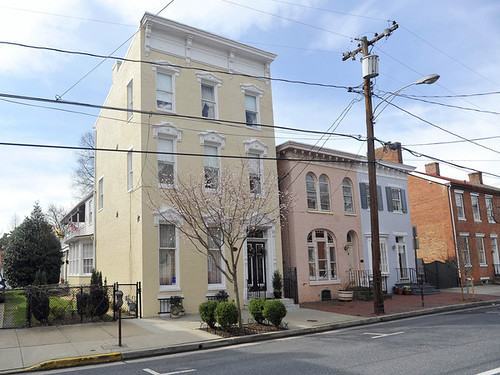
I don't see how this is an issue in historic districts, where for the most part, houses can't be built up, at least on the front, although this could be an issue with additions. And across the city, if new zoning rules ("DC proposes limits on pop-ups," Washington Post) are put into place concerning what are called "pop ups," that will address the issue anyway, without the need for special legislation.

Rowhouses in Frederick, MarylandWould this taller rowhouse in Frederick, Maryland make it hard for the abutting property to generate electricity from a solar energy array?

But, speaking as an objective analyst, with regard to CM Grosso's legislation one could similarly make the case that a household desiring unfettered access for solar should pay abutting households for the loss of their ability to build up.

There are takings issues here, although maybe a conflict of public policies and the promotion of solar energy could obviate a requirement to pay for the loss of the ability to expand a house.

2. Just last night I happened to have a conversation with an ANC6B commissioner, who asked me about a "solar issue" involving "historic preservation" that came up in the Capitol Hill Historic District, where she characterized the issue as "historic preservation being against solar."

While I might have too short term of a perspective on the utility of solar energy--it's not all that cost effective, without significant subsidies--she made good points about higher income households typifying the demographics of historic districts like Capitol Hill Historic District being "first movers" who foster the development and implementation of new and important technologies, and that historic preservation shouldn't be seen as a laggard in terms of environmental improvement.

But I said to her, my understanding is that the "problems" involving the aesthetic impact of solar panels are not in rowhouse districts, because placement of solar panels on the roof doesn't have much in the way of visual impact.

She said the house was either a corner house or an angled property, meaning that it is visible from two elevations, and while the front facing elevation had no visual impact, the side elevation did. And she averred that regardless of the visibility of the side elevation, are solar panels any different than mechanicals (like HVAC) installed on roofs elsewhere in historic districts, and occasionally visible (she used the redeveloped Friendship House as an example).

Even so, I don't see how a solar array would be visible from the side elevation if placed on a flat roof.

Anyway, it turns out that the house in question has a conservation easement placed with the L'Enfant Trust and it was the Trust, not the local DC historic preservation regulatory structure, which rejected the application. Conservation easement holders typically apply a stricter interpretation of the impact of changes than is typical of the normal regulatory process.

I cautioned her to be very clear about the process and who made what decision and to not "denigrate" the normal "local" historic preservation community/regulatory function for this decision.

3.  Over the weekend Washington Post national real estate columnist Kenneth Harney wrote ("Why leased solar panels may not be an asset when a house is sold") about difficulties selling houses encumbered with long term leases (up to 20 years) of solar power generation equipment ("SolarCity Joins Rivals in Lending Solar Panels to Clients," New York Times), and how many sellers end up buying out the lease in order for the sale to go through.

4.  The federal tax credit for solar installations is dropping from 30% to 10% as of December 2016 ("SolarCity, a Vocal Critic of the Utility Industry, Joins It," New York Times).  One of my "problems" with solar energy at the household scale is that I don't see how it makes financial sense without the various local and federal tax credits.

There are some firms and advocacy groups in the city which promote bulk purchases of solar equipment--which I think is a very good idea, as people getting solar energy systems can save 20% to 30% of the cost, which makes a big difference in the return on investment.

But without incentives, according to the table provided by DC SUN (DC Solar United Neighborhoods), an advocacy group, it can take 20 years or more for a household energy system to hit break even.  And that presumes no additional costs for maintenance, replacement of failed equipment, etc.  I suppose it makes a big difference if you have air conditioning (we don't).

5.  Who pays for the cost of maintaining the electricity infrastructure?  Lately, with some help from the American Legislative Exchange Council, an organization which actively lobbies state legislatures to pass pro-business/anti-consumer legislation ("ALEC calls for penalties on 'freerider' homeowners," Guardian), the utility industry has been making the point that households moving "off the grid" because of the implementation of solar energy or other alternative energy sources should have to pay a monthly fee towards the maintenance of the electrical power energy distribution infrastructure, which they still have access to on a back up basis.

I actually agree that this is a reasonable point, that the maintenance and improvement of the electricity distribution infrastructure is a public good which should be paid for by all users.

Similarly, I don't think that electric cars should not have to pay the equivalent of gasoline excise taxes, which pay towards the maintenance of the road system, which all cars use, regardless of their power source.

6.  Adding electric car charging infrastructure as an amenity for renters is becoming more widespread, according to National Multi-Housing News ("The Hottest New Amenity for Multifamily Communities: Car-Charging Stations").

While useful for attracting tenants, many companies see it is an additional revenue source.  Given that the cost for recharging is $2.50 to $4 according to Plug In America, charging $5 to $12 per charge as mentioned in the article, is a pretty good profit margin.

7.  And in the Reprogramming the City exhibit that I just saw in Richmond, one of the case studies is an example of how Telecom Austria is repurposing public phone booths in Vienna, as a way to provide electric car charging equipment (and to develop a new line of business).

According to the company, "it takes about 6.5 hours to recharge an electric car, 80 minutes to juice a scooter and only 20 minutes to charge an electric bicycle."

Image from the exhibition.

Labels: , , , , , ,

Monday, October 15, 2012

A negative unintended consequence of district energy systems

There has been a lot of talk in DC about the creation of dispersed district energy production systems, where sub-districts of the city have their own electric generation plant, using natural gas as the feedstock.  This provides a variety of environmental benefits, reduces energy loss via transmission, etc.

Among other places, district energy plants will be implemented at The Wharf development in Southwest, independently of what might happen in the Southwest DC "Ecodistrict," which has a generating plant owned by the Federal Government (and to service non-federal buildings, laws will have to be changed), in the redevelopment of the Walter Reed Medical Campus in Upper Northwest DC, which already has a power plant, and in the creation of buildings above I-395, between Massachusetts Avenue NW and E Street NE, in the development called Capitol Crossing.

One of the advantages of the electrical infrastructure system is that the costs of adding and maintaining the infrastructure are spread out amongst all of the utility company's customers.  And typically, commercial customers--those most likely to be motivated and have the means to create their own power generation systems are more profitable to service than residential customers.

But the greater the number of commercial customers extracted from the grid, the smaller the number of customers over which infrastructure costs are amortized, increasing the cost of maintaining the infrastructure on the remaining base of customers.

Not to mention that the loss of commercial customers will lead to rate increases for the remaining customer base, in order to maintain profitability for the local utility.

Labels: , , ,

Saturday, June 02, 2012

Solar panels and historic districts: not a simple decision

Left photo:  simple bungalows on the 800 block of Van Buren Street NW.  These houses are not in a historic district.

Middle photo: simple bungalow on the 800 block of Van Buren Street NW with the addition of solar panels on the front roof.

Earlier this week GGW reported in "Preservation staff reject solar panels on Cleveland Park home," that DC's historic preservation office rejected a project to install solar panels on the roof of the building, out of a belief that it would significantly impact the architectural style of the house, vis-a-vis its inclusion in the Cleveland Park Historic District.

The article cites a piece by Matt Yglesias, who makes an interesting (but obvious) point:

The preservation process narrowly excludes every single factor except for historic "compatibility." In most public decisions, officials weigh a variety of factors against one another. Here, the board must ignore the value of environmental sustainability, the economic impact, and even the owner's hardship or religious freedom. 

He thinks this is a bad thing.  I don't.

The reason I disagree with Yglesias is obvious.  Historic compatibility is the whole point of having historic preservation zoning to begin with.  Why else would you go through the trouble to document the cultural and architectural history of a neighborhood if your aim wasn't to preserve the neighborhood?

Part of this comes down to the "greater good."  Most religious objections to historic preservation regulations are spurious.  Most individual hardship arguments are personal, immaterial to the house so much as the owner's financial condition.

While I think there should be revolving funds and other support programs to assist people who can't otherwise afford maintaining a house to historic preservation standards, in my experience, most individual hardship arguments are spurious as well.

The same goes for "economic impact."

The reason that historic preservation guidelines work the way they do is to preserve the great economic value present in the historic district as a whole, a point that Yglesias seems to miss.  The reality is that in most communities with historic district regulations, the historic districts have significantly higher values than comparable undesignated areas.  In fact, historic preservation tends to be the most reliable urban revitalization tool, especially for neighborhoods.

Plus, most of the time, changes in buildings made as a result of "personal freedom" are not made with no impact on others.  Changes that reduce the architectural integrity and other place qualities and values of individual properties can reduce the value of neighboring properties significantly, such as how living next to an empty, foreclosed house has been found to have a negative effect on property value of abutting houses averaging $150,000 per property.  (Research I've seen on the impact of architecturally inappropriate changes shows a property value reduction of around $60,000 for abutting and nearby properties.)


By repositioning the value and identity of neighborhoods around historic preservation, neighborhoods are stabilized and become more competitive in terms of metropolitan residential landscape.

This has been an essential element of the "back to the city" population movement and can't be ignored by cities focused on maintaining the place and economic value of their communities.

The current policy with regard to solar panels, which I think is reasonable, considers addition of solar panels on the front, visible portion of the house to be out of character, and therefore requests for such changes are routinely denied.

Certainly, the images above, showing the same types of houses on the 800 block of Van Buren Street NW, one with solar panels, the others without, demonstrates that there is no question that the building with solar panels looks significantly different.

That being said, dealing with how residential energy generation impacts historic buildings needs to be constantly monitored and considered (even though generally, historically designated houses tend to be far more "sustainable" than non-designated houses), especially if you want historic neighborhoods to remain in demand and (somewhat) flexible as homeowner preferences change.  This was a point made a couple years ago in a Scientific American blog post, "Are old houses doomed? The conflict between historic preservation and energy efficiency."

Given the reality that "traditional solar energy" is still significantly subsidized (and frankly, probably geo-thermal systems make more sense economically, especially for single family detached homes with decent sized yards), it makes sense to not be overly hasty in taking up and approving new types of treatments impacting historic districts, without necessarily waiting for better alternatives.  

The more commonly available technology, the "traditional" solar panel may not be the best choice.  Clearly there are many newer alternatives that appear to be more historically-appropriate than products that are more typically available.  Our focus should be on supporting the historically-appropriate options and not supporting the inappropriate options.

Below left: solar tiles; below right: solar shingles.


Given how this Angie's List article, "Go green, save green with a solar metal roof," describes the installation of a metal roof with solar laminate panels in Louisville, Kentucky (image by Maggie Harmon), clearly the technological developments underway with solar electrical generation are significant and multiple and deserve careful consideration, with a focus on yielding historically-appropriate outcomes that ideally also work for homeowners interested in deploying solar energy applications.

 And I'd like to see Hardie board that works as solar panels (it would be great for west facing side of our house, which gets terrific sun in the afternoons, including in winter).

Another tricky issue by the way is the addition of house-appropriate wind turbines.  This was an issue in Baltimore County when I worked for the Office of Planning there in FY10.  And it is coming up more frequently in New York City.  Washington is a windier city than people realize, and small wind turbines could be worth considering.  They'd be easy to pop on top of office buildings, but maybe more out of place in residential neighborhoods.


Image: Skystream 3.7 residential wind turbine, Atlanta, Georgia, deployed in a neighborhood that is eligible for historic designation.  CityData photo.

Preservation NJ has a good blog post about these issues,"Solar panels & other renewables in historic districts."  

And I think it makes sense for the Historic Preservation Office to have a standing committee, including citizens, to advise the office on sustainability related matters, at the same time recognizing that haste makes waste.

Labels: , , , , , , ,