Rebuilding Place in the Urban Space

"A community’s physical form, rather than its land uses, is its most intrinsic and enduring characteristic." [Katz, EPA] This blog focuses on place and placemaking and all that makes it work--historic preservation, urban design, transportation, asset-based community development, arts & cultural development, commercial district revitalization, tourism & destination development, and quality of life advocacy--along with doses of civic engagement and good governance watchdogging.

Friday, July 19, 2019

Cities and children: the future of cities is not childlessness but it will involve intra-city sorting and demand for better urban planning

The Atlantic has a piece, "The Future of the City is Childless," opining about the decline of households with children "in the city."

He is mostly writing about Manhattan, but includes data from other cities, which finds that yes, households with children are on the decline. And it finds that DC is one of those cities.

The most likely reason, as stated in the article, is the high cost of housing.  And this will make having and keeping children and families in the city a somewhat exclusive phenomenon based on income.

But I think the article misses a big point, about sorting.  Anti-city writer Joel Kotkin's take on cities and children has similar faults ("The Childless City: It's hip, it's entertaining—but where are the families?," City Journal).

The future of the city isn't childless at all.  But where a preponderance of families live will be a function of housing cost, space, and amenities.  And access to affordable child care.

Cities like DC extending "public school" to Pre-K -- the ages of three to five, before they start kindergarten -- significantly eases the financial burden of child care ("The Effects of Universal Preschool in Washington, D.C.," Center for American Progress).

Families aren't likely to locate in the densest, highest cost, smallest space precincts. But cities may be more likely to offer universal preschool than suburban communities.

First, as housing prices rise, lower income households are being displaced, and demographically speaking, these families tend to have more children.  As they leave cities, there is a net loss of families.

Outmigration to lower cost housing in the suburbs extends to starter households with children too, even if two income and on a likely trajectory into the upper middle class.  Starting out, they can't afford to buy housing in high cost urban centers.

Second, sorting is multidimensional.  While the author is writing about his experience in the heart of Manhattan, it may also be that higher income family households are moving out of the core of center cities, which tend to offer less in the way of amenities that support families, but still remaining in the city, but shifting and relocating to other parts of the city that are more amenable, not necessarily "the suburbs" which is what the article suggests is happening.

There are plenty of kids and families in Brooklyn, The Bronx, and Queens, if not in the core of Manhattan.

That's the nature of my own experience in DC, where it happens I too moved out of the core and to the outer city, which comparatively speaking is more suburban.  (Although you are seeing plenty of young kids in Capitol Hill and other neighborhoods in the city's core.)

Excepting us, every house that turned over on my face block has been bought by families. Most of those households had more kids after moving in. But that's only 1/3 of the houses (7 of 24 houses turned over; so 5 of the other 6 households added children once they moved in). If there were more housing turnover, there'd be more family accommodation.  I've noticed that most of the houses in the greater neighborhood that do turnover tend to have children.

But yes, this isn't a phenomenon supportive of "starter" families.  Or lower income households.

And yes, we must acknowledge that plenty of higher income family households move out of the city too.  Not every city has housing districts that are amenity-rich and lower priced.  E.g., housing prices in my neighborhood have doubled over 11 years.

This is old data, but the trade magazine Progressive Grocer used to run a monthly feature using Nielsen data, showing consumption in various food and beverage categories by household type and location. Cities are defined as "cosmopolitan centers" and as a rule have fewer households with children, as the data shows below.
Neilsen data on households
But it's interesting that while it shows that cities have fewer households with children compared to other place types, and are overrepresented in certain categories of households without children, which is what we'd expect, cities do have households with children, and surprisingly, the largest number of "older bustling families." 

Likely the families that do stay are higher income, and may add children over time as circumstances and income changes, even if they are selective about it, and have fewer children compared to decades past.

(On my block one household has 3 children, three households have 2 children, and two households have one child.)

A big problem is planning for cities often ignores the needs of children

Regardless, cities tend to under-plan for accommodating children, even as hundreds of millions of dollars are spent on public education.  Besides the quality of schools issue, and in DC, the rise of charter schools has provided households with choice a reason to not move to the suburbs, another element that shapes whether or not families decide to live in the city is the existence of some open spaces, parks, tot lots, etc.

Definitely if you ignore planning for accommodating children and families, you'll have fewer families.

When I started out in the Main Street world, I remember being very impressed by a presentation about a program which repositioned.  They had offered a lot of family-related events, but shifted away from that.  I thought that was an interesting and tough choice.

Now--16 years later--I think it was short-sighted.  Kids don't always need a lot in terms of space. And maybe you don't need a lot of family events, because they don't pay off in long term benefits versus the cost.

But sometimes, all kids need are places to run around and little playgrounds (and note kids of different ages have different needs when it comes to play), splash parks, and the like.

(But note, I think there should be designated times for adults to have access to splash fountains too.)

Even Downtowns like DC could have some tot lots and play equipment and a splash fountain or two.  (But the city doesn't plan adequately for recreation downtown for any demographic category, let alone kids.  There's no public urban recreation center in Downtown DC.)

Wulaba Park, Sydney.  Photo: Paul Patterson. "Venture to Green Square, turn left into Amelia Street and, hidden behind several tall apartment developments, you’ll find a rainbow wonderland: slides, towers, tunnels, nets and swings, with one mega slide for adventurous youngsters."

From a planning standpoint, I refer to this as planning systematically for different demographic and household types.

It's the approach I recommend for sustainable mobility too.  E.g., one off initiatives for African-Americans, or kids, or women get lots of media and other attention.  But it's better and more equitable to address all demographics and household types in a systematic way.

More commercial districts should aim to include these kinds of kid-related park amenities, especially little playgrounds, to be "kid- and family accommodating" at the very least, even if it doesn't rise to the level of "kid and family friendly."

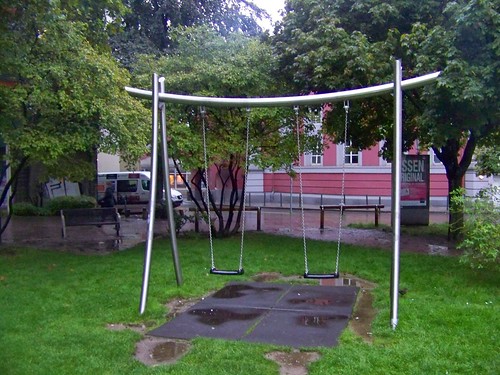
I noticed that was done in Downtown Essen in their pedestrianized district, which didn't have any mixed use housing.  It was all retail or civic space.  But here and there the civic space included little play spaces.  And constructed of the best quality materials, often stainless steel.

And splash fountains probably aren't enough.  Kids and therefore families need a variety of things to keep them occupied.  And at least some restaurants need to be kid friendly, etc.

Splash fountain in Columbia Heights DC
Splash fountain in Columbia Heights, DC

Small swing set in Downtown Essen
Swing set in the Essen pedestrianized Downtown, note the use of long lasting stainless steel

But there are various planning initiatives focused on making cities amenable to families, such as the 8-80 Cities program. And other resources:

-- Child in the City
-- Basic urban planning for children, Unicef
-- "Designing Better Urban Spaces for Kids," CityLab
-- A child-friendly approach to urban planning, 100 Resilient Cities
-- "Cities alive: Designing for urban childhoods," ARUP
-- "Cities Without Children," The American Conservative
-- "Why do young parents move away? Our cities aren’t designed for kids," Curbed

Montgomery County Maryland also has an initiative to better provide park and recreation spaces in the county's urban centers.

-- Energized Public Spaces Functional Master Plan

I've not written about it, but in the Petworth neighborhood, Sherman Circle, an NPS controlled space, across from E.L. Haynes Charter School, is increasingly used as a community park and play space by families, although it has nothing more than green space, trees and some benches.

Similarly, a "guerrilla play space" was created on a portion of the Eastern Market Metrorail Station "park" -- one of the four land pieces is where the station entrance is, while the other largest space is catty-corner across Pennsylvania Avenue between 8th and 9th Streets.

It set the stage for replacing it with a more formal playground, although not without controversy ("DC to clear out kids "Plastic Park" near Eastern Market Metro," Hill Now).

More of the city's schools are making playgrounds more accessible outside of school hours.  This is true for both traditional public schools and charter schools.

With the help of Kaboom, the Capital City Public Charter School in my neighborhood put its playground in front of the school and it's open to all.

Etc.

There are all kinds of ways to do this, but it won't happen without focused and innovative planning.

Labels: , , , , , , ,

Saturday, April 14, 2018

When residents of a neighborhood fight a day care center (Toronto)

When I ran for City Council in Ann Arbor in 1987, I was called to speak at a neighborhood meeting organized to fight the approval of a day care center.  I couldn't bring myself to be against it, and it cost me votes although I would have lost anyway (I ran in a Republican ward, back when the election for local offices was in the Spring, disconnected from the state and national election cycle, which got students out to vote).

I sure didn't understand transportation demand management then, but the fact of the matter was that the proposed location was at the very outside edge of the neighborhood, proximate to a major street and so the traffic of dropping off and picking up children wouldn't have impacted them.

(These days I do argue that while embedding schools and such in neighborhoods is a good thing, at the same time they need to be placed in ways that facilitate traffic movement and that these kinds of facilities need to have transportation demand management plans to minimize negative traffic impacts.)

Columnist Edward Keenan of the Toronto Star writes about the Cabbagetown neighborhood's successful opposition to the approval of a day care, which didn't go through a relatively objective approval process, but through the City Council ("Consider the character of a neighbourhood that rejects a daycare")..

From the article:
I am trying to imagine the absolute misery of a life that would lead someone to say — publicly — about the sound of children playing in a backyard, that “the idea of tolerating this type of noise is frankly ludicrous, and completely incongruent with this, or any other, residential corner in this city.”

How scarred and dark the psyche of an adult human being would have to be for her to stand up in a room full of other people and suggest that strollers on a front porch present an unbearable “heritage concern” or a threat to the “character” of a neighbourhood. ...

Good neighbourhoods need day nurseries, and they need schools and healthcare facilities, and other amenities. For that matter, a strong city needs homeless shelters and needle exchanges and half-way houses. Many of those are things you might prefer to locate a few blocks away, rather than directly next door to your house. But all of them are things that need to go next to someone’s house. “I was here first and prefer not to have anything change on my street” is not an argument worthy enough to justify impoverishing your community and your city.

Given the range of possible new uses for a building—a Wal-Mart, a tire factory, an abattoir — most of us would find a new daycare welcome, even enriching. A sign of our neighbourhood’s health. ...

Indeed, it seems to me that if somehow the presence of children threatens the character of your neighbourhood, then the character of your neighbourhood sucks. And if you find yourself arguing for the preservation of that character over serving the needs of a living urban community of your neighbours, consider that you might benefit from spending some time reflecting on your own character instead.

=======
You get what you plan for
(Also see "Keeping Cities from Becoming “Child-Free Zones”: With kids on the decline in urban areas, cities can make themselves more attractive to young families by building more playgrounds," Governing Magazine.)

While I don't have children, I live in an area with children, and close to a bunch of schools, and we have watched the two girls next door grow up, and we interact with them and other kids as a result.

For a long time, the idea was that the city wasn't a place for kids, that you need a big yard which is only available in the suburbs (our neighbors as it happens do have big yards), city schools aren't very good (an issue to be sure but an overgeneralization at the same time), public safety as an issue, that commercial districts were only for adults, etc.

But it's not that simple. Or that hard. Making places amenable for families and children merely means taking the time to consider those needs, and accommodating them, like playgrounds. How hard is to have a pocket park playground in a commercial district, especially the larger ones? It's not hard at all.

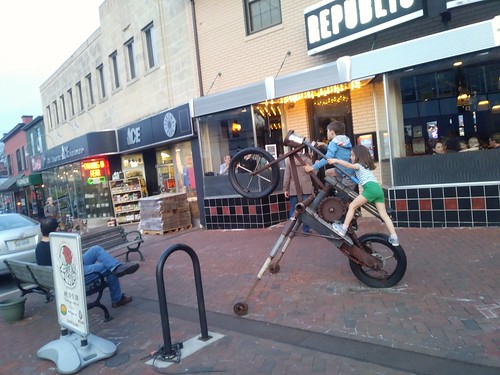
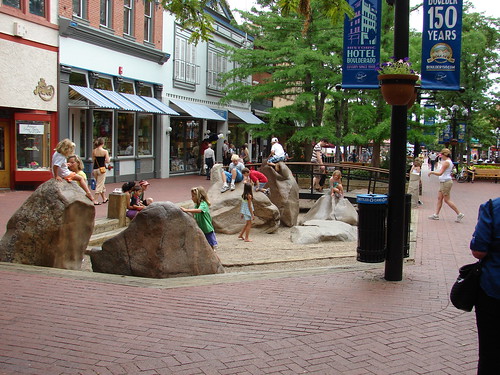
And kids repurpose stuff anyway. I've seen kids play on bike racks, while I use them for parking. Play on rocks put into the streetscape, etc.

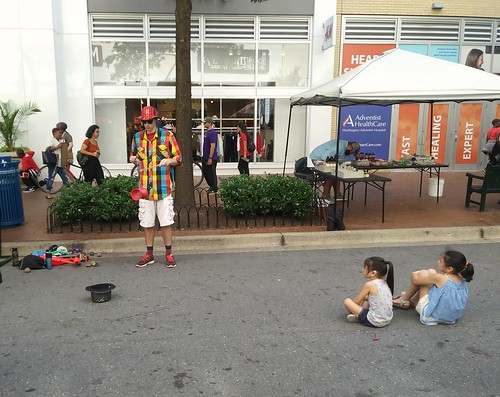
Children watching a street performer on Ellsworth Ave. in Silver Spring, Maryland

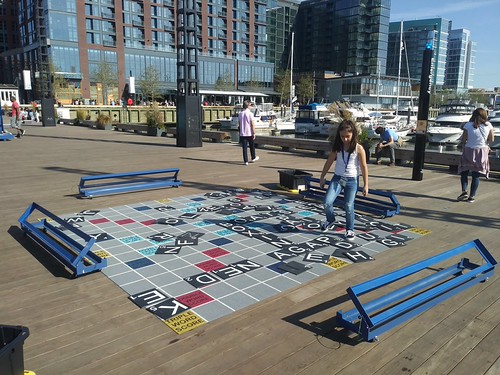
A public scrabble board set up on one of the piers at the Wharf District, Southwest DC

The charter school a couple blocks away put the playground in the front yard and it is open to the community
The charter school a couple blocks away put the playground in the front yard and it is open to the community.


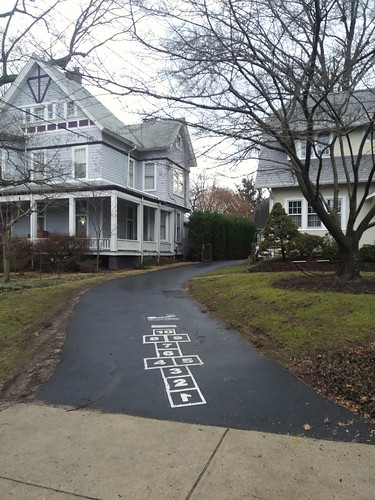
A hopscotch box painted on a driveway, Maple Street, Takoma Park. Maryland

Kids playing on a kinetic sculpture in Takoma Park, Maryland

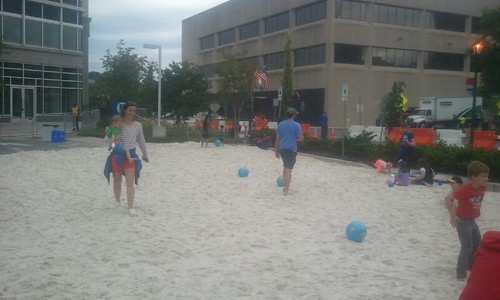
Temporary parking lot beach at Rockville Town Center

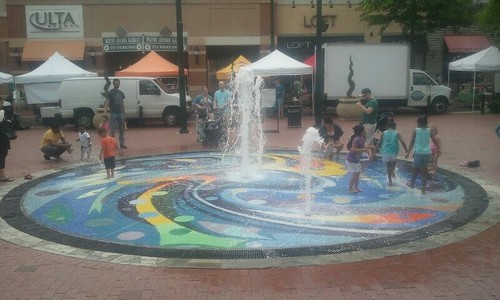
Splash Fountain, Downtown Silver Spring
Splash fountain, Silver Spring, Maryland

Pearl Street Mall - Rock Play Area

Swing set in the Essen pedestrianized Downtown, note the use of long lasting stainless steel
Swing set in the pedestrianized Downtown of Essen, Germany, note the use of long lasting stainless steel

Labels: , , , , , , ,

Friday, June 05, 2015

Keeping families in cities: safety; schools; space + money

In "What Happens When Millennials Age Out of Micro-Lofts?," Next City interviews the author of Downtown Families: Discovering How Cities Support Urban Family Living.

I aver the issue of "aging out" of the city as people age and the nature of their household changes is nothing new.

I first was exposed to it on a tour of the Warehouse District in Cleveland in 2002, on a field tour during the National Trust for Historic Preservation national conference. 

In your mid-30s, you don't go out drinking so much and noise at night tends to be more bothersome. So living in an apartment above a night-life oriented street becomes less appealing (also see "Daypart and age-group planning in mixed use (commercial) districts" from 2009).

Singles committed to living in the gritty city can deal with safety issues somewhat, and young marrieds don't have to worry about schools or having a yard and a bigger place (space) if they don't have any children.

Willingness to deal with grit and crime changes as household characteristics change.  Plus, as you get older, "tiredness" from dealing with municipal problems increases and if the situation doesn't appear likely to change, moving out of the city becomes more likely.

Whether or not you can retain families (and in a way this is a financially bad choice for cities as the income to the city from a household is far exceeded by the cost to the city of paying for public schooling) is also shaped by whether or not the city is a strong or a weak real estate market.

Generally, housing costs increase as you move from apartments to single family housing, and the price differential can be significant, let alone the issue of whether or not there is a decent inventory of available housing.

In a strong market, high prices make retaining families much more difficult unless household incomes are extremely high, because the cost of housing + children + day care is significant.

If there are general public safety issues, people will move out of the city regardless of housing availability.  If there are general problems with the quality of public schooling, people will move out the city.

Note this presumes that families with choice will still prefer semi/detached houses surrounded by decent sized yards.  It's only dense, hyper expensive places, like New York City or to some extent Vancouver, where the nature of the housing market steers families to apartment buildings.

Cost of housing.  The biggest issue in retaining family households in strong market cities like DC is the cost of housing. Rowhouses in the core cost $1 million or more.  At today's interest rates, that requires a mortgage+tax+insurance payment of close to $5,000/month  (think about how much the cost was when interest rates were 2.5 to 5 times greater than they are today).

Some neighborhoods well placed but undiscovered may have housing costs significantly less, say around $500,000, but as housing inventory shrinks, prices are rising in these neighborhoods too.

Schools.  In the outer city, at least in Ward 3, traditional public schools are quite successful.  But in those areas, housing costs are equally high as in the core, if not significantly more because houses are bigger.

In outer city areas where public schools lag most households have access to charter schools, which may or may not be much better than traditional schools, but people generally have higher satisfaction and confidence in those options.

Pre-school/day care: availability and cost. One advantage possessed by DC compared to other communities is publicly-funded Pre-K, starting at three years old. This means families can offload expensive daycare onto the public and charter school system.

Public safety.  If people experience a great deal of crime, if they have the choice, they will move out of the city as they build their family, because of their concerns.

Multiunit family living.  In 2006, The Vancouver Courier community newspaper ran a story, "In the City," about families with children living in the downtown, often in high-rise buildings (as opposed to garden style apartments).

It's an article worth reading because it shows that with the right mix of amenities--schools, parks, places to go and things to do--and high housing costs, people may be induced to shift their preferences and accept multiunit housing options.

One of the familes featured in the story has 6 children, and they live in a 1,300 s.f. townhouse. (The average DC rowhouse has far fewer than 8 inhabitants, and tends to be that size or larger.)

The Spino Family, from the US, chose to move to Vancouver to live as an urban family, after observing friends doing so in Sweden.  They searched across North America for similar conditions, and chose Vancouver.

From the article:
For 39-year-old Spino, an elementary teacher recently hired on the Vancouver School Board's teacher-on-call list, downtown is the ideal place to raise children. "I don't see the need for having rooms in houses that you don't use. I don't see why you have two spare bedrooms for visitors that you just use to store boxes. I don't think that's efficient. I don't think that's a responsible way to live," he says. "You don't need that space. You don't need skis in the garage or a snowmobile somewhere and stuff in the attic-all that consumerism collecting. I don't think we're occupying a lot of space here. This high-density living is good for the city. It's good for the environment. It's good for the children-it's a fantastic way to live." ... 
They own one car. Otherwise, the Spinos walk or ride bikes kept in a bike locker. They don't have to go far for entertainment. Granville Island, English Bay, Stanley Park, the aquarium, shops, and restaurants are nearby.
In Vancouver, it helps that the government planning process ensures that there are community amenities including parks (downtown is already close to the water), schools, and other services. Most other cities haven't figured this out.  Also see "Pack up the kids - we're movin' downtown! from the Toronto Globe and Mail and "Families say sacrifices to live in downtown Vancouver well worth it" from Global TV.

-- "Downtown living: for families? : the Vancouver, BC urban livability experience and lessons for other cities," MIT master's thesis, 2008

The pedestrianized center of Essen, Germany does not include residential housing, but there are a number of playground facilities--constructed of the highest quality materials--installed throughout the area. 

For example, DC's downtown park and plaza spaces lack any playground accommodations and there aren't many public schools located within the central business district or the neighborhoods on its outskirts.

If you get schools, safety and space right, the real issue is housing cost.  However, with escalating housing costs in Downtown Vancouver, family living has become less prevalent, abetted also by the lack of production of family-sized units, and the cost to the city to provide additional schools, and leasing costs price out day care facilities.

Policy changes.  Figuring out an appropriate set of policies to encourage the production of larger units as well as how to lower construction costs is an important issue.

But so is deciding how many families a city can afford, compared to the cost of servicing them.  Even a city like DC, which collects 100% of the local (state) income tax on households, "loses money" on a household when it pays to educate them.

Some practical advice comes from this All About Cities piece, "Urban families after the great reset."

Multiunit housing developers aren't developing buildings with internal amenities for families.  For example, while multiunit housing developers in strong markets are developing buildings with a wide range of amenities from rooftop pools and dog walking accommodations, outdoor barbecues and exhibition kitchens, outside of garden apartment complexes, I haven't come across articles ("5 Apartment Amenities to Incorporate in 2015," Multihousing News) highlighting center city apartment buildings with out of the ordinary amenities for children and families.

Of course, another option is to pay towards the development of common amenities serving multiple buildings in a subdistrict of the city.

And maybe, still, mobility.  It's difficult to get around with young children between strollers, supplies, and basic wrangling.  Without amenities and services easily accessible, living in the core can be a problem for young families.   Between bikes, car share, and transit, and probably package delivery, people do it, but it isn't easy.

Labels: , , , , ,

Thursday, January 01, 2015

New Year's Post #1: More thoughts on creating a world class children's cultural facility in the city

=======
On occasion, I've written a series of posts on New Year's Day, covering various topics of interest, using the excuse of the New Year as a reason to call attention to particular issues and items.  I'll be doing that over the next few days this year as well.
=======

Doing visionary projects in local DC is tough, because generally, the city isn't particularly focused on best practice.  Plus, people don't seem to get out much, so they think whatever they do is not only "best practice" but "world class" when more likely it is average.  Plus there is the execution element.

Atlanta streetcar at an opening day ceremony in Woodruff Park on December 30th, 2014.  Atlanta Journal-Constitution photo by Hyosub Shin.

For example, at the time streetcars were first proposed for DC in 2003, modern streetcars, especially on the East Coast, were seen as new in the United States, but the process to bring them to service in DC has been fraught with problems and opposition, and Atlanta's streetcar started service yesterday ("Streetcar service will not begin in 2014," WTOP; "Atlanta's Streetcar makes first trip," WSB-TV), even though the process in DC started much earlier.

... it's ironic because I remember a conversation I had with an H Street business proprietor maybe 5 years ago about streetcars, and I said "why wouldn't you want to be in the commercial district that has the first modern streetcar service on the East Coast?"  Now that city is Atlanta.

But DC has done some good parks (Georgetown Waterfront, Yards, Canal Park), the proposed 11th Street Bridge Park ("Building a Park to Span a Divide in Washington," New York Times) is reasonably visionary, and the way that the redesign and renewal of the Martin Luther King Central Library is shaping up will be much better than originally proposed (probably because it seems as they have adopted most of my ideas for how they should have gone about it).

Recently, the Children's Museum trip to the suburbs has turned out to be less successful than they had hoped and they plan to return to the city ("National Children's Museum to close Jan. 4," Washington Post).

While the organization has had troubles figuring out its mission over the past decade, out of problems can come opportunity for rebirth, as was discussed in a November entry, "Back to the 'hood for the "National" Children's Museum."

I stand by the suggestions in that entry, which date to 2002. 

 But it's worth thinking, as we enter 2015, about the opportunity to build a national best class multi-faceted children-focused cultural facility.

In a piece from 2012, I suggested adopting a Phoenix children's theater show on US presidents for DC ("Rock the presidents (cultural planning and the national experience in DC)") and in a 2009 piece on Poplar Point ("Thinking really really really big for Poplar Point's park"), I suggested recasting the children's museum there along the lines of Charlotte's ImaginOn, a city library and theater facility, plus with a ferris wheel, as a signature cultural facilty east of the Anacostia River.

With regard to the 11th Street Bridge Park project, I wrote a bunch of entries suggesting that the city should engage in broader planning initiatives sparked by the park concept, with an aim of aiming bigger and achieving more:

-- "The Anacostia River and considering the bridges as a unit and as a premier element of public art and civic architecture"
-- "DC has a big "Garden Festival" opportunity in the Anacostia River"
-- "A world class water/environmental education center at Poplar Point as another opportunity for Anacostia River programming (+ move the Anacostia Community Museum next door)
-- "Saving the South Capitol Bridge as an exclusive pedestrian and and bicycle bridge

From the article "Children’s Participation in Planning and Design" from the book Spaces for Children:

Democratic responsibility can be acquired only through practice and involvement. It does not arise suddenly in adulthood through simple maturation; it must be fostered directly from an early age. I believe that the environments we occupy as children and the extent to which we feel involved in shaping them, or caring for them, is a particularly important domain for such learning.

One Bridge Park-related entry proposes a world-class environmental educational center focused on water, and mentioned moving the Anacostia Community Museum next door, with the intent of creating a museum complex alongside the Bridge Park, not unlike the Library Park initiatives in Medillin, Colombia, which I wish I would have known about ("Medellin, Colombia offers an unlikely model for urban renaissance," Toronto Star) when I first wrote the post back in August.

Now I'd suggest adding a Children's Museum-Library-Theater facility to that proposed grouping as part of the Bridge Park project, the redevelopment of Poplar Point, and cultural investment East of the River.

Other resources:

-- "2012 10 Best Children's Libraries," Livablity.com
-- "10 Magical Children’s Libraries In Honor of Our Library Theme of the Week!," Reading Rainbow
-- "Children's Libraries in New York City," NY Public Library (includes discussion of specialized children's libraries in non-NYPL facilities)
-- 12 Best Children's Museums In The U.S.," Forbes Magazine
-- "7 Best Children's Museums in Chicago," Chicago Parent blog
-- "Designing Space for Children and Teens in Libraries and Public Places," article
-- Re-envisioning New York City's branch libraries, Center for an Urban Future


From "Designing Libraries for Customers," Library Administration and Management.

Labels: , , , , ,

Tuesday, November 18, 2014

Back to the 'hood for the "National" Children's Museum

The former Capital Children's Museum was on H Street NE for decades and so it was a leading cultural asset back when we created the H Street Main Street program back in 2001/2002.

By then it was a pretty tired facility that needed a jump start.  And the consultants working on the H Street revitalization plan, released in 2003, felt that the museum did need to move, although they didn't recommend it in the plan because it wasn't politically palatable.

But they thought it would work better as part of a nascent museum complex including the Smithsonian National Postal Museum, on the west side of Union Station, in the old Main Post Office building, across from Union Station.  (Since then the Postal Museum has expanded, kicking out a restaurant, although it is still one of the least visited of the Smithsonian Museums.)

Shortly afterwards, the Children's Museum decided to sell their H St. property, which is now a condominium and apartment complex, for space in a redeveloped L'Enfant Plaza.

But soon after that, not being too successful in fundraising for a new space, with a great offer--likely free rent--from a developer wanting "activation", they agreed to move to the National Harbor development in Prince George's County, a location disconnected from transit.

The move pretty much made them a non-factor in the area's cultural offer generally, and for children specifically.  And they haven't been all that successful in their new location ("Children's museum plans stall; new space a 'downgrade,' official says" from the Gazette) although they did open a small space eventually, one that when reviewed, didn't receive favorable reactions when it finally opened in 2012 ("New National Children's Museum underwhelms the under-8," Post).

Hence the decision to move back to DC, reported today in the Washington Post ("National Children's Museum leaving Prince George's to return to DC").

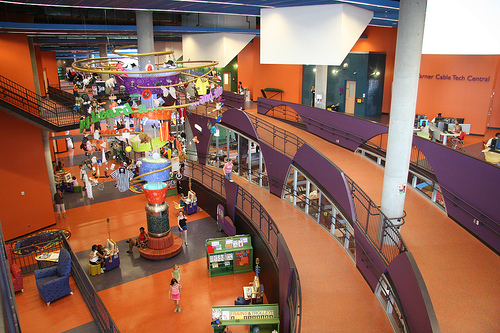
Ideas for a great Children's Museum, circa 2002.  In late 2002, during the planning process for H Street improvement, I wrote a short memo including ideas for how to improve significantly the Children's Museum and leverage it as a destination for the H Street commercial district.

Museums that focus on children visiting via class trips don't make much money.  Partly it recognizes the biggest problems with museums and educational centers targeting kids--they don't make much money.  See for example ("Please Touch Museum may be forced to sell assets, exhibits" and "Sluggish economy, stifling debt imperil city’s cultural future," Philadelphia Business Journal; and "Good grief! Just look at Port Discovery - Baltimore Sun," Baltimore Sun).

Most of the attendees come via class trips. And they bring their lunch. SO most of the visits during the week don't generate much in the way of additional revenue or support for retailers on or off site.

ImaginOn, Charlotte, NC.

Note that I expanded these ideas after the Children's Museum left the city, in suggesting new children's museum in Poplar Point ("Thinking Really Really Really Big for Poplar Point") which frankly would work well with some of the other recommendations I've made concerning civic facilities in the context of the 11th Street Bridge Park and Poplar Point ("A world class water/environmental education center at Poplar Point as another opportunity for Anacostia River programming (+ move the Anacostia Community Museum next door)").

But the differences are slight, a ferris wheel and a specific mention of the ImaginOn, which is a combined library-children's theatre facility in Charlotte, NC and the children-serving elements of the then new Connecticut Science Center "Future shock made science play," Boston Globe).

Note that I am not holding my breath that any of these ideas are on the table for a revitalized children's museum in DC.

-------- From 2002 --------

-- A revitalized Children's Museum with attractions such as an IMAX theater and a Children's live theater, a carousel, a children's library--a museum really focused on "building creativity in children" would offer the opportunity to draw retail serving children to the immediate vicinity.

The kinds of stores I am thinking about would be a quality toy store, a store that serves teachers, a children's book store, a "Crayola" store (one was opened in Arundel Mills I believe), a "Lego" store, a gallery focused on children's art or perhaps Dr. Seuss.

[At the time there was a traveling Dr. Seuss art exhibit, which I had recently seen in Cleveland  Since then there has been the creation of the musical, Seussical, and I also wrote about a play about the US Presidents, "Rock the presidents (cultural planning and the national experience in DC)" in Arizona that would be a logical offering for DC.]

-- Doubling the attendance of the Children's Museum by revitalizing the programs they offer would bring great numbers of families into the neighborhood on weekends, presumably with a fair amount of disposable income.

The stores would also serve as destinations, whether or not people are visiting the Museum. I understand the Museum wants to leave the neighborhood, but I think it's important to maximize the benefit of its presence while it is here. We should also work to convince them that this neighborhood remains the best location for their facility.

Rock the Presidents children's play promotion, Tempe Center for the Arts.

Attachments mentioned stores like Build-a-Bear Workshop ("Build-A-Bear to open 50th store," St. Louis Business Journal) and a children's hair salon ("Hair salon aimed at kids opens," Denver Business Journal--although there is a newer concept, Snip-Its, as well [story]) as additional complementary retail and service options.

Labels: , , , ,

Friday, August 22, 2014

Commerce as the engine of urbanism and parks

A couple weeks ago the Wall Street Journal had a good article on parks, "Cities' Message to Young Families: Play and Stay--New Features Include Parks, Playgrounds and Beer Gardens," and I was struck by the description of what we might call a blending of business and park, specifically food and beverage service, and that "beer gardens" are the most in-demand feature of new parks.

I guess it makes sense, given the historical connection to beer production, that Milwaukee County in Wisconsin has beer gardens in some of their parks, and a traveling beer garden park promotion program.

This reminds me of the comment by Professor Alex Wall, who wrote a book about Victor Gruen, one of the leaders in the development of shopping malls, which is:

"Commerce is the engine of urbanism."

The flip side is something that they teach in "Main Street Approach" commercial district revitalization training about "events" that there need to be four components:  something to buy; something to do; music; and something to eat.

In short, it's about "activation" but also enabling people to refresh themselves.  Sometimes that means eating.  Other times that means going to the restroom.  But when people can refresh themselves they can also stay longer.

Two entries back I mentioned the Mosaic District in Merrifield/Fairfax.

There is a big green, bracketed by a movie theater with an outside screen for open-air screenings, such as cartoons on Saturday mornings.

The "beer gardens" are on the perimeter, a bunch of restaurants with patios, although the movie theater also has outside food service, plus there is a coffee house building set up separately, supporting the green, and the coffeehouse brackets splash fountains for children and is set up like a beach, but without sand, with Adirondack chairs.

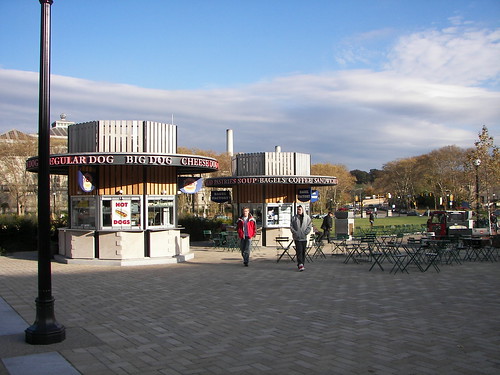
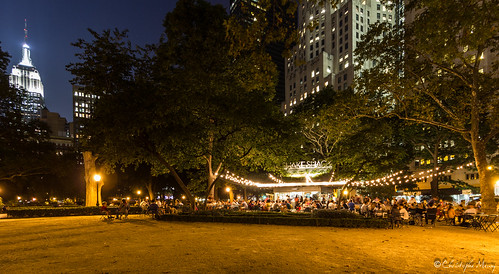
Food booths at Schenley Park, Pittsburgh's Oakland Cultural DistrictThis also reminds me of how food shacks, like Shake Shack in Madison Square Park, food service at Bryant Park, both in New York City, are essential activation elements in those parks.

And in Schenley Plaza in Pittsburgh (pictured at right, but in late fall) as well.

Traditionally, we have been unable to do this in many equivalent spaces in DC because they are run by the National Park Service and subject to various laws and regulations limiting "non-park activity."

Unfortunately, the Park Service has had a difficult time creating a differentiated set of policies for urban parks, which are also complicated by the fact that many park spaces are subject to specific Congressional mandates.

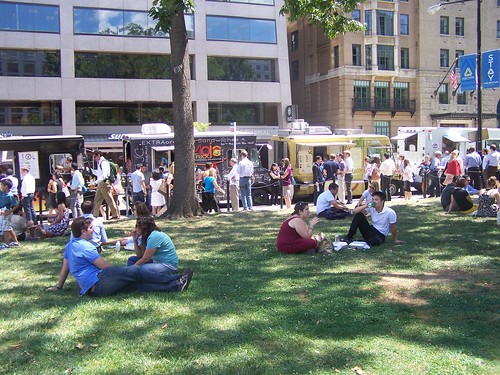
For some of these NPS parks downwotn, the rise of food trucks has filled the breach, and they converge on various downtown parks and set up shop during lunch time.

People lined up for Food Trucks, Farragut SquarePeople lined up for Food Trucks, Farragut Square

I noticed when we were in Salt Lake City that while Liberty Park doesn't have a food stand within, there looks to be a great cafe just across the street, the Park Cafe.

Being more liberal about commercial uses in spaces abutting parks is one way for cities to get around strictures they might have about for profit operations and food services within park spaces.

Salt Lake City's Pioneer Park is also home to the Saturday Downtown Farmers Market, which in my opinion has to be one of the top 15 farmers markets in the U.S., competitive maybe even better than Portland's and better than the Greenmarket in Union Square in NYC.
Shake Shack Madison Square by night

Shake Shack Madison Square by night by Christophe Meusy, on Flickr.

Labels: , , , , ,