Rebuilding Place in the Urban Space

"A community’s physical form, rather than its land uses, is its most intrinsic and enduring characteristic." [Katz, EPA] This blog focuses on place and placemaking and all that makes it work--historic preservation, urban design, transportation, asset-based community development, arts & cultural development, commercial district revitalization, tourism & destination development, and quality of life advocacy--along with doses of civic engagement and good governance watchdogging.

Tuesday, January 13, 2026

Trump's F****** with Culture and Civil Society Harms the Nation and Washington DC

Normally government moves pretty slow. The pace at which President Trump is destroying institutions and enriching his family, while spending much of his time playing golf, staying up late, and tweeting, is unprecedented. It's almost impossible to keep track.

Good thing he had the Heritage Foundation's Project 2025 blueprint to destroy progressive leaning government! ("The year Trump broke the federal government," Washington Post).

Including attacking nonprofit, progressive leaning organizations ("Trump's Secret War Against Vital Nonprofits," Alliance for Justice, "What is Trump doing to US nonprofits and philanthropies?," Devex. "Progressive Nonprofits Condemn Trump’s Targeting of George Soros and His Foundations," Chronicle of Philanthropy, "Senate GOP Ramps Up Attacks on Left-Wing Nonprofits," NonProfit Quarterly).

MAGA-fying civic education ("Trump Administration Announces New Civics Effort With MAGA-Aligned Groups," NYT) plus prayer in schools ("Trump wants prayer back in schools. Boston has a cautionary tale," Boston Globe).

And specific attacks on "blue" states although not limited to culture ("Trump is waging war on Democrat-led states," Globe).

Banner at the Kennedy Center calling it the "Nation's Cultural Center."  Photo by Bonnie Cash/UPI.

Because the arts and education are seen as dominated "by the left" the Trump Administration has been militant about defunding organizations that support or practice these disciplines.

The same goes for nonprofit organizations involved in human services, agriculture and other fields.


Work continues on the construction of the ballroom at the White House on 9 December in Washington DC, where the East Wing once stood. Photograph: Pablo Martínez Monsiváis/AP

Here's a line up of some of the destruction.

And building grandiose monuments to his ego

President Donald Trump addresses a dinner for donors who have contributed to build the new ballroom at the White House, Wednesday, Oct. 15, 2025, in Washington. | John McDonnell/AP Photo
Photo: Nathan Howard, Reuters.

Massive banners with Trump’s face are adorning some federal buildings in DC. 
Democrats are crying foul.  CNN photo.
Armored vehicles drive during the Army's 250th anniversary parade in Washington, D.C. 
Alex Wroblewski/AFP via Getty Images
  • And he wants his face on coins even though the law says living people can't be so honored.
The U.S. Mint released three prototype designs for a $1 coin featuring President Donald Trump 
to celebrate the country’s 250th anniversary this year. 

====

In DC, he also wants to take over the public golf courses ("Trump’s self-serving takeover of D.C. public golf is bad news for all," The Athletic/NYT).

Labels: , , , , ,

Wednesday, March 12, 2025

Southern California Museums “Free-For-All” day: March 16th

I think coordinated "Open Doors" events like this are a great way for the cultural community to market itself while providing access to people who might not otherwise visit.

-- Southern California Museums “Free-For-All” day, Sunday March 16th

The only thing is one day probably isn't enough, I'd do the full weekend.  The downside of such Open Doors events, like the one the Smithsonian Museums sponsors in September, is that they are super crowded and can be uncomfortable.

Although in the SoCal case, it turns out that some of the institutions aren't open on Sundays, only Saturdays, so it works out.

Cultural heritage tourism. When you travel, looking for such events can be pretty cool.  So many cities have them, such as New York City, Pittsburgh, and Toronto.

Labels: , , , ,

Thursday, January 13, 2022

Revisiting: a proposal for heritage streetcar service on the National Mall | adding service to the DC waterfront

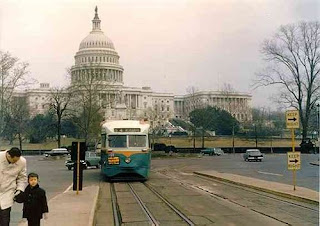
DC Transit 1101 on Pennsylvania Avenue, just west of Peace Monument Loop. This photo gives an excellent view of the third rail slot used to collect power in downtown Washington.

In 2013, as part of a more comprehensive approach to visitor services and visitor transportation in association with DC's place as a major tourist destination in the United States because it is the national capital, I suggested the creation of a heritage streetcar service on the National Mall, with a starting point at Union Station and an ending point at a proposed infill Yellow Line subway station across from the Jefferson Memorial, with service across the Potomac River to Arlington Cemetery and the Iwo Jima Memorial.  But I didn't really think too much about the routing.

-- "A National Mall-focused heritage (replica) streetcar service to serve visitors is a way bigger idea than a parking garage under the Mall"
-- Department of Interior - Visitor Access and Transportation Guide, Volpe Center, USDOT

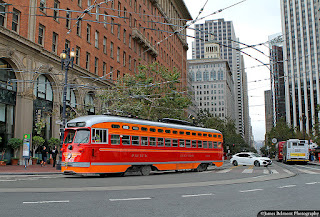
Dressed in Pacific Electric tribute livery, Market Street Railway PCC car 1061 leaves Market Street while entering Steuart Street near the Ferry Building on Sept. 6, 2019. Flickr photo by James Belmont.

Using heritage cars was suggested as a way to build tourist interest as well as being modeled after San Francisco's Market Street Railway F Line, which runs heritage streetcars of all types, with liveries representing various historic transit lines from across the country which are no longer in operation.

Last time I checked, because of its novelty, the F Street Line had a 200% farebox recovery.

Later, with the re-institution of DC Circulator bus service on the National Mall, I realized that in terms of the National Mall, we think about accessing it from the east, from Union Station and the Capitol, but not so much from the west, in particular Georgetown.  

National Park Service Map of the National Mall
Note it includes Arlington Cemetery and related destinations in Virginia.
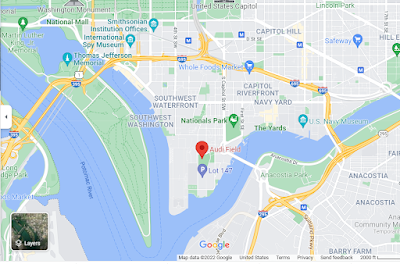
This Google map view shows the DC waterfront in SW and SE
more completely than the NPS map (which has a different purpose)

So I expanded the concept with the eastern node at Union Station and a western node in Georgetown, with an intermediate node at the proposed Jefferson Memorial Metrorail Station but again, I didn't get into routing.

-- "New DC Circulator route serving National Mall reminds us that we are neglecting connections from west to east and fail to adequately connect Georgetown to the National Mall," 2015
-- National Mall maps and planning documents, National Park Service

Note that the NPS map, surprisingly, shows the route of the DC Circulator service on the Mall (but not for Georgetown).

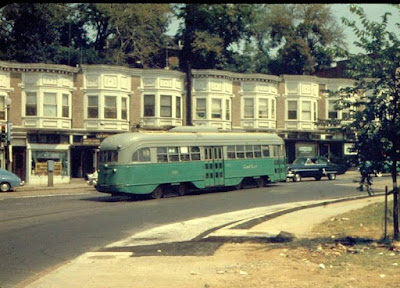
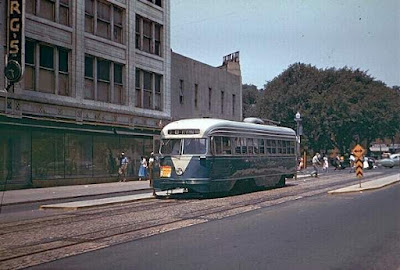
This streetcar crossed the Key Bridge from Rosslyn, and is eastbound on M Street NW

Visitor services and the idea of an under the National Mall parking garage.  Equal to the importance of the addition of transit was the creation of a set of high quality visitor centers, at Union Station, at the National Mall, at the proposed Jefferson Memorial Metrorail Station, and in Georgetown ("Today is World Tourism Day," 2016) as part of a broader  city tourism development and management plan ("National Tourism and Travel Week 2019: DC recap | DC needs a tourism development and management plan," 2019).

And later I realized that the National Park Service ought to create an anchor visitor center of its own covering all of its DMV parks and sites (see item 6, "National Public Lands Day," 2021).

A railway and tourism museum at Union Station.  Other writings suggest the creation of a railroad and tourism museum at Union Station, in conjunction with its expansion program (see the sections "More fully leveraging Union Station's potential as a portal and visitor center" and "Including a cultural interpretation element in the plan on railroad history and a museum-exhibiting program centered at Union Station" within "New State Rail Planning Initiative in DC," 2015).

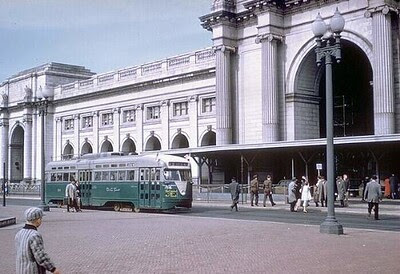
DC Transit 1516 on Route 42 at Union Station. February 22, 1957:  Joe Testagrose Collection

Of course, a heritage streetcar system along the lines of the Market Street Railway is a form of open air museum too, and could be operated in association with the National Capitol Trolley Museum in Montgomery County.

Separately, I've suggested developing tourist rail services from Union Station ("Two train/regional transit ideas: Part 2 | Running tourist trains from Union Station," 2021).

Underground parking on the National Mall.  And I am fine with the National Mall Coalition's proposal adding a big underground parking structure at the National Mall, including flood protections, to capture, interdict, and reduce visitor traffic, I just thought that it needed to be part of a bigger program ("Parking under the National Mall should be part of an integrated approach to visitor services and management," 2013).

In fact, given the increased severity of weather events in the face of climate change, implementation of this concept is even more imperative ("How and why the D.C. area was deluged by a month’s worth of rain in an hour Monday," 2019, Washington Post).

Transportation and the Wharf/Washington Channel/Southwest Waterfront.  Will just sent me another article ("Here's What Next at DC's Wharf and Fish Market," NBC4) about transportation issues around the Wharf district, which is a rebuilding of old urban renewal along Maine Avenue SW.  

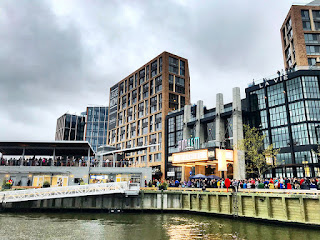
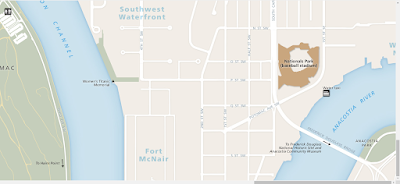
Washington Channel and the Wharf district

The first phase opened in 2017, and a second phase will open later this year.  The second phase will add 1,000 more parking spaces.

The area is near the L'Enfant Plaza and 4th Street SW Metrorail stations and a free bus shuttle travels to the Wharf from the National Mall/L'Enfant Plaza.

A long time ago, when DC had expansive plans for streetcar service, one of the planned lines was a Georgia Avenue/7th Street streetcar terminating at the Washington Channel's Wharf district on the Southwest waterfront--recreating the historic route that had its destination as the "Wharves," docks for steamboats and other ships.

But DC has pretty much given up much interest in streetcar expansion beyond H Street.

But as the NBC4 article discusses, there are many trips to the Wharf district, which will only increase as the second phase opens, and transit connections are somewhat inadequate, and there isn't enough "parking" either, were everyone to drive--and of course from a transportation demand management perspective, we want to discourage driving in the city as it promotes unnecessary congestion.

Adding a Southwest-Southeast Waterfront leg to the heritage streetcar visitor transportation proposal.  Some thoughts about routing:

  • The original concept starts at Union Station and travels down Louisiana Avenue to the National Mall.
  • On the Mall, it would travel westbound on Madison Drive NW (the side of the Mall with the National Gallery)
  • and on the return, eastbound on Jefferson Drive SW (the side of the National Mall with the Smithsonian Castle, Hirshorn, Air and Space Museum) and then crossing back to Louisiana Avenue and Union Station.
  • At 14th Street/the area of the Washington Monument, westbound it would probably follow the routing of the Circulator to Lincoln Memorial (shown on the NPS map as a red hatched line)
  • But I didn't figure out how it could travel from Lincoln Memorial to Georgetown and Arlington Cemetery 
  • It could cross into Arlington over the Memorial Bridge, serving Arlington Cemetery, traveling west to the Iwo Jima Memorial and then into Rosslyn, crossing back into DC, into Georgetown at the Key Bridge  
  • From Georgetown it needs to be routed back to Lincoln Memorial, with service to the Kennedy Center in Rock Creek Park
  • Continuing eastbound from Lincoln Memorial, it would go over to Jefferson Memorial and the proposed Jefferson Memorial Metrorail Station.
  • The Circulator does this by traveling through West Potomac Park, with intervening stops at the MLK and FDR Memorials, and from the Jefferson Memorial, back to the Mall providing intervening stops at the Bureau of Engraving and Printing and the Holocaust Museum
  • From Jefferson Memorial it would return to the National Mall, 
But with the "debacle of transit" for the Wharf, as well as Buzzards Point, where the soccer stadium is, and potentially even the Washington Nationals baseball stadium and the Navy Yard, wouldn't it make sense to have another streetcar line further south as part of this network, serving those destinations as well?

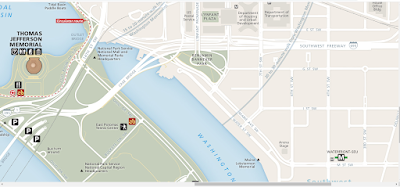
This section of the NPS National Mall map shows the Jefferson Memorial on the left.
The Wharf district lies on the north side of the Washington Channel.

This section shows Washington Nationals Baseball Stadium
but not Audi Field or Buzzards Point, which is undergoing development also.

The NPS map doesn't specifically delineate the Wharf district or Audi Field, the stadium for the DC United Soccer team, although it does show the Nationals Baseball Stadium.

I am not sure it makes sense to make a streetcar service there subsidiary to a National Mall service, but one that is separate and co-equal as part of a Mall-centric visitor transportation system, linking those attractions to local transit stations (just like how you could have a little streetcar spur between Foggy Bottom Metrorail Station to Kennedy Center to make the latter easier to get to).

The SF Giants stadium is served by both heritage and modern streetcars. SFMTA photo.

When the Nationals baseball stadium was first proposed, I suggested a straight line streetcar from Union Station to the Stadium, to provide a way to get people to the Orange/Blue/Silver and Red Lines and Union Station more directly ("Baseball World Series in DC #3: Five lessons for transit," 2019).  The problem though is traveling through the US Capitol Campus, and their security issues.

More thought needs to be directed to routing. 
 
Ideally, it would link L'Enfant Plaza, SW Waterfront, Navy Yard and Capitol South stations, in a circle that starts at Union Station and travels part of the National Mall as well.

Labels: , , , , , , , ,

Sunday, February 14, 2021

Proposed Obama Presidential Center in Chicago

Presidential libraries have been in the news of late over speculation on what former President Trump might do wrt a library ("Will There Be a Trump Presidential Library? Don’t Count On It.," Politico).

The proposed Obama Presidential Center will be located in Jackson Park in the Woodlawn Neighborhood of Chicago, and will displace existing park functions. Photo: Zbigniew Bzdak / Chicago Tribune.

The proposed Obama Presidential Center in Chicago won't be a traditional library because of various decisions made by the Obamas.  The records won't be going to the library but will remain in the custody of the National Archives and Administration, which plans to put the records online. 

(The memoir book by Robert Caro has a nice discussion of his looking at the LBJ archives box by box at the Presidential Library in Austin, Texas.  There is great value in physical records, going through them, making serendipitous connections, etc.)

The Chicago Tribune has an editorial ("Obama center in Jackson Park must deliver on 3 key pledges") about current negotiations and attestations about the Obama Center, which controversially will use park land.  

Economic impact.  One of the claims is that the Center will generate 700,000 visits per year and $3 billion in spillover economic development.  

I think that's a stretch because no presidential library has consistently generated that high of an attendance year after year.

An economic impact study of the Clinton Center in Little Rock, Arkansas shows the difficulty of pinning down impacts in a realistic way.  For example, how much of the $3.3 billion in development elsewhere in Downtown is attributable to the Clinton Center?  Some of it certainly is, but not all.  

Similarly, it states that there was at the time of the study, almost $700 million in travel expenditures.  But much of that money isn't spent locally, e.g., airplane travel, hotel stay revenues repatriated to out of town owners, etc.

Still, the economic impact, especially in otherwise weak submarkets, can be important, and as a priming action, trigger the opportunity for spillover investment.

A key aspect is structuring retail and other functions proximate by off site to spread development effect outward.

Stoking attendance at presidential libraries.  A few years ago the CT ran a great article ("10 ways to keep up attendance at a presidential library") with advice on how to maximize attendance at presidential libraries based on the experience of existing libraries. 

It's worth reading regardless of the type of cultural institution you might manage.  

However it's worth pointing out that attendance, techniques for boosting attendance, and average spending per visitor are different issues.  For example, many visitation segments (children, college students) don't spend much money when they visit cultural institutions.

I do think the Obama Center has a better chance for higher attendance because it will be located in a major city.  With the exception of the JFK Library in Boston and the LBJ Library in Austin, Texas, most presidential libraries aren't located in major cities that are already experiencing high visitorship.

The ten lessons from the CT article:

  1. Location matters.
  2. Make events, programs free.
  3. Get to know the neighborhood.
  4. Partner with local universities.
  5. Appeal to schools [note that one problem with focusing on school groups is that students typically don't spend money on stuff and bring their own lunch]

  6. Focus on more than the president [this is in keeping with the idea of planning presentation at cultural attractions in terms of their location within different scales of history at the local, national, and international scale]
  7. Recruit a range of speakers.
  8. Change exhibits often.
  9. Celebrate anniversaries.
  10. Use technology.

Labels: , , , , , ,

Thursday, May 07, 2020

Boston Athenaeum as a model for what central libraries should strive to be: Culture Centers with lots of books and other resources

Writings such as:

-- "Update: Neighborhood libraries as nodes in a neighborhood and city-wide network of cultural assets," 2019
-- "The DC Central Library, the Civic identity and the public realm," 2011
-- "The Salt Lake City Central Library is absolutely incredible," 2013
-- "Civic assets and mixed use: Central Library edition," 2013
-- "The Central Library planning process in DC as another example of gaming the capital improvements planning and budgeting process," 2013
-- "A follow up point about "local" library planning and "access to knowledge," 2013
-- "National Library Week," 2015

lay out the concept that libraries should be positioned not just as centers for knowledge but as centers for (community) culture.

One of the many best practice examples listed in "Neighborhood libraries as nodes" is the Boston Athenaeum:
a membership organization rather than a public library open to all, besides having an extensive book collection including rare books, there is an art collection with more than 100,000 items, a gallery space, and an extensive public program of lectures, readings, concerts and other events.
which just got a new administrator ("Veteran Harvard administrator will lead the Boston Athenaeum," Boston Globe).

Membership is pretty steep: $460/year, and a day pass is $40!

The Boston Athenaeum has had management and other issues as it continues as a membership organization in the context of a playing field where most libraries are public and broader cultural centers get both public and private support.

But it's still a good model for how central libraries can be more than just a place for books, but for culture more generally.

That being said, there are plenty of central libraries that already do just that, including Seattle, Portland, Salt Lake City, Dayton, Ohio, etc.

Labels: , , , , ,

Thursday, April 16, 2020

Arts and culture economically screwed by pandemic closures

Just like other "consumer facing" sectors, the arts and culture sector is being crushed by the closure of facilities.

Seattle.  Photo: Jason Raymond, Reuters.

There is tons of coverage (in the US and elsewhere) on the closing of museums and other cultural facilities, employee layoffs and pay cuts for those who remain, cancellation of events, exhibits, and seasons (like for symphonies), concerts, television and film production, cinemas, etc. ("Museums Across the US Are Furloughing and Laying Off Workers—But Hopeful They’ll Get Help From the Federal Government," Artnet; "At least 170,000 lose jobs as film industry grinds to a halt due to coronavirus," Guardian).

For profit cinema chains face bankruptcy.  Etc.

And coverage about how individual artists often cobble together a living from multiple gigs, all of which have disappeared ("She Had 3 Jobs to Support Her Music. Now All Are Gone," New York Times), and it doesn't place them well to get income support from various government programs that may offer help to businesses generally and large firms specifically.  Although some arts organizations are organizing grant initiatives both nationally ("National arts groups establish $10 million fund to provide $5,000 emergency relief grants to artists needing help during pandemic," Cleveland Plain Dealer) and locally.

Some stories I found particularly interesting include:

-- "Meow Wolf, the Art Collective That Became a Multimillion-Dollar Symbol of the Booming Experience Economy, Just Laid Off More Than Half Its Staff," Artnet. 

One of the "culture experiences" that the Meow Wolf Collective had planned to open was slated for DC.  It appears that plans for facilities in Las Vegas and Denver are still on the table.  Not DC or Phoenix.

-- "Arts were ‘the catalyst’ for economic renewal in the Berkshires. What now with a summer of closures and cancellations?," Boston Globe.

Western Massachusetts had a significant manufacturing-based economy at one time especially around textiles and industrial products.

By the end of the 1980s, most of those firms shut down, either to relocate elsewhere in the US or in other countries, or to close altogether. That area has been a textbook example of how to leverage the arts and culture as economic development in the post-industrial economy.  The documentary "Downside UP" discusses the program developed in Western Mass.

(I didn't know until a couple years ago, that Thomas Krens, who went on to expand the Guggenheim Museum across the globe, was one of the key visionaries there.)

#massmocaThe Massachusetts Museum of Contemporary Art is an adaptive reuse of the Sprague Electric complex.  (Frank Sprague developed the electric streetcar; but he eventually was forced to sell out to Edison.)

Now it's under threat. The article states that 70% of the income for MassMOCA in North Adams comes from ticket sales and related revenues. And like most museums outside of the majors, it has a minimal endowment.

But given the centrality of the culture-based economy, the economic privation will go far beyond the museums, to hotels, restaurants, and other service businesses. In turn, the reduction in sales tax revenues threatens local government budgets. Etc.

-- "After the crisis – a new model for the arts?," Arts Professional (UK).

The article suggests more marketing initiatives and "wringing out more value from assets" will be key. That's true.

But the likelihood of it being enough is remote (see the discussion about arts organizations and revenue here: "What would be a "Transformational Projects Action Plan" for DC's cultural ecosystem" and "A comprehensive list of funding sources for arts and culture"). In part this comes down to philosophies around the market/neoliberalism and public goods and how to fund them.

In any case, a handful of arts institutions are able to generate a fair amount of income from space rentals, real estate development, and other activities, but overall, it's pretty rare and the average arts organization tends to not possess that kind of skill set.

For example, MassMOCA has been incredibly successful, with annual attendance rising to about 300,000, which is far greater than the average cultural facility.  And yet, they face big problems.

But even so it hasn't been able to generate "excess revenues" to create an endowment.

Labels: , , , , ,

Monday, January 20, 2020

National Archives photo "retouching" is another example of the tension between National Ideology and Memory and Inquiry in the funding of national museums, archives

Banner at the National Archives.

The Washington Post reported that a photograph used to promote an exhibit on the 100th anniversary of Women's Suffrage at the National Archives has been "retouched" to eliminate specific references to President Trump and "offensive" words describing female anatomy ("National Archives exhibit blurs images critical of President Trump").

In the controversy after the article, the National Archives backed down and apologized ("National Archives apologizes and removes altered photo of 2017 Women's March: 'We made a mistake'," CNN).

Original photo by Mario Tama, Getty Images.

The Post's art critic, Philip Kennicott wrote a piece "The National Archives used to stand for independence. That mission has been compromised" about the issue, but to me it was more of a one-off piece, not recognizing that this is but one more incident in a line of incidents involving museums (and archives) although he did discuss a bunch of similar incidents involving Executive Branch agencies being ordered to obscure the truth.

And then there is the issue of the agencies de-emphasizing scientific research and findings in order to rollback environmental regulations ("E.P.A. to Limit Science Used to Write Public Health Rules<" New York Times).

Grashping the World: The Idea of the MuseumOver the years, I've written a bunch of pieces about how the federal museums, particularly the constituent units of the Smithsonian Institution, and institutions in Washington, like the no longer extant Corcoran Gallery, frequently have to heel to ideologically driven elected officials--usually in Congress but at times in the Executive Branch too, because that's where they get their funding.

I argue that the Smithsonian has a tough time being great because its mission as a repository of "national memory" and its role as a federal government entity often means that its overseers--members of Congress and parts of the Executive Branch--believe that its job is project American "greatness" rather than to be an institution that also questions and reinterprets the dominant narrative,

The Smithsonian is caught between this tension and as a result, its ability to be edgy or serious gets compromised.

-- "Dancing with the one that brung ya and challenging the dominant narrative," 2008
-- "You don't gotta have art," 2010

The Corcoran story is a little different, but their caving to the pressure of a Congressman to not show the photos of Robert Mapplethorpe ended up in the long run leading to that institution's demise.

The examples that have come up in the past:

-- Robert Mapplethorpe photographs at the Corcoran ("Corcoran, to Foil Dispute, Drops Mapplethorpe Show," New York Times, 1989)

- a somewhat critical exhibit label on the Enola Gay airplane at the National Museum of Air and Space which was opposed by WWII veterans groups (see "The Enola Gay Controversy" website from Lehigh University)

- criticism, ironically led by then Washington Post columnist Marc Fisher, of a culturally-specific narrative paradigm at the National Museum of the American Indian (see "A Museum of the Indian, Not for the Indian" The American Indian Quarterly; "The National Museum of the American Indian as cultural sovereignty," American Quarterly).

- Plus, you could argue that Marc Fisher's criticism that the National Museum of American History's "renovation" didn't do much in the way of change and challenge is also relevant to the discussion. See "German-American Heritage Museum promotes culture, doesn't tell whole story."

I am distinguishing a bit the general arguments over culture, commonly referred to as "The Culture Wars."

Like the Culture Wars, this is about (1) National Mythology/The Story of the Nation -- e.g., that the US always does the right thing, has superior moral authority, George Washington and the cherry tree which is a made up story -- (2) versus independent fact-based or framework-based interpretation (3) but also intertwined with reliance on federal funding.

When you allow ideology to trump knowledge, this is what happens.

Especially when a President gets much more involved in what agencies do, especially when it comes to challenging the conservative narrative.

The power of art to challenge the dominant narrative remains ("How a Museum Cancelling a Controversial Mapplethorpe Exhibition Changed My Life," Smithsonian Magazine).

But it's increasingly difficult for national institutions, at least in the US, to present this kind of challenge.

Also see:

-- "Parochialism and historiography," 2011
-- "Local history museums and critical analysis opportunities for communities," 2014
-- "A brief comment about Confederate monuments," 2017, which includes as a reprint
-- "Museums and Modern Historiography," 2014

2.  I have not tracked down and read either of these books, Capital Culture: J. Carter Brown, the National Gallery of Art, and the Reinvention of the Museum Experience and Who Owns America's Past?: The Smithsonian and the Problem of History, but I'd argue that both should be required reading for members of the local and national cultural community.

After such a reading, we'd be in a better place for making recommendations to Secretary Skorton about what he should be focusing on.

From the description of Who Owns America's Past?:
Never before has a book about the Smithsonian detailed the recent and dramatic shift from collection-driven shows, with artifacts meant to speak for themselves, to concept-driven exhibitions, in which objects aim to tell a story, displayed like illustrations in a book. Even more recently, the trend is to show artifacts along with props, sound effects, and interactive elements in order to create an immersive environment. Rather than looking at history, visitors are invited to experience it.

Who Owns America’s Past? examines the different ways that the Smithsonian’s exhibitions have been conceived and designed—whether to educate visitors, celebrate an important historical moment, or satisfy donor demands or partisan agendas. Post gives the reader a behind-the-scenes view of internal tempests as they brewed and how different personalities and experts passionately argued about the best way to present the story of America.

Labels: , , , , ,

Friday, October 11, 2019

Reopening of Anacostia Community Museum: Sunday October 13th

Why this is important is not so much a chance to meet the new director, but to see the fabulous "Right to the City" exhibit, which I think is a great model for showing how to present community history at the neighborhood scale.

The neighborhoods it covers are Adams-Morgan, Anacostia, Brookland, Chinatown, Shaw, and Southwest.

It takes 3-4 hours to go through the exhibit. It is rich and deep. One of the great scores is footage from ABC-TV featuring Dr. Martin Luther King, Jr. riding in a parade and his speech to the group, a Shaw neighborhood improvement initiative led by civil rights activist Walter Fauntroy, Jr., who later became DC's Congressional Delegate.

====
For me, having been in DC since 1987, I feel like civil society today here is pretty weak. The exhibit shows that in the 1960s and 1970s especially that was decidedly not the case.


Labels: , , , , ,

Friday, May 10, 2019

(US) National Travel and Tourism Week, DC's local museums and sites need a combo pass for visitors

According to Matthew Gilmore's Washington DC History Resources blog, DC has more than 70 museums and historic sites that aren't federal.

Market development issues.  DC's locally significant cultural sites have two big marketing disadvantages.

First, most visitors see DC only in terms of the national story, which means that when they visit they focus on the national museums and sites associated with the founding of the US or the general story of the country and reifying national memory and narrative, such as the Mount Vernon Plantation in Northern Virginia, which was the home of George Washington, the nation's first president.

That means that the local institutions need to be comprehensively, regularly, and creatively marketed and promoted and they aren't.  It doesn't help that we have dis-coordinated visitor marketing in the city and metropolitan area.

Second, in the DC area, most of the federally-related sites: museums; monuments; historic sites; and national parks; are free, putting all but the most prominent independently controlled sites at a disadvantage, because those sites charge admission.

Plus, the federal sites don't distribute non-federal visitor information.

It's tough for non-federal cultural facilities to survive in DC.  An example of this is the failure of the original City Museum ("Cultural resources planning in DC: In the land of the blind, the one-eyed man is king," 2007), the Corcoran Gallery (">Should community culture master plans include elements on higher education arts programs?, "), but also more recently the Newseum ("Johns Hopkins to acquire Newseum building in Washington, D.C.," JHU press release: "What the Fall of the Newseum Says About News, and Museums," CityLab).  

The National Museum of Crime and Punishment shut down ("Crime museum is closing at the end of September," Washington Post), the Children's Museum has taken 15+ years to reopen after leaving DC originally for Prince George's County, although now it is back in DC ("New National Children's Museum will finally open Nov. 1 after a delay," Post), and the International Spy Museum recently relocated and changed their corporate status to nonprofit ("Will Tourists Follow the International Spy Museum to L'Enfant Plaza?," Washington City Paper).

Although, pretty much except for the International Spy Museum, all of these programs experienced some form of institutional failure independent of charging admissions.  On the other hand, having to charge in the face of a sea of free options, this made them vulnerable to anything but superlative operation.

City Passes.  Other cities don't have the same conditions.  Mostly, all sites have an admissions fee.  Most have visitor centers.  And there isn't competition over narrative.

Many of these cities have various visitor pass products, like "CityPass," which is a combo ticket that covers entrance into a set number of attractions, usually over a multi-day period, and depending, is bundled with some form of mobility.

MUNI CABLE CARS--25 at Washington/Mason IBFor example, in San Francisco the passes include access to all MUNI transit services for no additional charge, even the cable cars, which normally cost $7 per ride.

DC does have passes.  One of DC's tour bus companies offers the Go Card Explorer Pass.

But since most tourists are primarily interested in the national museums and monuments, it likely isn't a big player in the tourism market, except that it is marketed alongside tourist bus transportation.

The Go Pass offers access to Mount Vernon, the National Geographic Museum, Wax Museum, Newseum, Washington Cathedral, a Washington Nationals Ballpark tour, the National Law Enforcement Museum, Artechouse, National Building Museum, Hillwood Estates, Museum of the Bible, audio tours at two Smithsonian Museums, two walking tour options, a boat cruise to Mount Vernon, and a boat tour at The Wharf. + the choice of the Alexandria Key to the City Pass too.

The Go Pass actually has a good array of attractions to choose from, but depending on your choice, it covers only 3 to 5 places total.  That's comparable to other pass products, but given that most people are likely to focus on attractions related to the national narrative, locally-focused sites are likely to get short shrift.

Maybe Alexandria's Key to the City pass is a better model.  The City of Alexandria has its own museum pass product.  It's $15 and includes access to 9 city-focused sites, plus a 40% discount (a savings of $8) on Mount Vernon.

This is a good approach.  The Alexandria museum pass product focuses on local sites, anchored to a discount on admission to the area's premier nationally-significant site.

The discount is an inducement to experiment with visiting some additional locally-focused sites for less than $1 per site after factoring in the admission discount, making consumption of local cultural history a low cost "line extension" to their visit.


=======
Note that this 2017 entry, "A proposal for a DCResidentCulturePass in DC ," is a related discussion of how to promote local attractions to local resident audiences.

Labels: , , ,

Sunday, January 14, 2018

Better understanding of how to benefit from sports tourism

The Boston Globe has an article, "Tourism and sports win big by teaming up," extolling the value of sports-related tourism, such as the creation of halls of fame, the under construction Olympics Museum in Colorado Springs ("U.S. Olympic Museum breaks ground in Colorado Springs," Denver Post), and people who go on "pilgrimages" visiting every baseball stadium in the US, etc.

The story didn't mention any sports tourism failures, such as the NASCAR Hall of Fame ("Nascar Hall of Fame Leaves Charlotte Home With Bank Debt"," Bloomberg).  And the difference between focusing on the sports industry, such as how Indianapolis has made attracting association headquarters a key economic development initiative ("(i) on Economic Development: Indy Doubles Down on Sports," Inside Indiana Business), how Oklahoma City is developing a focus in white water sports ("Oklahoma City's RiverSport Rapids, 'revitalized Oklahoma River," Daily Oklahoman), Colorado Springs being the headquarters of the US Olympic Committee, how increasingly the value of football bowls is as television programming, not as an augur of economic activity in the place where the game is played ("How college football bowl game system mixes socialism, capitalism," USA Today), or the lack of much economic return from supporting training camps for professional football teams ("Redskins camp is a bad deal for the RVA," Richmond Times-Dispatch)

Separately, the Norfolk Virginian-Pilot is covering the plan to construct a new "sports tourism" oriented field house in Virginia Beach, one specifically built to attract tournaments and other events generating hotel rooming nights, rather than a facility designed to meet the needs of area residents ("Virginia Beach selects firms to build and operate a new field house at the Oceanfront").

This coverage reminds me of the failure of many communities to replicate "the Bilbao Effect" ("Why can't the Bilbao Effect be reproduced? | Bilbao as an example of Transformational Projects Action Planning").

Like with the success of Bilbao's broader economic redevelopment agenda as well as the related insight that arts museums tend to be better at generating high attendance than other museum forms, the success or failure of "sports tourism" is more complicated, and ephemeral events such as the Olympics ("Big sporting events (World Cup/Olympics), economic development and trickle down economics" and "More thinking on "return on investment" from different types of sports facilities and DC, and an Olympics in DC") or annual events like the Super Bowl or All-Star Game rarely have the kind of immediate economic impact that is touted ("Economics of the Super Bowl and other big sports events") because these events stoke very narrow segments of the local economy -- food and beverage, some labor associated with hotels, and some limited transportation.

Certain types of events and activities are likely to have great positive impact, other types are not, and it is important to develop a framework to distinguish between the various types, comparable to the framework I have been developing concerning sports arenas and stadiums -- it's not that I think public funding is a good idea, I don't, but recognizing that the likelihood of successfully warding off public funding in most cases is remote, let's figure out how to best capitalize on the spending, to reap the greatest possible amount of benefit.

For arenas and stadiums, I came up with this framework:

Characteristics that support successful ancillary development associated with professional sports facilities: 
  • isolation or connection: how well is the facility integrated into the urban fabric beyond the stadium site and does it leverage, build upon, and extend the location and the community around it;
  • size of the facility (baseball, football, basketball, hockey, soccer), bigger stadiums--football stadiums specifically--are harder to integrate in the urban fabric;
  • frequency of events held by the primary tenant--baseball has 82 home games/year, football about 10 including pre-season, basketball and hockey have 41, soccer about 17--so football stadiums are very rarely used (according to the Chicago Sun-Times article "Emanuel mulling 5,000-seat expansion to Soldier Field," the facility holds about 22 events including annually, 12 non-football events);
  • how many teams use the facility, maximizing use and utility of the building--for example, Verizon Center in DC is used by professional men's and women's basketball, hockey, and one college basketball team for more than 100 sports events each year;
  • are events scheduled in a manner that facilitates attendee patronage of off-site businesses--a business isn't an anchor if it aims to not share its customers; the earlier events are scheduled, the harder it is to patronize retailers and restaurants located off-site, at night during the week, there is limited post-game spending as well, on the weekends it's a different story with more opportunity to patronize off-site establishments--teams manipulate scheduling to reduce spending outside of their on-site and 100% controlled facilities;
  • use of the facility for non-game events drawing additional patrons--such as concerts and other types of programming; and
  • how people travel to events: automobiles vs. transit--if automobiles are the primary way people get to events, then large amounts of parking usually in surface lots needs to be provided, making it difficult to foster ancillary development because of lack of land and poor quality of the visual environment, whereas if transit is the primary mode, then more land around a facility can be developed in ways that leverage the proximity of the arena. 
which is discussed specifically in this 2014 entry, "An arena subsidy project I'd probably favor: Sacramento," and is based in part on the arguments laid out in this 2012 piece, "Hampton Roads-Virginia Beach Kings professional basketball team."

Past entries that complement this listing include "Stadiums and economic effects," "Sports stadiums (and arenas) and local economic development and a DC soccer stadium," and "Stadiums and arenas as the enabling infrastructure for "money-making" platforms ."

WRT other sports tourism elements, more criteria need to be added to the above list, and a more honest evaluation of the economic impact on food, beverage, lodging, transportation, and other retail.

Like with Indianapolis, and note that Richmond's SportsBackers initiative is similar ("Case study in created events: Richmond's Sports Backers," Sports Planning Guide), a wide ranging plan specific to sports on the scale of what I call a "Transformational Projects Action Plan" is likely to be more successful than various one-off ventures.

... who knew that there is Sports Destination Magazine?

Note that wrt local-regional museums and exhibits on local sports, the Heinz Center in Pittsburgh does a particularly good job with its Western Pennsylvania Sports Museum.  The failure of the Sports Legends Museum in Baltimore ("Sports Legends Museum closes its doors," Baltimore Sun) likely demonstrates that stand alone regional museums dedicated to local sports are less likely to be successful than those programs which are part of larger museums.

Labels: , , , , , ,

Wednesday, September 06, 2017

Membership benefits of museums participating in the North American Reciprocal Museum Association (NARM): 923 museums offer free admission

When I came up with what I thought was a great idea, a "local resident history pass" ("A proposal for a DCResidentCulturePass in DC"), John Suau, Executive Director of the Historical Society of Washington, pointed out to me that a form of that exists already, through museums and related organizations participating as members of the North American Reciprocal Museum Association (NARM).

Membership in a museum at a certain level--for the Historical Society of Washington it is $100 and above--entitles members to visit other museums and sites across North America for no additional charge.

Just within DC, it means that if you're a member of the HSW, you can also visit:
  • Dumbarton House
  • Hillwood Estate, Museum and Gardens
  • International Arts & Artists/Hillyer Arts Space
  • Jewish Historical Society & Lillian & Albert Small Jewish Museum
  • Kreeger Museum
  • National Building Museum
  • Phillips Collection
  • Tudor Place Historic House and Garden
for no additional charge. Additionally, some DC museums that don't charge admission are also members:
  • American University Museum (Katzen Center)
  • George Washington University Museum and Textile Museum
Plus, there are some participating museums nearby in Virginia and Maryland.
=======
Note that it turns out there is a competing organization called ROAM, the Reciprocal Organization of Museums, and some organizations are members of both. So by joining a museum or organization that is a member of both, such as the Hillyer Arts Space or Kreeger Museum, you can expand your options.

There is also the Western Reciprocal Program linking a number of museums from Minneapolis to the West Coast, and the Time Travelers Network, organized by the Missouri History Network, of history museums.

Interestingly, Philadelphia area museums put a 15 mile radius restriction on NARM participation, so that unlike in DC, you can't join one museum and visit others with no additional charge or membership fee.

Labels: , , , ,