Rebuilding Place in the Urban Space

"A community’s physical form, rather than its land uses, is its most intrinsic and enduring characteristic." [Katz, EPA] This blog focuses on place and placemaking and all that makes it work--historic preservation, urban design, transportation, asset-based community development, arts & cultural development, commercial district revitalization, tourism & destination development, and quality of life advocacy--along with doses of civic engagement and good governance watchdogging.

Thursday, October 15, 2026

October is National Community Planning Month: A program for Citizen Involvement

I never did get a PhD in planning (a big regret) but I wanted to do my dissertation on better citizen involvement processes, because outside of families with children in local schools, land use issues were the ones most likely to get the average citizen involved in local civic affairs.

I've been busy travelling or being sick or tired, so I haven't been writing.  I try to write pieces based on a theme, like National Public Lands Day in late September, or National Community Planning Month in October.

The American Planning Association webpage has some resources.  Next year's conference is in Houston in the Spring.  

They used to have a membership tier for community representatives on planning commissions and similar public bodies with review responsibility for planning and zoning issues that was individually based.  Now the planning organization joins, and individuals join under the group.  I don't know if planning groups at the sub-city scale qualify for this type of membership.

While I can be very voluble, I joke that I follow the lyric from the Talking Heads song, Psychokiller, "When I have nothing to say, my lips are sealed.  Say something once why say it again?"

Yes I joke I write the same stuff over and over, albeit with redos and expansions and even reversals over the years, because mostly my insights are the same.  And sometimes I have to change my mind, based on new information and experiences, which I try to do as well.

A public planning meeting in Montgomery County, Maryland.

The necessity of capacity building.  My biggest take away from 25 years involvement with a citizen advocacy perspective is that cities don't invest in capacity building and training to help citizens be better at involvement.  

To me it's damning that with each additional planning engagement they participate in, they don't become more knowledgeable, creative, and "better."  I have written about this a lot, and this is as good a sum up as any. 

-- "National Community Planning Month | Civic Involvement" (2025)

A few cities, notably Minneapolis with a program that doesn't exist anymore, Seattle, and Calgary, Alberta, are quite good at it, many aren't.  (In parks, the City Parks Foundation in NYC has a workshop and training program for park-involved citizens.)

Some communities have citizen academies, but I'll call that an idiosyncratic approach, because it's individually focused, not individually and organizationally.  Organizations as a whole need capacity development and the ability to pass on programs and best practice even as older members leave and are replaced by younger ones.

Plus groups tend to be somewhat hermetic and that needs to be addressed as well.  

Of course, the Internet is a great source of information on urban issues.  Urban Land Magazine is published by the main real estate development trade association and is a good way to begin to understand how developers think.

Libraries can be a way to organize and deliver such training, and create special collections of books, periodicals, and other resources on all aspects of urban planning.  Dallas offers the Grants Information Center and the Urban Information Center as part of the Government documents section, as a resource along these lines.

Originally established to strengthen the informational foundation for community development and urban revitalization efforts, the center provides tools, specialized resources, and subject guides tailored for researchers, city planners, and local residents

Money for travel/training.  Off site training is usually criticized as junkets.  People don't seem to have much respect for it.  When DC's Main Street program started out, they provided some funding to attend the Main Street conference.  But not anymore.  

My going to various conferences, on my own dime, like National Trust for Historic Preservation, Congress for the New Urbanism, APA and American Society of Landscape Architects when they cycled through DC, of course the Main Street conference, Urban Land Institute meetings, and other trainings lwas invaluable.  It accelerated my learning greatly, especially doing field trips as part of the conference.  

NRPA Exhibit floor at a past conference.

Oh and many such conferences come with exhibit halls and exhibitors and you can learn a lot from what you see there as well.  I just sent back over 50 pounds of literature I picked up at the National Recreation and Parks Association meeting in Philadelphia.

Maybe it has to be done through philanthropy and creating an endowment, but involved citizens in recognized groups should be able to get at least some financial support to go to such meetings, with requirements to do "after action reports" to share the learning with others.

Placemaking workshop as a training platform.  I don't think Project for Public Spaces does this workshop, "How to Turn A Place Around" anymore.  

They used to do one every year in NYC and then out in the field when asked to do so as consultants--I participated in one for Scenic America in DC in like 2004 ("write up").

I think every city should do a workshop like this every year, moving it around the city.  

Obviously, it would be held at a particular project or site, or more generally in a specific neighborhood, with groups in that neighborhood being co-sponsors and the lead participants, but also have the workshop open as a training bed, to other interested citizens, organizations, and city/county staff as informed participant-observers.  

One thing I found is that having a mix of people with deep local knowledge, and less local knowledge but more technical knowledge is that the "new people" help the long time neighborhood residents in seeing a place differently, with possibilities, rather than the "same old, same old."

The workshop is great for helping to develop a consensus about community priorities and initiatives, but not so detailed as a full blown neighborhood plan.

Together Bay Area conference.

Annual community conference.  Some parks friends organizations like Park Pride in Atlanta have an annual conference.  It's more for professionals but interested members/residents are welcome.  Friends of the Parks in Chicago includes community awards for people and programs, so there is a celebratory element.  The Together Bay Area open space group's annual conference sometimes includes advocacy activities as well as field visits.

At the state level, most bike advocacy, historic preservation, and commercial district revitalization programs (Main Street) have conferences too, and these can be particularly good.

Past entries on Community Planning Month.  Rather than write something new, past entries related to the month are still fully relevant and worth (re)reading.  Here goes:

-- "National Community Planning Month | Civic Involvement continued, Orange County Register's Be the Change" (2025)
-- "National Community Planning Month | A Planner's Bookshelf" (2025)
-- "National Community Planning Month | Citizen advocates matter" (2025)
-- "National Community Planning Month | Civic Involvement -- Sometimes you lose" (2025)

-- "National Community Planning Month: Resource | Planning Whole Communities Toolkit, Puget Sound Regional Council" (2022)
-- "National Community Planning Month: Schools as community anchors" (2022)
-- "Community Planning Month and transportation" (2022)
-- "October is National Community Planning Month" (2022)
-- "Planning books to read for National Community Planning Month" (2020) [to the public safety section I would add Peter Moskos Back from the Brink, an oral history of the implementation of Broken Windows policing theory in NYC, blog entry]

-- "Community planning, capitalism, and housing/real estate development" (2020)
-- "October as National Community Planning Month (and "defund the police")" (2020)

Labels: , , , , , , , , ,

Thursday, February 20, 2025

Celebrating the 250th anniversary of the Declaration of Independence/start of the Revolutionary War | We aren't doing very well

In 2007, Virginia spent a lot of time and money promoting the 400th anniversary of the founding of Jamestown as the first successful British settlement on US soil.  

They especially focused on Jamestown, Williamsburg, and Yorktown, but had investment programs that supported historic interpretation and tourism elsewhere in the site.  They got the Smithsonian Folklife Festival to feature the anniversary as one of their threads, etc.

-- Official site of America's 400th anniversary
-- "Every American Should Stand Here Once": Jamestown's 400th Anniversary Commemoration and the Creation of an American Origin Narrative," William and Mary master's thesis
-- "T he Jamestown Commemoration of 2007: Remembering Our Diversity in the Past and Present," Southern Anthropological Association
-- "One nation, two founding stories: A study of public history at Jamestown and Plymouth," University of Massachusetts Boston master's thesis

1976 was big for the US Bicentennial founding and for federal government involvement (Report to the Congress: Planning For America’s Bicentennial Celebration- A Progress Report, 1975).  Theoretically, 2026, the 250th anniversary would be an equally good opportunity to focus on American's founding and national memory and historiography.  

Philadelphia has been known for promoting this anniversary every 50 years ("Late for the Party: Philly’s preparations for America’s 250th anniversary lost momentum amid COVID and other challenges. Is it too late to pull off a great party in the nation’s birthplace?").  A series of articles in the Philadelphia Inquirer focused on this wrt Independence Mall, which has suffered from under-investment for years ("A Much-Needed Makeover: How Philadelphia’s Independence National Historical Park is getting ready for America’s 250th birthday") totaling about $200 million as of 2024.

“This is really an opportunity to build the profile of the city and, certainly, of Independence National Historical Park,” said Kathryn Ott Lovell, president and CEO of the Philadelphia Visitor Center Corp., which cooperates with the National Park Service to operate the Independence Visitor Center — where tens of thousands start their journey to the park.

The park has an annual budget of about $27 million. But more than $85 million, a mix of funds from the federal government and private donations, is targeted this year to begin tackling the maintenance backlog in time for 2026.

Renovations of the First Bank of the United States are the most ambitious projects facing Independence National Historical Park ahead of 2026 celebrations. The work is projected to cost $27 million. Tom Gralish / Staff Photographer
People “think the park should be able to just pay for everything. But those extra things that enhance the visitor experience might not be in the budget,” said Jonathan Burton, director of development for Independence Historical Trust, a nonprofit organization that raises philanthropic funds for the park. Private funds are necessary, he says.

Also see "Philly 250," an ongoing articles collection, "Independence Park is ‘woefully behind’ for 2026 and in ‘grave need of resources,’ stakeholders say" and "Boston’s Freedom Trail is annoyingly great. Could Philly do the same by 2026?."

Plus, the Park Service has an excellent interpretative plan for the Independence Mall, even if it doesn't have the money to execute it.

-- Independence National Historical Park Long-Range Interpretive Plan

Similarly, the Boston Globe reports, "The plans by Massachusetts for the Revolution’s 250th anniversary are being questioned," that only $2 million has been allocated for support for programming there.  From the article:

Massachusetts proudly calls itself the birthplace of the American Revolution, but critics say the state’s plans for its 250th anniversary might be too little, too late for a celebration that begins in only two months at the Lexington and Concord battlefields. 

Less than $2 million in local grants for the 250th has been awarded so far in Massachusetts for this once-in-a-generation commemoration, and a mix of historians, lawmakers, and nonprofit officials are concerned that Massachusetts has fallen behind compared with other key Revolutionary states in its grass-roots programming.

Time is running short, the critics say. Nearly all of the remaining major 250th anniversaries in Massachusetts will occur over the next 13 months, coinciding with the evacuation of British troops from Boston in March 1776. Afterward, the fighting moved elsewhere.

"On a misty morning in Lexington, muskets ring out, recalling first shots of Revolutionary War," Boston Globe

 “We’ve prepared poorly. It’s never really been seen as a Massachusetts priority,” said state Senator Michael Barrett, a Democrat whose district includes Concord and parts of Lexington. “Random grants are being handed out now, but there doesn’t seem to be a plan other than making people happy with small amounts of money.” 

By contrast, legislators in Virginia have appropriated $27 million to date, primarily for hundreds of local grants. New Jersey has allocated nearly $30 million for the 250th, including $25 million for improvements at battlefield sites. And South Carolina lawmakers have set aside about $12 million, mostly for site preservation. 


 "Thousands of dollars for the 250th anniversary of battles of Lexington and Concord fail to pass Legislature, frustrating organizers," Boston Globe

Pennsylvania has raised $9.4 million, a sum that officials there expect to double, including funding for a major celebration of the Declaration of Independence in 2026. Governor Josh Shapiro has proposed an additional $10 million to market the state and attract tourists next year.

Interestingly, the Trump Administration has created a commission to address the anniversary, but most of the efforts thus far, unlike the Bicentennial, have been at the state and local level.  

And one year is hardly enough time ("Trump signs order to plan nation’s 250th anniversary celebration, punish those who vandalize statues," AP).  Although according to Politico, "Trump’s latest policy pitch: A massive birthday party for the nation," he put the concept forward in 2023.

Especially if you fire lots of NPS personnel ("US Forest Service and National Park Service to fire thousands of workers" and "‘The greatest propaganda op in history’: Trump’s reshaping of US culture evokes past antidemocratic regimes," Guardian).

Planning is key.  Philadelphia started but didn't finish.  From ("Late for the Party: Philly’s preparations for America’s 250th anniversary lost momentum amid COVID and other challenges. Is it too late to pull off a great party in the nation’s birthplace?"):

USA250 eventually floated heady plans to spur billion-dollar infrastructure improvements that would last the city until the next party in 50 years. By 2018, the dignitaries of the United States Semiquincentennial Commission, a congressionally appointed body established after lobbying by Hohns, were holding ceremonial sessions in Independence Hall.

But the efforts of the commission — and its affiliated nonprofit, the America250 foundation — fizzled in 2022 after a lawsuit alleged sexism, cronyism, and corruption in the organization.

It's an example of the need for long term planning, and the Transformational Projects Action Planning approach.

Labels: , , ,

Monday, February 17, 2025

February is African-American History Month: Art History and Prominent Black Artists

Typically, African American or Black History Month is about "regular" history and how Black Americans have experienced the US.  I take it a little further in my piece on transportation history ("African American History Month and Transportation: February 4th | Transit Equity Day," 2025), and have written about creating "history trails" in systematic ways ("Four points about presentation of African American History in the context of Black History Month | reprint with an addition about the US Civil Rights Trail (versus the Dixieland Trail)," 2024).

I'm the last person to be able to write about art history generally, or in terms of African-Americans specifically, but that seems like a great topic area to celebrate during the month as well.  I don't recall a lot of art presentation in the context of Black History Month.  

Although yes, we see exhibitions all the time of Jacob Lawrence, Sam Gilliam, and contemporary artists Kehinde Wiley and Kara Walker.

For example, the Boston Globe has an article, "Art Review: Has John Wilson’s time arrived? He’s been here all along," on a retrospective at the Museum of Fine Arts on the sculptor John Wilson.  Who I hadn't heard of, but hell, I can pretty much only identify Rodin and Wiley as sculptors generally, given my lack of knowledge

“Eternal Presence” (1987), sculpture by SMFA alumnus John Wilson at the Museum of the National Center of Afro American Artists in Roxbury. Photo: Alonso Nichols

“Father and Child Reading” by John Wilson. PHOTO: COURTESY OF ROXBURY COMMUNITY COLLEGE

Also see, "Sculpting a Legacy: The Art and Impact of John Wilson," Tufts Now.

Labels: , , , , , , , ,

Tuesday, February 06, 2024

Four points about presentation of African American History in the context of Black History Month | reprint with an addition about the US Civil Rights Trail (versus the Dixieland Trail)

February is Black History Month

-- "Transit equity day, Sunday 2/4/24, in honor of Black History Month, Rosa Parks, and the significance of transportation history to African-American History," 2024
-- "Three ideas about presentation of African American History in the context of Black History Month | reprint with an addition about the US Civil Rights Trail (versus the Dixieland Trail)," 2024

The first two sections were published last year and are reprinted.

1.  Creating state-wide and regional history networks for African-American cultural interpretation.  One of the problems with creating African-American history museums is that while it is supported politically, once a museum is created they tend to not be well patronized.  Many have had serious budget problems.

Virginia Civil War Trails directional markerWhen I was doing work with some people in Cambridge, Maryland--where Harriet Tubman lived, and there is a small museum in Cambridge and more recently, the National Park Service created the Harriet Tubman Underground Railroad National Historical Park--I came to the conclusion that rather being satisfied with creating one off museums; local history trails; and the like, why not, using the example of the multi-state Civil War history trail, create regional and multi-state African-American history trails, incorporating existing assets.

The Civil War multi-state trail program includes more than 1000 sites in Maryland, North Carolina, Pennsylvania, Tennessee, Virginia and West Virginia--six states.  (In fact, DC should participate too.)

But states could create statewide African-American trails of sites, museums, places, etc. too.

South Side Station historic marker, Petersburg, VA:  Lee's Retreat, Virginia Civil War Trails

I wrote about this in more depth in "6Ps and cultural planning and the failure to create a network of African American historic sites across the DMV" (2016) in response to articles spurred by the opening of the Smithsonian National Museum of African American History and Culture.

Many local culture professionals argued it would be a boon to other African American history sites and facilities in the area, whereas I thought that it wouldn't happen on a trickle down basis, that an overt network of such assets, facilities, and sites needed to be created.

Local DC does have a history trail, Baltimore has a variety of relevant sites, Richmond has a Slave Trail, there is the Alexandria Black History Museum, among many such resources across the region.  Just think how much stronger and more powerful these trails could be linked up as part of a broader system.
DC African-American Heritage Trail sign, Georgia Douglas Johnson Residence

2.  How about a month long "Doors Open" event during Black History Month.  "Doors Open" events were pioneered in Europe, and are when a community's culture organizations band together to provide a coordinated schedule of events, usually over a weekend, where people get free access to various cultural sites and events, many of which are not normally open to the public.

In North America, Doors Open Toronto is probably the biggest.  The Toronto Star even publishes an event guide. (2011 Doors Open Toronto Guide)

But Open House New York Weekend  is increasingly a big deal.  Pittsburgh created Doors Open Pittsburgh.

In DC the Dupont-Kalorama Museums Consortium has had a district-specific Doors Open event for many years, as do the art galleries on Upper Wisconsin Avenue in Georgetown, but including the participation of AU's Katzen Center for the Arts and the Kreeger Museum.  It's not exactly the same, but Georgetown Glow, an outdoor sculpture walk in December and January is growing into a great event.

My latest idea is that during February, Black History Month, community cultural organizations should organize a common calendar of events, along the lines of "Doors Open" events, where a community's cultural organization organize a weekend, week, or month of related activities.

In the DC context, ideally federal assets like the NMAAHC, the Frederick Douglass National Historic Site, and the Carter G. Woodson Home National Historic Site would also participate as well as the area PBS stations, etc.

A regional example from Southern California, Pacific Standard Time, a cross-museum program promoting California arts, spearheaded by the Getty Museum, shows how this can be done across jurisdictions.

3.  US Civil Rights Trail and historiography/critical race theory
.  I didn't realize that such a multi-state history trail had been created along the lines, until I was doing some ephemera research ("Travel the U.S. Civil Rights Trail," AAA World).

Long before white supremacists got worked up over "Critical Race Theory" ("What Is Critical Race Theory, and Why Is It Under Attack?," Education Week) I've been interested in the issue of historiography, especially the interpretation of Civil War in terms of "the Lost Cause."  


Often this idea of National Myth/National History is termed "civil religion" ("Can America's 'Civil Religion' Still Unite The Country?," NPR).

I was sad that President Obama didn't avail himself of the opportunity to give a major speech at the 150th anniversary of the Battle of Gettysburg.

Where this comes up with the US Civil Rights Trail is that I came an earlier form of the trail, but of Dixieland, and the Dixieland Trail and the promotion of "the unique culture of the South."


The Dixieland Trail was an automobile route organized and promoted by the travel divisions and state development boards of Georgia, Kentucky, North Carolina, South Carolina, and Tennessee. This map, featuring artwork by Logan Bleckley dated 1962, was issued by the Tennessee Department of Conservation and shows the manufactured highway meandering about the five participating states. Sixty-five different locations of interest are numbered and labeled and a variety of illustrated vignettes highlight important industries, recreational opportunities, and the natural beauty across the region.

Another version of the brochure, probably dating to the 1970s.

By contrast, the Civil Rights Trail covers 15 states, and should include more, like DC and Maryland.  But talk about different approaches to historiography, and the need to discuss it.


4. Some DC stories.  I lived in the H Street neighborhood starting in the late 1980s.  I followed urban issues but I wasn't involved.  Around 2000 I decided if I didn't get involved the neighborhood would continue to languish.

Sometime in 2000 or 2001 I went on a road trip with a college friend from Ft. Lauderdale to New Jersey and we stopped in cities known for historic preservation like Savannah and Charleston.  I came back thinking my neighborhood was no less beautiful then those, just different.

Eventually I got roped into running "a history study" for the neighborhood, with the idea that would lead to creation of a historic district.  Instead, I got diverted in Main Street historic preservation based commercial district revitalization.  But the study was detailed enough that in some academic treatise I am criticized as a gentrifier.  At the same time, I got more interested in DC's local history.

The Front Page Restaurant, Dupont Circle.  Shut down when WeWork bought the building.  It's decorative claim to fame was a bunch of newspaper pages posted throughout the restaurant, mostly from the now defunct Washington Star.  One of the pages was classified ads from WW2, organized in some categories--housing and jobs--by race.  I was floored, because at the time that was less than 50 years before.

Uline Arena, E.B. Henderson
.  One of the buildings I helped save was the old Uline Arena, site for professional hockey, basketball and other events. 

In the process of documenting the building for preservation, we learned that local civil rights activist (and DCPS official) E.B. Henderson coordinated an every event protest for almost two years in the late 1940s, to get the building desegregated ("Civil rights, public accommodations laws, and religious belief exceptions," 2016).

Carter Woodson home.  Woodson taught at Howard University and was the founder of the Association for the Study of African American History and African-American History Month.  

His house was owned by Shiloh Baptist Church which let it rot ("Losing my religion: Shiloh Baptist Church and Neighborhood Destabilization," 2005).  The church otoh wanted plaudits for "saving" the building. Eventually the National Park Service bought and restored it.

I was talking about it at a community meeting in Shaw once, and made the point that it was a shame that the building was in its sorry state, because that building is significant to American History, not only to "black history."  The person was surprised: "I never thought of it that way."

This company had restaurants in DC and other major cities.  It was party to a public accommodations lawsuit that was decided in 1953.

Public accommodations protesting and organizing in DC.  In the early 1950s, activists like Mary Church Terrell led campaigns against department stores and restaurants over segregated spaces.  Howard University students even led a "counter strike" at restaurants in the 1940s, although it's not well known ("How One Woman Helped End Lunch Counter Segregation in the Nation’s Capital," Smithsonian Magazine).

These were among the battles that pushed nondiscriminatory public accommodations laws forward.

Labels: , , , , , , , ,

Friday, December 30, 2022

If you want people to act, provide them with the means to do so: neighborhood historic district sign lacking contact information

Yalecrest is a neighborhood historic district in Salt Lake City.  The State oegislature makes it exceedingly difficult to create locally designated historic districts with controls over development.

A National Register historic district provides protections only against federal undertakings--urban renewal, a freeway, etc.--so it provides little in the way of substantive protection against incursions, demolition, inappropriate rebuilds, etc.

And those are the problems faced by Yalecrest and other neighborhoods of historically eligible building stock in Salt Lake City.

K.E.E.P Yalecrest--Keep Educating and Encouraging the Preservation of Yalecrest--is the organization focused on historic preservation matters in the neighborhood.

I write often about wayfinding and cultural interpretation signage systems. As well as neighborhood/commercial district branding and identity systems ("Basic planning building blocks for urban commercial district revitalization programs that most cities haven't packaged: Part 2 | A neighborhood identity and marketing toolkit (kit of parts)").

And I have written about historic district signage ("Reassessing historic preservation on account of it being National Historic Preservation Month," 2010).

As the Internet--URLs, and QR codes have been widespread, there is no excuse for erecting a sign in 2022 and not having a URL or QR code link, ideally to a website or app with more information about the community, a webpage on the historic district nomination (context statement), link to the sponsoring organization, meeting and events page, etc.

Labels: , , , , , , ,

Monday, October 10, 2022

October is National Community Planning Month

 -- National Community Planning Month, American Planning Association

For a number of years during National Community Planning Month, the APA ran an awards program, Great Places in America, featuring great streets, neighborhoods, and other types of places across the country.  It's a great "case study" list of examples to think about in terms of urban design and placemaking in your own community.

Exhibits on local planning history. Gothamist reports that there's an exhibit on NYC's urban planning history at Grand Central Station ("New exhibit in Grand Central Terminal tells NYC's history through urban planning").  It's about the Regional Plan Association, a citizens stakeholder organization that has weighed in on regional planning issues since the 1920s.  

They are known for every so often--10-15 years or so--in producing a wide ranging regional plan vision. I frequently mention one of the volumes from the Second Regional Plan, Urban Design Manhattan, which has given me lots of insight in thinking about vertical and horizontal mobility in cities.  (I found it at an estate sale in NW DC,)

That seems like a great idea, and there ought to be a kind of permanent or at least traveling exhibit across the city, as a way to educate citizens about planning issues in the city at large and in their neighborhoods.

Many years ago I saw a great exhibit in NYC on Jane Jabobs and urban renewal at the Municipal Arts Society.  

And the Museum of the City of New York has a permanent exhibit on activism in the city, and some of the issues are planning related ("Local history museums and critical analysis opportunities for communities," 2014).  

And I remember a great exhibit years ago at the Brooklyn Historical Society on neighborhood renewal initiatives in the 1970s, with conflicting approaches.

Also a pop up history exhibit on Coney Island by an advocacy group there.

In DC, the Anacostia Community Museum had a great exhibit called "Right to the City," featuring six different neighborhoods.

In general, I like going to city history museums which generally cover planning related issues too. Museums in Richmond, Virginia, Pittsburgh, and Montreal are standouts.  Professor Schweiterman's exhibit Terminal Town, based on his book on the city's passenger terminals across all modes.  I saw part of it at Chicago's Union Station.

Including a section on local planning history in master/comprehensive plans.  When I first got involved in revitalization, I remember reading an update to the Baltimore Master Plan and there being a chapter on the city's planning history.  I thought it was "constrained" in that it was all positive, not particularly critical about the city's urban renewal phase, but I was still impressed by its inclusion, which is rare.

Labels: , , , ,

Monday, December 14, 2020

Outdoor photography exhibits as public art and public history

I was going through a recent NYT, and came across an article/photo essay on the Ghosts of Segregation photography project by Richard Frishman.  He records elements of the built environment that were created to facilitate and maintain segregation, such as "colored doors," separate entries to cinemas and other places.

Negro League baseball games took place at Hamtramck Stadium in Hamtramck Michigan.   

Two of the photos featured in the Times online article were from the Detroit area, where I grew up, and were about area history that I knew nothing about.  

Similarly, years ago I read an obituary in the Times about the prominent educator Jewel Cobb, and I learned from it that for more than 100 years, the University of Michigan campus didn't even allow African-Americans to stay in dorms.  That's not something I ever learned during the many years I was in Ann Arbor.

My Budapest Photo Project, displayed in Madách Square, Budapest.

Earlier in the day, looking up images for Madách Square in Budapest (also because it was featured in a photo published in the Times), I came across a story about a public photo exhibit last year in Madách Square, about the city from the perspective of the homeless ("My Budapest Photo Project: The Capital Through the Eyes of Homeless People," Hungary Today).

Salt Lake City has a public art project called the Temporary Museum of Permanent Change, which has stands placed on the sidewalk-facing perimeter of some parking lots along 200 South in the Downtown.  

The displays change frequently and may touch on current issues in the community like development and land use, public events of great import, activism, etc.

This is easily adaptable to other places.

There's another project in Salt Lake right now, placing public art on vacant lots, buildings, and a recycling dumpster in a local park ("This outdoor art project adds vibrancy to overlooked parts of Salt Lake City," Salt Lake Tribune).  

Reading that article, before I came across the Frishman or Budapest projects, I was thinking how these kinds of exhibits need to be placed not just in derelict places or temporarily in large, centrally located places like Madách Square, but in neighborhood parks and squares, libraries should have rotating exhibits*, etc. ("Radio Chipstone: How a Museum Represents Its Community," WUVM/NPR).

I remember such an exhibit on the Liverpool Waterfront, although I can't find my photos.

1000 Families by Uwe Ommer, presented in Chicago, 2004

Chazen Museum, Madison, Wisconsin: exhibit of photographs by Kay Chernush on human trafficking.

In Baltimore, the Walthers Museum had a program of displaying copies of paintings in its collection, outdoors, across Baltimore and Howard County ("Walters Art Museum goes off the wall," Baltimore Sun).
Walters Museum spokesman Matt Fry tells why the sturdy replica of "Attack at Dawn" was placed on top of Baltimore's Federal Hill. The outdoor exhibit called "Off the Wall," is designed to make art more approachable.  Photo: Janet Podolak, News-Herald, Ohio.


Salt Lake's Parks and Public Lands agency is very good about including permanent historic and park interpretation signs in most of the city's parks, which provide teaching moments about history, landscape, flora and fauna, and the environmenet.

These are important things to learn about.  Every city should have a traveling public exhibit about civil rights in their community, etc.

Otherwise, people are able to avoid confronting or acknowledging the reality of history, especially with civil rights and segregation (which is sadly apparent when you read the comment thread on an article like this one, "Too many of D.C.’s youth are victims of violence — or causing it. We have to help them all," from the Washington Post).

With regard to library exhibits, DC Public Library and Anacostia Community Museum did do a project where the ACM created smaller exhibits for libraries serving neighborhoods featured in the exhibit, "A Right to the City."

But the parent exhibit was so good, that the much smaller neighborhood presentations were disappointing, at least to me, because they were so abbreviated.  Still, it provided the opportunity to learn more and hopefully led to some people visiting the parent exhibit.

But more generally, I argue that neighborhood libraries should be repositioned in part as cultural centers with regular exhibit programs ("Update: Neighborhood libraries as nodes in a neighborhood and city-wide network of cultural assets").

Ride!Philadelphia cultural interpretation board in a bus shelter. 

Relatedly, transportation systems should provide exhibits on transit history within bus shelters, transit stations, etc.

Over the years, I've come across such displays around the country.

Ride!Philadelphia was a program that did that in Philadelphia, placing historical displays in bus shelters (information sheet).  Actually, what they did is create area maps, and therefore had a blank side on the back, which they used to present transit history.  

I've seen transit history information posted in vehicles in San Francisco (the streetcars) and Portland, and at transit stops, such as in Walla Walla, Washington or a historical trolley waiting station in Baltimore.  

I can't find a photo, but there is a nice cultural interpretation sign outside the Queen Street bus station in Lancaster, Pennsylvania.  Some of DC's Cultural Trails feature signboards with transit history also.

There is a traveling exhibit based on the book Terminal Town, about the various transit terminal buildings and structures in Chicago, that I saw displayed in Chicago's Union Station.  

But it has been displayed in public buildings across Chicago, such as at the Thompson Government Building.

Folks walking through the James R. Thompson Center in downtown Chicago Tuesday, Sept. 2, 2014, pause to view the “Terminal Town: Celebrating 75 Years of Travel to the Windy City,” exhibit on display. DePaul University’s Chaddick Institute for Metropolitan Development is launching a six-month community program to explore Chicago’s history and future as the epicenter of U.S. passenger transportation. “Terminal Town: Celebrating 75 Years of Travel to the Windy City,” opens a traveling exhibit Sept. 1-5 at the James R. Thompson Center, 100 W. Randolph St., and continues through the fall with tours, events and a new 300-page illustrated guide by transportation expert Joseph Schwieterman. (DePaul University/Jamie Moncrief)

Labels: , , , , , ,

Thursday, October 08, 2020

Chestnut Hill, Philadelphia, "Night of Lights" public history and art event

Via the Philadelphia Inquirer: 

From October 9th-2th5, Chestnut Hill’s Germantown Avenue turns into an outdoor public art exhibit celebrating the area’s history and architecture. 

Called "Night of Lights," businesses display historic photos and films from the archives of the Chestnut Hill Conservancy while lights illuminate buildings throughout the neighborhood. 

Note that the Georgetown Business Improvement District in DC sponsors a similar kind of event in December and January called "Glow," focused on outdoor, lighted public art.  It's equally cool, but  doesn't specifically aim to promote local history as part of the exhibition.   

Public art projections, public history projections, architectural lighting of buildings, church steeples (Cleveland has a program that assists churches in the cost of implementing and operating the ongoing lighting of steeples), etc., should be considered as part of neighborhood cultural history planning, public art planning, and community and commercial district activation planning.

-- "Planning programming by daypart, month, season: and Boston Winter Garden, DC's Holiday Market, etc.," 2019

Labels: , , , , ,

Friday, February 28, 2020

Two ideas about presentation of African American History in the context of Black History Month

1.  Creating state-wide and regional history networks for African-American cultural interpretation.  One of the problems with creating African-American history museums is that while it is supported politically, once a museum is created they tend to not be well patronized.  Many have had serious budget problems.

Virginia Civil War Trails directional markerWhen I was doing work with some people in Cambridge, Maryland--where Harriet Tubman lived, and there is a small museum in Cambridge and more recently, the National Park Service created the Harriet Tubman Underground Railroad National Historical Park--I came to the conclusion that rather being satisfied with creating one off museums; local history trails; and the like, why not, using the example of the multi-state Civil War history trail, create regional and multi-state African-American history trails, incorporating existing assets.

The Civil War multi-state trail program includes more than 1000 sites in Maryland, North Carolina, Pennsylvania, Tennessee, Virginia and West Virginia--six states.  (In fact, DC should participate too.)

But states could create statewide African-American trails of sites, museums, places, etc. too.

South Side Station historic marker, Petersburg, VA:  Lee's Retreat, Virginia Civil War Trails

I wrote about this in more depth in "6Ps and cultural planning and the failure to create a network of African American historic sites across the DMV" (2016) in response to articles spurred by the opening of the Smithsonian National Museum of African American History and Culture.

Many local culture professionals argued it would be a boon to other African American history sites and facilities in the area, whereas I thought that it wouldn't happen on a trickle down basis, that an overt network of such assets, facilities, and sites needed to be created.

Local DC does have a history trail, Baltimore has a variety of relevant sites, Richmond has a Slave Trail, there is the Alexandria Black History Museum, among many such resources across the region.  Just think how much stronger and more powerful these trails could be linked up as part of a broader system.
DC African-American Heritage Trail sign, Georgia Douglas Johnson Residence

2.  How about a month long "Doors Open" event during Black History Month.  "Doors Open" events were pioneered in Europe, and are when a community's culture organizations band together to provide a coordinated schedule of events, usually over a weekend, where people get free access to various cultural sites and events, many of which are not normally open to the public.

In North America, Doors Open Toronto is probably the biggest.  The Toronto Star even publishes an event guide. (2011 Doors Open Toronto Guide)

But Open House New York Weekend  is increasingly a big deal.  Pittsburgh created Doors Open Pittsburgh.

In DC the Dupont-Kalorama Museums Consortium has had a district-specific Doors Open event for many years, as do the art galleries on Upper Wisconsin Avenue in Georgetown, but including the participation of AU's Katzen Center for the Arts and the Kreeger Museum.  It's not exactly the same, but Georgetown Glow, an outdoor sculpture walk in December and January is growing into a great event.

My latest idea is that during February, Black History Month, community cultural organizations should organize a common calendar of events, along the lines of "Doors Open" events, where a community's cultural organization organize a weekend, week, or month of related activities.

In the DC context, ideally federal assets like the NMAAHC, the Frederick Douglass National Historic Site, and the Carter G. Woodson Home National Historic Site would also participate as well as the area PBS stations, etc.

A regional example from Southern California, Pacific Standard Time, a cross-museum program promoting California arts, spearheaded by the Getty Museum, shows how this can be done across jurisdictions.

Labels: , , ,

Friday, October 11, 2019

Reopening of Anacostia Community Museum: Sunday October 13th

Why this is important is not so much a chance to meet the new director, but to see the fabulous "Right to the City" exhibit, which I think is a great model for showing how to present community history at the neighborhood scale.

The neighborhoods it covers are Adams-Morgan, Anacostia, Brookland, Chinatown, Shaw, and Southwest.

It takes 3-4 hours to go through the exhibit. It is rich and deep. One of the great scores is footage from ABC-TV featuring Dr. Martin Luther King, Jr. riding in a parade and his speech to the group, a Shaw neighborhood improvement initiative led by civil rights activist Walter Fauntroy, Jr., who later became DC's Congressional Delegate.

====
For me, having been in DC since 1987, I feel like civil society today here is pretty weak. The exhibit shows that in the 1960s and 1970s especially that was decidedly not the case.


Labels: , , , , ,

Tuesday, December 05, 2017

Art and inquiry and moving Confederate memorials

(Other stuff, and being sick seems to get in the way of writing.)

-- "(Public) History/Historic Preservation Tuesday: Museums and Modern Historiography," 2014
-- "Battle Scars: The Fight Over Virginia's Confederate Monuments," New Yorker Magazine
-- "Mayor Stoney: Commission to consider removal of Confederate monuments," Richmond Times-Dispatch
-- Monument Avenue Commission, Richmond
-- "Charlottesville rally: Report faults police over planning, failure to protect public," CNN

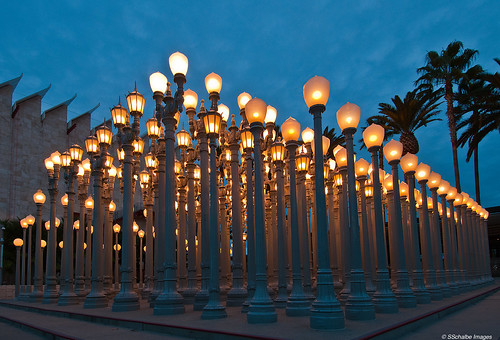
WRT the issue of Confederate monuments, something I have been thinking about for awhile but am reminded by this article, "Confederate monument in Decatur can be moved but not hidden," from the Atlanta Journal-Constitution, I can't help but think of how removing them for "art museums" brings up the opportunity to create a Chris Burden-like installation, comparable to the streetlights at LACMA in Los Angeles ("Chris Burden's roundabout route of bringing 'Urban Light' to L.A.," Los Angeles Times), called Urban Light.

From the AJC article:
A 30-foot Confederate monument in downtown Decatur could be relocated to another visible site or placed in historical context, but it can’t be destroyed or concealed, according to a DeKalb County legal opinion released Tuesday.

The DeKalb Board of Commissioners will now consider what to do about the monument after passing a resolution in October condemning the monument for glorifying the Confederacy.

The legal opinion by County Attorney O.V. Brantley concludes that the county government owns the monument and is prohibited by state law from removing it from public view. But the opinion says the monument could be moved to a cemetery, museum or other property.

Vintage lamps
Urban Light"
A street lamp installation at the Los Angeles County Museum of Art (LACMA) by Chris Burden. These are a collection of 202 restored cast-iron vintage street lamps that are fully operational. The lights are from the 1920's and 1930's.

Labels: , , , , , ,

Wednesday, December 28, 2016

Tiny museums in Somerville, Massachusetts

The Mµseum is installed in a case on a retail storefront wall, next to a Subway sandwich shop on Union Square in Somerville, Massachusetts.

Comparable to the "Little Free Library" where people set up a kiosk in their front yard (some institutions also participate) for books and other printed matter, where people are free to take or leave items, two kiosk-type exhibits, "museums," have been created in Somerville, Massachusetts, with the support of the Somerville Arts Coalition

The "Mµseum" created by Judith Klausner, aims to show art produced by New England artists who are under-represented in Greater Boston's fine arts museums ("Mµseum- The Tiny Museum," Atlas Obscura). From the article:
In 2010, Klausner noticed an alarming irregularity in the New England art community. Despite Boston’s having the second highest number of artists per capita of any city in the United States, art institutions in the greater Boston area were not showing exhibits from New England artists. The Mµseum’s first exhibit, “Invisible Cities,” contains pieces from local artists that speak to life in the urban environment and will run from August 15th, 2013 to October 11th, 2013.

While The Mµseum may seem like an art gimmick, to Klausner, it is something far more important. By placing this gallery in an unused alley in a public square, she hopes to take fine art out of the basketball-court-sized institutions that can be so intimidating and give it back to the cities and the people who often find art inaccessible.
Aram Boghosian for The Boston Globe. Martha Friend spoke with passerby Joseph Sullivan about the tiny museum in front of her home on Highland Avenue in Somerville.

With the support of the Somerville Arts Council, Martha Friend has created the city's second tiny museum, "The Friend Smithsonian Museum," also to showcase local artists ("'Tiny Museum' adds to Somerville’s list of small attractions," Boston Globe).

But tiny museums could take different forms and exhibit other things, such as along the lines of the kind of scientific exhibits created by artist Mark Dion ("Mark Dion Reimagines a Pioneering Botanist's Lab," Hyperallergic; "Hidden Treasures: Exploring the work of artist-in-residence Mark Dion," UVA), community exhibits, etc.

Comparable to DC's reordering of police and fire call boxes into public art installations, called Art on Call, Somerville has done something similar with deaccessioned pay phone boxes.

Twitter photo by Daniel A. Gross.

Still, there are some problems in terms of exhibiting ephemera and other materials--weather and the potential of damage to original artifacts.

So I can see a focus on creating displays, but not necessarily exhibiting original items.

Left: Mark DION Scala Naturae 1994. Stepped plinth, artefacts, specimens, taxidermic animals, bust 238 x 100 x 297 cm. Tanya Bonakdar Gallery.


Labels: , , ,

Friday, September 23, 2016

6Ps and cultural planning and the failure to create a network of African American historic sites across the DMV

(6Ps = prior planning prevents p*** poor performance)

Image from "The Smithsonian's NMAAHC Takes Shape on the National Mall," Architect Magazine.


This piece is in response to the Washington Business Journal story, "What the new African-American Museum means for its small peers," and the opening of the new Smithsonian National Museum of African American History and Culture ("Historic bell will ring for 'justice' at opening of new African American History Museum," USA Today).

When I was working with some people in Cambridge, Maryland, in response to a point about better harvesting of African American cultural history as part of cultural heritage tourism, I said that African-American history would be better marketed if the area's tourism departments created a multi-state African-American heritage site network.

The model would be how a multi-state "Civil War Trail" has been created by joint efforts by the states of Maryland, North Carolina, Tennessee, Virginia, and West Virginia.

In advance of the opening of the new Museum, it's a shame that the area's tourism authorities didn't come together and create a comparable heritage interpretation system, as a way to co-market their museums and sites and complement the national museum.

-- African American Heritage and Ethnography, National Park Service, Park Ethnography Program

The many hundreds if not thousands of sites in such a trail network could include those mentioned in the WBJ article including the Alexandria Black History Museum, Frederick Douglass National Historic Site, the Carter G. Woodson House in Shaw, the Martin Luther King Jr. Memorial near the National Mall, the African American Civil War Memorial and Museum and the Howard Theatre, in the U Street Historic District, and Smithsonian’s Anacostia Community Museum.

... as well as many other sites and facilities throughout the multi-state region including examples of segregated schools, Howard University, the Reginald F. Lewis African American Museum in Baltimore, the Harriet Tubman Museum and Educational Center in Dorchester County, Maryland and the Harriet Tubman Underground Railroad Scenic Byway, as well as the sites on the DC African American Heritage Trail and the Richmond Slave Trail in Virginia.

That way, the Smithsonian National Museum of African American History and Culture contributes more broadly to heritage interpretation and the number of people visiting these sites, rather than diverting people from those sites to the Museum.

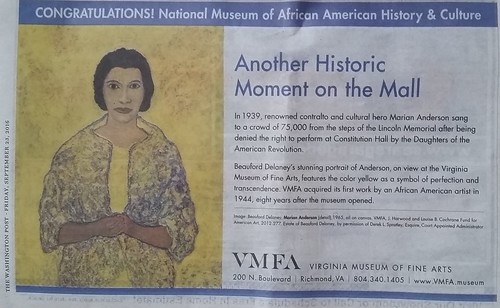
Ad published in the Express, by the Virginia Museum of Fine Arts, Richmond, congratulating the NMAAHC on its opening, and calling attention to a work in its collection, a portrait of Marion Anderson by Beauford Delaney.
20160924_085900.jpg

Labels: , , ,