Rebuilding Place in the Urban Space

"A community’s physical form, rather than its land uses, is its most intrinsic and enduring characteristic." [Katz, EPA] This blog focuses on place and placemaking and all that makes it work--historic preservation, urban design, transportation, asset-based community development, arts & cultural development, commercial district revitalization, tourism & destination development, and quality of life advocacy--along with doses of civic engagement and good governance watchdogging.

Tuesday, February 06, 2024

Four points about presentation of African American History in the context of Black History Month | reprint with an addition about the US Civil Rights Trail (versus the Dixieland Trail)

February is Black History Month

-- "Transit equity day, Sunday 2/4/24, in honor of Black History Month, Rosa Parks, and the significance of transportation history to African-American History," 2024
-- "Three ideas about presentation of African American History in the context of Black History Month | reprint with an addition about the US Civil Rights Trail (versus the Dixieland Trail)," 2024

The first two sections were published last year and are reprinted.

1.  Creating state-wide and regional history networks for African-American cultural interpretation.  One of the problems with creating African-American history museums is that while it is supported politically, once a museum is created they tend to not be well patronized.  Many have had serious budget problems.

Virginia Civil War Trails directional markerWhen I was doing work with some people in Cambridge, Maryland--where Harriet Tubman lived, and there is a small museum in Cambridge and more recently, the National Park Service created the Harriet Tubman Underground Railroad National Historical Park--I came to the conclusion that rather being satisfied with creating one off museums; local history trails; and the like, why not, using the example of the multi-state Civil War history trail, create regional and multi-state African-American history trails, incorporating existing assets.

The Civil War multi-state trail program includes more than 1000 sites in Maryland, North Carolina, Pennsylvania, Tennessee, Virginia and West Virginia--six states.  (In fact, DC should participate too.)

But states could create statewide African-American trails of sites, museums, places, etc. too.

South Side Station historic marker, Petersburg, VA:  Lee's Retreat, Virginia Civil War Trails

I wrote about this in more depth in "6Ps and cultural planning and the failure to create a network of African American historic sites across the DMV" (2016) in response to articles spurred by the opening of the Smithsonian National Museum of African American History and Culture.

Many local culture professionals argued it would be a boon to other African American history sites and facilities in the area, whereas I thought that it wouldn't happen on a trickle down basis, that an overt network of such assets, facilities, and sites needed to be created.

Local DC does have a history trailBaltimore has a variety of relevant sitesRichmond has a Slave Trail, there is the Alexandria Black History Museum, among many such resources across the region.  Just think how much stronger and more powerful these trails could be linked up as part of a broader system.
DC African-American Heritage Trail sign, Georgia Douglas Johnson Residence

2.  How about a month long "Doors Open" event during Black History Month.  "Doors Open" events were pioneered in Europe, and are when a community's culture organizations band together to provide a coordinated schedule of events, usually over a weekend, where people get free access to various cultural sites and events, many of which are not normally open to the public.

In North America, Doors Open Toronto is probably the biggest.  The Toronto Star even publishes an event guide. (2011 Doors Open Toronto Guide)

But Open House New York Weekend  is increasingly a big deal.  Pittsburgh created Doors Open Pittsburgh.

In DC the Dupont-Kalorama Museums Consortium has had a district-specific Doors Open event for many years, as do the art galleries on Upper Wisconsin Avenue in Georgetown, but including the participation of AU's Katzen Center for the Arts and the Kreeger Museum.  It's not exactly the same, but Georgetown Glow, an outdoor sculpture walk in December and January is growing into a great event.

My latest idea is that during February, Black History Month, community cultural organizations should organize a common calendar of events, along the lines of "Doors Open" events, where a community's cultural organization organize a weekend, week, or month of related activities.

In the DC context, ideally federal assets like the NMAAHC, the Frederick Douglass National Historic Site, and the Carter G. Woodson Home National Historic Site would also participate as well as the area PBS stations, etc.

A regional example from Southern California, Pacific Standard Time, a cross-museum program promoting California arts, spearheaded by the Getty Museum, shows how this can be done across jurisdictions.

3.  US Civil Rights Trail and historiography/critical race theory
.  I didn't realize that such a multi-state history trail had been created along the lines, until I was doing some ephemera research ("Travel the U.S. Civil Rights Trail," AAA World).

Long before white supremacists got worked up over "Critical Race Theory" ("What Is Critical Race Theory, and Why Is It Under Attack?," Education Week) I've been interested in the issue of historiography, especially the interpretation of Civil War in terms of "the Lost Cause."  


Often this idea of National Myth/National History is termed "civil religion" ("Can America's 'Civil Religion' Still Unite The Country?," NPR).

I was sad that President Obama didn't avail himself of the opportunity to give a major speech at the 150th anniversary of the Battle of Gettysburg.

Where this comes up with the US Civil Rights Trail is that I came an earlier form of the trail, but of Dixieland, and the Dixieland Trail and the promotion of "the unique culture of the South."


The Dixieland Trail was an automobile route organized and promoted by the travel divisions and state development boards of Georgia, Kentucky, North Carolina, South Carolina, and Tennessee. This map, featuring artwork by Logan Bleckley dated 1962, was issued by the Tennessee Department of Conservation and shows the manufactured highway meandering about the five participating states. Sixty-five different locations of interest are numbered and labeled and a variety of illustrated vignettes highlight important industries, recreational opportunities, and the natural beauty across the region.

Another version of the brochure, probably dating to the 1970s.

By contrast, the Civil Rights Trail covers 15 states, and should include more, like DC and Maryland.  But talk about different approaches to historiography, and the need to discuss it.


4. Some DC stories.  I lived in the H Street neighborhood starting in the late 1980s.  I followed urban issues but I wasn't involved.  Around 2000 I decided if I didn't get involved the neighborhood would continue to languish.

Sometime in 2000 or 2001 I went on a road trip with a college friend from Ft. Lauderdale to New Jersey and we stopped in cities known for historic preservation like Savannah and Charleston.  I came back thinking my neighborhood was no less beautiful then those, just different.

Eventually I got roped into running "a history study" for the neighborhood, with the idea that would lead to creation of a historic district.  Instead, I got diverted in Main Street historic preservation based commercial district revitalization.  But the study was detailed enough that in some academic treatise I am criticized as a gentrifier.  At the same time, I got more interested in DC's local history.

The Front Page Restaurant, Dupont Circle.  Shut down when WeWork bought the building.  It's decorative claim to fame was a bunch of newspaper pages posted throughout the restaurant, mostly from the now defunct Washington Star.  One of the pages was classified ads from WW2, organized in some categories--housing and jobs--by race.  I was floored, because at the time that was less than 50 years before.

Uline Arena, E.B. Henderson
.  One of the buildings I helped save was the old Uline Arena, site for professional hockey, basketball and other events. 

In the process of documenting the building for preservation, we learned that local civil rights activist (and DCPS official) E.B. Henderson coordinated an every event protest for almost two years in the late 1940s, to get the building desegregated ("Civil rights, public accommodations laws, and religious belief exceptions," 2016).

Carter Woodson home.  Woodson taught at Howard University and was the founder of the Association for the Study of African American History and African-American History Month.  

His house was owned by Shiloh Baptist Church which let it rot ("Losing my religion: Shiloh Baptist Church and Neighborhood Destabilization," 2005).  The church otoh wanted plaudits for "saving" the building. Eventually the National Park Service bought and restored it.

I was talking about it at a community meeting in Shaw once, and made the point that it was a shame that the building was in its sorry state, because that building is significant to American History, not only to "black history."  The person was surprised: "I never thought of it that way."

This company had restaurants in DC and other major cities.  It was party to a public accommodations lawsuit that was decided in 1953.

Public accommodations protesting and organizing in DC.  In the early 1950s, activists like Mary Church Terrell led campaigns against department stores and restaurants over segregated spaces.  Howard University students even led a "counter strike" at restaurants in the 1940s, although it's not well known ("How One Woman Helped End Lunch Counter Segregation in the Nation’s Capital," Smithsonian Magazine).

These were among the battles that pushed nondiscriminatory public accommodations laws forward.

Labels: , , , , , , , ,

Tuesday, July 12, 2022

SEPTA Philadelphia removal of Belgian block paving stones illustrates four points about urban history/cultural resource/transportation planning

Mark D. Sanders of Ogontz, president of the Philadelphia Street Railway Historical Society, talks about construction that threatens the last bit of historic Belgian block paving under the trolley tracks on South 40th Street in University City. Photo: Tyger Williams, Philadelphia Inquirer.

This post is in response to the Philadelphia Inquirer article, "A historic West Philly street, built with iconic Belgian paving stones, is being torn up as SEPTA upgrades trolley tracks ." From the article:

As they rip up worn trolley tracks on South 40th Street, construction crews have been excavating pieces of Philadelphia history.

SEPTA says safety is at stake.

But those granite paving stones, called Belgian block, helped accelerate the development of West Philadelphia into the city’s first suburb in the late 19th and early 20th centuries by enabling electrified streetcars to link Center City to an area that was then mostly rural.

Now members of the Philadelphia Street Railway Historical Society are scrambling to save the Belgian block, without gaining much traction so far. As of last week, only a small portion remained, between Locust and Spruce Streets.

Because of strong historic protections, O and P Streets in Georgetown remains paved in stone blocks (I admit it looks cool but is a pain in the butt from a biking standpoint) and the steel rails from the old Route 20 Streetcar line have been retained as well.   

It was re-constructed about 10 years ago.

-- Remembering Georgetown’s Streetcar Era: The O and P Streets Rehabilitation Project, DC Department of Transportation

But I bet they only did it because they had to. Because of DC's previous existence as a department of the federal government, Georgtown has special status as a federal historic district, created many years before the National Historic Preservation Act was passed.   This is why the stone block road and streetcar rails were saved to begin with.

Note that the O and P Rehabilitation Project was 100% identical to what they are doing in Philadelphia and is proof that retention of the Belgian block in Philadelphia is no problem.  Except for cost.


This is a streetcar photo likely from either O or P Streets in Georgetown, from the Historic Prince William webpage on DC area streetcar photos. The streetcar destination sign says "Georgetown" and it's a stone block paved street.

WRT the Philadelphia project specifically:

1. It demonstrates that the City of Philadelphia lacks a strong commitment to preservation in Philadelphia.  While an incredibly historic city, Philadelphia has pretty weak historic preservation protections generally, and not much of a commitment to it by elected officials.  Philadelphia, sadly, is a city where the ward councilmembers have veto power over development decisions, including preservation, and they don't use this power to good use ("‘Councilmanic prerogative’ is a campaign issue. But WTF is it?," BillyPenn).

In fact, early on in my involvement in urban revitalization, at a conference in Philadelphia in 2003 I asked a leading question of a plenary speaker to embarrass the city in its lack of prioritization of historic preservation in its Neighborhood Transformation Initiative (" An outsider's vision for saving Philly," Philadelphia Daily News, 2003).  It led the city to work with the National Trust for Historic Preservation on a reconfiguration of the process.  

But despite that and other programs, such as the state receivership program ("Pennsylvania passes receivership law with regard to vacant/nuisance properties," 2010), the city hasn't upgraded its approach.

It's not that they don't know, but I guess because Philadelphia is considered a primary example of the urban renewal approach, even though at the time it involved some preservation, they didn't develop the same emphasis where preservation was enthusiastically adopted as a way to stabilize otherwise shrinking cities ("The City that Might Have Been: Edmund Bacon’s Philadelphia," PhillyHistory Blog).

Although they do have some great publications, like the Philadelphia Rowhouse Manual, a decent preservation organization, the Preservation Alliance of Greater Philadelphia, the core of historic buildings like Independence Hall and the related museum, etc.

Economics of Uniqueness: Investing in Historic City Cores and Cultural Heritage Assets for Sustainable Development, World Bank

The solution would be to do what I recommend for DC, treat the city as if it were a heritage area, whether or not they got state or national designation to do so.

From "What would be a "Transformational Projects Action Plan" for DC's cultural ecosystem":

The city should acknowledge the built environment as a key element of the city's identity, in particular historic architecture and urban design.   This is Item #3 in "40th anniversary of the local historic preservation law in DC as an opportunity for assessment," 2019:

Treat the entire city as a "heritage area" from the standpoint of the design management of the built environment, using the concept of the cultural landscape, so that all buildings would have some basic design review and demolition protections, regardless of whether or not they are listed either individually or as part of an existing historic district.

Otherwise, so many buildings and neighborhoods are unprotected now, and likelihood of protection is slim, e.g., our 1929 bungalow is quite intact, but there is no chance our neighborhood would ever become a historic district, or that a typical building of its type (e.g., bungalow, Craftsman style rowhouse, Italianate frame or rowhouse, Queen Anne rowhouse, etc.) would be able to be designated individually as opposed to being a contributing structure in a neighborhood historic district, except in exceptional circumstances.

In the US, there are two types of heritage areas, either state or federally designated.  I am not arguing that we need to create a formal heritage area in DC.  Rather we can use that framework, that is thinking about the city in its entirety as a cultural landscape, for managing the city's built environment.

Locally, Maryland has a system of state heritage areas, although they have limited additional protections concerning designation and protection and are more focused on tourism development.

Also see A Users Guide to Implementing City Competitiveness Interventions : Competitive Cities for Jobs and Growth, Companion Paper 4, World Bank.

 2.  At the local level, transportation agencies need to have stronger requirements for historic preservation. The reality is that they do have strong requirements.  Because they receive federal funds, it is considered a "federal undertaking" and they are required to do evaluations of projects for their effects on historic buildings, structures, and sites, with an aim towards preservation and mitigation. 

While preservationists frequently refer to Section 106 reviews resulting from the National Historic Preservation Act, there is a specific section of the Department of Transportation Act, 4(f), calling for historic preservation review of transportation projects ("Section 4(f) of the Department of Transportation Act," NTHP).

But a lot of times it seems like agencies are able to slide on this at the local level.  This is true in DC too, with the exception of the O and P Streets matter.

a.  When the city department of transportation was replacing alley pavements, they thought they were great because they were replacing them with red brick.  But red brick was one of at least four different pavements used, in addition to yellow brick, asphalt block, and cobblestones.  I do think my complaints on this led them to use yellow brick too, but I don't think asphalt block.

b.  I remember "arguing" with a DDOT representative when they installed a concrete wall on a historic property, when to be historically accurate it should have been constructed of stone.  They said it's not in a historic district so it doesn't matter.

This isn't the property, but this is the kind of stone wall that should have been constructed, although it would have been a few feet taller.  Instead they poured concrete.

c.  WMATA, the metropolitan transit agency for the DC area, was "gifted" a bunch of transit infrastructure from its acquisition of the old DC Transit agency--streetcars stopped running in 1962 but there was extant infrastructure like bridges, and bus related infrastructure.

One such structure was the Foundry Branch Trestle in the Palisades neighborhood.  They didn't want to maintain it, because it had zero relevance to their service program ("D.C.’s last trolley trestle is in ‘imminent risk of collapse’," Washington Post)

While I don't disagree that it shouldn't have been there problem, DC should have stepped in, taken title, and preserved it. But DC Department of Transportation refused.

And because DC's elected officials aren't particularly committed to preservation and because there is no substantive plan for interpreting and preserving resources particularly important to DC's transportation history, the bridge was allowed to be demolished.

-- Decision and Order: Application of Washington Metropolitan Area Transit Authority Foundry Branch Trestle, DC Government

 3.  DC and Philadelphia, like most communities, don't have specific transportation history preservation and interpretation plans. I was clued into the need for this because of seeing a presentation which mentioned how Passaic County, New Jersey recognized the importance of maintaining and interpreting historic transportation infrastructure in their community as part of the county's master transportation plan.  Later the county's tourism plan expanded on this idea.

Terminal Town is a book by DePaul professor Joseph Schweiterman, about all the city's transportation terminals.  An exhibition based on the book was created and displayed in various locations across the city. (Photo: DePaul University/Jamie Moncrief).

Freedom Rides Museum, Montgomery, Alabama.  Photo by Michael Harding.

I've written about this in the context of railroads, although from my writings it sounds like that's all I care about ("May should be National Train Month: Rethinking promoting more comprehensively travel by train in the US "), which isn't true.  

Canals, roads, even parking lots (like those associated with the Park and Shop shopping center type), railroads, bus systems, streetcar, light rail and heavy rail, ferry systems (+ airports, ports and maritime activities, etc.) should all be covered.

And this shouldn't necessarily be at the expense of the transportation agency, because it's more of a city historic preservation matter.  In any case, funds separate from the maintenance of operating transportation and transit resources should be provided to maintain this infrastructure.

Chapter 8 of the Passaic Transportation Plan is  mistitled as "Scenic and Historic Byways" because it has a broader purpose, not just the preservation and interpretation of historic transportation infrastructure, but providing access to to these resources:

1.  Prepare a History and Tourism Element of the Passaic County Master Plan:

  • Coordinate transportation services to provide better access to and between major sites and byways;
  • Develop way-finding and promotional materials around major transportation hubs and activity centers; and 
  • Coordinate information sharing on all levels.

2.  Adopt a process for identifying, preserving and enhancing scenic and historic resources as part of the County Development Review and Capital Planning Processes:

  • Direct Passaic County staff to follow the procedures and guidelines outlined later in this section;
  • Coordinate with all local planning boards, historic and environmental commissions in municipalities where byways exist;
  • Promote resources along byways that are not currently on local, state and federal historic registers;
  • Formally adopt guidelines that will raise awareness of these byways for potential development review applicants and local agencies; and
  • All capital engineering and construction projects should e referred to the Planning Board for a review of all scenic and historic resources.

Note that the chapter is worth reading in its entirety.  Probably it would be better to do interpretation of transportation infrastructure as one chapter, and providing better transit/transportation access to historic resources should be another. 

Still, it's a pathbreaking document.

My line about historic preservation in DC is that it's the strongest law in the country for resources that are already designated, but it's not strong enough for resources that are eligible for designation, but aren't.  Clearly, DC shows this with the items I mentioned in the previous section, and Philadelphia shows us this is the case too.

Ironically, as mentioned above, this blog was started in part as a way to keep my thoughts and writings in one place, and the first substantive entry was a reprint of an op-ed I wrote in 2003 in the Philadelphia Daily News about how Philadelphia was missing the boat on historic preservation as a revitalization strategy.

=====

Point 4 is not specifically related to Philadelphia or DC and preservation but is about:

4. Belgian/asphalt block as a pavement material ideally suited to manage operating speed of motor vehicles.  I argue that transportation agencies should reimagine how they use paving materials to better manage operating speed of motor vehicles in relation to land use context, especially in residential areas.  

-- "Extending the "Signature Streets" concept to "Signature Streets and Spaces"," 2020

First Street SE, Washington, DC.

In fact I submitted that concept as one of many comments on the update process for the Salt Lake City Transportation Master Plan.

Such pavement provides "visual, aural, and physical cues" to drive more slowly.  

Ideally, residential streets would be so paved, as well as streets abutting transit stations, within commercial districts, and parks, libraries, and schools. 

The Belgian block in Philadelphia that SEPTA is ripping out of South 40th Street is a perfect example of how "old pavement" is still relevant to today's transportation needs.

Labels: , , , , ,

Friday, February 28, 2020

Two ideas about presentation of African American History in the context of Black History Month

1.  Creating state-wide and regional history networks for African-American cultural interpretation.  One of the problems with creating African-American history museums is that while it is supported politically, once a museum is created they tend to not be well patronized.  Many have had serious budget problems.

Virginia Civil War Trails directional markerWhen I was doing work with some people in Cambridge, Maryland--where Harriet Tubman lived, and there is a small museum in Cambridge and more recently, the National Park Service created the Harriet Tubman Underground Railroad National Historical Park--I came to the conclusion that rather being satisfied with creating one off museums; local history trails; and the like, why not, using the example of the multi-state Civil War history trail, create regional and multi-state African-American history trails, incorporating existing assets.

The Civil War multi-state trail program includes more than 1000 sites in Maryland, North Carolina, Pennsylvania, Tennessee, Virginia and West Virginia--six states.  (In fact, DC should participate too.)

But states could create statewide African-American trails of sites, museums, places, etc. too.

South Side Station historic marker, Petersburg, VA:  Lee's Retreat, Virginia Civil War Trails

I wrote about this in more depth in "6Ps and cultural planning and the failure to create a network of African American historic sites across the DMV" (2016) in response to articles spurred by the opening of the Smithsonian National Museum of African American History and Culture.

Many local culture professionals argued it would be a boon to other African American history sites and facilities in the area, whereas I thought that it wouldn't happen on a trickle down basis, that an overt network of such assets, facilities, and sites needed to be created.

Local DC does have a history trail, Baltimore has a variety of relevant sites, Richmond has a Slave Trail, there is the Alexandria Black History Museum, among many such resources across the region.  Just think how much stronger and more powerful these trails could be linked up as part of a broader system.
DC African-American Heritage Trail sign, Georgia Douglas Johnson Residence

2.  How about a month long "Doors Open" event during Black History Month"Doors Open" events were pioneered in Europe, and are when a community's culture organizations band together to provide a coordinated schedule of events, usually over a weekend, where people get free access to various cultural sites and events, many of which are not normally open to the public.

In North America, Doors Open Toronto is probably the biggest.  The Toronto Star even publishes an event guide. (2011 Doors Open Toronto Guide)

But Open House New York Weekend  is increasingly a big deal.  Pittsburgh created Doors Open Pittsburgh.

In DC the Dupont-Kalorama Museums Consortium has had a district-specific Doors Open event for many years, as do the art galleries on Upper Wisconsin Avenue in Georgetown, but including the participation of AU's Katzen Center for the Arts and the Kreeger Museum.  It's not exactly the same, but Georgetown Glow, an outdoor sculpture walk in December and January is growing into a great event.

My latest idea is that during February, Black History Month, community cultural organizations should organize a common calendar of events, along the lines of "Doors Open" events, where a community's cultural organization organize a weekend, week, or month of related activities.

In the DC context, ideally federal assets like the NMAAHC, the Frederick Douglass National Historic Site, and the Carter G. Woodson Home National Historic Site would also participate as well as the area PBS stations, etc.

A regional example from Southern California, Pacific Standard Time, a cross-museum program promoting California arts, spearheaded by the Getty Museum, shows how this can be done across jurisdictions.

Labels: , , ,

Sunday, August 25, 2019

Designing conflict in #2: bar crawls

Bar crawls are designed to promote negative behavior -- basically lots of drinking, inebriation, etc., which usually includes a lot of misbehavior, public drunkenness and nuisance crimes like public urination, vomiting, litter, etc.

So, if you don't want misbehavior, gross public drunkenness, public urination, massive amounts of litter, etc., you probably should outlaw bar crawls, even if it costs bars some business.

This has been a problem in DC and Arlington.

-- "After a Disastrous Halloween, D.C. Bar Crawls Face New Regulations," Washington City Paper, 2016
-- Pub Crawl Applications and Requirements, DC Alcoholic Beverage Regulatory Administration
-- "New rules for St. Patrick's pub crawl in Arlington aim to curb drunken hijinks," 2015

And according to the Guardian, it's a big problem in Prague, "The fall of Prague: 'Drunk tourists are acting like they conquered our city."

This is a classic case of "designing conflict in."

Labels: , , , ,

Thursday, July 12, 2018

A well designed train station is a well designed train station: it's not about "luxury"

Interior, Grand Central Station.  Alexsandr Stickpin Photography. ("Grand Transit: MTA and Grand Central Terminal," Art History Today).

MobilityLab Express has an article, "Grand Central was designed for luxury travel. That’s why commuters love it," attributing the success of Grand Central Station in New York City to the fact that it was designed for long distance trains during the heyday of railroad passenger travel.

I don't agree.

It is a pretty station.  But virtually all big city railroad stations constructed before 1935 were similarly grand, even if the level of grandeur was scaled to the size of the city.  Grand Central Station was built to be both functional and aesthetically attractive.

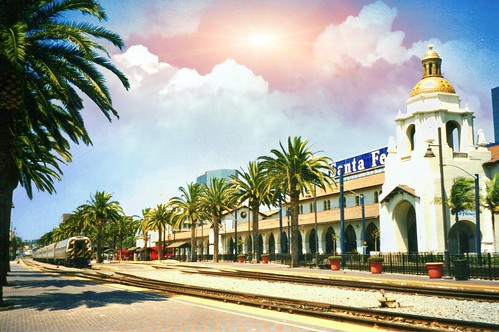
But so was the Santa Fe railroad station in San Diego or Union Station in Denver, etc.  (Or for that matter, the Ferry Terminal Building in San Francisco.)
Union Station ~ San Deigo CA ~ Historic Building

In the postwar period and in the context of an automobile-centric transportation, the importance of design and aesthetics was stripped out of railroad station planning, whereas most train stations in the US are now built to be functional. (Separately, the train station preservation movement, both for use as transportation facilities or as adaptive reuse projects to maintain the building in the face of the loss of its function.)

NJ Transit platform at Penn Station.  Wikipedia photo.

Penn Station, while originally built with a beautiful façade, was built for both local--presumably not "luxury"--and intermediate distance travel primarily between Washington, Philadelphia, New York City and Boston, and according to some architectural historians was poorly designed as it relates to passenger throughput.

And anyone who uses the station knows how cramped the platforms are, which were created as part of the original station and retained after the above-grade building was demolished in the early 1960s.

I think more than "building a station to serve luxury markets," the issue is the design of the station as a way to maximize the quality of the trip and the experience, specifically:

-- quality of accommodations for passenger throughput generally (entry and exit, connections to other transit services)
-- quality of accommodations for passenger throughput specifically to/from and on platforms
-- centrality of its location (for example the recently in the news Michigan Central Station was deliberately constructed in a location outside of the center thinking it could attract patronage regardless)
-- its place as an anchor of the area transit system and the mixed use district in which it is placed
-- amenities, especially retail and food service
-- architectural design and aesthetics.

In my two trips to Europe, I have been in train stations in Hamburg, Essen, and Dortmund in Germany and in the UK, St. Pancras, Kings Cross, Euston, and London Bridge in London; Lime Street, the Liverpool airport station (some distance from the airport), and the Liverpool Central commuter rail station.

Hamburg especially impressed me.  It's one of the busiest stations in Europe with 650,000 people moving through the station, with connecting service from multiple underground lines, the main inter-city bus terminal nearby (with an underground connection across the street); superior placement and separation of tourist bus services from traditional local transit service; and it anchors both the city's pedestrian shopping district and the Spitallerstrasse transit mall.

The way local transportation intertwines but is separated to foster throughput with the Hamburg train station as the anchor to all the services is far superior to any train station I've experienced in the US, especially Union Station in Washington, where taxicabs, tourist buses, ride hailing pick up and drop off, and individual passenger pick up and drop off are all massed together--poorly--in front of the station.

But even smaller stations in Essen and Dortmund were similarly situated--adjacent to the main pedestrian shopping district, with inter-city bus and local transit services, and tourist bus services, all well integrated but separated as needed for optimum service provision.

Similarly, my more recent trip to the UK super impressed me in terms of the way the train stations were so massive, beautiful, full of amenities, and successful (even if there were wayfinding and other issues) and itinerant service problems on the Thameslink/Southern Rail and Northern Rail services.

Euston is an "old station" undergoing renovation so it was cramped--especially in the face of recent massive train service breakdowns. But it still has great underground and bus connections, and compared to just about any train station in the US, bike accommodations.

By contrast, each of the other stations I visited in London, all renovated more "recently," was amazing, and mixed longer distance service with commuter trains.

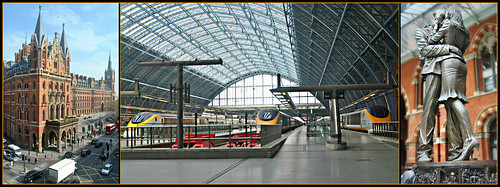
St. Pancras is also home to the Eurostar trains connecting London to the European continent, with decidedly luxury options, but that didn't make the station necessarily more beautiful or successful. (Although yes it is stunning inside and out.)
St Pancras International Station London

Similarly, in Liverpool, Lime Street station has longer distance and commuter trains, a "low level" (local underground) station, is adjacent to the main city local transit station at Queens Square, and anchors the adjacent pedestrian district.

The "airport" station is not at the airport but links to it, and has local and long distance train connections, plus local bus transit, and intercity bus transit.  It also provides for a dose of redundancy in that the station can be used for long distance trains while Lime Street station is closed for renovation, which was the case when I was leaving Liverpool.

Many of the Liverpool area local train stations have combined ticket office-retail stores run by Merseytravel and the "automatic" coffee dispenser at the Airport station ticket office (the coffee shop was closed by the time I got there) made excellent coffee!

(Note that I also visited the Victoria Coach bus station in London and the Liverpool One inter-city bus station in Liverpool.  The Victoria station is beautiful art deco outside and terrible inside.  I learned that the problem inside is multiple landowners and the inability of Transport for London to take control of the design, planning, and operation for the service.  The Liverpool One station is outdoors, but has good information and wayfinding systems, excellent platform shelters, and a ticket and information office run by the local transit authority.)

"Old" books on train stations.  I hate to admit that it wasn't until I saw a book by John Droege, Passenger Terminals and Trains, at an antique mall, that I realized it would be helpful to bone up on the historical literature on railroad station design and architecture.

The Droege book dates to 1916 but has been reprinted.  Carroll Meeks' The Railroad Station: An Architectural History dates to the 1950s.

The past blog entry "Transit, stations, and placemaking: stations as entrypoints into neighborhoods" (2013), discusses how, especially in the urban context, transportation infrastructure's aesthetic elements have often been ignored and this can have deleterious impact on quality of life.

After I wrote that piece, because the Wall Street Journal mentioned a 100 year old article on "railroad beautiful" I tracked down some early planning writings from the early 1900s on the aesthetic qualities and design elements of railroad systems, concerning both station grounds and the right of way and yard facilities.  The Boston and Albany Railroad was a leader in adopting such an approach.

See "A Railroad Beautiful" and "The Treatment of City Squares--III; The Square Before the Railroad Station," House and Garden (2), 1902 and "Railroad Gardening," Standard Cyclopedia of Horticulture. (These resources have been scanned for online access by the Hathi Trust.)

Transit station reviews.  I have written reviews of the Silver Spring Transit Center and the Takoma Langley Crossroads Transit Center, as well as submitted comments on the redesign and expansion of Union Station.

-- "Updating my review of the Silver Spring Transit Center: a few things I missed in 2015," 2018
-- "Takoma Langley Crossroads Transit Center: a critical evaluation," 2016
-- "DC Union Station EIS FRA -- Comments due November 9th," 2016

Clearly station designs today have a lot to learn from the station designers of yesteryear.  As do I.

Note that the Network Rail train station design manual is superior.

-- Guide to Station Planning and Design, Network Rail

But the US Federal Railroad Administration publication is good on the underlying principles, but provides limited direction in terms of specifics, and it doesn't give examples of supra-best practices, which would raise the expectations of planners and riders both.

-- Station Area Planning for High-Speed and Intercity Passenger Rail, Federal Railroad Administration, US DOT

Similarly the SEPTA guide for their light rail/trolley stations is a useful resource, but for a much different scale of transit service

-- Modern Trolley Station Design Guide, SEPTA

Labels: , , , , , , , ,

Friday, May 12, 2017

US National Tourism Week: a perspective from New Zealand

My NZ e-correspondent comments on the recent blog post on DC tourism issues:

Your recent entry on your website refers to:
The lack of information center will be DCs biggest downfall for tourism , given the large number of sights and attractions are in the region.
New Zealand i-site in Fiordland.

Are US tourist information centers under any sort of governing body? All licensed tourist info centres in NZ are under the "i - site "umbrella," which is a bit like KOA branding of campsites . There is a set level of standards to be maintained

i - sites can book domestic travel anywhere in NZ by any mode ( air , bus , ferry ) has information on ALL types of accommodation in their region -- budget backpackers to ultra luxury, and communicate with each other to make bookings in other parts of NZ .

Some of the better i-sites include internet access, cafes , DoC information (the Dept. of Conservation administers National Parks and wildlife conservation), sells topo maps and videos, sells postage stamps, has a gift shop with quality souvenirs ..... all in a one stop shop.  Even some of the smaller towns in NZ ( with population of 3,000) have good i--sites -- it's not just the big players.

My response:
wrt info centers, here we're bigger country-wise and because conservatives for decades don't like funding federal "economic development," tourism promotion is primarily a state activity. That being said, most states do a very good job supporting "welcome" or visitors centers across their states, although they may or may not do accommodations reservations.

DC is an exception for a major city in that it does such a poor job, and this is complemented by the very parochial approach of the federal agencies. And DC extends its poor job by not extending information to area visitors centers located outside of the city but in the metropolitan area.

I missed out once on buying ephemera off ebay when there was a c. 1930s or 1940s photo of a federal "information center" in DC, but somehow I missed the deadline to bid and could never find another one.  I need to track it down.

With the federal agencies, fwiw, the problem isn't limited to DC.  It's the same for federal parks and lands and rec. centers across the country. They won't provide "local" information on site. Yet, they do economic impact studies every year about the economic impact of these facilities on local economies. It would be much greater if they would bend on this particular element.

the poor job of NPS marketing is why Utah stepped in to do its own campaign. It's so successful that they are overwhelming the facilities...
On what we might call "public diplomacy" and projecting the image of the US to "foreigners":


The following is a NZ perspective, which may or may not be widely known ( I suspect not)) by Americans.

Tourism -- People who are transiting through the US, but are not leaving the airports, have to pay for a visa to do so.  If I am flying from NZ to LAX, transferring on to another flight to London UK, will only be in the transfer terminal in LAX for an hour or two, I have to pay for a visa.

This is dumb !! As I will not be processed into the US by ICE , I don't understand why I need a visa to do so. Apart from places in Middle East, notably Saudi Arabia  there is no other country where I need a transit visa.

Who says?  (ABC LA photo.)

Entry conditions into US are a lot stricter, and more cumbersome. The US Embassy and Consulates do NOT handle visa applications. It is done by paying a toll call (regardless where one is phoning from in NZ).

I don't know what it is like now, but the US immigration that I struck were some of the most obnoxious folk I ever came across in the US . For starters it would help if they spoke slowly and clearly to us -- even those of us who speak English sometimes find a Southern Drawl a little hard to follow ...

And uniformed men waving guns in the air, herding us round like a bunch of sheep in the arrivals hall, is not exactly a friendly welcome. If these folk REALLY need guns (how often are they used?) they could be a little more discreet about it.

Twitter photo, Detroit Metropolitan Airport.

There are 2 lines for queuing; One marked "US Citizens" , and the other marked "Aliens" Although I am not a US citizen, I am NOT an alien. ET might be an alien, but the rest of us are "foreign citizens or "visitors to the US."

And with Donald Trump as your country's leader, goodness knows what he will do to make entry to the US harder for those of us who wish to visit.

Tipping.  Although some countries have a tipping culture, this is abhorrent to NZ or Australian folk, unless the service provided was (1) actually wanted, and (2) greater than expectations.

Porters who automatically take my luggage and put it into the trunk of a cab , then expect me to pay them to do what I would have done myself is asking for an argument from me.  American porters should ASK customers if they need their services, not just help themselves.

Labels: , , , ,

Monday, May 08, 2017

Some DC tourism issues (National Tourism Week: May 7th - May 13th)

One of my earliest blog posts is from February 2005, when I wrote that people in commercial district revitalization should think of themselves as "destination managers," and if we make places that are great "for us," fortunately they are also interesting and attractive to visitors.

-- "Town-City branding or 'We are all destination managers now'"

Bike share.  An example is how the city's bike share system is subsidized by visitors who rack up lots of extra fees for using the bikes.  This pays a significant proportion of the system's operating costs.

Destination DC is DC's destination marketing organization.  Destination DC is the city's "destination marketing organization" (formerly referred to as "convention and visitors bureaus) and it is complemented by EventsDC, which owns and manages sports facilities.

Earlier in the week Destination DC announced that DC had record tourism numbers for last year ("DC draws 20 million domestic tourists in year for 1st time," Associated Press), chalked up in large part to the opening of the new Smithsonian National Museum of African-American History and Culture.  From the article:
According to Destination DC, the 20 million visitors was an increase of 700,000 over the previous record for domestic visitation, which was set in 2015. International visitor totals will be released in August.

The Smithsonian's National Museum of African American History and Culture, in the shadow of the Washington Monument, opened in September and has already drawn more than 1 million people. Admission is free, but unlike other Smithsonian institutions, the museum is using timed entry passes to manage the crowds.

Visitors also were drawn to Washington by new and refurbished hotels and, for the first time, Michelin-starred restaurants, Destination DC president Elliott Ferguson said in a statement. By far the highest-profile hotel to open last year was Trump International Hotel on Pennsylvania Avenue, five blocks from the White House, which quickly became a gathering spot for supporters of President Donald Trump.

Michelin released its first travel guide for Washington in October and 11 restaurants in the city earned stars, along with the Inn at Little Washington in the rural town of Washington, Virginia.
DC definitely has opportunities for improving how it deals with and profits from tourism.  This might give us the idea that my criticisms of how DC organizes and delivers its tourism offer are unfounded.  They're not.

I have some basic criticisms:

-- unlike other major US cities, DC doesn't have a real visitor center (it does have an information desk in the Convention Center, but the Convention Center doesn't offer parking, which is a problem for people arriving to the city by car and seeking information)
-- the federal institutions with visitor centers (National Park Service, Smithsonian, Capitol Visitor Center) do not distribute any information not produced by the federal government, so these centers do not provide printed information or guidance on any other city attractions
-- the tourism tax revenue stream needs to be used more systematically to support tourism assets other than the Convention Center
-- the city's "destination marketing organization" needs to support systematically sub-city tourism, especially for Capitol Hill, Dupont Circle, and Georgetown (many other jurisdictions have secondary visitor centers in major destinations within the city)
-- the city ought to have an annual tourism conference -- most states have them (e.g., both the Maryland Tourism and Travel Summit and the VA-1 Tourism Summit are in November) -- to help build the tourism sector beyond the federal institutions
-- Destination DC isn't very good about providing tourism information to visitor centers outside of DC, even though most of those centers report that the primary interest of visitors
-- the federal government should consider the creation of a master visitor center (such activities would be covered by the Visitor Element of the Federal Elements of the DC Comprehensive Land Use Plan)
-- the region should consider developing a set of systematic visitor centers at the region's three airports (two in Virginia and one in Maryland)
-- the transit system could do a better job offering special pricing for tourists -- granted providing such pricing is seen as unfair to residents, who fund the system, on the other hand it should be seen as a transportation demand management initiative

Yes, I understand DestinationDC focuses on filling the Convention Center with events since they have to pay off the bonds that financed its construction.  From "Massive anime convention Otakon comes to DC this summer," (WTOP):
The District will host nearly two dozen citywide conventions this year — those that take up multiple hotels and venues — including the city’s first time ever hosting a massive anime convention called Otakon.
But other DMOs have similar situations and still manage to have a much broader purview.

DC needs a tourism plan.  The best way to deal with this would be to create a Tourism Development and Management Plan as part of the DC Comprehensive Plan, something I suggested c. 2004, based on the experience of Charleston, SC.

It would cover marketing too.  I am not a fan of the current program ("I don't get DC's visitor marketing ad campaign at all,") but it is claimed that it is successful.

-- DC Cool in Washington, Washington.org

Sharing options for lodging.  Personally, I don't think airbnb and similar sharing programs are a big issue in the city. 

Mostly, the hotels and hotel workers unions are fighting this battle, because they believe it's an either-or choice, and they don't want to lose any business. 

As I argued in the other piece, that's too simplistic a perspective, and the hotel industry isn't the only player that needs to be satisfied. People want access to a variety of lodging types and experiences when they travel, and this is an option that satisfies a certain segment of the market, and likely many of these people wouldn't visit the city otherwise, had this option not been available.

I do think that it's reasonable to put restrictions on how many properties can be listed, they should be licensed and stays taxed, so that these visitors still contribute to the tourism tax revenue stream, and of course, properties that shouldn't be made available through such programs shouldn't ("DC attorney general sues Ginosi for allegedly treating rent-control apartments like ‘hotel rooms’," Washington Post).

City Tourism

The United Nations World Tourism Organization also sponsors a Global Summit on Cities Tourism.  The sixth conference will be held in December in Kuala Lumpur, Malaysia.

The first conference resulted in the production of the Global Report on City Tourism.  The UNWTO is especially focused on the economic development potential that tourism presents.  From the report:
Cities appeal to a broader market, they are easy to reach and they have a lot to offer, this also brings a new spending pattern that can go from those staying in budget hotels to the five star hotel customer, but all have one thing in mind: they want to discover and visit other cities. Cities need to assess their products and understand which of their products offerings appeal to the market.

What does tourism mean for cities?The report on City Tourism is part of a series of UNWTO reports, ranging from UNWTO AM Report Vol. 4 'Global Report on Food Tourism and AM Reports Volume 3 'Global Report on LGBT Tourism to AM Report No.5 Global Report on Aviation.

Urban Cultural Tourism

A big thrust in urban tourism for the last 20+ years has been "cultural tourism," which addresses historic architecture and local history.  It's touted for many reasons, especially because improving local cultural assets also serves residents.

From "Cultural Visitor Profile" from the National Assembly of State Arts Agencies:

In a nutshell, cultural tourists compared to the average U.S. traveler:
  • Spend more: $623 vs. $457
  • Are older: 49 vs. 47
  • Are more likely to be retired -- 20 percent vs. 16 percent
  • Are more likely to have a graduate degree: 21 percent vs. 19 percent
  • Use a hotel, motel or B&B -- 62 percent vs. 55 percent
  • Are more likely to spend $1,000+/-: 19 percent vs. 12 percent
  • Travel longer: 5.2 nights vs. 3.4 nights
  • Travel by air: 19 percent vs. 16 percent.
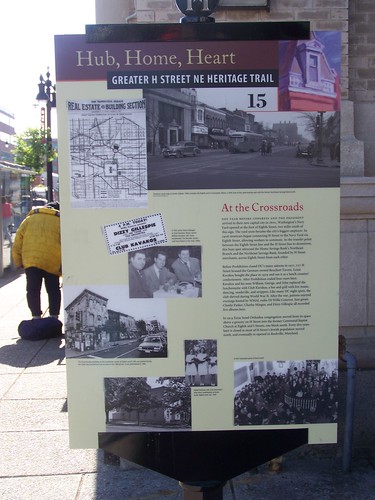
H Street Heritage Trail sign, northeast corner of 8th and H Streets NELeft: CulturalTourismDC trail sign on H Street NE in Washington, DC.

Because cultural tourists spend more time and money compared to other segments of the tourism market, this is seen as a particularly desirable segment of the market.

DC and tourism planning.  DestinationDC is the city's tourism bureau, called a "convention and visitors bureau" in the trade.  It mostly focuses on landing big events to be held at the Convention Center.

It doesn't provide systematic support for sub-city tourism initiatives and services, unlike say, Miami ("Why Miami-Dade has more visitor centers than any city in the U.S.," Miami Herald).

While regional tourist centers experience a high demand of information on DC, because DC is the primary visitor destination, for the most part DestinationDC doesn't provide information to those centers (guidebooks and maps) unless they pay for them.
    Urban Cultural Tourism and DC (and Salt Lake City)

    In DC, CulturalTourismDC is the leading organization focused on strengthening local history interpretation.  They used to sponsor walking tours across the city in the spring and fall.  Now they only do this in the fall.

    CTDC's funding has dropped considerably over the years and I argue that the local tourism destination marketing organization, Destination DC, ought to do more focused funding of development activities for cultural destinations. 
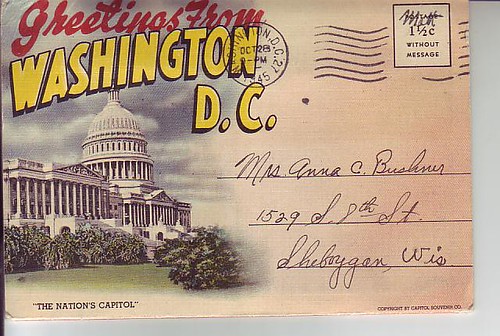
    Greetings from Washington, DC 1945 Postcard Folder Linen Vintage (item 230017469602While I hesitate to use the word "unique" in comparing jurisdictions, DC (and Salt Lake City, which is defined in terms of its place as the headquarters of the Mormon Church, or Vatican City and its place as the Holy See) has a unique tourism marketing problem in that it is defined globally as the Federal City, the US National Capital, and this shapes very specifically what visitors want to consume when they come here:

    - US Capitol
    - White House
    - Museums on the National Mall, especially the Air and Space Museum, but also the Museums of National History and American History
    - the Monuments on the National Mall
    - Mount Vernon, George Washington's plantation
    - Alexandria and Georgetown as old port towns but mostly as commercial districts with historical references
    - maybe the Kennedy Center
    (and for certain audiences, the Franciscan Monastery and the Shrine of the Basilica of the Immaculate Conception, both in Brookland).

    National "cultural tourism" versus "neighborhood cultural tourism."  That doesn't leave much time, space, and interest for visiting "local DC."  Note how the souvenir postcard folder pictured above doesn't feature "local" historic landmarks, but landmarks related to the federal city.

    One of the problems of neighborhood-based tourism in the city is that while you can walk around attractive neighborhoods and appreciate the architecture, or follow a heritage trail, there are few attractions to visit and the retail and restaurant options are limited.

    Fortunately, as the city's population increases, it supports more interesting local businesses and a restaurant scene is developing ("In DC, a Street's Grit Gives Way to Glamour" and "A Trendy Turn in Obama's Town" from the New York Times and "DC's Diverse Cuisine," from the Cooking Channel show "Chuck's Eat the Street").

    Eastern Market is one of the few neighborhood attractions of major scale outside of a shopping district, but is more likely visited in association with the out-of-town visitor market associated with people who live here.  The National Zoo has a mix of local and out-of-town visitors.

    Union Station is called the city's #1 visited place, with more than 20 million visits each year, but the majority of these visits are associated with local transportation (subway and commuter related railroads) and aren't really tourist visits.

    Salt Lake City has a similar marketing positioning problem in terms of how it is perceived as the home and headquarters of the Mormon Church and therefore "everything there to see must be related to the Church."  That is decidedly not true--and Utah more generally has been very successful at marketing its outdoor activities as part of its tourism offer.

    With the failure of the City Museum here in 2004, and my realization that we don't have a "local" art museum devoted to local and regionally relevant art, I have come to realize how problematic it is that we don't have a wide ranging cultural plan and our funding scheme for local attractions is disjoint--we spend a lot of money, but we don't spend it very well. 

    I can't even count the number of entries I've written on the topic, but here are some:

    -- "Town-City branding or 'We are all destination managers now'"
    -- "Tourism Marketing and DC"
    -- "You (Don't) really like me--DC and its suburbs"
    -- "Who DC? -- More about DC tourism"
    -- "Civic Tourism"
    -- "Central Library Planning efforts and the City Museum, how about some learning from Augusta, Maine, and Baltimore"
    -- "Cultural resources planning in DC: In the land of the blind, the one-eyed man is king"

    I have argued that the city should manage itself in terms of heritage and tourism as a cultural landscape, comparable to a "heritage area," whether or not the city aimed to create a formal heritage area or seek federal designation as a national heritage area.

    Visitability

    The New York Times reported about how the local Convention and Visitors Bureau, NYC & Company, has put a visitor center in Macy's, because the store gets a huge number of tourist visits, more than six million annually.  See "Tourist-Hungry New York to Put Visitor Center in Macy's."

    I came across some interesting work from Australia (via the Australian National Tourism and Events Excellence Conference website), including how Destination Melbourne is refocusing their work on the elements which make cities great places to visit, which they call "visitability."  The concept is based on a presentation to the organization by Rick Antonson, CEO of Tourism Vancouver, and focuses on five elements equally important to residents and visitors:
    • Safety
    • Access and transport
    • A sense of community – no matter where you are from
    • Confidence
    • Good infrastructure that serves the people
    These elements comprise the offer by the "place" and end up being "packaged" and consumed through experiences at particular places and destinations.  Personal, unique, and memorable experiences allow people to make deeper relationships with the place.

    Bad experiences are memorable too... 

    Destination Melbourne is creating a "visitability framework" to focus their efforts in making Melbourne a "compelling destination" and driving continuous "improvement in services and experiences" offered to residents and visitors.
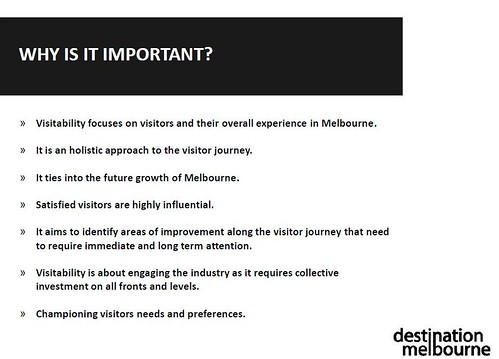
    Visitability, from a Destination Melbourne presentation
    Slide from a presentation by Destination Melbourne at the TEE Conference.

    NOTE that in the urban planning world, especially relating to transportation and the built environment--although because of a strong bike helmet requirement, bike sharing has basically failed there, and livability, Melbourne is highly touted and has been picked by The Economist Magazine as the world's most livable city for three years in a row.  See "Melbourne ranked world's most liveable city - again" from the Melbourne Age.

    So they must be doing something right.  Even so, clearly they aren't satisfied with resting on their laurels, and partly this is because when the compare their city to others, "they have no great icons - no Rock, Reef, Opera House, SeaWorld, Disneyland or Giant Pineapple."  This motivates them to work harder.

    But the visitability concept is applicable to tourism entry points at all levels: sub-local; local; regional; state; and national/international. 

    Visitor Center policies and case studies
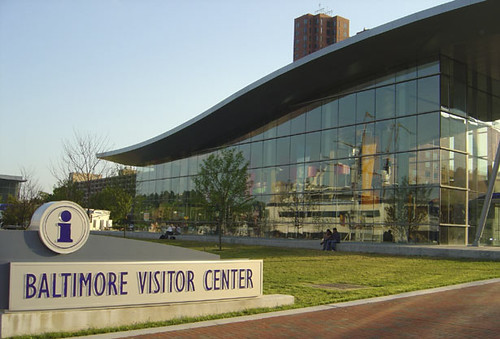
    Baltimore_VisitorCtrLeft:  The Inner Harbor is Baltimore's #1 visitor attraction and the Visitor Center is located in a building on the waterfront.  

    Most states have a network of visitors centers, which are typically run by the state tourism agency (which is usually part of the Dept. of Economic Development) in conjunction with local destination marketing organizations.

    Cities may have more than one visitors center, a main location definitely, and sometimes subsidiary centers.  New York City has main tourist centers and certain business improvement districts, like Chinatown and the Fashion District, run local visitor centers.  Pittsburgh has a main center in the Golden Triangle and secondary centers at highly visited attractions such as the Pittsburgh History Center (a great local history museum).  Petersburg Virginia has a main visitors center in the city, but they also run a "state" visitors center on I-95, and include some artifacts displays there as well.
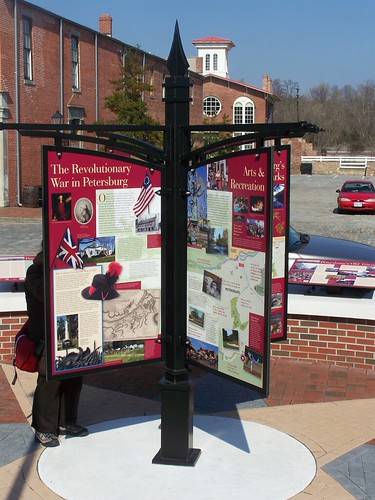
    Kiosk, historic/history interpretation, Petersburg, VARight:  Petersburg has a great set of cultural-historic interpretation signage in the plaza across from their visitor center (which is located in an old railroad station).

    For the most part, DC proper doesn't really have a visitor center, while most other big cities do.

    At the state level the hierarchy is bigger centers at main entry points and in big cities, and smaller centers at the city/county level.  A third level is information racks that are placed at hotels and other places, and to be included organizations pay for their information to be distributed. 

    Most US states and the largest cities have excellent tourism development programs, as do many foreign nations, such as the Provinces of Canada.  Their reports and guides make useful resources.

    While DC doesn't have a main visitor center comparable to other large cities, there are a number of "main" visitors centers run by federal agencies.  The Smithsonian has one.  Congress has one (the Capitol Visitors Center).  The National Park Service runs the visitors center associated with the White House.  There is a visitors information desk in the Convention Center.  In the past, the DC Chamber of Commerce ran a visitors center buried in the Ronald Reagan Building.

    Federal visitor centers do not distribute any information produced by local organizations, including DestinationDC.  An interesting wrinkle is that compared to traditional visitors centers which are "codification points" for a wide variety of information about nonprofit and for profit visitor experiences, ranging from museums and parks to antique stores, restaurants, and hotels, federal laws preclude at least the CVC and the White House center from providing any other "local" information.

    This makes them singularly un-useful from the standpoint of promoting "local DC" to people visiting the city, other than their visits to federal facilities.

    In my opinion, DC should have a main visitors center at Union Station and should provide support to permanent secondary centers in certain key commercial districts like Georgetown and Capitol Hill, with the ability to have more temporary set ups (Arlington County has a mobile vehicle, Downtown Bethesda has a rolling kiosk, Montreal supports both permanent secondary centers such as at the Mont Royal Metro Station and temporary movable kiosks such as in the summer months in "The Village").  The federal visitor centers should be integrated into this system, and an attempt should be made to get these facilities to carry all types of information relevant to visitors.

    I have written about this more extensively: "A National Mall-focused heritage (replica) streetcar service."

    Left: the Silver Sightseer streetcar in front of the US Capitol, sometime before October, 1962.

    Besides marketing their state and providing information to potential and actual visitors, Tourism Queensland offers a wide variety of resources to the industry, including an active support and research program for "Visitor Information Centers."

    -- Visitor Information Center Policy Resource Kit, Tourism Queensland
    -- Visitor Information Center case studies, Tourism Queensland

    DC does get from 13 million to 17 million visitors annually, and while that is only about 1/3 of the number visiting NYC, it's still a lot.  It would be good to benchmark the area's visitor centers, and DC's offer against what it argues are peer cities.

    Consideration of the findings by Tourism Queensland can inform improvement efforts here.

    Airports, visitability and international visitors: 
    Bureaucracy dooms the brand promise of Brand America

    Another "problem" is that three of the main entry points into "Washington" aren't in DC proper-- National Airport and Dulles Airport in Virginia and Marshall-BWI Airport in Maryland.  Each has a visitor information desk, but none of the services are comparable to the airports with the best visitor information set ups.

    Plus, at Dulles Airport especially, the experience for visitors leaves a lot to be desired, which is something that Tyler Brule of Monocle Magazine mentions from time to time, especially in his weekly column in the Financial Times, where he has been very negative about Dulles Airport, because of big problems with the customs entry process.  From "Let’s play ‘Guess where I am?’":
    I’ve just come off an airliner and it’s absolute pandemonium. There are gate agents screaming for transfer passengers, there are sniffer dogs, there are loads of immigration officers and there’s a general sense of disorganization. My fellow passengers look bewildered and flustered after their eight-hour, 45-minute flight from Frankfurt, and there’s a lot of huffing and puffing as we’re divided up into groups of arriving passengers and “connectors”. ...

    description of 1,000 people waiting to go through ICE at shift change, when many people leave their posts, with the result that even fewer agents are there to work with the passengers.

    As I approach the desk, I feel like giving the young gentleman a lecture about how bad this whole performance is for Brand USA – particularly on top of a whole week of television reports about the new fee that visitors will have to pay to get a visa and how these funds will be used to create a campaign to encourage more tourism to the US. I want to ask him if he (and his bosses not far away in the District of Columbia) think a 90-minute wait in a dumpy airport is any way to welcome the world and if his department is really that interested in having people visit the US.

    Of course, this is even worse now given the "America First" and anti-global rhetoric and actions of the Federal Government as discussed in the previous entry, "National Tourism Week (May 7th - 13th), Public Diplomacy, National Heritage Areas, etc."

    Combine this experience, plus the then less than sterling experience of getting to the city from the airport--this will change in a few years when there is subway service there, but the location of the subway station will be less than ideal--and then think about what this says not only for BrandAmerica ("Brand USA, a campaign to lure back foreign tourists — and their money" Washington Post and "Re-branding America" from the Sunday Boston Globe) but BrandDC (see the blog entry "Creating Brand Washington"), and is it any reason that the number of international visitors to the US is falling?

    Note that while the FT piece is from 2011, the problem at Dulles continues.  See "Editor's note: BWI is the big winner in the battle for passengers" from the Washington Post.  And the MWAA has responded with a advertising campaign.  But I would aver the problem is more structural and fundamental--something that marketing can fix, but advertising can't.

    An evaluation of area airports in terms of the "visitability" approach is long overdue.  Also see the past blog entry, "More on transportation to the DC area airports." which discusses airports planning at the regional scale.

    Local airports and the provision of visitor information

    That the area's major airports are in Maryland and Virginia and not DC complicates the realization of my recommendation that there should be a coordinated set of visitor centers at the region's airports, as part of the DC city network of visitor centers.  There are information desks at each of the airports with some visitor information.  But there should be a much better offering than there is currently.

    But I don't claim it would be easy to get the airports and Destination DC to come together and do this.  Also, Maryland has visitors centers north and south of Baltimore on I-95 and they might think that this suffices, although such facilities only target automobiles, and miss out on reaching people on mass transit of various sorts.
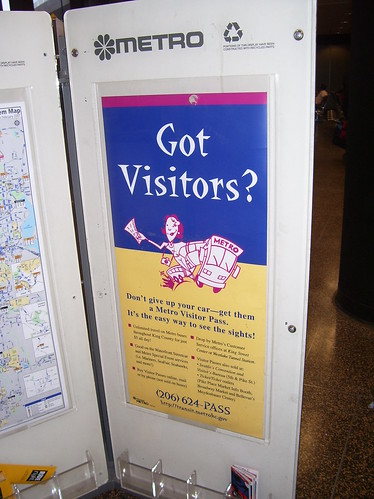
    King County Metro Bus promotional poster at an information rack at the Seattle-Tacoma Airport
    Right:  King County, Washington Metro used to have a kiosk in the airport terminal promoting bus transit use.  Now that they have a light rail station at the airport, they seem to have removed marketing materials from within the airport terminal.

    Airports and transit

    Transit wayfinding needs to be improved at all the airports, especially to be able to reach people who are less accustomed to riding transit, and therefore need more information in order to be comfortable in choosing it.

    That's discussed here, "More on airport-related transit/transit for visitors."

    Comprehensive airports planning at the regional scale would address public transit issues as well.  It's really a surprise (not) that this isn't done.  

    A key element of appealing to international visitors is a reasonably efficient transit system for getting to the major lodging centers in the metropolitan area.  This will improve for Dulles Airport with the extension of Silver Line service there sometime within the next 5-6 years.

    Transit service to BWI Airport is pretty good, considering the distance from DC and has improved as BWI improved its surface transportation programming, integrated bus service to and from the train station into its ground transportation system, and MARC added weekend train service on the Penn Line.  Light rail service to the airport is available from Baltimore, and WMATA runs a bus from the end of the Green Line Metro at Greenbelt--although this ride is now so expensive it's cheaper to take a MARC train.
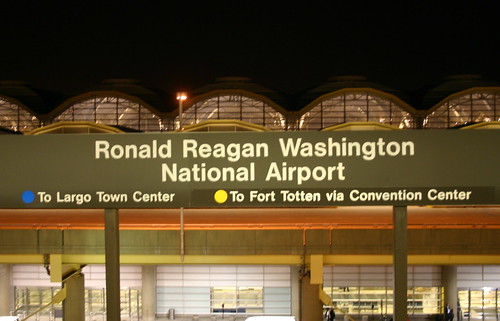
    07.WMATA.RRWNA.VA.08mar07Left:  Flickr photo by Elvert Barnes.

    National Airport has great transit service when the Metrorail is running--the subway station is conveniently located for reaching both terminals--and paltry service when the subway isn't running and airplanes are still landing and taking off.

    Conclusion


    DC needs to truly up its game as far as visitability, cultural tourism, and visitors centers are concerned. 

    National Tourism Week, World Tourism Day and other tourism promotion activities are a way to call attention to the need for better tourism planning, development, and management activities in DC.

    Labels: , ,