Rebuilding Place in the Urban Space

"A community’s physical form, rather than its land uses, is its most intrinsic and enduring characteristic." [Katz, EPA] This blog focuses on place and placemaking and all that makes it work--historic preservation, urban design, transportation, asset-based community development, arts & cultural development, commercial district revitalization, tourism & destination development, and quality of life advocacy--along with doses of civic engagement and good governance watchdogging.

Friday, October 11, 2019

Reopening of Anacostia Community Museum: Sunday October 13th

Why this is important is not so much a chance to meet the new director, but to see the fabulous "Right to the City" exhibit, which I think is a great model for showing how to present community history at the neighborhood scale.

The neighborhoods it covers are Adams-Morgan, Anacostia, Brookland, Chinatown, Shaw, and Southwest.

It takes 3-4 hours to go through the exhibit. It is rich and deep. One of the great scores is footage from ABC-TV featuring Dr. Martin Luther King, Jr. riding in a parade and his speech to the group, a Shaw neighborhood improvement initiative led by civil rights activist Walter Fauntroy, Jr., who later became DC's Congressional Delegate.

====
For me, having been in DC since 1987, I feel like civil society today here is pretty weak. The exhibit shows that in the 1960s and 1970s especially that was decidedly not the case.


Labels: , , , , ,

Saturday, August 24, 2013

Washington, DC and protest

Being the National Capital, Washington, DC is a symbol of the nation, and the National Mall is frequently a place of celebration; such as events held during the Presidential Inauguration; festival, such as the annual Smithsonian Folklife Festival or National Book Festival; and protest, ranging from the Bonus Army marchers in the 1920s, the Anti-War protests in the 1960s and 1970s, and of course, many marches on Washington for peace, justice, and civil rights, including the 1963 March on Washington for Jobs and Freedom, which is being celebrated this weekend, its 50th anniversary ("50 years later, thousands retrace March on Washington," USA Today).

I collect postcards about Washington, images of either the Federal City as well as the local city (restaurants, landmarks located within neighborhoods, church buildings, etc.), and I am especially interested in the messages that visitors write on the postcards which tells about their impressions of the city.

One of the great things about DC ephemera (and sadly, with the migration of such materials to the Internet they cease to be able to be collected) is that back when people sent postcards and such, they sent them home to friends and relatives, so you can find good stuff all around the country.

I picked up some postcards in Seattle.  Going through them at the shop I set interesting ones  aside for further review.

Suzanne commented on this one, it seemingly being a particularly average "Greetings from Washington" postcard.  She wondered why I wanted to spend money on such a boring card.

But I wasn't interested in the cover image.  It was the message.

The person visiting the city came during a big Anti-War protest, the "Moratorium," and the message comments on how the protest made getting around difficult, that streets were closed, and also full of people.

Some of the other elements I look for in postcards are the postmarks--most are generic "Washington" postmarks, but I've picked up postcards with Takoma Park, Brookland, Terminal Station (Union Station), and Mount Vernon on the Potomac (Mount Vernon, Virginia) postmarks--and the cancellation message, which on occasion may be interesting.

This particular postcard was sent by a health care professional to someone that she worked with, addressed to a specific medical ward at the hospital.  She had come to DC for a conference.

Maybe this is some of what she saw. 

Caption: With the U.S. Capitol in the background, demonstrators march along Pennsylvania Avenue in an anti-Vietnam War protest in Washington, on Moratorium Day, November 15, 1969.  From: an AP file photo reprinted in a North Jersey Herald history feature on events in the year 1969.

Labels: , , ,

Thursday, February 16, 2012

Ford's Theatre Center for Education and Leadership

Image: Ford's Theatre Center for Education and Leadership in Washington on Wednesday, Feb. 8, 2012. The new museum, located across from Ford's Theatre and next door to the house where Lincoln died, will open in time for President's Day. ((AP Photo/Jacquelyn Martin))

The Ford's Theatre, a landmark and tourist destination in DC because it is where President Lincoln was shot by John Wilkes Booth, is opening a museum and educational facility across the street. The facility will be open for free as part of an open house on February 20th, which is Presidents Day, and will be open to the public with an admission charge starting on February 21st.

Labels: , , ,

Wednesday, November 02, 2011

More stuff to do: #2, Washington DC Historical Studies conference

Tomorrow, Friday, Saturday, and a Sunday bus tour

Labels: , , , , ,

Thursday, October 13, 2011

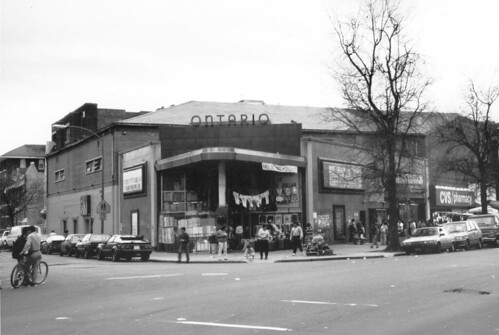
DC's Ontario Theater's interesting history

Ontario Theater in 1994
Flickr photo by Scott Seymour.

The Streets of Washington blog has a nice entry on Adams-Morgan's Ontario Theater, "The Ontario Theatre's Many Past Lives." The theater was converted to a drug store and other retail a couple decades ago.

From the history I learned about Carlos Rosario, who has a school named after him. He was one of the founders of the DC Government Office of Latino Affairs, and owned the theater for a time.

Rosario showed Spanish language movies on Sundays and during the week, the theater was managed by a guy named Seth Hurwitz. Well, Seth Hurwitz is the founder of the concert company IMP, which owns the 9:30 Club and manages the Meriweather Post Pavilion in Columbia, Maryland and they would like to revive the Uline Arena as a concert hall. At the time Hurwitz was a radio DJ and did booking at the Ontario--music acts and movies. From that he grew a business.

Interesting.

There is a lot of great history in the buildings in our commercial districts (as Alex Wall says, "commerce is the engine of urbanism") and it is too easily forgotten, especially as retail business "chains up" and the key decision makers are located elsewhere, outside of a locality or region.

Labels: , , , ,

Sunday, September 25, 2011

WalkingTown & BikingTown DC

Aerial view, U.S. Capitol Grounds. Image: Architect of the Capitol.

I have been remiss in not mentioning that this weekend and next weekend, CulturalTourismDC is once again holding WalkingTownDC and BikingTownDC, walking and biking tours of various places across the city.


Many of the tours require reservations.

There are still many interesting tours today, and next weekend, plus next week there will be lunchtime and evening "happy hour" tours.

Interesting topics include the Swampoodle neighborhood that is now "NoMA" (although the registration list is full), tours of the grounds of the U.S. Capitol, which were designed by Olmsted and Vaux, the Park View neighborhood adjacent to the Petworth Metro Station, the Rock Creek Cemetery), Georgetown, previews of upcoming "heritage trails," a fitness oriented walk of some of the city's circles and squares, the art collection at the Convention Center, a bilingual tour of some of the Hispanic related sites in the city, and one focused on sites related to the "temperance" movement.

BikingTown tours include the monuments, the Anacostia Riverwalk Trail led by Councilmember Tommy Wells, the National Arboretum, a Coffee House "Bar" Crawl, and the Civil War Defenses of the city ("Fort Circle Parks").

Labels: , , ,

Friday, September 23, 2011

Joseph Passonneau (obituary)

Image of the bike path along Interstate 70 in Glenwood Canyon, Colorado. From Rocky Mountain Scenery.

Yesterday's Washington Post ran an obituary for Joseph Passonneau, one of the city's leading urban designers.

He is known for his work on DC urban design issues--e.g., he suggested that the Southeast-Southwest Freeway be converted to an at-surface boulevard, and is the author of Washington through Two Centuries: A History in Maps and Images, although the book is focused on the central business district (Downtown), and it has a great set of maps of the district at different points over the past 200 years.

And in the Catholic U architecture library, I came across the Central Washington Transportation and Civic Design Study from 1977, which had, among other graphics, this one, which I publish in various blog entries from time to time.
Mobility efficiency -- Passonneau

But the obituary, and two from St. Louis, "Joseph Passonneau dies, architect who fought to build Arch" (St. Louis Post-Dispatch,) and "Joseph Passonneau: Architect and engineer who designed part of interstate highway system" (far more detailed than the others, from the St. Louis Beacon), informed me about stuff I didn't know, that he had been dean of the school of architecture at Washington University in St. Louis, and he was instrumental in the development of the Gateway Arch there.

Plus, I had no idea he was one of the lead designers of the Glenwood Canyon section of Interstate 70 in Colorado (see "Glenwood Canyon 12 Years Later" from Public Roads. From the standpoint of integrating bicycling as a mode of transportation, and providing connections to park resources, this freeway project is an outlier in the history of U.S. freeway building--the only fault I have "with the project" is that for whatever reason, the Federal Highway Administration didn't capture these practices and processes and communicate them far and wide to the highway departments in other states.

From the St. Louis Beacon article:

Glenwood Canyon in Colorado has been the primary route through the Rocky Mountains since before wagon trains gave way to the iron horse. But a 30-year controversy over environmental concerns, aesthetics and economics kept the canyon outside of the interstate highway system until 1992. Finally, a long-planned engineering feat by Passonneau and fellow architect Edgardo Contin transformed the 2000-foot-deep I-70 passageway into a transportation work of art.

"It's a monumental accomplishment of great beauty and engineering skill," said Eugene Mackey III, an architect and former student of Mr. Passonneau. "His negotiation with the public was also an extraordinary accomplishment."

The canyon highway's final design included 40 bridges and viaducts, five tunnel bores (traffic openings) and 15 miles of retaining walls for a stretch of freeway 12 miles long.

In 2000, Mr. Passonneau received the Presidential Award for Design Excellence from President Bill Clinton for the canyon work.

Mr. Passonneau's daughter said the beauty of the Glenwood Canyon project epitomized her father's philosophy of his work. "He wanted to ensure that the ecological impact was minimal," Polly Passonneau said. "His maximum focus was on the human."

Labels: , , ,

Saturday, January 15, 2011

East of the River exhibit at the Historical Society

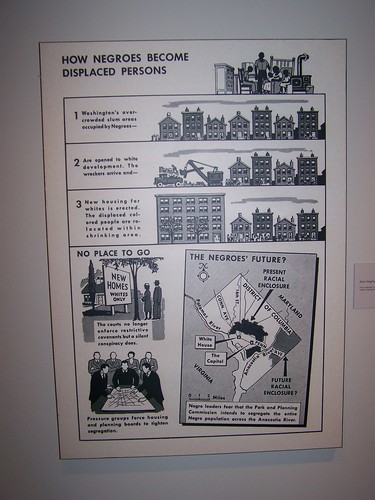
While I don't think it's the most amazing exhibit, the exhibit, "East of the River: Continuity and Change," produced a few years ago by the Smithsonian Anacostia Community Museum and now on display at the Historical Society of Washington til the end of the month, is worth looking at. There are some interesting images, a good explication of the historical themes, and a set of video oral histories on a loop.
012

"How Negroes Become Displaced Persons."  From the National Committee on Segregation in the Nation's Capital.  Segregation in Washington (1948).
"How Negroes Become Displaced Persons." From the National Committee on Segregation in the Nation's Capital. Segregation in Washington (1948).

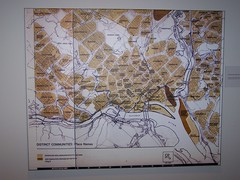
DC Neighborhood place names, from
DC Neighborhood place names.

Labels: , , , ,

Tuesday, August 24, 2010

2010 DC Historic Preservation Conference

Friday Sept. 24th and Saturday Sept. 25th.

More information here.

Labels: , , ,

Tuesday, April 27, 2010

Book talk and signing: Washington at Home

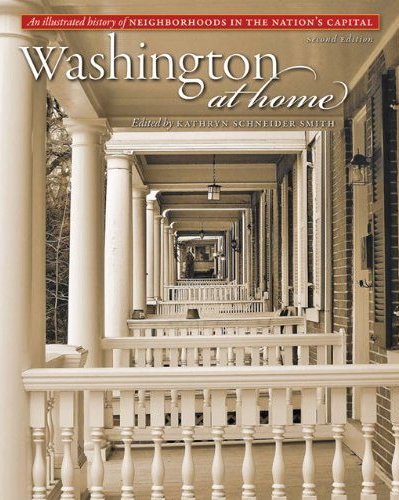
Washington at Home, edited by Kathy Smith
From H-DC via email:

1 p.m. Saturday, May 1
Politics & Prose Bookstore
5015 Connecticut Ave. NW
Washington, DC
Information:202-364-1919

Kathy Smith, the historian, the founding executive director of Cultural Tourism DC and a past president of the Historical Society of Washington, D.C., discusses the newly-updated " Washington at Home: An Illustrated History of Neighborhoods in the Nation's Capital."

Labels: ,

Saturday, December 05, 2009

Author talk tomorrow--DC: Politics and Place

From the Historical Society of Washington website (the HSW is Downtown at the Carnegie Building on Mount Vernon Square):

Sunday, December 6
2:30 - 4:00 p.m. HSW Author & lecture Series
WASHINGTON D.C.: POLITICS AND PLACE
By Mark N. Ozer

“The District of Columbia is a place devoted to politics. Thus, it offers a unique opportunity to explore the interaction of geography and history, the place and the effects of politics on that place. This book describes the impact of the historical developments on the place evidenced by structures and other artifacts that the reader may explore today. Each era is exemplified by its characteristic design starting with the neoclassic original public buildings. These developments are crystallized in the manmade modifications—the streets, the landscapes, the buildings, and monuments—the changes in space that document the political trends. At each stage, the book focuses on specific buildings, their sculpture and other decoration that embody these changes. The political changes include the evolution of the concept of America from its republican origins with limited suffrage to people of different religions and races. Modernization and globalization have occurred while the previous layers of local and regional identities and earlier political thinking remain. Concurrently what had been a town in the Tidewater region developed into a national capital and then a world capital.”

“Thoughtful and useful guide to the current city. Skillful demonstration on how the city’s history and geography interact to capture the political philosophy of the American Experiment.” — Donald Kennon, Vice-President for Scholarship and Education U.S. Capitol Historical Society

About the Author

Mark N. Ozer, in his travels and writings, has explored the interaction of history and geography of many of the great cities of the world. A resident of Washington since 1964, he has found the place of especial interest as he has interpreted it both to visitors and inhabitants who are seeking a deeper understanding of the meaning of America. Copies of the book will be available for purchase and autograph by the author.(Ages 16 to Adults) No RSVP required. FREE

Labels: ,

Monday, November 02, 2009

Tonight, TV documentary: Washington in the '60s

A special documentary produced by WETA-TV, one of the local PBS television stations in the DC region. It's on at 9pm.
Washington 60s: DC Home Rule Rally - 400x300
Opening of Rally for DC Home Rule (Photo credit: Star Collection, DC Public Library; © Washington Post)

Washington 60s: Civil Rights March on Washington DC - 400x300
Civil Rights March on Washington, D.C. at the Lincoln Memorial. The photograph shows two men in the foreground reading a newspaper with the headline: "They're Pouring In From All Over." (Photo credit: Prints & Photographs Division, Library of Congress)

Labels: , ,

Sunday, September 27, 2009

Marketing the local experience that is also DC

Tourists determinedly taking on Washington on the National Mall
People visiting "Washington." (Original photo source unknown.)

I have written about this a lot over the years, this is putting together some of my responses to a thread about the topic on the HistoricWashington e-list, with the added benefit of some post-sending editing.

The biggest problem with "selling" DC history is that the entire world interprets "local DC history" through the lens of the story of the founding and continued management of the United States of America.

And don't under consider the issue of charging admission in a city where the majority of the most in demand destinations are free. It's not like the Phillips Collection and the Corcoran Museum of Art, which need to charge admission as a part of their revenue generation model, thrive vis-a-vis the National Gallery of Art and the Smithsonian art museums, which do not charge admission fees. (See "Museum negotiates masterpiece of a deal" from the Washington Business Journal, about the Phillips Collection.)

Note also that while the International Spy Museum (a for profit entity) has thrived, despite having to charge admission, the Madame Tussaud's Wax Museum has not.

So developing the local narrative, packaging it, and selling it becomes a "Market Development" (look up the term in the marketing literature) problem of almost immeasurable difficulty.

The people who visit DC come here to go to the Smithsonian Museums, the U.S. Capitol, the White House, the Washington Monument, maybe Mount Vernon (are you familiar with the complete reworking of the exhibits/narrative there over the last couple years), as well as a visit to either or both Alexandria and Georgetown to combine both seeing "old" buildings as well as shopping and entertainment.

While the Destination DC (the local CVB) campaign "Power Play" does market, some, local destinations, the campaign is more focused on the national narrative more than the local. (And these days with the economic downturn, Destination DC has problems too. See "Destination D.C. lays off 12 employees," from Washington Business Journal.)

While it is true that the "cultural tourist" stays longer and spends more compared to non-cultural tourists according to all of the research, "cultural tourists" come to DC to consume a significantly different "non-local" but place-based experience compared to the typical cultural tourist visiting other places

Besides, depending on the tranche of tourist demographics, many stay outside of the city because of the high room rates at hotels/motels based in the city. That is a big issue with National Harbor, the soon-to-be-location of a Disney Hotel (see "Walt Disney to build at National Harbor" from the Washington Business Journal) and local tourism marketing campaigns from other jurisdictions, i.e., Montgomery County Maryland's "DC Days, Montgomery Nights" (mean visit DC during the day but stay in Montgomery County) campaign of a few years back.

To consume a portion of the local story (visit some neighborhoods, walk a history trail, go to a local history museum) visitors will need to stay at least one additional day, which means at least one more rooming night, andspending more money. (Plus let's face it, if you are visiting here with children, going to see decidedly local attractions might be a stretch.)

You mention local corporate support. The DC region has real estate developers (and their support staff--law firms, financiers, and parking magnates in the city) and military contractors primarily. The city is full of nonprofit organizations (trade associations, advocacy groups, universities). The federal government is not a donor organization either.

In short, there is limited support and limited recognition of the value of "DC" as opposed to being in DC to be proximate to the federal government. This makes it doubly difficult to promote a local narrative through a local history museum. To get a better sense of the local business establishment I always recommend the urban sociology article "The City as a Growth Machine." Promoting local history if it can't be adequately monetized isn't high on their agenda.

Then there is the issue of tourism taxes (hotel tax, car rental tax, some portion of restaurant meals taxes). Most go to pay off the convention center. Upwards of $10 million goes to Destination DC, the organization tasked with marketing the city as a place to visit.

Very little goes to fund the development and presentation of local history and cultural assets. (This is discussed in my paper on cultural heritage and assets.) And the while Convention Center supports local hotels and restaurants, although most of the hotels do not have local owners, I do question whether or not the fact that the Convention Center consumes the bulk of the local tourism tax revenue stream is the best use of the money.

The primary reason I advocate for separating out a tourism development and management element within the DC Comprehensive Land Use Plan is to reorient how the city develops, manages, markets, and funds cultural assets.

And speaking of the federal government, specifically the 435 members of the House of Representatives and the 100 Senators. They don't care about DC either. They are in DC because DC is the home of the national government, but they are not of DC.

Since so many of them position their image/role as being "against DC/running against Washington," the last thing you're going to do is see them throw off their yoke of parochialism and focus on what we might call meta-national issues, one of which would be putting resources into the National Capital (buildings, monuments, parks, transportation infrastructure, cultural assets) so that it shines and communicates a great message about "America" (the United States) as a nation that also cares about its cultural as sets and the way it is displayed to the world.

See for a contrast this 1992 NY Times Magazine article about Paris, "Why Paris Works." From the article:

FOR MANY OF THE CITY'S 2.2 million residents and many of the 20 million tourists who visit each year, Paris remains a magical, even transcendent, place. While many Americans shun their own cities as if they were places suffering from the plague, Paris is a city with which countless people still have a passionate love affair.

The people who run Paris know that if their city relied on just the charms of its past, it would lose its magic. Thus, they have sought to superimpose a smoothly running, modern metropolis on the city bequeathed them by medieval kings and 18th-century revolutionaries. And they have succeeded royally.

Garbage is picked up seven days a week, mail is delivered three times a day and all of Paris's 800 miles of streets are swept by hand each day. At rush hour, the subways come once every 80 seconds, and many Metro stops are decorated with mosaics and murals. Affluent families are rushing not to flee for the suburbs, but to buy apartments in Paris's choicest neighborhoods and to send their children to public schools.

There is no single explanation for why Paris works so well. Rather, Paris has become a shining model for urban planners thanks to numerous ingredients lacking in many other cities: ample financing, sound administration, farsighted planning, technological ingenuity, a flair for design and an ambition to always improve.

France puts more federal money than the norm into Paris because Paris is the national capital and because it defines France and how France is "consumed" when it is visited. AND because how France and Paris looks to others matters to people in France, particularly members of the government, but also to many French citizens whether or not they live in Paris.

Congress will spend money on itself--the underground National Visitors Center at the U.S. Capitol cost over $500 million to build. (Note that in the first year, not yet over, the NVC at the Capitol has received over 2 million visitors.) But Congress is less inclined to put money into other parts of the city to improve the quality of the experience. They don't think much about the "nation" and how it is perceived. They do think a lot about their districts and how to get reelected.

I meant to blog about the new "tax," or $10 fee on international visitors. (See the AP story, via the Seattle Times, "Industry pushes new international visitor fee.")

The fee is supposed to fund marketing the U.S. to international tourism markets. Most national governments in other countries have extensive marketing and tourism programs. In fact, I regularly use development materials that are produced by tourism departments from Canada, the United Kingdom, and Australia, because the materials are so good. (Actually in the U.S., most states are quite good at tourism development and marketing, even if I complain about DC's efforts in this area. While not perfect in every respect, both Maryland and Virginia are well respected for their tourism development and marketing programs.)

This fee has been opposed by some quarters, but is in some respects a desperate move to raise money for something that is necessary, but is impossible to get Congress to appropriate money for otherwise.
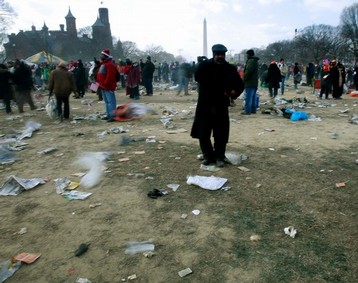
A dirty National Mall after the Obama Inauguration
WASHINGTON, D.C. - JANUARY 20: A man walks past trash after the inauguration of Barack Obama as the 44th President of the United States of America on the National Mall January 20, 2009 in Washington, DC. Obama becomes the first African-American to be elected to the office of President in the history of the United States. (Photo by Mario Tama/Getty Images)

See the AP story, "Neglected National Mall languishes," which reports on how Members of Congress write earmarks for national parks and other cultural institutions in their own states, while voting against appropriations for improvements to the National Mall, which connects the U.S. Capitol, the Washington Monument, and the White House, and is visited by tens of millions of people each year.

From the article:

The mall didn't just lose out on earmarks. In January, Congress deleted $200 million in stimulus funding for the mall. And last year, a bill that would have appropriated $100 million for mall repairs failed.

Republican Rep. Jeb Hensarling of Texas said mall funding wasn't an emergency.

"It's entirely appropriate for Congress to fund repairs for the National Mall in the traditional process, but the American people are smart enough to know that it will do very little or absolutely nothing to provide economic stimulus," he said.

House Republican whip Eric Cantor of Virginia similarly derided efforts to "help upkeep the grass on the lawns of Washington."

Yet Congress invests in sod and flower beds on its own grounds at the Capitol, which are kept carefully manicured, even as the mall — which runs 2 miles from the Capitol to the Lincoln Memorial — has languished.

Congress employs about 1,900 workers to maintain its buildings and 450 acres, while the National Park Service has about 200 maintenance workers for the 650-acre mall and memorials.

To deal with all the very difficult issues recounted above you need more than a blog, you need to have people who are really really good, and very much focused on developing and extending the quality of locally based and significant cultural heritage.

My joke about DC is that the big government (the federal government) trickles down and shapes little government (the local municipal government) and civil society in its image.

So you can imagine we also have a vision and personnel problem too.

Labels: , , , , , ,

Friday, September 18, 2009

Don't forget -- DC history/place walking tours this weekend

Walking Town DC logo

Walking Town DC, the twice yearly weekend set of walking or bicycling tours of places around the city, which is organized by CulturalTourismDC, is scheduled for this coming weekend, Saturday September 19th and Sunday September 20th.

I am leading two tours, one of the Florida Market on Saturday, and an H Street mostly alley tour on Sunday. (WRT the alley tours--I do one of Capitol Hill east alleys in the spring--I am not sure how long I will continue to do them as they are a lot of work.)

Explore Florida Market/Capital City Market
Saturday, September 19
11 am - 1 pm
Meet outside New York Ave-Florida Ave-Gallaudet U Metro station
Florida Avenue exit (Red line)
End at Litteri’s Italian Deli, 517 Morse Street, NE


H Street Alley Exploration
Sunday, September 20
10 am - 1 pm
Meet outside New York Ave-Florida Ave-Gallaudet U Metro Station
M Street exit (Red line)
End at the 1400 block of H Street, NE

Labels: , , , , ,

Wednesday, May 27, 2009

This weekend: WalkingTown tours across the City of Washington

From CulturalTourismDC:

WalkingTown, DC Spring Edition 2009
Saturday, May 30, 2009 - Sunday, May 31, 2009
Location: Across the CityEnjoy a weekend of more than 120 free walking tours (and a few bike tours) in neighborhoods across DC. Discover the cultural capital's vibrant street life and little-known historic treasures with professional and volunteer neighborhood guides!

Too much information? Check the overview schedule.

"My" two tours are:

Explore Florida Market / Capital City Market
Saturday, May 30
10 - 11:30 am
Meet outside New York Avenue Metro station (Florida Avenue exit)
End at Litteri’s Italian Deli, 517 Morse Street, NE

The Florida Market is the city’s major wholesale food distribution center. The tour will stop at restaurants and vendors selling at retail, including the DC Farmers Market building, and address development issues that threaten the market. Led by Richard Layman and presented by Citizens Planning Coalition, Frozen Tropics weblog, Capitol Hill North Neighborhood Association, and Rebuilding Place in the Urban Space weblog.
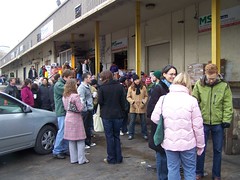
Outside MS3000, Florida Market tour, Saturday 2/23/2008
Outside MS3000, Florida Market tour, Saturday 2/23/2008.

Alley Living in Capitol Hill
Sunday, May 31
12 noon - 2:30 pm
Meet at northeast corner of Third Street and Pennsylvania Avenue, SE (next to the SunTrust Bank)
End near Eastern Market

Alleys were used for stabling horses, industry, and housing the poor in the 1800s and early 1900s. Housing reform, zoning regulations, and urban renewal made most of these uses illegal. Visit Capitol Hill alleys to get perspective on alley dwelling and industry in Washington. Led by Richard Layman and presented by Alley Residents of Washington, Citizens Planning Coalition, and Rebuilding Place in the Urban Space weblog.
Capitol Hill West alley tour
Tour from 2008.

Labels: , , , , , ,

Friday, April 11, 2008

Free Tours of City Places in Washington, DC

Walking Town DC logo
From Cultural Tourism DC:

Cultural Tourism DC presents WalkingTown, DC Spring Edition (Saturday, April 26 and Sunday, April 27), a weekend of free neighborhood walkingtours (and a few bike tours) across the city.

Follow professional guides and community leaders as they share historic anecdotes, point out architectural gems, and discuss current issues. Discover both established and emerging Washington neighborhoods from Capitol Riverfront; H Street, NE; and Anacostia, in addition to better known spots like Georgetown, Capitol Hill, and Embassy Row. All tours are free! Pick one (or several!) at WalkingTown, DC Spring Edition make reservations if needed, and just show up!
---------------
I'm doing tours on Saturday (Florida Market and Alleys in SE/Capitol Hill) and on Sunday (H Street Alleys).

Labels: , , ,

Wednesday, July 25, 2007

Historical Society of Washington, D.C. to be featured on today's Kojo Nnamdi Show on WAMU-FM

From email:

*Board Chairman Merrick Malone to discuss the Society's first new exhibit*

Recovering from the D.C. City Council's debate on public funding for D.C. history programming, Historical Society of Washington, D.C. Board Chairman Merrick Malone will detail the Society's first new exhibit, *Wages of War: Bonus Army to Baghdad,* on *The Kojo Nnamdi Show* on Wednesday, July 25 at 1:00 pm. Society members and supporters are strongly encouraged to join the show, which airs on WAMU 88.5 FM, by calling 1-800-433-8850 or emailing kojo@wamu.org .

The striking and daring exhibit, opening this Saturday, July 28 at 1:00 p.m., explores the parallel struggles of World War I veterans and present-day veterans from the Afghanistan and Iraq conflicts. The Saturday, July 28 exhibit opening program will feature:

· detail about the District of Columbia's war time history and veterans;
·
an opportunity to hear first-hand accounts from veterans;
·
a viewing of the critically-acclaimed PBS video, The March of the Bonus Army; and
· question and answer with the authors of the 2004 critically-acclaimed book The Bonus Army: An American Epic.

Merrick T. Malone, Esq., Principal, Metropolis Development Company LLC, is the Chairman of the Board of Trustees, Historical Society of Washington, D.C.

Labels: ,

Thursday, July 05, 2007

Historic Photos of Washington, D.C. -- Book talk & signing

From email:

Authors: Matthew Gilmore and Andrew Brodie Smith

Sunday, July 8 at 5:00pm
Candida's World of Books
Store Hours Tue. - Sat. 10 am - 9 pm Sun. 12 pm - 6 pm Mon. closed
1541 14th Street, NW Washington DC 20005 (202) 667-4811
toll-free (866) 667-4811 Fax (202) 667-4813

This is an absolutely gorgeous coffee-table book on DC's history! The volume captures unique and rare scenes through the lens of hundreds of historic photographs. Published in striking black & white, these images communicate historic events and everyday life over two centuries of this unique city's history and growth.

Come talk to the authors, learn more about DC's history and enjoy this visual feast of a book!

Preview the photos.

Labels: , ,

Sunday, April 15, 2007

Dare to be great

[Revised around 6 pm Sunday]

L'Enfant Plan, Washington, DC
L'Enfant Plan.

I wasn't able to attend the conference on the future of the Mall on Wednesday (I signed up but since I have missed so much work being sick I can't do anything like go to conferences, including having to miss APA). Fortunately, Phil Kennicott wrote it up in yesterday's Post, in "D.C. Needs to Capitalize On Its City-Like Qualities."

Dammit, DC is a city!

From the article:

It doesn't necessarily have to be that. Yes, as Tangherlini pointed out, the city's self-determination needs to be taken out of the hands of national politicians. But on a deeper level, there's an emotional and intellectual sea change that needs to wash over the city. In many ways, as various speakers pointed out, Washington is a very successful city. We have better mass transit than most cities in the country. We have better cultural institutions than most cities in the country. We have better neighborhoods -- more lovely, more walkable and, for what you get, in many cases more affordable -- than most cities in the country. As Alex Krieger, a professor at the Harvard University Graduate School of Design, pointed out, the city should present itself as "a national showcase for urban living." Which, despite the confidence crisis, is what we are.

Krieger's talk made the distinction between cities and capitals, and he argued that the American notion of a capital is of a city that is "purified," an agglomeration of clean, orderly citizens that is not, in the end, really a city at all. It took Washington a century to look like a capital. And it took another century to make it feel like a city. Now it needs to start thinking like a city, showing the 25 million annual tourists the cutting edge of architecture, sustainable design and development, and the bustle and bumptious energy of a real metropolis. A good start would be a few restaurants that serve until 4 a.m.

But there are a couple things that makes recognizing this very difficult:

1. Many residents aren't originally from the area.
2. They lack a sense of history generally, and tend to be underknowledgeable about urban history and local history specifically.
3. They are imprinted with the suburban development paradigm (automobile centric, low density, segregated uses) which they apply inappropriately to fundamentally urban issues. (Note that DC's zoning code is fundamentally a product of suburban thinking, especially with its orientation about servicing and accommodating the car.)
4. And these problems often imprint true urbanites from places other than NYC or Chicago, who don't understand how cities are supposed to work (this includes most residents of Washington, and those residents who believe in "the American Dream" and that things in suburbs, such as Wendy's franchises are a sign of modernism and achievement and ought to be available within the city as well.)
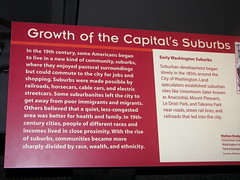
"Growth of the Capital's Suburbs," interpretation board, American on the Move exhibit, Smithsonian Museum of American History
Growth of the Capital's Suburbs, interpretation board, American on the Move exhibit, Smithsonian Museum of American History

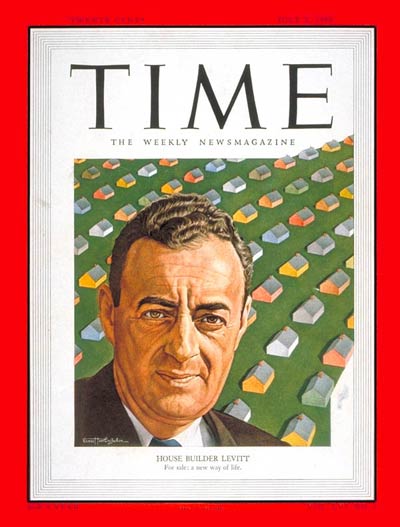
William Levitt on Time Magazine Cover
5. And too often this includes elected and high-level appointed officials.

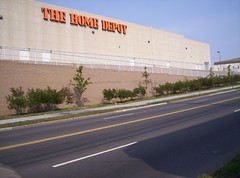
Blank wall anti-urban design, Home Depot, Brentwood, DC
The Brentwood Shopping Center, now called Rhode Island Place, in northeast DC is a perfect example of plopping a suburban design paradigm into the heart of the city. This opportunity should have been seized to repattern this area into a more urban feel, utilizing the air for housing and other mixed uses, leveraging the location immediately adjacent to a subway station. This was done by city officials, who were either unaware or unwilling to push urban design principles on this site and on the developer.
Brentwood Shopping Center, DC

I disagree with Kennicott's assertion that DC needs "cutting edge architecture" to be a city. It needs to recognize and revere what it has, which unlike most cities in North America other than Montreal, is a European feel, with vibrant neighborhoods, density, and an incredible transit system. This is our competitive advantage, that which makes DC unique vis-a-vis almost every other city in the United States, and an advantage that should be strengthened at every opportunity, not diminished.

To recap, for about 5 years, I have testified about what I see as DC's competitive advantages:

1. historic architecture
2. a walking city-based urban design
3. history and authenticity
4. a transit system that allows for non-automobility in the core of the city
5. the steady employment engine of the federal government (cf. Pittsburgh, Newark, Baltimore)

This was complemented by the neighborhood-based historic preservation movement, which worked to preserve DC's great neighborhoods during the many decades in which people didn't want to live in the city.

Note that Cameron Logan, a PhD student at GWU, is writing a fascinating dissertation on what he calls "The Constituent City," based on a report by the National Capital Planning Commission, published in 1950, which for the first time recognized that it was important to plan for the people who lived in the City of Washington, not just around the federal presence. (Lindsay Silver is also writing her dissertation on Capitol Hill and the neighborhood-based organizing there, the rise of the Capitol Hill Restoration Society, fighting freeways and federal government expansion, etc.)

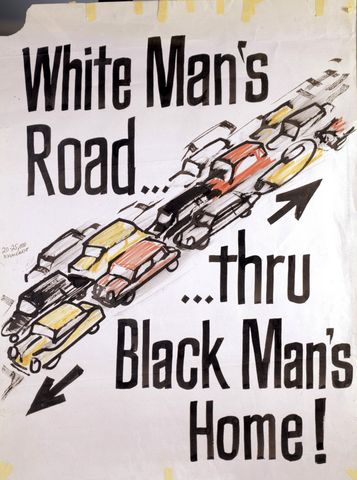
The flipside of the strong neighborhood-based movements was a failure for advocates to focus on city-wide issues, and issues in areas where there were no or few residents, such as downtown, and in areas that lacked the capacity for significant organizing. Of course, one exception to this was the cross-city and multiracial anti-freeway coalition, the Emergency Committee for the Transportation Crisis, which successfully fought off the destruction of the city by freeways--various plans called for a couple of beltways within the city, such as through Dupont Circle, and I-95 along the northeast corridor railroad tracks.
Freeway protest poster, Emergency Committee on the Transportation Crisis, Washington DC
This poster, drawn by Sammie Abbott, was displayed at a demonstration protesting the building of a highway through Washington, D.C. African-American neighborhoods. Artifact. Hand painted sign on paper. Date Made: about 1968. Dates Used: 1968 - 1973. D.C. Community Archives, ECTC Collection, Washingtoniana Division, D.C. Public Library

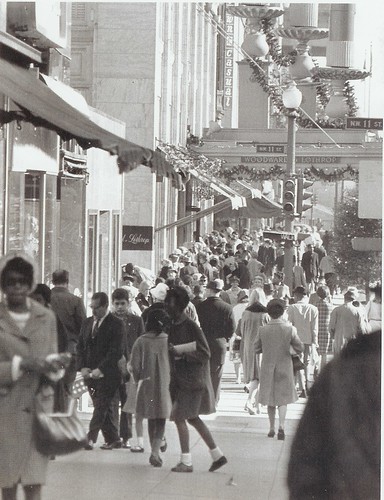
A few years ago, I toyed with the idea of creating a "Jane Jacobs" urban design reading group, never managing to pull it off (I need others to help, I have too much going on). I got a response from someone who argued that unlike NYC, by comparison DC is an "immature" city. The reality is that DC, especially downtown, had all the same characteristics of a traditional city, the kinds described by Cy Paumier in Creating a Vibrant City Center, where the pattern of downtowns (central business districts) as comprised of pedestrian-scaled streets, blocks, and buildings came about because of:

Concentration and Intensity of Use: "The intensity of development in the traditional central area was relatively high due to the value of the land. Maximizing site coverage meant building close to the street, which created a strong sense of spatial enclosure. Although city center development was dense, construction practices limited building height and preserved a human scale. The consistency in building height and massing reinforced the pedestrian scale of streets, as well as the city center's architectural harmony and visual coherence." (p. 11)

Organizing Structure: "A grid street system, involving the simplest approach to surveying, subdividing, and selling land, created a well-defined, organized, and understandable spatial structure for the cities' architecture and overall development. Because the street provided the main access to the consumer market, competition for street frontage was keen. Development parcels were normally much deeper than they were wide, creating a pattern of relatively narrow building fronts that provided variety and articulation in each block and continuous activity on the street." (p. 12)

The street grid, transportation practices and construction technology of the times, and the cost and value of the land led to a particular form of development on city blocks that focused attention on the streets and sidewalks, creating a human-scaled, architecturally harmonious built environment.

As construction technology advanced and taller buildings could be constructed, and as the walking and transit city was supplanted by the automobile, the scale of block development changed significantly, with a focus away from the pedestrian and towards the car.
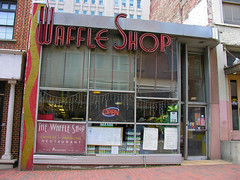
Waffle Shop
Waffle Shop Downtown. Horydczak photo, Library of Congress.

330593280_3e922e751c_b
Current photo of the Waffle Shop by Otavio DC.

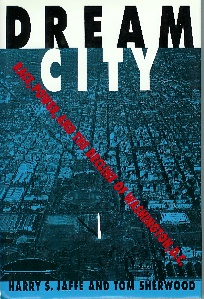
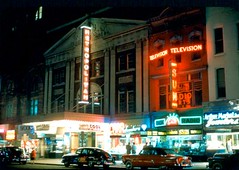
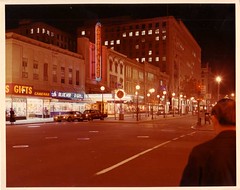
But it got destroyed for the most part by developers like Oliver Carr, who rebuilt downtown into a bunch of superbuildings, destroying the context, destroying life on the street. Now, Waffle Shop is one of the only businesses left downtown that harkens back to the pre-1980s reconstruction of Downtown. (See chapter four of the book Dream City to understand what happened.)
Dream City

11th and F Streets NW, Washington, DC, December 1968
11th and F Streets NW, Washington, DC, December 1968. Washington Star photo.

Metropolitan Theater on F Street in the 1950s.
Metropolitan Theater on F Street NW in the 1950s. Photo from Reston Paths.

'F
F Street, NW, at 13th Street looking west, with "F Street Plaza," DDOT historical photo.

Here are some suggestions for reading about Washington and its history so you don't sound like a fool:
• Washington in Maps: 1606-2000 by Iris Miller
• Washington on View: The Nation's Capital since 1790 by John Reps
• Washington Through Two Centuries by Joseph Passonneau
Washington Then and Now by Peter Penczer (where you start to see some of the old photos of the city)
Washington at Home by Kathy Smith (about neighborhoods in the city)
• context statements for historic districts and thematic surveys (such as for transportation or warehouses) and the printed brochures for historic districts produced by the Historic Preservation Office
• even fiction by George Pelecanos, which describes here and there DC's old ethnic neighborhoods
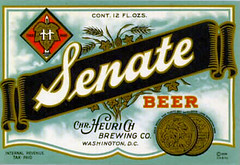
Where DC drank tavern Washington.jpg
• the various books produced by Arcadia Publishing about DC are interesting (although for many the image research is a bit circumscribed)
• the journal Washington History published by the Historical Society of Washington, and the predecessor publication, Records of the Columbia Historical Society
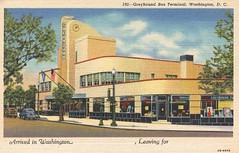
Greyhound Bus Terminal, Downtown, Washington

Labels: , , , ,