Rebuilding Place in the Urban Space

"A community’s physical form, rather than its land uses, is its most intrinsic and enduring characteristic." [Katz, EPA] This blog focuses on place and placemaking and all that makes it work--historic preservation, urban design, transportation, asset-based community development, arts & cultural development, commercial district revitalization, tourism & destination development, and quality of life advocacy--along with doses of civic engagement and good governance watchdogging.

Sunday, October 05, 2025

More examples of cinemas

This article in the Minneapolis Star-Tribune, "Uptown movie theaters were once about facades, ceilings. Now they are about luxury chairs, cocktails," makes the interesting point that the focus of modern cinemas has shifted from a focus on the exterior of the building, to the experientially-oriented benefits package offered to the movie-goer or the interior experience.  Also see "Is there a future for neighborhood theaters in the Twin Cities?," which makes the point that if you don't patronize local theaters they can't survive.

The Los Angeles Times writes about the rise in retro movie showing and going ("Retro movies are hitting big at the box office. Why cinephiles and theaters are going back in time").

1.  In the past, I've written about multi-site nonprofit groups running cinemas in Seattle and how this is a model to keep places open ("Seattle preservation: Pike Place Market, Neptune Theater, and the Cinerama," 2021).  Apparently, it's not working out for the Seattle International Film Festival, which bought the historic Cinerama from the Paul Allen estate ("SIFF lays off staff amid financial challenges," Seattle Times).

I think it's partly because of a post-covid drop in people going out more generally, plus past problems with order in Downtown.

2. "Saving the Garden movie house in Greenfield," Boston Globe
Garden Theater marquee, Greenfield, Mass.

The cinema, a key anchor of the community's downtown, is owned by a resident couple and run as a for profit. Necessary renovations and the $500,000 cost to accommodate digital delivery of movies have been significant costs.

3.  Expansion of the Coolidge Corner Cinema, Boston ("Coolidge Corner Theatre unveils $14m expansion that’s nothing short of cinematic," Boston Globe).

These are just some of the expansion’s marquee features: a pair of theaters that offer an additional 200 seats, an indoor lobby where moviegoers can buy popcorn and beer at the same time, and a third-floor education and events center with sweeping views of Brookline and beyond. 

All told, the $14 million, three-story addition to the rear of the original structure gives the Coolidge six working theaters. The generously proportioned lobby, with sly Art Deco nods to the original building, houses the new box office, so guests no longer have to wait outside in bad weather. Plentiful bathrooms offer amenities on every floor, the education center doubles as a screening room, and projectionists no longer have to clamber up the fire escape to bring film cans to the upper booth. 

Less obvious, perhaps, is that the 14,000-square-foot expansion is the brick-and-mortar embodiment of the Coolidge’s twin ambitions: It promises to secure the art house’s financial future by strengthening its earning potential, while also burnishing the theater’s reputation as a leading regional center for film and culture. 

“This really brings us into that next level,” said Katherine Tallman, executive director and chief executive of the foundation that operates the nonprofit Coolidge. “There won’t be a better place to see a movie.” 

The theater leaned into its repertory programming after it reopened during the pandemic, showing old classics, foreign films, midnight movies, and more. The result: The Coolidge is less dependent on new films than most theaters, last year garnering some 30 percent of revenue from this type of programming. 

But people will only pay so much for a movie ticket. And with four theaters, the Coolidge could only fill so many seats, even as demand (and expenses) continued to rise. “We’re revenue-capped in the current space ... Two additional theaters will not only mean more seats, she said, but will also allow the theater to offer more diverse programming, enabling it to fulfill its daily screenings obligations to distributors, while also beefing up its repertory offerings. 
The Noyo Theater’s neon is a mainstay of Willits’ evening ambiance. Photo taken in December 2024. Matt LaFever/SFGATE

4.  The Noyo Theater in California's North Coast ("A movie theater clings to life in California's 'Gateway to the Redwoods'," San Francisco Chronicle).

Hutchins laid out the theater’s financial reality six months into the endeavor: “We paid $650,000 for the theater. Right now, we’re losing about $9,000 a month. The building’s old and expensive to heat and cool, plus California’s minimum wage is $16.50. What people don’t realize is 60% of ticket sales go directly to the studios. Hard to make money under that model.” 

Devine has bold ideas for boosting revenue. In October 2024, they hosted a successful John Carpenter horror film festival and plan to organize more. Last fall, the theater proved its potential for live events by hosting a comedy show, further expanding its entertainment offerings. With its versatile space, the venue could become a hub for concerts, theater performances and community events.

The Guild 45th Theatre, in Wallingford across the freeway from the U District, closed in 2017. (Peter Liddell / The Seattle Times, 1982)

5.  U District Seattle as a hub of cinema on the decline ("Seattle’s U District no longer the moviegoing hub it once was," Seattle Times).  From the article:

Of course, movie-loving University of Washington students these days don’t need to go out to see “Moonstruck,” or any other title, like we did in the ’80s and ’90s, and that’s in large part why these once-magical spaces are gone. We stay home and stream, where it’s comfortable and there aren’t strangers sitting next to us texting at inappropriate moments. And for most of us that works just fine. I thought it worked fine for me, when I stayed home watching movies for 15 months during the pandemic — but when I finally saw a movie in a theater again, I suddenly remembered why I’d missed it: the bigness, the darkness, the place where I could lose myself and once again be that very young woman dazzled by movies. In a column I wrote in 2021, after that first screening back, I noted that there isn’t a practical justification for going out to the movies, “except that it’s wonderful, and maybe that’s enough.”

6.  A mayor threatened a local cinema for showing a film from the Palestinian perspective ("Miami Beach mayor drops proposal to evict O Cinema for ‘No Other Land’ screening," Miami Herald).

7.  "Classic movie theaters are making a comeback around Philly," Philadelphia Inquirer.  Like the article from the LAT, retro programming is a point of differentiation in a declining market.

Single-screen movie theaters in urban downtowns and on small town main streets began closing nationwide in the late 1940s with the advent of television. This cultural shift also was driven by competition from new theaters near or inside suburban malls and shopping centers. 

“In the 1980s and ’90s, movie theaters helped generate foot traffic for suburban malls,” said Daniel Loria, a senior vice president at the film trade publication Box Office Pro. The launch of online movie streaming platforms — Netflix was first in 2007 — as well as the pandemic kept away people who otherwise would have watched movies in theaters. 

According to the most recent data available from the Cinema Foundation, the number of screens in the United States declined from 41,172 in 2018 to 39,007 in 2022. 

The 2004 opening of the nonprofit Bryn Mawr Film Institute in the former Bryn Mawr movie theater in Lower Merion preserved screens and demonstrated that a mix of classic films, film series, classes, and current movies could breathe life into old theaters. ”We’re not simply taking what Hollywood is giving us, like a Despicable Me 10,” said Collier, whose theaters are in the center of Doylestown, Jenkintown, Ambler, and Princeton.

“Movie theaters are now boosting foot traffic for restaurants and coffee shops in local downtowns,” said Loria.

The Gap Theatre opened in 1949 in the town of Wind Gap. It shut down in January 2020, reopening in March. Photo: Stephen Silver

8.  "The hottest ‘new’ movie theater this summer is a two hours’ drive from Philly," 

In a Northampton County town of fewer than 3,000 people — about two hours’ drive from Center City — a newly restored movie theater is drawing crowds with an ambitious programming schedule that rivals many urban repertory cinemas.

The Gap Theatre, in the town of Wind Gap, first opened in 1949. After operating as a first-run theater for a time, it closed its doors in January 2020, shortly before the pandemic. Revived in March, it now shows all kinds of older films, from acclaimed classics to genre films to rarities, six days a week, with more than 50 films a month. And that includes plenty of double and triple features.

... “What Harry, Michael, and Kaitlyn have done is not only bring NYC-style repertory programming to a nonurban space, but also revitalize a small-town cinema — giving it a second life when it might easily have sat vacant, eventually sold off to developers eager to turn it into a parking lot or something equally soulless,” said Santelli, who long worked at Ardmore’s Viva Video and now programs at the Colonial Theatre in Phoenixville.

Eltrym Theater.

9.  When traveling to the Oregon Coast, came across this cinema on a street parallel to the main street.  

Photo in the daytime.

I'm sure it's well known to residents, but would be missed by travelers unwilling to explore ("Secret Screens: Your Guide to Oregon’s Best Unsung Movie Theaters," Willamette Week). 

They offer a loyalty program which provides various types of awards, including free admission, based on patronage.

10.  "Reinvigorated as Row House Hollywood, an old Dormont theater is almost ready to 'bring some energy'," Pittsburgh Post-Gazette.

With the former Hollywood Theater’s grand reopening only two months away, Dormont businesses and residents are gearing up to once again have a cinema in the heart of their community.

The theater on Potomac Avenue has shuttered a few times in recent years, including in 2008, again in 2010 and, most recently, in 2023. Rebranded as Row House Hollywood, it is slated to open to the public on Nov. 6, with a film nearly as old as the theater itself — Fritz Lang’s 1927 silent classic “Metropolis.”

Owner Brian Mendelssohn, who also runs Row House Cinema in Lawrenceville, estimated the theater will bring anywhere from 300 to 1,000 people to Dormont daily, and that has some residents and surrounding businesses excited for the expected impact on the area’s vitality.

The tough thing about cinemas and commercial district revitalization is that a lot of the patrons only want to do one thing, see the film.  Perhaps the cinema could work with restaurants to provide meal + cinema promotions and deals.

Fitting in with the LAT article on retro cinema, the operator, Row House Cinemas, says it's focused on providing experiences, not just a film showing, so there is potential.

Labels: ,

Monday, April 03, 2023

Adaptive reuse of a high school to a concert space in Portland, Oregion: Revolution Hall

A friend just visited Portland and she and her friends attended a concert, and hung out on a rooftop deck, in a venue that had once been Washington High School, now called Revolution Hall.

Laying the groundwork.  Most cities aren't capable of a willingness to entertain such an idea.  Portland is "exceptional" in that it does.  But I attribute this in large part to the groundbreaking approach of the McMenamin brothers ("Vision and Versatility: The Story of McMenamins," Spirited Magazine, "Preservation Brotherhood," Chicago Tribune, 2004).

First, they started buying movie theaters like the Baghdad Theater on Hawthorne Avenue, and added brewpub functions to help them survive.  In the process they've helped to preserve neighborhood embedded cinemas across the city.

From that they moved to taking on other historic buildings in the city, focusing on tavern and food related operations.  From "The McMenamin Brothers," Northwest Travel and Life):

“I’ve always gone with what just feels good,” says Mike McMenamin, 64, the senior of the two.

Few business plans get very far with a “what feels good” engine behind it. Mike’s laid-back persona belies the astute business savvy within. It turns out what feels good to Mike and Brian feels good to a lot of people, not only those who share their boomer generation, but younger guests as well.

“We sell an experience,” Brian says. A McMenamins property is a destination, not just a place you bed down for the night or grab a meal. The “experience” Brian refers to is unique to McMenamins. And the devil is in so many detail.

... Armed with inspiration, the brothers went into business together in the early ‘80s. McMenamins was born. It has since grown to include nine hotels (with two more in the wings), dozens of pubs and restaurants, movie theaters, spas, music venues, a coffee roaster, and a winery, brewery, cidery and distillery.

“We always try to reach out and be part of the community,” says Brian. This is the offspring of an implicit karma philosophy of doing the right thing. For the McMenamin brothers, it’s not amassing an empire that matters, it’s that each property, each venue is a part of the community where it resides—in the community, for the community.

Kennedy School.  The second key element is the example of Kennedy School, also involving the McMenamins, which has been converted into a bed and breakfast, the Kennedy School Hotel, with a brewpub-restaurant and special event facilities ("From Portland, cues for Philly school-building reuse," WHYY/NPR).  From the article:

A lesson in creative thinking

Neighbors had successfully campaigned to have the Kennedy School historically designated, but several attempts to find an appropriate redevelopment failed. The McMenamins, developers of hotels, brewpubs and entertainment venues in Oregon and Washington, won city approval for their proposal.

It took creative financing, but more importantly, creative thinking. As a result, The Kennedy School‘s 57-room hotel may be not be the weirdest thing in Portland, but it is among the most unique.

The school remains a vital community gathering point by offering public meeting space and through events. The auditorium is now a movie theatre, with weekly matinees and infant-friendly showings; lectures and community events are held in the old library and classrooms; weddings happen in the former gymnasium.

Start with a plan.  I use this case as an example of the difference between issuing a Request for Proposals versus creating a master plan first.  With an RFP, you're at the mercy of the respondents, with a plan, you lay the groundwork for possibilities--hopefully, because a plan can also constrain possibilities--and a community consensus for what can be done.

Portland did a plan for Kennedy School first.  And only after the plan was finished and adopted did they issue an RFP.

-- Kennedy School Master Plan, Portland

And McMenamins was the winning respondent to the subsequent RFP.

They've since gone on to do similar and even more innovative projects across the Pacific Northwest.

Conclusion.  At the same time, the McMenamins have created a/the space in cities like Portland, but also in adjoining states, for the consideration of creative and innovative adaptive reuse projects, that wouldn't normally be considered by most communities, especially for old school buildings still located within neighborhoods.

Their idea of "community citizenship," that the building will remain in the community and they need to be responsive in part to be good neighbors, is also atypical of many developer-operators.

McMenamins has also motivated other organizations to take on similar kinds of projects, and be successful at it.

(Note this argument about the importance of "laying the groundwork" for innovation was also made in an entry about urban design improvements in Downtown Oklahoma City, see "Change isn't usually that simple: The repatterning of Oklahoma City's Downtown Streetscape.")

Labels: , , , , , , ,

Saturday, June 05, 2021

Cultural master plans and Drive in theaters?

In the past, I've argued with smart growthers in Montgomery County, Maryland who wanted to remove the parking lot from the "park and shop" in Silver Spring's Downtown, when that element is key to the historic significance of the complex.  

To me, historic integrity was more important than making the point about automobile-centricity.  Plus, a parking lot doesn't always have to be for parking...


Although, instead of allocating the space for parking, they could use the space more as an events space.  Surprisingly, parking lots are re-purposable.

The Lido Theater in Newport Beach, California remains privately owned, but keeping it open as a single screen cinema remains a struggle.

Another thought, were I to win one of those many hundred million dollar lottery tickets, would be to create a fund to buy and/or support the continuation of various historic theater buildings across the country, creating an organization to provide support, technical assistance, even the creation of a national booking circuit.

Anyway, I have a bunch of pieces about typically missing elements in culture master plans, and how such planning initiatives should be broadened significantly.  Although I don't think I have a separate piece on cinemas.


Add saving drive in theaters to county arts plans: the Redwood Drive-in in Salt Lake County.  I hadn't mentioned drive in theaters.  As metropolitan areas have urbanized drive in theaters have mostly been demolished, as their large footprints have been attractive for redevelopment.


And yes, they are definitely a car-focused use type, and typically this blog isn't focused on that, but history is history.  

Patrons watch "Avengers: Infinity War" on a Saturday night in early May, 2018 at the Redwood Drive-In Theatre in West Valley City. Photo: Josh Terry, Salt Lake Deseret News.

The Redwood Drive-In in West Valley City, Utah is now owned by a real estate developer who wants to convert the property into a housing development ("Developer pulls plans for WVC drive-in theater, swap meet site after community opposition," Fox13).  

From the standpoint of urban planning we have a conflict of interests.  In a booming housing market, adding to housing supply is a priority.  OTOH, saving one of the last examples of a significant use type, from both an arts and historic preservation standpoint, is in order too.  In this case, I vote to save the drive in.

In a cinema element in a community cultural plan, saving and operating various types of cinema facilities ought to be considered.  

Salt Lake County has the opportunity to preserve such a facility, unlike Sonoma County, California ("Drive-in movie theaters gone but not forgotten in Sonoma County," Santa Rosa Press-Democrat).
In Salt Lake County, I vote for saving the Redwood Drive In as a significant cultural asset worth preserving ("Happiness is a drive-in movie and a bag of Twizzlers," Salt Lake Deseret News).

Hull's Drive in from the air.
The Hull's Drive-in in Lexington, Virginia is a nonprofit.  It turns out that there is a nonprofit drive in in Virginia.  The original owner died, the next door property owner bought it but didn't have the money to maintain it, and the community came up with the money to buy it from him and operate it going forward, around 2000.
Salt Lake County is best practice for owning and operating arts facilities.  Salt Lake County is a national best example for financial support for the arts, as a portion of the sales tax, called ZAP, for Zoo/Arts/Parks, is used to support cultural activities and venues.

The county itself owns a number of such facilities, facilities in Salt Lake City and the just opened Mid-Valley Performing Arts Center in suburban Taylorsville ("Mid-Valley Performing Arts Center, a $45 million ‘jewel’ in Taylorsville, opens doors to arts groups big and small," Salt Lake Tribune).  From the article:
The Mid-Valley Performing Arts Center is a new concept for Salt Lake County, which has built a cultural empire with its four venues in downtown Salt Lake City: Abravanel Hall, the home of the Utah Symphony; the Capitol Theatre, where Ballet West and Utah Opera perform; the Eccles Theatre, which plays host to touring Broadway productions and major concerts; and the Rose Wagner Performing Arts Center, home to such groups as Plan-B Theatre, Repertory Dance Theatre and Ririe-Woodbury Dance Company.
The County also owns the Salt Palace convention center and other events centers outside of Salt Lake (including the place where I got my vaccine shots, the Mountain America Expo Center).  Some of these facilities are managed by the national firm SMG.

So having a drive in theater as one of these assets isn't a stretch.

The Salt Lake County program is complemented by other efforts.

The County Library system created an events space and amphitheater at their main branch, which supports various meetings and events also.  

Separately, the local Salt Lake Film Society runs cinemas including one in a c. 1950 building in the 9th and 9th neighborhood called the Tower Theatre, which also contains a video rental facility as another form of cultural preservation ("Why Tower Theater Video Rentals Thrive While Blockbusters Rentals Fail," Utah Stories).  

I'm not sure if city and county monies went towards buying these facilities.  Likely SLFS gets funding from ZAP and the city.

In a cultural master plan, organizations like SLFS need to be acknowledged and included, as stewards of key cultural assets.

Ideal solution.  Salt Lake County should buy the Drive In and have the Salt Lake Film Society operate it.

Labels: , ,

Monday, September 07, 2020

DC's music venues ask for government support

9:30 ClubAccording to the WTOP story "DC music scene rocked by pandemic appeals to city leaders":
Using the hashtag #SaveDCVenues, the campaign by DC Music Stakeholders is hoping to convince D.C. Mayor Muriel Bowser and the D.C. Council to adopt legislation that would help local clubs and restaurants that rely on live music for their income.

DC Music Stakeholders is a coalition of venue owners, area musicians, activists and other nonprofit leaders that have been working together since the coronavirus pandemic began, trying to find financial support for the hard-hit local music scene. ...

Under the proposed act, dedicated music venues would be eligible to receive up to $15,000 a month in support. Smaller restaurants and bars who hosted live music will be eligible to receive up to $7,500 a month.

The coalition is now gathering signatures from the public online, asking people to sign on to an open letter supporting the relief act, so it can deliver the signatures with the letter to the D.C. Council, which is set to reconvene this week.
RamonesCulture planning is pretty weak and tends to not produce discipline-specific plans.  In the first version of "Arts, culture districts, and revitalization" (updated 2019) published in 2009, I wrote that artistic disciplines need to produce discipline-specific plans, including recommendations concerning space, facilities, and venues and cultural history.

I've written a lot about this as it relates to music and radio:

-- "Ground up (guerrilla) art #2: community halls and music (among other things)" (2011)
-- "Song remains the same" (2016)
-- "Under threat: Austin's music industry as an element of the city's cultural ecosystem and economy," 2016
-- "Leveraging music for cultural and economic development: part one, opera" (2017)
-- "Leveraging music as cultural heritage for economic development: part two, popular music" (2017)
-- "Revisiting community radio" (2020)

(Arlington County Library started a punk music archive.  DC Public Library followed. The Seattle Public Library maintains a collection of locally-produced music called Playback.  Some libraries have music practice rooms.)

But even in the more recent "What would be a "Transformational Projects Action Plan" for DC's cultural ecosystem" (2019) I didn't state overtly that this planning needs to include for profit entities, since they are part of the whole.

This is important to state because government planning processes typically only extend to the facilities that the entity controls, meaning that many elements of the functional area as a whole are missed.

For parking and curbspace management that means that privately owned facilities are often ignored--just parking on the street and government owned facilities are part of the planning process.

In a place like NYC, where there are three different public library systems (Brooklyn and Queens have separate systems from "the New York City Public Library" which covers Manhattan, Staten Island and the Bronx) it means that overall planning objectives may be missed.  And this is especially true with other libraries--university, trade association, private, etc., that may exist within a jurisdiction.

In DC, it means that city library planning doesn't acknowledge the libraries of universities, trade associations, private groups, and the federal government, especially the Smithsonian Institution, Library of Congress and the National Archives.

This is also an issue with museums and cultural facilities more generally.

For parks planning it means that a city plan is likely to ignore county, state, federal, and other facilities within the jurisdiction.  But also, for profit facilities that offer fitness and other recreational services, and independent practitioners.

For the music discipline, plans need to drill down for different genres and include privately owned facilities and retail stores selling instruments and scores ("Revisiting cultural plans having elements for retail: music instrument stores"), radio stations featuring locally produced music, etc.," 2020).

Ideally, a functional plan would include the other entities, if only to provide guidance and to be prepared when circumstances warrant.  Especially when facilities face threat of closure or lost of significant funding streams.

Fugazi, Ignition, Moss Icon, Nation of Ulysses punk hardcore flyer
Music venues.  Such is the case with music venues and festivals (and theaters, cinemas, and museums) in the time of the coronavirus, when the facilities are shuttered as a result of bans on group activities ("Music festivals face 'catastrophe' under social distancing rules," Telegraph; "First To Close, Last To Open: Will Chicago’s Independent Music Venues Survive The Coronavirus?," Chicago Block Club; "Financially Vulnerable, Independent Music Venues Worry Of Having To Sell," NPR; "Independent music venues face extinction amid virus shutdown" CNN).

Performance facilities in the music ecosystem are usually privately owned and managed.  And without them, the ability of performers to make a living is severely constrained.

Conclusion.  It's reasonable for community cultural funding to be tapped to support for profit players within the cultural ecosystem. But it would have been easier to do this, had more community cultural plans acknowledged the existence of for profit entities heretofore, and/or created discipline-specific plans as part of overall planning processes.

Labels: , , ,

Thursday, April 16, 2020

Arts and culture economically screwed by pandemic closures

Just like other "consumer facing" sectors, the arts and culture sector is being crushed by the closure of facilities.

Seattle.  Photo: Jason Raymond, Reuters.

There is tons of coverage (in the US and elsewhere) on the closing of museums and other cultural facilities, employee layoffs and pay cuts for those who remain, cancellation of events, exhibits, and seasons (like for symphonies), concerts, television and film production, cinemas, etc. ("Museums Across the US Are Furloughing and Laying Off Workers—But Hopeful They’ll Get Help From the Federal Government," Artnet; "At least 170,000 lose jobs as film industry grinds to a halt due to coronavirus," Guardian).

For profit cinema chains face bankruptcy.  Etc.

And coverage about how individual artists often cobble together a living from multiple gigs, all of which have disappeared ("She Had 3 Jobs to Support Her Music. Now All Are Gone," New York Times), and it doesn't place them well to get income support from various government programs that may offer help to businesses generally and large firms specifically.  Although some arts organizations are organizing grant initiatives both nationally ("National arts groups establish $10 million fund to provide $5,000 emergency relief grants to artists needing help during pandemic," Cleveland Plain Dealer) and locally.

Some stories I found particularly interesting include:

-- "Meow Wolf, the Art Collective That Became a Multimillion-Dollar Symbol of the Booming Experience Economy, Just Laid Off More Than Half Its Staff," Artnet. 

One of the "culture experiences" that the Meow Wolf Collective had planned to open was slated for DC.  It appears that plans for facilities in Las Vegas and Denver are still on the table.  Not DC or Phoenix.

-- "Arts were ‘the catalyst’ for economic renewal in the Berkshires. What now with a summer of closures and cancellations?," Boston Globe.

Western Massachusetts had a significant manufacturing-based economy at one time especially around textiles and industrial products.

By the end of the 1980s, most of those firms shut down, either to relocate elsewhere in the US or in other countries, or to close altogether. That area has been a textbook example of how to leverage the arts and culture as economic development in the post-industrial economy.  The documentary "Downside UP" discusses the program developed in Western Mass.

(I didn't know until a couple years ago, that Thomas Krens, who went on to expand the Guggenheim Museum across the globe, was one of the key visionaries there.)

#massmocaThe Massachusetts Museum of Contemporary Art is an adaptive reuse of the Sprague Electric complex.  (Frank Sprague developed the electric streetcar; but he eventually was forced to sell out to Edison.)

Now it's under threat. The article states that 70% of the income for MassMOCA in North Adams comes from ticket sales and related revenues. And like most museums outside of the majors, it has a minimal endowment.

But given the centrality of the culture-based economy, the economic privation will go far beyond the museums, to hotels, restaurants, and other service businesses. In turn, the reduction in sales tax revenues threatens local government budgets. Etc.

-- "After the crisis – a new model for the arts?," Arts Professional (UK).

The article suggests more marketing initiatives and "wringing out more value from assets" will be key. That's true.

But the likelihood of it being enough is remote (see the discussion about arts organizations and revenue here: "What would be a "Transformational Projects Action Plan" for DC's cultural ecosystem" and "A comprehensive list of funding sources for arts and culture"). In part this comes down to philosophies around the market/neoliberalism and public goods and how to fund them.

In any case, a handful of arts institutions are able to generate a fair amount of income from space rentals, real estate development, and other activities, but overall, it's pretty rare and the average arts organization tends to not possess that kind of skill set.

For example, MassMOCA has been incredibly successful, with annual attendance rising to about 300,000, which is far greater than the average cultural facility.  And yet, they face big problems.

But even so it hasn't been able to generate "excess revenues" to create an endowment.

Labels: , , , , ,

Saturday, November 11, 2017

Seattle Times series on impact of the city's upscaling of wealth on the arts

The marquee painting for “Everything You Love Turns Into a Condo,” an art installation by Seattle street artist Jazz Mom and friends housed in a vacant Capitol Hill office. (Brendan Kiley/The Seattle Times)


-- "How Seattle’s growing pains are impacting the arts scene"
-- "Seattle visual artists paint an ambivalent picture of the future — but are determined to survive"
-- "Seattle dance community takes leap of faith amid city’s changes"
-- "Seattle live-music clubs feel the burn from red-hot real-estate market"
-- "Rent hikes, transit issues take center stage for Seattle theater scene"
-- "Seattle classical-music, opera groups shake off dust to capture new audiences"
-- "Seattle growth brings hits, misses for comedy clubs"

=======
I will say that this reporting reiterates my point that artistic disciplines need:

-- to have plans ("Arts, culture districts, and revitalization") which distinguish between arts as consumption ("Arts-based revitalization, community building, network strengthening, commodification, and Artomatic), arts as presentation, and arts as production;
-- which include facilities elements that lay out and implement mechanisms for buying and holding property ("BTMFBA: the best way to ward off artist or retail displacement is to buy the building") for permanent arts use;
-- funding mechanisms ("A way for a metropolitan area to support arts institutions based in the center city")
-- address higher education matters ("Should community culture master plans include elements on higher education arts programs?")
-- and include a media and communications element, including the support of critics, calendars, and reporting in print and broadcast media, and production ("Culture planning at the metropolitan scale should include funding for "local" documentary film making") [... I keep thinking I've written about the broader point in terms of the arts but I haven't, the writings have been more focused on community media and civic engagement]

Superstrong real estate markets vs. strong real estate markets vs. weak real estate markets.  The other thing that's important to acknowledge is that the strength of real estate markets makes a huge difference on the ability of social and public uses to maintain access and pay for and "compete" for space.

In a weak real estate market like Pittsburgh or Baltimore or Detroit, it will take many years before "higher value" real estate uses can crowd out arts uses.  Of course, in cities like Cleveland and Pittsburgh, they already have arts-based community and cultural development corporations that buy, develop, and hold property.

In an average strong real estate market, like Chicago, it's more difficult, but not impossible for artists to find lower cost housing, and arts organizations and DIYers to find and hold spaces--partly it's because a city like Chicago is big and there is a large inventory of available housing and commercial buildings both.

It's the superstrong real estate markets like Boston,  Los Angeles, West Los Angeles County, New York, San Francisco, Seattle, and Washington, DC that deal with this at a whole other level.  Limited property inventory, high demand for both residential and commercial property, and high cost of housing and space make it hard for lower income earning artists and arts organizations to compete.

Without extranormal mechanisms to acquire and hold property, it's very difficult for arts organizations, especially new organizations or those organizations addressing segments of the arts sector that are more controversial, new and/or innovative, or less popular by comparison to traditional museums and fine arts and performing arts institutions, to get and hold space, raise money, etc.

This of course is true at all rungs on the tier, for example the near death of Baltimore Clayworks ("Baltimore Clayworks to reopen with new board, old debt," Baltimore Sun), the failure of the Corcoran Gallery of Art, the closure of opera companies, theater groups, and orchestras in response to the 2008 recession, etc., but is heightened in the superstrong real estate markets.

Culture Crash by Scott Timberg.  I haven't read this book (it's in my pile) but the major  points is that digital-economic changes in various  sectors (e.g., the loss of bookstores, record shops, newspapers, etc.) makes it that much harder for artists to find work.

Labels: , ,

Thursday, October 24, 2013

More thoughts on suburban hipness (it's really about commercial hipness generally, not urban vs. suburban)

In the previous entry, "Millennials and suburban hipness and Montgomery County, Maryland," and the comments, there was discussion about the possibility of creating night life districts/attractive places in the suburbs.  Frankly, I don't think it's all that "difficult" if we can think a little differently about how to go about it.

It would be very useful to compile a wide ranging set of places as examples.  Some of course would be from cities but are still relevant, because the issue is more about the district-neighborhood and building type, and not so much whether the location is in the city or the suburbs or a suburban town.

Here are some that come to mind.

The Royal Oak Theater, now the Royal Oak Music Theater, is a key cultural and entertainment anchor in this Michigan city.  I remember just before I went off to college going there to see a double feature of "Harold and Maude" and "Annie Hall."  At the end of my freshman year, we celebrated there (I lived in the next city over) by going to see the Boomtown Rats.  Photo from City Data.

In the comments we talked about places like Royal Oak and Ferndale in Michigan, which are in Oakland County, along the Woodward Avenue corridor that starts almost at the Detroit River and proceeds more than 20 miles northward, ending in Pontiac.

Royal Oak is a traditional town, with an old "downtown," located about 3 miles north of the Detroit City border.  Oakland County was once one of the nation's wealthiest counties.

In the entry I mentioned a coffee shop in West Seattle, Uptown Espresso on Delridge Way SW, that is located in a three bay traditional strip shopping center.  It's a really cool place.  Great coffee. You'd never expect a place that cool to be in a strip shopping center.

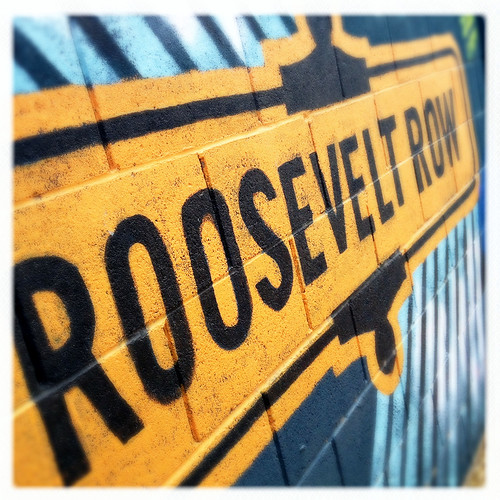
Roosevelt Row Arts District Street Art Phoenix Arizona IMG_8636Photo by David Kozlowski on Flickr, via Dallas Photoworks.

I didn't mention the Roosevelt Row Arts District in Phoenix. 

Phoenix, obviously is a city, but it's a suburban city, very spread out and deconcentrated.  Roosevelt Row is marked by a variety of building types, but some of the coolest shops were in bungalows.

Also in Phoenix, at the intersection of  Camelback Road and Central Avenue ("Get Your Boutique On: Central and Camelback," Downtown Phoenix Journal), where more recently a light rail station has opened, because of sprawl and the devaluing of many city locations, low rents at some of the shopping centers have attracted cool shops and boutiques--we bought a Fugazi compilation at a record store called Stinkweeds, Suzanne bought some stuff at a boutique, and we bought art stuff at another, Practical Art, because we were staying nearby at the Maricopa Manor Bed & Breakfast (one of the only B&Bs in the city) and these places were a short jaunt.  (The AJ Supermarket in the traditional shopping center across the street was also cool.  It's the upscale banner of the Bashas Supermarket chain.)

This undistinguished strip shopping center on Camelback Road in Phoenix is home to cool shops and boutiques.  Image from the Drama Queen blog.

Note that the coming of light rail is likely to raise rents and lead to land intensification, and the funky shops will have to move on eventually as the sites are redeveloped.

Other relevant city examples would be the Gordon Square Arts District in Cleveland and the Penn Avenue Arts Initiative in Pittsburgh.  The Station North District in Baltimore City.  Carytown in Richmond.  H Street NE in DC and Clarendon in Arlington County, as discussed in the comments.

There are many others.  If we had to come up with a formula I think it would be something like this:

Opportunities = Buildings + cheap rent

But creating a fun destination is a bit more complicated.  Not all opportunities can create a district.  The State Theatre in Falls Church, Virginia is really cool--a great place to see a concert--but it is one building, without much else around it.  The same goes for the coffee shop on Delridge Way SW in Seattle.  One great use doesn't make a district, even if its offer is strong enough to survive by itself as a destination of its own.

A map of the Roosevelt Row Arts District, painted as a mural.  It also shows the value of a critical mass of establishments.  Image from the Hanger Shortage blog.  

You need a place.  That is a concentration of adaptable buildings that are inexpensive to rent.   A group of buildings is key, because one great use, as cool as it might be, isn't enough to make a district.  As much as we push historic buildings, buildings are the envelope and even ugly buildings can be great building blocks, so long as the use is cool.  Ideally the mix of building sizes includes larger buildings, which can serve as anchoring uses such as music clubs and theaters and cinemas.  Anchors draw audiences and share them with taverns, boutiques, galleries, and other uses.  Collectively these elements comprise a destination district.

So the final formula would be more like this:

Destination District = Place + Opportunities (Buildings + Cheap rents) + Anchors + Other cool uses

Finally, three more elements to consider.  One is accessibility, or the means to get to the place.  Transit is a useful element but isn't absolutely necessary.  It helps a lot.  But in places where most people drive as long as you have parking you're ok, probably.  And if your transit options at least initially, are less than stellar, if you have the other elements, people may make due.  H Street NE is a perfect example.

Second is the mix of businesses in terms of whether they are independent businesses or chains.  This is a complicated vector.  A study by the Clue Group found that successful "independent" commercial districts had as much as 20% of its mix being chain stores.  Cool, interesting places tend to be single stores or what we sometimes refer to as "chainlets."

In the DC area, the Matchbox Restaurant Group, the Neighborhood Restaurant Group, and the groups run by Geoff or Jeff Black are examples of chainlets.  The Big Bad Woof pet store in DC now has a branch in Hyattsville, so it qualifies.  So do Yes! Markets and My Organic Market (MOM's) natural foods supermarkets.  The Plan 9 Record Store in Virginia is another (although they have been shrinking).

The third element might be what we call "high art" vs. "popular culture."  The Atlas Performing Arts Center on H Street is an anchor use and helped to redefine the corridor.  But more people go to the taverns and restaurants on the corridor than to the Atlas.

Similarly, while you might think that a children's museum or nature center is a great anchor, the reality is that such establishments mostly attract school children who bring their lunches, and aren't the kind of patrons who then spend money at other establishments in the area.

The key is to get the right retail and entertainment mix, that includes a variety of well run businesses, with interesting and unique concepts and anchors--high and low, commercial and nonprofit--that are designed to be complementary and collectively activate and animate the district throughout the day and into the night.

Flower Theatre image from the Silver Spring Singular blog.

In terms of Montgomery County, Maryland, Long Branch, which has an old theater building that could be a wonderful anchor, and Takoma Crossroads are two places that have the opportunity to become destinations, especially because of the opportunity presented by the coming of the Purple Line light rail.  South Silver Spring and Fenton Street south of Wayne Avenue could be another cool district, as discussed previously. 

And I am sure that there are random seemingly marginal shopping centers dotting the county that have the opportunity to support coolness too, based on the Seattle and Phoenix examples.

Labels: , ,

Friday, February 24, 2012

Interesting research/planning in London to harvest the presence of the Olympics in 2012 and future years

(Image of major Olympics construction projects in London from the Daily Mail.)

From the london 2012 meta-evaluation webpage of the Department of Culture, Media & Sport:

Meta-Evaluation of the Impacts and Legacy of the London 2012 Olympic Games and Paralympic Games

From the outset the London 2012 Olympic and Paralympic Games have aimed to deliver a lasting legacy for the UK. DCMS has commissioned a consortium led by Grant Thornton, including Ecorys and Loughborough University, to undertake a comprehensive meta-evaluation of the impacts and legacy of the Games.

The meta-evaluation will pull together the results of evaluations of individual legacy programmes, projects and initiatives, and use these along with additional research to evaluate the overall legacy of the Games. It will aim to address overarching questions such as the impact of the Games on the UK economy and on the uptake of sport.

The study will enable Government to understand and demonstrate the long-term impact of the Games to help ensure current and future programmes provide value for money.
A post Games initial evaluation will be published shortly after the Games, in spring/summer 2013. Prior to this, a number of interim outputs will also be published. Further research will be commissioned separately to look at the effect of the Games up to around 2020.


The various reports and surveys are listed on the page and are downloadable/accessible.

Labels: , , ,

Monday, January 16, 2012

The length of time it takes for others to take up an idea: music edition

DCBEATLESTICKET-750149.jpg
I joke with people I know that I my ideas are not really all that transformational, but merely 3-5 years ahead of most others. I guess I should give myself more credit, or at least a longer time frame. This comes up in the context of the Uline Arena. According to the Post, in "What’s going on with ... Uline Arena?" :

On Feb. 10, as part of its design fellowship, the Washington office of the architecture firm HKS will convene about a dozen design students from mostly local colleges and universities to determine how best to develop the building into a for-profit music museum. HKS designer Chad Porter and project architect Shantee Jamison said they discussed the idea with Paul Milstein of Douglas Development Corp., which owns the building, and heard that company founder Douglas Jemal had a similar vision.

“We started to talk about it and then [Milstein] sort of stopped us in our tracks and told us this was Doug’s dream, to bring a music museum to the city,” Porter said.


This is a pretty hysterical statement.

1. The people who led the effort to get the Uline Arena landmarked (I was the person who led the effort, with the participation of many others including Alan Kimber, Justine Christenson of the National Park Service, and the DC Preservation) League) made this point all the time. See the 2006 blog entry, "Uline Arena Landmarked."

At that time the Federal City Council kept pushing their National Music Museum proposal but never considered the Uline as an authentic venue for such an establishment. Instead, they did something at the Carnegie Building on Mount Vernon Square which failed miserably and pushed the Historical Society of Washington towards bankruptcy. See the blog entry from 2008, "Why did DC's attempt at a music museum fail?"

2. And the other point I kept making was that a music facility could be developed there in association with the then XM Satellite network, now Sirius, in that they could promote music and the development and promotion of their music and radio programming service. See the blog entry from 2005, "Speaking of creative asset utilization."

3. Later, the people who own 9:30 Club approached Douglas Development in hopes that they would be able to acquire the building, and open a concert facility there, but for the most part, Douglas Development never gave them the time of day.

And now, it seems like the 9:30 Club group is looking elsewhere in DC to open up a larger venue. (Although I am not at liberty to discuss the details of either.)

... So, maybe it took Doug Jemal 8 years or so to accept this idea, which he wouldn't consider before, but I guess it's merely an illustration of being ahead of the curve, and that it takes many years for people to accept (obvious) ideas that weren't originally theirs, and to move concepts along towards reality.

(I know I've moved on. I don't deal much with neighborhood revitalization or historic preservation anymore as I now do transportation-related work.)

Note that the entry "Why did DC's attempt at a music museum fail?" mentions cultural planning initiatives in Seattle and Chicago that address music. This entry "Planning your community's night time attractions in terms of music" discusses the Seattle initiative, with links.
Last year, Richmond, Virginia raised the concept as well. See "RVA Music Fest part of Harris' plan to promote creative capital" and "City Envy: Richmond Music District?" from the Richmond Times-Dispatch.

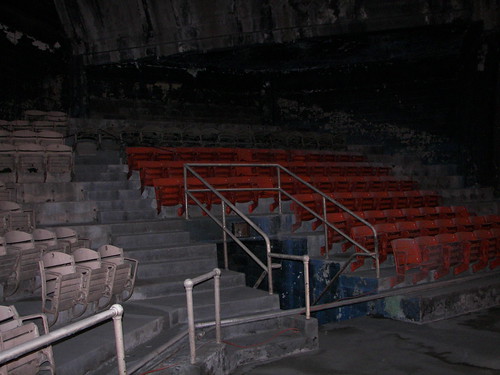
Extant seats, Uline Arena
A few seats are still extant in the Uline Arena.

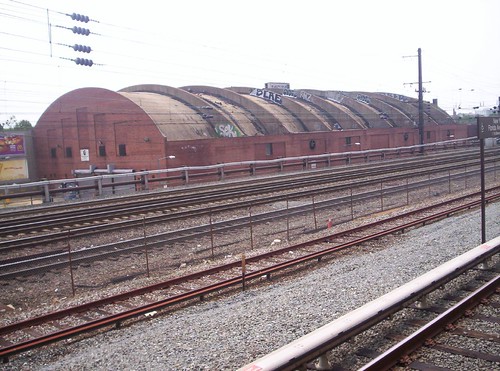
Uline Arena and the Union Station railyard
Being across the street from a subway station repositions the Uline Arena's ability to be relevant and successful as a concert and events facility in the 21st Century.

Labels: ,