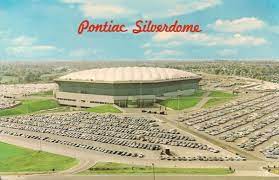
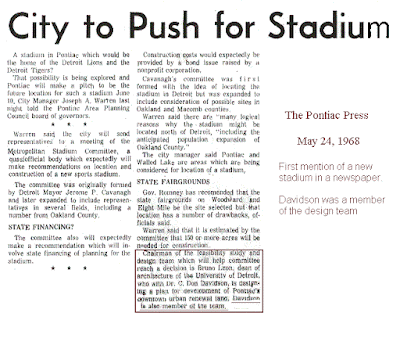
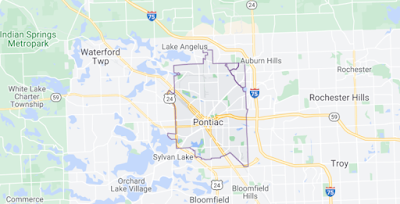
Football stadium. As part of an earlier period of outmigration from the center city, for a time, the Detroit Lions football team relocated to a covered stadium built in Pontiac, called the Silverdome, although the team returned to Detroit in 2002.
(For a time, the Detroit Pistons basketball team played at a suburban arena in nearby Auburn Hills/Auburn Township. Chrysler moved from inner city Highland Park to Auburn Township as well.)
Being located on the edge of the city, by freeways, the stadium provided zero energy to Pontiac's core.
Although Pontiac was hardly an exception, as other suburban stadium and arena projects across the county also had minimal positive impact ("Framework of characteristics that support successful community development in association with the development of professional sports facilities").
Deindustrialization was a problem across the state and the state failed to step up. Like Detroit and Flint ("The real lesson from Flint is about municipal finance," 2016), Pontiac was one of a set of legacy cities in Michigan that because of the drop in property and income tax revenue from population shrinkage and deindustrialization went into bankruptcy, being the first to do so in 2011. Plus, the economic multiplier effect. Each auto job supports 3-4 other jobs. Not all are local (e.g. parts plants from afar) but many are, furthering job losses and economic decline.
Even when plants stayed open, automation often reduced employment by as much as 75%. It occurs to me that in multiple cities across Michigan, facing similar problems, not limited to GM or Chrysler or Ford:
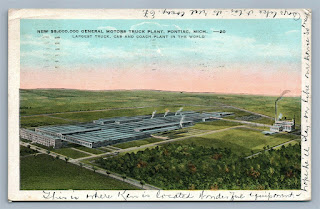
- Battle Creek (Case Equipment moved to Kentucky), Bay City (GM), Benton Harbor, Detroit, Flint (GM, Buick), Jackson, Kalamazoo (Upjohn and GM, see "Former GM plant in Kalamazoo finds second life as successful business park," Kalamazoo Gazette--while successful the industrial park replacing the GM plant has 1/8 of the workforce), Lansing (Oldsmobile), Pontiac (Pontiac, GM Truck), Saginaw (GM)
Instead, later Republican administrations focused on cities declaring bankruptcy, fitting their narrative of incapable cities run by Democrats, rather than developing a broader economic revitalization initiative.
Pontiac looks to do Downtown street calming. A recent article in the
Detroit Free Press, "
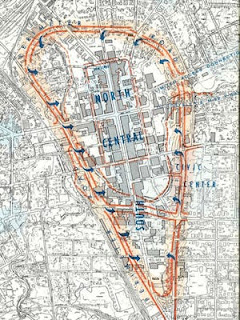
State agrees to unwind Pontiac's Woodward 'Loop' that leaders say strangles their downtown," says that the city is going to get rid of the ring road, in an attempt to reapply more city-centric urban design principles. From the article:
When it opened in 1964, the design of Pontiac’s Woodward Avenue Loop — formerly called Wide Track Drive — was hailed as a triumph. (Wide Track was named after a Pontiac Motors marketing campaign for its cars.)
Its swaths of one-way pavement unsnarled bottlenecks and shunted GM workers as well as parts-laden tractor-trailers through Pontiac’s downtown and to half a dozen bustling factories. The high-capacity roadway played into the dreams of midcentury designers, on a binge they called urban renewal.
The road re-routing created a set of five one way streets, each five lanes wide. It was decidedly anti-urban, facilitating car movement over people and a thriving downtown.
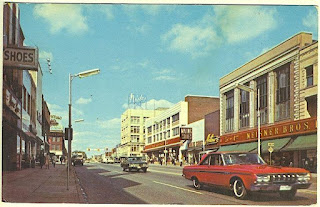
Moving the government center and the creation of Pontiac Mall, on the border of the city and Waterford Township, were other actions that redirected economic activity away from Pontiac's Downtown to other parts of Oakland County.
Why does Pontiac lag in the midst of great wealth?
And I hate to admit, reading that article, that I hadn't ever really thought about the reality that while Oakland County is wealthy and white, could that wealth have been harnessed to spur the economic revitalization of Pontiac, to reverse the steady drumbeat of decline?
Deindustrialization and outmigration? It's not just deindustrialization, although that's a factor. Pontiac was on the decline long before GM shut down its plants, just like many other cities across the state, the Midwest, and the nation.
Lack of political longevity? The now deceased County Executive L. Brooks Patterson was in office for 27 years. Certainly, unlike Mayors who are in office for usually no more than 2 terms, he had the opportunity to address Pontiac's poverty over the long term. (Community revitalization is a multi-decade process, see "Main Street Niches in a Mass Sales World," 2004.)
Lack of attention to revitalization needs in legacy communities? It's not like Patterson wasn't paying attention to the needs of inner ring suburbs, as Oakland County is the first and only county in the US to have created a county-wide Main Street commercial district revitalization program, which it did in 2000. Pontiac participates, and has had a Downtown Development Authority for decades.
Tax harmonization. Could the county have applied various tax harmonization strategies, like what has been done in Greater Minneapolis, or how various counties share sales taxes with legacy communities. (This likely would have required approval by the state legislature.)
Best practice county revitalization initiatives. To be fair, plenty of counties have areas of persistent poverty. But should this be the case?
Are we taking poverty for granted, especially when it is co-terminate with race?
Recently I made this point about Montgomery County, Maryland and how its East County section remains a laggard ("East County, Montgomery County, Maryland: Council redistricting spurs ideas for revitalization | Part 1 -- Overview").
Fairfax County, Virginia has been working on the revitalization of the Route 1 Corridor for decades ("Fairfax County’s Richmond Highway area ripe for development during next decade," Virginia Business). And both counties are comparable to Oakland in terms of wealth.
The most typical initiatives focus on inner ring suburbs. But Pontiac is different as it was never a suburb in the traditional sense, but a stand-alone city, secondary to the center city, but significant and unitary, with its own economy, newspaper, civic institutions, etc.
Previous entries call attention to Hennepin County, Minnesota ("A County and Its Cities: the Impact of Hennepin Community Works", Journal of Urban Affairs) and Oklahoma City--not a county exactly, but the city is larger than other city-counties like Philadelphia or San Francisco ("Change isn't usually that simple: The repatterning of Oklahoma City's Downtown Streetscape").
Maryland had/has a couple of smart growth related initiatives. The "Community Legacy Revitalization Program," is a state program funding revitalization planning and projects in existing places, and there was a similar initiative at the county scale in Baltimore County under former County Executive Jim Smith ("Community renaissance set down in writing," Baltimore Sun; "Baltimore County Confronts Suburban Decline").
Is it racism or the "soft bigotry of low expectations"?
Pontiac is a little place, 60,000 residents and 20 square miles. In the midst of great wealth.
From the standpoint of money, political administrative longevity, and political capacity, there's no reason that Pontiac should have continued on its negative trajectory. Just like the way that cities like Bilbao have been renewed, using an approach that I call "transformational projects action planning."
-- "Why can't the "Bilbao Effect" be reproduced? | Bilbao as an example of Transformational Projects Action Planning," 2017
-- "Economic restructuring success and failure: Detroit compared to Bilbao, Liverpool, and Pittsburgh," 2014
-- "Minneapolis Super Bowl: Urban Revitalization and Transformational Projects Action Planning," 2018
-- "Downtown Edmonton cultural facilities development as an example of "Transformational Projects Action Planning"," 2018
there's no reason that Pontiac couldn't have been improved similarly.
It seems like economic revitalization there ought to be a straightforward process although granted they went through a bunch of flawed urban renewal iterations and severe deindustrialization
10 Pontiac School District buses were destroyed in an attack by the Ku Klux Klan. Detroit News photo.On the other hand, L. Brooks Patterson did start his political career defending opponents to busing and school integration. In Pontiac! ("RIP, L. Brooks Patterson, Racist," Detroit Metro Times, "Busing set off Democratic debate flare-up, but does it still matter in Detroit?," Detroit News).
While Patterson's campaign "against" Detroit and Wayne County could be termed to be more a kind of "economic county-ism," racism was an issue.
But wrt Pontiac, perhaps it was more about benign neglect in the context of institutionalized and/or structural racism, and the failure of the state to think systematically about deindustrialization and its impact across the state.
The default is to see Pontiac/blacks as perennially poor, as a condition not particularly amenable to change.
While it's rare for counties to develop revitalization programs the way that Hennepin County did--which it did out of desperation, facing severe property tax revenue losses in the face of economic and population decline in Minneapolis--we can raise the bar for counties like Oakland, where overall they are fine economically, but possessing severe pockets of poverty and decline.
Some recommendations.
1. The State of Michigan should develop a program addressing deindustrialization more systematically, using the Massachusetts Gateway Cities Initiative and "Hennepin County Works" program as models.
2. Oakland County should make "leveling up" Pontiac its number one economic development priority.
3. Building on the nascent road dieting effort and examples of successful communities nearby like Royal Oak ("Downtown Royal Oak social district opens this weekend -- Here's what to know," Fox2 Detroit, "Baker College to Build Flagship Metro-Detroit Campus in Downtown Royal Oak," "Royal Oak and Rochester Downtowns Win National Awards," OC Times) and Birmingham, focus on redeveloping the residential and retail possibilities Downtown.
-- Reinventing Suburban Business Districts (ULI)
-- Reinventing America's Suburban Strips
-- Revitalizing Distressed Older Suburbs
-- Putting the Urban in Suburban: Art and Business of Placemaking
-- "The secret to a successful suburb: Lakewood, Cleveland Heights and the Inner-ring Divide," Cleveland Plain Dealer
4. Develop a revitalization plan using the Transformational Projects Action Plan approach, with Oklahoma City's Metropolitan Area Projects program and the downtown streetscape program as best practice models..
5. Why not merge Pontiac into Oakland County? This would make County prioritization of Pontiac revitalization unavoidable.
6. Baring that, why not consolidate Pontiac and Waterford Township (Michigan makes it almost impossible now for cities to annex townships. Waterford is 92% white and has 72,000 residents). But combining the two would make it tied as the state's third largest city, and would add the stronger residential tax base of Waterford.
7. Consider merging the Pontiac School District with adjoining school districts, like Waterford. This is difficult, as communities like local control of schools.
OTOH, a majority of Oakland County school districts are shrinking and consolidation could be advantageous, especially if combined with a MAP 4 Kids program of construction and other improvements like the second phase MAP program in Oklahoma City ("MAPS for Kids wraps up," Daily Oklahoman).