Rebuilding Place in the Urban Space

"A community’s physical form, rather than its land uses, is its most intrinsic and enduring characteristic." [Katz, EPA] This blog focuses on place and placemaking and all that makes it work--historic preservation, urban design, transportation, asset-based community development, arts & cultural development, commercial district revitalization, tourism & destination development, and quality of life advocacy--along with doses of civic engagement and good governance watchdogging.

Saturday, August 02, 2025

Despite what Trump and Fox News says, cities are pretty good places to live

 About Seattle, "A Seattle visitor’s guide:  Riots, bad drivers, the big dark and overrated Dick’s burgers. Locals and experts tell the truth,." Seattle Times.

Josh Cruz, 38, head of marketing for a small software company, moved here from St. Petersburg, Fla., with his partner. Cruz belonged to a group of fans of the Tampa Bay Lightning hockey team. “One of the first literal responses I got from a conservative colleague was, ‘What are you gonna do there? Join antifa?’

“I took it to mean he watched too much Fox News,” Cruz says about his fellow hockey fan. He says his mom also asked about the protests that were portrayed as riots. “I told her the news focuses on one group of three people as the night ended, (who) did one stupid thing,” he says.

... Jeff Asher, co-founder of the firm, says, “From a crime perspective, Seattle is just like any major city. If crime is your main concern, then you shouldn’t be visiting any major American city.”

Friends and neighbors were in Portland recently it's fine, which is probably why housing prices are high ("Buying a Home in Portland Is More Expensive Than You Think") Wall Street Journal).

High demand for housing in Forest Hill Queens ("Home Buyers Are Paying Millions to Experience the ‘Fairy Tale’ of Forest Hills," Wall Street Journal).

SF isn't a cesspool.

Trump and his LA military incursions were a way to satisfy his base ("Newsom Slams Trump For ‘Brazen Abuse of Power’ as L.A. Mayor Imposes Curfew," New York Times), not based on reality ("Trump wants to 'liberate' Los Angeles, residents say 'no thanks'," Reuters), and the National Guard and Marine troops he sent there have left ("More than 1,000 National Guard troops leaving L.A. Newsom says Trump’s ‘political theater backfired’," Los Angeles Times), "Marines Will Begin Withdrawing From Los Angeles," New York Times).  

The "rioting" was limited to a couple blocks of demonstrations, with riot police and Trump's federal police and troops escalating the situation.

Although yes, Seattle, SF and Portland reached progressive overreach in the early 2020s, and the electorate dialed back, voting a bit more to the center than to the left.  This is particularly evident in Seattle.

In SF, a Levi Strauss heir connected to the business community won the mayoralty.  And the super progressive prosecutor was recalled out as crime climbed.

OTOH, also in Boston, the Downtown housing market is stagnant ("As housing prices in Mass. soar, they’ve remained stagnant in downtown Boston. Here’s what that means for the city").

It's so obvious on article comments that are negative on particular cities that the writer has no real experience with cities.  The same with Fox News and of course Trump ("‘Cesspools,’ ‘Hellholes’ and ‘Beautiful Places’: How Trump Describes the U.S.," New York Times, "Trump keeps brutalizing immigrants because he's failing at everything else," USA Today), "The politics of fear," New Yorker).

Fox trumps up crime in cities before elections especially and it probably had an effect in increasing the number of Republican House members from New York State ("Crime coverage on Fox News halved once US midterms were over," Guardian).


=====

In Boston's election for mayor, Josh Kraft, of the New England Patriots and a conservative, is running, figuring he had a chance like Daniel Lurie in SF.  His polling is terrible ("Can the Josh Kraft campaign be saved?," Boston Globe).

Labels: , , , , , , ,

Monday, January 04, 2021

Quality of messaging: fact-based versus post-truth Republicans

-- "Post-truth politics and why the antidote isn’t simply ‘fact-checking’ and truth," The Conversation
-- "Defining Post-truth: Structures, Agents, and Styles,"  Ari-Elmeri Hyvönen
-- "Truth vs. Lies," October 2020 special issue, Scientific American


Yesterday, the Washington Post released a blockbuster, "I just want to find 11,780 votes’: In extraordinary hour-long call, Trump pressures Georgia secretary of state to recalculate the vote in his favor," a story with the audiotape of a call made on Saturday by President Trump to Georgia's Secretary of State, asking him to come up with 11,780 votes in Trump's favor, so the previous decision awarding the state's electoral votes to Biden could be challenged.

-- "Here’s the full transcript and audio of the call between Trump and Raffensperger"

(I listened to most of it, and while Trump was repetitive and evasive and a wack job, I wouldn't say he sounded "mentally ill," as many others have said.)

Today, a different Georgian election official had a press conference ("Trump made false claims in call pressuring Georgia secretary of state to undo Biden win, official says," NBC News) where he refuted each of Trump's fallacious claims.

What struck me was the "presentation board" he used to support his presentation.  It's matter of fact.

NBC News photo.

I thought back to the Republican campaign by members in the House of Representatives to impugn witness Michael Cohen testifying about his experiences working for and with Donald Trump ("'Liar, Liar, Pants on Fire,’ and Other Contentious Exchanges From Cohen’s Congressional Hearing," New York Times). Here's the quality of their presentation boards.

Reuters photo.

Labels: , , , , ,

Saturday, January 25, 2020

Some interesting articles on national politics

1. Work continues to disappear, with devastating impact on people and communities.  Earlier in the week, charlie shared this New Republic article, "Educated Fools: Democrats Misunderstand Politics and Social Class," Thomas Geoghegan, who has been writing about the impact of culture based appeals to "traditional voters" for more than 20 years in very provocative ways.

I don't fully buy the thesis. He says that Democrats argue that everyone needs advanced degrees, that this is demeaning to the working class. But the jobs, especially "mass production," that people could do without advanced education are increasingly being replaced by capital and the jobs that remain, even if "industrial" are increasingly knowledge intensive.

Last week, we watched a documentary on the "America Reframed" series on the PBS World Channel called "Detroit 48202," about the changes in a particular area of Detroit, seen through the eyes of the mailman on the route. It featured interviews with a radical union organizer, and he made the point that when they were organizing in the late 1960s, the Dodge Main plant had 10,000 workers. Over time, with automation, the number of workers dropped by 75%.

2. Hope... I mentioned about two weeks ago, the new book by Nicholas Kristof and Sheryl WuDan, on how "work is disappearing everywhere" and belief that we can change the trajectory of failure.

-- "New York Times article on community decline associated with loss of work"

3. ... and aspiration.  This is on British politics, a Guardian article, "Yes, ‘aspiration’ can be a socialist idea – if the left can rid it of its baggage," which discusses "aspirational socialism." I include it, because even though there is no consensus within Labour politics about grassroots influence on policy, politics, and governance, it gets at why I believe there is an opportunity to build bridges, as incendiary as today's politics are. From the article:
It is a striving – in the face of ferocious opposition, and despite countless defeats and disappointments – to give working people greater control over their lives and surroundings, instead of casting them adrift to fend for themselves, and to create the conditions that allow them to reach their full personal, intellectual and creative potential. ...

Long-Bailey hopes that in aspirational socialism she’s found a way to communicate radical ideas in a media environment largely unreceptive to them, and of signalling to Labour’s lost voters that she heeds their concerns. But building a genuinely empowering and aspirational socialism would necessitate a distinct break from the party’s established traditions of administering palliatives from above. What remains to be seen is whether the ideological baggage attached to “aspiration” as a term will allow it to be redefined convincingly by the left, and whether this socialist reappropriation of distinctly Blair-era language can be made to cut through. Long-Bailey’s underlying message is nonetheless correct. Socialism is about transforming society in order to put people in charge of their own lives – and what could be more aspirational than that?
The fact is that many more of us are in the "precariat" and the solutions are in community and support, not Social Darwinism.

4. Community organizing is key.  Eitan Hersh has authored a book, Politics Is for Power, excerpted in The Atlantic, "College-Educated Voters Are Ruining American Politics: Political hobbyism is to public affairs what watching SportsCenter is to playing football." He distinguishes between talking and thinking about politics versus community organizing. (I guess I am part of the problem. I am less personally involved in issues these days, and more about analysis and prognostication. But there's a need for that too.)

5. A December article ("How to Turn Anger and Fear Into Political Power: Latinos in Arizona can show how it’s done") in the New York Times about Latino organizing in Arizona, aptly illustrates Hersh's point.

6. Lessons from Vietnam era politics.  John Judis has a piece in the Washington Post Magazine, "I was a '60s socialist. Today's progressives are in danger of repeating my generation's mistakes," arguing the flip side of Geohagen in terms of mistakes the left is making now in terms of building a coalition and narrative and approach that can win national elections.

7. Opportunities at the scale of the city.  The Guardian has an article ("The case for ... truly taking back control – by reversing the privatisation of our cities") on "remunicipalization," as a response to privatization of government services.

8.  The middle class isn't always liberal.  An op-ed in the New York Times, "The Myth of Middle-Class Liberalism," makes the point that historical interpretation arguing that the middle class always sparks progressivism and "enlightenment" isn't accurate, that when times are tough, liberals can "do the wrong thing.  I agree somewhat.

When society and the economy was growing, it was forward looking and the middle class, involved in doing, was open to change.  Now that things are more of a zero sum game--it doesn't necessarily have to be that way, but it is when certain groups aim to game the system to maintain their position and privileges, the middle class is worried about the future, and no longer confident it can withstand change or has enough resources so that it is inclined to share.

Labels: , , , , ,

Monday, November 18, 2019

Post-elections...

postage meter indicia.

1.  Yeah, yeah, Virginia, but that isn't a surprise.  The pace of suburbanization along with some legal end to gerrymandering, meant that the Republicans could no longer maintain their hold on the legislature ("Virginia's new blue wave: A portrait of things to come — or things left undone?, Salon)

And yes, the Republican brand is toxic ("In Virginia, Republicans confront a fearful electoral future," Washington Post).

2.  President Trump campaigned for the Republican candidates for Governor in Kentucky and Louisana, and both lost.

I didn't think the election result for Kentucky was earth shattering in terms of figuring out Democrats and Republicans and the 2020 election because the Republican Governor incumbent, Matt Bevin, was so toxic, and despite that Democrat Andy Beshear barely eked it out, even though he was Attorney General and son of a popular former Governor ("Kentucky Governor Race: Matt Bevin Concedes to Andy Beshear," New York Times).

But the Louisiana Governor result is more significant ("With Louisiana Vote, a Governor and State Chart Their Own Path," NYT) because he won by a couple percentage points, 40,000+ votes, so it's worth projecting from a little ("Back-to-back losses in key governors’ races send additional warning to Trump and GOP ahead of 2020," Washington Post) but not too much maybe ("WHY JOHN BEL EDWARDS WINS," First Things).

3.  But because of the way that the runoff system works in Louisiana, which usually works against Democrats such as former Senator Mary Landrieu ("Mary Landrieu Is Defeated by Bill Cassidy in Louisiana," NYT), it is worth paying attention to, the continued shift of suburbs to the Democratic column ("Pennsylvania suburbs revolt against Trump," POLITICO), and the importance of the African-American vote.

4. A Working Families Party candidate won one of the two City Council at large positions allocated to "the minority party" in Philadelphia. ("Kendra Brooks captures a Philadelphia City Council seat in a historic win for the Working Families Party and Philly progressives," Philadelphia Inquirer). Whereas in DC, Democrats get away with terming themselves independents and running for those seats, that hasn't been the case in Philadelphia, where Republicans consistently held the two minority seats.

This is comparable to how Justice Democrats figured out that certain very reliable Democratic Party seats in Congress were amenable to a hardcore progressive candidate like Alexandra Ocasio-Cortez ("Safe Districts Exist To Produce Insurgents Like AOC," New York Magazine).

5. Kshama Sawant ended up fending off the Amazon-business backed opponent in her District 3 Council Race in Seattle. People thought she was toast (and I didn't think she could pull it out either) after the initial results put her behind, but with each succeeding wave of vote counting, she gained ground. This may mean that a "head tax" on business will move forward ("Amazon Cash Fails to Oust Seattle Socialist Kshama Sawant," The Nation).

6. New York City approved rank choice voting for local elections ("What to know about ranked-choice voting in NYC," amNY). This is important in cities dominated by one particular party, where the primary race is the most significant election event, where many candidates vie but only one wins. RCV may allow a greater diversity of candidates to get through the typical "first past the post" method.

Maine approved RCV in 2016.  Pierce County, Washington did in 2006, but after two iterations, they reversed the decision in 2009 ("What Really Happened With Instant Runoff Voting in Pierce County, Washington?," Sightline Institute).

7. Chesa Boudin, son of 1960s radicals, was elected to the District Attorney position in San Francisco, another element of the wave of progressives aiming to re-articulate what "law and order" means in the context of law and justice ("Son of jailed radicals, reviled by the police union. Now, Chesa Boudin is San Francisco's top cop," Guardian).

It will be interesting to see how this trend works out ("Progressive DAs are shaking up the criminal justice system," NBC News). Traditional law and order forces, especially police unions, are tough forces to counter ("A Sad Last Gasp Against Criminal Justice Reform<" New York Times).

Labels: , ,

Thursday, April 25, 2019

Fusion voting and political competition: and a way to make third parties relevant in the US

The US political system (and in reality, the UK and Canada) is set up for two parties, not a multi-party system led by a majority coalition, which is more typical in European countries.  In Europe, while it can take decades, it's possible for third parties to grow to the point where they can lead governments ("How Germany's Green Party Keeps Winning,"NPR).

Shaped by capitalism and the concept of market forces and competition, many people argue that cities dominated by one political party "need competition."

While they didn't mention this specifically, the Post's recent editorial, "Businesses need predictability to thrive. That's not happening in DC," about the over-taxing approach to business on the part of DC's elected officials is a short step from that kind of argument, and sheds light on why the paper so often endorses candidates with strong ties to the business community.

In our two party system, that means the answer is Republicans in local government, to counter overly progressive tendencies in center cities.

Just like Howard Schultz finds a presidential candidacy a tough slog because his message of social liberalism and conservative finances especially low taxes doesn't resonate with much of the electorate, progressive-leaning cities aren't likely to vote for a traditional Republican message, although there are examples of "Republican" mayors doing some interesting and progressive stuff, albeit mostly around infrastructure, in cities like St. Petersburg, Florida (Rick Baker), Oklahoma City (Mick Cornett), and Carmel, Indiana (Jim Brainard).

It's possible to add political competition within of two parties 

But recently, both with the election of Alexandria Ocasio-Cortez in New York City and the almost success of the Green Party in provincial elections in Prince Edward Island, Canada earlier this week--they led in polling but on Election Day they garnered 9 seats, losing to the Progressive Conservatives who won 12 seats, while the Liberal Party ended up with 6 seats--I am thinking that maybe the solution, or at least a step forward, is to add New York State's "fusion voting" approach to the mix.

What AOC's election made me realize that we can create a typology of districts, and work to elect particularly left candidates from those districts where this is possible--and in fact, that has been the case for years, where many of the Democratic Party's most progressive Representatives came from such districts in states like California and New York.  AOC just pushes this a bit more leftward, and is more focused on organizing and media at least now, than people like Henry Waxman or Ted Weiss, who got into the nitty-gritty of legislation and oversight.

Fusion voting as an alternative

Fusion voting is a system of multiple parties, and candidates can run for election with more than one party affiliation.

Historically, fusion voting was an important way for the Populist and Socialist Parties to stay relevant and influence the issue space, which is why most State Legislatures outlawed the practice.  Now just a handful of states allow for it.

In New York, fusion voting would be a more formalized way of taking the "Democratic Socialist" message out to those districts where they have a good shot at winning.  Still, many interests would rather it go away (Is fusion voting going to be eliminated?," City & State New York).

New York is still dominated by Republicans and Democrats.  But there are multiple and smaller third or minor "parties" that participate in the election system.  We can think of them as "caucuses" (or professionally speaking, "practice groups") focused around a particular set of principles.

In New York there are many: Conservative as opposed to Republican; Working Families which is more left; Greens; Libertarians; etc.

Fusion voting would provide a way for cities that are dominated by one party to add "competition" in a way that's meaningful.

And at the state level, for the Green Party.

But it's probably not a way to add more conservative voices in progressive settings

But for entities like the Washington Post or Seattle Times looking for more conservative voices to be represented in local government in Washington, DC and on the Seattle City Council respectively, this won't satisfy them, because in progressive areas, it's a way to empower an even more progressive agenda.

Labels: , , , , ,

Friday, September 21, 2018

(Too often) Politics doesn't favor proactive responses by government, especially when the threat is averted

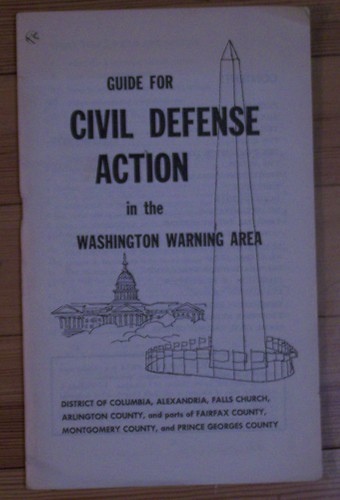
Civil Defense Map for Washington, DC, 1959Redundancy.  In college, not for a class, I came across work by Charles Perrow about the concept of "redundancy."

That's the point that you have multiple systems and backups for elements that have the potential for fault. It's been a strong influence on my thinking about organizations and systems ever since.

Separately, in business there is the concept of "resource slack," where resources are not fully committed or constrained and thus available.

In times of reduced financial capacity and "just in time" manufacturing and tightly linked supply chain management and logistics, there's little room in business or government for redundancy or slack resources that are able to be drawn upon in times of need.

For example, if a subway line goes out of service, it's not like a transit agency has hundreds of buses sitting around in reserve or the drivers to operate them.

Preparedness as a fault.  It's unfortunate that sound practice in emergency management -- "be prepared" -- is seized upon by political opponents when it turns out that the advance preparations were unneeded.

This is happening in Virginia, which mercifully wasn't really hit by Hurricane Florence although earlier predictions expected it ("'Somebody's gouging us': Virginia lawmakers question $60M price tag for storm response," Richmond Times-Dispatch). From the article:
Virginia lawmakers on Thursday sharply questioned the costs of the state’s preparations for Hurricane Florence, saying they were shocked to learn officials committed to spend up to $60 million to set up shelters and deploy response teams for a storm that ultimately veered south.
Members of Gov. Ralph Northam’s administration have stood by the decision to order the first-ever mandatory evacuations of low-lying coastal areas, saying it was a call based on scientific predictions about the potential path of a storm that had minimal impacts in Virginia but devastated eastern North Carolina.
Flooding in Lumberton, North Carolina after Hurricane Florence, CNN photo.  The area had been hit similarly two years ago as a result of Hurricane Matthew.

It'd be worse for Gov. Northam had he been Governor in North Carolina.

In 2012 the NC State Legislature passed laws forbidding government agencies from acknowledging climate change, and by extension extranormal weather impact, on building regulations for fear it would reduce property values and harm real estate development interests ("North Carolina didn't like science on sea levels … so passed a law against it," Guardian). From the article:
But dire predictions alarmed coastal developers and their allies, who said they did not believe the rise in sea level would be as bad as the worst models predicted and said such forecasts could unnecessarily hurt property values and drive up insurance costs.

As a result, the state’s official policy, rather than adapting to the worst potential effects of climate change, has been to assume it simply won’t be that bad. Instead of forecasts, it has mandated predictions based on historical data on sea level rise.
Preparedness costs money.  And recognition of the necessity.

But the problem with the response of Republican legislators in Virginia to the so-called waste of money in response to a threat that never materialized is that the next time, officials could be hesitant to take proactive steps, fearing political consequences.  Then, the consequences could be much worse.

Floodwaters from Hurricane Florence inundate the town of Trenton, N.C., Sunday, Sept. 16, 2018. (AP Photo/Steve Helber)

FEMA.  WRT FEMA, the Federal Emergency Management Agency, I've been thinking that it needs to be extracted from the politics of governance altogether, and constituted as a kind of sixth branch of the military, functioning like the Coast Guard.

The Coast Guard is a hybrid agency with both military and civil elements--reconstitute FEMA as focused on the "defense of the US from disasters" in terms of mitigating the potential effect of disasters as well as responding to disasters--but somewhat disconnected from vagaries of politics.

The old Civil Defense agency focused on saving lives in case of nuclear war.  Why can't we take a similarly serious approach in those areas that are particularly vulnerable to various effects emanating from climate change including hurricanes, storms, and wildfire?

-- "Organizing to Reduce the Vulnerabilities of Complexity," Charles Perrow, Journal of Contingencies and Crisis Management, 1999

Yes, the military is subject to politics too, but the way military bases and units function day-to-day, month-to-month, and year-to-year is relatively exempt from that.  That's the way FEMA needs to be functioning.

Flood waters isolate homes in the aftermath of Hurricane Florence September 19, 2018, in Lumberton, North Carolina. (Joe Raedle/Getty Images)

As currently constituted, the leadership of the agency changes with each change in government, and can be worsened depending on how seriously politically-focused officials take the management and crisis responsibilities seriously in terms of agency management, leadership and operations and its need for experienced professionals.

-- 2017 HURRICANES AND WILDFIRES: Initial Observations on the Federal Response and Key Recovery Challenges, Government Accountability Office

Plus, in terms of disaster preparedness and emergency management, way more money needs to be spent proactively in terms of reducing risk rather than in post-crisis response.

This New York Times opinion piece, "What Trump Doesn't Get About Disasters," isn't really about "President Trump" and his failure to understand epidemiology ("Nearly a Year After Hurricane Maria, Puerto Rico Revises Death Toll," New York Times) so much as it is a discussion of how emergency management practice in the US has been shaped in favor of thinking about disasters as discrete events, rather than as certain types of disasters such as hurricanes having elements that are addressable in advance of a specific event.

Articles such as "How To Build Hurricane-Proof Cities After Irma and Harvey," The Atlantic, and "Hurricane Florence’s floods caused severe property damage. Here’s a solution | It’s time to talk about managed retreat from the coasts," Vox, offer proactive proscriptions, from better zoning and building regulation requirements. From the Vox article:
Mostly, though, we're stuck with a harder question: What to do before the next storm to prevent such losses?

One solution is strategic retreat: moving out of harm’s way. As seas rise, flooding is becoming almost a weekly occurrence in cities up and down the East Coast. Wilmington, North Carolina now is subject to chronic tidal flooding due to sea level rise. As storms grow stronger, so are the calls to walk away from the most flood-prone places.

For many, the notion of retreat brings to mind post-apocalyptic visions of empty highways, rusty skeletons of buildings, and houses grown over with weeds. It’s daunting. But scenarios that involve retreat don’t need to be. Innovative thinking about the role of relocation can foster cohesive, rich communities as some move to safer, higher grounds.
Not taking measures in advance of weather events that we know are going to come sooner or later is the height of political and governance failure.

Labels: , , ,

Saturday, January 20, 2018

Quote of the day: Federal Government Shutdown

From the Guardian column "With government shutdown, Republicans reap what they sow":
During previous shutdowns, calm heads ultimately prevailed: people who cared about good government, or at least worried about the polls that pointed to widespread public disgust. But this is now Donald Trump’s Washington and there are no calm heads to be found.During previous shutdowns, calm heads ultimately prevailed: people who cared about good government, or at least worried about the polls that pointed to widespread public disgust. But this is now Donald Trump’s Washington and there are no calm heads to be found.
====
In any case, it seems unbelievable that Congress is incapable of doing one of the only things they are mandated to do, which is to pass an annual budget for government operations.

Still, while I concede the idea of a "swamp" as it relates to lobbying, especially in favor of the interests of capital, the reality is that "Washington" isn't created in or by "Washington" but by the electoral choices they make when voting who to represent them in their House Districts and as their state's Senators.

DC government.  Because DC is a federal district, local government gets mixed up in the crosshairs of shutdown.  With the last shutdown, DC carved out its locally-generated monies and made the argument that spending local monies shouldn't be held hostage to the federal budget, and it continued to operate and function.  Mayor Bowser is taking the same course this time ("'DC is open' If Federal Government Shuts Down, Mayor Says," NBC4).

DC also plans to step in and maintain NPS properties that will go unmaintained during the shutdown.  From the article:
If the government shuts down, crews with the D.C. Department of Public Works (DPW) will pick up trash from 126 federal properties in the city, including the National Mall, Pennsylvania Avenue and Dupont Circle. If it snows, the same crews will clear roads the National Park Service usually would clear.

"People from across the nation and around the world come to visit our nation's capitol, and we take great pride in our city and want to ensure it looks clean and its best, regardless of what's happening at the federal level," DPW director Christopher Shorter said.

The work will cost an estimated $100,000 per week. D.C. could request reimbursement from the federal government for costs incurred during the shutdown, or could include these costs in federal payment budget requests.
Federal shutdowns and national parks.  In the past I've written about the impact of the shutdown of national parks on local economies, but this time, Republicans aimed to allow parks to be open to the public but without staff ("What Does the Government Shutdown Mean for National Parks and Park Visitors?," National Parks Conservation Association). T

hey're doing this because parks shutdowns seemed to generate the most negative reaction on the part of communities and the electorate (along with cutbacks of TSA personnel at airports).

According to the
US Travel Association ("Shutdown Would Cost U.S. Travel Economy At Least $185M per Day"), a federal government shutdown would cost the U.S. travel sector at least $185 million per day in economic output due to lost activity and affect 530,000 travel-related jobs due to temporary layoffs, reduced wages and fewer hours worked.

Local residents complain about the closing of the Grand Canyon National Park
Protest: Locals complain about the Grand Canyon National Park closure which is costing the community in lost tourism.  Image via the Daily Mail.

In those parts of the country with federal parks and public lands that are key elements of local tourism, there are more specific and hard felt effects on local economies from shutdowns.

This is why for some time I have argued that local and state parks and tourism planning needs to include contingency planning for federal shutdowns, and state and federal budget cutbacks ("Federal shutdown as another example of why local jurisdictions should have more robust contingency and master planning processes" and "Contingency planning in parks planning: Montgomery County Maryland edition").

According to the NPS report Effects of the October 2013 Government Shutdown on National Park Service Visitor Spending in Gateway Communities:

• A 7.88 million decline in overall NPS October visitation resulting in a loss of $414 million NPS visitor spending within gateway communities across the country;
• Gateway communities near forty five parks experienced a loss of more than $2 million in NPS related October visitor spending;
• Five states experienced a decline of over $20 million in NPS October visitor spending;
• Each dollar of funding for the 14 parks opened with state funding before the end of the shutdown generated an estimated $10 in visitor spending.
It turns out that the National Park Service does allow states to step in and pay for operation of facilities during shutdowns ("Feds will let states pay to reopen national parks," Associated Press).

But it's best to plan ahead and have those agreements in place before a shutdown, not once a shutdown is underway.  Which is what DC is doing in terms of committing to providing trash pick up and snow clearance.

Labels: , , , ,

Wednesday, November 08, 2017

Whew! (Yesterday's elections)

So the Democrats won in Virginia, and for Nassau County Executive and Westchester County Executive in Suburban New York City ("Westchester County election results: 9 Takeaways," Westchester-Rockland Newspapers), and in a bunch of other places. 

It doesn't look as if Ginger Jentzen, the Socialist Alternative candidate for Minneapolis City Council's Ward 3 is likely to win.  While she got the most first place votes, in Minneapolis' ranked choice voting system ("How ranked choice voting works," Minneapolis Star-Tribune), second and third place votes count too, and Steve Fletcher, the candidate with the second most first place votes got way more second and third place votes ("No winner in Ward 3 Tuesday night," Minnesota Daily).

I didn't mention that Mayor Betsy Hodges faced eleven candidates, as police killings and other matters plagued her tenure.  It appears that she lost, although results won't be finalized until today.

Photo: Sharon Cantillon, Buffalo News.

I didn't mention many referenda.  According to the New York Times, "New York Voters Reject a Constitutional Convention."  According to the Buffalo News:
"Voters appeared ready to approve a referendum that would allow the state to create a 250-acre land bank in the Adirondacks and the Catskills while giving local communities more flexibility in making infrastructure improvements. That referendum had a 2.6 point lead with 77 percent of precincts reporting.
The Denver area passed a number of referenda concerning parks, roads, and cultural asset financing ("Denver voters strongly approve $937 million bond package for roads, parks, libraries and cultural facilities: Program with big sticker price will unleash about 460 projects in first large bond program in a decade," Denver Post).

It's interesting how these types of referenda tend to win, including roads (Maine's 2017 measure on road funding passed too) while it's more of a toss-up on transit measures, although a bunch seem to have been passed with this election cycle according to the Center for Transportation Excellence.

In Maine, where hard right Republican Governor Paul LePage kept vetoing expansions of Medicaid, a referendum calling for that expansion passed decisively ("Maine OKs Medicaid expansion in first-of-its-kind referendum," ABC-TV).

The Virginia election wasn't just important for the Governor's race, but also for the House of Delegates, where all of the 100 seats were up, and the Republicans had an almost 2-1 advantage. According to the Richmond Times-Dispatch, "Democrats erase 32-seat GOP advantage in House; recounts likely to determine control," that situation has significantly changed.  From the article:
Democrats picked up three open seats — including one in Henrico County — and knocked off at least 13 Republican incumbents on Tuesday to draw even in power in the House, pending recounts that could still swing in either direction.
Still, most of the rural seats stayed in Republican columns, so the election there continues to reflect the urban-rural political divide. Attention to figuring out better ways to connect rural and urban interests within a progressive agenda is still absolutely necessary. From the article:
But nowhere was the Democratic wave more powerful than in Northern Virginia, especially Prince William County, which Toscano had called “the battlefield” for the House.

Democrats defeated five Republican incumbents who represent parts of Prince William, including House Republican Caucus Chair Timothy D. Hugo, R-Fairfax, who lost by 68 votes to Democrat Donte Tanner in another race that will go to recount, and House GOP Whip Jackson H. Miller, R-Manassas, who was beaten decisively by Lee Carter despite tepid Democratic support for the challenger.

Del. Richard L. Anderson, R-Prince William, and Del. L. Scott Lingamfelter, R-Prince William, both members of the House Appropriations Committee, lost to Democrats Haya Ayala and Elizabeth R. Guzman, respectively.
Representative Ligamfelter was one of many anti-urban legislators from the area.

In Minneapolis ("Voter turnout for Minneapolis municipal election highest in decades," Minnesota Daily, Virginia, Maine and other jurisdictions, turnout was up significantly.

Labels: , , ,

Tuesday, November 07, 2017

Today's elections

As some commentators put it, it's an "off-off election," not associated with the national elections at all, so turnout tends to be significantly reduced.  This type of election separated from elections for national offices which normally increases turnout, derives from some of the political "reforms" of the Progressive Movement, which aimed to shift the primacy of voting from the "unwashed" (immigrants) to the educated.

But it comes at the expense of majority participation and tends to support elite and conservative interests.

In this election, only in Virginia and New Jersey do you have Governor's races.  But many localities have their elections during this cycle, including New York City and various counties in New York State, communities in Maryland, Boston, and Minneapolis, where a Socialist Alternative candidate is vying for a seat ("A Minneapolis socialist thanks the local paper for not endorsing her," The Nation; "Editorial endorsements: Reich and Bildsoe for Mpls. City Council," Minneapolis Star-Tribune).

Also various measures (referenda) are on the ballot, such as a transportation funding vote in Maine and a proposal to call for a Constitutional Convention in New York State.

2017-10-02_01-03-48
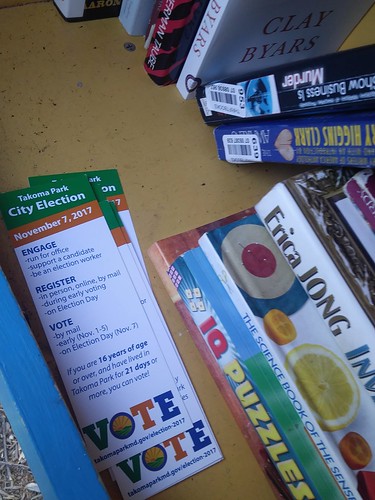
In Takoma Park, people tend to put literature on local activities, including the election, in the various Little Free Libraries that have been constructed around the city.

In College Park, Maryland, the election has been roiled by a proposal to allow non-citizens to vote in local elections ("Debate over noncitizen voting has upended College Park elections," Washington Post).

The City of Takoma Park, which borders DC, has its elections--a couple years ago they voted to lower the voting age to 16 years of age, but it hasn't had much impact on turnout--and at October's Street Festival most of the candidates had booths and were politicking. Annapolis and Frederick also have elections.

Campaign mailer sponsored by the New York Republican State Committee supporting Jack Martins, Republican candidate for Nassau County executive. Photo Credit: New York Republican State Committee. Also see "Martins defends MS-13 mailer against Curran; others cry foul," Newsday.

Interestingly, elections for Governor in Virginia, the Mayor's race in New York City ("Malliotakis Ad Hammers de Blasio on Quality of Life in New York," New York Times), and even for New York's Nassau County Executive race ("In New York Suburbs, Campaigns Are Anything but Genteel," NYT) have sought to paint Democratic nominees as soft on crime and abetting immigrant-fueled crime--the specter of the Salvadoran crime gang MS-13 has been raised in ads--even though national statistics find that crime is dropping, both in New York City--the murder rate is on track to be the lowest ever in the modern age of easy access to guns--and in the State of Virginia.

... Not that MS-13 isn't a problem, but it's not a scourge threatening society in the US (unlike in El Salvador where the flow of gang members from and to the US has led to a surge of crime and death in the home country), so the fear mongering is comparable to Newt Gingrich railing against the imposition of Sharia Law in the US as a way to stir people up over something that can't happen ("Newt Gingrich clarifies comments on Sharia law," USA Today).

I am not an ad guy, but I wonder how you would paint conservatives against gun control laws as soft on death.  Because there are plenty of people with grievances, who when armed, end up killing a lot of people.  Without guns, especially access to guns specifically designed to kill lots of people, they wouldn't be able to be so successful at murder.

Still, people will be looking at the election results to gauge what might happen with next year's mid-term national elections and various state elections in the Time of Trump. It appears that in New Jersey the Democratic candidate will win, after two terms of Republican Chris Christie, and Bill De Blasio appears to be sailing towards a decisive win, despite some grumblings about his governance and associations with corruption around access.

The Virginia election is likely to be close. The state is pretty evenly divided between parties and urban and rural interests, and the statewide elections for the US Senate, Governor, Lt. Governor, and Attorney General tend to be close always, although shifting to Democrats over time.

Because the off-off year election depresses turnout, conservatives have an advantage in a Virginia, and if Ed Gillespie wins it will be seen as support for a Trump presidency, especially as Gillespie has employed Trump-like campaign tactics.

Malliotakis ad against Bill De Blasio, New York City


Ed Gillespie MS-13 ad, Virginia

Labels: , , ,

Tuesday, October 03, 2017

Guns, guns and cities and public space

There are many defects in the governance system in the U.S.  The biggest is how rural interests have been favored in the creation of legislative districts and concomitantly legislatures.  Access to guns is one of the many areas of policy where vastly different needs concerning gun access in urban areas vs. rural areas are subsumed within "the lowest common denominator" of policy favoring gobs of access.

-- "Why more than 100 gun control proposals in Congress since 2011 have failed," CNN
-- "Congress vs. the States on Guns," New York Times
-- "Open Carry for All: Heller and Our Nineteenth Century Second Amendment," Yale Law Journal, 123:5 (2014)
-- HeinOnline Second Amendment search term

At the very least, there should be a recognition for the need for differentiated laws between urban and rural areas.

And a limit on how many guns people "need" to express their Second Amendment Rights.

It's amazing to me that the Branch Davidians purchase of a large quantity of guns (300+) drew attention from the ATF ("Davidian Compound Had Huge Weapon Cache, Ranger Says," Los Angeles Times), but an average person can amass an arsenal of more than 40 high powered rifles and other weapons that can easily be converted to shoot "automatically" and this draws no notice.

Trump's campaign quote about "you Second Amendment people":
TRUMP: Hillary wants to essentially abolish the Second Amendment. By the way, and if she gets to pick -- if she gets to pick her judges, nothing you can do, folks. Although, the Second Amendment people, maybe there is, I don't know but. (CNN transcript of a Trump campaign event)
====
The Onion's fifth use of the same headline on a parody article about gun massacre in the U.S., "No Way To Prevent This,’ Says Only Nation Where This Regularly Happens,"
In the hours following a violent rampage in Las Vegas in which a lone attacker killed more than 50 individuals and seriously injured 400 others, citizens living in the only country where this kind of mass killing routinely occurs reportedly concluded Monday that there was no way to prevent the massacre from taking place. “This was a terrible tragedy, but sometimes these things just happen and there’s nothing anyone can do to stop them,” said Iowa resident Kyle Rimmels, echoing sentiments expressed by tens of millions of individuals who reside in a nation where over half of the world’s deadliest mass shootings have occurred in the past 50 years and whose citizens are 20 times more likely to die of gun violence than those of other developed nations. “It’s a shame, but what can we do? There really wasn’t anything that was going to keep these individuals from snapping and killing a lot of people if that’s what they really wanted.” At press time, residents of the only economically advanced nation in the world where roughly two mass shootings have occurred every month for the past eight years were referring to themselves and their situation as “helpless.”
-- "Another worst mass shooting in the United States," New Yorker
-- "Want Gun Control? Learn From the N.R.A.," op-ed New York Times
-- "Preventing Mass Shootings Like the Vegas Strip Attack, column by Nicholas Kristof, New York Times

======
Mass casualty events are becoming all too frequent in cities.  This is a public safety and freedom of assembly matter.

It's obvious that there need to be more restrictions on guns, but the privileging of rural interests in our political system seems to make this impossible ("Why the Majority Doesn't Rule on Guns," Washington Post).

-- Guns on the Roof, lyrics, The Clash

Labels: , , , , ,

Friday, June 24, 2016

(un?)informed electorates, democracy, and referenda

A little more than 20 years ago I went to a conference sponsored by a group affiliated with Newt Gingrich, and I remember him talking about the rise of "irredentist" movements across the world. Then particularly prominent examples were the Basque Region in Spain or the Kurds, which spread across Iran, Turkey, and Iraq.

In many respects, you can consider the Brexit vote in the UK to be an irredentist movement, vis a vis the European Union.  Ironically, it will trigger further irridentist moves within the UK as it is likely that Scotland will vote to become independent and to remain within the EU.

Not being in the UK, I only know about the campaign -- Remain or Leave -- from what I read in the online newspapers, mostly the Guardian (The London Times has always had a very strong paywall) and in print in the the Financial Times, plus articles in the US media.

Obviously, there are many parallels with the Republican campaign for President by Donald Trump. The demographics of people who support Trump -- older, whiter, less educated -- are comparable to the people favoring Brexit.

And we have a kind of irredentist movement in the US, the East and West Coast versus the interior of the country, and the rural-urban divide, and how political districts drawn for the US House of Representatives and state legislatures tend to be shaped in favor of rural interests at the expense of cities and metropolitan areas.

Media and the informed electorate.  But in the UK, while on the decline sure, newspapers are still prominent and relevant.  The London papers have national reach, especially the big "populist" tabloids like the Express or the Mail.

But there, more than in the US, the owners dictate coverage of issues, and on both the recent national election and Brexit. for the most part, especially the tabloids, were "all in" on the Conservatives and exit from the EU, and newspaper coverage of issues was manipulated in crass and craven ways to support their positions ("Power without accountability in our tabloid press" and "The triumph of the tabloids," mainly macro).

The blog mainly macro published this composite image of covers from the Daily Express which played up immigration as the UK's biggest problem.

If you can't rely on the media to be "somewhat objective," the basic requirement in democratic systems of having an informed electorate cannot be met.

Political positions versus the truth and an informed electorate.  This problem is further accentuated by the fact that "the politics" is similarly poisoned in that ideologies and agendas more than "doing the right thing" are driving elected officials and what they say.

These days politics is more about winning and imposing ideologies and agendas rather than making the right policy choices based on knowledge.  (Maybe it's always been this way, and I am merely a naif in my belief that knowledge and doing the right thing matters the most.)

For example, mainly macro ("Why do people want less EU immigration") argues that people's sentiment in favor of Brexit was largely driven by their belief that immigrants were disproportionately using the National Health Service and this is the cause of its decline.

False claim promoted by the Vote Leave campaign.  Publishers Association photo.

But their popular understanding of the decline of NHS is counter to the facts.

First, the fact that immigrants consume government services at rates less per capita, and second, pay more money to the state in taxes than they get back in services.  The real problem with NHS is that the government has been cutting funding as part of its general economic austerity program.

But the Prime Minister didn't want to tell people that.  From mainly macro:
Which means that in reality EU migration creates more resources that allows the government to spend more on the NHS and other public services. Not only do EU migrants pay for themselves in this respect, they also make access easier for natives. Add in the negative impact of making trade with the EU more difficult, and it is clear that Brexit would have a negative impact on public services. No wonder Dr Sarah Wollaston switched sides.

Yet this is an argument David Cameron was reluctant to make, because it raises an obvious question. If EU migration is not the reason why the NHS is in crisis, what is? The answer is that his government has chosen to shrink the share of national income going to the NHS, when there are good reasons why this share should be rising. In other words the government has taken the taxes EU migrants pay, and used them to cut taxes or cut the deficit. Because Cameron will not make the case for why EU migration helps the NHS, that case is not heard by voters. Instead they are told all the time that the NHS has been 'protected'.
And self interested politicians.  Others take positions to support their own interests.  Boris Johnson is a perfect example ("EU referendum live: Boris Johnson hails 'glorious opportunity' of Brexit as David Cameron resigns," Telegraph).  He wants to be Prime Minister, so he joined the Leave campaign, whereas a few years ago he was in favor of immigration, etc.

Directing fury at the wrong target.  So the rise in support for Brexit was a reaction against the austerity policies of the Conservative government, but instead of voting them out last year--the Conservatives won decisively--instead they blame the EU and vote Brexit.

Similarly, in the US the rise of the Tea Party as a conservative movement was triggered out of a ridiculous belief that President Obama is a socialist and wanted the government to take over the economy, which was their interpretation of the huge bailouts made of the financial industry in 2008-2009, which was necessary to ward off an economic depression.

Yes, the bankers weren't punished, but from the standpoint of Marxism, this was a type of "Capitalist Crisis" where capitalists required the intervention of government in order to recover and maintain overall control.  That's capitalism, not socialism -- privatizing profit, socializing risk.

Implications for democracy and the referenda process.  If you can't count on there being an informed electorate, which is further complicated by the nature of voting patterns (older people vote more, younger people vote less, poor people vote less than rich people, etc.) that can distort overall preferences, putting major policies to vote in referenda doesn't make sense ("If referendums are the answer, we’re asking the wrong question," Guardian).

Especially when you can't count on equal resources being spent to present "both sides" of the issue, let alone both sides being presented within the media, and adequately by the elected officials.

Labels: , , , , ,

Tuesday, May 10, 2016

Ho hum: the proposed State of New Columbia Constitution doesn't change very much

I suppose when I first moved to DC almost 30 years ago, I believed in "statehood" for the city.  Back then, the DC Statehood Party still had a couple representatives on City Council.

Over the years--despite the unfairness imposed by lack of voting representation in Congress and the authority of Congress to overturn initiatives by the city--I've become less committed to it because "it's not efficient" in that the US needs fewer states, not more (e.g., the "Connectography argument" or the similar but 35 year old "Nine Nations of North America" argument, written in a book by Joel Garreau), and how "state's rights" arguments are more often used to deny people rights and privileges rather than to extend them.  Plus I think we are Americans first and citizens of states "second."
Economic geography of the US, Connectography book
Map showing the seven main economic geographic regions of the US, from Connectography: Mapping the Future of Global Civilization. From the Post article: These seven colorful patches are the natural topography and economic geography of the United States. It separates the U.S. into areas that focus on farming, automobile manufacturing, technology, finance, tourism, national parks, etc. Each of those regions has an urban anchor that serves as a financial and business center, a population center and a transportation hub. That’s what those white patches are. Then we need the black lines, which are the high-speed rail networks and freight railways connecting these regions to each other.

The other point I make is that nothing is in the way of DC acting like a state, being exemplary at policy, governance, and practice like in the days of the Great Society when DC was used as a site to demonstrate best or better practice to the rest of the nation, so that the city would demonstrate that it has "earned" the right to statehood, as all other states have had to do heretofore.  (DC's role as an example was discussed in the book Between Justice and Beauty by Howard Gillette.)

In many policy areas, already DC has the advantage of being North America's only functioning city-state, although without the full legal powers of state, unlike Mexico City (Distrito Federal) or the city-states of Hamburg, Bremen, and Berlin in Germany.

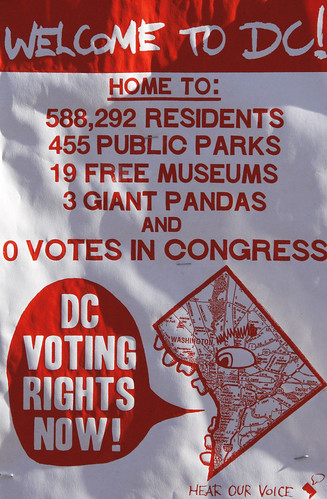
DC Voting RightsBut as a city, in terms of being at the leading edge of policy, governance, and innovative practice, for the most part DC is pretty average, with a handful of practices that stand out as national best practice (maybe bike share, better in the US, although not in terms of global practice; the Combi electricity and waste reduction generators at the Blue Plains Wastewater Treatment Plant; the original program supporting the development of community-based clinics and the health insurance coverage program that predated Obamacare).

Rather than focus on being great, instead the focus is on "our right to representation."  I get that.  But it doesn't make me particularly motivated to expend much energy on advocating for DC's statehood.

I joke that seeking statehood for DC amongst DC's progressive electorate is the equivalent of trying to stoke vote in conservative states by putting anti-immigrant or anti-gay rights referenda on the ballot.

Image from DCI Reporter.

I have to wonder, "why now?"

Looking at the proposals of the draft "Constitution" ("Draft constitution for 51st American state would let almost anyone be governor of D.C.," Washington Post) in terms of the governance structure, I have to say I am incredibly disappointed.  It renames the Mayor the Governor and renames the City Council the House of Representatives.  But otherwise there aren't significant changes.

Changing DC's system of governance by adding democracy.  I have written quite a bit over the years about how DC should consider expanding the number of elected representatives, by having two Councilmembers per ward instead of only one, and perhaps by expanding the number of wards.  In "Continued musing on restructuring DC's City Council (mostly)" I make the following recommendations:

1. Increase the number of wards.
2. Increase the number of councilmembers
3. Move the legislature to part-time service and reduced pay
4. Reduce the size of councilmember staff
5. Increase the research capacity of local government
6. Institute term limits for elected officials.
7. Change the date of the primary election to extend the electioneering period.
8. Institute ranked choice voting for local elected officials.
9. Institute additional campaign finance limits for local elections.
10. Create an elected public advocate/ombudsperson.
11. Reconstitute a school board with oversight over pre-K to 12 public education, traditional and charter schools.
12. Build civic capacity and infrastructure.

(Other posts have covered capital budgeting and participatory budgeting as processes that the city should adopt to generate better and fairer results and to reduce political meddling.)

There are at least four advantages to such a plan: (1) greater representation; (2) elected positions could shift to part-time, although that could create conflicts of interest; (3) there would be intra-ward competition rather than the default of ward-based monarchies headed by the single Councilmember; and (4) it would be harder to pass legislation--now bills can be passed by as few as seven Councilmembers.

Renaming the city a state and not much more.  By contrast, the proposed Constitution comes with no serious rethinking--we have about 40 years of experience with Home Rule now (the Act was passed in 1973), and it is time for an assessment of "how we've done"--of the city's system of representation and to see if we can do better.

Which again causes me to ask, "Why now" and "What for?" beyond adding representation in Congress, which is a serious longshot, and the system for representation in Congress needs many other changes to be fairer--for example, states like California and New York have less per capita representation than smaller states, the way that the Senate is organized to favor small states, etc.

Labels: , , , , , , ,

Wednesday, November 07, 2012

The 2012 national election

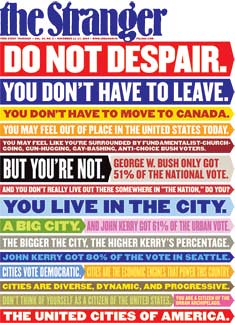
stranger Scary how the demographics skew so much in terms of race.  And how center city and suburban voters trend Democrat.  When you look at a red/blue map of the entire country, it looks like bits of blue in a sea of red, but if its weighted by population, its a bit more equal.  The Patchwork Nation site looks at the demographics in a more fine-grained manner.  See "Why Obama Won: Explaining the Patchwork Vote" from WNYC.

I was worried that I was going to have to reprint The Stranger's--Seattle's leading alternative weekly--screed after the 2004 election, which was very bitter over the results, and how cities and suburbs were trumped by more exurban voters.  See "The Urban Archipelago: It's the Cities, Stupid."

With regard to Virginia, the city/suburban vote definitely favored Tim Kaine in the Senate race over George Allen, even, surprisingly, in the Hampton Roads area.

Labels: , ,

Wednesday, July 11, 2012

DC's Advisory Neighborhood Commissions: What they do, How to Run and Why you Should!

From EmpowerDC:

Wednesday, July 18th 2012
6:30-8:30 PM
Watha T. Daniel Public Library
1630 7th St, NW (Shaw Metro Station)

With Special Guests:

Gottlieb Simon
Director, Office of Advisory Neighborhood Commissions

Kathy Fairley
Special Assistant, DC Board of Elections & Ethics

ANC Commissioners:
Darrell Gaston (8B03), Sylvia Brown (7C04) and Keith Silver (6C01)
sharing their experiences, successes and challenges

LOOK UP YOUR ANC HERE

New ANC boundaries will be in effect for the Nov 6th election. Candidates must live in the Single Member District for which they are running for 60 days prior to the election, and be age 18 by the date of the election. Candidates can collect 25 signatures to appear on the ballot or run a write-in campaign. Petitions are available now through August 8th. Come find out more!

---------
DC ANC license plateANCs in DC are grassroots level government structures, with the statutory right to "weigh in" on matters before DC Government agencies from plans to zoning matters and alcoholic beverage licensing issues.  Some ANC commissioners have gone on to become City Councilmembers or work for various DC Government agencies (the latter, personally, I think can present conflicts of interest).

AND many ANC commissioners believe that "great weight" means that city agencies have to defer to the position of ANCs, which isn't the case.

There is no real training structure for ANCs, so they can be either great or terrible.  A big problem is "personalization vs. process."  Like a lot of politicians, ANC commissioners want to make the office about them, rather than to work the process and fairness of government.

Some of my writings on the general subject of ANCs are:

- Another failure to lead: DC's Advisory Neighborhood Commissions
- System transformation or people vs. systems and structures
- Contempt of the citizenry
- Stultified vs. flat organizations, democracy vs. autocracy 
- ANCs and civic engagement
- "Incentivizing" ANC Commissioners 
- An aha! moment about why DC Government is "problematic"
- The Agony of Defeat
- YIMBYs from Brooklyn to DC -- Thinking about Community Participation in Shaping Development"
- ANCs build up political muscle, and yet....

The well functioning ANCs tend to involve residents in the operations of standing committees.  The less well functioning ANCs tend to (1) not have standing committees and (2) don't involve residents in the operations of those committees.  The law creating ANCs allows for non-elected commissioners to serve on committees, even chair them, but most ANCs do not exercise this aspect of citizen involvement in their operation.

When I first learned about this type of government structure, I was in college, and they had similar structures in Columbus, Ohio.  Representation wasn't by geography, but by stakeholder group, so college students were represented, as well as merchants from the local commercial districts and residents.

I thought it was a really neat idea.

While I still think that some form of local government participation structure needs to exist at a level subsidiary to the City Council in cities, and there are various forms of which it can take (see "The uncreative city #2: neighborhood capacity building and leveraging the power of proximity and networking" and "(Even more on) ANCs (Advisory Neighborhood Commissions in DC)"), I am a little less enamored of ANCs from the standpoint of supporting civil society in DC.

There are two negative aspects.  One is that they "cream off" the better leadership available within neighborhoods, so that other civil society organizations such as community associations, garden clubs, friends organizations, and the like have a difficult time maintaining operation with quality leadership.

The second is that I think the presence of local government structures such as ANCs can contribute to a kind of "governmentalizing" (like the concept of infantilization) any and all neighborhood issue to one that needs to be "solved" by "government" rather than through self-help and the response by interested citizens/residents who care enough about the issue to organize, tackle the problem and to propose, create and implement solutions.

In any case, building robust capacity building institutions would be the first step to improving grassroots "governance" systems in DC.  And the second necessary step is in building the right organizational support structures, especially around financial management, to reduce the likelihood of corruption and to just make it easier for commissioners to focus on substance issues, rather than spend a lot of time on organizational form matters.  See "Networked solutions" for some problems with ANCs in DC" and "A neat solution to (some of the) petty corruption in DC government-related civic organizations."

In the meantime, getting more people who understand this running and serving as ANC Commissioners would be an important step towards general improvement of the ANC concept in practice.

Labels: , , , , , ,