Rebuilding Place in the Urban Space

"A community’s physical form, rather than its land uses, is its most intrinsic and enduring characteristic." [Katz, EPA] This blog focuses on place and placemaking and all that makes it work--historic preservation, urban design, transportation, asset-based community development, arts & cultural development, commercial district revitalization, tourism & destination development, and quality of life advocacy--along with doses of civic engagement and good governance watchdogging.

Wednesday, January 05, 2022

Pontiac Michigan: a lagging African American city in one of the nation's wealthiest counties

I've written about Oakland County, Michigan vis a vis Detroit, and how the multi-decade County Executive, L. Brooks Patterson, spent a lot of time working to keep the county ascendant at the expense of the majority black center city.

-- "The rise of Oakland County is built on Detroit's fall," 2014
-- "One more idea about Detroit: merging not with Wayne County but Oakland County," 2019
-- "Revisiting stories: the death of L. Brooks Patterson, County Executive, Oakland County, Michigan," 2019
-- "Michigan politics as an illustration of the impact of the decline of industry on social capital," 2020

Oakland County has not quite 1.3 million residents and the population is roughly 75% white and 14% black.  Located immediately north of Detroit, later waves of black outmigration from the city led to significant demographic changes in communities like Southfield and Oak Park, which are now majority black.

Built on the earlier success of the auto industry, as of the 2010 Census, Oakland was the seventh wealthiest county in the US--and the second wealthiest, after Fairfax County, Virginia, of places with at least one million residents.

The county has lots of office parks, Oakland University, and an industrial promotion initiative called Automation Alley, aimed at keeping its industrial base competitive.  While definitely a suburban community, it has a number of traditional town centers predating suburbanization, like Royal Oak, Ferndale, and Birmingham, and Pontiac, the county seat.

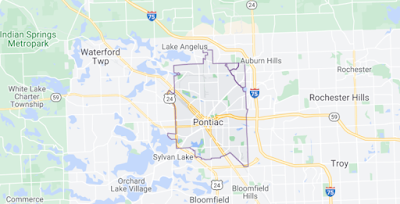
Pontiac, about 20 miles north of Detroit, is the Oakland County seat, but in the 1970s, the county government began relocating most of its facilities to a new automobile-centric headquarters campus in adjacent Waterford Township, with criminal justice facilities (courthouse, jail) remaining in the city.  This removed the valuable energy government office districts can provide to city economic health.
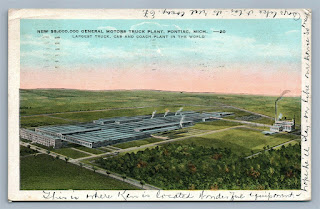
When I lived in Michigan, Pontiac was known for its industry--home to GM's Pontiac Motors division when that brand still had verve, but also GM's extensive medium truck and bus manufacturing operations, and for being a majority black community in a predominately white community.

It was one of the first cities in Michigan to employ busing to achieve school integration, and it was challenged violently, with bombings of buses in 1971.

Pontiac is about 20 square miles, while Oakland County is 907 square miles.  Today the city has about 60,000 residents, down from a peak of 85,000 in 1970.  The population is about 52% black, with over 20% of the population below the poverty line. By contrast, the overall poverty rate in Oakland County is 7.8%.
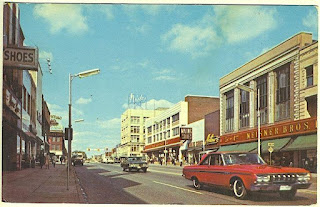
Deindustrialization.  At its peak, GM had 30,000 employees working at various plants in Pontiac, and was the largest property holder and paid the most in property taxes ("Pontiac, Michigan feels brunt of GM's pain," Reuters).  

But GM's dissolution of the Pontiac brand, the sale of its bus manufacturing operations, and the cessation of the manufacturing of large trucks led all but one of GM's facilities to close there by 2010. 

Now there are a few hundred employees, at a single facility.

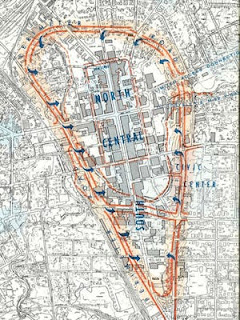
The city also suffered population outmigration and went through some iterations of urban renewal, including the construction of a ring road around the city, to facilitate car-based commuting traffic, at the expense of walkability and the economic health of the Downtown.

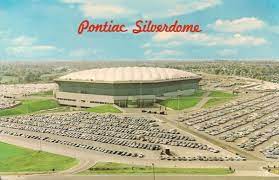
Football stadium. As part of an earlier period of outmigration from the center city, for a time, the Detroit Lions football team relocated to a covered stadium built in Pontiac, called the Silverdome, although the team returned to Detroit in 2002.  

(For a time, the Detroit Pistons basketball team played at a suburban arena in nearby Auburn Hills/Auburn Township.  Chrysler moved from inner city Highland Park to Auburn Township as well.)

Being located on the edge of the city, by freeways, the stadium provided zero energy to Pontiac's core.  

Although Pontiac was hardly an exception, as other suburban stadium and arena projects across the county also had minimal positive impact ("Framework of characteristics that support successful community development in association with the development of professional sports facilities").
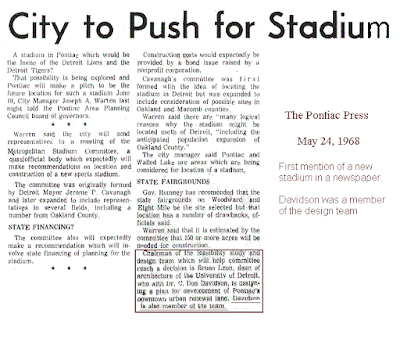
Deindustrialization was a problem across the state and the state failed to step up.  Like Detroit and Flint ("The real lesson from Flint is about municipal finance," 2016), Pontiac was one of a set of legacy cities in Michigan that because of the drop in property and income tax revenue from population shrinkage and deindustrialization went into bankruptcy, being the first to do so in 2011.  Plus, the economic multiplier effect.  Each auto job supports 3-4 other jobs.  Not all are local (e.g. parts plants from afar) but many are, furthering job losses and economic decline.

Even when plants stayed open, automation often reduced employment by as much as 75%.  It occurs to me that in multiple cities across Michigan, facing similar problems, not limited to GM or Chrysler or Ford:

  • Battle Creek (Case Equipment moved to Kentucky), Bay City (GM), Benton Harbor, Detroit, Flint (GM, Buick), Jackson, Kalamazoo (Upjohn and GM, see "Former GM plant in Kalamazoo finds second life as successful business park," Kalamazoo Gazette--while successful the industrial park replacing the GM plant has 1/8 of the workforce), Lansing (Oldsmobile), Pontiac (Pontiac, GM Truck), Saginaw (GM)  
that like the Massachusetts Gateway Cities Initiative, the State of Michigan should have developed a state-wide initiative addressing deindustrialization and its impact on center cities across the state ("Growth Ideology in a Period of Decline: Deindustrialization and Restructuring, Flint Style," Social Problems, 1992, "Understanding Resilience Through Regional Responses to Economic Restructuring," dissertation, 2010).

Instead, later Republican administrations focused on cities declaring bankruptcy, fitting their narrative of incapable cities run by Democrats, rather than developing a broader economic revitalization initiative.

Pontiac looks to do Downtown street calming.  A recent article in the Detroit Free Press, "State agrees to unwind Pontiac's Woodward 'Loop' that leaders say strangles their downtown," says that the city is going to get rid of the ring road, in an attempt to reapply more city-centric urban design principles. From the article:

When it opened in 1964, the design of Pontiac’s Woodward Avenue Loop — formerly called Wide Track Drive — was hailed as a triumph.  (Wide Track was named after a Pontiac Motors marketing campaign for its cars.)

Its swaths of one-way pavement unsnarled bottlenecks and shunted GM workers as well as parts-laden tractor-trailers through Pontiac’s downtown and to half a dozen bustling factories. The high-capacity roadway played into the dreams of midcentury designers, on a binge they called urban renewal.

The road re-routing created a set of five one way streets, each five lanes wide.  It was decidedly anti-urban, facilitating car movement over people and a thriving downtown.  

Moving the government center and the creation of Pontiac Mall, on the border of the city and Waterford Township, were other actions that redirected economic activity away from Pontiac's Downtown to other parts of Oakland County. 

Why does Pontiac lag in the midst of great wealth?

And I hate to admit, reading that article, that I hadn't ever really thought about the reality that while Oakland County is wealthy and white, could that wealth have been harnessed to spur the economic revitalization of Pontiac, to reverse the steady drumbeat of decline?

Deindustrialization and outmigration?  It's not just deindustrialization, although that's a factor.  Pontiac was on the decline long before GM shut down its plants, just like many other cities across the state, the Midwest, and the nation.

Lack of political longevity?  The now deceased County Executive L. Brooks Patterson was in office for 27 years.  Certainly, unlike Mayors who are in office for usually no more than 2 terms, he had the opportunity to address Pontiac's poverty over the long term.  (Community revitalization is a multi-decade process, see "Main Street Niches in a Mass Sales World," 2004.)

Lack of attention to revitalization needs in legacy communities?  It's not like Patterson wasn't paying attention to the needs of inner ring suburbs, as Oakland County is the first and only county in the US to have created a county-wide Main Street commercial district revitalization program, which it did in 2000.  Pontiac participates, and has had a Downtown Development Authority for decades.

Tax harmonization.  Could the county have applied various tax harmonization strategies, like what has been done in Greater Minneapolis, or how various counties share sales taxes with legacy communities. (This likely would have required approval by the state legislature.)

Best practice county revitalization initiatives.  To be fair, plenty of counties have areas of persistent poverty.  But should this be the case?   

Are we taking poverty for granted, especially when it is co-terminate with race?

Recently I made this point about Montgomery County, Maryland and how its East County section remains a laggard ("East County, Montgomery County, Maryland: Council redistricting spurs ideas for revitalization | Part 1 -- Overview").  

Fairfax County, Virginia has been working on the revitalization of the Route 1 Corridor for decades ("Fairfax County’s Richmond Highway area ripe for development during next decade," Virginia Business).  And both counties are comparable to Oakland in terms of wealth.

The most typical initiatives focus on inner ring suburbs. But Pontiac is different as it was never a suburb in the traditional sense, but a stand-alone city, secondary to the center city, but significant and unitary, with its own economy, newspaper, civic institutions, etc.

Previous entries call attention to Hennepin County, Minnesota ("A County and Its Cities: the Impact of Hennepin Community Works", Journal of Urban Affairs) and Oklahoma City--not a county exactly, but the city is larger than other city-counties like Philadelphia or San Francisco ("Change isn't usually that simple: The repatterning of Oklahoma City's Downtown Streetscape"). 

Maryland had/has a couple of smart growth related initiatives.  The "Community Legacy Revitalization Program," is a state program funding revitalization planning and projects in existing places, and there was a similar initiative at the county scale in Baltimore County under former County Executive Jim Smith ("Community renaissance set down in writing," Baltimore Sun; "Baltimore County Confronts Suburban Decline").  

Is it racism or the "soft bigotry of low expectations"?

Pontiac is a little place, 60,000 residents and 20 square miles.  In the midst of great wealth. 

From the standpoint of money, political administrative longevity, and political capacity, there's no reason that Pontiac should have continued on its negative trajectory.  Just like the way that cities like Bilbao have been renewed, using an approach that I call "transformational projects action planning." 

-- "Why can't the "Bilbao Effect" be reproduced? | Bilbao as an example of Transformational Projects Action Planning," 2017
-- "Economic restructuring success and failure: Detroit compared to Bilbao, Liverpool, and Pittsburgh," 2014
-- "Minneapolis Super Bowl: Urban Revitalization and Transformational Projects Action Planning," 2018
-- "Downtown Edmonton cultural facilities development as an example of "Transformational Projects Action Planning"," 2018

there's no reason that Pontiac couldn't have been improved similarly.

It seems like economic revitalization there ought to be a straightforward process although granted they went through a bunch of flawed urban renewal iterations and severe deindustrialization

10 Pontiac School District buses were destroyed in an attack by the Ku Klux Klan.  Detroit News photo.

On the other hand, L. Brooks Patterson did start his political career defending opponents to busing and school integration.  In Pontiac! ("RIP, L. Brooks Patterson, Racist," Detroit Metro Times, "Busing set off Democratic debate flare-up, but does it still matter in Detroit?," Detroit News).

While Patterson's campaign "against" Detroit and Wayne County could be termed to be more a kind of "economic county-ism," racism was an issue.

But wrt Pontiac, perhaps it was more about benign neglect in the context of institutionalized and/or structural racism, and the failure of the state to think systematically about deindustrialization and its impact across the state.

The default is to see Pontiac/blacks as perennially poor, as a condition not particularly amenable to change.

While it's rare for counties to develop revitalization programs the way that Hennepin County did--which it did out of desperation, facing severe property tax revenue losses in the face of economic and population decline in Minneapolis--we can raise the bar for counties like Oakland, where overall they are fine economically, but possessing severe pockets of poverty and decline.

Some recommendations.

1.  The State of Michigan should develop a program addressing deindustrialization more systematically, using the Massachusetts Gateway Cities Initiative and "Hennepin County Works" program as models.

2.  Oakland County should make "leveling up" Pontiac its number one economic development priority.

3.  Building on the nascent road dieting effort and examples of successful communities nearby like Royal Oak ("Downtown Royal Oak social district opens this weekend -- Here's what to know," Fox2 Detroit, "Baker College to Build Flagship Metro-Detroit Campus in Downtown Royal Oak," "Royal Oak and Rochester Downtowns Win National Awards," OC Times) and Birmingham, focus on redeveloping the residential and retail possibilities Downtown.

-- Reinventing Suburban Business Districts (ULI)
-- Reinventing America's Suburban Strips
-- Revitalizing Distressed Older Suburbs
-- Putting the Urban in Suburban: Art and Business of Placemaking
-- "The secret to a successful suburb: Lakewood, Cleveland Heights and the Inner-ring Divide," Cleveland Plain Dealer

4.  Develop a revitalization plan using the Transformational Projects Action Plan approach, with Oklahoma City's Metropolitan Area Projects program and the downtown streetscape program as best practice models..

5.  Why not merge Pontiac into Oakland County?  This would make County prioritization of Pontiac revitalization unavoidable.

6.  Baring that, why not consolidate Pontiac and Waterford Township (Michigan makes it almost impossible now for cities to annex townships.  Waterford is 92% white and has 72,000 residents). But combining the two would make it tied as the state's third largest city, and would add the stronger residential tax base of Waterford.

7.  Consider merging the Pontiac School District with adjoining school districts, like Waterford. This is difficult, as communities like local control of schools.  

OTOH, a majority of Oakland County school districts are shrinking and consolidation could be advantageous, especially if combined with a MAP 4 Kids program of construction and other improvements like the second phase MAP program in Oklahoma City ("MAPS for Kids wraps up," Daily Oklahoman).

Labels: , , , , , , ,

Sunday, August 11, 2019

One more idea about Detroit: merging not with Wayne County but Oakland County

Vacant houses in Detroit
Rebecca Cook, Reuters.

In the 2014 piece, "The rise of Oakland County is built on Detroit's failure," I did discuss city-county merger as one way to change the trajectory for the City of Detroit, which while revitalizing at its core, faces real long term issues concerning lack of market demand for residential living.

I favor city-county merger for legacy cities like Pittsburgh, St. Louis (it will be on the ballot but I haven't written about it yet), Baltimore ("Opinion: What Baltimore and D.C. can do to start working better together as a region (Baltimore Business Journal op-ed)," 2016), and Detroit, as a way to deal with difficult financing and governance issues ("The real lesson from Flint Michigan is about municipal finance," 2016).

But Detroit's decline has significantly impacted Wayne County too, and the County has other issues besides Detroit, aging infrastructure

Since the tri-counties haven't grown much, there isn't much chance of Detroit's recapturing the lost 1.2 million residents...

That's why after I wrote the 2014 piece, I realized that instead of merging with Wayne County, Detroit should merge with Oakland County, which is the most economically successful county in the Detroit Metropolitan Area.

That would be an unprecedented kind of merger.

But outside of creating more rigorous metropolitan government structures, along the lines in Greater Portland Oregon and Minneapolis-St. Paul, that's maybe the only kind of quantum scale change that could truly change Detroit's trajectory.

All the great media discussion notwithstanding:

-- "12 big developments set to transform Detroit," Curbed Detroit
-- "Detroit's Revival Is in Full Swing, But Some Question Its Future," Barron's
-- "Commentary: How Detroit Became a Model for Urban Renewal," Fortune
-- "Detroit's Big Comeback: Out Of Bankruptcy, A Rebirth," NPR
-- "Is Detroit Really Experiencing a Full Recovery?" CityLab

When I did a tour of New Orleans in 2006, after Katrina when the city was devastated, the native tour guide was outraged, and wanted us to be outraged too. I said, "how is this any different from what happened to Detroit?"

Detroit suffers from racism sure (see the writings of Thomas Sugrue) but it was also the auto industry's plan to break the UAW, which mostly has worked, but at the expense of cities in Michigan, especially Detroit and Flint (Pontiac, Lansing, Bay City, and Saginaw too).

In the 1950s, Detroit had something like 15 auto assembly plants, each of which employed thousands of people, and scads of supplier plants, each of which employed hundreds or thousands of people.  Now Detroit has two assembly plants.

Similarly, Flint at its peak had over 80,000 people employed by GM.  Now it is fewer than 8,000.

So that is why Michigan shifted Republican over the past few decades as auto workers, who tended to vote Democratic (cf. George Wallace, and Reagan Democrats), lost their jobs and left the state.

It's also why I get f*ing tired of reading comments on articles about how Democrats who run cities drive them into the ground.  The issue is far more complicated.

Look at all those robots!  Photo from "10 Auto Industry Jobs that Will Die Due to Automation," MoneyInc.

At the end of the day, locally elected officials have little control over what corporations do and mega economic trends like capital investment, globalization, the replacement of workers with machines, industrial consolidation, etc.

The systems that fund local government were created when the nation was growing rapidly.  We are past that phase now, and in many cases, especially for legacy communities with aging infrastructure and growing pension liabilities, local government funding systems won't generate enough revenue

Labels: , , , , , ,

Friday, May 26, 2017

The so-called myth that cities are growing when suburbs are still growing more

The other day, the New York Times ran a story, "Return to Cities an Urban Legend, Mostly," making the point that despite all the talk of population growth in the cities, more people are moving to and more growth is happening "in the suburbs."

I think this story misses very important points, a kind of "burying the lede."

Suburbs make up a much greater proportion of a metropolitan area's land mass and population.  It should be obvious that as metropolitan areas continue to grow, more people live in suburbs. It should be clear why this is so. Compared to the entire land mass and population of a metropolitan area, the formal center city, such as Washington, Baltimore, Boston, New York City, etc., is but a small proportion of a metropolitan area's total population and land mass.

For example, the DC metropolitan area has a population of about 6 million.  Less than 15% of this population is located in DC. DC comprises about 1.5% of the total land area of the metropolitan area (less when you take into account how much of the land is controlled by the federal government and not subject to development). Given these facts, it's unlikely that the city could capture a majority of population and economic growth.

New York City is part of a three-state metropolitan area greater than 13,000 square miles. The total population of the metro is slightly more than 20 million. New York City has about 8.5 million residents, in an area a cotch larger than 300 square miles.

What is significant first is that center cities are dense, with a large population in a small area. DC is about 60 square miles and has about 680,000 residents. The suburbs Fairfax County, Virginia and Montgomery County, Maryland are each about 400 square miles in size, and each has about 1.1 million residents. Each is about 6.5x larger than DC physically, with less than twice the population.

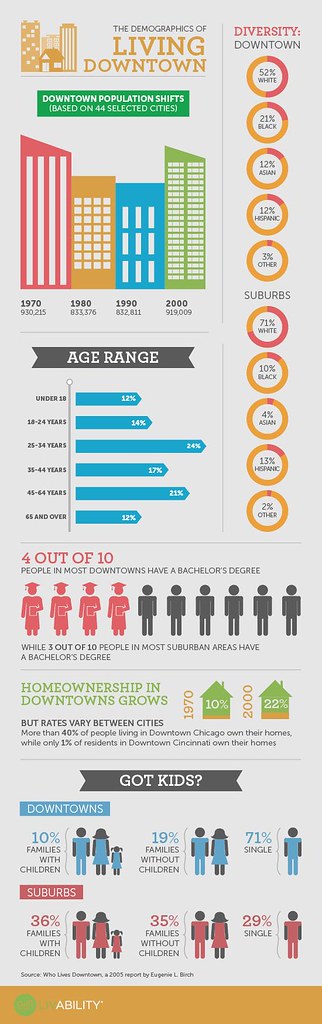
What is significant second, is rather than a story of center city shrinkage--which was the case from the 1950s to around 2000--there is a renewed interest in living and working in center cities, and center cities are capturing more residents and more business than they had previously. Since roughly 2000, there has been a change in demand for urban living.  It's marginal, but significant enough to demonstrate significant "relative" levels of population in-migration, new construction especially of multiunit housing, etc.

Much of this in-migration has been centered upon downtowns or the "central business district," which has shifted from a unidimensional office canyon active only in the daytime to a mixed use district including a significant proportion of multiunit housing and night-time districts supported in large part by residents.

-- Downtown Living, Lincoln Institute of Land Policy, 2002
-- Who Lives Downtown, Brookings Institution, 2005

Downtown Living Infographic

This is true for most major cities, Chicago being an exception in terms of experiencing population shrinkage, but growth in terms of business headquarters capture.

Baltimore too is an exception, which is why I have suggested that Baltimore City and Baltimore County re-merge--they de-merged in 1851--becoming the nation's seventh largest city ("Baltimore Business Journal).

Interestingly, in DC specifically, we have been less successful than other cities like Boston or Chicago, in capturing large businesses relocating from the suburbs. E.g., Hilton moved from California to Tysons, and Choice and Marriott stayed in the suburbs with their moves/announced moves. A large Nestle division is moving from California to Rosslyn, not DC. (Although Caterpillar recently announced a move from Peoria to Deerfield, not Chicago proper, because they want easy airport access).  Etc.

The suburbs are intensifying too.  The NYT article does make a crucial point, that suburbs are moving to a newer stage of development that is confusingly also called "urbanization" in the academic study of land use.

The phenomenon called the "edge city" 30 years ago is moving to a new stage that is moving towards greater accommodation of transit and walking, more focused on developing placemaking qualities, and somewhat less automobile-centric.

This is demonstrated within the suburbs in how the "intensifying areas" are succeeding in terms of adding population and business activity, the more disconnected and car-dependent areas of these places are languishing.

 The fact is that the market is bifurcating along the lines of concentration vs. disconnection. See "Continued Strength In Suburban Office Markets Dispels Myths, Bisnow versus "Big foreclosure suit ensnares suburban office, industrial buildings," Crain's Chicago Business. I have written about this in terms of the Fairfax County market, which is going through "reproduction of space" as a result of the Silver Line subway refocusing development in the Tysons-Reston Corridor.

With opposition.  Although intensification in the suburbs is accompanied by a great deal of angst, as suburban residents often believe that suburban intensification is somehow a kind of repudiation of the "suburban ideal."  See "End of free parking is the last straw for some Reston residents" and "In downtown Bethesda, residents and county debate whether more height is right," Washington Post, and "Reston: On a Collision Course," Connection Newspapers.

Suburban growth accompanied by growth in poverty and demand for aging services.  Just as suburbs continue to capture "more growth," as suburbs mature they are capturing more poverty ("Suburbs and the New American Poverty," Atlantic).

When the original "unique selling proposition" of the suburbs was how center cities functioned as a metropolitan area's "poverty sink" with a disproportionate share of the region's poor, and the demand for social services to serve them. I used to call that reality a type of "quality of life subsidy" to the suburbs, one dumped on the cities, but now there is a turnabout.

-- Confronting Suburban Poverty website
-- Build a Better Burb website
-- First Suburbs Consortium, Greater Cleveland

Similarly, as people age, suburbs are forced to meet a greater demand for aging services, with limited financial means to address the need ("Aging in the American Suburbs: A Changing Population," Aging Well Magazine.

Center city proponents need to be conversant with the nuances.  In any case, there are many ways to look at this issue, and proponents of center city primacy must be able to discuss the objective and subjective elements of the argument.  A particularly good argument is presented by Steve Belmont in Cities in Full, which argues for "recentralizing growth" on the center city.  And in some respects, that is what is occurring, with a lot of opposition from states, suburbs, and Republican legislators.

I have argued for a long time ("DC as a suburban agenda dominated city") that the people most traditionally active in local civic affairs in DC came to the fore during the period of the shrinking city when the priority was staunching outmigration and stabilizing neighborhoods in the face of trends that did not favor urban living.

Now that the city has the opportunity to grow in terms of population and business activity, people may need a different skill set and attitude, and also concern themselves with satisfying future residents, not just current residents, based on events and experiences solely from the past.

The digital economy renews the value of "agglomeration economies" Reading Richard Florida's new book, The New Urban Crisis, I wouldn't claim that this point was made as directly as it should have been, but it spurred me to think about how with changes in economic and social conditions in terms of the impact of digitalization and globalization, "agglomeration economies" have again become increasingly important.

"Agglomeration economies" is a fundamental concept from urban economics. The Geography of Transportation webpage at Hofstra University defines them thusly:

Agglomeration economies are a powerful force that help explain the advantages of the "clustering effect" of many activities ranging from retailing to transport terminals. There are three major categories of agglomeration economies:

Urbanization economies. Benefits derived from the agglomeration of population, namely common infrastructures (e.g. utilities or public transit), the availability and diversity of labor and market size;

Industrialization economies. Benefits derived from the agglomeration of industrial activities, such as being their respective suppliers or customers. This favors the emergence of industrial clusters;

Localization economies. Benefits derived from the agglomeration of a set of activities near a specific facility, let it be a transport terminal (logistics parks), a seat of government (lobbying, consulting, law) or a large university (technology parks).:
The job market and the world economy is much more competitive and operates much faster, making agglomeration or "clustering" valuable again when in the post-war period through the first decade of the 21st century, automobile-centric land use and transportation development paradigms allowed automobility to trump the clustering value of place/location.

Transportation and agglomeration economies.  Transportation efficiencies have always been the primary factor in the development of cities, starting with how most cities developed as ports on oceans, lakes, and rivers.

For example, wheat was milled close to where it was produced (Minneapolis-St. Paul) because of the cost of transportation.  Heavy appliances like stoves and bathtubs were manufactured locally because they were "too heavy" to transport cheaply to other markets, etc.

The development of an integrated railroad system meant that businesses could transcend constraints on their ability to do business imposed by the difficulty and cost of transporting goods, and led to the creation of a unified national market and the consolidation of various industries.

Mills could locate far from where wheat was grown and no longer did every city need its own manufacturing plant for appliances.

It still wasn't perfect, because railroads didn't charge a flat rate for transportation of goods, they charged on the basis of the value of the product, so there was still a reticence to ship long distances goods that were particularly expensive.

The road network enabled--for a long time but not indefinitely--automobile transportation to trump the value of agglomeration.  The creation of a ubiquitous and integrated road network serving local, metropolitan, regional, multi-state and national markets supported the rise of a deconcentrated land use and transportation planning paradigm, where uses are separated, and people mostly use a personally-owned automobile to get from place to place.

Cheap cars, cheap gas, the "open road" and plenty of free parking enabled the outward spread of commerce from center cities to the arterials and freeways of the suburbs with the creation of strip shopping centers, shopping malls, and business districts off freeways.

The carrying capacity of the road network is fixed.  This works, at the cost of owning and maintaining a car, building and maintaining the road network, and at the economic, military, and environmental costs of a fossil-fuel based mobility network.

But it stops working when any of those factors/conditions change substantively, including the "carrying capacity" of the road network.

Richard Florida argues that as metropolitan areas reach a population of 5 to 6 million, an automobile-centric mobility network has decreasing marginal returns.  (I believe that the writings of Newman and Kenworthy make a similar point.)

There is a line in the Jacobs book Nature of  Economies, when she responds to a question of "Why aren't there enough roads?" with the response, "You're asking the wrong question.  The right question is 'why are there so many cars?'"

Cities long ago recognized that the carrying capacity of the road network wasn't great enough to satisfy the various mobility and exchange needs of the cities and developed robust transit systems. According to a book review of David Engwicht's Reclaiming our cities and towns: better living through less traffic:
Engwicht maintains that cities were originally created as places for people to come together to trade goods and stories. A city, by definition, can be seen as a concentration of exchange opportunities. Cars get in the way of these exchanges in several ways. They drive people out of public spaces and create inhospitable environments for social interaction because of noise, fumes, and the barrier effects of the stream of traffic. Furthermore, they eliminate what he calls the "spontaneous" exchange — the unplanned encounter — thereby depriving cities of their essential spontaneity and life.

Traffic also sets into motion a wide range of self-reinforcing inefficiencies, according to Engwicht. Cars require roads, which require space, which require urban expansion, which requires more travel, which in turn requires more space.
Conclusion:  The need to reposition economic development and governance systems around metropolitan areas.  The issue isn't whether or not cities are growing faster than the suburbs but is the economic value of the metropolitan area and the necessity of strong center cities as thriving anchors of these places.

This is the general argument of the Center for Metropolitan Studies at the Brookings Institution, that "metropolitan areas" -- that is center cities and the suburbs combined -- should be seen as the primary building blocks of the national economy and that US political and governance systems should be reformulated to recognize and support this reality.

Brookings laid these arguments out in the book Metropolitan Revolution.

See my review and also "Resurging cities, resurging metros, the impoverished and the Metropolitan Revolution (continued)" and "States, economic development, and sub-state/metropolitan area political restructuring."

In the meantime, the Trump Administration is doing all it can to screw cities in terms of proposals to defund transit, housing programs, health insurance programs, other poverty programs, etc.

And the DC area specifically, as the Trump Administration proposes significantly less money than is required to build new facilities for agencies such as the FBI and the Department of Homeland Security.

Labels: , , , , , , , ,

Friday, December 16, 2016

Opinion: What Baltimore and D.C. can do to start working better together as a region (Baltimore Business Journal op-ed)

I wrote an op-ed in response to an article that ran in last week's Baltimore Business Journal discussing the meeting of a group of stakeholders from DC and Baltimore sitting down over dinner and talking about the need for a stronger focus on regionalism.

I have paid attention to Baltimore pretty carefully since I got involved in urban revitalization as an avocation and vocation, partly to contrast the difference between strong and weak real estate markets and to be able to become more nuanced in understanding the differences in opportunity that result from significant differences in material conditions.

For example, DC still has a strong center and a transit network, while Baltimore is bigger, has more poverty and crime (although for a time crime was worse in DC), has lost relevance with the outmigration of population and economic activity, and has a couple rail transit lines, but no transit network.

I worked briefly as a planner in Baltimore County in FY2010 (I wasn't able to stay on for a couple reasons, one being during the recession they were cutting staff and agencies not adding people) and that gave me more insights into some of the issues in the metropolitan area, and I have written many blog entries over the years about it, including:

-- "From the files: transit planning in Baltimore County"
-- "Best practice suburban bicycle planning using the 'action planning' method"
-- "Morgan State University should move their architecture and planning school to Downtown/Station North Arts District"
-- "Marketing resident attraction"
-- "New Baltimore area regional plan for sustainability"
-- "One big idea: Getting MARC and Metrorail to integrate fares, stations, and marketing systems, using London Overground as an example"

Here's the article but note that the actual article is locked and only available to subscribers.
============================
"Opinion: What Baltimore and D.C. can do to start working better together as a region," Baltimore Business Journal, 12/16/2016

In “Building a case for regionalism between Baltimore and D.C.,,” published Dec. 9, Melody Simmons reported on a recent meeting of Baltimore and Washington stakeholders.

As a planner-writer with experience in both communities, I believe building the Baltimore and Washington metropolitan areas into a single region is dependent on three things:

1. Each metro needs to “get its house in order” by functioning and acting at a “best practice” level;

2. More efficient physical connections need to be constructed within and between the metropolitan areas; and

3. More attention needs to be put on working together — rather than reflexively choosing to be obstreperous, the first inclination needs to be to collaborate.

Here are five initiatives where Maryland can start setting the stage for making real a powerhouse Baltimore-Washington region:

1. The state must acknowledge that the two metropolitan areas drive the state economy and rather than pit the areas against each other or against other parts of the state, a program of high value investment in both the Baltimore and Washington areas needs to be prioritized.

2. While as a Washington resident I would never argue for re-merging the city into Maryland. Maryland should “take ownership” of D.C. by recognizing it is the linchpin of the economies of Anne Arundel, Charles, Howard, Montgomery, and Prince George’s counties.

3. For example, the state government needs to have an open mind about financial solutions for the D.C.-area’s sputtering Metrorail system and should be “all in” on not only building the Purple Line as currently planned, but should initiate the planning process now for extending the Purple Line from New Carrollton to Alexandria, Va., and extending the Purple Line from Bethesda to Tysons in Northern Virginia should be part of any discussions about rebuilding the American Legion Bridge.

4. As the home to national political dysfunction, Washington has serious image problems. For different reasons, so does the Baltimore area. The metropolitan economy languishes in the face of Baltimore’s crime and population shrinkage despite the city’s incredible array of assets.

To completely redefine “Baltimore,” serious consideration must be given to a merger of Baltimore City and Baltimore County. The two jurisdictions separated in 1851. Consolidation isn’t easy, but Louisville and Lexington in Kentucky and Nashville, Tenn., offer models that show that it can be done.

A combined city and county would have a population of 1.425 million, making it the nation’s seventh largest city, the most populous and powerful jurisdiction in Maryland, and a much bigger player in the multi-state mid-Atlantic region.

It would increase bonding-financing capacity and enable significant transformation of the role of transit. A merger of the city and county community colleges would create a powerhouse institution as well, as would the merger of the parks and recreation systems

A merger could create difficult political issues, because the formerly suburban county would have more legacy residents and like in Toronto and London, where more conservative suburban voters tend to outvote more progressive voters in the core, this could create representation and governance issues.

A slightly different governance model could be adopted, providing for city-county consolidation, but also the creation of separate boroughs within “the city.” Boroughs are smaller and more local governments, with elected representation and responsibilities for planning and the delivery of certain services. London, Montreal, and Paris are some of the cities that are organized in this fashion.

5. High quality transit defines great cities. Right now transit in the Baltimore area doesn’t have the kind of multiplicative place and investment value that can intensify development and population. That’s why it’s so hard to build transit oriented development projects like State Center or Penn Station, or new lines like the Red Line.

The major impetus for New York City’s consolidation in 1898 was to increase its ability to raise funds to build the subway system. A merged Baltimore would have the heft to address strengthening, extending, and leveraging transit investment.

Reconfiguring the light rail system to serve Towson and extending it a bit into Hunt Valley, extending the line southward to Howard County, spiffing it up with new, design forward, rail cars, connecting the light rail and subway lines more directly in the vicinity of Lexington Market, and extending the subway line to White Marsh would begin to create a transit system and network out of what are now two disconnected rail lines.

================
They did a good job cutting the piece down.  But mostly, they did so by cutting the last three points.  Here's the rest:

6. MARC is one of the more successful commuter railroads in the US. In recent years, the system has added weekend service on the Penn Line between Baltimore and Washington, but the Camden and Brunswick lines operate only on weekdays, and the Brunswick line doesn't offer reverse commute service from Washington to business districts in Montgomery and Frederick Counties.

Like how London reconfigured some rail lines to function as a railroad equivalent of subway service, MARC should integrate its fare media system and station network into the local transit systems in Baltimore and Washington--the MTA CharmCard and WMATA SmarTrip fare cards are already interoperable.

Building on that, Maryland should create a framework where DC can become a co-owner of MARC system, with expanded coverage and stations within DC, new lines to Annapolis from Baltimore and Washington, service to Charles County, and reverse commute service added to the Brunswick line. An improved station in West Baltimore, a new station in East Baltimore, and service between Frederick and Baltimore should be part of this program.

7. Longer term the merger of MARC and Virginia Railway Express should be on the table -- I suggest calling the new system RACER, for "Railroad Authority of the Chesapeake Region" -- extending the Penn Line into Virginia, and adding lines throughout the multi-state region including connections to Delaware, Pennsylvania, and Richmond.

8. DC’s public higher education system does not have institutions of quality comparable to the University System of Maryland. Why not treat DC residents as “residents” for enrollment purposes at Maryland’s public institutions of higher learning?

There are plenty of other initiatives that can be added to this list, ranging from integrating tourism planning, building the region into a biotechnology powerhouse, better leveraging the value of federal research facilities and higher education institutions, integrating airport planning, supporting the Port of Baltimore at the multi-state scale, etc., but this is definitely a start. Now on to making a list for Washington.

Labels: , , , ,

Thursday, September 24, 2015

Australia creates Ministry for Cities and the Built Environment

Liveable cities, efficient productive cities, the environment of cities, are economic assets. 
Malcolm Turnbull, Prime Minister of Australia
Apparently, the previous Prime Minister was a road proponent primarily.  See "Prime Minister Malcolm Turnbull cabinet reshuffle: first Minister for Cities and Built Environment appointed," and "PM appoints Jamie Briggs as Minister for Cities," Sydney Morning Herald.  From the second article:
"Historically the federal government has had a limited engagement with cities, and yet that is where most Australians live," Mr Turnbull said. "It is where the bulk of our economic growth can be found. We often overlook the fact that liveable cities, efficient productive cities, the environment of cities, are economic assets."
According to Architecture Australia ("PM Turnbull appoints new minister for cities"), the Australian Institute of Architects supports the change and made specific recommendations:
  • appoint a federal government architect to further promote high quality buildings and public spaces, and provide expert, high level strategic advice
  • adopt an urban design policy
  • develop strategic planning for the built environment to promote globally competitive, sustainable and socially inclusive urban centres and towns
  • increase density through design – to capitalize on the role of good design to accommodate urban growth
  • champion world-class urban design and architecture to help solve Australia’s urban growth challenges and enhance the nation’s international design reputation
My 2008 suggestion of a new federal agency, the US Department of Cities, Regions and Urban Ecology.  This reminds me that when Barack Obama was elected as President, I suggested that he create a new agency out of the Department of Housing and Urban Development and parts of EPA and the Department of Energy and other units called the Department of Cities, Regions and Urban Ecology ("How will Obama relate to the District?").

 But of course that was a grandiose idea, as creating a new government agency requires Congressional approval.  (I recommended other reconfigurations of other agencies as well.)

It doesn't work that way in the parliamentary government system, where the governing party possesses a great deal of authority on how it chooses to organize the way it governs.  Of course, that can be good and bad, as priorities can change significantly from government to government.

Australia is different too from other parliamentary systems, because the legislative branch, the Parliament, has more power vis-a-vis the executive (Prime Minister), which is why the governing party, the Liberals, recently changed its leadership ("Australia shows us what parliamentary democracy looks like," Toronto Globe & Mail).

Urban and transportation policy in Australia.  Like the US, in Australia, much of the authority concerning urban and transportation  policy and practice lies with the states, although the national government in both places is a key funder.

-- Public Transport Network Planning in Australia: Assessing current practice in Australia’s five largest cities, Paul Mees and Jago Dodson, Griffith University Urban Research Program
-- Our Cities, Our Future | A National Urban Policy, Department of Infrastructure and Transport, Government of Australia

Victoria is a global leader in advancing policy and practice concerning transportation demand management.

Melbourne is a global leader in sustainable mobility and livability--The Economist regularly ranks the city as the most livable in the world ("Daily chart: The world's most 'liveable' cities"), retaining a dense network of streetcars, and has been quite creative in using block interiors ("laneways") as innovative spaces to support local retail and cultural activities.

Bike sharing isn't particularly successful there. This is widely attributed to mandatory bike helmet laws.

Note that other ranking systems put Sydney ahead of Melbourne ("Economists say Australia's most livable city is Melbourne, or Sydney or Canberra," Melbourne Age).

The country has a number of bus rapid transit systems and the Public Transport Users Association in Victoria state does a lot of great advocacy work.

As one of the world's early modern examples of starchitecture/architectural tourism, Sydney's Opera Hall is known world-wide, and Australia's capital city, Canberra, was planned in a manner comparable to Washington, DC.
On Sydney Harbour.
Flickr photo by Bernard Spragg.

Labels: , , , ,

Tuesday, June 09, 2015

New Baltimore area regional plan for sustainability

Baltimore photo collage.  "BaltimoreC12" by Excel23 - Own work. Licensed under CC BY-SA 3.0 via Wikimedia Commons.

Is discussed ("A plan to lift Baltimore region from good to great") by Baltimore Sun columnist Dan Rodricks who writes:
I have read a lot of reports and recommendations for improving life in metropolitan Baltimore over the years — some interesting, some scathing, many bland or puny-minded, most ignored or forgotten. 
The regional plan released Monday by the Baltimore Metropolitan Council goes further in describing our problems than any report I've seen from a local government entity; it's refreshingly honest about the area's racial, economic and social issues, and it provides a road map to a "shared regional destiny" that is clear and even bold. ...

For years, the council's main interest was transportation. In fact, until recently, it seemed to have little to say about anything potentially controversial, such as poverty and affordable housing. But with the establishment of the Opportunity Collaborative — the entity that came up with Monday's report — the council ventured fully into the areas of housing and workforce development.
Also see "A regional approach to close the Baltimore Metropolitan opportunity gap" (op-ed, Baltimore Sun).

The Baltimore Metropolitan Council is the designated metropolitan council of governments, focused mostly on transportation as it is the "Metropolitan Planning Organization" designated by the US DOT as the transportation planning organization for the region. (The bike and pedestrian plan I did for Western Baltimore County was funded through the BMC.)

-- Opportunity Collaborative, Baltimore Metropolitan Council
-- the planning document doesn't seem to be available yet, although it was released yesterday, but should be made available here, Regional Plan for Sustainable Development

-------
Not having read the plan, given that it isn't available, here's my take.

1. Too much development capacity in the metropolitan area.  The biggest problem for the Baltimore metropolitan area is that there is too much "build out" capacity compared to demand.  So there will always be pressure from the outlying counties (Howard, Baltimore, Carroll, Anne Arundel, Harford) to capture development which might otherwise be focused on Baltimore City.

Baltimore County alone has maybe double the "growth areas" or supply of developable land -- Towson, Hunt Valley, Owings Mills, White Marsh, area near the Aberdeen Proving Ground ("Harford, military officials worried about lay-offs, BRAC," Baltimore Sun), Essex-Middle River -- than there is demand.  Baltimore County too, like Baltimore City, has lost a lot of its previous manufacturing-industrial base. For example, the Sparrows Point steel plant is actually in the county.

It is the "sprawling outward" and migration of office space outside of the city to mostly greenfield locations despite a lack of demand over the past 40 years that has consigned Baltimore City to its impoverished state.

2. The lack of a transit network, as opposed to some transit lines, (see the past blog entry "From the files: transit planning in Baltimore County") prevents re-centering of development in the core.

Towson aerial photo.  From the Baltimore Sun.  Towson has about 90,000 residents and is the County seat and business center, along with Hunt Valley, which is not quite 10 miles north of the incorporated area.

3. I can't speak about counties other than Baltimore County, but I thought when I worked there that the County was content to measure success in terms of "doing better than Baltimore City" as a baseline, and that was the wrong comparison.

Interestingly, Baltimore County has over the decades done some of the region's most innovative planning.  Arguably, it may be the location of the first Urban-Rural Growth Boundary (Urban-Rural Demarcation Line), created in 1967, a few years after the pathbreaking environmentally focused "Plan for the Valleys," done by Ian McHarg.

Later innovations included creation of one of the earliest county agencies focused on the environment (for example, zbout 15 years before DC created an equivalent agency), "outsourcing" programming planning responsibilities within the park and recreation system to citizens (although this was mostly for budgetary reasons, it's a forward approach to citizen involvement), land use planning focused on redirecting growth to existing places, co-location of government facilities (such as the combined Senior Center and Library in Pikesville), and an urban design unit to provide technical assistance to communities.

The planning office tried to implement a smart growth planning code (which was successfully opposed by the land use bar, the biggest source of campaign contributions) and in the 1950s, the parks department and school system developed a wide-ranging MOU for joint use of facilities, with the parks department funding more robust facilities in the schools to support time-shifted access for residents more generally.

(And I developed my "Signature Streets" concept there, rooted in part in the County's history of planning-related innovation.)

4. Baltimore City and County should merge.  In 1851, Baltimore City and Baltimore County split, so the City technically is separate, although there were some annexations until about 1919 (a later amendment to the state Constitution precludes Baltimore City from annexing any more County land)..

Interestingly, rather than splitting between city and county, around the same time, Philadelphia instead became a city-county, and later so did San Francisco.  And New York City consolidated out of five counties in the 1890s--technically the counties still exist legally, under the rubric of the city).

Between the City and County, they have not quite 1.5 million residents.  But Baltimore's peak population, around World War II, was close to one million.

The City and County should re-merge, comparable to some of the combined city-counties elsewhere in the country such as Indianapolis, Lexington, Louisville, Macon-Bibb County, and Nashville-Davidson County.

It would be very controversial, in part because the County has more residents (823,000 vs.622,000) and fewer elected officials (seven Councilmembers in the County + the County Executive vs. 14 Councilmembers, plus the Council President, plus the Mayor in the City), which would change the political calculus somewhat, and in ways that the African-American dominated political structure in the city could see as being designed deliberately to disenfranchise their political power and prominence within the city.

The disenfranchisement issue is subtly different from the related issue of more conservative suburban voters outweighing more progressive voters in the core of the city, a problem common to Toronto and London and typical of the large city-county combinations like Indianapolis--but not the center city counties like Philadelphia and San Francisco, while in New York City, Staten Island is the conservative outpost that gets politically outweighed by the rest of the more progressive city.

5. But a combined City-County would be the nation's sixth largest city, just edging Phoenix. Harnessing some of the financial prowess of county could help to better address the poverty problems in the city.

Baltimore City is a "small city," ranking 26th (DC is 23rd), while Baltimore County is the third largest county in the state by population, and 69th largest by population in the nation (Fairfax County, Virginia is the 36th, Montgomery 41st, and Prince George's 59th).  

By merging, the City and County would be resetting their trajectories, albeit jointly.

Rank City Population
1 New York City 8,405,837
2 Los Angeles 3,884,307
3 Chicago 2,718,782
4 Houston 2,195,914
5 Philadelphia 1,553,165
6 Phoenix 1,513,367
7 San Antonio 1,409,019
8 San Diego 1,355,896
9 Dallas 1,257,676
10 San Jose 998,537
14 San Francisco 837,442

Note that different population estimate sources yield different conclusions.  Some add up so that a Baltimore City+County combination would be greater than Phoenix's population, others show Baltimore City+County slightly behind, but still ahead of San Antonio.

At worst, a combined Baltimore City+County would be the nation's seventh largest city.

6.  This would allow Baltimore to begin to reassert its importance and position as a leading city on the East Coast and in the Mid-Atlantic region.  Now, it's a distant third to DC and Philadelphia in the Mid-Atlantic region, no longer considered in the same tier as New York City or Boston, with a negative velocity, especially in terms of external perception post-Freddie Gray riots.

(Note that residents I've talked to are actually heartened by the post-riot community response.)
Crumbling house in Baltimore neighborhood
Patrick Semansky/Associated Press.  Crumbling house in Baltimore neighborhood.

7.  What this would mean to the metropolitan area is that Howard County would continue to be residential suburban in orientation, Harford and Carroll Counties would remain mostly rural, and Anne Arundel, with Annapolis, would be the political center, with its commerce focused on government and maritime functions.

Labels: , , , ,

Wednesday, September 17, 2014

Presentation by Henry Cisneros

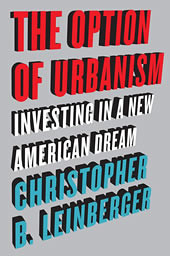
Island Press - Option of Urbanism Investing in a New American Dream - Christopher LeinbergerYesterday was the third conference on "Walkable Urban Communities" with the topic of "Social Equity and Walkable Urban Places," held by the GWU Center for Real Estate and Urban Analysis, featuring the ongoing research project spearheaded by Christopher Leinberger, a developer and advocate focused on re-centering more real estate development activity towards "walkable urban places" in the suburbs or the center city, rather than on "drivable suburban" (or "conventional subdivision development").

The conference was co-produced by the Urban Land Institute with the sponsorship of the Venable Law Firm and LOCUS, a program of Smart Growth America.

The opening presentation was by Henry Cisneros, who was the Secretary of the US Department of Housing and Urban Development under President Clinton, and before that was Mayor (and Councilmember) of San Antonio, Texas.

Since then he has led CityView, a company that builds urban housing as a revitalization strategy, working with funders committed to community investment.  I didn't know that he has a PhD from GWU...

My notes from his talk.  I won't claim this is verbatim.

There are many factors converging that favor cities as places that attract residents and businesses.  At HUD, I worked to refocus the department on urban places.  To do so we needed place-based metrics to be able to answer the question "are we making a difference in physical places."  (He made the point that the way the federal government is set up, how program authorization and appropriations work, that programs function in ways where it can be difficult to see substantive impact.)

Cities are the platforms for social progress.  Cities have the ability to be masters of their own destiny and are the places where government has the real opportunity to make a positive difference in people's lives.  Plans and visions make this happen.  Many cities have willed their way to a different destiny.

The motive force of a city's agenda is the public good.  While cities work with the private sector in public-private partnerships, the agenda of the city is different.  It is not motivated by generating profit primarily, even if profit is generated.  The primary outcomes are social improvement and equity--the larger public good.

13 trends impacting cities

  1. Sustainability, both in terms of the impact of climate change (e.g., Superstorm Sandy and the way it impacted New York City and the New Jersey Coast) and the opportunities presented by new building materials
  2. Embedding technology in urban real estate
  3. Harnessing new advanced technology businesses (media, information technology, etc.) and anchor instutions like universities and medical centers as engines of urban growth and opportunity
  4. modernization of urban infrastructure (not just replacing infrastructure, but extending and improving it.
  5. Mixed income mixing, affordable housing and cross-subsidization
  6. Preparing for demographic change--the population is aging, and the composition of youth demographics is changing, e.g., starting this year, the majority of the K-12 student population is majority minority
  7. taking on density--many constituencies oppose this, but in the urban context density is key
  8. making walkability real
  9. adding transit related value to communitys
  10. incorporating public space and amenities into public and private projects as a way to improve them and make them successful
  11. creative design and modern materials offer new opportunities in construction 
  12. financing of urban real estate development in more creative ways
  13. cementing public-private partnerships and how they work
The new urban moment.  Despite all the talk about stasis in politics and the dysfunction of national government, this is a new moment and there is a new urban reality that is one of great opportunity. This potential is provided by our cities and the opportunities present within them.

Labels: , , ,

Thursday, August 01, 2013

Detroit and the New York Times

Detroit street artists Ayem and Melo created a new mural on Grand River and Henry just north of Downtown. The colorful piece is a statement on Detroit's recent cash flow problems. The artists used 8 different overlapping colors to create a 3-D effect. 

The mural was approved by the property owner at 2481 Grand River, currently a vacant building. The piece is currently unfinished according to the artists who spent 6 hours on Saturday completing the letters, July 20. (Tanya Moutzalias | MLive.com)

The NYT published a letter yesterday. "Invitation to a Dialogue: A Plan to Help Cities," that will serve as the basis for the "Sunday Dialogure" in the Review section.  Here is the letter in its entirety:

A fact sometimes ignored in discussions of Detroit’s bankruptcy filing is that its metropolitan area, which officially includes three neighboring counties and unofficially parts of several more, has not shared the city’s distress. White flight, beginning in the early 1950s and accelerating thereafter, relocated much of the city’s tax base and economic vitality into the surrounding suburbs and exurbs.

The economic, social, political and demographic composition of southeastern Michigan looks different when the entire region is brought into view. In fact, the metropolitan area’s population increased from 1950 to 2010. And the region remains a major location for auto manufacturing and employment.

The failure to devise a workable regionalization of government and its services between the city and its surroundings accounts for many of the city’s problems. Perhaps there is a lesson for other cities that are under threat.

Two contrasting events in the region’s history hint at the problems and the promise of regionalization.

In the early 1970s racial tensions exploded when a federal court endorsed a plan for cross-district busing of school children between black Detroit and white suburbia. Eventually the Supreme Court calmed the tumult when it ruled against the plan. A regional approach had failed.

But in 2012 a three-county referendum that authorized a property tax levy to support a financially beleaguered Detroit Institute of Arts won approval. Common interests have the potential to cross the boundary separating city and suburbs.

Perhaps a regionally grounded effort, in collaboration with the state and federal governments, offers a way forward for other cities. The question is whether our rickety, dysfunctional political system can muster the wisdom and the will for such an effort. Anything less is likely to fail.

JOHN BARNARD
Orleans, Mass., July 29, 2013

I agree, regionalization is the issue. As was discussed recently here, "More on Detroit: Part 1" and "More on Detroit: Part 2."

I read something somewhere that pointed out that while the US government stepped in to help the "Detroit" auto industry, it's keeping its hands off stepping in to deal with various city/local government bankruptcies.  Also see the Booth Newspapers article "Who or what is to blame for Detroit's bankruptcy? 15 theories."

Reliant on property taxes, cities, towns, and special tax districts are increasingly unable to meet their financial needs and obligations

This is what's going on in the 21st century economy:

- continued population outmigration and exurbanization
- the integration of the US into a global economy
- declining wages
- declining number of high paying jobs requiring low skills as mass manufacturing becomes capital and knowledge intensive
- anti-tax sentiment
- pro-market neo-liberal policy paradigms that delegitimize the role of government and civil society as key actors (unless the economy tanks, and capital goes to the brink of disaster and requires bailouts)
- commercial and residential decision making at the metropolitan scale

So the way that many metropolitan areas are divvied up into a myriad of cities, towns, counties, and special tax districts is increasingly dysfunctional, given the financial demands to keep deteriorating infrastructure in functioning condition, in the face of continued outmigration, and declining property values.

In response to similar kinds of needs, New York City is a special city-county hybrid that merged the five boroughs in order to have enough taxing capacity to build the subway system, but also to provide and manage services on the right scale, because the separate boroughs were increasingly operating as one city.  This finally happened in 1898 after decades of campaigning for the change by Andrew Haswell Green and others.

There are three or four primary methods for dealing with these material changes in conditions and opportunities for local government districts:

- merging of the center city and the county (e.g., Indianapolis, Nashville, Lexington, Louisville, New York City in 1898, Toronto, etc.)
- not merging the center city and county but having strong metropolitan scale planning and governance institutions (Minneapolis; Portland, Oregon)
- tax revenue sharing across a metropolitan area (Minneapolis)
- special tax districts that operate across a city-county-region (Regional Asset District, Allegheny County, PA; Huron-Clinton Metropolitan Parks Authority, Southeastern Michigan).

There are probably more examples.

And in the previous 150 years there were earlier forms of this in both directions.  Philadelphia and San Francisco are city-county hybrids.

But Baltimore City and Baltimore County separated around the same time that Philadelphia consolidated--imagine if they had stayed together, it would be the biggest political jurisdiction in the region, with about 1.5 million residents.

Similar, Arlington and Alexandria broke off DC in the 1850s (so they could remain slave areas).  Had the change not occurred, DC would have 1 million residents now, and some of the worst economic repercussions of population outmigration may have been able to have been staved off.

The downside of the city-county merger is that the progressive politics that a center city typically has are drowned out by the greater number of suburban voters.  This prevents many cities from pursuing such a course. 

These writer-academics are probably the biggest proponents of the harmonization of taxing, funding, and certain elements of planning and governance on the metropolitan scale:

-- Gerald Frug, Harvard University
-- Myron Orfield, Institute for Metropolitan Opportunity, University of Minnesota Law School
-- David Rusk, Inside Game/Outside Game: Winning Strategies for Urban America

The biggest failure of the Obama Administration right now is on this issue, that they aren't taking the opportunity to raise the scale and breadth of the discussion.

Instead it's a great time to flog cities, unions, elected officials (although they deserve it).

We aren't very good at change, political institutions especially.

------
This is not dissimilar from my point that the failure of many of DC's local cultural institutions is an indicator of problems in how we manage, fund, and plan in the cultural sector.

The increased number of failures of local governments across the country is an indicator that we need to change the scale at which "local" government operates and is funded.

Labels: , , , , , , ,