Rebuilding Place in the Urban Space

"A community’s physical form, rather than its land uses, is its most intrinsic and enduring characteristic." [Katz, EPA] This blog focuses on place and placemaking and all that makes it work--historic preservation, urban design, transportation, asset-based community development, arts & cultural development, commercial district revitalization, tourism & destination development, and quality of life advocacy--along with doses of civic engagement and good governance watchdogging.

Thursday, April 11, 2024

WMATA and MWCOG announce new joint transit initiative | Could a regional "transport association" be on the horizon, or just a transit bailout?

According to Twitter and other news sources ("WMATA and MWCOG announce new joint transit initiative," DC News Now) WMATA the operator of regional subway and bus services, and the Metropolitan Washington Council of Governments, are going to start working together.

The COG is the union of local governments and designated by the USDOT as the region's metropolitan planning organization for regional transportation planning and coordination.

From the article:

In a news release sent out Wednesday, officials said that the organizations’ Boards of Directors will meet on May 1 to start “months-long discussions about how to efficiently provide, fund, and govern public transit.”

Funny of course, because this is driven by the financial pressures faced by WMATA foremost ("Facing massive budget shortfall, Metro releases budget proposal that slashes service and increases fares") but also other area transit providers, who've lost lots of riders in response to work from home.

But the issue of base funding for WMATA has been discussed for decades, including by me.

-- "Getting WMATA out of crisis: a continuation of a multi-year problem that keeps getting worse, not better," 2015
-- "DC area transit commission board member thinks he has a brilliant idea on how to fund Metrorail: sales taxes," 2022

It's a shame that it had to reach the level of a super crisis to do anything.  15 years ago I first wrote that WMATA needed to rebuild the regional consensus about the value of transit:

-- "St. Louis regional transit planning process as a model for what needs to be done in the DC Metropolitan region" (2009)

DC area transit planning and operations is an extreme example of gaps.  Sorry to repeat ad infinitum but my joke is I might be a bad planner but I am great at gap analysis and I have been writing about this failure in transit and transportation planning coordination in the DC area for almost 20 years, with very specific suggestions on how to address it.

Concepts.  The concept of a multi-regional and multi-state transit network is outlined in "The meta-regional transit network" (2009).  I made a presentation about this at the University of Delaware public policy school in early 2010, "Metropolitan Mass Transit Planning presentation"  (link to presentation within).

My mobility shed/mobilityshed and transit shed entry dates to 2006, "Updating the mobilityshed / mobility shed concept."  

Another related concept is intra-district versus inter-district transit ("Making the case for intra-city (vs. inter-city) transit planning," 2011).  This concept eludes almost everyone who writes about transit.  It's about speed versus access.  Also see, "A thought about an intra-district transit network for Tysons," (2020).

And a more expanded concept of "sustainable mobility" as a platform dates to 2018 ("Further updates to the Sustainable Mobility Framework").

Other seeds include Steve Belmont's Cities in Full and his discussion about monocentric versus polycentric transit systems, Robert Cervero's coining of the term "commuter shed," the hierarchy of networks in the Arlington County Master Transportation Plan, the invention of transportation demand management planning in Victoria state, Australia (also see Engwicht's Reclaiming our cities and towns: better living through less traffic), mobility hubs, and the concept of high frequency transit sub-networks.

The 2018 entry, "Branding's not all you need for transit," states that there are three elements to transit systems:

  • an integrated metropolitan/regional transit system through a transport association
  • treating transit as a design product
  • tying it all together with an integrated branding system

1.  I first understood the DC area transit planning gap in two dimensions.  By default, WMATA is the area transit planner, with no checks.  Second, when budget crisis hits services are cut.

-- "Without the right transportation planning framework, metropolitan areas are screwed, and that includes the DC area," 2011

2.  And financing. The area doesn't have a dedicated sales or payroll tax for transit (MTA and a couple other systems do have a payroll tax, it's standard in France). 

My point was to get one passed, do it when you're successful, not when you're desperate. Best would have been the early 1980s when the system was still bright and shiny and growing.

Plus WMATA's success in farebox revenue recovery (at one time, 80% for rail) was true but a chimera. It charges by mode, so bus + rail is two fares. Most transit agencies charge one fare. (2) There was a lot of use of the federal transit pass, so there was a lot of insulation from the high fares. (3) for a long time there were no real discounted transit passes, where other systems offer them to encourage transit use and discourage car use.

So in good times, revenue was high and this made the jurisdictions happy because it reduced their annual outlays.

Note in bad times, sales and payroll tax revenues tend to drop also.

Some places also take a percentage of the real estate transfer tax.  It's easier though when all the participating jurisdictions are within one state, not three.  For example, Virginia Governor Ralph Youngkin has vetoed more money for WMATA out of pique on losing another issue ("Youngkin Dumps Metro Subsidy on F.C., N. Va.," Falls Church News-Press).

-- "Metrolinx Toronto: 25 potential tools to fund transit-transportation infrastructure," 2013


Metro (WMATA) Owner's Manual: Your Metro...How to Use It, cover.  Advertising supplement to the Washington Star, 1975.

3.  My recommendation was to split planning from service..  That the planning function should define network breadth -- the broad area in which services are to be provided and network depth -- level of service standards and other requirements for service.

If the budget didn't match the network breadth and depth requirements, rather than cut service, first the transit operators should make their case for more money.  If it wasn't forthcoming, only then cut service.

4.  Combine the commuter railroads, make it a 24/7 service.  A variant is that starting in 2006 I also wrote that the area's railroad passenger services should integrate into what I later called RACER, Railroad Authority of the Chesapeake Region.  But the idea wasn't unique to me, it started a few years before that by Dan Malouff of BeyondDC.

This map is a concept, it didn't include Southern Maryland because at the time, Maryland MTA was planning light rail for the US-301 corridor.  I'd say there should be a line between Baltimore and Frederick, etc.

In 2017, I wrote "A new backbone for the regional transit system: merging the MARC Penn and VRE Fredericksburg Lines," about how to jumpstart the railroad merger.  I note that GGW just wrote about this this week...

5.  Hamburg's transport association is the model.  In 2014, I visited Hamburg, Germany which has an amazingly integrated transit system with multiple modes--train, subway, bus, ferry--reaching hundreds of miles into two adjoining states.  

I learned that it was led by the City of Hamburg, which often holds ownership stakes in the various services, but services were delivered, including bus, by more than two dozen operators.

Hamburg "invented" the German transport association form, where all the transit operators in a region are coordinated as a group, that planning is separate, that schedules and fares are integrated.*

This came about because Hamburg realized in the early 1960s that if they wanted people to use transit, it had to be easier to use.  It took them 5 years to get everyone together, and to create a coordinated schedule and fare system. 

Later the method was adopted by Germany as a whole, as well as Austria and Switzerland.

-- HVV, Hamburg Transport Association
-- "HVV Celebrated 50 Year Anniversary, City of Hamburg
--"Verkehrsverbund: The evolution and spread of fully integrated regional public transport in Germany, Austria, and Switzerland," Ralph Buehler, John Pucher & Oliver Dümmler, International Journal of Sustainable Transportation (2018)
-- Transport Alliances - – Promoting Cooperation and Integration to offer a more attractive and efficient Public Transport, VDV, the trade association for German transport associations.  

* note that one "problem" with the VV model is it isn't expansive enough, you need private services like taxi and bike share and at times, the highway people, at the table too

A good model for coordination and presentation of modes is laid out on a website is for the Manchester, UK system.  Transport for London and SF MUNI also.

6.  Gaps don't abate.  While continuing to write often about discoordination in transit planning in the DC area, with multiple different BRT systems, and the railroads, etc.

-- "Silver Line Metro expansion a classic example of the need to have true regional transportation planning," 2011
-- "One big idea: Getting MARC and Metrorail to integrate fares, stations, and marketing systems, using London Overground as an example" 2015
-- Will buses ever be cool? Boston versus the Raleigh-Durham's GoTransit Model," 2017
-- "Route 7 BRT proposal communicates the reality that the DC area doesn't adequately conduct transportation planning at the metropolitan-scale," 2016
-- "Reviving DC area bus service: and a counterpoint to the recent Washington City Paper article," 2019

7.  German VV as the model for DC.  It took me until 2017 to write an entry specifically mentioning the German VV as the way forward for the DC area, in an organization I suggested could be called the DMVTA.  That's 7 years ago in March.

-- "The answer is: Create a single multi-state/regional multi-modal transit planning, management, and operations authority association"

Conclusion.  But I imagine the impetus for this initiative is WMATA's massive budget shortfall, not better transportation planning, coordination, and integration in the DC metropolitan area.

Note the area does some best practice things.  Like a common fare media card system, which even works in Baltimore.  

But otherwise, there are multiple different transit "stores," systems and liveries for BRT, lack of one integrated call center, failure to integrate railroad services into the fare card system, lack of coordinated planning, etc.

I guess I'll send this to them.

Labels: , , , , , , ,

Tuesday, March 27, 2018

Planning on meta scales

1. Wildfire prevention.  The State of California has mandated that cities/counties include mitigation of the potential for wildfire events in their general/master plans.

The City of San Diego is working through compliance with that mandate currently ("San Diego adding wildfire prevention policies to development blueprint," San Diego Union-Tribune).


2.  Metropolitan hazard mitigation planning.  The article mentions that the County of San Diego has a Multi-Jurisdictional Hazard Mitigation Plan. That seems like a noteworthy effort that other metropolitan areas, through the auspices of their respective council of governments, ought to take up.

3. Mitigation of the potential for wildfires in terms of watershed protection.  Flagstaff, Arizona is one of a few jurisdictions to look at management of the potential for wildfires as an element of watershed and water quality management. In 2012, they passed a bond issue to pay for mitigation. It was particularly noteworthy because much of the watershed lies outside of the city borders.

Santa Fe does this too ("Got water? Thank (and save) a forest," Santa Fe New Mexican).

-- Flagstaff Watershed Protection Project: Home

But 8 years later, $10 million turns out to not be enough, even though other property owners are matching this with funds of their own ("Flagstaff watershed protection reason to celebrate," Arizona Daily Sun).

And complications working with other public landowners, especially the US Forest Service, add cost and time to the execution of the plan as well. Plus just because they thin the forests doesn't always mean there's a profitable market for the lumber or sawmills to process it.

Note that large scale water authorities like the Baltimore City DPW, which serves the area counties also, do a similar kind of management of reservoir lands that they own, although out this way, they don't have to worry too much about wildfire.

And EPA has a Community-Based Water Resiliency Initiative, although who knows the status of this program under the current administration.

Chris Rodriguez, director of the D.C. Homeland Security and Emergency Management Agency, points to real-time traffic updates and other data being broadcast at the agency’s command center ahead of the March for Our Lives rally in Washington, D.C. on March 24, 2018. (Photo: Caitlin Dickson/Yahoo News)


4. Emergency management behind protests.  There was an interesting Yahoo News article ("How DC protects rallies like the March for Our Lives") on the emergency management behind the March of Our Lives protest in DC.

5.  Houston: hurricanes, wetlands, and development.  We know, post-Hurricane Harvey, that Houston has done a poor job of restricting development in areas that are likely to flood in the case of extreme weather events ("How Houston's unregulated growth contributed to Harvey's flooding," Washington Post).  Although to be fair, no system is designed, so far, to withstand getting 50 inches of rain in one week.

Tulsa offers a different path.  The city frequently experienced floods on the Tulsa River, many of which resulted in death and property damage. In 1984, after flooding which resulted in 14 deaths, the city created a Department of Stormwater Management and developed a Citywide Flood and Stormwater Management Plan, which provides for specific improvements across the city.

The primary focus of the plan is removing buildings from the flood plain and converting these spaces to greenways and parks as a way to absorb flooding while minimizing damage.  The plan has been frequently updated--another iteration is underway--and since 1990, no structure built before 1987 has been damaged by flooding.

-- From Roof Top to River: Tulsa's Approach to Floodplain and Stormwater Management

For building regulation, after Hurricane Andrew Florida toughened building regulations to deal better with the potential of hurricanes and high winds ("25 years later: How Florida buildings are better able to withstand Category 5 storms," ABC-TV) although South Florida needs to study the Hurricane Harvey incident and learn from it in terms of preparing for flooding ("What if Hurricane Harvey-type flooding hit South Florida?," Fort Lauderdale Sun-Sentinel).

Labels: , , , , , , ,

Friday, September 15, 2017

International entities that affect communities: embassies; sewage

A woman walks along a beach closed due to sewage contaminated water Wednesday, March 1, 2017, in Coronado. (Gregory Bull / Associated Press)

The San Diego Union-Tribune reports ("Tijuana sewage, wastewater spills continue with no end in sight") about how problems with waste water treatment in Tijuana, Mexico leads to contamination of ocean waters in Greater San Diego.   From the article:
Hundreds of thousands of gallons of polluted water often carrying sewage and other contaminants have flowed over the Mexico border into the San Diego region every month this year — including a nearly four million gallon spill on Sunday, according to federal records.

The continued flows come in the wake of a massive spill in Tijuana that polluted beaches as far north as Coronado in February. The contamination came as sewer pipes cracked and manhole covers bubble over amid winter storms, which caused 256 million gallons of wastewater to go unaccounted for south of the border.
In the US, water service and waste water treatment is conducted on a large scale--metropolitan, multi-county, or regional.

The article discusses an existing compact between the US and Mexico, the International Boundary and Water Commission, which handles water treaties between the two countries. The US also funds a small grant program, the U.S.-Mexico Border Water Infrastructure Grant Program, which is one of the many programs threatened by budget cutbacks or elimination in this case because of the severe reduction in the federal budget proposed by the Trump Administration.

From the article:
Efforts to improve infrastructure along the border have greatly reduce the amount of sewage that flows across the board since the 1990s, when millions of gallons of raw sewage flowed daily down the river and across the border into the ocean.

Despite efforts, South Bay beaches have continued to suffer more than 80 percent of all the beach-closure days in the county since 2006, according to data from the San Diego County Department of Environmental Health. Imperial Beach, which stretches past the Tijuana Slough National Wildlife Refuge to the Mexican border, has had sections of its shoreline off-limits to swimmers for more than a third of each year on average in the last decade, according to county records.

The city of Imperial Beach has taken steps to sue the IBWC in an effort to force action on the part of the federal government.
It appears as if the need within San Diego County for safe waters outspans the capacity of the International Boundary and Water Commission to deal with the problem posed by decayed and decrepit infrastructure in Tijuana, because even if the grant program were not threatened, the grant amounts--$5 million or less--pale against the needs of the waste treatment system in Tijuana, which total many hundreds of millions of dollars.

Solution: Because the quality of waste water management and treatment in Tijuana has cross-border ramifications, San Diego County should aim to create a bi-"county" authority with the City of Tijuana to run waste water treatment.  It would have to involve the respective states (Baja California and California) and the nations, because cross-border arrangement such as this have to be approved by the national governments.

(In the Great Lakes region, the Great Lakes Basin Commission, an organization of US states, includes the Provinces of Ontario and Quebec as associate members, while the International Joint Commission brings the US and Canada jointly to address common interests concerning the waterways connecting the two countries.

Other cross-border agreements. More recently, a cross-border pedestrian connection from San Diego County to the Tijuana Airport was authorized and constructed ("How San Diego Built a Bridge Over the Wall," Politico).

This year is the 150th anniversary of the creation of Canada, and the Toronto Star published an article ("Canada 150: How the St. Lawrence Seaway changed the channel") about the Saint Lawrence Seaway as a seminal event in the country's development, a shipping canal along the US-Canadian border.  Canada had to strong arm President Eisenhower to accede to the project, which had been discussed for decades.  The US ended up paying about 1/3 of the cost of the project.

Until 1974 , at least one of the City of El Paso's streetcar lines crossed the border into Juárez.  The system is being rebuilt and service to is part of the plan ("A Trolley And A Dream: Texas Border City Aims To Boost Ties With Mexico," Fast Company).

In Detroit and Windsor, the privately owned Ambassador Bridge connects the two countries.

In Arizona, the Arizona-Mexico Commission, a public-private organization, brings together Arizona and Mexican stakeholders, including the State of Sonora, to address matters of common interest.

2.  Decrepit foreign mission buildings in DC.  There have been articles ("Neighbors face uphill battle against abandoned foreign missions" and "Norton pushes State Department to act on vacant foreign missions") in the Northwest Current/Dupont Current, a DC community media publication, and more recently the Washington Post ("Only in D.C.: What to do when your neighbor is a foreign government") about unhappy residents abutting decrepit foreign mission buildings--unused embassy and chancery buildings. From the Post article:
From Alan and Irene Wurtzel’s master bathroom, they can watch shingles fall off the neighbor’s roof, pigeons flutter through broken windows and rain pour into the four-story brick behemoth. And then there are the rats.

There’s nothing the city can do about the vacant Kalorama property because it’s owned by the government of Argentina, which doesn’t have to pay property taxes, adhere to local building codes — or evict vermin. ...

Residents like the Wurtzels must rely on the State Department to delicately encourage foreign governments to clean up their properties without instigating retaliation at U.S. embassies abroad. Sometimes it works, other times not so much.
Because of the way international law works, a locality can't enforce building regulations on such properties, which may moulder for decades.

Although according to the Current article, the State Department can revoke diplomatic designation on buildings, which then subjects them to local taxation and building regulation, but even then, there is no real ability to enforce the regulations and taxes may not be paid.

Solution: Because the issues are usually financial, I'd suggest that DC and the State Department facilitate the creation of what we might think of as "Friends" groups for the buildings, working with the foreign government, to help maintain the building, secure financing for improvements, etc.

The International Border and Water Commission and its grants program is another (imperfect) model for an organizational structure that could help to address this problem.

... When I first moved to Washington in 1987 and worked at 16th and P Streets NW there were two different buildings nearby, one on 16th Street, the other on Massachusetts Avenue, that were neglected properties owned by foreign governments.  Eventually the buildings were sold and renovated, but it took many years.  Having a mechanism to facilitate better relationships and solutions between residents, DC Government, the State Department, and foreign missions would go a long way towards rectifying this long standing problem.

Labels: , , ,

Friday, May 26, 2017

The so-called myth that cities are growing when suburbs are still growing more

The other day, the New York Times ran a story, "Return to Cities an Urban Legend, Mostly," making the point that despite all the talk of population growth in the cities, more people are moving to and more growth is happening "in the suburbs."

I think this story misses very important points, a kind of "burying the lede."

Suburbs make up a much greater proportion of a metropolitan area's land mass and population.  It should be obvious that as metropolitan areas continue to grow, more people live in suburbs. It should be clear why this is so. Compared to the entire land mass and population of a metropolitan area, the formal center city, such as Washington, Baltimore, Boston, New York City, etc., is but a small proportion of a metropolitan area's total population and land mass.

For example, the DC metropolitan area has a population of about 6 million.  Less than 15% of this population is located in DC. DC comprises about 1.5% of the total land area of the metropolitan area (less when you take into account how much of the land is controlled by the federal government and not subject to development). Given these facts, it's unlikely that the city could capture a majority of population and economic growth.

New York City is part of a three-state metropolitan area greater than 13,000 square miles. The total population of the metro is slightly more than 20 million. New York City has about 8.5 million residents, in an area a cotch larger than 300 square miles.

What is significant first is that center cities are dense, with a large population in a small area. DC is about 60 square miles and has about 680,000 residents. The suburbs Fairfax County, Virginia and Montgomery County, Maryland are each about 400 square miles in size, and each has about 1.1 million residents. Each is about 6.5x larger than DC physically, with less than twice the population.

What is significant second, is rather than a story of center city shrinkage--which was the case from the 1950s to around 2000--there is a renewed interest in living and working in center cities, and center cities are capturing more residents and more business than they had previously. Since roughly 2000, there has been a change in demand for urban living.  It's marginal, but significant enough to demonstrate significant "relative" levels of population in-migration, new construction especially of multiunit housing, etc.

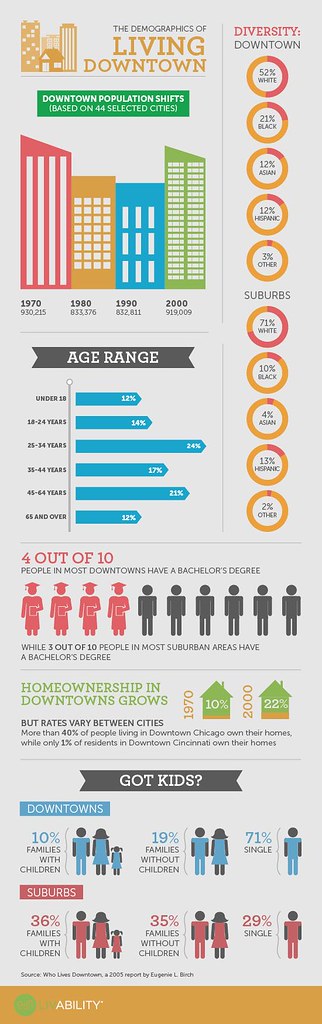
Much of this in-migration has been centered upon downtowns or the "central business district," which has shifted from a unidimensional office canyon active only in the daytime to a mixed use district including a significant proportion of multiunit housing and night-time districts supported in large part by residents.

-- Downtown Living, Lincoln Institute of Land Policy, 2002
-- Who Lives Downtown, Brookings Institution, 2005

Downtown Living Infographic

This is true for most major cities, Chicago being an exception in terms of experiencing population shrinkage, but growth in terms of business headquarters capture.

Baltimore too is an exception, which is why I have suggested that Baltimore City and Baltimore County re-merge--they de-merged in 1851--becoming the nation's seventh largest city ("Baltimore Business Journal).

Interestingly, in DC specifically, we have been less successful than other cities like Boston or Chicago, in capturing large businesses relocating from the suburbs. E.g., Hilton moved from California to Tysons, and Choice and Marriott stayed in the suburbs with their moves/announced moves. A large Nestle division is moving from California to Rosslyn, not DC. (Although Caterpillar recently announced a move from Peoria to Deerfield, not Chicago proper, because they want easy airport access).  Etc.

The suburbs are intensifying too.  The NYT article does make a crucial point, that suburbs are moving to a newer stage of development that is confusingly also called "urbanization" in the academic study of land use.

The phenomenon called the "edge city" 30 years ago is moving to a new stage that is moving towards greater accommodation of transit and walking, more focused on developing placemaking qualities, and somewhat less automobile-centric.

This is demonstrated within the suburbs in how the "intensifying areas" are succeeding in terms of adding population and business activity, the more disconnected and car-dependent areas of these places are languishing.

 The fact is that the market is bifurcating along the lines of concentration vs. disconnection. See "Continued Strength In Suburban Office Markets Dispels Myths, Bisnow versus "Big foreclosure suit ensnares suburban office, industrial buildings," Crain's Chicago Business. I have written about this in terms of the Fairfax County market, which is going through "reproduction of space" as a result of the Silver Line subway refocusing development in the Tysons-Reston Corridor.

With opposition.  Although intensification in the suburbs is accompanied by a great deal of angst, as suburban residents often believe that suburban intensification is somehow a kind of repudiation of the "suburban ideal."  See "End of free parking is the last straw for some Reston residents" and "In downtown Bethesda, residents and county debate whether more height is right," Washington Post, and "Reston: On a Collision Course," Connection Newspapers.

Suburban growth accompanied by growth in poverty and demand for aging services.  Just as suburbs continue to capture "more growth," as suburbs mature they are capturing more poverty ("Suburbs and the New American Poverty," Atlantic).

When the original "unique selling proposition" of the suburbs was how center cities functioned as a metropolitan area's "poverty sink" with a disproportionate share of the region's poor, and the demand for social services to serve them. I used to call that reality a type of "quality of life subsidy" to the suburbs, one dumped on the cities, but now there is a turnabout.

-- Confronting Suburban Poverty website
-- Build a Better Burb website
-- First Suburbs Consortium, Greater Cleveland

Similarly, as people age, suburbs are forced to meet a greater demand for aging services, with limited financial means to address the need ("Aging in the American Suburbs: A Changing Population," Aging Well Magazine.

Center city proponents need to be conversant with the nuances.  In any case, there are many ways to look at this issue, and proponents of center city primacy must be able to discuss the objective and subjective elements of the argument.  A particularly good argument is presented by Steve Belmont in Cities in Full, which argues for "recentralizing growth" on the center city.  And in some respects, that is what is occurring, with a lot of opposition from states, suburbs, and Republican legislators.

I have argued for a long time ("DC as a suburban agenda dominated city") that the people most traditionally active in local civic affairs in DC came to the fore during the period of the shrinking city when the priority was staunching outmigration and stabilizing neighborhoods in the face of trends that did not favor urban living.

Now that the city has the opportunity to grow in terms of population and business activity, people may need a different skill set and attitude, and also concern themselves with satisfying future residents, not just current residents, based on events and experiences solely from the past.

The digital economy renews the value of "agglomeration economies" Reading Richard Florida's new book, The New Urban Crisis, I wouldn't claim that this point was made as directly as it should have been, but it spurred me to think about how with changes in economic and social conditions in terms of the impact of digitalization and globalization, "agglomeration economies" have again become increasingly important.

"Agglomeration economies" is a fundamental concept from urban economics. The Geography of Transportation webpage at Hofstra University defines them thusly:

Agglomeration economies are a powerful force that help explain the advantages of the "clustering effect" of many activities ranging from retailing to transport terminals. There are three major categories of agglomeration economies:

Urbanization economies. Benefits derived from the agglomeration of population, namely common infrastructures (e.g. utilities or public transit), the availability and diversity of labor and market size;

Industrialization economies. Benefits derived from the agglomeration of industrial activities, such as being their respective suppliers or customers. This favors the emergence of industrial clusters;

Localization economies. Benefits derived from the agglomeration of a set of activities near a specific facility, let it be a transport terminal (logistics parks), a seat of government (lobbying, consulting, law) or a large university (technology parks).:
The job market and the world economy is much more competitive and operates much faster, making agglomeration or "clustering" valuable again when in the post-war period through the first decade of the 21st century, automobile-centric land use and transportation development paradigms allowed automobility to trump the clustering value of place/location.

Transportation and agglomeration economies.  Transportation efficiencies have always been the primary factor in the development of cities, starting with how most cities developed as ports on oceans, lakes, and rivers.

For example, wheat was milled close to where it was produced (Minneapolis-St. Paul) because of the cost of transportation.  Heavy appliances like stoves and bathtubs were manufactured locally because they were "too heavy" to transport cheaply to other markets, etc.

The development of an integrated railroad system meant that businesses could transcend constraints on their ability to do business imposed by the difficulty and cost of transporting goods, and led to the creation of a unified national market and the consolidation of various industries.

Mills could locate far from where wheat was grown and no longer did every city need its own manufacturing plant for appliances.

It still wasn't perfect, because railroads didn't charge a flat rate for transportation of goods, they charged on the basis of the value of the product, so there was still a reticence to ship long distances goods that were particularly expensive.

The road network enabled--for a long time but not indefinitely--automobile transportation to trump the value of agglomeration.  The creation of a ubiquitous and integrated road network serving local, metropolitan, regional, multi-state and national markets supported the rise of a deconcentrated land use and transportation planning paradigm, where uses are separated, and people mostly use a personally-owned automobile to get from place to place.

Cheap cars, cheap gas, the "open road" and plenty of free parking enabled the outward spread of commerce from center cities to the arterials and freeways of the suburbs with the creation of strip shopping centers, shopping malls, and business districts off freeways.

The carrying capacity of the road network is fixed.  This works, at the cost of owning and maintaining a car, building and maintaining the road network, and at the economic, military, and environmental costs of a fossil-fuel based mobility network.

But it stops working when any of those factors/conditions change substantively, including the "carrying capacity" of the road network.

Richard Florida argues that as metropolitan areas reach a population of 5 to 6 million, an automobile-centric mobility network has decreasing marginal returns.  (I believe that the writings of Newman and Kenworthy make a similar point.)

There is a line in the Jacobs book Nature of  Economies, when she responds to a question of "Why aren't there enough roads?" with the response, "You're asking the wrong question.  The right question is 'why are there so many cars?'"

Cities long ago recognized that the carrying capacity of the road network wasn't great enough to satisfy the various mobility and exchange needs of the cities and developed robust transit systems. According to a book review of David Engwicht's Reclaiming our cities and towns: better living through less traffic:
Engwicht maintains that cities were originally created as places for people to come together to trade goods and stories. A city, by definition, can be seen as a concentration of exchange opportunities. Cars get in the way of these exchanges in several ways. They drive people out of public spaces and create inhospitable environments for social interaction because of noise, fumes, and the barrier effects of the stream of traffic. Furthermore, they eliminate what he calls the "spontaneous" exchange — the unplanned encounter — thereby depriving cities of their essential spontaneity and life.

Traffic also sets into motion a wide range of self-reinforcing inefficiencies, according to Engwicht. Cars require roads, which require space, which require urban expansion, which requires more travel, which in turn requires more space.
Conclusion:  The need to reposition economic development and governance systems around metropolitan areas.  The issue isn't whether or not cities are growing faster than the suburbs but is the economic value of the metropolitan area and the necessity of strong center cities as thriving anchors of these places.

This is the general argument of the Center for Metropolitan Studies at the Brookings Institution, that "metropolitan areas" -- that is center cities and the suburbs combined -- should be seen as the primary building blocks of the national economy and that US political and governance systems should be reformulated to recognize and support this reality.

Brookings laid these arguments out in the book Metropolitan Revolution.

See my review and also "Resurging cities, resurging metros, the impoverished and the Metropolitan Revolution (continued)" and "States, economic development, and sub-state/metropolitan area political restructuring."

In the meantime, the Trump Administration is doing all it can to screw cities in terms of proposals to defund transit, housing programs, health insurance programs, other poverty programs, etc.

And the DC area specifically, as the Trump Administration proposes significantly less money than is required to build new facilities for agencies such as the FBI and the Department of Homeland Security.

Labels: , , , , , , , ,

Wednesday, December 14, 2016

Launch of the Greater Washington Partnership

Interestingly, last week the Baltimore Business Journal ran a piece, "Building a case for regionalism between Baltimore and D.C.," about a meeting of stakeholders from both Baltimore and Washington talking about the opportunity within coming together as a true region. (Note that I define a region as a combination of two or more metropolitan areas.  That's why I try to not refer to Greater Washington as a region, but as a metropolitan area.)

Of course, I don't have a problem with that, but I whipped off an op-ed for the BBJ about necessary antecedents.  I wrote that:

1. Each metro needs to "get its house in order" by functioning and acting at a "best practice" level;
2. More efficient physical connections need to be constructed within and between the metropolitan areas; and
3. More attention needs to be put on working together--rather than reflexively choosing to be obstreperous, the first inclination needs to be to collaborate

and listed eight initiatives that the Baltimore area and or the State of Maryland could take up that would help build what we might call the platform for regionalism. At a list of eight, I had already cut about five items from the list. (I haven't yet come up with an equivalent list for Washington, DC and Northern Virginia.)

My piece was more than twice the length of the 500 words they said to submit, so I will be interested to see the final, edited article.  I'll do a full write up when the piece is published.

In my e-box this morning was the longest press release I have ever received, about the creation of Greater Washington Partnership, which will focus on economic development matters "from Baltimore to Richmond."

From the press release:
A group of leading CEOs and entrepreneurs today announced a first-of-its-kind collaboration for the Greater Washington region – from Baltimore to Richmond – to address the critical economic issues facing the region and ensure it remains one of the world’s best places to live, work and build a business. The new Greater Washington Partnership (Partnership) will advance inclusive, actionable solutions that strengthen the regional economy and position Greater Washington as a leading global region and center for commerce and innovation.

The Partnership brings together civic-minded business leaders who share a commitment to the future of Greater Washington. It draws from a cross-sector of leading industries including health care, life sciences, energy, manufacturing, professional services, education, sports & entertainment and financial services.

The Founding Board of the organization includes the CEOs and leaders of Ramsey Asset Management, JPMorgan Chase & Co., Monumental Sports & Entertainment, Johns Hopkins University, Capital One Financial Corporation, Dominion Resources, MedImmune, S&R Foundation, WGL Holdings, Inc. and Washington Gas, Akin Gump Strauss Hauer & Feld, LLP, Under Armour, The Carlyle Group, McKinsey & Company, MedStar Health, T. Rowe Price, Rally Health, and EY.

The Partnership will focus on the high impact drivers of the region’s economic growth including:
  • Advancing infrastructure solutions that strengthen regional mobility and improve quality of life; 
  • Educating and training individuals for the jobs that employers need to fill now and in the future; 
  • Increasing recognition of Greater Washington, from Baltimore to Richmond, as a vibrant hub for business and innovation; and
  • Building long-term leadership positions in high-growth industry sectors.
“The Greater Washington region is more than just home to our nation’s capital, it’s one of the most vibrant, diverse and dynamic places to live and work in the world,” said Russ Ramsey, CEO of Ramsey Asset Management, Chairman of the Greater Washington Partnership, and former Chairman of Washington 2024, the organization established to lead the region’s recent effort to host the 2024 Olympic Games. “The unity, goodwill, and cooperation achieved through the 2024 bid process provided a brief glimpse of what we can accomplish together if we harness the energy and untapped resources available to us. The Greater Washington Partnership is how we do that, and I am thrilled to lead an impressive and dedicated group laser focused on improving this great region we call home.”
-- Greater Washington Partnership

Of course, I would be remiss by not mentioning that this is another example of what Harvey Molotch calls the "Growth Machine," which makes the point that despite seeming intra-elite competition, local political and economic elites are for the most part united on a pro-growth agenda focused on intensification of real estate, since local governments are dependent on property taxes (and sales taxes) for the bulk of their revenues.

(Harvey Molotch's paper, City as a Growth Machine: Toward a Political Economy of Place, published in 1976, and later expanded into the book Urban Fortunes: Towards a Political Economy of Place, serves as the foundation for this theory.)

I don't have a problem with the reality that the Growth Machine exists and operates, but I do have a problem with how the agenda tends to be pretty narrow, developed as it is by a limited number of highly connected people (and their consultants) who don't seek out other ways of looking at the world, with a tendency to focus on big projects (see the discussion in Roberta Gratz's Cities: Back from the Edge, which I think of as a primer based on Jane Jacobs) that often don't have the kind of payoff that is touted.

Plus, while I believe this is an important initiative, it will be very difficult to balance the competing interests of two states and three metropolitan areas.

Relatedly, I wrote this as part of the BBJ op-ed:
While as a Washington resident I would never argue for re-merging the city into Maryland, Maryland should "take [virtual] ownership" of DC by recognizing it is the linchpin of the economies of Anne Arundel, Charles, Howard, Montgomery, and Prince George's Counties.

For example, when we need a plumber at my house, we call one plumber exclusively. He lives in Charles County, but only works in DC, because he knows he can charge much more for his time and expertise--we're fine with that because he's willing to work with "historic buildings"without trying to make over the bathroom or kitchen fixtures into the latest and greatest from Home Depot--compared to his home market.

Like our plumber, with National Harbor and the new MGM Casino in Prince George's County, Maryland recognizes proximity to DC as a key competitive advantage.

But rather than cherry pick, the state needs to acknowledge the place and position of DC within its economy and act collaboratively rather than competitively.

In this vein, the State government needs to have an open mind about financial solutions for the DC-area's sputtering Metrorail system and should be "all in" on not only building the Purple Line as currently planned, but should initiate the planning process now for extending the Purple Line from New Carrollton to Alexandria—and extending the Purple Line from Bethesda to Tysons in Northern Virginia should be part of any discussions about rebuilding the American Legion Bridge.
And I think this verysame point is the crux on whether such an initiative can be successful.  Virginia and Maryland "have to take a kind of ownership" in DC being successful, even though DC will get some of those benefits too, not just their respective states.

It's about cooperation and collaboration not just marketing their states against DC on an almost continuous basis.

Labels: , , , , ,

Tuesday, June 28, 2016

Canada update: municipal taxes, transit, and regional planning

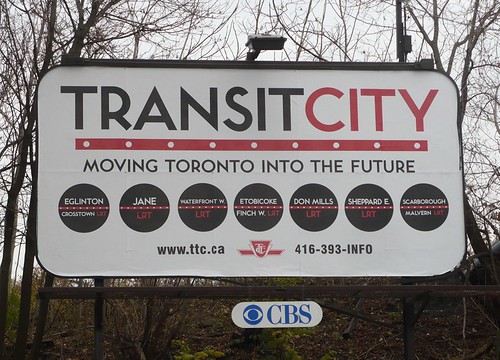
1.  Toronto transit.  Crazy things keep happening with regard to transit expansion planning in Toronto.  This has been a problem for a long time.  The Transit City proposals for expansion, developed under then Mayor David Miller, which were focused almost exclusively on adding light rail to the mix were junked by his successor, Rob Ford.
Transit City billboard promotion, Toronto Transit Commission
Transit City billboard, Toronto, modified to criticize a then Mayoral candidate.

Ford focused primarily on cars and was notorious for getting rid of bike lanes because they took space away from cars but pushed a subway as a transit line replacement for the city-suburb of Scarborough, as a kind of equity issue, not for "the poor" but for "suburbanites" receiving less flashy transit service compared to "over-served" urbanites, even though from a financial and ridership standpoint, heavy rail was the wrong choice.

It's very rare for a transit agenda to make it to an individual campaign sign, as how John Tory's Smart Track proposal was featured on his signs. Photo: Ari Perlin-Bain, Humber News.

That has mucked up the discourse ever since, as Ford's successor John Tory remains committed to a subway connection for Scarborough ("Why I support the Scarborough subway: John Tory," Toronto Star), even though it would be one station and $3+ billion ("One-stop subway plan needs ‘rethink’ with 25 LRT stops possible, critics say," Star) and competes with his separate Smart Track concept ("The Truth About SmartTrack," Torontoist) to bring more frequent and expanded service to the Go Railroad "commuter" lines.

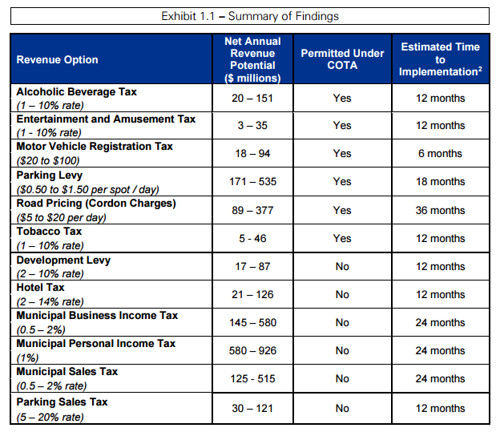
2.  Toronto city finances.  The City of Toronto is desperate for new revenues to support current activities as well as transit expansion, and the City Council is considering recommendations ("Report puts congestion tax, alcohol tax on Toronto council's radar" and Don't impose parking tax, coalition urges city," Star) for how they may go about doing so (Toronto Revenue Options report, KPMG).
Toronto revenue options
However, Star columnist Royson James, who believes the city does have a need for additional revneues, argues that when elected officials waste limited funds--and the Scarborough subway proposal aims to serve 4,300 new riders/day at a cost significantly greater than building many miles of a many station light rail system--they undercut their case for the need for greater revenues ("Toronto council’s $3 billion choice doesn’t inspire trust").

3.  Urban government taxing capacity in Canadian cities.  Like the relationship between local jurisdictions and state governments in the United States, Canadian cities act subject to authorization by the provincial legislature, and most cities lack the taxing authority they need to be able to function more successfully in the 21st century, especially as federal and state/provincial governments devolve more responsibilities to local governments.

The Institute on Municipal Finance and Governance at the University of Toronto released a report yesterday, More Tax Sources for Canada’s Largest Cities: Why, What, and How, calling for greater revenue capacity for the country's largest cities. From "Canadian big cities need new revenue sources: experts":
Toronto and other big cities should rely more on revenue tools and less on property tax revenue to pay for municipal services and unfunded capital projects, write two leading municipal finance experts in a new paper.

“Although the challenges have increased over the last few decades, the revenues available to cities to meet those challenges have remained largely the same,” say the authors.

“Other cities around the world use a wider range of tax choices, including income, sales, fuel, and other vehicle taxes. It is time for Canadian cities to have access to some of those choices as well.”
I haven't worked through the report, but I imagine the recommendations are pertinent to cities across the globe. (For example, as part of the UK national government's austerity budget, local government budgets have been crushed--Liverpool's has been reduced by 58%--with the provision of almost zero new revenue sources.)

(The claim to fame of the professor of the first poli sci course I took was his work on "taxing capacity" of national governments, and his analysis of North and South Vietnam found that North Vietnam was much more successful in collecting taxes and therefore much more likely to have greater political legitimacy compared to the South, with the edge on winning their War of Liberation. Taxing capacity and realization is an important indicator.)

Be Ready Or Be Left Behind, report cover, Advisory Panel on Edmonton's Future4.  Planning and Metropolitan Edmonton.
Canada is different from the US in that generally, there is a level of government and planning at what they call the regional scale, not unlike how in many areas of the US there are separate governments for counties and cities, towns, and townships.

But in Canada, the regional government includes elected representatives from the various communities separate from those elected to town councils.  Also some cities, in particular Toronto and Montreal, are an amalgamation of the core "historic" center city and former inner ring suburbs.

In Edmonton, the report, BE READY, OR BE LEFT BEHIND by the Advisory Panel on Metro Edmonton’s Future, calls for greater integration and cooperation, and it doesn't pull punches ("Edmonton mayors warned to work together in new report," Metro). From the article:
The capital region needs to work together or risk being left behind and it better not wait. That was the blunt assessment delivered to nine regional mayors, by the expert panel they commissioned last year to study the Edmonton area’s competitveness in a report they released Friday.

The nine communities involved were Edmonton, St. Albert, Strathcona County, Parkland County, Sturgeon County, Fort Saskatchewan, Spruce Grove, Leduc County and Leduc. ... the report [...] recommends the area look to work together on economic development, land use planning and inter-municipal transit quickly if the city wants to be competitive globally.
In these days of people not reading long reports (for example, a study by the World Bank of the number of downloads of its online publications found that many had not been downloaded even once) it's nice to have a very direct title in big type on the cover.

Likely this initiative is being driven in part by the oil industry's impact on cities in Alberta.  For the past few years, they had been growing like crazy and likely weren't handling it as well as they needed to, at least in Edmonton, likely leading to the creation of the advisory group.

By contrast, Calgary's mayor Naheed Nenshi, is considered to be one of North America's most progressive mayors ("Calgary Mayor makes us look like rednecks" and "'Canada's mayor' sees the city positively," Star), they hired controversial planner Rollin Stanley (he had been the chief planner in Montgomery County, Maryland, brought in to shake things up and help the County develop a more intensified approach to suburbanism in the 21st century) to try to be proactive on land use planning and management of development, and the city opened a light rail line in 1981, and they continue to expand it.  Edmonton's light rail opened for service a couple years ago.

But now, as the report is released, the economic circumstances are significantly different--really bad instead of excellent.  Now they have to deal with the fallout from the drop in the price of oil on the Albertan economy, and the likelihood of lower oil prices for many years into the future.

Like other oil patch areas, Metro Edmonton jurisdictions are going to have to maximize their shrinking budgets in order to perform well.  In the long run, coordination and integration is cheaper and more effective.

5.  Vancouver transit.  Last year, a referendum to expand funding for transit and transportation investments was defeated by residents of Metropolitan Vancouver in British Columbia.  Like a lot of these kinds of transportation fundraising referenda, it was set up to fail, with a hyper short timeline and other issues.  While those of us elsewhere in North America think TransLink is managed well, the no campaign made the transit agency out to be inept, and that likely led to the defeat of the plan.
"Yes we need transit, but TransLink sucks so it's better not to tax ourselves for transportation improvements, even though we need them, because they'll be wasted" is the narrative.
Vancouver SkyTrain.  Ironically, Vancouver uses the same transit technology that was used for Scarborough's RT.  In Scarborough the system was allowed to deteriorate and rather than fix it, they'd rather build something else.

It's the same narrative in most places, just as anti-transit advocates push BRT instead of rail and then when that element of their campaign is successful, they continue their anti-transit campaign in a different guise and push back against improved bus service also.

But with the victory of the pro-city Liberal Party in last fall's national election, and part of their platform was increased investment in cities and infrastructure, the federal, provincial and local governments put together a program for transit investment, despite the failed referendum ("Vancouver area to see $740-million in transit improvements over three years," Toronto Globe & Mail).  The federal government will pay half the cost.

The monies will pay for new rail cars for Vancouver, planning for three light rail lines in Surrey, a suburban community southeast of the center city with almost 500,000 residents and many colleges, and extension planning for the Broadway rapid transit line in Vancouver.

Labels: , , , , ,

Tuesday, June 09, 2015

New Baltimore area regional plan for sustainability

Baltimore photo collage.  "BaltimoreC12" by Excel23 - Own work. Licensed under CC BY-SA 3.0 via Wikimedia Commons.

Is discussed ("A plan to lift Baltimore region from good to great") by Baltimore Sun columnist Dan Rodricks who writes:
I have read a lot of reports and recommendations for improving life in metropolitan Baltimore over the years — some interesting, some scathing, many bland or puny-minded, most ignored or forgotten. 
The regional plan released Monday by the Baltimore Metropolitan Council goes further in describing our problems than any report I've seen from a local government entity; it's refreshingly honest about the area's racial, economic and social issues, and it provides a road map to a "shared regional destiny" that is clear and even bold. ...

For years, the council's main interest was transportation. In fact, until recently, it seemed to have little to say about anything potentially controversial, such as poverty and affordable housing. But with the establishment of the Opportunity Collaborative — the entity that came up with Monday's report — the council ventured fully into the areas of housing and workforce development.
Also see "A regional approach to close the Baltimore Metropolitan opportunity gap" (op-ed, Baltimore Sun).

The Baltimore Metropolitan Council is the designated metropolitan council of governments, focused mostly on transportation as it is the "Metropolitan Planning Organization" designated by the US DOT as the transportation planning organization for the region. (The bike and pedestrian plan I did for Western Baltimore County was funded through the BMC.)

-- Opportunity Collaborative, Baltimore Metropolitan Council
-- the planning document doesn't seem to be available yet, although it was released yesterday, but should be made available here, Regional Plan for Sustainable Development

-------
Not having read the plan, given that it isn't available, here's my take.

1. Too much development capacity in the metropolitan area.  The biggest problem for the Baltimore metropolitan area is that there is too much "build out" capacity compared to demand.  So there will always be pressure from the outlying counties (Howard, Baltimore, Carroll, Anne Arundel, Harford) to capture development which might otherwise be focused on Baltimore City.

Baltimore County alone has maybe double the "growth areas" or supply of developable land -- Towson, Hunt Valley, Owings Mills, White Marsh, area near the Aberdeen Proving Ground ("Harford, military officials worried about lay-offs, BRAC," Baltimore Sun), Essex-Middle River -- than there is demand.  Baltimore County too, like Baltimore City, has lost a lot of its previous manufacturing-industrial base. For example, the Sparrows Point steel plant is actually in the county.

It is the "sprawling outward" and migration of office space outside of the city to mostly greenfield locations despite a lack of demand over the past 40 years that has consigned Baltimore City to its impoverished state.

2. The lack of a transit network, as opposed to some transit lines, (see the past blog entry "From the files: transit planning in Baltimore County") prevents re-centering of development in the core.

Towson aerial photo.  From the Baltimore Sun.  Towson has about 90,000 residents and is the County seat and business center, along with Hunt Valley, which is not quite 10 miles north of the incorporated area.

3. I can't speak about counties other than Baltimore County, but I thought when I worked there that the County was content to measure success in terms of "doing better than Baltimore City" as a baseline, and that was the wrong comparison.

Interestingly, Baltimore County has over the decades done some of the region's most innovative planning.  Arguably, it may be the location of the first Urban-Rural Growth Boundary (Urban-Rural Demarcation Line), created in 1967, a few years after the pathbreaking environmentally focused "Plan for the Valleys," done by Ian McHarg.

Later innovations included creation of one of the earliest county agencies focused on the environment (for example, zbout 15 years before DC created an equivalent agency), "outsourcing" programming planning responsibilities within the park and recreation system to citizens (although this was mostly for budgetary reasons, it's a forward approach to citizen involvement), land use planning focused on redirecting growth to existing places, co-location of government facilities (such as the combined Senior Center and Library in Pikesville), and an urban design unit to provide technical assistance to communities.

The planning office tried to implement a smart growth planning code (which was successfully opposed by the land use bar, the biggest source of campaign contributions) and in the 1950s, the parks department and school system developed a wide-ranging MOU for joint use of facilities, with the parks department funding more robust facilities in the schools to support time-shifted access for residents more generally.

(And I developed my "Signature Streets" concept there, rooted in part in the County's history of planning-related innovation.)

4. Baltimore City and County should merge.  In 1851, Baltimore City and Baltimore County split, so the City technically is separate, although there were some annexations until about 1919 (a later amendment to the state Constitution precludes Baltimore City from annexing any more County land)..

Interestingly, rather than splitting between city and county, around the same time, Philadelphia instead became a city-county, and later so did San Francisco.  And New York City consolidated out of five counties in the 1890s--technically the counties still exist legally, under the rubric of the city).

Between the City and County, they have not quite 1.5 million residents.  But Baltimore's peak population, around World War II, was close to one million.

The City and County should re-merge, comparable to some of the combined city-counties elsewhere in the country such as Indianapolis, Lexington, Louisville, Macon-Bibb County, and Nashville-Davidson County.

It would be very controversial, in part because the County has more residents (823,000 vs.622,000) and fewer elected officials (seven Councilmembers in the County + the County Executive vs. 14 Councilmembers, plus the Council President, plus the Mayor in the City), which would change the political calculus somewhat, and in ways that the African-American dominated political structure in the city could see as being designed deliberately to disenfranchise their political power and prominence within the city.

The disenfranchisement issue is subtly different from the related issue of more conservative suburban voters outweighing more progressive voters in the core of the city, a problem common to Toronto and London and typical of the large city-county combinations like Indianapolis--but not the center city counties like Philadelphia and San Francisco, while in New York City, Staten Island is the conservative outpost that gets politically outweighed by the rest of the more progressive city.

5. But a combined City-County would be the nation's sixth largest city, just edging Phoenix. Harnessing some of the financial prowess of county could help to better address the poverty problems in the city.

Baltimore City is a "small city," ranking 26th (DC is 23rd), while Baltimore County is the third largest county in the state by population, and 69th largest by population in the nation (Fairfax County, Virginia is the 36th, Montgomery 41st, and Prince George's 59th).  

By merging, the City and County would be resetting their trajectories, albeit jointly.

Rank City Population
1 New York City 8,405,837
2 Los Angeles 3,884,307
3 Chicago 2,718,782
4 Houston 2,195,914
5 Philadelphia 1,553,165
6 Phoenix 1,513,367
7 San Antonio 1,409,019
8 San Diego 1,355,896
9 Dallas 1,257,676
10 San Jose 998,537
14 San Francisco 837,442

Note that different population estimate sources yield different conclusions.  Some add up so that a Baltimore City+County combination would be greater than Phoenix's population, others show Baltimore City+County slightly behind, but still ahead of San Antonio.

At worst, a combined Baltimore City+County would be the nation's seventh largest city.

6.  This would allow Baltimore to begin to reassert its importance and position as a leading city on the East Coast and in the Mid-Atlantic region.  Now, it's a distant third to DC and Philadelphia in the Mid-Atlantic region, no longer considered in the same tier as New York City or Boston, with a negative velocity, especially in terms of external perception post-Freddie Gray riots.

(Note that residents I've talked to are actually heartened by the post-riot community response.)
Crumbling house in Baltimore neighborhood
Patrick Semansky/Associated Press.  Crumbling house in Baltimore neighborhood.

7.  What this would mean to the metropolitan area is that Howard County would continue to be residential suburban in orientation, Harford and Carroll Counties would remain mostly rural, and Anne Arundel, with Annapolis, would be the political center, with its commerce focused on government and maritime functions.

Labels: , , , ,

Tuesday, June 25, 2013

Resurging cities, resurging metros, the impoverished and the Metropolitan Revolution (continued)

1.  Urbanophile (mentioned in the book whereas this blog was not) has just run a review of The Metropolitan Revolution, and Aaron Renn makes many good points that I didn't necessarily raise or emphasize.  Three points that stand out for me are:

•  In a globally connected and competitive economy, even thriving cities (like New York City) cannot rely on their ability to attract talent, they have to secure the means of production and produce it too.  From his review:

The most notable thing here in my view is that New York believes it has to be in the tech talent production business. NYC has traditionally been the ultimate talent attractor. They didn’t need to worry about producing the world’s top talent because it would seek them out. Silicon Valley and most tech hubs rely on this kind of talent attraction for their supply. By setting up a tech talent factory in town, however, NYC is saying that they don’t think they can meet their tech industry ambitions solely through hoovering up outsiders. They need to be in the production business as well. I’m not sure what Jim Russell thinks of this, but he’s often claimed that the era of prosperity on an attraction model is waning in a more convergent world (i.e., where tech & talent are becoming more decentralized). NYC seems to be responding to this reality.

• The difference between a stagnant and a growing metropolitan economy is a focus on  export markets.

I acknowledged this in my piece. Aaron indicates (what globalization means to non-global cities) that there is a greater role for government and NGO involvement in shaping this reality than I did.

Of course, Germany's mittelstand companies are a different example of the same concept of small companies being globally significant producers. (See "Extreme Focus and the Success of Germany's Mittelstand" from the Harvard Business Review and "Engines of Growth" from the Wall Street Journal.)  And it's why I think it comes down to business-to-business interaction.

What is interesting and I didn't mention it in my review is how this is counter to older themes of how to foster regional and national economic development.  Jane Jacobs, in Economy of Cities, and my remembrance of the concept of "import-substitution industrialization" from political science studies of Latin America, focused on fostering industrial growth by producing those items that had been purchased from foreign sources.

And this touches on something that was in the discussion thread of my review, how I have a difficult time with the arguments of economist Robert Fogel, over whether or not railroads were a significant driver of US economic development.

Fogel argued that wagons and barges were substitutes so railroads didn't contribute all that much to economic growth, while I counter that railroads were essential to the creation of one large, national, and integrated market economy in the US, which could not have developed otherwise.  It was certainly a lot easier and cheaper (as difficult and as expensive as it was) to build a railroad network than it was to build an integrated network of rivers and canals.

During what Henry Luce called "The American Century," US companies could be very successful focusing only on the US market.  In other countries, to be successful, companies had to be export focused (like the Mittelstand) because their markets were comparatively small, and this positioned those companies to be more successful when the field of economic activity is global rather than national.

In short, for some time, at least the largest US companies have been playing catch up, and many smaller companies too have begun to refocus their efforts on export markets.  E.g., I came across this article while I was traveling, "Exports mean jobs, in any language" from the Minneapolis Star-Tribune, which illustrates the point, as does this piece also from the MST, "Minnesota to open trade office in Germany," not that the latter is particularly unique anymore.

• And while I emphasized it a lot, you can't emphasize enough how cities for the most part are screwed (I mean constrained) by state action and the actions of other communities within a metropolitan area.  An example in the DC region is how the State of Virginia's politics foster anti-metropolitan policies vis-a-vis Northern Virginia (see )

Frankly, it's the source of the reservation I have with the argument that going forward, "Metropolitan Areas are coming together".

It's easier to do when the suburbs feel superior, it's harder when the center city becomes more competitive.

And suburbs are no longer able to take their economic superiority for granted, as various trends that favor cities have begun to achieve critical mass and have become not just noticeable but un-ignorable ("The Future of the American City" from the Financial Times), such as

- city population growth vis-a-vis suburbs ("Population Growth Accelerates in Large Cities from Governing Magazine)
- location of successful businesses in city locations ("Google exploring move to West Loop" from Crain's Chicago Business)
- and relocation to the center city of business operations formerly located in the suburbs ("Mortgage lender Quicken bets on downtown Detroit's revival" from Reuters)
- the rise of suburban poverty ("Poverty finds the suburbs" from the Boston Globe").

As a result, suburban communities will be less inclined to be willing to join in with center cities and develop and work on achieving a consensus agenda.  Aaron mentions some examples of this behavior from Greater Denver and Greater Cleveland.

This reminds me of my brief experience working for Baltimore County Government a couple years ago.  I thought Baltimore County wasn't striving--they are mostly content comparing themselves to Baltimore City, which has been on a downward spiral for 50+ years, and thereby judging as wildly successful most any of the County's economic initiatives.

But if local elites instead chose to reference and benchmark the County against the most successful counties in the Baltimore-Washington region and the US more generally, it would be found wanting.  Going forward, to be successful on a national basis, Baltimore County and many other communities need to reset their expectations, goals, and standards for achievement.

In Washington, where DC is no longer the metropolitan area's basket case (well, not in terms of government corruption, but that's another blog entry) it's almost impossible to get the suburbs to work with the city in substantive ways.

So while I want to believe in the metropolitan imperative, the jury's still out.

2.  Aaron also calls our attention to Kaid Benfield's review ("Two very different views of the condition of American cities"), which pairs a review of The Metropolitan Revolutions book with the discussion of a report, State of the City: 5 Trends Impacting America’s Cities, published by the Living Cities consortium.  From Kaid's review:

Here are the five trends detailed in the report:

• Fiscal strain is causing city governments to reduce services and scale back capital investment.
• Failing infrastructure is inhibiting economic growth, sustainability and overall mobility of goods, people, and information.
• Stagnant educational outcomes have implications for talent production, attraction and matching to jobs.
• The changing economic landscape is creating unemployment and shifting centers of job creation.
• The collapse of the housing market and the tightening of the rental market are creating material pressure on household economics and the health of communities.

In other words, where Katz and Bradley see excitement, innovation, leadership, and economic recovery, Living Cities sees declining city services, crumbling infrastructure, a failing educational system, unemployment, and struggling households. ...

The report observes that many of the challenges faced by cites and their lower-income residents are due to or profoundly influenced by large social and economic forces, and are so fundamental that new, more systemic approaches are needed to achieve reform.


They are both right. Recentralization (a la Belmont's Cities in Full) trends centered around quality of life and urban design, form and mobility network characteristics more typical of center cities favor cities, but long term favoring of suburban development and financial strictures on cities make it tough on cities.

Kaid's review and the Living City report definitely deserve our review and consideration.

Still, as far as addressing the need to integrate the impoverished into exchange networks and the market economy, again I will mention the Houston case study from TMR. The Neighborhood Centers Inc. organization is not bringing the city and suburbs together, but it does have an interesting approach to economic integration and capacity building for the economically disadvantaged, and this kind of approach is typically missing in local, regional, state, and national planning.  If you believe that in the global economy, we have to utilize all of our potential human capital, it's an example worthy of further consideration.

3.  And not every city/metropolitan area is well-positioned to take advantage of metropolitan trends either (Aaron says to focus on the top 50 Metros).  I argue that cities on the East and West Coast along with cities connected to extractive industries--for example, Houston as the center for the US oil and chemical industry, is well-positioned to be successful without many of the qualities of otherwise resurging "old cities" because as oil production increases and the cost and therefore the revenue rises, they will continue to benefit--are best positioned for these trends.

I think (although it's yet another book I need to read) that the argument in Meredith Whitney's new book Fate of the States, that coastal cities aren't well-positioned, and states between the coasts are, is based on the increasing importance of extractive industries in the global economy, but misses those elements of the knowledge and applied science-based economy that are favored by coastal location.  See "Mapping out the state of the future," from USA Today.  From the article:

In Fate of the States, Whitney argues that a "new map of prosperity'' is emerging in the wake of the bust, with jobs moving away from the coasts and toward 17 ''central corridor'' states in the Midwest and Mountain West.

Using statistics mostly covering years from 2007 to 2011, she argues these states are outperforming the U.S. because leaders elsewhere are hamstrung by public-employee pensions and other commitments that housing-boom states made in flush times.

Although there is no question, like the points raised by the Living City report, that cities have plenty of issues to address, and that success in the global economy going forward is hardly a cake walk.

And in the constrained economic environment faced by governments, we are going to have to be parsimonious and ensure that every dollar we spend accomplishes multiple objectives.

Labels: , , , , ,