Rebuilding Place in the Urban Space

"A community’s physical form, rather than its land uses, is its most intrinsic and enduring characteristic." [Katz, EPA] This blog focuses on place and placemaking and all that makes it work--historic preservation, urban design, transportation, asset-based community development, arts & cultural development, commercial district revitalization, tourism & destination development, and quality of life advocacy--along with doses of civic engagement and good governance watchdogging.

Sunday, November 23, 2014

Marion Barry, DC's "Mayor for Life," dead at 78

Some things you don't really imagine (although in good scenario planning you should), and one I hadn't really thought about is Marion Barry, former Mayor of DC and Councilmember of Ward 8, dying, which happened last night.

-- "Former DC Mayor Marion Barry dies at 78," WTOP radio
-- "Marion Barry, Former Mayor of Washington, Dies at 78," New York Times
-- "Marion Barry dies at 78; 4-term DC mayor was the most powerful local politician of his generation," Washington Post

The "Mayor for Life" moniker was devised by Ken Cummins, the original "Loose Lips" columnist for the Washington City Paper.  The former mayor adopted the phrase as the title of his autobiography ("Marion Barry officially embraces 'mayor-for-life' title," City Paper).

I've always said chapter 4-it turns out it is chapter 7--of the book Dream City (",Dream City: Race, Power and the Decline of Washington, DC" Washington Monthly), was the best description of the way that the local coalition of politicians and real estate developers works together along the lines of the Growth Machine theory of Harvey Molotch (City as a Growth Machine: Toward a Political Economy of Place).

Howard Gillette's Between Truth and Beauty: Race, Planning, and the Failure of Urban Policy in Washington is a good explication of what we might call the "city beautiful" vs. "social justice" agendas of the first generation black mayors more generally, although the book is about Washington.

I haven't read The Last of the Black Emperors: The Hollow Comeback of Marion Barry in a New Age of Black Leaders by Jonetta Rose Barras.  She has a reprise opinion piece in the Post, "The death of Marion Barry."

The book The Future Once Happened Here, focusing on DC, New York, Los Angeles, and Philadelphia, is widely derided by progressives, but I think it's a good discussion of the decline of cities in the 1980s and 1990s,

It describes DC's decline in part as a result of the massive expansion of the local government--despite the city possessing "county and state functions" as well as those of a municipality, DC had thousands more employees than much larger cities.

The big increase in government employees, decline in federal payments to cities, continued outmigration of the Black middle class to Prince George's County especially, and minimal in-migration of higher income households contributed to the city's bankruptcy and the takeover of the city's finances by the federal government through a specially created Financial Control Board.  While this happened during the mayoralty of Sharon Pratt Kelly, the stage was set by the previous administrations of Marion Barry.

Lately there has been some discussion among the younger set that the older and mnority urbanites had their chance at "fixing the cities" and failed, with the conclusion that it's time for them to move out of the way.

The reality is much more complicated.  Urban decline and urban improvement lies on a continuum, and was built, positively and sometimes negatively, through the efforts of many, including Marion Barry, who had so much promise and sadly, threw much of it away.

A new councilmember for Ward 8.  Newer and younger residents of Ward 8 have clamored for different representation, even running candidates against Marion Barry in the 2008 and 2012 primaries, although each time Marion Barry received between 70% and 80% of the total vote.

Now that he has died and didn't create a true machine that could designate and elect a successor, it will be interesting to see what develops in the run up to the special election to replace him.

At one time, it was asserted that Marion Barry aimed to make his son, Christopher, his successor on Council, but that's no longer a real option.

The special election for the seat--probably in May but maybe in April and it is unclear if it will be set to be the same day as the special election in Ward 4 to fill the Council seat vacated by incoming Mayor Muriel Bowser--is likely to be wild, with as many as 20 candidates.

Labels: , , , , , ,

Thursday, August 01, 2013

Detroit and the New York Times

Detroit street artists Ayem and Melo created a new mural on Grand River and Henry just north of Downtown. The colorful piece is a statement on Detroit's recent cash flow problems. The artists used 8 different overlapping colors to create a 3-D effect. 

The mural was approved by the property owner at 2481 Grand River, currently a vacant building. The piece is currently unfinished according to the artists who spent 6 hours on Saturday completing the letters, July 20. (Tanya Moutzalias | MLive.com)

The NYT published a letter yesterday. "Invitation to a Dialogue: A Plan to Help Cities," that will serve as the basis for the "Sunday Dialogure" in the Review section.  Here is the letter in its entirety:

A fact sometimes ignored in discussions of Detroit’s bankruptcy filing is that its metropolitan area, which officially includes three neighboring counties and unofficially parts of several more, has not shared the city’s distress. White flight, beginning in the early 1950s and accelerating thereafter, relocated much of the city’s tax base and economic vitality into the surrounding suburbs and exurbs.

The economic, social, political and demographic composition of southeastern Michigan looks different when the entire region is brought into view. In fact, the metropolitan area’s population increased from 1950 to 2010. And the region remains a major location for auto manufacturing and employment.

The failure to devise a workable regionalization of government and its services between the city and its surroundings accounts for many of the city’s problems. Perhaps there is a lesson for other cities that are under threat.

Two contrasting events in the region’s history hint at the problems and the promise of regionalization.

In the early 1970s racial tensions exploded when a federal court endorsed a plan for cross-district busing of school children between black Detroit and white suburbia. Eventually the Supreme Court calmed the tumult when it ruled against the plan. A regional approach had failed.

But in 2012 a three-county referendum that authorized a property tax levy to support a financially beleaguered Detroit Institute of Arts won approval. Common interests have the potential to cross the boundary separating city and suburbs.

Perhaps a regionally grounded effort, in collaboration with the state and federal governments, offers a way forward for other cities. The question is whether our rickety, dysfunctional political system can muster the wisdom and the will for such an effort. Anything less is likely to fail.

JOHN BARNARD
Orleans, Mass., July 29, 2013

I agree, regionalization is the issue. As was discussed recently here, "More on Detroit: Part 1" and "More on Detroit: Part 2."

I read something somewhere that pointed out that while the US government stepped in to help the "Detroit" auto industry, it's keeping its hands off stepping in to deal with various city/local government bankruptcies.  Also see the Booth Newspapers article "Who or what is to blame for Detroit's bankruptcy? 15 theories."

Reliant on property taxes, cities, towns, and special tax districts are increasingly unable to meet their financial needs and obligations

This is what's going on in the 21st century economy:

- continued population outmigration and exurbanization
- the integration of the US into a global economy
- declining wages
- declining number of high paying jobs requiring low skills as mass manufacturing becomes capital and knowledge intensive
- anti-tax sentiment
- pro-market neo-liberal policy paradigms that delegitimize the role of government and civil society as key actors (unless the economy tanks, and capital goes to the brink of disaster and requires bailouts)
- commercial and residential decision making at the metropolitan scale

So the way that many metropolitan areas are divvied up into a myriad of cities, towns, counties, and special tax districts is increasingly dysfunctional, given the financial demands to keep deteriorating infrastructure in functioning condition, in the face of continued outmigration, and declining property values.

In response to similar kinds of needs, New York City is a special city-county hybrid that merged the five boroughs in order to have enough taxing capacity to build the subway system, but also to provide and manage services on the right scale, because the separate boroughs were increasingly operating as one city.  This finally happened in 1898 after decades of campaigning for the change by Andrew Haswell Green and others.

There are three or four primary methods for dealing with these material changes in conditions and opportunities for local government districts:

- merging of the center city and the county (e.g., Indianapolis, Nashville, Lexington, Louisville, New York City in 1898, Toronto, etc.)
- not merging the center city and county but having strong metropolitan scale planning and governance institutions (Minneapolis; Portland, Oregon)
- tax revenue sharing across a metropolitan area (Minneapolis)
- special tax districts that operate across a city-county-region (Regional Asset District, Allegheny County, PA; Huron-Clinton Metropolitan Parks Authority, Southeastern Michigan).

There are probably more examples.

And in the previous 150 years there were earlier forms of this in both directions.  Philadelphia and San Francisco are city-county hybrids.

But Baltimore City and Baltimore County separated around the same time that Philadelphia consolidated--imagine if they had stayed together, it would be the biggest political jurisdiction in the region, with about 1.5 million residents.

Similar, Arlington and Alexandria broke off DC in the 1850s (so they could remain slave areas).  Had the change not occurred, DC would have 1 million residents now, and some of the worst economic repercussions of population outmigration may have been able to have been staved off.

The downside of the city-county merger is that the progressive politics that a center city typically has are drowned out by the greater number of suburban voters.  This prevents many cities from pursuing such a course. 

These writer-academics are probably the biggest proponents of the harmonization of taxing, funding, and certain elements of planning and governance on the metropolitan scale:

-- Gerald Frug, Harvard University
-- Myron Orfield, Institute for Metropolitan Opportunity, University of Minnesota Law School
-- David Rusk, Inside Game/Outside Game: Winning Strategies for Urban America

The biggest failure of the Obama Administration right now is on this issue, that they aren't taking the opportunity to raise the scale and breadth of the discussion.

Instead it's a great time to flog cities, unions, elected officials (although they deserve it).

We aren't very good at change, political institutions especially.

------
This is not dissimilar from my point that the failure of many of DC's local cultural institutions is an indicator of problems in how we manage, fund, and plan in the cultural sector.

The increased number of failures of local governments across the country is an indicator that we need to change the scale at which "local" government operates and is funded.

Labels: , , , , , , ,

Monday, July 29, 2013

Urbanism (and smart growth) as a pejorative

Pierre Charles L'Enfant Plan of the City 1791I am not a big fan of hyper-relativistic thinking, but I guess a lot of people are, at least when it comes to planning in DC, and the desire to ignore the city's time of origin during the Walking City era and the city's planning history.

This history started with Pierre L'Enfant, the original city's planner, who laid out the design of the city's core in 1790-1791; followed by the McMillan Plan in 1901, which updated the city's planning regime using "City Beautiful" precepts.

----------------------------------
Smart growth isn't racist.  It's pro-city.

Urbanism isn't anti-city.  It's pro-city.
----------------------------------

In a blog entry a couple months ago, Capitol Hill Corner denigrated pro-city planning practices as "new urbanism" ("Zoning Regulations Revision Proposes Major Parking Changes for Capitol Hill – City Proposes Shifting Parking Costs From Developers to Residents"):

The proposed revisions would have the effect of increasing density near Metro and bus stops and reducing parking in an attempt to further the currently in-vogue city planning concept of creating a livable, walkable city under the rubric of “new urbanism.”

I countered somewhere that this is incredibly ironic because a livable, walkable city in a city like Washington is anything but "new urbanism", it's quintessential "urbanism" or maybe "old urbanism." There's nothing new about it.

All my various entries tagged touch on various elements of city-appropriate urbanism.

-- Urban Design Compendium

2. Similarly, in a press release, the Committee of 100 on the Federal City, the city's oldest planning advocacy group, has criticized the updating of the city's Zoning Regulations as being the result of a "smart growth" agenda, as if that is a bad thing. From the release:

The Comprehensive Plan, often quoted by OP, states that "the Zoning Regulations themselves need substantial reorganization, ranging from new definitions to updated development and design standards, and even new zones." Critics of OP's proposals say that the agency has selectively used Comprehensive Plan policies to advance a "smart growth" agenda that is in conflict with DC's goal of an inclusive city and fails to respect neighborhood differences.

"The time has come for DC residents to make their views known to the Zoning Commission," says Nancy MacWood, chair of the Committee of 100 on the Federal City, a 90 year-old citizens group that promotes responsible land use and planning. "It's your city, your neighborhood and way of life that's at stake."

Creating a Vibrant City Center by Cy PaumierI find this almost unfathomable, considering that DC is the leading example in the U.S. of a "planned city" and that smart growth is merely urbanism considered at the metropolitan scale.

For a center city, "smart growth" ought to be the basic DNA undergirding a locality's land use, economic development, and transportation planning practice.

I am disappointed that C100 paints the "smart growth" concept in racial overtones, stating that smart growth is anti- "inclusive," which is code for "racist" power relations in which African-Americans are subjugated.

Given that the city's population is 50% African-Americans, and there has long been the tension between "social justice" and "urban form" as the city's dominant agenda (see the arguments in Between Justice and Beauty by Howard Gillette), this is a clear appeal to get African-Americans to join in to scuttle the zoning rewrite, not unlike how the NAACP was one of the organizations that came out against the transportation tax referenda in Georgia (see "Failure of the transit-roads sales tax measure in Metro Atlanta").

Also, neighborhoods are more alike than they are different.  I argue that while every place is unique, few places are exceptional and can't be compared and contrasted and analyzed.

Structurally, neighborhoods function similarly to other neighborhoods.  Differences occur depending on their respective characteristics: mobility network; access to transit; urban form; building and population density; demographics including socioeconomic status, etc.

-----
• The biggest failure of this process is the attempt to ward off the future.  Most people aren't even thinking about today, but about yesterday, and fail to consider what should the city be in order to be resilient, robust, sustainable, and a great place to live in the context of the 21st century.  

• While it's fair to say that I am pretty critical of how the Office of Planning has handled the zoning update process, I believe fervently in the need for an update, to ensure that the city has zoning regulations that promote urbanism and optimal mobility, rather than suburbanism.

• The problem with master plans is that they can be read in many different ways, depending on your own understandings of what planning is and should be.  I read the plan and see support for urbanism.  Others read it and see support for automobility.

• What planning departments have to do (the problem isn't just in DC) is recognize that shifting the planning paradigm from suburbanism to urbanism requires "campaigning" and providing alternate (and "better") explanations and the tools to understand the need to shift.

The Office of Planning mostly relied on the creation of the Comprehensive Plan document as the means to do it.  After the finalization of the document, they didn't campaign, they didn't educate, they didn't do a massive "road show" to explain to people what the document says and what it means for the city.  They just took it for granted that everyone is committed to what the most enlightened planners and urbanists believe comprises urbanism.

Clearly, a significant number of people in the city don't agree.  That stands to reason because they moved to the city from suburbs and only the core of the city is decidedly urban.

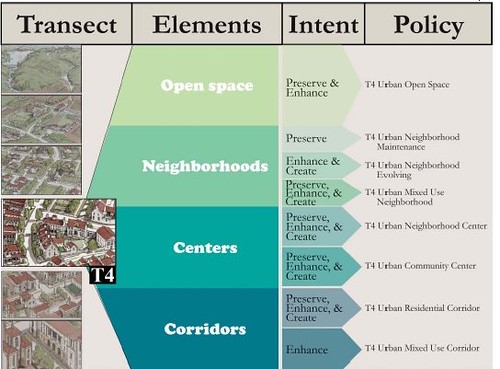
Nashville Community Character Manual: T4Diagram outlining the different character zones within the "T4" category from the Nashville Community Character Manual.

•  One thing that planning departments need to provide are translation tools, so that people can understand the difference between "smart growth," "dumb growth," "stagnation," and "failure."

In "DC as a suburban agenda dominated city" I argued that DC is a lot more suburban in outlook than people realize.

In "DC and the zoning rewrite and the approach not taken" I lament that in the zoning revision process, the framework from the Nashville Community Character Manual wasn't adopted and adapted for use in DC, to better shape the understanding of urbanism and change going forward.

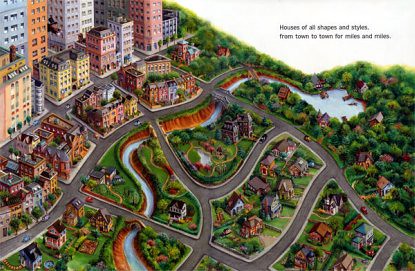
Illustration from The House Book by Keith DuQuette (resized)
This illustration from The House Book by Keith DuQuette is a good conceptual rendering of the transect concept.

• I do believe that using the NCCM's "transect-based" approach, which for the three major transect zones appropriate for DC then breaks down the character zones into 21 sub-zones, would have made it easier for people to understand planning practice at the neighborhood level.

Labels: , , , , , ,

Wednesday, July 24, 2013

More on Detroit: Part 2


Faygo Beverages is a regional soda pop company based in Detroit.  They used to market on sports broadcasts and television.  They made very sweet soda ("Rock'n Rye, etc.) which I used to drink prodigiously til I was about a junior in college and my taste preferences changed a bit.  This was a very famous ad by the company.

Reading James Breuckman's first email reminded me of some of the work by the Brookings Institution a few years ago, in Pittsburgh and Allegheny County, Pennsylvania, where they opined that the metropolitan area's problems were somewhat intractable as long as the county was divided into scads of towns, boroughs, and special tax districts--more than 200 separate entities--making it very difficult to manage the area out of decline.

Detroit has the same problem.  It's in Wayne County and abuts Oakland and Macomb County.

You need some sort of regional government and tax harmonization scheme (like in Greater Minneapolis), and regional funding of cultural institutions and parks, like Allegheny County's "Regional Asset District," which I have written about before.  It was created out of recognition that major cultural institutions originally funded by the city only served residents of the entire metropolitan area, and should be funded more broadly.

But Detroit recently agreed to a regional tax for the Detroit Institute of Arts and it has had a regional parks district--separate from city and county park systems--with regional funding, since the 1940s, called the Huron Clinton Metropolitan Authority.

For lease sign posted on a downtown building.  Getty Images photo by Bill Pugliano.

But politically the likelihood of the creation of some new forms of metropolitan government in Greater Detroit is not likely to happen and it is a shame that the opportunity that Detroit's financial failure provides us to reboot our thinking about metropolitan-scale governance, a la the arguments in Metropolitan Revolution is being missed.

Aaron Renn wrote another important piece in Urbanophile, "What Detroit’s Bankruptcy Teaches America," which offers to us some bitter lessons about "what's happened in Detroit?," something that bugs me a lot, which is why, when we see mounting problems, can't we act in advance, instead of after everything is about at the precipice?

The lessons:

• The Day of Reckoning Can Take Much Longer Than We Think to Come (interestingly, he lists articles from major national magazines dating from the 1940s to the 1960s, about Detroit's decline, also see "Even a Half-Century Ago, Journalists Were Predicting Detroit Would Go Bust: Longstanding flaws contributed significantly to this week's bankruptcy" from The Atlantic)
• Decline Poisons Civic Culture and Sunders the Commonwealth
• America Doesn’t Learn Lessons From the Past

I responded to James Breuckman with this:

The only thing to correct the "problem" would be city-county consolidation but of course, that will never ever happen, or the creation of a Metro Govt. with some tax sharing policies comparable to what has happened in Greater Minneapolis.

The other thing that is interesting about Michigan is the provision of K-12 schooling. It wasn't til I moved to DC in the late 1980s that I learned that Michigan's provision of school districts was atypical, with provision at the city/township level rather than being county-wide. That contributes somehow to some of the problems.

DK if you have been following the Memphis-Shelby County schools saga. The mayor of Memphis got the bright idea to de-organize the city school district to force Shelby County to take it over. Now after 2 tries, 6 affluent Shelby County towns won at the ballot box the ability to set up their own school district.

A joke... when East Detroit was in the process of changing its name to Eastpointe, my best friend in college suggested that Detroit change its name to Pointe.

He wrote:

The school thing in Michigan is very odd. Some cities have 3-4 school districts. In many cases school district boundaries are an interesting artifact of latent racism. The political structure of the region, including schools, was set up to make Detroit fail. The inertia of moving past our isolated balkanized state is a precondition to supporting a revitalized, vibrant Detroit as you correctly point out, but it will take a long time to get there. Many of the regional institutions are now gaining regional support (the Zoo, the DIA, potentially the Detroit Water and Sewer Department), so the process is starting. But there's a long way to go.

... The RAD-model would seem to have benefits - mostly avoiding voter fatigue with the string of one-off requests for specific institutions. But how do the institutions within the RAD divvy up the funds?

The State was going to take Belle Isle and make it a state park, but the Detroit City Council vetoed the deal. It was an irrational decision, but there's a pervasive feeling within the city limits that the white suburbs and the state want to cherry pick all the valuable assets of the City. So even though the City can't afford to maintain it, they wouldn't relinquish control of the island. It will probably happen eventually, because the inevitable. Or, it will get sold to a developer during the bankruptcy proceedings.

-----
The sad thing is that watching Detroit's decline, coupled with living in Oakland County in my junior and high school years and in Ann Arbor for a long time after that, helped me understand revitalization, its problems and opportunities, when I moved to DC.

Even so, DC, because of the relatively steady employment engine of the federal government, with its focus on knowledge-related jobs not metal-bending, the city's historic building stock, walking- and transit- spatial pattern, historicity and identity, and the subway system, has advantages that many other cities do not have.

It's why I've tried to keep a foot in Baltimore, because there the issues and opportunities are different, because like Detroit, they were an industrial town that has been de-industrialized, and they have all the same issues of race that DC and Detroit have.

Labels: , , , , , , ,

More on Detroit: Part 1


There has been a lot of writing on the City of Detroit bankruptcy in the New York Times, Wall Street Journal, and Washington Post.

Urbanophile has a very good piece, "Detroit – Why Hast Thou Forsaken Me? by Pete Saunders," which, like  two particularly excellent op-eds, "It's not so simple in Detroit" and "Who's to blame for Detroit's collapse?" in the Los Angeles Times, goes more deeply into the broader conditions that shaped what happened.

In one of the LAT pieces, Scott Martelle, author of Detroit: A Biography, puts the date in the 1950s (I had written the 1970s) to when the Detroit auto industry starting relocating facilities from Detroit and Michigan to other places around the country, in part to make shipping more efficient, but also to reduce the political and economic power of the United Auto Workers union and the strength of the Democratic Party in Michigan state politics.  (Also see "Collapse of Detroit," by Scott Martelle from 2011.)

On the Urbanists e-list, James Breuckman wrote a great piece, which he is allowing me to reprint.

---------
So what happened to Detroit? I've had a front row seat for the past 4 decades, watching the City fall apart as I grew up, went away to school, came back, and have lived right on the northern border of the City since coming back. I work in the region and am raising a family here.

It's the -isms. Racism, parochialism, and isolationism.

Racism is obvious. Detroit is the most segregated metropolitan area in the nation. It's deep and insidious.

At its core, Detroit is a company town. For so long it was possible to be ignorant and yet to make a good life because of the auto industry. That generation is older now, and their kids largely flee to greener pastures if they go to college. That was parochialism. Now that auto industry jobs pay $14 and hour with limited benefits, parochialism is dead.

Isolationism, well, there's this attitude that we're just not interested in transit or anything else that would move the region away from our bankrupt way of living. You see, transit brings "those people" out here who will steal our cars and TVs and then go back to where they live. But on the other hand, Chicago and Toronto are such great places to visit! We love going to visit there and seeing all the big buildings and Yonge Street or Michigan Avenue...but when we get back we go back to the mindset of we can't have that here.

 Nobody can ever offer a good reason why...but it comes down to isolated jurisdictions jealously guarding their turf and a refusal to have true regional cooperation because, well, racism and an unwillingness to send our money to benefit Detroit etc. etc. We do have a regional transit authority now after only 4 decades of trying, but we'll see what happens when they ask the millage question to fund it. The isolationism is a manifestation of the racism and parochialism, and we have to overcome it. It will take time.

So that's the environment in which Detroit has to operate. Pivoting to the city itself, one of the issues that was touched on by Richard is that the vast majority of the city was built as boomtown worker housing. It was, and is, disposable. It had maybe a 30 year life expectancy when built, and it was all built between 1910 and 1950. It wasn't lovable and it was not maintained, rather, it was fled by anyone with the means to do so. This is key - when you combined sub-par housing stock and a generally poor public realm with the -isms above you got white flight starting in 1950, not 1975. By the time Coleman Young was elected mayor the game was already over.

The parts of town that are doing well now are the ones that pre-date the rise of the auto industry. They were built before 1910, and they were built well. There are some pockets of wealth where the captains of industry built their new money mansions in the 20s that are doing well, too. These areas are probably no more than 20% of the total land area of the City. And that's the crux of the issue - how do you maintain the infrastructure and police a city of 138 square miles based on about 20 square miles of places that are actually desirable to live? There's no question that city government made many bad decisions, but even if they made good decisions there were strong headwinds. They almost would have had to make the optimal decision every time to have avoided some version of the situation the city finds itself in today.

Regionally, there are pockets of walkability centered on 19th and early 20th century towns that were along the interurban lines that were all removed by the start of WWII. I live in one of those towns just north of the northern city border. When we were looking for a place to settle down we looked at some very nice neighborhoods that are just south of us, in the northern parts of Detroit. They have the Detroit Country Club and the University of Detroit as anchor institutions. They have beautiful and substantial houses that were very well built - not disposable. You could get a 2,750 square foot house with a solid wood paneled library and so on in the $150k to $300k range. The flipside is that property tax rates are 50% higher in Detroit than where we live now. Police response times are nonexistent. The streetlights don't work. You have to contract private trash pickup. And you're committing to sending your kids to private school. All this adds up to a huge price premium to live in a City where you basically get no services. Plus the crime, which is real. So instead urban-minded people have to live in one of the old streetcar suburbs that at have varying degrees of urbanism and walkability.

It's an intractable problem, and the issue of the majority of the City being an economic drain will persist after bankruptcy. Unless there is de-incorporation of large parts of the City, or a true commitment to shutting off services to large parts of the City per the Detroit Future City plan, the ledger will never balance.

We wait and hope that the nascent revival in the downtown and midtown - largely in response to massive regional pent up demand for true urbanity - will catalyze spillover benefits for the city's neighborhoods, but there's so much else that has to happen before city living is an option for anyone with children.

But there is hope. More so now than at any other time in my lifetime at least, things are aligning that have the potential to truly create a better future for Detroit. It's just hope for now.

Labels: , , , , , , ,

Sunday, January 13, 2013

New York Times article on DC's success misses the most important point

-- "Washington’s Economic Boom, Financed by You," New York Times
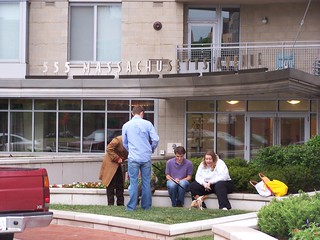
People on the street at 555 Massachusetts Ave. NWThe article argues that DC's success over the past 15 years is the result of a federal spending boom in response to 9/11, wars in Iraq and Afghanistan, and the increase in spending on counter-terrorism.

Likely that contributes, sure, but I can't fully agree with the thesis.

Federal spending has been increasing for decades, it's just that it was mostly being spent outside of DC

The reality is that federal spending has been increasing significantly throughout the past 50 years.

What happened is the bulk of that spending has been outside of Washington, DC proper, and spent in the suburbs--military spending in Northern Virginia ("Why Virginia's Become Mecca For Military Contractors" from Forbes Magazine) and health, science (NIH, NIST, FDA especially in Montgomery County), and military in Maryland, with telecommunications and computing spinoffs in NoVA somewhat derived in a broad ecosystem sense from military spending on telecomm and information technology.

However note that much of the increase in spending over the past decade, and discussed in the NYT article, has been military related (e.g., the Post series "Top Secret America," from 2010) and most of this spending isn't spent _within DC proper_ (e.g. contractors, defense agencies, etc.)

The real story is that from from the 1960s until 2000, DC wasn't capturing "its fair share" of this growth which was mostly captured by the suburbs.

And even today, almost 70% of the people earning wage income in DC continue to live in the suburbs.

What has happened is that DC is capturing a bit more of this growth in spending

Through the combination of a number of factors, over the past 10 years, DC has been able to reposition slightly vis-a-vis the suburbs in terms of capturing residents and other new development where proximity to the federal government is advantageous (trade associations, lobbyists, law firms especially).  It's now seen, generally, as a competitive location for certain types of business.  Especially because of the subway (see below).

But it's not a continuous upward trajectory.

DC continues to lose federal agencies--it is likely that the FBI will be the latest agency to leave the city--and other businesses with large numbers of employees (such as Intelsat or the Bureau of National Affairs) to the suburbs.

Plus DC generally isn't very successful competing for headquarters operations relocating to the metropolitan area (recently both Hilton and Northrup Grumman chose to locate in Northern Virginia).

Although it is true that military base consolidation and the relocation of some military facilities to the Navy Yard and the relocation to the area by related military contractors, has contributed somewhat to the revitalization of M Street SE and the Capital Riverfront District.
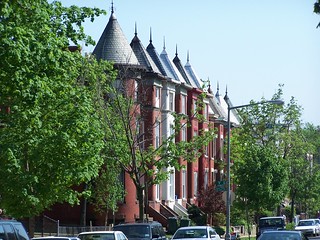
Bloomingdale RowhousesRight: rowhouses in Bloomingdale. 

Urban pioneering from the 1970s through the 1990s reaches critical mass around 2000

It is somewhat pejorative to use the term "urban pioneering," because like saying that Columbus discovered America while Native Americans were already here, the same goes for in-migration to the city, but...

Even after white flight in the 1950s, DC's population continued to decline.  In 1950, the population was about 802,000, in 2000 it was 572,000.

Yet, significant numbers of people were still moving into the city, despite prevailing trends, attracted to nice neighborhoods, typically comprised of historically significant residential building stock, the ability to get to work without having to rely on a car, cultural amenities, etc., despite the double whammy of declining quality of municipal services and increasing crime.

These "pioneers" helped to stabilize otherwise declining and shrinking communities and over time in some areas (such as Capitol Hill, Dupont Circle) built up large enough numbers so that they began expanding the boundaries of where they were willing to live--e.g. "Capitol Hill" moved from around the Capitol and Union Station to eastwards of Lincoln Park and the definition of Dupont Circle continued to move southward to 14th Street.

I would argue that around 2000 and onward, in-migration began to achieve critical mass in many neighborhoods, like Logan Circle and Bloomingdale, not just in Capitol Hill.  See the past blog entry "Revitalization in stages: Anacostia."

Day 1 on the Washington Metro, Railway AgeTransit

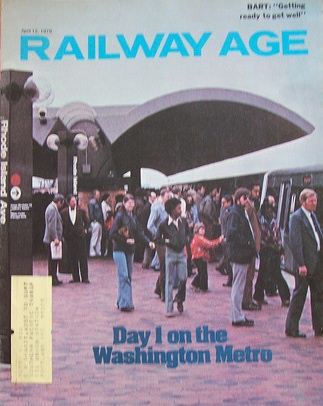
The same goes for transit oriented development.  From the opening of the WMATA subway system in 1976, it took about 25 years to begin seeing significant spillover development benefit from proximity to transit.

First this happened in Downtown and West End, and over the last 10 years in the East End of Downtown (assisted a bit by Verizon Center).  Then in places immediately outside the core (NoMA, Columbia Heights), and now further out.

Besides maintaining the economic relevance of the central business district, access to fixed rail transit contributed to the success of neighborhoods like Dupont Circle or Capitol Hill.

And over time, more housing proximate to transit is being built throughout the city, such as in Columbia Heights, Downtown, on U Street, H Street, etc., and even in places further out like Takoma and Fort Totten and Petworth.  This has significant positive benefits.

In any case, the biggest change in the dynamics of the metropolitan housing market in Washington is that neighborhoods with high quality transit remain in demand despite the vicissitudes of the market.

This favors DC because DC has 40-42 transit stations (two are on the border and shared with Maryland) with 30 stations in the core of the city.  It should be no surprise that in the core of the city, virtually every neighborhood with fixed rail transit service is either healthy or in the process of significant improvement.  (The area around Rhode Island Ave. Station languishes because of the persistent application of suburban rather than urban design.)

Dogs in the NoMA district, 1st and M Streets NE, southeast cornerBefore large houses and lots far from the core were seen as valuable.  With the real estate crash, many of these areas have lost 50% or more of their value.  (Although gasoline prices are expected to decline and so this may change somewhat, plus the relative economic success of the Washington region may mean that housing distantly located will still be somewhat valuable, at least compared to other metropolitan areas.)

Right: 1st and M Streets NE in NoMA, one block from the NoMA-Gallaudet subway station.

This favors Washington, DC specifically, but also places like Arlington, Alexandria, and parts of Montgomery County which have in-demand neighborhoods that are served by high quality fixed rail transit service.

Many people think that it's transit that matters most.  It's more complicated than that.

It's transit plus access to activity centers and employment in high quality neighborhoods.  Successful TOD at places that have no "there" qualities ("no there there") takes much much longer--and in fact may never be achieved.

And I didn't fully realize this til the last 18 months, but much of the desire for the Silver Line subway expansion in Northern Virginia is driven by a recognition that Fairfax and Loudoun Counties would need fixed rail transit to remain competitive for new development when compared to locations that already had subway access.

Continued crime reduction

Towards the end of the 1990s crime began dropping--in the early 1990s, murders in the city approached as many as 500 per year, and in 2012, the number was 88 ("Washington, D.C., finishes 2012 with fewer than 100 homicides," Los Angeles Times).  A focus on problem-oriented policing has made a big difference in the city ("Cathy Lanier Changes Policing in D.C. and Maybe Nation" from Governing Magazine) although so has outmigration from the city of poorer residents who have been displaced from changing neighborhoods.
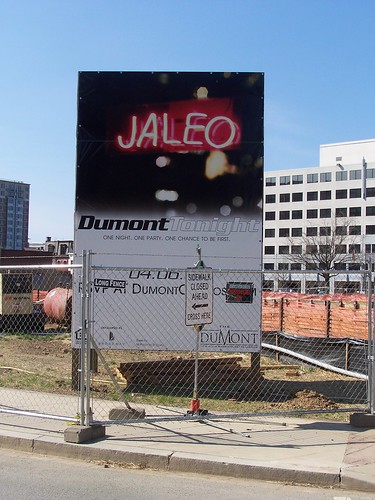
City Living is Hot and Sexy #3 (Dumont, 4th and Massachusetts Ave. NW, Washington, DC)Addition of multiunit housing

For the most part, DC's neighborhoods are typically comprised mostly of rowhouses or detached housing.  The buildings tend to be small and aren't typically occupied by large numbers of residents.

By adding multiunit housing, more people can be accommodated in a smaller footprint.  Plus, this type of housing appeals to different segments of the housing market that might have otherwise looked elsewhere for places to live.

Since 2000, a significant amount of new multiunit housing has been added to DC.  This is what supports the general economic improvement of the city and allows DC to capture a bit more of the region's growth than it had been capturing previously.

What has changed is the last 10 years is DC's ability to capture residents vis-a-vis other locations in the metropolitan landscape of choice neighborhoods

The city became much more competitive as a place to live beginning with the election of Anthony Williams, and his focus on improving the quality of local government, simultaneous with reaching the tipping point in terms of favorable attitudes towards living in the city (the "Friends" and "Seinfeld" effect).
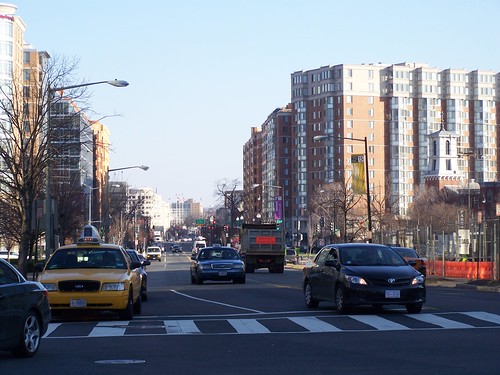
Massachusetts Avenue looking eastward from around the 600 blockThe tipping point of a willingness to live in the city matters a lot.

As many urban pioneers as it seemed there were, there weren't enough to significantly move neighborhoods beyond stabilization.  That's why DC's retail languished for decades.

Only now, with the increase in population in many neighborhoods are you starting to see improvements in places like Petworth and 8th Street SE.

And the addition of large amounts of multiunit housing supports commercial district revitalization, retail growth, and transit frequency.

Schools as a long term issue that still is up in the air

This will be subject of another blog entry sometime in the next month (I have grand jury duty which limits my ability to do much of anything three days/week.)  But... it might not matter so long as families see charter schools as the solution to problems with local elementary schools.

Labels: , , , , ,

Monday, June 11, 2012

Brilliant piece on Chicago's woes by Aaron Renn


Speaking of why I have so much respect for the Urbanophile blog (I had the privilege of meeting "Chicago" bloggers Aaron Renn and Lynn Stevens of Peopling Places when I attended the Main Street conference there in 2009-- Lynn and I were going to meet anyway and she brought Aaron along), Aaron has a piece in the City Journal (yes, the publication of the "conservative" Manhattan Institute).

It's on how he sees Chicago's situation--a city deeply in debt, with a shrinking population both for the city and regionally, lack of a particularly strong business sector powering claims to being a "global city," comparatively low per-capita GDP, and its role really being the center city (from the standpoint of center-periphery concepts in underdevelopment studies, although he doesn't cite this work) of the still declining Midwest (with the exception of those areas experiencing booms related to oil and natural gas production).

-- The Second-Rate City?:Chicago’s swift, surprising decline presents formidable challenges for new mayor Rahm Emanuel


He also mentions bureaucracy as stultifying local business development (he doesn't mention contracting, my bicycle facilities systems integration firm ran into the buzzsaw of Chicago contracting last fall), and the failure to systematize laws and zoning practices, but instead preferring the very personal practice of law and action according to "aldermanic privilege" -- kind of like so-called "state's rights" arguments to allow states to do mostly really terrible [and yes, occasionally good things, but very rarely] things like discrimination, instead each Aldermanic district does its own thing, mostly badly.  Along with corruption and the power of the political machine, these ways of dysfunction make it hard to re-generate organic growth.

It's kind of a Chicago specific chapter that would be great to include in an update of the book, The Future Once Happened Here, coincidentally authored by a Fellow of the Manhattan Institute, Fred Siegel.

A lot of people criticize Siegel's work, but I think it's not just inciteful but insightful, and if you don't understand what's up, and you're just focused on cheer-leading, you'll never really be able to improve your city and its economic position, in either its metropolitan, regional, or national context.

Likely people will take Aaron's article as personal criticism rather than critical analysis, and the problems present will continue to fester and only get worse.

Labels: , , , , , , ,

Thursday, March 29, 2012

Disturbing photos of Detroit in Washington Post photo essay

(I am doing filing in advance of someone visiting this weekend--as you can imagine, my place is full of articles and reports, usually unfiled...)

I clipped a photo from the Post, which ran during the runup to the Republican presidential primaries there. They had articles, but photos too, mostly online.

While the caption to this photo isn't very accurate--you don't get this kind of deterioration after 42 months of recession, but because of 40+ years of outmigration, abandonment, and Depression--it is truly disturbing in so many dimensions.
The ramshackle remains of a home in a Detroit neighborhood are a reminder of the fallout of the economic downturn
The ramshackle remains of a home in a Detroit neighborhood are a reminder of the fallout of the economic downturn. Bonnie Jo Mount / The Washington Post

It's been more than a decade since I've been back to Detroit. The last time I was there I went around the city, looking at places that I had lived. Some blocks were completely devoid of housing. Schools that I had gone to are now closed.

Labels: , , ,