Rebuilding Place in the Urban Space

"A community’s physical form, rather than its land uses, is its most intrinsic and enduring characteristic." [Katz, EPA] This blog focuses on place and placemaking and all that makes it work--historic preservation, urban design, transportation, asset-based community development, arts & cultural development, commercial district revitalization, tourism & destination development, and quality of life advocacy--along with doses of civic engagement and good governance watchdogging.

Tuesday, January 13, 2026

Trump's F****** with Culture and Civil Society Harms the Nation and Washington DC

Normally government moves pretty slow. The pace at which President Trump is destroying institutions and enriching his family, while spending much of his time playing golf, staying up late, and tweeting, is unprecedented. It's almost impossible to keep track.

Good thing he had the Heritage Foundation's Project 2025 blueprint to destroy progressive leaning government! ("The year Trump broke the federal government," Washington Post).

Including attacking nonprofit, progressive leaning organizations ("Trump's Secret War Against Vital Nonprofits," Alliance for Justice, "What is Trump doing to US nonprofits and philanthropies?," Devex. "Progressive Nonprofits Condemn Trump’s Targeting of George Soros and His Foundations," Chronicle of Philanthropy, "Senate GOP Ramps Up Attacks on Left-Wing Nonprofits," NonProfit Quarterly).

MAGA-fying civic education ("Trump Administration Announces New Civics Effort With MAGA-Aligned Groups," NYT) plus prayer in schools ("Trump wants prayer back in schools. Boston has a cautionary tale," Boston Globe).

And specific attacks on "blue" states although not limited to culture ("Trump is waging war on Democrat-led states," Globe).

Banner at the Kennedy Center calling it the "Nation's Cultural Center."  Photo by Bonnie Cash/UPI.

Because the arts and education are seen as dominated "by the left" the Trump Administration has been militant about defunding organizations that support or practice these disciplines.

The same goes for nonprofit organizations involved in human services, agriculture and other fields.


Work continues on the construction of the ballroom at the White House on 9 December in Washington DC, where the East Wing once stood. Photograph: Pablo Martínez Monsiváis/AP

Here's a line up of some of the destruction.

And building grandiose monuments to his ego

President Donald Trump addresses a dinner for donors who have contributed to build the new ballroom at the White House, Wednesday, Oct. 15, 2025, in Washington. | John McDonnell/AP Photo
Photo: Nathan Howard, Reuters.

Massive banners with Trump’s face are adorning some federal buildings in DC. 
Democrats are crying foul.  CNN photo.
Armored vehicles drive during the Army's 250th anniversary parade in Washington, D.C. 
Alex Wroblewski/AFP via Getty Images
  • And he wants his face on coins even though the law says living people can't be so honored.
The U.S. Mint released three prototype designs for a $1 coin featuring President Donald Trump 
to celebrate the country’s 250th anniversary this year. 

====

In DC, he also wants to take over the public golf courses ("Trump’s self-serving takeover of D.C. public golf is bad news for all," The Athletic/NYT).

Labels: , , , , ,

Wednesday, December 10, 2025

Big Time College Sports Teams should lose their tax exempt status

 Was the focus on an opinion piece in the Washington Post, "It’s a strange ‘charity’ that pays fired football coaches $228M," calling attention to the high salaries of coaches and the outlandish costs of contract buyouts.  

In Pennsylvania, some county courts have ruled that the high salaries of nonprofit hospital presidents are such that local properties may/or not be eligible for tax exempt status, because the impact is similar to for profit hospitals ("“Eye-popping” executive salaries led these hospitals to lose their property tax benefits," Lown Institute).  But two years later, the Philadelphia Supreme Court reversed the decision ("Pennsylvania court rejects nonprofit hospital property tax exemptions," RSM).

One of the issues, is like with professional sports where private equity is increasingly buying into teams ("What is behind the growth of private equity in sports?," JPMorgan), is that the same thing is on the verge with college football and related sports.

In the past five years, private equity firms have acquired stakes in teams across all four of the major U.S. professional sports leagues (NFL, NBA, MLB and NHL), and nearly one in five teams now has some level of PE involvement. What’s driving this surge?

Sports team ownership was once the preserve of the uber-wealthy, and that is still largely the case. But as the total valuation of sports teams in the four major leagues approaches $500bn, and with the average NFL team valued around $7bn, some franchises are growing even beyond the means of the wealthiest buyers. Private capital investors taking minority stakes allow ownership and risk to be shared among a larger group of investors, bringing an infusion of cash for opportunities such as the development of stadiums and surrounding properties.

The University of California private equity investment fund wants to buy into the BIG Ten League ("Michigan is a hard no. Where does Ohio State stand on Big Ten private equity deal?" USA Today, "But some of the universities like Michigan, are opposed ("UC Investments puts $2.4 billion Big Ten deal on hold amid pushback from Michigan and USC," New York Times).  From USA Today:

As part of the proposed deal, UC Investments would earn 10% of the Big Ten’s media and sponsorship rights earnings for 15 years, after which it could sell its stake. The remaining 90% would be divided among the schools, with payouts varying based on a university’s earning potential.

... At a previously scheduled meeting of Michigan's Board of Regents in October, members Jordan Acker and Mark Bernstein criticized the idea of bringing private equity into the conference, calling the deal "reckless" and "short-sighted." Bernstein, the board's chairman, specifically compared the deal to a "payday loan."

One of those members went as far to say that Michigan would consider leaving the Big Ten when the current media rights deal expires in 2036 if the deal goes through without unanimous approval.

... USC has also expressed some concern with the deal, though it hasn't gone as far as Michigan. USC's issue seems to stem from its position outside the top tier of member institutions. The deal currently calls for a tiered distribution of funds based on a school’s market value. Ohio State, Michigan, and Penn State would be in the top tier and could receive as much as $190 million. The other schools would get anywhere from $110 million to $150 million.

But University of Utah, a decent football team but not often in the top 10, just pulled the trigger, and sold a portion of its sports operation to Otro Capital ("Utah approves partnership with private equity firm," ABC).  The expectation is that the sale will generate $500 million.

Otro Capital, based in New York, is the first for-profit company that will handle finances for Utes athletics. Decisions will still be made by athletic director Mark Harlan, but a new company called Utah Brands & Entertainment will oversee the department’s resources. Otro Capital will be a minority owner in Utah Brands & Entertainment. This will mark the first university partnership with a private equity firm in college sports.


(Rick Egan | The Salt Lake Tribune) Rice-Eccles Stadium on Saturday, Sept. 6, 2025.

Utah Brands & Entertainment will preside over tickets sales, stadium events, broadcasting, concessions, licensing, brand content and finance. However, coaches and athletes will remain with the athletics department. Fundraising will also remain with the school.

Also see "The risks and rewards of Utah’s private equity plans: Will others around college sports follow?," The Athletic.

Separately, Travis County, Utah is suing the University of Texas Club, a members-only private club that is an operation separate from the University, for property taxes ("Travis County sues UT Club over unpaid property taxes," Daily Texan).  It's reasonable as its a for profit business that happens to be located on nonprofit land.  There's really no public purpose.

Travis County filed the lawsuit on behalf of the Austin Independent School District, the city of Austin, Travis County, Travis County Health Care District and Austin Community College, which are all eligible to receive the county’s local property taxes, including taxes from the club, according to the lawsuit.

At the club’s cheapest membership level, it requires a $350 initiation fee and $125 monthly dues for non-faculty and staff members, according to the club’s website. It was recently renovated in 2024 and is the “epicenter of exquisite dining, first-class events, lively watch parties, vibrant social gatherings, and a celebration of Texas sports,” according to the website.

Increasingly, especially with massive television broadcast rights payouts, it seems that college football teams, and basketball, should be responsible for the payment of Unrelated Business Income Taxes (UBIT) as television revenues should not be considered a primary purpose of providing football as a university spectacle or opportunity for student athletes. 

====

Also see "Stadiums and arenas as the enabling infrastructure for "money-making" platforms" (2014)

Labels: , , , , , , ,

Tuesday, March 11, 2025

The "nonprofit industrial complex," city government and service delivery

The Baltimore Sun has a commentary, "Baltimore is being strangled by the nonprofit industrial complex," criticizing the city for making a grant of almost $1 million to an organization with a limited track record.
A $900,000 grant by the Baltimore Children and Youth Fund (BCYF) to a nonprofit organization known as Thrive Arts Inc. in 2022 is the latest evidence that Baltimore’s version of the “nonprofit industrial complex” wields too much power. 

As reported by The Baltimore Sun, Thrive Arts was incorporated in 2021 but lost its corporate charter last year after failing to file tax returns for three straight years, and is [legally] now defunct.
It was an extraordinarily large grant for a small organization with no proven track record. Yet to be confirmed is how much of the $900,000 was disbursed to the grantee and spent on the purposes for which it was intended or returned to the city.
I do intend to do a book review on the book Nonprofit Neighborhoods: An Urban History of Inequality and the American State, which discusses how cities began outsourcing dealing with inequality and social issues to nonprofits.  This brief blog entry is by the author too, "The Origins of the Nonprofit Industrial Complex."

I have written many times over the years about problems with DC government grants and nonprofit execution.  

This is in the news more recently because of alleged bribes to a councilmember ("Trayon White expelled from the DC Council for corruption but he’s free to run for his old seat," AP) and government employee ("Former DC government official charged with taking bribe,"NBC4) by a grantee eager to secure their place in the system.

But it's been an issue for a long time, in fact the organization in Baltimore that is criticized by the author is similar to one that engaged in improper grant making in DC ("Harry Thomas, former D.C. Council member, is sentenced to more than three years in prison," Post), leading to the jailing of a Councilmember.

Minneapolis had some terrible problems/mistakes during covid, when it granted tens of millions to a grantee to provide meals, when the grantee had zero capacity to do so ("Minneapolis man admits to stealing at least $3.8 million from COVID-19 relief programs," KARE-TV).

Thinking about this I have five main points:

1.  A lot more money needs to be invested in capacity development and technical assistance for nonprofits, especially those receiving government grants.

2.  There must be transparency with the grant making process--something definitely not present in the Baltimore example.  An RFP and open call process with deadlines and decision making criteria.

3.  Accountability mechanisms must be in place to ensure that the right stuff is being done with the money and that it gets results.  This has been an issue with violence prevention programs in many places, including DC, where one recipient of funds recently was imprisoned for murder ("Former D.C. Violence Interrupter Sentenced for His Involvement in Drive-By Shooting," Washington City Paper, "Violence Interrupters Push Back Against Calls for Defunding," Washington Informer,  Many cities are putting hopes in violence interrupters, but few understand their challenges," NBC News).

4.  Evaluation of success and failure needs to be built into the program ("D.C.’s Violence Intervention Programs To Receive In-Depth Evaluation,".DCist").

5.  Ethics training is mentioned in the academic literature as being important.  I wonder...

=======

=======
I just came across this, I haven't read it.  From the Journal of Business Ethics article, "The Labyrinth of Corruption in the Construction Industry: A System Dynamics Model Based on 40 Years of Research," :

Abstract 

The academic literature has viewed drivers of corruption in isolation and, consequently, failed to examine their synergistic effect. Such an isolated view provides incomplete information, leads to a misleading conclusion, and causes great difficulty in curbing corruption. This paper conducts a systematic literature review to identify the drivers of corruption in the construction industry. Subsequently, it develops a system dynamics (SD) model by conceptualizing corruption as a complex system of interacting drivers. Building on stakeholder and open systems theories, the proposed SD model shows how the complex reinforcing relationship between authoritative, organizational, cultural, and financial drivers of corruption further increases corrupt practices. The new model also provides lessons that can be helpful in the development of policy frameworks to control corruption in the construction industry. To achieve success in the fight against corruption, the findings of this research suggest that (1) corruption must be understood at both the organizational and state levels, (2) anticorruption practices must be informed by ethically grounded stakeholder management strategies, and (3) anticorruption reforms must go hand-in-hand with strategies to tackle the economic downturn.

No wonder corruption is so endemic.  It's embedded deep within the system.  Below is the diagram from the article showing the dimensions of corruption within construction.


Labels: , , , , , ,

Tuesday, May 31, 2022

Interesting community initiative in Detroit: Marygrove Conservancy

The Detroit News reports in "How partnerships revitalized Detroit's McNichols corridor," about commercial and neighborhood revitalization initiatives in the 6 Mile Road corridor--also named McNichols. (Subscription required).  From the article:

A decade ago, a stretch of storefronts along McNichols on the city's west side were in disrepair, open to the elements and left to deteriorate. 

During the past few years, developers have either revitalized or made plans to rehab several of the buildings to provide amenities to the community: restaurants, a brewery taproom, apartments and retail. Geneva Williams, executive director of Live6 Alliance 

“We are thrilled, delighted and walk with those developers hand in glove as they do some incredible work,” said Geneva Williams, executive director of the Live6 Alliance, a nonprofit serving communities surrounding the McNichols and Livernois area. “You know, this whole aspect of having Brown and Black developers working in neighborhoods that they have connections to — many of them were born and raised in the area. ...

Several of the development projects are funded in part through Invest Detroit and the city of Detroit's Strategic Neighborhood Fund, the public-private partnership with the goal of improving 10 neighborhoods in the city. Among the projects are the Enclave at 7400 McNichols, which will house the brewery taproom, two restaurants and a small business incubator space after a $3.4 million renovation.

It's relevant to two different blog series from 2020 on commercial district revitalization

-- "Basic planning building blocks for urban commercial district revitalization programs that most cities haven't packaged: Part 1 | The first six"
--  "Basic planning building blocks for urban commercial district revitalization programs that most cities haven't packaged: Part 2 |  A neighborhood identity and marketing toolkit (kit of parts)"
--  "Basic planning building blocks for urban commercial district revitalization programs that most cities haven't packaged: Part 3 | The overarching approach, destination development/branding and identity, layering and daypart planning"
-- "Basic planning building blocks for "community" revitalization programs that most cities haven't packaged: Part 4 | Place evaluation tools"

and neighborhood revitalization:

-- "The need for a "national" neighborhood stabilization program comparable to the Main Street program for commercial districts: Part I (Overall)"
-- "To be successful, local neighborhood stabilization programs need a packaged set of robust remedies: Part 2"
-- "Creating 'community safety partnership neighborhood management programs as a management and mitigation strategy for public nuisance programs: Part 3 (like homeless shelters)"
-- "A case in Gloucester, Massachusetts as an illustration of the need for systematic neighborhood monitoring and stabilization initiatives: Part 4 (the Curcuru Family)"
-- "Local neighborhood stabilization programs: Part 5 | Adding energy conservation programs, with the PUSH Buffalo Green Development Zone as a model," 2021

The article is more about commercial districts than neighborhoods, but it does both. It's part nostalgia that I list it, because when I was a child in Detroit (early 1960s) when my father was still alive, we lived a couple blocks from McNichols Avenue, although the area mentioned in the article is a few miles away from where we lived.

In my day the major Detroit arterials like 6 Mile, 7 Mile, Greenfield, Livernois, etc. were lined for miles with block after block of small retail stores. Today many of the buildings have been demolished.  So it's hard for me to give credence to today's efforts at revitalization, because they will never bring back the city I remember.

From an urban revitalization standpoint, I've had to sluff off those memories, because that kind of revival is not possible.  Detroit had almost 1.7 million residents then, now it has fewer than 700,000.  The thing is that the city was in decline even then, but we didn't realize it.  Now the point is to rebuild based on the opportunities present today.

A noteworthy element mentioned in the article is the "Marygrove Conservancy," which is separate from the efforts to revive the commercial corridor.

 It's a nonprofit with foundation and corporate support ("PNC Bank and Kresge Foundation Fund $57.3M for Marygrove Conservancy Renovation") that has taken over the deaccessioned Marygrove College campus ("Conservancy builds a place for community, learning on site of former Marygrove College," Detroit Free Press).

The school shut down (I don't know why they didn't try to merge with the University of Detroit Mercy, where earlier the UD merged with Mercy College, all three are Catholic related schools of higher education), but instead of redeveloping it (not that there is that much demand to do so), the campus was turned into a community-serving nonprofit.

The Conservancy is focused on a variety of community focused initiatives including housing a charter school and community development programs.  From the Detroit News article:

Allen said the conversancy’s involvement goes beyond the campus. For example, it has art projects planned along the McNichols corridor and plans to partner with the Enclave on its business incubator. 
The sprawling, 53-acre campus includes The School at Marygrove, a high school that opened in 2019. There's also an early education center that opened in 2021, and an elementary school will open in the fall. 
The campus is also home to 60 organizations, including nonprofits and small businesses. For example, the owners of the Detroit Pizza Bar occupied space on the campus while construction for the restaurant was underway, Allen said. Other organizations on campus include the Detroit Youth Choir and Shakespeare in Detroit. 
“We provide space and access to our facilities, but we also aim to be a convener, a resource for the businesses and for the residents of the community as a way of really just leveraging our resources in ways that benefit the community,” Allen said. “And that's a unique role for us.


Another initiative, Neighborhood HomeBase, is relevant to the entry yesterday on community space and facilities planning:

-- "Community facilities: it's not just building them, it's making the program better when you do so"

where the McNichols-Livernois improvement group has created a storefront community space.  From the article:

The Live6 Alliance recently reopened its Neighborhood HomeBase, a storefront community space at 7426 W. McNichols, following a two-year closure due to COVID-19. The space first opened in 2019 and down the street from the Detroit Sip coffee shop that opened in 2017.

-- "Neighborhood HomeBase: A new model for collaborative community revitalization," Medium

There are equivalent efforts here and there, but they aren't very frequent.  I need to start keeping a list.

Labels: , , , ,

Tuesday, March 15, 2022

Project Rehab, University City District, Philadelphia: Best Practice Neighborhood Stabilization Program

In 2020/2021, I wrote a five part series on creating a model framework for systematic neighborhood stabilization, suggesting the creation of a national program comparable to the Main Street commercial district revitalization program, but for neighborhoods/residential property, modeled after a program created in Pennsylvania, called Elm Street.

-- "The need for a "national" neighborhood stabilization program comparable to the Main Street program for commercial districts: Part I (Overall)"
-- "To be successful, local neighborhood stabilization programs need a packaged set of robust remedies: Part 2"
-- "Creating 'community safety partnership neighborhood management programs as a management and mitigation strategy for public nuisance programs: Part 3 (like homeless shelters)"
-- "A case in Gloucester, Massachusetts as an illustration of the need for systematic neighborhood monitoring and stabilization initiatives: Part 4 (the Curcuru Family)"
-- "Local neighborhood stabilization programs: Part 5 | Adding energy conservation programs, with the PUSH Buffalo Green Development Zone as a model," 2021 

The major point is the framework and ability to implement, but that programs need complementary remedies to be able to act, and organized initiative so that they are able to implement and effect change.

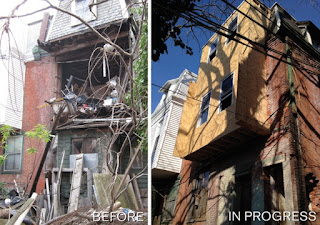
Photo from the first Project Rehab project, in 2012.

The Philadelphia Inquirer has an article, "A ‘Mr. Fixit’ helps West Philly residents and businesses cut through red tape," about the Project Rehab initiative of the University City District business improvement district.  It focuses on addressing problem properties--distressed, vacant, etc.--as a way to "cure nuisances" by assisting the property owner, rather than seizing or demolishing buildings.

It's not a huge program, they've addressed about 5 properties per year since the program's creation in 2011.  That demonstrates not failure, but how time consuming the process can be.

From the website:

While Project Rehab responds to the unique needs of each property owner, the core steps of every project are the same. 

 1. Property Monitoring and Identification UCD uses a variety of methods to monitor problem properties in the district. Staff conduct physical surveys to identify distressed real estate, and seek input from community and civic associations as well as concerned community members. Staff also work closely with the City, making use of information and investigations gathered by the Department of Licenses and Inspections. 

2. Owner Identification Project Rehab then uses a variety of resources to clarify property ownership, which can be challenging to unravel. Staff conducts online research and interviews community organizations, neighbors, and owners’ family members. Project Rehab also partners with government offices such as the Philadelphia Revenue Department, the Records and Deeds Office, the Register of Wills, and Licenses and Inspections to obtain information on owners and their properties. 

3. Defining the Course of Action Once we establish contact with an owner, Project Rehab and the owner develop a course of action for the property, which often entails renovation for eventual personal use, sale, or rental/leasing. Whatever the desired outcome, UCD provides a range of free supports and services to help the owner achieve their goals: 

Financing: Working in partnership with local banking institutions, UCD drafts and develops financing packages for owners who want to finance the rehabilitation of the property. 

Rehabilitation: UCD has developed a list of licensed contractors who are experienced with the rehabilitation of distressed properties. Staff provide support and knowledge to owners throughout the process, helping to obtain all required permits, licenses and inspections. '

Sale: UCD has built a network of realtors who support those owners who decide to sell their property. Zoning: UCD connects owners with local attorneys and community organizations to work through the zoning process. 

Conservatorship: Project Rehab works with 501-4C not-for-profits to utilize Pennsylvania legislation known as the Act 135 Conservatorship Act to redevelop distressed properties with no known owners. 

Along the way, the Project Rehab team is able to deploy outside the box strategies to help each owner achieve their rehabilitation goals, regardless of the issue surrounding the real estate. From helping a family open an estate to untangling title issues to ensuring that owners are well represented while seeking equity development partners, Project Rehab is a guide and support for property owners.

======

The UCD is an association so to speak, not a typical business improvement district where property owners in the district are taxed a small amount on the assessed value of the property. Instead property owners in the district pay voluntary amounts.

-- "In University City, a model for a [neighborhood improvement district]," Philadelphia Daily News, 2012

It was pointed out to me that this wasn't altruistic, but a strategy by the nonprofit property owners--University of Philadelphia, Drexel University, Amtrak, etc.--to ward off the idea of taxing nonprofit property owners as a way to generate tax revenues for cities.  Some institutions pay what are called PILOTs, or payments in lieu of taxes.  

--"Proposal to eliminate nonprofit property tax exclusion in Maine," 2015

But some cities, which have significant swathes of property off the tax rolls because of the concentration of nonprofit institutions within their borders, look to tax nonprofits too.  (Note that Ontario doesn't have the kind of tax exemption system we do in the US.  Even the provincial government and nonprofits pay property taxes.)

Separately, Pittsburgh is looking for PILOTs as a way to fund infrastructure improvements ("Pittsburgh City Council proposal would turn to nonprofits for infrastructure funding," Pittsburgh Tribune-Review).  

PILOTs are an alternative to an earlier proposal to impose a 1% tax on tuition and medical bills--the city has two major hospital systems and at least two large universities, Carnegie-Mellon and the University of Pittsburgh ("Pittsburgh Councilman Ricky Burgess proposes 1% tax on higher-ed students, medical patients," PTR).

That built on similar proposals, at least for a capitation tax on students, in Providence, Rhode Island.  Providence College was disfavorable ("Student Fee Would Break Bond of Trust").

Labels: , , , , , , ,

Thursday, June 04, 2020

Innovation infrastructure as an element of community economic development: BioSpaces; TechShops; Maker Spaces; Arts spaces

The response to the pandemic has engendered a wide variety of "innovative responses" by people, businesses, and nonprofits, to address gaps of all sorts--lack of personal protection equipment, food, access to cultural resources, schooling, etc., which has been a surprise compared to a general "hardening of the arteries" when it comes to the ability of organizations to respond and transform.

-- "Innovation in Response to the COVID-19 Pandemic Crisis," Academic Medicine
-- "FDA Oversight Emerges For Additive Manufacturing," Forbes
-- "How 7 local businesses are pivoting to PPE production," Boston Globe
-- "7 Weird And Unexpected Business Pivots During The Coronavirus Pandemic," Forbes

Jane Jacobs and Urban Innovation. In Death and Life of the Great American City, JJ argues that "a large stock of old buildings" is one of the four key requirements for healthy cities, because old buildings, paid off and with low running costs, offer cheap rent, and startups (and artists) are fostered by low cost space.  This argument was extended in her second book, The Economy of Cities.

Note that JJ didn't anticipate that there would be a serious disconnect between supply and demand of space in cities and that even old buildings would end up being significantly repriced upward in strong market cities.

Space and facilities as infrastructure for innovation. My arts-based revitalization writings ("Arts, culture districts, and revitalization"), citing John Montgomery's crucial distinction between arts as consumption and arts as production, reference a publication by the Creative City Network of Canada, Cultural Infrastructure: An Integral Component of Canadian Communities, which provides a framework categorizing the types of spaces and facilities that artists and arts organization need to have a functioning arts production system.

Using that framework, I argue that within cultural planning, space needs for artistic disciplines must be differentiated, and that we should endeavor to ensure the availability of the variety of spaces needed to support a healthy and functioning local arts ecosystem.

Best practice discipline-specific arts center examples include Baltimore Clayworks,  London Sculpture Works, UK, Pittsburgh Glassworks, Podcast Garage, Boston, Pyramid Arts Center (printing) in Hyattsville, Maryland, and The Writing Center in Bethesda Maryland

Multidisciplinary examples include BRIC House in Brooklyn, Cabelfactory in Helsinki, GoggleWorks in Reading, Pennsylvania, La Friche in Marseille, and Symphony Space in NYC.

Hackerspaces as infrastructure for innovation.  One type of space not included in the CCNC Cultural Infrastructure framework are hackerspaces.  The framework needs to be extended outward from the arts, for innovative business, various creative endeavors, nonprofits, etc., to provide spaces, technical assistance, and access to specialized equipment.

Hackerspaces are non profit, community run spaces where people with a common interest and a need for specialized equipment, such as computing, machining, technology, digital media, and science can have access to workspaces, equipment, and meeting and collaboration spaces.  Training, classes, talks and other programming may be offered.

The types of spaces and range of equipment vary.  Universities often have such spaces, although access is typically limited to people affiliated with the school.  These days, "maker spaces" in public libraries are in vogue, with some interesting resources, from 3D printers to sewing machines, but not highly technical equipment.

Woodworking.  An early example is the creation of woodworking clubs, which have a wide variety of specialized equipment.  People can become members and be certified and then able to work with specialized machinery.

People like me without that kind of interest or skill can usually take pieces to such places to be worked on, at a reasonable cost. For example, I didn't have the equipment to do a precise cut for butcher block kitchen counters.  So we took the counter to Woodworkers Club of Rockville and they did the cuts.

Community Kitchen.  As a way to support local food production and business development, the Appalachian Center for Economic Networks created a food production kitchen with a food safety manager and other technical assistance programming to support local business development around agriculture.

Other places have developed similar operations, including La Cocina in San Francisco ("What Are Food Incubators and Do They Create Viable Businesses?," Eater), which is focused on supporting immigrants and Spice Kitchen Incubator in Salt Lake City, which is focused on job training and business development.

In DC, Union Kitchen operates similarly but on a for profit basis ("Food Entrepreneurs Have Much to Weigh Before Tying Their Fates to Union Kitchen's Accelerator," Washington City Paper).

Business Incubators.  On the economic development side, business support organizations and/or government agencies or universities create incubators to support business development.  There are various types, depending on the area and what business specializations a community might have.

Incubators sponsored by economic development organizations usually offer other technical assistance and programming.  One distinctive element is that business incubators usually have an "up and out" approach, putting a limit on the amount of time a business can be housed at low rents.

There can be for profit variants.

-- InBIA: Global Network of Entrepreneurial Ecosystem Builders

BioCurious Lab.

BioSpaces.  This entry is sparked because a recent issue of New Yorker Magazine has an article ("The Rogue Experimenters") about hackerspaces or "community labs" for biology, such as the Baltimore Underground Science Space, which has lab equipment, storage freezers, and a PCR machine to duplicate DNA.

The article discusses the DIY-bio movement, which even includes an effort to create nonprofit insulin production, because of increasingly high cost of insulin sold by traditional pharmaceutical companies. e-NABLE is a 3D printer-supported network of volunteers creating low cost or no cost prosthetics.

-- Just One Giant Lab network
-- GenSpace, Brooklyn
-- BioCurious, Santa Clara, California
-- Counter Culture Labs, Oakland, California
-- Harlem BioSpace

Photo by Leonard Ortiz, in This Village is Orange County's first building dedicated to housing nonprofits," >Orange County Register.

Nonprofit Centers Network.  NCN supports shared facilities for nonprofit organizations ("BTMFBA revisited: nonprofits and facilities planning and acquisition," 2016). In Philadelphia, Cultureworks provides space, back office support, and other technical assistance and support to nonprofit cultural organizations.

For profit attempts

Third Ward/Brooklyn and Philadelphia.  Third Ward was an for profit attempt at a broader type of maker space, with equipment beyond wood, and a combination of a co-working space.  But the reality is that there isn't tons of profit in such facilities (cf. WeWork), and investors looking for quick returns end up pushing such facilities to bankruptcy.  That's what happened to Third Ward ("What happened to Third Ward," New York Observer).

Philadelphia Sculpture Gym.  Technically was a for profit too, but more like a community facility including a gallery. It had a wood shop, metal shop, jewelry shop, forging area, ceramics area and a mold making and casting area.

But the owner decided to sell the building and there wasn't a system in Philadelphia able to assist the organization in moving, especially to equally cheap space (they were paying about $4/s.f.) and the organization folded ("A FOND FAREWELL TO THE PHILADELPHIA SCULPTURE GYM," Knight Foundation).

Shepard Test Stand, TechShop Arlington.

TechShop.  Like Third Ward, TechShop was a for profit maker space.  Started in the Silicon Valley, it expanded across the country, stoked by venture capital.

But after a few years, it failed also ("Sad but not a surprise: bankruptcy and shutdown of TechShop MakerSpace chain." 2017 blog entry).

Shared Office Spaces/WeWork. One way to address the need for lower cost space but providing greater opportunities for networking ("agglomeration economies") are shared work spaces like WeWork or business incubators, where participants pay a fee for access to shared space and business equipment (printers, etc.), meeting rooms, a mailbox (ideally with a more distinguished address), etc.

For Profit Business Incubators.  Venture capitalists, property owners seeking active uses for their spaces, and others create business incubators too.

And like with TechShop and Third Ward some fail, like 1776 in DC ("Why 1776 is closing its original incubator location, and thoughts on its future in DC," Technical.ly).  For communities focused on community economic development, nonprofit approaches may work better.

Conclusion.

(1) Community economic development planning needs to include the creation and maintenance of "hackerspaces" as an element within facilities and entrepreneurship development planning.

(2) Hackerspaces need to be included in cultural facilities planning frameworks like that of the Creative City Network of Canada.

(3)  Frequent examples of failure of for profit maker space type ventures demonstrate that expecting such facilities to be wildly profitable are unrealisttic.  A nonprofit approach may work best.

(4) If for profit hackerspaces/incubators exist, they should be monitored and like in the case of TechShop or Philadelphia Sculpture Gym, scenarios for stepping in to ensure continued organizational existence should be developed.

(5)  In high cost markets, the primary need isn't "start up" space per se, it's relatively permanent--or at least long term--access to lower cost space and equipment.  Community development corporations could be an avenue for creating and maintaining making spaces within a broader network of spaces and capacities.

(6) A focus on incubation as a start up initiative may be too limiting.  To me, too many people are focused on helping people "start up" organization be they for profit or nonprofit, when the longer term need is for maintenance.  People focused on creating incubators offering short term space miss the point.

The same goes for "up and out" approaches to business incubation.  Artificially short time limits on participation may be unrealistic and more flexible approaches are required.

Labels: , , , , , , ,

Thursday, March 29, 2018

The loss of a nonprofit hub in Boston: the Congregational Library and Archives

United Methodist Building, DC. Photo from the Interpreter.

Not unlike how the United Methodist Building is a hotbed of social activism located across the street from the US Capitol ("A Beacon on Capitol Hill: The United Methodist Building," Interpreter), Congregational House in Boston serves a similar role in Boston, across the street from the State Capitol of Massachusetts.

Primarily the home of the Congregational Church Library and Archives, over the years the church has rented space for offices to social justice groups. More than 30 nonprofits rent space there, and the cost is significantly less than market rate.

But the church sold the building because of its high property value, and the other groups located there are being pushed out by the for profit owners, who aren't particularly as community minded as they suggested they would be ("As Beacon Street landmark changes hands, nonprofits fear losing access to power," Boston Globe).

Although I don't think that should be a surprise.  They bought the building as for profit real estate developers, not as a provider of low cost space to nonprofits.

Ideally, through a community foundation, the building could have remained in nonprofit hands with a social justice purpose, but most communities don't have processes in place that aim to do that.

The Nonprofit Centers Network is a national technical assistance organization that works with nonprofit shared use facilities like the Congregational House, although that particular organization is not a member.

The Village at 17th Street, shared nonprofit building, Orange County, CaliforniaThis story is about Orange County Shared Spaces located in The Village at 17th Street office complex. This is OC's first "shared spaces" building for nonprofits. By clustering in one building, nonprofit groups can collaborate and share amenities. Leonard Ortiz, Orange County Register, "This Village is Orange County's first building dedicated to housing nonprofits."

As discussed in the 2016 piece, "BTMFBA revisited: nonprofits and facilities planning and acquisition," in strong market cities, as commercial property rents and cost to own rises, nonprofits are increasingly priced out of the market too, just as lower income residents get displaced in the residential housing market.

Planning offices ought to do overarching plans for the nonprofit sector, including facilities planning, just as I suggest this be done for cultural planning and for cities generally ("Town-city management: we are all asset managers now").

====
I was doing filing yesterday, and came across an older article about this as it relates to colleges and universities.

-- "Protecting and Enhancing Campus Facilities: 6 Principles for Boards," College Trusteeship, v20:2 p22-27 Mar-Apr 2012.

The principles:
  • Principle #1: Make Facilities Stewardship a Core Governing Board Value
  • Principle #2: Link Long-Range Capital Planning Directly with Institutional Strategic Priorities
  • Principle #3: Ensure Institution-Wide Leadership Responsibility in Facilities Stewardship
  • Principle #4: Create Credibility for Capital-Investment Decisions
  • Principle #5: Ensure Accountability in Implementation
  • Principle #6: Sustain Continuity of the Long-Term Plan through Leadership Changes.

Labels: , , , , ,

Wednesday, November 30, 2016

BTMFBA revisited: nonprofits and facilities planning and acquisition

Because of DC's height limit, the kinds of buildings that Jane Jacobs was thinking about when she wrote that healthy cities need "a large stock of old buildings" that have been paid off and have low running costs and therefore lower rents affordable to start ups, nonprofits, and other innovative uses looking for lower cost space, tend to get demolished and rebuilt to the maximum allowable size, and because the buildings are new, at the current highest rents.

A few weeks ago there was an op-ed in the Washington Post, "The rent is too darn high for nonprofits, too," about how DC nonprofits face a crisis because of the cost of space.  This isn't a phenomenon unique to DC, it's a particular problem in San Francisco ("SF takes action: perspectives on nonprofit displacement, NCG; "Skyrocketing Rents Challenge San Francisco Bay Area Nonprofits, Nonprofit Quarterly), New York City, and other high cost markets.

Like my frustration with the art community complaining about the same problem, but rarely availing themselves of the opportunity to buy buildings ("BTMFBA: the best way to ward off artist or retail displacement is to buy the building" and "When BTMFBA isn't enough: keeping civic assets public through cy pres review"), the nonprofit community needs to come together, develop a facilities/space plan, and create vehicles to assist them to buying and holding buildings.

Organized as the Center for Public Administration and Local Government, in the late 1980s, the Metropolitan Washington Council of Governments did this for themselves and a couple of related nonprofits, including the International City/County Management Association, constructing a building close to Union Station.

But there hasn't been much of a push to do something similar for groups of lesser means. I discuss some options in the BTMFBA article.


Photo: Leonard Ortiz, Orange County Register.

Nonprofit shared spaces.  The Nonprofit Centers Network is an organization that assists facilities across the country that offer shared spaces for nonprofit groups.

The Village in Orange County is one example, with a focus is providing space to housing-related organizations ("This Village is Orange County's first building dedicated to housing nonprofits," Orange County Register).

More communities should work to develop spaces to support nonprofit groups as well as civil society initiatives (although neighborhood groups could be provided space/facilities access at community centers and branch libraries).

A way to "use up" a so-called "white elephant" buildings: multi-faceted arts centers.  With deindustrialization, many communities have large manufacturing buildings that have been abandoned.

In many instances, buildings and communities have been revived by redeveloping these buildings or complexes into multi-faceted arts centers.  Examples include the creation of the MassMOCA contemporary arts museum in North Adams, Massachusetts, which has huge spaces capable of displaying very large art pieces and installations, the GoggleWorks in Reading, Pennsylvania, the Cablefactory in Helsinki, or LaFriche in Marseille, France.

The Trans-Europe Halles organization is a collective of such arts facilities across Europe.

-- New times, new models: Investigating the internal governance models and external relations of independent cultural centres in times of change
-- CREATIVE BUSINESS MODELS: Insights into the Business Models of Cultural Centers in Trans Europe Halles
-- Managing Independent Cultural Centres


In my opinion, DC should have done this with the old Walter Reed Medical Center building on Georgia Avenue in Northwest DC.

The 2.1 million s.f. building could have seeded arts and cultural initiatives for a generation.

But white elephant buildings can be used more generally for nonprofits too.  Note that the best nonprofit arts centers also provide low cost office space to cultural organizations.

Central libraries have the potential to become multi-faceted cultural centers.  There are some examples of libraries sharing some of their space with related organizations.

In the DC area, Arlington County expanded the Shirlington Library to include theater facilities, the Signature Theatre Company. Some Montreal neighborhood libraries include cultural centers.  The provincial "state" library in Montreal has spaces on its back alley/court for small booksellers.  The Hollywood library branch in Portland has a cafe on the ground floor and affordable housing above.

The Drumbrae Library in England has a teen center, cafe, and day care.  Some libraries have space for used bookstores.

The best example is how the Salt Lake Central Library has space for related facilities such as the local NPR station and the Community Writing Center program of the local community college.

I've suggested that libraries could expand upon the SLC example in significant ways ("Civic assets and mixed use: Central Library edition") but thus far we don't see many examples of such co-locations.

Note that community center facilities could be similarly reconfigured to serve more and multiple uses along these lines.

Conclusion:  Um, how about some planning?  The point of urban planning is to manage community needs, land use, and other characteristics of a community.

Given the increasing importance of the nonprofit sector as an element of a community's social, cultural, and community health, as well as a source of economic activity, planning offices should step in and provide leadership for planning space needs for the nonprofit sector, and work with local governments to create ways of providing such space, perhaps through community development corporations comparable to the "Center for Public Administration and Local Government" or the SEMAEST organization in Paris.

In San Francisco, the Northern California Community Loan Fund has stepped in to provide such assistance through the San Francisco Nonprofit Displacement Mitigation Program, which is a model easily exported to cities like Washington.

Labels: , , , ,

Monday, February 16, 2015

Pennsylvania has a stricter interpretation of the justification of nonprofit property tax exemptions

If you read the section of the Internal Revenue Code about the justification for a nonprofit tax exemption, one of the key elements is "reducing the burden on government."  For example, a hospital provides uncompensated health care to indigents, saving money for the social welfare system.  A commercial district revitalization organization helps improve the building stock, economic success of property owners and business proprietors, and generates more property tax revenue for the city, etc.

But for the most part, groups engaged in activities "serving the public" don't necessarily have to simultaneously "reduce the burden on government" to be able to get a federal tax exemption.

Generally, local governments follow this interpretation, although I have noticed in DC that nonprofits engaged in national activities with no local service elements tend to not get property tax exemptions, although they might be eligible for sales tax exemptions.

In Pennsylvania, there is a five-part test that organizations must meet to justify a tax exemption, and it is focused on providing services to the indigent, not to the general public.  According to an article on the legal case, Hospital Utilization Project v. Commonwealth, 487 A.2d 1306 (Pa. 1985) ("HUP"):
The institution must: (i) advance a charitable purpose; (ii) donate or render gratuitously a substantial portion of its services; (iii) benefit a substantial and indefinite class of persons who are legitimate subjects of charity; (iv) relieve the government of some of its burden; and (v) operate entirely free from private profit motive.
As a result, more Pennsylvania nonprofits are losing property tax exemptions because the primary beneficiaries are not the indigent.  See "Small non-profit groups losing property-tax exemptions in first wave of county's review," from the Pittsburgh Post-Gazette.

-- previous entry, "Proposal to eliminate nonprofit property tax exclusion in Maine"
-- interesting paper, PILOTs and SILOTs Revisited, National Association of Independent Schools

Labels: , , , ,

Wednesday, January 21, 2015

Proposal to eliminate nonprofit property tax exclusion in Maine

Maine's Governor is proposing to eliminate annual revenue sharing with local governments, suggesting that local governments could make up the loss in revenue by charging property taxes on nonprofits--schools, universities, hospitals, land trusts--holding more than $500,000 in property.

Typically, nonprofits are exempt from property taxes, in the expectation that they are providing other services to localities, thereby reducing the overall burden on local government.

The Maine Medical Center in Portland is a nonprofit hospital.

This is in response to his desire to reduce income tax rates and to eliminate the estate tax.  Some of the revenues would be made up by higher sales taxes.  The rest would come from eliminating state aid to local governments and slashing social and human services.

- "Tax reform plan rattles Maine towns, nonprofits," Portland Press-Herald
- "Plan to tax nonprofits could be costly to Maine's land-conservation trusts," Portland Press-Herald
-"LePage’s budget aims to make big changes in the state’s tax code," Portland Press-Herald

From the second article:
LePage’s massive tax overhaul plan is intended to reduce Maine’s income tax rate through a series of changes in the tax code. Part of the plan eliminates state aid to municipalities and attempts to replace those revenues by opening the door to municipal property taxes on nonprofit organizations. The budget language makes specific mention of exempting churches and houses of worship from the tax, but no other nonprofit types are highlighted in documents provided by the administration or in the actual legislation.
Tax the river?  Land preserved by the Brunswick-Topsham Land Trust.

Nonprofits aren't replete with extra cash.  The problem with the proposal is that most nonprofits don't generate significant budget windfalls on an annual basis--universities tend to be an exception, but that is because some have very large endowments--so it's unlikely that most nonprofits have available funding to start paying property taxes.

Payments in lieu of property taxes.  Property taxes provide the bulk of local revenues and can be supplemented with payments from the state and federal governments for certain types of programs.

On the other hand, the major cost borne by local property taxes is K-12 education, and these nonprofit properties don't generate much in the way of demand for local schooling.

For decades, cities with large clusters of nonprofits, such as universities or health care facilities, have complained about how much of their land ends up being non-taxable.

That's why the method called PILOT, payment in lieu of taxes, was developed, which allows for nonprofits to provide payments to localities, without having to accede to or authorize the taxation of property owned by nonprofits.

Taxing college students.  A few years back, Providence and Pittsburgh put forth proposals for a capitation tax on college students, as each city has many colleges and universities, and they aren't paying property taxes ("Pittsburgh Sets Vote on Adding Tax on Tuition," New York Times).

(Note that "eds and meds" are said to be the primary economic drivers for center cities and the prominence of central business districts declines and cities are no longer central to the manufacturing economy.)

Bowdoin College map, Brunswick, Maine. Under the proposal, government institutions and churches would be exempt from property taxes.  

Therefore, private colleges and universities would be responsible for property taxes, but not public colleges and universities.

And interestingly, the University City Business Improvement District in Philadelphia is paid for, not by an assessment on property, but by voluntary payments by the major nonprofits based there (the University of Pennsylvania, Penn Hospitals, Amtrak, and now maybe Drexel University, I'm not sure about them).

Will a decrease in state income taxes be absorbed by local property tax increases?  In Maine, rather than an increase of revenues from PILOT type programs, what's more likely to happen is that if state income taxes decrease, sales taxes increase, and the state cuts aid to localities and social welfare, localities will be forced to increase overall property tax rates, while continuing to maintain property tax breaks for nonprofits.

It will be interesting to watch how this plays out.

Labels: , , ,