See "
Federal government cancels costly, decade-long search for a new FBI headquarters."
According to the article:
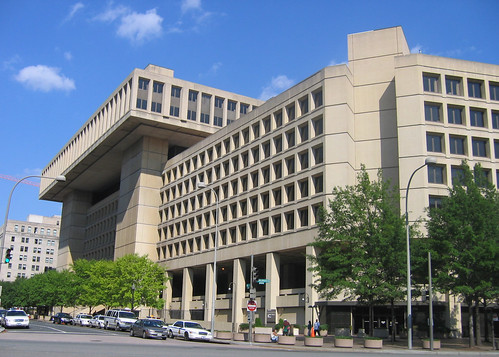
The federal government is canceling the search for a new FBI headquarters, according to officials familiar with the decision, putting a more than decade-long effort by the bureau to move out of the crumbling J. Edgar Hoover Building back at square one.
The decision follows years of failed attempts by federal officials to persuade Congress to fully back a plan for a campus in the Washington suburbs paid for by trading away the Hoover Building to a real estate developer and putting up nearly $2 billion in taxpayer funds to cover the remaining cost.
... Officials and executives involved in the process also said a lack of permanent leadership at both agencies [the FBI and the General Services Administration] could have hindered the case for funding.
Interestingly, given the alleged interest by President Trump in promoting infrastructure development, this is an example of the incredibly backwards way that the Federal Government handles capital budgeting.
First, unlike state and local governments, the federal government doesn't have a separate capital budgeting process separate from annual appropriations ("
The FBI Building as another example of 'I told you so'," and "
Town-city management: 'We are all asset managers now'").
This creates distortions in how projects are conceived and scored.
Second, (unfortunately) large projects require specific approval by Congress, and because so many Representatives and Senators believe that "the government is bad by definition" they start from a position of being unfavorable.
I expected this to be a big problem for DC's economy with the election of President Trump and Republican control of both houses of Congress ("
Implications of a Trump/McConnell/Ryan Administration on DC's commercial real estate market") and sadly I am being proved right.
Third, this is accentuated by the fact that long term projects are funded from a particular year's appropriations. Which gives rise to arguments that such investments "add to the deficit" rather than add to the economic productivity of the federal government.
Because of this, the GSA did something I thought made little sense, promoting the idea of a land trade "to get a new building for free," which did not work out because it wasn't economically feasible, and it confused the issue. Note that the Government Printing Office tried the same thing a few years ago, for nought, because again, the economics didn't make sense for the private sector ("
GAO-09-392R, Government Printing Office: Issues Faced in Obtaining a New Facility").
Infrastructure is an investment. Note that the "adding to the deficit" argument is usually fatuous because of the experience of the Civilian Conservation Corps ("
Civilian Conservation Corps honored,
USA Today), the Public Works Administration and the
Works Progress Administration.
From the VCU webpage "
The Social Welfare History Project":
Between July 1933 and March 1939, the PWA funded the construction of more than 34,000 projects, including airports, electricity-generating dams, and aircraft carriers; and seventy percent of the new schools and one third of the hospitals built during that time. It also electrified the Pennsylvania Railroad between New York and Washington, D.C. PWA workers built the state capitol building in Oregon, the highway linking the Florida Keys to the mainland United States, the Bay Bridge in San Francisco, the Federal Trade Commission Building in Washington, D.C., the city hall in Kansas City, Outer Drive Bridge in Chicago, the Ellis Island Ferry Building, Washington National Airport and the Grand Coulee Dam in the state of Washington.
Not only did these programs put people to work, these Depression-era "works programs" built significant infrastructure across the country--buildings, roads, bridges--which contributed to the post-war economic resurgence of the US, and many of these projects continue to serve the nation today.
(The right kind of) Infrastructure sets the stage for economic growth.
A chance for reconsideration does have some benefits. While this sets back redevelopment of the Pennsylvania Avenue corridor by at least a decade, and makes effective management of the FBI that much harder, one good thing could come out of restarting the process--except for the fact that the people running the Executive and Legislative Branches of the Federal Government are anti-government and the Federal Government doesn't have a separate capital budgeting process--new criteria could be set that make keeping the FBI in DC a greater possibility.
Resizing/reallocating space. In terms of space demands and optimal sizing of agency functions, the FBI could consider dividing certain headquarters/management functions and operations functions and keep the headquarters functions in DC, while relocating certain other functions elsewhere* either in the city or elsewhere in the region.
-- "
Intelligent Enterprise," James Brian Quinn
--
Resizing or Right-Sizing?, CCIM Institute
-- "
Law firms are 'rightsizing' their office spaces, JLL says,"
Boston Globe
--
Rightsizing the Multi-Divisional Firm: Individual Response to Change Across Divisions,"
M@n@gement Journal, Vol. 2, No. 3, 1999, 195-208
While there are many problems now with having federal agencies "in the city" because security requirements usually require that buildings be set apart from the city rather than being integrated within it, agglomeration economies make keeping the headquarters functions of agency in the city beneficial, being close to the Department of Justice, the Department of Homeland Security, ATF, Congress, and other agencies.
Possibly DC could consider trying to lease part of the St. Elizabeths East Campus to the Federal Government for the FBI. Or maybe, at least for the management/headquarters functions, there would be enough room on the St. Elizabeths West Campus, which remains under the control of the Federal Government.
======
* I am in the process of writing a piece comparing the issues of the DC and NYC rail transit systems, and the Southern Rail system in Greater London and Penn Station in NYC, because the issues are different, but too often conflated (e.g., "
Call it Metro schadenfreude: As New York's subway woes worsen Washingtonians offer sympathy,"
Washington Post).
The problem with the NYC transit system is popularity reaching the system's breaking point, while in DC it's about failure to maintain the system and the addition of a new line stretching the system beyond equilibrium.
Anyway, as part of the review of the problems with the London railroad system, the British Government commissioned a review by rail executive Chris Gibb. Reading
the report I was struck by what a difference in seriousness, rigor and thoroughness compared to the recent announcement of a million dollar prize "to fix" the NYC transit system by Gov. Cuomo ("
Subway upgrade contest from Cuomo to pay $3M to anyone who can fix signals,"
AM New York).
It's obvious what the problems are with the NYC Subway--they need new signal systems capable of supporting more trains, and continued investment in tracks and equipment. Instead, lack of budget means it will take decades with the current capital program before the signals are upgraded.
The Gibb report made some amazing recommendations ("
Gibb report into improving Southern performance published,"
Railway Gazette), recognizing that when creating the franchise by merging three different railroads, the "program" on offer was not seriously evaluated or "rationalized," and the reality is that the lines compete, even today, so that the timetable is not optimized for efficient operation.
Given that the system (Southern Railway, Thameslink, Gatwick Express) is the busiest in Britain, the various changes put on the franchise, including new equipment and moving to single engineer operation which is opposed by the Union and led to labor action, along with unnecessary duplication stresses the system.
Given the usage--not unlike the problems experienced in NYC both on the subway and at Penn Station--extra normal shocks to the system like derailments bring everything to a standstill, although in the case of Southern Rail, Gibb argued it was the labor union strikes and other actions that pushed the system to the edge ("
Southern rail strike causes worst disruption in 20 years,"
Guardian).
Five recommendations stuck out to me:
1. Rightsizing the schedule between the services, focusing on the Thameslink brand
2. Retroceding the Southern Metro train line, which functions more as transit for London, to Transport for London, to provide more resources
3. Electrifying the one diesel line, to make common operation possible, and releasing the diesel equipment to other areas, and eliminating the need for investment in diesel-specific storage and maintenance facilities**
4. Possibly selling the Gatwick station to the airport, because it matters more to the airport to invest in the station than it does to the rail system
5. Changing the way hiring and depots are organized, distributing staff around the system in ways that mean more time is spent moving active trains rather than on off-schedule equipment moves
This kind of detailed analysis seems to be out of the scope of similar processes in the US. Instead, there is political grandstanding.
** Similarly, when David Gunn ran Amtrak, he changed the Cardinal--the only train Amtrak created on its own--from ending in DC, to NYC. He did this because NYC had the maintenance equipment already in place for that kind of train and DC did not. Rather than pay for and install such equipment in DC, he routed the train to NYC. Interestingly, not only did it save money, it increased ridership of that train by 40%.
Labels: capital improvements planning, commercial real estate market, electoral politics and influence, government contracting, government oversight, public finance and spending, real estate development


.jpg)