Rebuilding Place in the Urban Space

"A community’s physical form, rather than its land uses, is its most intrinsic and enduring characteristic." [Katz, EPA] This blog focuses on place and placemaking and all that makes it work--historic preservation, urban design, transportation, asset-based community development, arts & cultural development, commercial district revitalization, tourism & destination development, and quality of life advocacy--along with doses of civic engagement and good governance watchdogging.

Wednesday, September 21, 2022

Weird intra-governmental spat in DC over the Washington Nationals stadium

Events DC is a DC government instrumentality.  

-- board of directors
-- staff

Technically it's independent of the city government, but its top officer and board members are appointed by the Mayor and City Council.  It holds the city's financial interest in facilities like Washington Nationals stadium, the Wizards practice facility, the RFK complex, the Convention Center, etc.

It's not particularly forward thinking when it comes to its facilities and urban planning ("The time to plan for retail in and around the Convention Center was long before it opened in 2003 and certainly before 2015," 2015, "Yes, modify and extend the RFK Campus lease; No, don't do it for the Washington Redskins football team," 2018), but then again, the city government's commitment to planning is constantly shrinking and diminishing too.

Flickr photo.

The Washington Post reports ("D.C. threatens to shut down Nationals Park, putting events at risk") that the Department of Consumer and Regulatory Affairs, which is responsible for building regulation, is threatening to not renew the certificate of occupancy for Washington Nationals stadium--which is owned by the city and rented by the Washington Nationals baseball team--because Events DC hasn't followed through on providing related retail and commercial space development that was part of the original agreement.  From the article:

The District is playing hardball in a dispute with the owner of Nationals Park, effectively threatening to shut down the stadium if Events DC fails to develop the commercial and retail space it promised before the ballpark’s 2008 opening.

Under its original agreement with the city, Events DC had pledged to build 46,000 square feet of commercial and retail space around Nationals Park, located along the Anacostia River in the Navy Yard neighborhood. But the company — arguing that the “extremely unique circumstances” of the pandemic and other business factors have made those initial plans unworkable — now is seeking to be released from that responsibility.

If no deal is reached, the dispute could threaten games, concerts and other events scheduled to be held at the ballpark.

This is very interesting because it's one department of the city arguing with another department, both within the executive branch.  I mean, it's not like the arguing that is typical between the Executive and Legislative branches, this is an intra-government tiff.

Clearly the Mayor isn't happy with Events DC--I don't know why because I am increasingly distant from day in, day out intra-city happenings--because this wouldn't be happening otherwise.

Obviously, Events DC isn't doing what the Mayor wants.  And an attempt to deny a C/O is a very public way of saying so.

It might not even be about the Nationals Stadium specifically, but that this is the best "point of entry" in the Mayor executing her best leverage.

And it could be about the director, who is new and interim.  I guess that Greg O'Dell, long time CEO, left for the private sector a couple years ago ("Greg O’Dell Named OVG360 President for Venue Management," SportsTravel).  He's now with Oak View Group, which was created by people who had worked for years at AEG--OVG is involved in facilities for the Seattle Kraken and the New York Islanders among others.

FWIW, EventsDC is probably right that the market doesn't support adding that space, and that it would be better for the private sector spaces to be activated.  Plus, they are crappy at managing non-sports functions in their spaces.

And the Mayor probably believes she made her point, since DCRA is issuing a temporary C/O) while negotiations continue ("D.C. backs off threat to close Nationals Park," Post).

====

Certificate of occupancy and sports facilities.  I didn't realize that DC didn't issue permanent C/O for sports stadiums and arenas.  NYC issues sports facilities (or at least Madison Square Garden) C/Os with a ten year term, which allows for revision of agreements and gives the city leverage.  But those facilities are all privately owned.

I like the idea of ten year terms to be able to "force" transportation demand management agreements on teams ("Framework of characteristics that support successful community development in association with the development of professional sports facilities").  But that only works if the facility is owned by the team.  In DC, only the Capital One Arena is privately owned.  

When the government owns the facility, TDM agreements need to be part of the lease with the tenant--the sports team.

Labels: , , , , , , ,

Friday, March 18, 2022

DC Schools capital planning: a legacy of waste

The Washington Post reports ("Bowser proposes money for stand-alone middle school for Shaw students") that DC plans to build two new schools, a high school in Ward 3 and a middle school in Ward 1.

When I talk with people from other cities about how DC continues to build new schools when a majority are underenrolled, they're shocked because by contrast those cities find it difficult to raise the money they need for necessary capital improvements.

There's tons of planning all the time for the city's schools, so much I can't even claim to be clear about the process: local school transformation teams; charter schools; charter schools being able to be approved without taking into account enrollment demand and demographics ("Applying CEQA urban decay concept to DC charter school approval process," 2014), public schools capital planning, Allen Lew ("Allen Lew got it done," Washington City Paper), etc.

The 21st Century School Fund is a nonprofit that has done some work on master planning for DC Public Schools.

But there isn't a good master plan, a single document, covering schools.  Allen Lew's claim to fame was focusing on sub-systems within schools, not master planning for the entire school district and its facilities, e.g., HVAC, roofs, etc. ("D.C. schools chancellor recommends overhaul of capital planning process," Post).  From the article:

D.C. Schools chancellor Kaya Henderson is calling for an overhaul of the process for mapping out school modernizations in the coming years, saying that the renovations have become overly political and prohibitively expensive. 

 “My very honest assessment is that the whole CIP process is jacked up,” she said, referring to the Capital Improvement Plan, a six-year capital budget and construction plan that outlines the timing for school modernizations... 

She proposed developing a task force within the next year that would come up with a way to develop the capital plan according to some “very transparent” and “logical” criteria rather than “how loudly your community screams.” 

She said the criteria should include the building’s condition and school enrollment, with more crowded schools getting higher priority. She suggested that the number of “at-risk” students could also be a factor. 

Adding to the pressure is the cost of construction, which Henderson said has grown 30 percent, limiting the number of projects the school district can take on in a given year. “We have got to get some discipline around what kind of schools we are building,” she said.

Things haven't improved in the seven years since that article was published.

I've written a bunch about how DC doesn't have a public process for capital planning.  There is an office as part of the mayor's office, and in the Chief Financial Officer's agency, but there isn't a public process of setting priorities that is exclusive to capital projects.  Instead it's subsumed in the annual budget process.

-- "Another example of the need for more formal and open capital budgeting planning practices (in DC)," 2019
-- "Capital/civic asset planning, budgeting and management processes," 2015

This is left over from when DC was a department of the federal government, which handles capital planning the same way.  (It turns out that in the 1930s, the Executive Branch tried to create a capital planning process, but Congress disagreed.)

By contrast, most cities and counties have a capital budgeting process separate from the annual budget process, and usually it is updated every year or every two years, on a six year cycle.

I have criticized DC's schools capital planning process, because except for Wilson High School, virtually all the high schools are underenrolled.  But the city keeps tearing down schools and building new ones--and winning "sustainability awards" in the process.

-- "DC wastes $122 million on new high school: evidence of failures in capital improvements planning and budgeting," 2013
-- "DC high school that wasn't needed and rebuilt at a cost of $122 million wins sustainability award," 2015

This comes up again, as the Post reports that the city will build a new high school in Ward 3, and a new junior high school in Ward 1.

WRT the high school capacity demand in W3, years ago I suggested that: 

(1) Ellington School for the Arts, in the old Western High School, and not accessible by Metrorail even though it is a city-wide school, should instead be moved to either Coolidge or Roosevelt High Schools in Ward 4 as both are underenrolled and both are Metrorail accessible.

(2) Allowing Western High School to be able to be repurposed as a local high school

(3) Creating a single W4 high school with adequate enrollment capable of supporting a full range of classes.

By not doing that W4 still has two underenrolled high schools and W3 "needs" another high school.

Although part of the demand for Wilson can be shifted some to other city high schools, like Cardozo in Columbia Heights, which is also underenrolled.

2.  Separately, DC built a new Banneker High School on the grounds of the old Shaw Junior High.  If instead they would have rehabilitated Banneker High School in its Columbia Heights location, Shaw Junior High School could be reopened.  But the new plan calls for a new middle school on the site of the old Banneker High School.

-- "Banneker vs. "Shaw middle school" matter as another illustration of failures from the lack of public capital planning processes in DC," 2019  

Instead the city has or will build three new schools: (1) Banneker; (2) a new high school for Ward 3; (3) a new junior high for Ward 1.

The big problem: not planning and resident demand for new schools, which is more an emotional process.  As former Chancellor Henderson implied, if there were a public capital budgeting process, based on logical, transparent criteria, it would be possible, maybe, to rationalize school planning.

But DC, comparatively, is wealthy so it can waste money left and right.

But given the reality that there isn't a growing student population in the city, building so many new schools (Woodson, Dunbar, Banneker, etc.) is incredibly wasteful.

===

Separately, I've written about how sometimes, underenrolled schools should be kept open as a part of planning for healthy neighborhoods.

-- "Reprint: Rethinking community planning around maintaining neighborhood civic assets and anchors," 2020/2011
-- "The bilingual Key Elementary School in Arlington County as another example of the "upsidedownness" of community planning," 2019

===

When I first got involved in urban revitalization around 2000, early in that process, there was a schools planning initiative for Spingarn High School and related schools on that campus, which included a technical school and an elementary school in Ward 7, which was adjacent to the H Street NE neighborhood, where I lived when I first got involved.

The school system contracted with Roy Strickland and his program at the University of Michigan Architecture School, to come up with a transformational plan.  Which he did.  And was abandoned a couple years later.

-- "The City Of Learning‚: School Design and Planning as Urban Revitalization in New Jersey, Berkeley, and Washington, D.C.," Urban and Regional Research Collaborative Working Paper, University of Michigan, 2003

There is no overarching approach to schools master planning.  And the charter schools are approved independently.

It's really "flawed up."

=====

There was a similar groundswell to build a new middle school in W4.  One junior high, Paul, was one of the first schools in the city to be turned into an independent charter school.  Another, Rabaut, had been shut down decades before, but in the intervening years had been sold off to charter schools.

So W4 was left without a middle school, and this hurt the pipeline for the public high schools, Roosevelt and Coolidge, because after elementary school, there was no DCPS middle school to go to.  By the time enrolling in high school came along, the students were mostly fully ensconced in the charter schools.

Anyway, their proposal was to use up most of the land of the Takoma Recreation Center, my neighborhood park.  I said, why build a new middle school when the ward is full of underenrolled schools as well as parking lots (like at Fort Totten Metrorail Station) that could be repurposed.

Fortunately, they shifted their proposal, to instead use some of the underutilized Coolidge High School.

Labels: , , , , , ,

Friday, June 21, 2019

Wow: Revisiting DC's Corruption Caucus

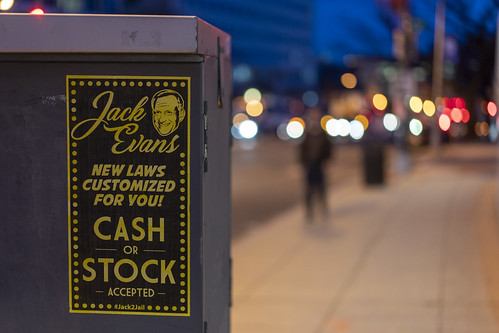
Jack 2 Jail (Connecticut Ave)The Washington Post has been covering the ongoing investigation into ethics violations by DC Councilmember Jack Evans.

The most recent articles report on WMATA's, the area transit agency, investigation of ethics complaints against DC Councilmember Jack Evans, currently the Chairman of the Board.

-- "Jack Evans to resign from Metro board after probe shows he 'kniwingly' violated rules"

It's damning--not so much because of the WMATA ethics committee, which didn't produce a report of its own or write anything down, but because of the investigation that WMATA commissioned.

Evans' actions didn't involve tons of money--maybe $100,000/year in consulting fees--but definitely are replete with multiple glaring conflicts of interests, since the fees were paid by firms that wanted to do business with the transit agency.

Interestingly, Jim Graham, the now deceased and previous DC Councilmember chair of the WMATA board had similar conflicts and had to step down from the board in 2012.

-- "Bringing Jim Graham to account," Washington Post
-- "More legal woes for Metro and Jim Graham," Washington Post
-- Full text of "WMATA board report on Jim Graham", Internet Archive

The difference is that Graham didn't personally benefit, although he tried to steer contracts to benefit campaign donors, but wasn't receiving income for doing so, while Evans received consulting fees directly from clients for whom he tried to help in getting WMATA contracts, without disclosing this.

The ethics charges are what ultimately led to Graham going down to defeat in the 2014 primary election.

These days Evans is facing at least four announced challengers and a recall campaign, although the election isn't until next year. Plus, the FBI has an ongoing investigation.

I figure he probably will decide not to run.  And that more prominent people than the current candidates will enter the race--you know the thing about sharks smelling blood in the water.

(That didn't happen with Graham because the bombshells didn't come out til very close to the primary election, and by that time most people had passed on the opportunity to enter the race, except for Brianne Nadeau.)

Corruption is about systems, not so much about individuals.  This problem derives from how the DC Councilmember job is considered part-time. It creates a structure supportive of conflict of interest.

Evans is hardly the first to work hard at earning outside income from firms that have business with DC Government or other agencies.

In the wake of the issues around Evans, Council is considering legislation to ban most forms of outside income, except for teaching ("Jack Evans scandal revives push to ban outside jobs for DC Council members," Post).

Years ago, blogreader EE shared with us a book published by the World Bank, Corrupt Cities: A Practical Guide to Cure and Prevention and I wrote about it in this 2011 piece, "DC ethics legislation misses the point: focus on what produces corruption as a regular outcome, not monitoring."

While the book focuses on "developing nations," the reality is that corruption in government works the same way where ever it occurs.  As the authors write:
Corruption equals monopoly plus discretion of public officials minus accountability.
My piece listed 9 particular issues (although there are more) with the way things work in DC.  Even though legislation was passed to reduce conflicts, most of the areas I identified as rife with the potential for conflict weren't addressed.

IACA is the International Association of Crime Analysts, and they provide technical assistance and training world-wide.  This particular issue of their alumni magazine focuses on local government and features an interview with one of the authors of the book Corrupt Cities and his work in La Paz, Bolivia.  One quote: "The problem is not corrupt individuals.  It's corrupt systems.

Other ways to restructure certain aspects of DC Council and other areas to increase accountability and "competition." Over the years I've made a bunch of suggestions besides making the job full-time, which if enacted would increase accountability, representation, and make council districts a little less like satrapies.

1.    [This happened] Create an independently elected Attorney General and build the capacity of this office to take control of local prosecution of crime (this responsibility is currently handled by the Federal Government);

2.   Create a public planning and budgeting process for capital improvements, sale of civic assets, and alley closings;

3.   Create a public and transparent process for tax abatement and eminent domain requests (see "Make eminent domain fair for all" from the Boston Globe; the recommendations pertain to both issues);

4.    Increase the number of wards;

5.    Increase the number of councilmembers (thereby making it harder to pass legislation), but also having two representatives for each ward, each elected in a different election cycle;

6.    Move the legislature to part-time service and reduced pay or to full-time service with a slight bump up in pay;

7.   Strengthen the capacity of councilmember staffing;

8.    Increase the research capacity of local government in developing policy and practice;

9.    Institute term limits for elected officials (Council as this already applies to the Mayor);

10.  Change the date of the primary election to extend the electioneering period;

11.  Institute ranked choice voting for local elected officials;

12. Institute additional campaign finance limits for local elections;

13. Create an elected public advocate/ombudsperson/Inspector General (and a civil jury process to investigate government agencies);

14. Reconstitute a school board with oversight over pre-K to 12 public education, traditional and charter schools;

15. Use participatory budgeting methods for appropriating constituent services funds requests and grants to nonprofit organizations ("More on ethics: discretionary funding-constituent funds");

16. Build civic capacity and infrastructure ("Neighborhood planning meta-website);

17. Strengthen the capacity of Advisory Neighborhood Commissions to be better and fairer representatives (""Networked solutions" for some problems with ANCs in DC" and "A neat solution to (some of the) petty corruption in DC government-related civic organizations");

18. Change the planning process to include the production of formal sector and neighborhood comprehensive land use plans ("Planning process failures generally and the upcoming DC Central Library planning process," "Rethinking community planning around maintaining neighborhood civic assets and anchors," and "A key problem in "community" planning: not simultaneously defining community-wide and neighborhood goals and objectives").

19. Various tweaks as needed to planning and zoning processes such as a Big Box Review Ordinance ("Lessons from Walmart's foray into Washington, DC"), community benefits negotiations ("Community benefits agreements revised again" and "What community benefits are supposed to be versus what people think they are about"), and urban design requirements ("New years post #6 -- the crazy thing about U.S. zoning is that it's not designed to maximize overall land value" and "Changing  matter of right zoning regulations for houses to conform to heights  typical within neighborhoods, not the allowable maximum").

Looking at the list, I could come up with some more items, such as creating a "Transportation Commission," using participatory budgeting processes to involve citizens in grant making review, etc.

Wards.  I think that wards should be smaller, meaning a few more councilmembers, and that there should be two representatives per ward, to create intra-ward "competition" and more opportunity for different perspectives.

When I toyed with running for City Council a few years ago, I came up with "Outline for a proposed Ward-focused (DC) Councilmember campaign platform and agenda," which has more focused suggestions for how to represent a Council Ward, including the creation of a center in each ward where a "constituent services office" could be, but also space for community and nonprofit organizations:
Create a “Democracy House," a center for involvement in public and civic life in the ward. If the city provided ward council offices, such a facility could also offer space for community organizations, meeting space, etc., but space would be managed using participatory techniques independently of the Councilmember/Ward office
comparable to the "precinct and ward halls" and social halls that used to exist in the early 1900s in many US cities, but with a decided focus on civic engagement and participatory democracy.

Building civil society and local participation.  #16 concerns building more ways for citizens to participate locally, and opportunities for "do it yourself."

For example, my big complaint about "constituent services" operations in the Mayor and Council offices is that these functions aren't focused on building the capacity of citizens and organizations to represent and act for themselves, but more on creating dependent relationships that promote incumbency.

The participatory budgeting process, where groups of citizens act within ad hoc committees to make decisions about priorities and funding is a way to add more participation to grant making processes.

Other "neighborhood" and association focused programs in cities like Seattle, Calgary, and Minneapolis build the capacity of citizens to take action themselves ("Framingham Massachusetts creates Citizen Participation Officer position").

One element of the offerings of the Seattle Department of Neighborhoods is the People's Academy for Community Engagement, which provides a specific training for two to three cohorts each year.

By contrast, organizations like the Federation of Calgary Communities or the Massachusetts Citizen Planner Training Collaborative have conferences and various trainings throughout the year open to all.

Another great example, although I think it's changed somewhat because the Main Street organization is now separated from the National Trust for Historic Preservation, is the training system that was offered in association with the Main Street commercial district revitalization initiative.  Programs are organized around four thrusts: physical design; business development and maintenance; promoting businesses and the destination; and internal organization and fundraising; and the "Four Point" trainings provided in-depth training on each point.

I did the training four times, some at national trainings, others locally, and I found it valuable each time, because of the different trainers providing different approaches, because I had learned more in the interim and had more experiences to bear, etc.

State Main Street support organizations typically provide this kind of training opportunity.  DC doesn't...  And the Main Street Approach is applicable to other types of organizations and issues.

Planning office trainings for citizens.  While I am not familiar with an agency that does this in the way I suggest below, another model is to have regular training exercises around community planning.

One example is the old "How to Turn A Place Around" workshop by Project for Public Spaces.  (I did this course twice.  An abbreviated version in DC, and once in NYC.)

-- Transforming Cities through Creative Placemaking, PPS presentation

 I think that city planning departments should offer this kind of program annually, moving it around the city, as a way to provide assistance to specific neighborhoods, while serving as a training program for citizens from across the city, in turn they can bring back improved skills to their involvements.

Similar opportunities exist in transportation planning, using workbooks like School Walk and Bike Routes: A Guide for Planning and Improving Walk and Bike to School Options for Students, Main Street: When a Highway Runs Through it, or the Smart Transportation Guidebook as the basis, or materials like the Pedestrian Road Safety Audit guide produced for the Federal Highway Administration.

(When I did the bike and ped plan in Baltimore County, I did do one safe routes to school workshop--on my own time, because my boss didn't approve, and I wanted to do one on trails planning too, but wasn't able to because it wasn't approved.  … and I wanted to have a community meeting on the weekend too, not just during the week at night, to expand the opportunity of people to participate.  Again, that didn't happen...)

Labels: , , , , , ,

Thursday, February 21, 2019

Sometimes it can be tough to choose your partners as a public organization

I have some pieces discussing, especially in the context of the Trump Organization, that governments and agencies need to be very careful in selecting "partners" for various projects, such as the conversion of the Old Post Office in DC to a hotel or the management of a public golf course, etc., in case the "winner" of the bid has a history of seeking tax abatements, challenging tax assessments, failing to pay contractors, paying taxes late, etc.

-- "Government contracting and being "careful" about your associations," 2017
-- "Been to Largo lately? Sports teams often aren't very good partners...," 2018

Today, this promotion from Choose Chicago, the city's convention and visitors bureau (CVB), landed in my e-box. The Trump Hotel is in a great location, but it's the last place I'd want to stay in Chicago.

Choose Chicago tourism promotion featuring Trump Hotel Chicago

But this is a problem for public groups like a CVB because they have to be open to membership by any organization involved in the field of hospitality, even though a promotion like this one is likely to be damaging to the Choose Chicago brand.

Labels: , , , , ,

Wednesday, January 30, 2019

If you want legitimate small and minority businesses operating in the government side of the construction trade you have to build the infrastructure for it

Photo by Darrow Montgomery, WCP, showing a small house-based office building used by multiple contractors.

The cover story in last week's Washington City Paper, "Construction Companies Open East-of-the-River Offices to Win Lucrative Contracts," is a nice piece about how despite claims by Events DC about how. in building the new professional basketball practice facility in Ward 8, large amount of work directed to contractors and workers based in the city's most economically impoverished areas, the reality is more nuanced.

It turns out that the companies are usually based elsewhere with only minimal ancillary operations in Wards 7 or 8, often having little more than a desk or two in small buildings shared by one half dozen or more businesses. And only small numbers of employees end up coming from the immediate area of the project.

From the article:
A City Paper review of DSLBD’s quarterly Entertainment and Sports Arena reports identified millions of dollars’ worth of contracts that went to businesses that are local by the District’s standards, but are actually headquartered outside of wards 7 and 8. Some of their D.C. locations are sparse, if they exist at all.

One company, JJ Prime Services, received a $1.7 million contract for work on the Ward 8 arena. The business does not appear to have a website—just a Facebook page, which does not describe what kind of work the company specializes in. But a quarterly report from DSLBD shows that JJ Prime Services was hired for “excavation” at the Entertainment and Sports Arena.

Public records from D.C.’s Department of Consumer and Regulatory Affairs show that the company is a Maryland-based LLC, with headquarters in Silver Spring and a separate office in Prince George’s County. But D.C.’s DSLBD records show that it’s also registered as a Ward 7 local business. City Paper visited the company’s Ward 7 address, an office park off of Bladensburg Road NE, just shy of the Maryland border.
The article features an extended interview with Adam Sacks of Saxon Collaborative, and he outlines the various difficulties in the way of truly small businesses making a go of it from construction contracts on government-funded projects and problems with basing offices East of the River:
Sacks says that, in his experience, it’s difficult to find CBEs based in Ward 8 that are financially stable enough to navigate the obstacles involved in working on larger D.C.-funded projects, which are often slow in reimbursing general contractors for work and stacked with burdensome hiring requirements. (“We know that’s been an issue,” McDuffie says of delayed payments.)
Sacks cites infrastructure work Saxon has completed on the St. Elizabeths East campus, and the beleaguered Parkway Overlook project (“truly a disaster,” Sacks says) as examples of poorly run D.C. projects in terms of timely repayment and subcontractor hiring.
Creating different business forms to support business development. In culture planning, I have discussed a report, Cultural Infrastructure: An Integral Component of Canadian Communities, by the Creative City Network of Canada, outlining the necessary infrastructure for artistic endeavor.  It outlines six elements including multi-use hubs, incubators, and creative production habitats.

Similarly, public market type buildings and retail cooperatives are ways to support the development of small retail operations or ways to provide the equivalent of grocery stores but through bringing small businesses together.

Similarly, in start up business development, there are all kinds of various business incubator operations.  Although a big problem with "incubators: is that they focus on providing assistance for a relatively short period of time, and often most businesses need more time and support in order to become successful and as importantly, stable, especially those working in the government sector, where margins can be very small.

-- "Business incubators models of the USA and UK: A SWOT analysis," World Journal of Entrepreneurship, Management and Sustainable Development

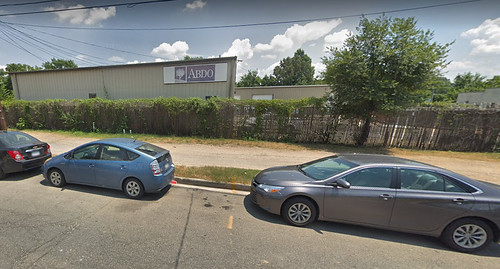
Abdo Development incubator building, 8th Street NEBut traditionally there aren't such initiatives in construction. More than ten years ago, the Abdo Company of DC didn't create an incubator exactly, but in a city where it is hard to find industrial space, they purchased a site for staging and storage, and made it available to their contractors. 

This provided the contractors an in-city place to locate their businesses that was stable and at a lower cost than finding or buying space elsewhere in the city or the region.

Construction business incubator in Greater Indianapolis.  While incubators primarily focus on development of new technologies, and some exist in the construction industry too, in Fishers, Indiana, there is a construction business incubator under development called the Hub & Spoke Design Center ("Indiana's skilled-trades workers are in short supply. A Fishers jobs incubator could help," Indianapolis Star).

It has multiple goals: (1) to provide lower cost space for businesses in the construction and design fields; (2) to provide access to peers for business development, technical assistance, and innovation; and (3) to provide training for potential employees to address labor shortages in the trades. From the article:
The center will be anchored by about 10 home-building-related businesses, with four scheduled to move in first: OnPoint; About A/Co, a Carmel-based flooring and cabinet dealer; Franklin Window and Door, of Carmel; and Battersby Danielson Azbell and Associates, of Westfield.

Decker said the center will offer a potpourri of goods and services.

“There will collaborative desks and offices, event space, showroom space where people can see the latest best projects and a dedicated “maker” space with tools where visitors can build things,” Decker said.

The tenants will work with higher education institutions and Hamilton Southeastern High School to develop a teaching curriculum that is likely to include students working on projects or gaining internships at a company at Hub & Spoke or elsewhere.
Government contractors also need help with finance.  Given the delays that are often experienced with payment, and the reality that payment isn't made in advance, so businesses need money to front operations and performance, there also needs to be access to financing and related technical assistance too, perhaps with the aid of what are called CFDIs, Community Development Financial Institutions.

But different from construction project finance, which many CFDIs already do, construction vendor finance and support, which I don't think any CDFI is doing.

Performance bonds.  Although there are some programs that assist with bond financing--performance bonds are one of the requirements for government contractors.

Microenterprise development.  Another way of looking at this is termed "microenterprise development" as part of the five step model outlined in the Community Economic Development Handbook by Mihalio Temali.  (Another of the steps is "workforce development.")

If you want local employees and local employers, provide contracts isn't enough, partly because the system is gamed, but also because the capital and organizational requirements are considerable and onerous, even if you're getting special considerations as a certified (minority) small business enterprise.

Labels: , , , , , ,

Friday, September 21, 2018

It's not like transit "outsourcing" I mean "public-private partnerships" are necessarily smooth sailing

WMATA has released an RFP for the operation of the second phase of the Silver Line ("Metro will outsource operation of Silver Line's second phase," Washington Business Journal). 

The Union announced they are opposed, seeing outsourcing as leading to safety and other issues,  although most comments on that score make the point that it's not like WMATA is running great now, with virtually all non-construction operations provided in-house.

While I do agree that WMATA needs to consider outsourcing as a way to reduce costs, and that needs to be seen in part as a shot at the major unions for their unwillingness to be more collaborative in considering system improvements and cost reductions, it shouldn't be seen as a smooth path.

Photo: Aaron Ontiveroz, The Denver Post A-Line flagger Chris Dugent holds a stop sign as the train passes at Steele Street on Tuesday, June 19, 2018.

Denver Transit Partners, the major example of finance-design-build-operate-maintain transit operation--this consortium got the contract for the Maryland Purple Line light rail too--is suing the transit agency in Denver in a dispute over charges against payments concerning certain aspects of operation of the A Line train ("Regional Transportation District sued by Denver Transit Partners," Denver Post). From the article:
Denver Transit Partners, through the lawsuit, is trying to force RTD “to reimburse them tens of millions of dollars for the crossing gate attendants that DTP has been paying for all along,” according to a RTD news release.

The transit consortium is citing a change in law, or a change in the interpretation of law, by federal and state rail safety agencies as being the reason for its failure to get final approval of grade crossings and quiet zones on RTD’s commuter rail system, according to RTD’s news release. Denver Transit Partners is attempting to recoup lost revenue, because of continual grade crossing failures, by suing the district, the release said.
That might be. I don't know the ins and outs of the safety regulations.

And in this case, maybe the change requires a mutual response from both DTP and the transit agency.

 And at least with there being flaggers in Denver, people aren't dying, as is the case in South Florida with the introduction of the Brightline railroad service ("Brightline train crashes into car in Hallandale Beach," WPLG-TV).

But usually it's on the other side, and the transit agency is left holding the bag.

When I was talking with an ex-Transport for London official when I was there in June, we discussed these kinds of issues, how such projects become 100% contractual, they aren't "partnerships." There, because of various national laws, transit services have to be operated by the private sector, with the exception of the London Underground, and services where the private sector will not bid, therefore requiring that the transit agency be the "Operator of Last Resort."

He commented on how the Crossrail concession wouldn't allow a change in technology which was developed after the contract was signed.

Using it will be cheaper and more reliable, but because it's not in the contract, they refused to change the specifications.  So the change will be installed after the trains are delivered, costing more money, and adding to the delays of opening the system--which has moved back by one year ("Crossrail delay: New London line will open in autumn 2019," BBC News).

I've written too about how the Purple Line is now a "contract" and there isn't much room for change or flexibility as a result ("A Purple Line update: the downside of Public Private Partnerships" -- they are contracts, not partnerships").

Even without complex financing-design-build-manage-operate-maintain contracts, lawsuits between government agencies and construction firms are pretty common.

Labels: , , , ,

Friday, April 06, 2018

An update on community participatory budgeting: New York City

Many localities set aside a "small" amount of money for each council district for local projects. 

Typically, the monies are allocated by the councilmember.  Participatory budgeting is a different method, where citizens get together and through an organized process, set the priorities and pick the projects to fund.

-- Participatory Budgeting Project

I think this is a great method, because it adds a great deal of openness and transparency to the process, when typically such grants come as a result of connections, as a way to help foster incumbency, and in murkiness.

New York City is one place where Councilmembers have the option of having funds allocated through participatory budgeting methods, and this year 27 of city's 51 districts are participating ("City Council program lets you choose what public projects to fund in your neighborhood," AMNew York) for a total allocation of about $30 million.

Some Chicago Alderman also use participatory budgeting, and some cities, like San Jose, are experimenting with the process both city-wide and at the district level.

====
DC doesn't have set funding for local projects, although most Councilmembers have a small "constituency services" fund.  I've argued those funds could be allocated through participatory budgeting, but that suggestion has made no headway here:

-- "More on ethics: discretionary funding-constituent funds," 2011
-- "Missing the point on constituent service/discretionary funds available from legislators," 2011
-- "The bane and benefit of constituent services funds: a response to the Washington Post editorial," 2015

I've also argued that the city Attorney General should use participatory budgeting, really it should be called "participatory allocation" as a way to distribute money from settlements to "worthy projects" ("Participatory "budgeting" and disposition of funds from legal settlements," 2015 ), rather than solely to groups with special connections to the AG.

Labels: , , , , ,

Wednesday, August 02, 2017

A Purple Line update: the downside of "Public Private Partnerships" -- they are contracts, not partnerships (+ a Penn Line infill station)

In "Purple Line moves forward," I wrote a couple weeks ago about how the Purple Line light rail program in Montgomery and Prince George's Counties in Maryland getting the go ahead, although as e-correspondent and graphic designer Paul J. Meissner says, he'll wait until the the US Secretary of Transportation actually signs the funding agreement.

In a number of posts over the years I've written about how Prince George's County and the metropolitan and region can benefit extra-normally from the addition of this line to our transit network, even if it is light rail rather than heavy rail.

The basic argument is that the Purple Line is as close as we're going to get to a Crossrail-type project.  Even though it's nothing like the scale of projects in London and Paris, it does have the ability to strengthen significantly the fixed rail transit network in Metropolitan Washington. 

(The Crossrail project creates new east-west railroad lines in London and its suburbs, adding 10 new stations and providing connections to 30 existing stations.  The project includes 11 miles of twin tunnels in London proper out of 73 miles of new trackline.)

-- "Maybe the Purple Line light rail project in Suburban Maryland is a lot bigger deal than is recognized (It's our Crossrail)," 2016

Later, in a series of posts totaling many tens of thousands of words, I laid out a program to seize the Purple Line as an opportunity to drive other complementary changes across the transit network which would both make the Purple Line more successful from the outset and improve significantly the transit network at the metropolitan and regional scales.

-- "Setting the stage for the Purple Line light rail line to be an overwhelming success: Part 2 | proposed parallel improvements across the transit network," 2017

This piece lists 19 items to improve the existing transit network, leveraging the development of the Purple Line as a way to do so:
  • Change the WMATA Metrorail map so that it includes the Purple Line and regional railroad services
  • Integrate the Purple Line light rail line into the Metrorail fare system
  • Integrate MARC fares into the SmarTrip/ CharmCard fare media system
  • Introduce bi-directional passenger rail service between DC and Frederick on the MARC Brunswick Line
  • Consider charging DC-Montgomery County trips on a bi-directional Brunswick Line using the Metrorail/Purple Line tolling/fare schedule. That would treat mileage from railroad trips in the context of a complete (linked) trip on railroad+subway+light rail as a single fare
  • The White Flint Sector Plan calls for an infill MARC station. Plans to build that station should be accelerated as part of this proposal
  • Provide integrated train arrival information screens at Metrorail, Light Rail, and MARC stations
  • Provide integrated bus arrival and departure information screens at Metrorail, Light Rail, and MARC stations
  • Bus service in certain corridors between DC and Maryland should be extended and/or frequency increased to better link these areas to the new light rail service
  • Montgomery County bus system improvements with the launch of the Purple Line and bi-directional service on the MARC Brunswick Line should include launch of planned Bus Rapid Transit services
  • Rearticulate, rebrand, and reposition-extend the Prince George's County TheBus bus transit service. Change the name of the service and the graphic design of the bus livery
  • Consider a redesign and rebranding of the metropolitan area's bus systems into an integrated framework, comparable to that of GoTransit in the Raleigh-Durham area
  • Set the opening of the Purple Line as the deadline for the integration of the MARC Penn Line and VRE Fredericksburg Line into one combined railroad passenger service
  • Set the opening of the Purple Line as the deadline for the implementation of a full-fledged integrated Night Owl bus network for the DC metropolitan area
  • Create a cheap weekend pass to use the local transit network, especially Metrorail
  • Incorporate quantum improvements in bicycle facilities across the mobility network in association with the launch of the Purple Line
  • Rearticulate transportation demand management programming and services in conjunction with the PL launch, including a single network of "customer information centers"
  • WMATA should upgrade its Metrorail station bus shelters
  • Create "sustainable mobility" corridors in Silver Spring (and other places), complementing the new PL.

Update 1:  Adding a New York Avenue infill MARC station to what I called the "Washington Area Transit Network Purple Line Complementary Improvements Program."

The comment thread on yesterday's piece looking at industrial land uses, including railroads, in DC's Ward 5, mentioned the concept of an infill MARC railroad station to serve the New York Avenue corridor. 

That should have been included as an additional recommendation in the Purple Line complementary improvements piece, just as accelerating the creation of the White Flint MARC station was recommended as point #6.

I will go back and add this in.  I did discuss it in the 2015 piece on applying London Overground principles to MARC and WMATA.

It would have to be on the Penn Line, because the line has 7 day service, and has hourly service roughly throughout the day til about 10 pm.

This would be done with the expectation that the MARC and WMATA fare media systems would be integrated (recommendation #3) and it would be possible to charge the equivalent of Metrorail fares for people getting on at this station and traveling "short" distances (recommendation #5).

Otherwise, the minimum fare on MARC is $5, and that is onerous for a short trip to Union Station.  The special fare zone should include eastbound trips to New Carrollton also.

But if this is done in association with a merger of the Penn Line and the VRE Fredericksburg Line (recommendation #13), it would be even more useful. Also see ("A new backbone for the regional transit system: merging the MARC Penn and VRE Fredericksburg Lines").

Update 2:  But the chance of this kind of program being realized is that of a snowball in hell. 

Last week, I was talking to someone who is particularly well placed, who made very clear that the concessionaire tasked with building and operating the Purple Line is committed only to executing and implementing what's specified in the contract, nothing more, nothing less.

Granted, these proposed transit network improvements for the most part have little to do with the Purple Line.

But the point illustrates the fact that "Public Private Partnerships" aren't "partnerships."  They are "service contracts"/"long term leases to build/operate infrastructure."

The advantage of such contracts in transit is that unlike when money is allocated by elected officials who can always find something else to spend money on instead of paying for maintenance, the private operator will meet the terms of the contract in terms of maintenance, schedule, on-time service, etc.  So at the very least, the line is likely to be better maintained than if it were under the direct operation of the typical transit agency.

But the Lessee won't spend money on anything else, or look to change the terms of the contract to make the transit and mobility system "better" overall, because they are not responsible for making the transit network better, they are only responsible for building and operating the Purple Line light rail., a sub-component of the transit network.

While this isn't privatization exactly, it's more a long term lease than a partnership, just as the parking structure and parking meter contract in Chicago has no elements within it that create a partnership between the City of Chicago and the owner of the lease ("A lesson to cities that they need to be very careful when leasing assets to public private "partnerships""). 

It's a straight up deal, structured to favor the lessee.

FWIW, this is a problem with government contracting in general.  The companies on the other side of the contract tend to have a lot more experience negotiating these types of contracts and they extract every advantage possible.

While there are municipal groups like the National League of Cities, the National Association of Counties, the International City County Management Association, and the Public Technology Institute, which can provide technical assistance, it doesn't seem as if local governments work as a national network to improve their capacity collectively to improve their negotiating positions (advertising and bus shelter contracts are another example).

Labels: , , , , , , ,

Tuesday, July 11, 2017

Washington Post reports that plans to redevelop the FBI headquarters are being scuttled

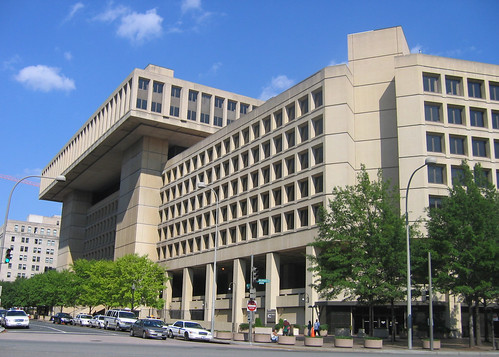
FBI Building, Wikipedia photoSee "Federal government cancels costly, decade-long search for a new FBI headquarters."

According to the article:
The federal government is canceling the search for a new FBI headquarters, according to officials familiar with the decision, putting a more than decade-long effort by the bureau to move out of the crumbling J. Edgar Hoover Building back at square one.

The decision follows years of failed attempts by federal officials to persuade Congress to fully back a plan for a campus in the Washington suburbs paid for by trading away the Hoover Building to a real estate developer and putting up nearly $2 billion in taxpayer funds to cover the remaining cost.

... Officials and executives involved in the process also said a lack of permanent leadership at both agencies [the FBI and the General Services Administration] could have hindered the case for funding.
Interestingly, given the alleged interest by President Trump in promoting infrastructure development, this is an example of the incredibly backwards way that the Federal Government handles capital budgeting.

First, unlike state and local governments, the federal government doesn't have a separate capital budgeting process separate from annual appropriations ("The FBI Building as another example of 'I told you so'," and "Town-city management: 'We are all asset managers now'").

This creates distortions in how projects are conceived and scored.

Second, (unfortunately) large projects require specific approval by Congress, and because so many Representatives and Senators believe that "the government is bad by definition" they start from a position of being unfavorable.

I expected this to be a big problem for DC's economy with the election of President Trump and Republican control of both houses of Congress ("Implications of a Trump/McConnell/Ryan Administration on DC's commercial real estate market") and sadly I am being proved right.

Third, this is accentuated by the fact that long term projects are funded from a particular year's appropriations. Which gives rise to arguments that such investments "add to the deficit" rather than add to the economic productivity of the federal government.

Because of this, the GSA did something I thought made little sense, promoting the idea of a land trade "to get a new building for free," which did not work out because it wasn't economically feasible, and it confused the issue.  Note that the Government Printing Office tried the same thing a few years ago, for nought, because again, the economics didn't make sense for the private sector ("GAO-09-392R, Government Printing Office: Issues Faced in Obtaining a New Facility").

Infrastructure is an investment.  Note that the "adding to the deficit" argument is usually fatuous because of the experience of the Civilian Conservation Corps ("Civilian Conservation Corps honored, USA Today), the Public Works Administration and the Works Progress Administration.

From the VCU webpage "The Social Welfare History Project":
Between July 1933 and March 1939, the PWA funded the construction of more than 34,000 projects, including airports, electricity-generating dams, and aircraft carriers; and seventy percent of the new schools and one third of the hospitals built during that time. It also electrified the Pennsylvania Railroad between New York and Washington, D.C. PWA workers built the state capitol building in Oregon, the highway linking the Florida Keys to the mainland United States, the Bay Bridge in San Francisco, the Federal Trade Commission Building in Washington, D.C., the city hall in Kansas City, Outer Drive Bridge in Chicago, the Ellis Island Ferry Building, Washington National Airport and the Grand Coulee Dam in the state of Washington.
Not only did these programs put people to work, these Depression-era "works programs" built significant infrastructure across the country--buildings, roads, bridges--which contributed to the post-war economic resurgence of the US, and many of these projects continue to serve the nation today.

(The right kind of) Infrastructure sets the stage for economic growth.

A chance for reconsideration does have some benefits.  While this sets back redevelopment of the Pennsylvania Avenue corridor by at least a decade, and makes effective management of the FBI that much harder, one good thing could come out of restarting the process--except for the fact that the people running the Executive and Legislative Branches of the Federal Government are anti-government and the Federal Government doesn't have a separate capital budgeting process--new criteria could be set that make keeping the FBI in DC a greater possibility.

Resizing/reallocating space.  In terms of space demands and optimal sizing of agency functions, the FBI could consider dividing certain headquarters/management functions and operations functions and keep the headquarters functions in DC, while relocating certain other functions elsewhere* either in the city or elsewhere in the region.

-- "Intelligent Enterprise," James Brian Quinn
-- Resizing or Right-Sizing?, CCIM Institute
-- "Law firms are 'rightsizing' their office spaces, JLL says," Boston Globe
-- Rightsizing the Multi-Divisional Firm: Individual Response to Change Across Divisions," M@n@gement Journal, Vol. 2, No. 3, 1999, 195-208

While there are many problems now with having federal agencies "in the city" because security requirements usually require that buildings be set apart from the city rather than being integrated within it, agglomeration economies make keeping the headquarters functions of agency in the city beneficial, being close to the Department of Justice, the Department of Homeland Security, ATF, Congress, and other agencies.

Possibly DC could consider trying to lease part of the St. Elizabeths East Campus to the Federal Government for the FBI.  Or maybe, at least for the management/headquarters functions, there would be enough room on the St. Elizabeths West Campus, which remains under the control of the Federal Government.

======
* I am in the process of writing a piece comparing the issues of the DC and NYC rail transit systems, and the Southern Rail system in Greater London and Penn Station in NYC, because the issues are different, but too often conflated (e.g., "Call it Metro schadenfreude: As New York's subway woes worsen Washingtonians offer sympathy," Washington Post).

The problem with the NYC transit system is popularity reaching the system's breaking point, while in DC it's about failure to maintain the system and the addition of a new line stretching the system beyond equilibrium.

Anyway, as part of the review of the problems with the London railroad system, the British Government commissioned a review by rail executive Chris Gibb. Reading the report I was struck by what a difference in seriousness, rigor and thoroughness compared to the recent announcement of a million dollar prize "to fix" the NYC transit system by Gov. Cuomo ("Subway upgrade contest from Cuomo to pay $3M to anyone who can fix signals," AM New York).

It's obvious what the problems are with the NYC Subway--they need new signal systems capable of supporting more trains, and continued investment in tracks and equipment. Instead, lack of budget means it will take decades with the current capital program before the signals are upgraded.

The Gibb report made some amazing recommendations ("Gibb report into improving Southern performance published," Railway Gazette), recognizing that when creating the franchise by merging three different railroads, the "program" on offer was not seriously evaluated or "rationalized," and the reality is that the lines compete, even today, so that the timetable is not optimized for efficient operation.

Given that the system (Southern Railway, Thameslink, Gatwick Express) is the busiest in Britain, the various changes put on the franchise, including new equipment and moving to single engineer operation which is opposed by the Union and led to labor action, along with unnecessary duplication stresses the system. 

Given the usage--not unlike the problems experienced in NYC both on the subway and at Penn Station--extra normal shocks to the system like derailments bring everything to a standstill, although in the case of Southern Rail, Gibb argued it was the labor union strikes and other actions that pushed the system to the edge ("Southern rail strike causes worst disruption in 20 years," Guardian).

Five recommendations stuck out to me:

1. Rightsizing the schedule between the services, focusing on the Thameslink brand
2. Retroceding the Southern Metro train line, which functions more as transit for London, to Transport for London, to provide more resources
3. Electrifying the one diesel line, to make common operation possible, and releasing the diesel equipment to other areas, and eliminating the need for investment in diesel-specific storage and maintenance facilities**
4. Possibly selling the Gatwick station to the airport, because it matters more to the airport to invest in the station than it does to the rail system
5. Changing the way hiring and depots are organized, distributing staff around the system in ways that mean more time is spent moving active trains rather than on off-schedule equipment moves

This kind of detailed analysis seems to be out of the scope of similar processes in the US. Instead, there is political grandstanding.


** Similarly, when David Gunn ran Amtrak, he changed the Cardinal--the only train Amtrak created on its own--from ending in DC, to NYC. He did this because NYC had the maintenance equipment already in place for that kind of train and DC did not. Rather than pay for and install such equipment in DC, he routed the train to NYC. Interestingly, not only did it save money, it increased ridership of that train by 40%.

Labels: , , , , , ,

Sunday, July 26, 2015

City of Richmond, Virginia not making much economic return from holding Redskins football practices

-- "Redskins return amid renewed concerns about economic performance," Richmond Times-Dispatch

A friend's uncle was a high level government official in a capital city government in Central America.  They were dealing with a landfill contract and they got technical assistance from an  international organization.

One of the provisions the group suggested including was about restricting radioactive waste.  They reacted, saying, "we don't have any nuclear facilities in our country."

The reply was "nothing prevents an international firm from depositing such waste in a facility in your country without your restricting it."

They realized it made a lot of sense to seek help from people with a lot more experiencing negotiating such contracts.

I am not party to high level government agency decisionmaking, but I often wonder whether or not similar levels of technical assistance are available within the US, since so many local governments get on the wrong side of contracts with business interests.

It doesn't seem like it. 

Because small and very large governments seem to be on the wrong side of such contracts more often than not.

A small city example is Richmond, Virginia, which so far finds that the economic benefits from sponsoring and subsidizing the Washington Redskins summer training camp are one-sided--although had they specified the number of training sessions open to the public, when they are held--morning sessions have less economic impact than afternoon sessions, etc., the city could have better protected their interests.

But it's also large cities like Chicago, which got its clock cleaned in the contract where in return for upfront payments--to be used to cover budget problems--they leased city owned parking structures and parking meters to a Wall Street group--giving up hundreds of millions of dollars in favor of private interests ("Revisited: Private financing of public infrastructure is good business for business").

But somehow there must be a lot of pressure to not protect a government's interest in these kinds of contracts.

Instead, there's a lot of wishful thinking, cf. "'The Art of the Con:' how scammers dupe art collectors and run off with millions"  (Post) where about people believing in the 'too good to be true" when it comes to art forgeries:
Amore, head of security at Boston’s Isabella Stewart Gardner Museum, provides chastening examples of people ignoring each of these warning signs and others nearly as blatant. The sad fact, as he writes in his introduction, is that the art market’s con artists never have any trouble finding marks who “believe, against all indications to the contrary, that they have actually stumbled on the rare deal that is both too good and true.” 
I think the same goes on when it comes to many municipal-private sector deals, because except in the case of minor league baseball stadiums, there aren't many examples of local, regional, and state governments benefiting significantly from providing stadiums, arenas, and practice facilities to professional sports teams.

Labels: , , ,

Monday, July 06, 2015

The financial cost to the public of building a football stadium

I wrote on this topic last week ("San Diego may do better without the NFL: Economically, almost anything beats public funding for a new Chargers stadium") but it's worth mentioning again because of a shocking column in the San Diego Union-Tribune.

It's shocking because the column says that putting public monies towards football stadium has insubstantial value. It focuses on the high cost of stadiums, of which about half is publicly funded, based on recent stadium construction projects. From the article:
A good start would be to fully appreciate why funding a new NFL stadium is such a bad business idea for the public.

For openers, it’s incredibly expensive. Based on recent NFL deals in mid-sized markets like San Diego’s, the Chargers are unlikely to settle for less than a $1.2 billion venue, with just $200 million or so coming from its owners.

About half of the construction cost, say $600 million, would come from the public. The rest, $400 million, presumably would come from fans as “seat licenses” and an NFL loan financed by club seat revenues, along with naming rights from an advertiser.

And the public generally doesn’t get an accurate estimate of longer-term costs, such as foregone property taxes, upkeep and operating subsidies, according to a 2012 study of public-private deals by University of Michigan planning and sports management professor Judith Grant Long.

Such hidden costs add 25 percent to the average total project, she estimated. If you’re keeping score at home, being average would push San Diego’s public tab to $900 million.
Long's work was published as Public-Private Partnerships for Major League Sports Facilities.

One alternative suggested by the columnist is to develop the proposed location for a new stadium as a new campus for San Diego State University, which rejects 70% of its applicants, in part because the university's campus is constrained.

Labels: , , ,

Tuesday, March 03, 2015

DC high school that wasn't needed and rebuilt at a cost of $122 million wins sustainability award

High school enrollments abysmally low.  Given that most of DC's high schools have enrollments around 500-600 students, I've argued that rebuilding Dunbar High School was an incredible waste of money.  It would have made much more sense to close the school and redistribute the students to other schools, thereby making those schools stronger, instead of maintaining the weaknesses of four schools.


It costs money to build a school.  Not to mention it cost $122 million to build the school, and with the interest costs, it will cost much more ("DC wastes $122 million on new high school: evidence of failures in capital improvements planning and budgeting").

Capital budgeting is weak.  DC doesn't have a independent and transparent capital improvements planning and budgeting process that is separate from the normal annual budget appropriations process, which is a problem. 

Surprisingly, the DCPS Chancellor has called attention to this recently, as reported by the Post (and pointed out to us by charlie) in "D.C. schools chancellor recommends overhaul of capital planning process."

From the article:
D.C. Schools chancellor Kaya Henderson is calling for an overhaul of the process for mapping out school modernizations in the coming years, saying that the renovations have become overly political and prohibitively expensive.

“My very honest assessment is that the whole CIP process is jacked up,” she said, referring to the Capital Improvement Plan, a six-year capital budget and construction plan that outlines the timing for school modernizations.

The queue for renovations is included in the mayor’s budget and submitted to the D.C. Council each spring. It gets rearranged annually, with some projects moving up or back or growing in scale and price tag. It also typically gets adjusted again halfway through the year.
It's significant that Chancellor Henderson raised the issue, more because of staff time than money, because ultimately the DCPS budget doesn't really pay for capital improvements.

DC will have to increase its debt cap.  Not to mention that the unneeded construction project absorbed a not insignificant proportion of the city's bonding capacity, which is coming close to being fully committed ("D.C. Council report suggests District may need to raise its debt cap," Washington Business Journal).

But Dunbar High School won an award for its advanced pro-environmental elements.  According to a press release:
Gilbane Building Company announces Dunbar Senior High School was awarded U.S. Green Building Council's LEED® for Schools v2009 Platinum certification – making the high school project the highest rated and only Platinum LEED BD+C: Schools v3 - LEED 2009 project worldwide to receive 91 out of 110 points.

The project incorporated many sustainable features including DC's largest "geothermal" system, a 482 kW photovoltaic array provided through the District's first Power Purchase Agreement (PPA), two 20,000-gallon cisterns, energy efficient low-E glass and low-VOC materials, sustainably harvested wood products, increased acoustical performance for the learning environments, recycled materials, use of regional materials, storm-water quantity and quality controls, utilization of innovative wastewater technologies, and 95 percent construction waste diversion.
But shouldn't negative points have been assessed against the project because it wasn't needed?

The New Dunbar High School in Washington, DC - Crisis Magazine, March, 1917
1918 article from The Crisis about the construction of the original Dunbar High School.

Dunbar as a historical example of waste and anti-sustainability in capital planning.  
The current Dunbar High School is the third building so named.  The first opened in 1918 and was of the collegiate gothic style that typifies other DC high schools still in operation, such as Eastern High School.

That Dunbar was torn down and replaced with a brutalist prison-like building. The original building is what we would now call a historic building that had unlimited useful life ahead of it--it didn't need to be replaced.

That was a very controversial decision that was even written up in the New Yorker ("A VERY SPECIAL MONUMENT")

But locally, the unnecessary replacement was seen not as waste, but as progress.  I imagine too it was a result of the city moving to Home Rule and wanting to construct a new high school as a symbol for a newly emancipated city.

It is the brutalist building from 1977 that has been recently replaced.  While the "old" building was probably "beyond repair" between its bad design and likely poor maintenance, it didn't need to be replaced, but demolished.

The newest Dunbar High School is the second example of the school's place in a local history of waste in planning, spending, and construction


The real lesson: a new school building doesn't make old problems go away.  Interestingly, Ghosts of DC dug up an article from the Post about the opening of the 1977 version, an ugly building sure.

The article discusses how on the first day of school more than 20% of students were absent, etc.  From the article:
Until 1954, when the Supreme Court struck down school segregation, Dunbar was a strictly academic school, drawing the brightest black youngsters from throughout the city and sending about 80 per cent of them on to college.

Dunbar since has become a neighborhood high school, drawing its students from some of the poorest neighborhoods in the city. It has the same difficult problems of discipline, absenteeism and low academic achievement that beset schools in big city slums throughout the country.

Yesterday, as the new building opened, principal Phyllis Beckwith announced, “We have been second-class citizens too long. Now we have a building that’s first-class, and we must have pride in it.”
In an attempt to improve the newest school's scholastic outcomes, there are proposals to take Dunbar back to its roots as "a selective school."  But this is not without controversy either ("Dunbar High School autonomy proposal stirs debate in D.C.," Post).

Conclusion:  there is nothing sustainable about building a facility that isn't needed.  Dunbar is a metaphor for lack of controls and spurious construction in DC's capital budgeting process.  I can't think of many projects that are better examples of an anti-sustainability development paradigm.

Labels: , , , , , ,

Thursday, February 12, 2015

Moving the pieces on the Growth Machine chess board or an anti-art move by DC's mayor?

Franklin School, DC.

There is a bunch of remonstration about how DC's new Mayor, Muriel Bowser, has blocked a number of previous development deals inked by the previous administration ("Bowser team puts hold on five projects awarded by Gray," Washington Business Journal),  the latest cancellation  ("Franklin School competition reopened as D.C. formally cancels museum bid," WBJ) being of a project to end the multi-decades languishing of the Franklin School.

That proposal was to reopen the building as the Institute of Contemporary Expression, to showcase the work of contemporary artists in a city that has limited venues to display such work because of how the national museums (National Gallery of Art, the Smithsonian American Art Museum, National Portrait Gallery, and the Hirshorn Museum) and the smaller local museums (Phillips Gallery, etc.) are set up to work.

Washington Post cultural critic Philip Kennicott argues in "Mayor Muriel E. Bowser's killing of DC cultural project shows only money matters," that the decision to start over is out of a desire for the city to make more money from the project.

At first I was a little skeptical of the ICE concept, but I think it's worth considering, and an even stronger case could be made for such an institution and city support if the city had a comprehensive cultural programming and facilities plan.

(An interesting take on the Guggenheim Museum Bilbao suggests that contemporary arts museums tend to have the best return on investment in terms of tourism, compared to other cultural institutions.  See "Art for Whose Sake? Modern Art Museums and their Role in Transforming Societies: The Case of the Guggenheim Bilbao," Journal of Museum and Conservation Studies.)

I don't think that wanting to make more money from the site is the real issue, although that might be a consequence of the decision (probably not, because the building's monetary value is constrained in many ways).

I believe that what is going on with the decisions to review or restart the bid process for these properties has to do not with trying to get more money from the developers, but has to do more with a changing of the guard, and the opportunity the new administration has to favor a different set of developers than those that had been the favorites of previous administrations--Eastbanc got a bunch of hot sites during the Fenty and Gray Administrations.

Eastbanc, the Georgetown-based firm shepherding this project, also is the lead on the Hine redevelopment project in Capitol Hill which has many neighbors up in arms but as Mayor Bowser said in a recent community meeting is too far along to stop according to the Capitol Hill Corner blog. This is a way for the city to slap Eastbanc, which may be slightly satisfying to Capitol Hill residents.

I argue that these actions are merely an example of the newly even more empowered members of the Growth Machine flexing their muscles and favoring their supporters.  Or as The Who sang in the song "Won't get fooled again," "meet the new boss, same as the old boss."  The end results, the actions are the same, but the actors and maybe the terms have changed a little bit.

Regarding the Growth Machine see:

-- A superb lesson in DC "growth machine" politics
-- That damn Growth Machine: developers, incentives, givebacks, accountability

A lesson from the Franklin School about community benefits agreements and proffers

Ironically, the Franklin School is a great example of a previous failure to adequately leverage DC government owned properties when development opportunities come along.  Many years ago, the adjacent office building (shown to the left in the photo above) was built with zoning bonuses and as part of the agreement, the developers paid to fix the facade of the Franklin School.

The exterior was fixed, but not the interior, which continued to moulder, and was further abused when it served as a homeless shelter.

An event in Hurlbutt Memorial Hall, Sumner Museum and Archives.

By contrast, leasing the old playground of the Sumner School for a new for profit office building not only generated money for the school system, but as part of the deal, the developer agreed to renovate the Sumner School building, which is now home of the DCPS archives and museum, and also to maintain this building for the 99-year life of the lease (given how DC Government tends to minimally maintain buildings, this is a huge win for the city).

So the school system got money from the lease, gets money from the ground lease year after year, and got a renewed cultural facility serving the school system and the city, and free maintenance of that building for 99 years.

Which type of deal, for Franklin School or for Sumner School, was better for the city?

Granted, the city didn't have the same amount of leverage concerning Franklin School.  But as I've argued about the community benefits agreement negotiation process, if we had consensus priorities set in advance for the various areas of the city, we could better direct proffers in ways that have significant long term and structural change value for the various districts and neighborhoods of the city.

Focusing proffers towards fixing Franklin School and rehabilitating downtown parks (albeit owned by the National Park Service which creates other problems) would have had significant long term value Downtown, instead of the patchwork of benefits that have been received.

Labels: , , , , , , , , ,