Rebuilding Place in the Urban Space

"A community’s physical form, rather than its land uses, is its most intrinsic and enduring characteristic." [Katz, EPA] This blog focuses on place and placemaking and all that makes it work--historic preservation, urban design, transportation, asset-based community development, arts & cultural development, commercial district revitalization, tourism & destination development, and quality of life advocacy--along with doses of civic engagement and good governance watchdogging.

Wednesday, April 13, 2022

Elanco HQ project in West Indianapolis: Harbinger of gentrification? | Economic development projects should include simultaneous neighborhood improvements

I came across discussion recently about how the expansion of a medical center in Buffalo is called "gentrification" when it is more about "reproduction of space"--a change in the use of the property, not a classic example of gentrification, or the replacement of low income residents with higher income residents ("Friction in the Fruit Belt," Buffalo News).

Maybe I am being pedantic, but it's not gentrification.  But no question that it is a scalar change in the nature of the place.

Indianapolis Star photo.

Apparently this is an issue in Indianapolis too, where the site of a former GM stamping plant has been empty for a decade, and an animal pharmaceuticals firm, Elanco Health, is going to build a new headquarters on the site, to accommodate the firm's acquisition of Bayer Animal Health Sciences.

Rendering of the new complex.

The Indianapolis Star reports on the groundbreaking, "Elanco breaks ground on $100M Indianapolis headquarters. Some worry about gentrification" (registration required), as well as how some residents express opposition to the project, fearing that it will spur displacement.

As part of the deal, Elanco wanted the area to be better connected to Downtown, and the city is adding bridges and other improvements.  From the article:

The state and city offered Elanco an enticing $170 million incentive package. Of that amount, $64 million is from the city in a special property taxing district called tax increment financing.

... The headquarters will consist of a 220,000-square-foot, six-story office structure and connected innovation and collaboration buildings, Elanco spokesperson Keri McGrath said. Roughly 1,000 employees will work there. 

Not everyone is for it. Jonathan Howe, who has lived near the location his whole life, has led opposition to the project, which he called government-funded gentrification. He lives in a neighborhood called West Indianapolis, which encompasses the new Elanco headquarters. 

“I’ve never received any investment from the city,” Howe said. “The amount of somersaults and backflips the city is doing for Elanco is sickening when you’re a resident here."

... The Elanco headquarters project is pitched as a way to “push downtown west,” Simmons said, “connecting The Valley (neighborhood) with the (Monument) Circle.” “Our community has longed for over a decade and much longer to be connected to downtown,” said Indianapolis councilwoman Kristin Jones, who is running for a state Senate seat. “And this project is going to provide that connectivity. (We) are going to finally have the infrastructure improvements that we have so longed for.”  ...

The alleys in Howe’s neighborhood look like a “war is taking place” he said. So badly damaged they are that residents cannot park behind their own home. The sidewalks outside Howe’s home and recording studio, where he’s lived all his life, are torn up, he said. A park sign knocked over by a car has not been replaced, he said. 

The Valley neighborhood is a historically working-class, lower-income area with a large renters population. The community has, in recent years, become home to a burgeoning Hispanic population. "People who are making $120,000, $150,000 a year at Elanco, they get all the infrastructure, they get all the roads, they get all the perks, they get everything," Howe said. "I get the inconveniences, I get to wait longer for my food, I get to continue to deal with neglect in my infrastructure and my schools and my parks."

While I'm not sure the residents are correct about gentrification, because how can improving a currently empty 45 acre site be gentrification, they have legitimate concerns.

First, they complain that the community is disinvested with significant infrastructure and civic asset needs.  Second, that the Elanco project is going to be funded in part through Tax Increment Financing (TIF), which instead of directing increased property taxes to neighborhood improvements, will take away that potential.

Cities should pair neighborhood improvements with big economic development projects, but usually they don't.  The article does make the point that the TIF district is part of the Downtown intensification plan, and that the Downtown TIF program doesn't provide for neighborhood improvements.

But that is the problem.  I understand why cities focus their economic development energies on downtown and central business districts, because that's where the best return on investment comes.  

At the same time, this creates tensions with residents, who see downtown interests as benefiting disproportionately from improvements, while they believe they get little in return.

I don't always agree with this sentiment, but indirectly it makes a very good point, that cities should ensure that economic development programs also spread benefits to the neighborhoods directly, 

-- "Revisiting community benefits agreements," 2021

rather than through trickle down and/or gentrification, which results in displacement.  (This is an issue in many places, including Dallas.  See "‘We don’t fit the demographic’: a community in Dallas grapples with gentrification," Guardian.)

Absolutely this TIF program for Elanco should be extended to include neighborhood improvements for West Indianapolis and the Valley neighborhood.  If people's property taxes are already going up, with no substantive change, they're being taken advantage of.

And if cities want to build stronger support for such property tax financing systems and subsidies of businesses, they are going to need to better link those projects with visible improvements in the greater community.

It's a no brainer to create a neighborhood improvement plan for West Indianapolis in association with the Elanco project.

Mount Dennis neighborhood, Toronto as an example.  I mentioned this neighborhood recently, which along with the addition of light rail, is getting other more resident-focused improvements.  It's a model of how to do this kind of co-beneficial planning.  

The Mount Dennis neighborhood in Toronto, which is about to be served by the Eglinton light rail line, is supportive of the new infrastructure, in part because there is a simultaneous program for neighborhood improvements ("Sidewalks, bike lanes and shops: why this neglected neighbourhood is saying ‘yes in my backyard’ to LRT development," Toronto Star), which illustrates the importance of the kind of complementary approach suggested here. 

The plans aim to make Mount Dennis a new transit hub with superior connections 
to Downtown Toronto and the Airport

The new planning framework builds on the 2019 community-initiated Mount Dennis Eco-Neighborhood Action Plan.

Note that because it's Toronto, the most populated city in Canada, densities for new development are much higher than in most US communities.

From the article:

The “Picture Mount Dennis” report contains a host of recommendations to improve Mount Dennis. Among them: 

  • Encouraging the development of Weston Road, which cuts diagonally through the area, as Mount Dennis’s historic main street. 
  • Low and midrise buildings would continue to dominate both sides of Weston Road. The height limit would be eight stories and the goal would be to create a “pedestrian-scaled” main street character. 
  • A height peak of 45 stories would apply for buildings immediately adjacent to Mount Dennis station, with those heights gradually decreasing to the north and south of the station and towards Weston Road. Choice Properties wants to build seven towers with about 2,356 units all told, with heights ranging from 20 to 49 storeys. 
  • Encourage a “balanced mix of housing types, unit sizes and tenures” in all new developments in order to provide housing opportunities for a variety of income levels and family sizes. For example, new buildings with more than 80 residential units should include more space for families, so 10 per cent of the units should be three-bedroom or larger, 15 per cent of units should be two-bedroom, while an additional 15 per cent should be a combination of two and three-bedrooms. 
  • New buildings with 80 or more units should have 10 per cent of units be affordable rental or affordable condos. 
  • Connect a new network of bike paths — including one that runs along the length of Weston Road — to planned cycling corridors in Toronto. 
  • A “post-secondary satellite campus” should be built in Mount Dennis, that could align with clean tech or an eco-business or some form of green-friendly transportation.
  • Attract jobs by promoting and attracting a major business such as a mass timber production facility that provides material for wood frame buildings, a food or social innovation hub, a photography or film museum or a major arts/cultural centre.

Systematic neighborhood stabilization program.  I wrote a series about this:

-- "The need for a "national" neighborhood stabilization program comparable to the Main Street program for commercial districts: Part I (Overall)"
-- "To be successful, local neighborhood stabilization programs need a packaged set of robust remedies: Part 2"
-- "Creating 'community safety partnership neighborhood management programs as a management and mitigation strategy for public nuisance programs: Part 3 (like homeless shelters)"
-- "A case in Gloucester, Massachusetts as an illustration of the need for systematic neighborhood monitoring and stabilization initiatives: Part 4 (the Curcuru Family)"
-- "Local neighborhood stabilization programs: Part 5 | Adding energy conservation programs, with the PUSH Buffalo Green Development Zone as a model," 2021 

Labels: , , , , , , ,

Thursday, November 11, 2021

Pharmacy deserts

=====

This could be an initiative in keeping with the November 2020 post, "What should a domestic Marshall Plan/21st Century New Deal look like?."

=====

The Washington Post has a story, "The last drugstore: Rural America is losing its pharmacies," about the dearth of pharmacies in rural areas in particular, because of market consolidation--nationally there are really only three primary firms, CVS and Walgreen's, which have many many thousands of stores, and Rite Aid, which is about 1/4 of the size of either of the other two.  

Note that the Post covered this story in 2018, "The Health 202: Here's why rural independent pharmacies are closing their doors."

And a few months ago, I remember reading this Kaiser Health News story, "How One Rural Town Without a Pharmacy Is Crowdsourcing to Get Meds."

A couple of "general merchandise store chains," Shopko and Fred's, which served smaller communities, included pharmacies or thought that was a point of differentiation (Fred's).

But now both companies are out of business, further reducing the presence of pharmacies in rural areas.

Supermarkets can be a major force in pharmacy, including Walmart, although the stores with pharmacies tend to be in larger communities.  This is much less the case for the much smaller stores that are more likely to serve rural communities.

And some supermarkets are getting out of the business too ("Wakefern to shut 62 ShopRite pharmacies," Supermarket News).

Unfortunately, today's pharmaceutical reimbursement programs penalize independent pharmacies, which is why there has been such consolidation.

Pilcher-McBryde Drug Store in Selma Alabama.  Photo by Michael Harding.

There are independent pharmacies supported by national pharmaceutical and medical supply distributors, run as franchises, like Good Neighbor, Health Mart, and Medicine Shoppes.  

Somehow, Rexall still exists in Canada, but I don't think in the US, although there are still remnant stores, maybe they still have signage up but are otherwise independent.

Here and there hospital groups may operate community pharmacies, but increasingly they are less interested in doing this because of cost and liability, especially the need for higher security.  For example, the Intermountain Hospital Group based in Utah recently closed all its 25 pharmacies ("Intermountain Healthcare to close 25 retail pharmacies across Utah," KUTV-TV).

Five-ish solutions.  Working with the National Community Pharmacists Association, the National Grocers Association, and other organizations...

Supporting the creation of independent pharmacies.  When I first got involved in commercial district revitalization, I remember a story recounted by the Hometown Advantage initiative of the Institute for Local Self Reliance.  A community that lost its pharmacy sent a letter to every registered pharmacist in the state, offering incentives for them to open a store in their city, that they would own.  They got a taker.  ILSR wrote about this a couple years ago as well ("How a Rebirth of Independent Pharmacies Could Cure Rural Ills").

A group like the National Association of Counties could work with the franchise groups and communities to offer an incentive program to address this.

Small supermarkets.  The same thing can be done with small supermarkets.  Just like Ace Hardware has a program to open hardware stores in association with supermarkets especially in small communities, the franchise groups could do this too, in association with a group like the National Association of Counties.

Or independent pharmacies could co-locate with supermarkets, operated independently, but each supporting the other and sharing customers.

State incentive programs.  Pennsylvania has a program to support the opening of supermarkets in underserved communities, called the Fresh Food Financing Initiative, which involves the state and community development and food advocacy organizations ("Success story," Reinvestment Fund; eligibility, application, Food Trust).  

A similar program can be created by states to support the opening of pharmacies in underserved areas, working with independent pharmacies and small supermarkets, backstopped by independent franchise systems

Federal and state insurance supports.  Just as teaching hospitals get a premium payment from federal insurance programs to recognize the greater costs and benefits from their teaching role, state and federal health insurance support programs could provide greater reimbursements for stores located in pharmacy deserts, just as teaching hospitals get a premium for the extra costs of teaching. The National Community Pharmacists Association is suing the federal government over this issue. 

Doctors offices.  Doctors could do this too ("Should physicians dispense drugs to their patients?," Quartz), although it creates a significant cost and security issue.  Most doctors offices aren't constructed to the security level required for dispensing pharmaceuticals.

Labels: , , , , ,

Friday, April 23, 2021

Opportunity zones and revitalization planning

 The New York Times reports ("Biden Administration Debating How to Overhaul a Trump-Era Tax Break") that the Biden Administration is proposing changes to Trump's Opportunity Zone initiative.  

8.764 census tracts are designated as Opportunity Zones
Source: OpportunityDb investment website

Trump et al touted it as a great program to stoke development in distressed areas, but mostly it was a boon for real estate investors.  From the article:

The most comprehensive study of investment in the zones to date, released by a pair of University of California, Berkeley, researchers last week, contradicts Mr. Trump’s assessment of the zones’ early performance. The authors, Patrick Kennedy and Harrison Wheeler, are graduate economics students who were granted access to anonymous tax returns filed electronically. Mr. Kennedy is also an economic analyst at the congressional Joint Committee on Taxation. 

The study suggests that in 2019, only about 16 percent of the 8,000 census tracts nationwide that were designated by state officials as opportunity zones using criteria set under the Trump administration received any investment at all. Rural areas received almost no investment. Most of the capital was concentrated in a small slice of zones.

That shouldn't be a surprise.  Even in the best of circumstances, revitalization is tough.  It's toughest in weak markets.

But it's also hard to stoke when the process is run by real estate investors motivated by tax savings, not the best interests of the community.

Not unlike my point to artists ("Reprinting with a slight update, "Arts, culture districts and revitalization" from 2009") that they shouldn't be looking to real estate interests to save them or do their planning, the same goes for revitalization.

My basic point is that real estate development interests have their own interests apart from artists, and that artists and arts organizations need to be conscious of what those interests are, harvest what they can from them, but never stop representing their own interests first and foremost.

I know the Trump Administration would have been opposed, but before initiating investments in these communities, there needed to be a revitalization plan.  Maybe there were in many of the communities, but even so they likely required an update.  I wrote about this at the time:

-- "I figured out why Opportunity Zones won't amount to much: no planning," 2019

I make similar points that:

And about how revitalization planning should be organized, with what I now call "Transformational Projects Action Planning":


Plus, the program is for ten years.  The revitalization process usually takes a lot longer than that, especially in distressed communities--periods of a minimum of 20-30 years are not uncommon.

How to move capital to underinvested areas?  But, you can also argue that as charlie pointed out wrt the New Deal, that it was about moving capital from Wall Street to the country's interior, especially the South and West, there need to be vehicles to incentivize capital investment in these places.

Especially because projects in distressed areas are harder to do, often more expensive, less profitable, and more risky.

Needed changes to the program.  But the program requires major changes:
  • community development plans should be created for each "Opportunity Zone"
  • investment incentives should be targeted to community priorities set out by the plans
  • extend the length of the program
  • provide the most incentives for the most difficult areas, especially weak market communities and rural areas
  • graduate the tax benefits, with minimal extra benefits in strong markets, e.g., Brooklyn
  • coordinate with other investment programs like New Markets Tax Credits, Historic Preservation Tax Credits, Low Income Housing Tax Credits, and Community Reinvestment requirements for banks.
Other changes to Trump changes in tax credit programs are in order.  Note that the lowering of the corporate tax rate made participating in tax credit programs much less attractive.  

Plus they made changes to certain programs like the Historic Preservation Tax Credit making it much less beneficial and therefore less effective as a tool for revitalization ("Historic preservation tax credit is saved, but weakened," Chicago Tribune).  And if anything, it should probably be increased from 20% to 30-40%.  

Same with tax credit programs for affordable housing ("Trump’s proposed tax overhaul puts affordable housing in jeopardy," The Real Deal).

These programs should be revisited as well, and necessary changes made.

Labels: , , , , , ,

Tuesday, October 20, 2020

Tax incentives to attract business: Wisconsin's Foxconn debacle

Foxconn is an Asian company specializing in the third party manufacturing of technology goods, like smartphones.  They operate at a huge scale.  

But they also have a history outside of their home base in China of making big announcements for new facilities in other countries, and never following through ("Foxconn’s history of broken promises casts a shadow on Wisconsin news," MarketWatch).

The Foxconn groundbreaking featured President Trump and Wisconsin Governor Scott Walker.  Getty Images photo.

The Verge has a great piece, "Foxconn's empty buildings," on the Foxconn debacle in Wisconsin.  The state and localities promised up to $4 billion in incentives and the company promised to create a North American technology research and manufacturing center with at least 13,000 high paying jobs.

They built a couple buildings--much smaller than what they said they would, with no real manufacturing capabilities--and hired people every so often so they could hit their hiring requirements to trigger incentive payouts by the end of the year, but basically nothing is going on.

Abandoned Fisher Body Plant #21, Detroit.  

This project was touted by President Trump and then Governor Scott Walker as a quantum change in manufacturing employment, the place of the US in the tech manufacturing ecosystem ("Why not build an iPhone in the USA?," USA Today), and a sign of a resurgence in the so called Rust Belt, where large scale manufacturing of products, cars, steel, and other goods has been in long term decline.

Wisconsin was once a big center of automobile manufacturing for both Jeep and GM ("A decade later, Janesville confronts life after GM," Automotive News), and a major manufacturing site for many other products.

While I did mention in this piece, "An example when I may disagree with Richard Florida: incentives for landing the Amazon HQ2," that this might make sense because it wasn't merely moving a business from one state to another, but creating new business, it was questionable because the Midwest isn't a known center for electronics manufacturing (washers and dryers, sure), because Foxconn has made similar announcements in other countries and never followed through, and because Trump and Walker are not to be trusted.

Photo: JOSH MARX. The Janesville Assembly Plant was GM's oldest plant when it closed in 2008 and employed 7,000 people in its heyday.

Interestingly, the Verge article makes the point that the local and state economic development officials presumed that Foxconn was being forthright and truthful and basing their announcement on sound economics and business planning, not recognizing that like Trump and Walker, they had other motives for making the announcement and it wasn't likely they would follow through.

It's also interesting, considering that Governor Walker's political decision to not support High Speed Rail development in Wisconsin, because it was proposed by Barack Obama, led Talgo, a rail manufacturing company to move its plant out of Wisconsin.  Talgo had been recruited by previous Democratic Party officials ("https://isthmus.com/opinion/opinion/you-thought-wisconsin-losing-high-speed-rail-was-bad/," Isthmus).

Politics and business (which often is a form of "crony capitalism") too often is a bad combination.  

This happens because the politicians want the ribbon cuttings, and their desire for action and maybe their inability to make sound judgments about whether or not business plans are sound.  But too often, there isn't much accountability, because by the time the project fails, the elected officials have moved on.

Of course, a city like Mount Pleasant, Wisconsin, where the facility was supposed to be developed, doesn't have that luxury.  

Even if they don't have to pay out incentives, they've already invested hundreds of millions of dollars in utility, transportation, and other infrastructure that isn't needed, and they displaced property owners, houses, etc.


Economic development versus building a local economy.  One the things I try to make a distinction between is what is typically called "economic development" -- focused on business recruitment versus "building a local economy" -- which is focused on leveraging existing advantages, higher education, existing businesses, and creating opportunities for new types of business.

The latter is harder and more time consuming, but can be much more successful over time.

-- "Lessons from CNN story on Allentown, Pennsylvania," 2020
-- "Economic dynamism: Northern Virginia ascendant, while DC and Suburban Maryland lag," 2020
-- "Naturally occurring innovation districts | Technology districts and the tech sector," 2014
-- "Better leveraging higher education institutions in cities and counties: Greensboro; Spokane; Mesa; Phoenix; Montgomery County, Maryland; Washington, DC," 2016
-- "Do tax incentives pay off? : Illinois; Tennessee; Rosslyn + "The Airport Access Factor"," 2017

Labels: , , ,

Friday, July 10, 2020

News flash: Lack of housing supply causes gentrification | How to facilitate transit oriented development

This was in my Google News feed yesterday:


Well, it's lack of supply and high demand both...

-- "Why "gentrification" is visible now... the Diffusion of Innovations Curve of Everett Rogers," 2018
-- "Yes the neighborhood will change, but it will take 10-25 years," 2020
-- "The nature of high value ("strong") residential real estate markets," 2017

Link to the article.

There's been a few good threads on the topic of moderate cost housing in cities on the pro-urb e-list.

A person from Boston pointed out something that is too often forgotten, that because geographic and political boundaries are longstanding, cities can't really "grow" and add lower cost land opportunities to the development mix, in terms of infill and redevelopment.

And that land, especially single family detached, theoretically suitable for more intensive redevelopment is poorly placed.

Another writer made the point that as housing demand increases, allowable zoning intensities should increase as well.

That's a way to effectuate policy wrt the fact that since 1930, the US population has increased by 150%.

Montgomery County Metrorail Housing Initiative.  The other day, I mentioned the Montgomery County initiative to provide tax incentives to build housing at Metrorail sites ("A tax break isn't always the "right" priming lever for desired development").  The Council voted to move ahead.

I didn't realize that the intent is to foster high density housing, as indicated in this graphic from Councilmember Riemer's twitter and facebook feeds.

In any case, upzoning at rail stations--heavy rail, light rail, and commuter rail--ought to occur as a matter of course, although as discussed in the past, the ability to actually do this is dependent on a couple factors especially distance from the core.

Stations far from the core have less potential for successful intensity.  In polycentric transit networks, stations distant from the core don't have much potential for intensive, let alone super intensive housing density.

The interesting question is whether or not allowing for much higher than normal density is enough of an inducement for developers to build and potential residents to choose to live in it.

Another issue is that the farther you live from the core, even though there may be transit stations connecting to it, the less people are connected to the core, and therefore the less demand there is for transit use and connecting to the core.

The Purple Line and DC area lessons for transit oriented development (TOD) in Montgomery County.  One of the things that surprises me about the Montgomery County Council initiative is that it doesn't extend to the County's existing MARC railroad stations and the forthcoming stations for the Purple Line light rail line.  Will it take decades for such legislation to be passed for the Purple Line, like it did for the Metrorail stations (e.g., Glenmont opened in 1998; Shady Grove in 1984).

Passenger rail. In the 2017 Purple Line series and follow ups, I suggest:

(1) there be bi-directional passenger rail service on the Brunswick line which serves Montgomery County and DC (this is in various plans but hasn't moved forward, historically the line was inbound in the morning and outbound in the evening, and the areas around the stations were railroad suburbs; demand conditions have changed significantly in the last 60 years);

(2) the proposed infill station at the White Flint redevelopment site be accelerated; and

(3) a split off line/spur along 270 (or from the White Flint area) be developed to provide service to Bethesda, potentially Georgetown, and Northern Virginia ("Maryland HOT lane study versus "corridor management" and regional scaled transportation planning," 2018.

If you could build denser at the rail stations, would that help to get the State of Maryland to actually consider such developments.  (Transit planning is "all fouled up" in Maryland at present because the Republican Governor is for the most part anti-transit, which makes sense, because his previous career was homebuilding.)

Also see:

-- "A "Transformational Projects Action Plan" for a statewide passenger railroad program in Maryland," 2019

Light rail/Purple Line.  But there is no question that there needs to be a push to develop housing at transit stations. In earlier writings about the Purple Line, spurred by a couple conferences about it, held at the University of Maryland College Park, in 2014, I wrote some about this, and this piece from 2017 synthesized and updated it:

-- "Part 6 |  Creating a transportation development authority in Montgomery and Prince George's County to effectuate placemaking, retail development, and housing programs in association with the Purple Line"

I was surprised at the conference is that they were focused on "learnings" from other light rail systems, particularly in Minneapolis and Denver, because that is the same mode as the Purple Line, and didn't take the time to codify lessons from the DC area's own Metrorail.

Although I get that the key learning was that you line up financial support before the line opens, not after--in both cities it came from foundations, but all in all it wasn't a whole lot of money, and in the context of the DC area, not nearly enough to make a difference.

In Montgomery County, development at the Long Branch and University Boulevard stations in the eastern county could be spurred by inclusion in the new legislation.

Chevy Chase too, although that would be more controversial because the land use context currently is much less dense.  But as a high demand area of the county, adding housing there would be a no brainer.

Density bonuses and implementation mechanisms are necessary to facilitate transit oriented development.  AND STATION AREA PLANS.  The biggest lesson for me is to put in place design and intensity inducements sure. But also implementation mechanisms.

Because the reality is that at the outset, demand, economics, and real estate financing conditions don't favor such intensive development.

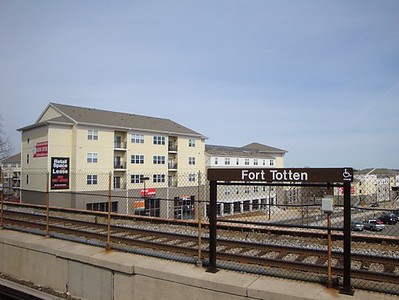
That's why you have four story housing at the Fort Totten Metrorail Station. It's an in-city location, but in a suburban patterned land use environment. Rhode Island Station is more urban (but with land pattern problems) and it still has four story apartment buildings, built relatively recently.

fort_totten_metro
I can't remember when this project was built, probably before 2008.  Since then, garden apartments a little further away have been or are being redeveloped into a much denser housing and retail development called Art Place at Fort Totten, and about half mile away is where JBG built housing with a Walmart on the ground floor (I've argued this should have been a bigger project, given its proximity to Metrorail.)  

Unlike with the West Hyattsville station, which has a station area plan, even if it's taken 15 years to start to see some response, DC didn't do a larger scale station area plan for either Greater Fort Totten or Greater Rhode Island Stations, so there are plenty of lost opportunities for not just more intense development, but the creation of a real center in a neighborhood that doesn't have one.

(Intensity is coming to the Rhode Island Station area, but it's taken decades longer because of the lack of a plan, and it comes with a lot of opposition and difficulty.)

Equity considerations/affordable housing.  These implementation mechanisms are more likely to be nonprofit, or at least to require a lot of subsidy, to be able to afford to build by leading the market.  And that sets the stage to include a lot of affordable housing in the projects.

While not included as a case study at those conferences, Phoenix might be a better example than either Denver or Minneapolis in terms of operating at a greater scale, especially in terms of lining up money in advance of the light rail's opening to fund affordable housing ("Light rail housing fund spurs 15 projects in metro Phoenix" and ""Why you don't see more vacant lots along light-rail route,"Arizona Republic).

The Phoenix program hasn't involved a lot of money, although none of the projects are particularly large.

Prince George's County.  Note that this entry has been about MoCo because of the current legislative initiative.  But all of these issues pertain to PG County too: the need to repattern land use around transit and transit stations; to add intensity; to provide ways to improve demand along at least one MARC rail line (Camden) and to add the opportunity for infill stations on or extensions from the Penn Line, etc.

For example, with an integrated rail passenger service on the Penn Line in Maryland and the Fredericksburg Line in Virginia ("A new backbone for the regional transit system: merging the MARC Penn and VRE Fredericksburg Lines"), it could be advantageous for PG County to add an infill station in Landover, etc.

Labels: , , , ,

Monday, July 06, 2020

A tax break isn't always the "right" priming lever for desired development

The Washington Business Journal reports ("Montgomery County eyes property tax breaks for projects on Metro-owned sites ") that Montgomery County Council is considering a 100%, 15-year tax break, to speed up housing development at Metrorail sites.  From the article:
Legislation on the subject is set to be introduced at the County Council Tuesday as part of an ongoing effort by a group of lawmakers to ramp up residential development in the Maryland suburb and help the county realize its housing production goals. This new tax incentive, along with a host of others, has been in the works for months.

This latest measure, authored primarily by Councilmen Andrew Friedson, D-Bethesda, and Hans Riemer, D-At large, would create a payment in lieu of taxes program for any private developer leasing land from Metro to construct new high-rise buildings.

The bill would abate 100% of real property taxes for these projects for up to 15 years, starting when use and occupancy permits are issued for the property. County staff would then negotiate some other form of payment with the developers in question, though the legislation does not set standards for that process.
Stations with the most opportunity for complementary real estate development tend to be closer in.  FWIW, I have written many times that there is no such thing as "automatic" TOD (transit oriented development).

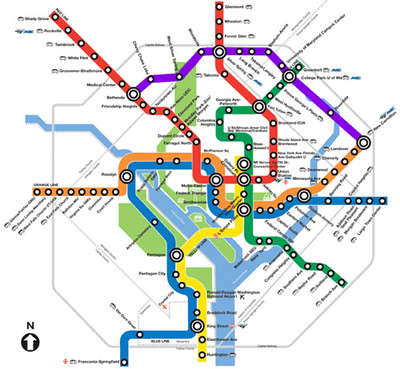
WMATA Map showing the Purple Line (but not the Silver Line)Metrorail Map showing the Purple Line light rail line, which is currently under construction.

For various reasons, especially stations farther from the core of a metropolitan area, housing is less attractive and still requires a car, even if it's located at a transit station. This is true for light rail, heavy rail, and commuter rail.

-- "Prince George's County still doesn't get "transit oriented development" and walkable communities: Greenbelt edition" (2012)
-- "With "transit-oriented development" urban design and/or planning is destiny" (2009)

Glenmont Station is about 12 miles from Downtown DC.  Forest Glen is closer, but is bracketed by the I-495, the Beltway Freeway.  Shady Grove is 24 miles from Downtown DC.

I don't think the issue is taxes.  Developing on transit agency land is really hard.  (1) Cost in terms of money and time is an issue, because the development process for transit agency land is super convoluted because it takes an inordinate amount of time, for example, the development at the Takoma Metrorail Station has been "underway" for 20 years !!!!!!!!!!!!! and is no way near any resolution.

(2) Besides the problems of contracting with a government agency anyway,  (3) it requires a federal review, since federal funds had been involved in the development and operation of the system; and (4) residents opposed to development seek various additional reviews and often the intercession of the Congressional representatives. 

Hard projects get developed once all the easy sites are taken.  If (5) the station isn't well located relative to housing demand, that makes it even more difficult.

While not in Montgomery County, but in Prince George's County, there has been a transit development plan for the West Hyattsville station for at least 15 years.  Although last year WMATA did sell land there, and a development program is apparently underway.

The problem is, more marginal development sites won't get developed til all the better sites are developed successfully.

Basically, the "problem" in Montgomery County is the stations that haven't been developed, in particular Shady Grove and Glenmont, are distant from the core and don't possess the characteristics that tend to draw "urban-oriented" residents who are the kind of people who want to live in housing at transit sites.

A tax break isn't going to change that reality.

More importantly, rather than offering a tax break willy nilly, I'd offer a tax break conditional on a plan and program for achieving multiple planning-related objectives.  The article says that's intended, but not defined in the legislation.  That's never good.

Purple Line and TOD tax breaks.  Because they'll be closer in, I'd say with the Purple Line, at the very least the Chevy Chase (Connecticut Avenue) station will be more in demand--also because it's in a much higher income area--than the outlying Metrorail Stations, while the Long Branch Station will not be, because it's in a lower income area--even though both stations will be located about 7 miles from Downtown.

I'd consider including stations like that, where the normal development timeline would be much longer, for tax breaks over a station like Shady Grove or Glenmont, because Purple Line stations are closer in, closer to the core, while Shady Grove and Glenmont are end of the line stations that are very suburban, and lack the pre-conditions for urban intensity.

Labels: , , , ,

Thursday, February 14, 2019

GE scales back its ambitions in Boston

Since GE announced plans to move from suburban Connecticut to urban Boston ("Corporate headquarters relocating to the center city: GE chooses Boston," 2016), the corporation has totally and completely tanked and significantly changed its focus, obviating the need for a larger headquarters campus with lots of space so people could work on digital initiatives that the company has now abandoned.

In less than two years, CEO Jeffrey Immelt was fired, and so was his successor, John Flannery, who has been replaced by Larry Culp, who had worked for the DC-based holding company, Danaher.

-- "What incoming CEO Larry Culp brings to GE," CNBC
-- "Larry Culp's long to-do list to fix GE," Washington Post

The Boston Globe reports ("GE says it will pay back Mass. $87m in incentives") that they've dropped the project, are returning $87 million in incentives they've already received, and are marketing the property where the campus was to be built.

Now, in line with the previous post on Amazon and NYC, I would have said that betting on GE was if not a sure thing, a good decision. So what do I know? (I had suspicions that GE did a lot of financial engineering and bad decision making, given the corporation's history with environmental contamination and various business disasters at GE Appliance, but who knew the extent?)

At the time, Strategy & Business had made a good point ("Corporate HQ and the Magnetic Pull of Cities"). As GE shifted away from financial services (and tv) they no longer had a reason to be so tightly connected to NYC. With their intent to refocus on manufacturing, Boston was a good choice because of the universities and Rte. 128 technology companies.

Other posts on the general topic of corporations moving back to the city include:

-- "A lesson that seeing is believing: Panasonic's new building in Newark, NJ as an example, positive and negative, in businesses coming back to the city center," 2015
-- "Businesses moving back to the center: not a universal trend," 2015

Labels: , , , , , ,

Not what I would have done, but the fact that citizen opposition led to the Amazon HQ2 NYC venture being dropped is important to acknowledge

From the BBC News article "Amazon cancels New York City campus plan":
Amazon has said it will not build a new headquarters in New York, citing fierce opposition from state and local politicians. The dramatic turnabout comes just months after the firm named New York City one of two sites selected for major expansion over the next decades.

City and state leaders had agreed to provide about $3bn (£2.3bn) in incentives to secure that investment. Those subsidies had prompted fierce backlash in some quarters.

Amazon said its plans to build a new headquarters required "positive, collaborative relationships with state and local elected officials who will be supportive over the long term".

It said: "A number of state and local politicians have made it clear that they oppose our presence and will not work with us to build the type of relationships that are required to go forward with the project we and many others envisioned.

"We are disappointed to have reached this conclusion."
======
While I consider myself a progressive leftist, the reality is that my politics and recommendations are mediated by the reality of working within the capitalist system and aiming to achieve as much social and public good as possible, given how the private sector does most of the actual doing when it comes to revitalization-focused real estate development.

So yes, I understand and support, depending on the case, tax and other incentives to facilitate certain kinds of development.

Offer the best package of tax incentives for the locations and projects that do the most to spur change and additional private investment. Instead of offering tax incentives on a first-come, first-served basis, without much in the way of criteria or focus, the best set of incentives should be targeted to those locations--anchor projects-- that are determined to have the most potential for spurring additional private investment because of they example of "quality" that they provide, which without the incentives, would not occur for many years, given the current investment climate and perceptions of the submarket.

Only give tax abatements to quality projects. Similarly, tax incentives should be directed to projects that are special rather than to projects that are ordinary and/or sub-optimal.

That means don't do what they do in Tennessee, where reports say that on average incentives are about $1.2 million per job ("State's largest tax credit for biz costs $1.2M per job, study finds," Nashville Tennessean) and Illinois, where an analysis of the State's main tax credit programs by the Chicago Tribune found that most of the projects did not generate significant economic return ("Chicago Tribune investigation on state tax incentive deals with corporations").

Amazon.  On that basis, from a benefit-cost analysis standpoint, providing financial incentives to Amazon, even $1 billion or more, is beneficial because of their obvious track record in meeting the contract terms in terms of actual jobs and buildings developed.

From "An example when I may disagree with Richard Florida: incentives for landing the Amazon HQ2":
... wrt this specific project I will say:

1. The cost/benefit is a helluva lot better compared to a stadium or other sports facility
2. It doesn't involve competition for the relocation of an already existing facility (e.g., Mercedes Benz moving to Atlanta from New Jersey; GE moving from Connecticut to Boston; etc.)
3. The firm seeking the incentive package has a high quality track record making the proposal significantly less risky compared to a business not already operating in the US or a start up firm or a project seeking to redevelop a brownfield site.
4. There are clear, monetizable benefits from landing this project.
Amazon is a much different case than the typical one.  Not just Foxconn in Wisconsin, as the firm has a history of not following through on "commitments" but more generally.  And definitely not for sports stadiums and arenas.

And the business, depending on what it is (warehouse jobs no, business development and technology jobs yes) has the opportunity to be leveraged to further develop related education disciplines and business activity, like how Virginia Tech is developing a computer sciences related school adjacent to the future HQ2 project in Crystal City/Arlington County, Virginia ("A look at Virginia Tech's planned $1 billion Potomac Yard campus").

Why not locate in an area that needs an economic boost?  Me, for social and other reasons, I would have suggested Baltimore -- which didn't make the cut; or Newark, which did, or Philadelphia.
But given that Amazon's HQ2 search hasn't focused on criteria I would have thought that mattered:

-- "The Amazon second headquarters "****show": Part 1 | Where could it go?," 2017
-- "Amazon second headquarters list of finalists," 2018

that wasn't the way the decision went.

Amazon's choice of Long Island City for half of the second HQ.  Amazon originally chose to split the new HQ2 between Crystal City in Arlington Virginia, across the Potomac River from DC, and a commercial district in Queens, New York City.

That made sense to me, because the DC area has large government customers as well as agglomeration economies when it comes to Internet backbone and related services, and because New York City is a center for both financial services and advertising, clusters where Amazon aims to generate more business.

The building that Amazon intended to locate its LIC-based HQ2 activities.  

Both places seemed to be selected on the basis that they had a lot of commercial space immediately available.  But yes, I was surprised that Amazon chose Long Island City in Queens, New York City.

Pushing higher housing costs up even higher.  Not because LIC is a bad place to do business, but because one of Amazon's originally stated reasons for not continuing to expand in Seattle was because of the negative effects on housing and the cost of doing business.

New York City is the highest cost place to do business in North America.  Sure, Queens is cheaper than Manhattan, and the former Citicorp building in Long Island City has plenty of empty space, virtually all that Amazon needs.  But there will be massive effects on the cost of housing and other negative effects.

Opposition.  There has been lots of opposition to the deal for New York City, both against incentives to be provided by the State of New York and separately by the City of New York.  So Amazon has backed out.

While I would have argued in favor of the deal, were I living in New York City, I can see why other people disagree and would fight the deal.   While I don't agree with them, I am amazed that this opposition caused Amazon to change its mind.

Interestingly, more than 50% of the population in a recent poll supported the incentive package ("Majority of New Yorkers support Amazon HQ2 deal, according to poll," CNY Central).

Chance to make a better decision.  But then, because of the impact on the housing market specifically, I thought that Amazon choice of New York City was wrong-headed.

And maybe now there is an opportunity to direct the investment to a location where the effects can be mediated and have extra-normally positive effects, by contributing to business development in a place that is underdeveloped, rather than a place that is already economically overdeveloped by comparison.

Labels: , , , ,

Thursday, September 20, 2018

An illustration of the complexity of urban construction of new housing from San Francisco

Affordable housing issues and "subsidy of market rate construction" housing are issues always in the news.

Tax abatements/subsidy of market rate housing.  WRT the latter, some elected officials are looking to end the 10-year tax abatement on newly produced housing ("Councilwoman Bass proposes eliminating 10-year tax abatement," Philadelphia Business Journal) and want to redirect the monies to affordable housing production.

But while it's looked upon as a subsidy, it's also a "residential recruitment device," and in a situation where Philadelphia continues to lose population even as other cities like Boston, DC, and NYC gain population, that's important.  Although there is no question that maybe a 10-year full tax abatement is overly sweet ("Philadelphia 10-Year Tax Abatement Here to Stay, for Now," NBC10) and perhaps the program needs some readjustment.

A similar debate is happening in Richmond ("Richmond's tax incentive program is promoting housing inequity," Richmond Times-Dispatch), unless you have a digital subscription, you'll need to access the article via a library-based articles database).  Also see:

-- "Stoney administration pitching council on tax break for Manchester developer; Richmond assessor: 'Why do you need to incentivize somewhere that's so hot?'"
-- "In reversal, developers pledge affordable units in Manchester project up for taxbreak"

It's tricky because people don't understand that generally the cost of construction of new housing, even rented at market rates, might not "pencil out" at least in the intermediate run.  And that the cost of construction (and land) is high and therefore renting it to other segments of the market isn't efficacious.

"Lifetime customer value" of a new resident.  And when you look at the total value of new housing in terms of resident income and sales taxes and other elements, just like how in direct marketing, you "buy" customers losing money in the short run, but making money on the "back end" in terms of purchasing over time and consideration of the total "lifetime value of the customer," the same goes for cities and adding new residents, especially those of high income.

Workforce housing production.  There is a great piece in Multihousing News about workforce housing production.  And I was surprised to see that MassHousing, a state government instrumentality, is happy to provide subsidies to projects that end up providing a "discount" to market rental rates of 10% to 20% tops.

-- "Work It!—Financing Solutions to the Middle-Market Housing Affordability Gap"

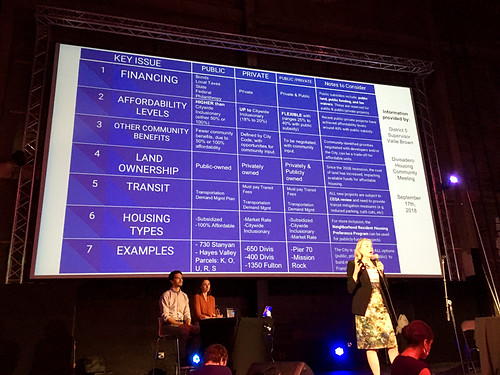
New Housing Construction in San Francisco.  Jim Dyer is an community advocate and I subscribe to his Flickr photo feed (we met once at a conference years ago, he is a biking advocate too), and I saw this photo, displayed at a meeting in his San Francisco Council District held by the elected official, Supervisor. Vallie Brown ("Community meeting aims to overcome impasse on new Divisadero housing construction," Hoodlline).

The projects are controversial because they propose a density that is greater than that which exists currently, in an area that is predominated by low height industrial type buildings.

20180917 d5-housing

When so many of the discussions on new housing focus on only one element, the fact that this slide lists six basic elements:
  • financing
  • affordability levels
  • community benefits
  • land ownership
  • transit access
  • housing types
plus whether the project is:

  • public
  • private
  • or a mix
along with 
  • "notes to consider"
is pretty incredible.

Labels: , , , ,

Wednesday, August 29, 2018

Revisiting stories: Tax breaks for Disneyland to end in Anaheim

In November 2017, we wrote about strife between the City of Anaheim and the Disney Corporation over tax breaks ("The Mouse that Roars: Disney's complicated arrangement with the City of Anaheim"). 

The 2016 election resulted in a shift on the City Council, from a pro-Disney majority to a majority that was more questioning of the tax breaks, which "cost" the city many millions of dollars of tax revenue each year, even as the city benefits considerably from taxes and revenues related to Disneyland.

-- "Outside Disneyland, a Reminder for Governments to Be Careful What They Wish for," Governing Magazine

My favorite is an old agreement for a parking structure. It cost $100+ million to build and Disney makes about $35 million/year from it, while paying $1 per year in rent.

About 45% of the city budget is derived from Disney-related revenues, about 20% of the city's employment base is made up of people employed by Disney, and significant segments of the local economy also benefit.

But in the face of a November referendum put on the ballot by labor interests ("Disneyland $18 Minimum Wage Qualifies for Anaheim Ballot," Variety), calling for high minimum wages for hospitality-related businesses benefiting from city tax breaks, Disney asked the city to cancel the tax breaks, thereby making the results of the forthcoming election moot ("Anaheim officially puts an end to tax breaks for Disneyland Resort," Los Angeles Times).

From the standpoint of generalizable lessons, I don't know exactly what to make of this.

First, I believe that strictures on collecting entertainment taxes are bad policy. The point of such taxes is to more directly benefit from the presence of such facilities. It's also a way to pay for the tax breaks that might be provided.

Second, I think it's reasonable to tie wage requirements to tax breaks, as an element of public policy.

Third, it shows that there are pressure points with corporations.

Fourth, but this is an exceptional case. Unlike a sports team that can move, e.g., the Rams football team from St. Louis to Los Angeles, or the Oakland Raiders to Las Vegas or the Seattle Supersonics to Oklahoma City, Disneyland can't up and move. It's a fixed asset.

It might reduce its rate of growth, but it will continue to be vital and successful.

It will be interesting to see the long term changes that result and any changes to the City of Anaheim's revenue base.

The company claims that it will look elsewhere for projects ("Disney, Wincome Group Could Abandon Future Projects In Anaheim If Minimum Wage Measure Passes," Bisnow) and it does have options to do so, in abutting communities that are close enough for projects to be integrated in the Disneyland ecosystem.

But in the short run, they've staved off the possibility of being forced to pay higher wages as a result of linkages with tax breaks.

Labels: , , , , , ,

Saturday, January 27, 2018

An example when I may disagree with Richard Florida: incentives for landing the Amazon HQ2

See the past blog entries, "The Amazon second headquarters "****show": Part 1 | Where could it go?" and "Amazon second headquarters list of finalists."

From email:
From Richard Florida:

The level of incentives being talked about for Amazon HQ2 is pretty bad. Worse is that so many of these bids are not even public. We are talking about BILLIONS in public handouts - the worst in modern history.

This will take precious public money that could be used for housing or schools or transit or inclusive development and hand it over to one of the most valuable companies and richest men on earth. It will set a precedent for these billion dollar mega-deals and more companies and cities will follow suit.

I am organizing an open letter imploring the cities and states that are finalists to avoid these giveaways and perhaps even organize themselves into a pact which limits or avoids such incentives.

Robert Putnam, Ed Glaeser, Robert Reich, Amy Glasmeier, Jeff Sachs, Jason Furman, Stephanie Kelton, Alan Kruger, Ben Hecht, Bruce Katz, Saskia Sassen, Pat Sharkey, Scott Stern, Erik Brynjolfsson, Joel Kotkin, Dani Rodrik, Genie Birch, Michael Storper, Allen Scott, and a variety of other prominent economists, urbanists and social scientists have already agreed to support this effort.
======
Also see "Amazon sweepstakes can be great even for the losers," Bloomberg. From the article:

... there’s a worry that the scramble to lure HQ2 will give rise to wasteful urban policies and set a bad precedent. Already there is speculation that Apple Inc. will build an HQ2 of its own, sparking a similar competition. What if this sort of industrial sweepstakes, used in the past to win everything from auto plants to sports teams, becomes the norm?

Many urban policy experts are worried that Amazon-style competitions will hurt cities by enticing them to spend too much on tax incentives and other giveaways. A recent roundup of opinions by the Penn Institute for Urban Research showed that this concern is widespread.

My response:

you guys make me feel like a conservative neoliberal, when I think of myself as a progressive. Yes, generally incentives work out in favor of the recipient, because local jurisdictions are in asymmetric and very negative positions, especially vis a vis the competition from other localities.

But wrt this specific project I will say:

1. The cost/benefit is a helluva lot better compared to a stadium or other sports facility
2. It doesn't involve competition for the relocation of an already existing facility (e.g., Mercedes Benz moving to Atlanta from New Jersey; GE moving from Connecticut to Boston; etc.)
3. The firm seeking the incentive package has a high quality track record making the proposal significantly less risky compared to a business not already operating in the US or a start up firm or a project seeking to redevelop a brownfield site.
4. There are clear, monetizable benefits from landing this project

For cities like Washington or counties like Montgomery in Maryland, which have "local" personal income taxes, the economic benefits can be even greater compared to cities that rely on property and sales taxes for the bulk of their locally generated revenues.

Plus, while I am not too sure on how they are calculated, the company will pay some level of corporate income taxes which a locality would not normally reap from a firm of Amazon's size.

So I would argue that the Amazon project--because it is decidedly 100% new economic activity not likely to be otherwise generated by a company with a real track record--and similar projects like Foxconn (Wisconsin) and Toyota-Mazda (Alabama) are quantumly different from the typical incentive-based project, which tends to involve poaching of existing businesses located elsewhere or sports facilities.

How much is the right amount to offer is another question, and I am not so well versed in financial calculations to be able to say.

But it's a combination of a multi-year stream of revenues from (1) commercial property tax; (2) commercial income tax revenues; (3) the likely percentage of workers you can capture as residents and the income, property, and sales taxes they generate; (4) the economic impact of visitors to the complex, both daily employees who don't choose to live in the locale plus business related travel.

Versus the opportunity cost of the incentives. (E.g., I don't see why DC is prioritizing the hiring of veterans at $30,000 each; I just don't see how that is specifically a local priority vis a vis other segments of the unemployed/underemployed _within the city_.)

Figure out the first and you can lay out a reasonable Net Present Value and a range of incentive packages at which the economic return from incentives remains positive.

Sports facilities/relocation of existing facilities: often a bad deal.  But concerning incentive projects for:

1. sports facilities
2. competition for relocating already existing facilities

I'd say the concern is real and I wish there were overarching federal legislation to limit this.

Even so:

Some sports facilities better than others.  Some locations are better than others.

1. with regard to sports facilities, depending on the type (baseball, basketball, hockey vs. football), up to a point, it may be worth laying out some level of incentives, if a reasonable and independent case can be made for positive economic return.

With regard to DC, while I am against incentives for sports teams generally, objectively speaking, the return to the city of hockey and baseball at the now named Capital One Arena (its third name in 20 years) was an important element of rebranding and the city's currently positive trajectory. Similarly, the Washington Nationals stadium helps to anchor and brand the ever developing Capitol Riverfront/Navy Yard district.

To the contrary, Detroit hasn't been so successful in getting suburbanites to attend events at the new Downtown hockey and basketball arena--basketball relocated from the suburbs, hockey has never left the city ("New arena hasn't led to new fans for Pistons," Los Angeles Times).  Similarly, the New York Islanders hockey team hasn't been so successful at attracting fans to Brooklyn and is relocating back to Nassau County.

However, it's only a few months into the new Detroit arena and it's far too soon "to judge." (Also see "An arena subsidy project I'd probably favor: Sacramento.") It took a few years, and the parallel improvement programs of the Downtown DC Business Improvement District to fully reap for the city the benefits of the sports arena as an anchor and image builder.

Residential property tax abatements: Philadelphia.  Separately, Philadelphia City Council President Darrell Clark has raised the issue of the city's generous 10-year property tax abatement on new residential properties (both conversion of existing buildings and construction of new buildings as well as certain investments in current properties) costing the economically pressed city too much money. See "Time for an honest discussion about fair taxation in Philly," Philadelphia Inquirer.

-- Philadelphia Tax Abatement Program, Building Industry Association
-- "Dispelling common myths about Philadelphia's 10-year tax abatement," Philadelphia Business Journal
-- "No property taxes, no problem: Study finds controversial abatement has been positive for Philly," Philadelphia Inquirer

The abatement program, launched in 2000, was an important initiative that helped to rebalance and reposition the attractiveness of residential living in Philadelphia at a time when the city had lost out to the suburbs in competition for residents, commercial activity, and retail. But after 20 years, maybe it's time for a reassessment. From the article:

From 2014 to 2016, the city granted 10-year tax abatements on 4,286 properties, thus forgoing more than $420 million in revenue. Nearly $8 billion in taxable property value is currently abated, resulting in $111 million in forgone revenue in 2016. A conservative estimate based on recent market trends finds that more than $1 billion in property tax revenue will be withheld from the School District and the city over the next 10 years.

Without a doubt, our rapidly transforming skyline and growing population are in part the result of the abatement program. But, given the larger fiscal and policy environment in the commonwealth and in Washington, it is time to revisit the 100 percent, 10-year tax abatement in its current form as part of a broader conversation about equitable growth.
The city's school system continues to face significant problems and there isn't enough money to invest properly in transit. Maybe it's time to adjust the abatement program?

Note that Baltimore has a similar but subtly different issue wrt residential property tax abatements. There, it creates two classes of owners, legacy property owners paying higher taxes, and newer property owners paying lower taxes. Often newer owners are higher income, so older property owners are subsidizing the better off. Then again, especially now, the city needs more initiatives that can successfully attract new investment.

Labels: , , , , , ,

Thursday, January 18, 2018

Amazon second headquarters list of finalists

-- "Here’s how cities are reacting to being finalists for Amazon HQ2," CNBC

See the past blog entry, "The Amazon second headquarters "****show": Part 1 | Where could it go?"

Sadly, Baltimore and Detroit didn't make the list, and landing this "whale" would have been an economic game changer for those communities.  Although Newark is on the list, and Philadelphia.


The finalists:
  • Atlanta, Georgia
  • Austin, Texas
  • Boston, Massachusetts
  • Chicago, Illinois
  • Columbus, Ohio
  • Dallas, Texas
  • Denver, Colorado
  • Indianapolis, Indiana
  • Los Angeles, California
  • Miami, Florida
  • Montgomery County, Maryland
  • Nashville, Tennessee
  • Newark, New Jersey
  • New York City, New York
  • Northern Virginia, Virginia
  • Philadelphia, Pennsylvania
  • Pittsburgh, Pennsylvania
  • Raleigh, North Carolina
  • Toronto, Ontario
  • Washington, D.C.
The issue to me comes down to maybe 3-4 criteria:

1.  Economic nationalism.  While Toronto makes a great argument, and national health insurance means huge savings for companies in Canada, I think that were Amazon to locate a new headquarters outside the US they would invite serious attacks from the current administration/federal government, especially because Amazon's founder owns the Washington Post, which President Trump sees as an opponent.

2.  The cost of housing for employees.  Many of the cities making the cut--Boston, DC/Northern Virginia/Montgomery County, New York City--have high housing costs and a small increase in demand could make an already frothy market that much more turbulent comparable to what is happening in Seattle and San Francisco now.

Since part of the reason for Amazon to build a second headquarters is to provide employees with more reasonably priced housing options, I can't see a high housing cost city being chosen in the end.  

3.  Proximity to higher education institutions with leading programs in information technology, engineering, and business.  To be honest, I think that dings the DC area, Indianapolis, and Nashville.

It should make us appreciate former Mayor Bloomberg's initiative to create a world-class engineering and technology graduate school in New York City to better develop and attract business ("New York's Silicon Alley Is (Still) No Match for Silicon Valley," Bloomberg).
.
4. Transit/Urbanism/Placemaking/Quality of Life.  I would think this factor would eliminate cities like Dallas and Atlanta and Denver, although they have transit systems.  And even Northern Virginia because the sites proposed to Amazon aren't "close in" to the center, but more distant locations that would be termed suburban, almost exurban.

Not sure how to handicap Los Angeles.  It's cool, but the housing market has rebounded and Western Los Angeles City and County doesn't have low cost housing.

I think it might give Montgomery County, Maryland a boost because of the ability to do some large developments along the Red Line, even to extend the Green Line out New Hampshire Avenue as I've suggested in the past.  There's enough room around the FDA campus there, but it isn't particularly dense and urban.

There is opportunity in Silver Spring, especially given that Discovery Channel will be leaving, but to put the Amazon project in perspective, Discovery has one big building capable of supporting 2,500 workers and Amazon is demanding the capacity for 20 buildings of that size...

====
Comments

WRT DC's bid ("DC discloses part of the Amazon HQ2 incentive package," Washington Business Journal, I was surprised to see such a huge incentive offered for each "veteran" to be employed.  I don't see why that would matter that much to DC specifically, compared to supporting DC business development and employment of residents.

WRT the likelihood of DC not being picked, I hope it will spur the city to take a deeper, harder look at the necessary antecedents for economic development and diversifying the local economy beyond its dependence on the federal government.

I think it means looking at DC's higher education institutions and figuring out how to up their game, along the lines of what Mayor Bloomberg started in NYC, collecting and publishing metrics on businesses developed out of DC universities and local research, etc.

See the past blog entry "Better leveraging higher education institutions in cities and counties: Greensboro; Spokane; Mesa; Phoenix; Montgomery County, Maryland; Washington, DC."

Where's the Catholic U research park? Along those lines, for more than a decade Catholic U has talked about creating a research park adjacent to their campus and they haven't done much of anything.

See the past blog entry, "Naturally occurring innovation districts | Technology districts and the tech sector".

Meanwhile, UMBC's business incubator keeps on generating new businesses ("UMBC eyes major expansion at research and technology park," Technical.ly Baltimore; "15 companies graduate from UMBC's bwtech, ready to grow on their own," Baltimore Business Journal).

Montgomery County, Maryland.  For all the hand-wringing about Montgomery County's competitiveness vis-à-vis Northern Virginia ("Montgomery County's real economic development problem: it's not part of the military economy," 2011 blog entry), Maryland's supposedly faulty business climate, and just announced decision of Discovery Channel to leave Silver Spring for New York City ("Discovery’s departure is ‘shot across the bow’ for Silver Spring, state and region," Washington Post) it says a lot that Montgomery County is a finalist.

Like DC, they need to look at this result in a very detailed way and figure out how to better leverage, strengthen, and market their competitive advantages.  (Personally, I don't think it's by outsourcing their economic development functions to the private sector, but that's me...)

My own belief: go for it.  It's worth aiming to recruit Amazon and to spend a fair amount of incentives to do it.  But recognize there will be some negative impacts to go along with the good.  See e.g., "Amazon has brought benefits - and disruption - to Seattle," AP and "How Amazon's Nonstop Growth Is Creating A Brand-New Seattle," Fast Company.

Labels: , , , , , ,