Rebuilding Place in the Urban Space

"A community’s physical form, rather than its land uses, is its most intrinsic and enduring characteristic." [Katz, EPA] This blog focuses on place and placemaking and all that makes it work--historic preservation, urban design, transportation, asset-based community development, arts & cultural development, commercial district revitalization, tourism & destination development, and quality of life advocacy--along with doses of civic engagement and good governance watchdogging.

Wednesday, March 18, 2026

Loss of business clustering/headquarters hurts secondary cities

 1.  "Boston has lost its financial services clout. Santander’s latest move is just another example," Boston Globe.

As recently as 25 years ago, Boston punched above its weight in financial services, with powerhouse mutual fund managers at almost every corner, a top 10 retail bank in FleetBoston, even a stock exchange of our very own. Now? That supremacy feels like it has slipped away. This is just the latest example.

... With each passing year, it seems, Boston’s Financial District sheds just a little more of the sector’s clout that gave the place its name. The big post-COVID hope for the district’s future hinges on real estate conversions: hotels, dorms, apartments, tourist attractions. Anything but new offices. (And many of the offices that remain are being taken over by the likes of tech firms such as SimpliSafe, DraftKings, and Klaviyo.)

(Baltimore too had at one time been a regional financial center with national heft.  The first private equity bank was founded there.  Some big mutual funds.  Insurance companies.  No more.)

Norfolk Southern headquarters, shown here in an aerial photo on Tuesday, March 10, 2026, sits squarely in the Midtown Atlanta landscape, reflected in its gleaming glass facade. (Hyosub Shin/AJC)

2.  A merger of Union Pacific and Norfolk Southern railroads likely means the serious diminishment of the importance of Atlanta to the new company--NS is based in Atlanta ("Atlanta is at the center of a railroad merger with big economic implications," "Coming soon to Midtown: A Union Pacific building?," Atlanta Journal-Constitution).  From the second article:

In addition to a Fortune 500 headquarters, the proposed plan would cost Atlanta jobs as operations consolidate in Nebraska, the application outlined. In total, more than half the Midtown headquarters’ management employee headcount would either relocate to Omaha or lose their jobs, the filing said.

... expects the company’s total Georgia headcount to remain at about 3,000 post-merger — versus its current 4,000.

3.  Corporate headquarters are leaving California.  Part of it is consolidation to bigger business clusters, such as Chevron from suburban San Francisco to Houston, but also conservative company owners like Elon Musk making political statements.  

Focus on new business development and growth.  The business columnist for the Orange County Register ("How can California survive the departures of big companies?") suggests the response should be to focus on the state's strength as a place for start ups and new businesses, some of which end up growing to be quite large.

4.  Another issue is the relocation of divisions from a corporate headquarters city.  For example, Starbucks, based in Seattle, has relocated its logistics division to Nashville, and appears about to sign a lease for space that could support up to 2,000 workers, far more than the size of the logistics group ("Starbucks reportedly eyes Nashville office large enough for hundreds," Seattle Times).

==========

Also see:

-- "A wrinkle on corporate headquarters: leaving the city as buildings age," 2026
-- "Clustering/agglomeration economies and revival of Southern California's space sector," 2025
-- "How the closure of a Pfizer research center in Ann Arbor, Michigan led to the development of a more robust and independent biotech sector," 2021
-- "Federal government research hub development initiative," 2023
-- "Universities and ancillary economic development (versus the anti-research agenda of the Trump Administration)," 2025
-- "Next Phase of Clustering of Business away from the Midwest," 2022
-- "Do tax incentives pay off? : Illinois; Tennessee; Rosslyn + "The Airport Access Factor"," 2017
-- "Corporate headquarters relocating to the center city: GE chooses Boston," 2016
-- "Businesses moving back to the center: not a universal trend," 2015 
-- "A lesson that seeing is believing: Panasonic's new building in Newark, NJ as an example, positive and negative, in businesses coming back to the city center," 2015
-- "Pennsylvania Avenue DC planning initiative," 2014
-- "Could bringing premier regionally headquartered business enterprises to the Pennsylvania Avenue Corridor be key to its renewal and revitalization?," 2014

Labels: , , , , , , , ,

Saturday, August 26, 2023

How do you make the ground floor of an arena strengthen the area around it, rather than diminish it? | Philadelphia 76ers

The Philadelphia 76ers basketball team (owned by the managing partner of the group that recently bought the Washington NFL football team), released a proposal last year to build a new arena as part of the sputtering Market East shopping center on Market Street, using examples of DC's Capital One Arena and the Barclay's Center in Brooklyn to demonstrate the value of centrally located arenas ("A downtown arena for the Sixers can be a Philly thing, too," Philadelphia Inquirer).

-- "Proposal to build new basketball arena in Downtown Philadelphia," 2022

Much of the opposition has centered around the potentially negative impact on Philadelphia's Chinatown, which may well lose Chinese related businesses and residential buildings as a result of the kind of reproduction of space that is unleashed as a result of such developments ("In Philadelphia, a new threat looms over Chinatown," Washington Post).

Along premier Inquirer urban design writer Inga Saffron argues the proposal will have significant negative effects on the Jefferson Street SEPTA station, which serves regional rail and the Market Street line ("Off track? A Sixers arena at 11th and Market would compromise Jefferson Station").

While not the reason--both outmigration to the suburbs and the earlier creation of the DC Convention Center is why--DC's Capital One Arena certainly hasn't strengthened the presence of Chinese-related community and commerce in what for a long time I have derisively called "Chinablock" in DC.  

Philadelphia's Design Advocacy Group, uniting more than 2,000 professional architects, designers, and planners, has come out against the proposal too, because it argues it will have a deadening effect on Market Street at the ground level ("A large Philly-based group of architects and designers just came out against the 76ers’ arena plan," PI).

Note that when I started out in revitalization work, DAG's Urban Design Evaluation Tool helped me think about how to approach proposals for new development in a systematic and "demanding" fashion.

That's a legitimate argument.  The buildings are big and usually the ground plane is not set up to be vibrant and active, the rents are high for the spaces that exist, and retail businesses focused on events in the building still have to find customers for the other 200-300 days of the year when there isn't anything going on in the arena.

When I've written about new arenas, I tend to focus more on the transportation demand management elements, although "Framework of characteristics that support successful community development in association with the development of professional sports facilities" has a big section on urban design:

Urban Design 

  • centrality of location: Downtown/central business district/waterfront versus outlying locations within a city or suburbs.  Negative examples include the Salt Lake Bees stadium outside of Downtown, with limited redevelopment opportunities; how the Atlanta Braves chose a suburban location for their new stadium, counter to the trend of siting in center cities; the debate in Oakland about a waterfront location versus a new stadium in their current location ("A's plan to build a new waterfront stadium at Oakland's Jack London Square takes big step forward," San Francisco Chronicle), and the location of the Real Salt Lake soccer team in the suburbs instead of the center city.  Positive examples include the waterfront stadium for the San Francisco Giants, the Downtown stadium for the Baltimore Orioles, and the relocation of the Washington Wizards basketball team and Capitals Hockey teams from the suburbs to the City of Washington;
  • size of the facility and its ability to be integrated into the urban fabric (baseball, football, basketball, hockey, soccer), bigger stadiums--football stadiums specifically--are harder to integrate in the urban fabric.
  • isolation or connection: how well is the facility integrated into the urban fabric beyond the stadium site and does it leverage, build upon, and extend the location and the community around it.  The classic example is Wrigley Field in Chicago versus White Sox Stadium ("Expert offers his dream Sox stadium," Chicago Tribune).  Wrigley Field is embedded in its neighborhood, while White Sox Stadium is disconnected from its.  But also in how Oracle Park in San Francisco leverages its waterfront location.
Oracle Park.  Photo: Ron Niebrugge.

 But the reality is that the point, "isolation or connection: how well is the facility integrated into the urban fabric beyond the stadium site and does it leverage, build upon, and extend the location and the community around it" needs to be further developed.

For example, while some arenas have nice public spaces around them--again, overall, minimally used--they don't generate a lot of activation on the ground plane.  This is definitely true of Capital One Arena in DC.

Capital One Arena, 7th Street NW, west facade

Actually, the Design Advocacy Group could be a significant boon on this issue, with impact nationally, if it addressed this issue as a charrette, and came up with a series of recommendations on how best to integrate arena ground planes into the neighborhood outside the arena, in ways that make it very active and vibrant.

Golden 1 Center. Image Credit: Sacramento Kings.  The Sacramento Kings arena is set off from the buildings around it, providing little opportunity for spillover activation.  

Together Credit Union Plaza, Ballpark Village, St. Louis.

A lot of teams now are into the idea of complementary developments to add activity during events, on non-event days, and to generate revenues theoretically to support team revenue needs to be competitive ("A Great Team, an Ambitious Plan and an 'Existential' Issue," New York Times).  From the article:

He generally keeps his distance from the field and clubhouse, focusing on the business of the organization. His priority for now is not a lease extension — Angelos does not like the word lease — but a “public-private partnership” that would reinvent the Camden Yards campus. 

The plans, naturally, would include the usual live-work-play stuff — residences, hotels, shops, restaurants, bars — that modern owners covet. 

But Angelos mentioned several other possibilities: an elementary school located in the warehouse, a health and wellness clinic, internship and mentorship programs for local youth. 

“People will speak about Baltimore like, ‘Wow, Baltimore is cutting-edge,’ which is what they said about Camden Yards,” Angelos said. “If we develop it right, and we include that impactful community program module, we can change the whole brand of Baltimore.” 

While Camden Yards inspired a building wave of stadiums and arenas designed to lift surrounding local businesses (at least in theory), the Atlanta Braves’ complex in suburban Cobb County, Ga., is the new standard. Instead of only profiting from in-ballpark sales, the Braves essentially built their own city — known as the Battery and opened in 2017 — to give them a stake in adjacent properties, too. 

You see it all over: The San Francisco Giants developed the area on the other side of McCovey Cove; the Boston Red Sox built a 5,000-seat music venue at Fenway Park; the Chicago Cubs bought several buildings that border Wrigley Field. But Atlanta is the ideal, and Angelos has visited the Braves’ complex with Maryland’s governor, Wes Moore, and stadium authority officials. 

“The Braves have a couple of things going for them,” Angelos said. “They’ve done very well on the baseball side. They have a really big market, which helps a lot. And then they’ve developed this whole other revenue stream, this whole other business. 

“And if big markets like Boston and Atlanta are doing it, it becomes existential — how are we going to compete and keep pace? Everybody won’t be able to do it. But I think because of what’s here — the brand of this ballpark, this piece of property of 60-odd acres with other land around it that could be accessed, maybe bolted on, with the mass transit you don’t even have in Atlanta, with the great highway systems — we think it’s existential.”

I'm skeptical.  I think they want more money, but with limited guarantees they will invest it in the team.

The Battery Atlanta, a mixed-use development with offices, residences, restaurants and bars, was built next door to the ballpark and attracts customers year round. Photo: Mortenson Construction.

And interestingly, while the Atlanta side project is touted as a national best practice ("New Atlanta Ballpark Considered Model for Royals Coming Downtown," CityScene KC), Kennesaw State University professor J.C. Bradbury, argues it hasn't done much for Cobb County, which provides significant subsidies ("Study finds Cobb residents are paying $15 million dollars to run Truist Park home of Atlanta Braves," Atlanta News First, "Reply to Zimbalist: 'Report on the Fiscal Impact of Truist Park and the Battery'," Social Science Research Network).

Mutual benefit should be the outcome of so-called "public private partnerships."

Good for the team, bad for the County?  It doesn't make sense to me that the high cost of sports income for owners and players should be subsidized by local and state government.

Labels: , , , , , ,

Monday, August 08, 2022

Camden Yards baseball stadium is 30 years old

The Ringer has an excellent article, "The Baseball Stadium That “Forever Changed” Professional Sports," assessing the contribution of Camden Yards--a throwback designed baseball stadium which opened in 1992--to baseball, other professional sports, and cities.

 Camden Yards in 2003.  Getty Images photo.

It makes excellent points:

-- that the throwback "design" hasn't been a special success economically (although I prefer it myself) or in terms of revitalization

-- but it has helped to draw teams back to center city locations (although there are still exceptions, like the Atlanta Braves, and football teams)

-- but that somewhat unrecognized, Camden Yards is also responsible for ushering in a new era of public subsidy, taking of advantage of perceived urban negatives and the uncertainties present in "declining cities" where teams were considering leaving (and Baltimore's Colts football team had decamped to Indianapolis in 1984, making Baltimore feel particularly vulnerable) which was then seized upon by other sports teams and has cost cities, counties and states many billions of dollars.

-- relatedly that governments tended to take on the responsibility for maintenance, charged low rents, and shared very little in the way of concession and other revenues, making certain annual losses "on the investment"

The article makes the point that baseball stadiums up through WW2 were key civic facilities, and afterwards not so much.  

I think wrt that, the issue is twofold.  First, as "center cities" were supplanted by "metropolitan areas" and suburbanization, civic facilities in the city became less important generally, and team owners were "chasing" their fans and relocating to the suburbs.

But second, and perhaps more importantly, with the rise of television and other entertainments, and vacation and leisure alternatives, baseball in particular became less central as an element of American society.  Why build a "civic cathedral" if baseball no longer held the same place of importance?

It also drills down a bit more on what makes stadiums marginally more economically successful, specifically the ability to spur significant private investment--and acknowledges that mostly it doesn't happen.

It also mentions a point I realized and have written about, that communities that snag the facility can benefit at the expense of the place that had it before, which is an element not captured in economic studies at the metropolitan scale of the impact of stadiums and arenas.  

Although it really depends, and in most instances it's a wash.  One exception is Capital One Arena in DC.  Also Barclays Center in Brooklyn (except NYC! so it's an outlier anyway).

====

The most significant issue is how well the stadium or arena can be integrated into existing urban fabric, where it's placed in that context--central locations great, not central locations bad, and for larger cities, how well it is paired with transit.

Also see:

-- "Framework of characteristics that support successful community development in association with the development of professional sports facilities," 2021
-- "Seattle Kraken expansion hockey team sets new standard for transit benefits in transportation demand management: free transit with ticket," 2021
-- "Revisiting "Framework of characteristics that support successful community development in association with the development of professional sports facilities" and the Tampa Bay Rays baseball team + Phoenix Coyotes hockey," 2022
-- "Proposal to build new basketball arena in Downtown Philadelphia ," 2022

Labels: , , , , ,

Tuesday, August 02, 2022

Proposal to build new basketball arena in Downtown Philadelphia

The northeast corner of 11th & Market Streets. The square block between 10th and 11th and Market and Filbert is the site of a proposal to build a new 76ers arena in the Fashion District space over SEPTA's Jefferson Station. Photo: Tom Gralish, Philadelphia Inquirer.

The 76ers propose a new arena downtown, on the site of the "Fashion District" mall ("The Sixers want to build a new $1.3 billion arena in Center City").  

An article in the Philadelphia Inquirer makes the point that the "fashion" initiative had no legs because of white flight and a change in the industry in terms of fast fashion ("White flight and fast fashion meant Market Street never got the attention it deserved. Could the 76ers change that?").  From the article:

The new arena would prove a few things: First, in this town, fashion will never be the game changer sports is. We like to think of ourselves as stylish, but the truth is Philadelphians are more likely to rally around James Harden than around haute couture. More importantly, it will test whether the city really can provide the infrastructure, investment, and urban planning solutions necessary for Center City to realize its full potential.

It will also would prove that it takes an influx of people from outside of the city for Philadelphians — especially those who live in underrepresented communities — to get the amenities we deserve in what’s supposed to be our downtown.

I do think she's right about "white flight" and downtown retail more generally.  For the most part, suburbanites shopping needs are met by options in the suburbs.  

They don't need to shop in the city, and/or they aren't buying such exclusive items frequently enough to go shop in the city.  Although the article points out that some of the stores there, like Century 21 and Ulta, were popular with actual city residents.

It's why Friendship Heights in DC isn't doing so great retail-wise ("Friendship Heights and the production of retail decay") and why DC can't really develop a strong retail center in the core. 

I do believe that basketball and hockey arenas should be located downtown and that they can contribute positively to economic development.

It took me too long to admit that, partly because even though downtown arenas can be "a good thing," they are still oversold and don't accomplish as much as is touted.  That's the point behind this blog entry:

-- "Framework of characteristics that support successful community development in association with the development of professional sports facilities"

which is aimed at identifying the characteristics that make for an arena that is more successful for the local community.

Also see:

-- "Revisiting "Framework of characteristics that support successful community development in association with the development of professional sports facilities" and the Tampa Bay Rays baseball team + Phoenix Coyotes hockey"

Frankly, there are plenty of in-city arenas and stadiums that don't have the kind of economic effect that is touted.  So the point should be to shape the project to get the best possible results.  

But you still need a wider ranging plan, because an arena or stadium is only one element of what should be a "transformational projects action plan."

-- "Why can't the "Bilbao Effect" be reproduced? | Bilbao as an example of Transformational Projects Action Planning," 2017
-- "Downtown Edmonton cultural facilities development as an example of "Transformational Projects Action Planning"," 2018

Nonetheless, such facilities can reposition downtowns, attract new audiences, contribute to economic development, and ideally leverage existing transit in a way to shift trips from cars.

A big element is the size of the city and transit.  Smaller market cities tend to have weak transit cities, and the majority of patrons drive to the arena or stadium, and this seems to reduce their propensity to patronize local establishments.

Interestingly, a different PI article ("Philly’s next mayor should boost city’s recovery, say biz leaders. ‘We need somebody that smiles.’."), saying the city needs a mayor who is a cheerleader, mentions the arena proposal and uses DC's Capital One Arena as an example of why a downtown arena project is important to Philadelphia:

“Just go to 16th and Market Streets,” Pearlstein said. “That used to be like the 50-yard line at lunchtime. But now Market Street has a long road to recovery.”

The possibility of a new 76ers arena in Center City “could drive midafternoon traffic on East Market Street, which has struggled even with the Fashion District,” Cooper said.

Much like the Capital One Arena in Washington, D.C., a Sixers stadium on Market between 10th and 11th Streets could “create enough gravity to attract restaurants, offices, and residential buildings, which followed the building of the arena. But we still need improved transit,” Usdan said.

Sports patrons don't spend on non-sports retail.  But such facilities can only do so much, especially because they support such a narrow range of "retail" that the spillover benefits are not as significant as people believe (see It's Hardly Sportin': Stadiums, Neighborhoods and the New Chicago, about how the Wrigleyville commercial district changed to a nightlife district from a mixed use retail district, after the Chicago Cubs stadium added lights and night baseball.)

What if teams aren't so great, with poor attendance?  Plus, what happens when the teams start failing and attendance drops off.  

For example, the Washington Nationals baseball team, now that it's tanking a couple years after winning the World Series, is suffering severe attendance falloff--the team is now 19th of 30 in average attendance.  That has to be hurting all the eating and drinking establishments that have opened around in the Navy Yard area.

Similarly, the NBA and MLB All Star Games and the NFL Super Bowl, when it comes down to it, don't have much effect on the local economy either, especially non-food retail.  This is because much of the money expended on travel and lodging ends up in the pockets of companies that aren't locally based.

=====

Academic writings.  I hate to admit that I never did much of a literature search when I began development the "framework characteristics" pieces, starting first with Sacramento in 2014 ("An arena subsidy project I'd probably favor: Sacramento").  Some of the work supports my argument.  Some is till more positivist than critical-analytical. 

-- "Sports Facilities as Urban Redevelopment Catalysts," Journal of the American Planning Association (2004) 
-- "In Defense of New Sports Stadiums, Ballparks and Arenas," Marquette Sports Law Journal (2000)
-- "Arena-Anchored Urban Development Projects and the Visitor Economy," Frontiers in Sports and Active Living (2022)
-- "Does the arena matter? Comparing redevelopment outcomes in central Dallas tax increment financing districts," Land Use Policy (2021)
-- "Role of Sports Facilities in the Process of Revitalization of Brownfields," IOP Conference Series Materials Science and Engineering (2017)

=====

Economic impact of individual spending by sports patrons.  When I first got involved in urban revitalization, wrt the H Street NE neighborhood in DC ("The community development approach and the revitalization of DC's H Street corridor: congruent or oppositional approaches?," 2013), one of my earliest writings was about cultural assets, given the then presence of the Children's Museum, the fallow Atlas Theater, and the then developing H Street Playhouse (it moved, now it's the Anacostia Playhouse).  

I touted the spending multiplier compiled by Americans for the Arts, but making the point that spending was likely to be less because it wouldn't involve overnight stays.  

-- Arts & Economic Prosperity 6: The Economic Impact of Spending by Nonprofit Arts and Culture Organizations and Their Audiences, Americans for the Arts

Plus, later I learned that children-based cultural visitation, like going to museums, generates very little additional spending.

Anyway, it would be interesting to drill down and generate a more detailed understanding of sports patron spending.  Is there a difference between people who get to the venue by transit versus driving?  Families versus individuals? Season ticket holders versus occasional attendees?  In-city versus metropolitan area versus out-of-the area in terms of domicile?  How much spending is captured by the team/arena versus off-site venues. Etc.

Labels: , , , ,

Thursday, June 09, 2022

Metra/Chicago creates a well priced German style all-mode transit pass

 Last week, I wrote a post, "Montreal first North American city with German/London style fare pass good on all transit, even local railroad services," after charlie called our attention to how the transit system in Greater Montreal is moving to a German style all-modes-in-one fare media system, which is really the first example of this in North America.

It appears that Metra, the commuter but 7 day/week railroad serving Chicagoland (mostly serving Illinois, with one line to Wisconsin, while Indiana is served separately from Metra), is sort of kind of backing into a similar system.  

In the past they've had a monthly pass, ranging from $116 to $275 depending on distance ("Metra to offer new $100 monthly pass, the latest change to draw back riders," CT), plus two add on pass options for local transit--a peak CTA rail and city and suburban bus pass ($55) or suburban only bus pass ($30).

But earlier this month, to stoke ridership in the face of pandemic decline, they've moved to a $100 monthly commuter pass.  And since they've announced a $30 add on city and suburban local transit pass, for a total of $130 ("CTA and Pace to offer new pass for Metra riders, as commuting habits change," Chicago Tribune).  

This is a significant reduction in price, as little as 1/3 the cost for some riders compared to previous rates.

Now it's not available in reverse, in that a CTA/Pace monthly pass for $75 can't add full rail access for $55.  But it's a start.

In a way, the Metra combo is better than the German options, because those increment higher based on zones, where due to the pandemic fall in ridership, Metra has shifted to a flat rate pass.

Conclusion: Desperation can lead to innovation.  In working in revitalization, I used to compare DC--a strong real estate market, and Baltimore--a weak real estate market, a lot, making the point that Baltimore had a "desperate willingness to experiment because they have no other choice."

Chicago's Nederlander Theatre and a busy Randolph Street on March 12, 2020, in downtown Chicago. (Terrence Antonio James / Chicago Tribune)

Metra and the Regional Transit Agency (RTA) are desperate because the pandemic has crashed visitorship and commuting to Chicago, destroying their ridership and revenues.  

At the same time, workers are liking telecommuting because it cuts the time and cost of telecommuting.  Bosses do like outsourcing the cost of office space to workers at home, but at the same time, want to see people in the office, out of the belief (which I believe) that people accomplish more when interacting.

With such significant reductions in transit cost, this is an economic development strategy for Downtown Chicago.  Fortunately, Chicagoland has a dense center city and commuter railroad transit network where they can pull this off.

====

I was talking to someone who knows someone who works for the Utah Transit Authority, who told him that the cost of collecting and process money is roughly equal to the revenue collected, so that the authority could move to a free transit system at no cost*.  But the Utah Legislature--70% Republican, 90% Mormon--is opposed to providing free transit.

* Note that in high transit use systems, the fear of moving to free transit is based on a rise in ridership, requiring more personnel and more equipment, so it would cost more and revenue would drop significantly as well.

Labels: , , , , , , ,

Thursday, February 14, 2019

GE scales back its ambitions in Boston

Since GE announced plans to move from suburban Connecticut to urban Boston ("Corporate headquarters relocating to the center city: GE chooses Boston," 2016), the corporation has totally and completely tanked and significantly changed its focus, obviating the need for a larger headquarters campus with lots of space so people could work on digital initiatives that the company has now abandoned.

In less than two years, CEO Jeffrey Immelt was fired, and so was his successor, John Flannery, who has been replaced by Larry Culp, who had worked for the DC-based holding company, Danaher.

-- "What incoming CEO Larry Culp brings to GE," CNBC
-- "Larry Culp's long to-do list to fix GE," Washington Post

The Boston Globe reports ("GE says it will pay back Mass. $87m in incentives") that they've dropped the project, are returning $87 million in incentives they've already received, and are marketing the property where the campus was to be built.

Now, in line with the previous post on Amazon and NYC, I would have said that betting on GE was if not a sure thing, a good decision. So what do I know? (I had suspicions that GE did a lot of financial engineering and bad decision making, given the corporation's history with environmental contamination and various business disasters at GE Appliance, but who knew the extent?)

At the time, Strategy & Business had made a good point ("Corporate HQ and the Magnetic Pull of Cities"). As GE shifted away from financial services (and tv) they no longer had a reason to be so tightly connected to NYC. With their intent to refocus on manufacturing, Boston was a good choice because of the universities and Rte. 128 technology companies.

Other posts on the general topic of corporations moving back to the city include:

-- "A lesson that seeing is believing: Panasonic's new building in Newark, NJ as an example, positive and negative, in businesses coming back to the city center," 2015
-- "Businesses moving back to the center: not a universal trend," 2015

Labels: , , , , , ,

Monday, October 24, 2016

Choosing urbanized places vs. choosing DC as a place to locate significant headquarters business operations: Marriott and CoStar

This is more of an aside.  I've written a number of pieces about how corporations are moving from suburban locations back to the city.  One of the biggest examples of this is how GE is moving from Stamford, Connecticut to Boston.

But DC (and Philadelphia) seem to be immune to the trend.  I am not familiar with the dynamics in Philadelphia, but in DC it has to do most likely with high costs of commercial office space, coupled with high cost of housing and high prevailing salaries.

-- "Businesses moving back to the center: not a universal trend," 2015
-- "A lesson that seeing is believing: Panasonic's new building in Newark, NJ as an example, positive and negative, in businesses coming back to the city center," 2015
-- "Smart Growth America report on businesses moving back to center cities (and suburban core business districts)," 2015

Marriott, based in Montgomery County (but originally based in DC), is moving from a suburban disconnected office park location to Downtown Bethesda ("Marriott to move headquarters to downtown Bethesda with $62 Million in incentives," Washington Post), within a couple blocks of the Red Line Metrorail Station.

I don't know if DC tried to land them, but given that more than 60% of the firm's employees live in Montgomery County, getting them to move into DC was a stretch.

The firm received incentives about 20 years ago to stay in Maryland, but didn't earn the complete amount because it didn't grow its employee count.  Partly this was because the company sold off the hotels it actually owned to a related company, Host, which is now an REIT ("Host Marriott Plans to Become REIT, Purchase Luxury Hotels," 1998, Wall Street Journal).   This reduced its employee growth rate.

CoStar, a real estate information firm which received tax incentives to locate their corporate headquarters in DC in 2010 ("D.C. Council OKs $6.1M in tax breaks for CoStar Group," Washington Business Journal") announced that they will be locating their research division in Richmond, Virginia ("CoStar picks Richmond for major research center; hiring 730 people here," Richmond Times-Dispatch), likely because the cost of space and salaries are much lower than in the DMV. From the article:
"We want to provide our people with competitive compensation," said Andrew C. Florance, CEO and founder of CoStar, adding that most of the research and analytic jobs - the bulk of its operations - will pay in the $60,000 range. ...

"We are thrilled to be in Richmond and we look forward to being an engaged corporate citizen," Florance said. "This will be our single biggest operations and global research center."

The company started its search about a year ago, narrowing its list from 20 cities to Atlanta; Kansas City; Charlotte, N.C.; and Richmond. Factors under consideration were a high quality of life, culture, cost of living and a highly educated workforce. ...

The company is expected to infuse a quarter of a billion dollars into the Richmond economy over the next several years in leases, payroll taxes and capital expenditures.
DC needs to study why it seems to be exempt from the trend of corporations relocating to the city from the suburbs, which is particularly pronounced in Chicago ("Companies moving to Chicago from the suburbs," Chicago Tribune) although yes, CoStar moved its headquarters to DC from the suburbs, but rather than to continue to grow its business footprint in the city, it chose to locate in Richmond. Even so, CoStar is a rare example of a somewhat large firm locating in the city from the area suburbs.

It is another example, IMO, of how the height limit drives up the cost of office space (and housing) therefore encouraging businesses to locate outside of the city.

But note also the companies also use the relocation process as an element of rightsizing, moving "headquarters workers" Downtown, while keeping support staff in lower cost locations in the suburbs and elsewhere. This isn't a new phenomenon, and was pioneered by Wall Street firms in the 1980s, which began moving support staff to nearby locations in Brooklyn and Jersey City.

Labels: , , ,

Wednesday, January 13, 2016

Corporate headquarters relocating to the center city: GE chooses Boston

I've written about this for awhile, especially in terms of a report produced by Smart Growth America on the subject ("A lesson that seeing is believing: Panasonic's new building in Newark, NJ as an example, positive and negative, in businesses coming back to the city center") although the issue is a bit more nuanced than has been reported by the advocacy groups.

Some corporations are moving back to the city, others are moving into better locations than they had been previously located, even adjacent to transit, but the sites are still very much automobile-centric, or into what are better termed "conurbations," which are more concentrated and urban but are likely to be suburban locations.  And some companies are living the city for the suburbs still ("TCF Bank to Move 1,700 Employees to New Corporate Campus in Plymouth," KSTP-TV (ABC)).

State Farm is a company moving to transit adjacent locations in Greater Dallas ("State Farm adds fourth building to Richardson campus project," Dallas Morning News) and Atlanta, but for the most part, the sites primary advantages are proximity to freeways.

In terms of suburban conurbations, one recent example is Baltimore County-based McCormick Spices, which after threatening to move to Pennsylvania or other distant locations, is relocating by just a couple miles ("McCormick & Co. will keep headquarters in Baltimore County," Baltimore Sun), but away from a cul-de-sac to a more directly connected location on York Road, and closer to the end of the light rail system.  (The company long ago moved away from Baltimore City.)  This could help recenter business location and development around the Hunt Valley end of line light rail station.

Current headquarters building for General Dynamics in Falls Church, Virginia is quite bucolic.

Another is how General Dynamics has announced they are moving to Reston, Virginia, which is 20 miles from DC, but an edge city in its own right, separate from Tysons ("General Dynamics moving HQ to Reston," Washington Business Journal).  Currently located in Falls Church, Virginia, they are trading one suburban location for another, but the new site will be just over one mile to a Metro station while the current site is about 4 miles from Metrorail.

But the big story that is unfolding concerns General Electric.  They have been looking for a new site for the past few months, spurred out of a complaint that Connecticut's business climate is unfavorable.

GE is located in Fairfield, which is pretty suburban.

After a search that has eliminated various sites, including Atlanta, as of yesterday GE was down to two choices, the waterfront in Boston, or a suburban location in Westchester County, New York--more convenient to NYC, especially by transit, compared to Fairfield, but still suburban.

Note that neither New York nor Massachusetts are considered particularly friendly to business, so the statements about the failure of Connecticut's business climate may have been a chimera.

-- "What GE's Search Says About 21st Century Business, And About Connecticut," Hartford Courant

If they choose Boston, we'll have strong evidence that major companies are choosing urban locations.

GE chooses Boston.  ... and GE announced within the last few hours that they are moving to Boston ("GE said to pick Boston for headquarters,"Boston Globe) in response to speculation in the media ("GE decision on Seaport move expected this month" and "Why Boston makes sense as a home for GE," Globe) that had been published yesterday.

According to today's article:
“We want to be at the center of an ecosystem that shares our aspirations,” CEO Jeff Immelt said in a statement. “Greater Boston is home to 55 colleges and universities. Massachusetts spends more on research and development than any other region in the world, and Boston attracts a diverse, technologically fluent workforce focused on solving challenges for the world.” ...

GE’s choice cements Boston as a hub of innovation in technology and life sciences. The city’s concentration of high-powered universities and tech firms proved to be a big draw for the company. Under chief executive Jeffrey Immelt, GE is selling most of its finance businesses to focus on industrial lines such as power and clean energy, oil and gas, aviation, and health sciences, which are all increasingly reliant on advanced technology.
It will be interesting to track the impact of this decision on other companies.  For example, this recent blog post. "Businesses moving back to the center: not a universal trend" links to a Philadelphia Inquirer article which reports on the difficulties that Philadelphia is having in attracting corporate headquarters.  So clearly, certain kinds of cities are better positioned to re-attract larger business operations than others.

Boston in particular is a special location given the huge number of universities there, anchored of course by MIT and Harvard University, its strong information technology and health care and biotechnology sectors, especially in Cambridge, and its relatively strong--but underfunded--transit system.

Labels: , , ,

Friday, September 18, 2015

Businesses moving back to the center: not a universal trend

Motorola--a much smaller company compared to its heyday--announced it is moving its headquarters to Downtown Chicago from suburban Schaumburg ("Motorola Solutions moving headquarters, 800 jobs to Chicago," Chicago Tribune). From the article:
In making the move back to Chicago, Motorola Solutions adds its name to a growing list of companies that have decided to jettison the suburbs for downtown digs, primarily in the city's Loop and West Loop neighborhoods. The list includes such venerable names as Kraft Heinz, Hillshire Brands and United Airlines, and they are all after the same thing: A tech-savyy, younger workforce that wants to work in the bright lights and big city, not on a sprawling suburban office campus. ...

Motorola Solutions is the 36th company to locate its headquarters in Chicago since 2011, according to the city.
State Farm--one of the nation's largest automobile insurers--has announced that they are locating new regional facilities in transit-adjacent locations in Tempe (Phoenix), Dallas ("New development to bring 650 apartments to Rowlett," Dallas Morning News), and Atlanta.  To me the Dallas location is more about automobility than transit, but the company has made statements that transit access is key to their decision-making going forward.  From the Arizona Republic article "Light rail now a must for central Phoenix development":
... State Farm Insurance Co. is going to lease almost all of a two million square foot, $600 million development on [Tempe] Town Lake because it is "vibrant." And a big part of being vibrant is its availability of public transportation. 
"Access to public transportation and multiple transportation options is critical to our operations going forward," said State Farm's chief operating officer about the company's choice of Tempe. That is corporate-speak for: We wouldn't be here without the light-rail.
Note that the Richardson Texas site is urban, but not the center city.  It will be interesting to see if the CityLine development there has good walkability and placemaking elements comparable to something like Northern Virginia's Reston Town Center.

And the Atlanta Business Chronicle terms State Farm's focus as more about "reshaping suburbs" than relocating to city centers ("How State Farm will remake 'outdated' suburbs"). The Dunwoody location is across the street from a MARTA subway station.

But the Philadelphia Inquirer reports ("Center city losing its position as a corporate metropolis") that other than Comcast's construction of a new headquarters, which includes bringing some NBC-related jobs in since they acquired NBCUniversal, corporations aren't moving back to Center City Philadelphia in the way that it has been reported in other cities.

From the article:
In the last two years, publicly traded Cigna, Sunoco, Arkema, Dow Chemical's advanced materials division (formerly Rohm and Haas), and Destination Maternity all moved their headquarters to the suburbs or out of state, following the vanished banks, insurance companies, railroads and manufacturers. 
A few public companies have moved downtown - DuPont spin-off Axalta Coating Systems from Wilmington, and construction-project manager Hill International moved in from South Jersey. 
But mostly, since 2000 Philadelphia "has witnessed a long, slow march to branch office-ville," says Howard Trauger, boss at Schuylkill Capital Management and a student of the local corporate scene since his days managing family fortunes at the former Girard Trust Co. Pittsburgh, less than one-fifth Philadelphia's size, can brag of bigger banks, manufacturers and energy companies, Trauger says.
According to Joseph DiStefano the author of the PI story, Paul Levy, the director of the Center City Philadelphia BID:
identified three groups of communities as to their attractiveness to corporate headquarters: those relatively attractive due to low costs and (by now) existing corporate concentrations (Texas cities, Atlanta); those with higher costs that are willing to spend a lot of money in subsidies to attract or keep companies (New Jersey, Illinois/Chicago, Connecticut); and those Northeastern cities like Philadelphia where the cost structure is high but there is not political will for very large subsidies.
DiStefano says "some of my readers disagree and say the new-construction tax breaks in Philadelphia are a large unfair subsidy." That can be an issue when tenants in existing buildings are attracted to new buildings also in the Center City but with lower rents because of tax breaks.

It's reported that DC is keeping the Advisory Board ("Exclusive: Advisory Board Co. picks new headquarters location," Washington Business Journal), but DC hasn't experienced the kind of relocation of businesses to the center city comparable to Chicago or San Francisco ("Blending Tech Workers and Locals in San Francisco's Mid-Market," New York Times).  It's more focused on not losing organizations, especially federal agencies, to the suburbs.

And clearly, at least with the suburban business center "relocations," placemaking and urban design elements are likely to be an ongoing issue (also see "A lesson that seeing is believing: Panasonic's new building in Newark, NJ as an example, positive and negative, in businesses coming back to the city center").

Labels: , , ,

Tuesday, September 23, 2014

Montgomery Alabama downtown loft tour

It's hard to believe these days, but 12 years ago it was a struggle to get certain segments of the housing market to consider living in Downtown and other neighborhoods in DC's core.  That's why in 2003, the city held the first and only "City Living Expo" to promote living in the city.

And I suggested to the city's "Long term revitalization coordinator" a "Downtown house tour" be created to highlight in-city living.  They never did it, and soon enough, trends and attitudes favoring urban living hit critical mass so that living in the city is no longer considered "outlier" behavior.

In my opinion, most other communities need to continue to promote urban living options in a concerted way, and house tours are a good way to do that.  However, most house tours are in more traditional neighborhoods comprised of single family households.

Printing Press Lofts.  Photo:  Julie Bennett, Huntsville Times.

Downtowns and similar districts are more typically comprised of multiunit housing, and not to many communities figure out that these districts can be promoted with house tours too.

Montgomery Alabama held such an event last Sunday, Loft Living Tour 2014.  See "Loft tour promotes downtown Montgomery living" from the Montgomery Advertiser.

-- Market District, Montgomery, Alabama
-- "Take a look inside The Printing Press Lofts," Huntsville Times
-- "Downtown's Printing Press Lofts have a storied past," Montgomery Advertiser
-- "City House: This loft has all the perks of suburban living and more right in the center of the city," Huntsville Times

From the first article:
The tour was a partnership between Foshee Management Co., which manages about 130 apartments downtown as well as other properties in east Montgomery and Prattville, and the nonprofit Landmarks Foundation, which promotes historic preservation.
Some of the featured residences were more like traditional apartments than true lofts, but each building offered a variety of repurposed urban living spaces that have no yard work involved. The demand for such downtown living has come about in just the last 10 years.
"Thirty or 40 years ago, apartments were by necessity," said Beau Daniel, regional property manager for Foshee. "Now, apartments are by choice."
Printing Press Apartments during construction. Huntsville Times photo.

Labels: , , , , ,

Saturday, June 16, 2012

Sub-urbanism: guns in public | Downtown Birmingham, Michigan

Gun supporters march in downtown Birmingham, Michigan
Photo: David Guralnick / The Detroit News.Shaun McElroy, left, of Chesterfield, shakes hands with Sean Michael Combs while participating in a protest on Combs behalf in Birmingham, Mich. on Monday, June 11. Combs, of Troy, was arrested in Birmingham on April 13 after strolling the downtown area while carrying a rifle. He was charged with brandishing a weapon, disturbing the peace, and obstructing a police officer.

Birmingham, Michigan is a traditional town located in Oakland County, Michigan, about 6 miles north of the City of Detroit.

In the Detroit metropolitan area, it's one of the suburban towns that has managed to maintain the integrity and success of its town center--Downtown--in the face of displacement of retail from towns to shopping malls (the Detroit area's once leading department store company, Hudsons, pioneered the development of the shopping mall to ensure its continued prominence as a retailer in the context of suburbanization).

For decades Birmingham managed to maintain two small regional chain department stores, although both companies finally failed--everywhere, not just in Birmingham--a little more than 10 years ago, and I don't know how the city responded.

I used to live a few miles from there.  Before we learned how to drive, as teenagers we could and did bike there.

I have to believe that observing how this commercial district functioned and was highly successful has influenced my thinking about commercial district revitalization, including the issue of tax incentives for retailers (a long story that I won't recount).  And Bob Gibbs, a leading national retail consultant, has his business based there.

This week, Birmingham is famous for different reasons.  In April, a teen was arrested for walking around the Downtown with an M1 rifle and earlier this week, a bunch of suburbites/exurbanites protested--by also prominently displaying guns in public.  See "Gun-toting advocates protest charges against teen in Birmingham," from The Detroit News.

The present level in bifurcation in social behavior and attitudes--what people think is right and what we think is wrong--in the US between conservatives and progressives is so pronounced and so scary.

I can't imagine that rational people would think it's a good idea for overly engaged and enraged and troubled people to carry guns around in public places (e.g., how former Congresswoman Gabrielle Giffords was shot and others were killed in Pima County, Arizona, see "Representative Gabrielle Giffords and 18 Shot Near Tucson" from the New York Times).

But a lot of people aren't rational.  And the idea that the 2nd Amendment of the Constitution regarding militias being the justification for widespread arming of the population and the right to carry--and display!!!!!!!!!!!!!!!!--guns in public is strictly a modern interpretation of the law as promoted by gun advocates.  ("Gun Control, the NRA and the Second Amendment" from FAIR)

Labels: , , , , , , ,

Monday, March 05, 2012

Office space per worker shrinking

The Wall Street Journal reports, in "Corporate Cram Bedevils Office Recovery: Trend of Companies Packing More People Into Less Space Picks Up Pace; A 'Tiny Library' at One Law Firm," that office space/worker is shrinking somewhat. The rule of thumb had been roughly 250 square feet per office worker, now it's 200 square feet per worker. That means more people will be working in typical office buildings.

Labels: , , ,

Monday, January 02, 2012

Downtown living ... in Nashville

Caption: Laurie Sheinkopf originally bought her condo as a weekend getaway but gradually began spending more and more time there. / Larry McCormack/The Tennessean.
-----

is profiled in this article, "Demand for downtown: With high interest in urban living, new flood of apartments expected," in the Nashville Tennessean, illustrating the argument that living in center cities, downtowns, and in conurbations (like Bethesda or Silver Spring) is a trend, that despite the way lots of anti-city commenters on blog entries characterize these choices as outliers, with momentum and staying power.

From the article:

Laurie Sheinkopf used to live in a large house in Franklin, but now she owns a downtown Nashville condominium and enjoys shopping at a grocery store in her building and walking to concerts at the Schermerhorn and Titans games at LP Field.

“I ended up falling in love,” she says of her 1,600-square-foot condo in the Viridian building on Church Street.

Sheinkopf isn’t alone. She’s one of about 5,650 residents living in downtown’s 3,836 condos and apartments, according to a recent survey by the Nashville Downtown Partnership.

More residents, and more apartments, are on the way. The organization predicts there will be more than 7,600 downtown residents by the end of 2014. To meet that demand, developers are either building or making plans for 1,247 new apartments.

“Rental occupancy is 96 percent, even with conversions” of condos into apartments during 2011, says Tamara Dickson, vice president of economic development for the Downtown Partnership.


A vacancy rate of 4% for downtown housing in Nashville is pretty intense, demonstrating the demand for housing there. As more people attract better retail and other attractions are brought to downtowns as part of general revitalization initiatives, demand for housing there increases.

Years ago I read how a Downtown Lexington KY group had regular house/apartment/condo tours, like a house tour in a historic district, showcasing downtown living.

You see examples of that here and there--it's been done in Mount Vernon Triangle here in DC--but more communities need to make this a regular feature of their commercial district/Downtown promotion programs.

And I've suggested that model apartments and condominiums could be staged by local houseware and home furnishings stores, further developing the idea of shopping and buying local.

A lot of the issue is promoting familiarity and comfort to people who haven't a lot of experience patronizing center cities and downtowns over the past 20-30 years--face it, those of us with great memories of shopping and going downtown have these memories up to the early 1970s at the latest--since then, suburban shopping centers have mostly supplanted the downtown shopping experience.

From the article:

Downtown resident Bernie Cox eventually plans to buy a condo in Nashville’s urban center, but for now he enjoys renting an apartment at The Cumberland on Church Street.

Cox, who has been a resident in the building for six years, especially enjoys being able to walk to work at the Wildhorse Saloon on Second Avenue.

“The money I save on wear and tear on my car and gas and parking makes it cost effective. When traffic’s crazy and people are coming in late, I’m there,” he says.

Renting has been a great way to check out the neighborhood, which Cox says is safe, with a visible police presence, and clean.

“There’s hardly a scrap of paper,” he says.

Cox walks to nearby restaurants and coffee shops and to work out at the Downtown YMCA. He has his choice of grocery stores, including the Turnip Truck Urban Fare in the Gulch and the H.G. Hill Urban Market in the Viridian.


Another idea I have is treating some apartments in a building as a kind of bed & breakfast, but can also be used as accommodations for people considering the move downtown, not unlike how Bernie Cox has been testing living in Downtown Nashville.

Labels: , , ,

Friday, December 30, 2011

Downtown and the Department Store as key "public" spaces

Last month I blogged about DC's Central Library and proposals to "co-locate" commercial space on the library site, to generate revenues to pay for renovations and expansions. See "The DC Central Library, the Civic identity and the public realm."

I mused about the key civic assets in a community, how they define the community, and whether or not communities would allow such key buildings as the City Hall, Courthouse, Main Library, or main public park to be commercialized.

As mentioned in the entry, some "public spaces" are in fact privately owned. I mentioned the railroad station--although these days for the most part these are publicly owned facilities--and while I didn't mention the primary Downtown commercial district specifically, I did mention the buildings that are/were there, such as the city's department stores, majestic theaters, signature restaurants, and other retail.

Of course, these shopping districts have long since been supplanted by the suburban shopping mall.

The Boston Globe opines about the loss that derives from the way retail shopping has changed, how department stores and the city's main shopping district have long since been supplanted, in "What is Christmas without the department store?"

For those of us with memories of the department store Santa--for me it was at Hudsons, in Downtown Detroit, but every city has its own examples, this of course resonates. Also see "How J.L. Hudson changed the way we shop" from the Detroit News.

Other resources

-- Going shopping: consumer choices and community consequences
-- Harvard Design School guide to shopping (Chapter 4 makes the point that the history of shopping is also in part about the history of women. After all, about 70% of retail transactions are conducted by women. And department stores were created to make shopping like theater.)
-- English Shops and Shopping
-- Downtown America

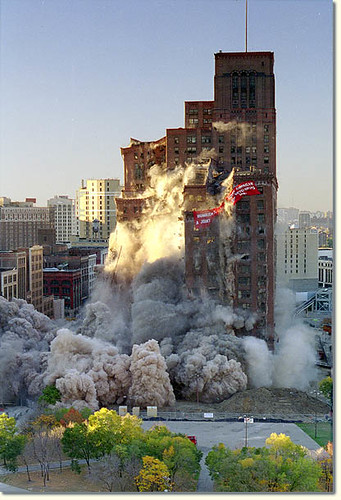
Demolition of Hudsons Department Store
"Final Sunset" The Requiem for Hudson's Suite, Lowell Boileau 1998. Demolition of the Downtown Hudsons Store, Detroit.

Labels: , , ,

Thursday, May 03, 2007

Brief comment on the height limit

Within the last couple months, there was a forum somewhere, the Building Museum I think, about DC, and Christopher Leinberger, a fellow at the Brookings Institution, and involved somehow in teaching real estate at the University of Michigan, commented about the height restriction in DC, that it should be lifted.

Yesterday, the Post (see "Growth Machine") ran a follow up story about this, "High-Level Debate On Future of D.C.," subtitled "With Land in Short Supply, Scholar Says Taller Buildings Should Be Permitted."

A small bone to pick would be calling Mr. Leinberger a scholar. He's a developer, who's always had a scholarly bent, writing quite prolifically as you'll see if you check out his website. But he's not quite the "independent" objective academic, he's part of the real estate industry. Granted that the Brookings website identifies him as a scholar, but Mr. Leinberger's own website describes himself as a "Urban Land Strategist and Developer."

Nevertheless, he raises a legitimate point, that the city's economic competitiveness is impacted by the height limit. This was mentioned in the O'Cleiricain (spelling) report from Brookings in the early 1990s about the structural problems with the DC budget, that the height restriction limits property tax revenues, and leads to higher rents (due to reduced supply and increased demand).

It's one of many reasons that justify the federal payment to DC, in response to revenues foregone in many ways (non-taxable land, non-sales taxable transactions, exemptions on the ability to tax certain businesses, such as Fannie Mae, etc.)

The reality is that submarkets in the region like Rosslyn, Bethesda, Tysons Corner, and Alexandria, which seems to specialize in attracting nonprofit associations, etc., can underprice DC rents because their buildings are taller, and therefore the cost per square foot is less when compared to DC.

However, Patti Gallagher, director of NCPC, reflects the concern of many in her quote in the article, referring to the important viewshed corridors afforded to the prominent buildings in the city as a result of the height restriction. You can see buildings and structures such as the U.S. Capitol and the Washington Monument, as well as the Basilica of the National Shrine of Immaculate Conception or the Washington Cathedral, or even well-located schools such as McKinley Tech or Cardozo High School from many points in the city because of this law.

Even so, buildings in certain locations are impinging views that I once took for granted. For example, the new condominiums at Senate Square--and I like the design quite a bit--obscure views of the Capitol from north of Florida Avenue.

Nonetheless, I think that the height restriction could be surgically modified. But the number of places where it could likely be done would be limited.

Go up to a prominent point like the grounds of McKinley Tech and look around the city from that point, and you'll see what I mean.

On the other hand, letting the traditional Downtown, formerly known as the "Central Business District" now being renamed and expanded and called the "Center City" could probably go up to 160 to 180 feet wouldn't have that much negative impact.

But I wouldn't necessarily say this about the adjoining areas that are being amalgamated into the "Center City." NoMa, M Street SE, South Capitol, because of their proximity to the Capitol especially, should retain fealty to the height restriction.

(Note: smaller buildings also contribute to the intra-city sprawl phenomenon that I have been writing about.)

Labels: , , ,

Wednesday, May 02, 2007

Considering Downtown DC: The Center City Action Agenda 2007

DC Builds
National Building Museum
Wednesday, 6:30 – 8:00 pm

Where is Downtown DC heading? Will it come into its own, with a character befitting a great capital city; while also thriving as a diverse, dynamic, and culturally rich centerpiece for the Washington area? Alex Krieger, principal of Chan Krieger Sieniewicz, will present strategic actions needed to ensure DC's competitiveness and livability. He will discuss the visionary framework and the near-term strategies developed in cooperation with local and federal partners. This lecture is presented in collaboration with the DC Office of Planning and held in conjunction with Washington: Symbol & City, which will be open for viewing.

$12 Museum members and students; $20 nonmembers. Prepaid registration required. Walk-in registration based on availability. Click here to register

Labels: , , , ,