Rebuilding Place in the Urban Space

"A community’s physical form, rather than its land uses, is its most intrinsic and enduring characteristic." [Katz, EPA] This blog focuses on place and placemaking and all that makes it work--historic preservation, urban design, transportation, asset-based community development, arts & cultural development, commercial district revitalization, tourism & destination development, and quality of life advocacy--along with doses of civic engagement and good governance watchdogging.

Saturday, November 30, 2019

Small Business Saturday

That American Express, a big corporation which mostly makes its money from big corporations, is the sponsor of Small Business Saturday, which focuses on independent businesses, is ironic and illustrates the contradictions in the American economy.

We laud independent businesses.  But we promote and support bigness.

Independent businesses often focus on providing artisanal goods, but such goods are more expensive, usually being produced with a lot more labor, and at the same time, our consumer economy is focused on buying a lot, but at the lowest cost.

In business there is the line: "Price, Quality, Speed: pick any two."  With a focus on price, independent business in terms of production and sales is usually the loser.

Furthering the contradictions, as part of its focus on Small Business Saturday, American Express has produced a set of videos focusing on small businesses, called "Saving Main."  The first one is on a clothing-focused store in Oakland, California, called OwlNWood.


Interestingly, while most of the economic changes--especially housing production and the attraction of higher income residents (because they can't afford to live in San Francisco) in Oakland are likely to benefit her ability to sell more product, it could affect her ability to stay in the same location if rents rise/she doesn't own the property. 

And in the video she mentions specifically how her local supplier for custom sewing, a small manufacturer, is likely to be displaced as higher value property uses replace industrial uses.

Her business closes.

But to me, not covered in the video, the issue is likely more than the changes in Oakland, although yes, they are an issue, but more about the commercial district and its foot traffic, and possibly the way that the store is managed.

Shifting to Salt Lake mostly, before moving we joked about opening an apparel, gift, and coffee shop, based on the way a couple stores in DC work.

Coffee bar at the back of the Modern General Store by Sylvester & Company in Savannah.   (This branch has closed but I think it would have worked in a more walking, less touristy district, in a community with a bigger population.  The company still has a store on Long Island, albeit in the tourist destination of Sag Harbor.)

But besides SLC being 1/3 the size of DC, the reality is that this is an automobile-centric community, not transit-walking based like many neighborhoods in DC, which was the model for the business concept.

(Other models are a couple stores in Hampden in Baltimore and in Savannah, where a bunch of stores--books, apparel and gifts, housewares--also incorporate coffee shops, which is a great element because as I say "people eat and drink every day, but they don't buy a shirt or book every day..."  More recently, the Shop Made in DC store which was on Dupont Circle had a cafe.)

So I am skeptical that the concept could work (or at least, I feel more confident about doing such a store in a walking district), unless we get the absolutely right space, and place, and rent, and publicity able to attract customers who have to consciously make the decision to visit, as opposed to stopping in while walking home from the transit station.

That being said, there are a fair amount of independent businesses here.

And they do succeed in the context of an automobile-centric community.

It's important to distinguish the characteristics a business needs in order to be successful.

The general belief is that an apparel shop like OwlNWood can't succeed in a small commercial district, they need to be located in a larger, more regionally serving district--that can still be a traditional commercial district, the big issue is being able to draw on a much larger customer base.

There are exceptions though.  And it's important to know why those exceptions work.

-- "Why ask why? Because," 2007
-- "Retail and restaurant check up surveys," 2009
-- "Indepependent retail businesses can succeed and thrive," 2008
-- "Critical analysis and critical analysis of retail, communities, etc.," 2014
-- "Little room for error: small retail business in general and in DC in particular," 2019

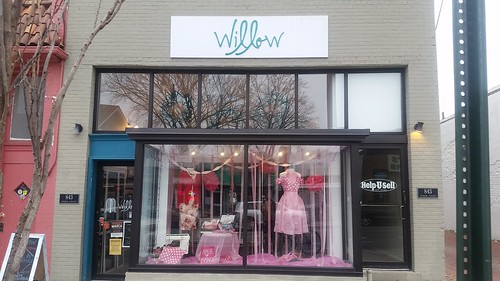
A couple that I've come across in my work are Pavement in the Lawrenceville District in Pittsburgh and Willow on Upshur Street in DC.

Storefront window, Willow retail storeI wrote down my 12 lessons from Willow, but those notes are boxed away somewhere.

For Willow, it's key that the store has an ever changing inventory of clothes that are competitively priced (constantly changing means that if you don't buy it when you first see it it might not be there when you return), is neighborhood-anchored, but also on the walking route to and from transit--both bus and subway, and that the owner lives in the neighborhood, and has developed what I call "a brigade", that is a group of fans, mostly neighborhood residents but not exclusively, who stop by to shop frequently.  The store also supports and develops events both for the store and the commercial district.

Bene hat shop, 6200 block of 3rd Street NWThis is key.  My Manor Park DC neighborhood has a little one block shopping district on the 6200 block of 3rd St. NW and there are three clothing stores there--a hat shop, a boutique, and a consignment store.

All do great window displays.

But by contrast to Willow--which also does great window displays--few people walk in Manor Park, and the displays are wasted.

Pavement is in a more widely known commercial district, but it isn't a setting with a lot of foot traffic.  So there has to be constant promotion in order to attract customers.  Although 10 years later when I first came across it, Lawrenceville has more than come into its own.

Trying to figure out why Pavement was an exception to the rule about apparel retail I read Designing Brand Identity which led to this table:

Principles for creating complete concepts/identity systems for independent retail businesses*

• Understand the needs, preferences, habits, and aspirations of the target audience.
• Good design sells. It is a competitive advantage. Design is systems and processes, not just graphics.
• A disciplined, coherent approach leads to a unified and powerful brand presence.
• Create a distinct position and complete identity for your store/concept.
• Experience and study the competition and learn from their successes and failures.
• Understand traffic flow, the volume of business, and economic considerations of your location.
• The storefront is a mass communications medium that works 24/7 and can attract new customers, influence purchasing decisions, and increase sales.
• Logo and signage expresses the brand and builds on understanding the needs and habits of users in the environment.
• Exterior signage must consider both vehicular and pedestrian traffic.
• Design an interior space that is sustainable, durable, easy to maintain and clean, and is energy efficient.
• Consider the dimensions of space: visual, auditory, olfactory, tactile, and thermal.
• Understand the psychological effect of light and lighting sources.
• Consider the needs of handicapped customers and those of different ages.
• The shelf is the most competitive marketing environment that exists.
• Align merchandising strategies with displays, advertising, and sales strategies.
• Create an experience and environment that makes it easy for customers to buy, and that inspires them to come back again and again.
• Create an environment that helps the sales force sell and makes it easy to complete a transaction.
• Align the quality and speed of service with the experience of the environment.
• Benchmark the quality and speed of service against the competition.
• Consider all operational needs so that the store delivers on the brand promise.
• Anticipate future growth. Measure, evaluate, change. Constantly ask: is the message clear?; is the content accessible?; is the experience positive?

* This table was built from the section on "creating touchpoints" from Designing Brand Identity (second edition) by Alina Wheeler

(Social media barely existed when I produced that table.  It's a necessary addition now.)


carytown3By contrast the Hampden district in Baltimore and Carytown in Richmond are regional destinations in that they are known for providing a wide range of independently run retail businesses.

So even though those communities are automobile-centric, those districts are destinations.

In "Little room for error: small retail business in general and in DC in particular," I listed 11 reasons why small retail businesses can fail:
  1. Rents are too high relative to sales.
  2. Property taxes for retail space are too high generally and in neighborhood commercial districts specifically.
  3. Size of the market.
  4. Too much retail space overall.
  5. Constant addition of new retail districts and space to the city's footprint and inventory of space. (WRT restaurants, there are some articles about the number of restaurants closing in DC, including the Washington City Paper article "What Are the Warning Signs That Your Favorite Restaurant Is About to Close?." Many chalk it up to there being too many restaurants relative the market. They didn't mention the number of "new" destination districts in the city such as the Wharf, Navy Yard, and Union Market.)
  6. Consolidation and chaining of the retail industry.
  7. Competition/Fit of the business model/lack of robust concept and operations model.
  8. The impact of e-commerce.
  9. Location (both generally and whether or not a particular location is a good fit for a particular business -- e.g., waterfront districts seem to be better for food and beverage and not so great for retail).
  10. Lack of a good commercial district marketing and coordination mechanism (the original list uses different wording, referring to DC's failure to have a differentiated set of commercial district revitalization approaches that can fitted to the conditions and needs of particular districts), especially ongoing marketing.  Also see "The "soft side" of commercial district competition"
  11. Store sizes are too big relative to sales.

Labels: , , , , ,

Wednesday, January 30, 2019

A great opportunity to see the value in including coffee/food/beverage as an element of "traditional" retail

Shop Made in DC is a retail shop in Dupont Circle selling locally made items, but it includes a coffee bar, and also sells artisan foods made locally as well ("Holiday Shopping, Small Business Saturday, etc.," 2017).

The firm is opening a new store in the new Wharf district on the Southwest Waterfron ("Shop Made in D.C. opening second location," Washington Business Journal) but without the coffee bar.  From the article:
The new location will give Shop Made in D.C. the chance to test a purely retail format, said Price. In Dupont Circle, the venue combines both traditional retail with a casual food and beverage component that highlights local food companies and beverage producers. ...

Price and Babin signed a one-year lease for The Wharf space to test the concept in a more tourist-heavy location.

“I think The Wharf will actually surprise us with the amount of people that live closer to there coming in,” Price said. “And of course, being in a neighborhood that is very tourist driven is of interest to us.”

Whereas the Dupont store opens early on weekdays for the coffee crowd and has more limited hours on weekends, Price expects The Wharf location to be much busier on weekends and in the evenings. It will be open from 10 a.m. to 8 p.m. daily to start.
My sense is that their retail sales will be significantly diminished by the failure to include a coffee bar.

People eat and drink every day.

OTOH, people buy retail stuff that is physical goods, especially artisanal produced items which tend to cost more (cf. The Arts and Crafts Movement), infrequently.

And the Wharf District customer base is likely to be visiting more for eatertainment purchases, and will be less inclined to buy physical goods.

Labels: , , , , ,

Wednesday, January 09, 2019

Little room for error: small retail business in general and in DC in particular

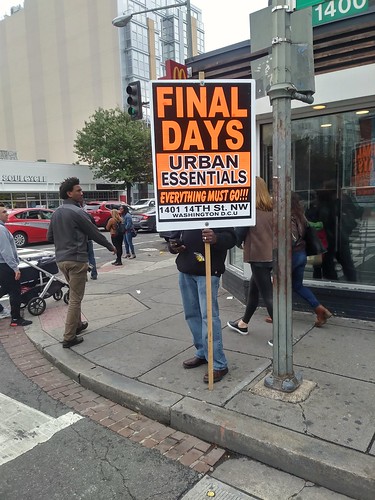
Final Days: Urban Essentials going out of business sale signLast week, Washington Post writer Paul Schwartzman had a piece, "Amid prosperity, D.C.'s independent retailers struggle to survive," on the seeming increase in failure of small retail businesses in the city.

Years ago, I took him around (actually, he wore me out) to look at popups -- third floors on traditional rowhouse buildings -- for a story.

And later he interviewed me for a story he wrote about the impact of property assessment rates ("Feeling the Pinch Of D.C.'s Prosperity"), something I had been agitating about for years. I stopped testifying about after awhile after realizing that Councilmembers didn't really care to understand why the problem existed.

-- "Avoiding the real problem with DC's property tax assessment methodologies," 2007
-- "Testimony -- Historic Neighborhood Retail Business Property Tax Relief Act," 2006
-- "Forcing Displacement by the disconnection of tax assessment models from public policy goals," 2005
-- "Displacement of retail businesses through increasing property tax assessments," 2005
-- "Revisiting the issue of neighborhood commercial district property tax methodologies," 2013

After Paul's 2007 article, I had a letter to the editor about it, re-emphasizing the point about the disconnect between property values, therefore tax rates, and the value of properties in terms of their revenue capacity in terms of sales/square foot.
My letter in the Post from July 25, 2007

Tax Policy Hurts D.C.'s Local Businesses 


A July 20 Metro Article ["Feeling the Pinch of D.C.'s Prosperity: Small Businesses Cry Out for Relief From Rapid Rise in Property Taxes"] inadequately explained why tax assessments are rising for small commercial property owners in the District.

Regardless of buildings' locations and use, the D.C. Office of Tax and Revenue values commercial buildings as if they could be converted into downtown office buildings. If the purpose is to turn the entire city over to office buildings and retail chains, then this property tax assessment methodology is working.

The market for downtown property is not local; it involves national and international developers, lenders, and portfolio investors. The market for small-footprint buildings in neighborhood commercial districts is local--in terms of property owners, investors, tenants, sales potential and rents. The solution is simple: differentiated tax assessment methods.

The legislative focus on property tax abatements or tax caps fails to address this fact.

As a result, locally owned businesses will continue to close or relocate to the suburbs, while more and more of the retail identity and uniqueness of the District is lost and the city's retail landscape becomes reshaped into yet another mall, albeit outdoors, featuring national brands.
But while I think the fact that DC commercial retail rents are too high, and that commercial property tax rates -- shaped by the fact that the Central Business District is a national-international real estate market, which reprices value beyond local considerations, and this ends up shaping the value of commercial property across the city, whether or not the commercial district is a part of the national or international real estate market -- independent store owners have other problems.

For example, Dupont Circle and Cleveland Park properties are often owned by national firms, whereas properties Downtown, Georgetown, and Friendship Heights involve both national and international firms.

Years ago, in the entry "Why ask why? Because," I discussed store operations in terms of various "mixes."  But it's about more than that.  Here's what I think is a more comprehensive list of the conditions faced by independent businesses:

1.  Rents are too high relative to sales.  The metric is that a business should pay no more than 4% to 10% of gross revenue in rent, although restaurants pay up to 15%.  In malls and large commercial buildings owned by major firms, after a certain point, tenants also pay out as rent a portion of total revenue.

Based on a calculation of estimated sales per square foot, you can figure out the gross revenue potential of a space, and calculate what the rent "should be" on that basis.

-- "Cleveland Park Retail: My off-hand evaluation, the rents are too high," 2009
-- "Commercial retail rents #2," 2009

At best, a store has a gross profit of 20% before taxes.  Paying more than 10% of gross revenue in rent pretty much wipes out profit.

(2.  Property taxes for retail space are too high generally and in neighborhood commercial districts specifically.)

3.  Size of the Market.  DC isn't that big, about 700,000 residents.  The number varies, but the average resident supports up to 7.5 s.f. of retail space.

Yes, the daytime population swells, but office workers have a very limited range of stuff that they buy, mostly prepared meals, and convenience goods.  A number I've used for years, derived from an economic research firm, said the average office worker supports 2 s.f. of retail and 5 s.f. of quick service food.  Although in the DC context, one study for the SW Ecodistrict found that about two-thirds of federal workers bring their lunch.

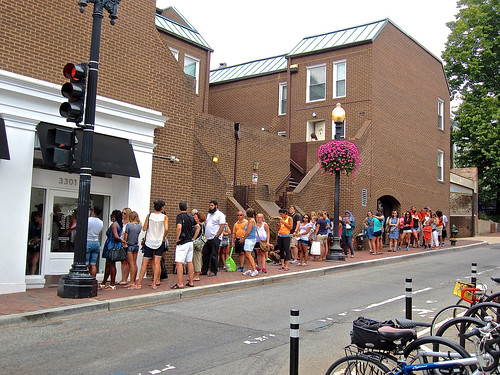
Tourists add to the mix, but mostly spend on food and lodging, and some retail.  The lines at Georgetown Cupcake or the busy restaurants at Washington Harbor in Georgetown when often the food isn't that great, demonstrates the value of tourism to retail and restaurant spending in DC.
Cupcakes in Georgetown, Washington, DC
People in line at Georgetown Cupcake.  Flickr photo by Robby Virus.

4.  Too much retail space overall.  With that 7.5 s.f/resident metric, DC can support upwards of 5 million square feet of retail space + some calculation for the spending by daytime office workers and districts.

There is much more retail space than that in the city.  E.g. on 14th Street and H Street NE likely there is more than one million s.f. in each place.

Nationally this is the case too, especially vis a vis the impact of e-commerce.  The US has 4x the retail space per person as the UK or other countries.  That's why so many chains are going under, or closing stores.

5.  Constant addition of new retail districts and space to the city footprint.  While in some respects the city is under-stored compared to the suburbs, the addition of new retail districts like The Wharf , Navy Yard, City Center in Downtown, and Ivy City puts pressure on existing districts, without there necessarily being a commensurate increase in the overall customer base.  Granted some of this space serves regional markets and tourist segments and isn't fully dependent on DC residents for success.

(Some of this space is sold on the belief that because it's located on commuter routes out of the city it will draw non-resident shoppers, but for the most part, most shoppers do their shopping nearer to home and not as part of work trips.)

Similarly, the impact of re/new/ed entertainment districts such as H Street or Ivy City puts pressure on existing districts like Adams-Morgan or Georgetown.
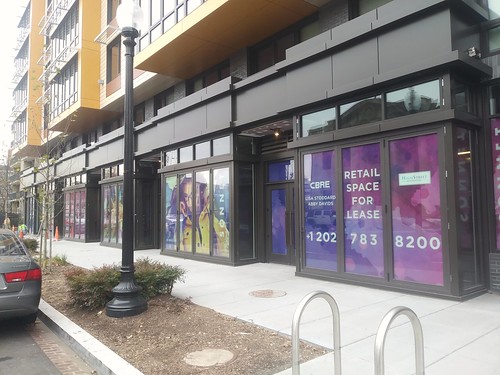
New retail space at the Sonnet mixed use building on the 1400 block north side of U Street NW, Washington, DC
New retail space at the Sonnet mixed use building on the 1400 block north side of U Street NW, Washington, DC.

Every new mixed use building adds more supply to the retail space inventory.  But it just isn't in big new districts as greyfield developments..  It's in most every place where new "mixed use" buildings are created, with retail on the ground floor.  For example, this new building on the 1400 block of U Street NW is in place of a parking structure.  It adds housing above, but new retail on the ground floor, where none had previously existed.  While you can argue it will help strengthen the U Street streetscape, tying together north and south and drawing from the energy of 14th Street, it still is adding space likely beyond the demand.

6.  Consolidation and chaining of the retail industry.  Independents are hurt by how the retail sector has become dominated by chains, which enjoy special treatment by vendors, banks, and laws.

One way to counter this is to join buying groups and business services cooperatives, but not all independent stores do this.

7.  Competition/Fit of the business model/lack of robust concept and operations model.  Chances are good that there are other stores selling the same types of goods, so to be successful, a store has to have a good "value proposition."  That might not necessarily be price, it can be quality, service, experience, etc.

-- "Why ask why? Because," 2007
-- "Retail and restaurant check up surveys," 2009
-- "An update to Richard's Rules for Restaurant-Based Revitalization on the failure of wine bar restaurants in DC and Baltimore," 2018

Plus some places may not be that great anyway.  That's why I recommend that more commercial district revitalization organizations contract out for independent third-party evaluations of retail businesses, such as what are called "mystery shopper" evaluations.

-- "Critical analysis and critical analysis of retail, communities, etc.," 2014

(See table below.)

8.  The impact of e-commerce.  Online purchasing shaves off upwards of 10-20% of sales -- and more in certain categories such as office supplies and electronics, and has completely destroyed other categories altogether, such as travel -- reducing the revenue stream, profit margins, and flexibility to face downturns.

9. Location.  Not all submarkets in the city can support every type of retail category or even multiple stores in particular categories.  This gets back to the size of market point, but also a recognition that some commercial districts are "regionally serving" in that they serve multiple neighborhoods and include anchors that draw beyond the immediate neighborhood (and need to do so in order to be successful).

The smallest districts tend to support convenience retail -- food, pharmacy, hardware, gasoline -- and might have one or two specialty stores that may also serve as destinations, e.g. a store specializing in antique lighting in Cleveland Park, etc

10.  Lack of differentiated commercial district coordination mechanisms.  DC has Business Improvement Districts or Main Street programs.  There are plenty of areas that need something different

-- "The "soft side" of commercial district competition," 2006

Typically, across the nation, Business Improvement Districts function in large city commercial districts, especially "Downtown."  Some of the most prominent BIDs in the US are in New York City and Philadelphia, along with DC's Downtown DC BID.  The main actors in BIDs are the property owners.

Main Street groups typically are present in smaller towns and in neighborhood commercial districts that don't have a lot of office buildings.

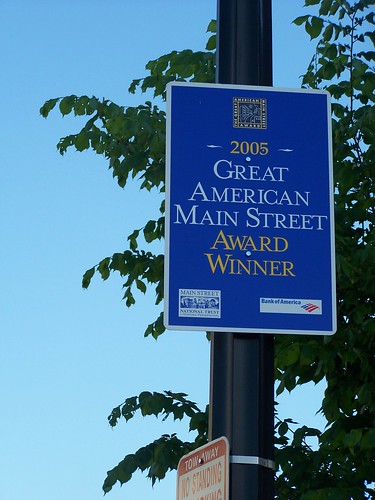
Barracks Row, Great American Main Street signThe Main Street approach is different from the BID approach in that residents and other stakeholders who don't necessarily own businesses in the commercial district are drawn into the organization, to broaden the range of skills and volunteers able to work on issues.  (In my experience, Main Street volunteers tend to be 10-15 years younger than typical historic preservation group members, and live within a couple blocks of the main commercial street.)  DC began a city Main Street program in 2002.

A hybrid of the BID and Main Street approach is the "Community Improvement District," a special service district (that's what BIDs are) that covers both commercial and residential areas.  Baltimore has a couple, and one in particular, Charles Village, has been very contentious with a group of residential property owners who resent paying towards the SSD.  California has a lot more types of these districts, especially in San Francisco. 

But I have also written about the BIDs in San Diego, which are somewhat unique, in that they use the BID funding mechanism--a fee per $100/property value--but tend to use the more ground up "Main Street Approach" to shape the programming and orientation of the organization.

So the commercial district revitalization organizations in San Diego have the advantage of steady funding from a property tax assessment like a BID, but the broader organizational, programming, and volunteer structure of a Main Street program.  See "Let's Assess the Assessments" from the San Diego Reader.

That's a form that we're missing in DC, and ultimately the lack of steady funding has been the biggest problem for neighborhood commercial district revitalization organizations in the city.  But also some districts need marketing and business support, but not necessarily the Main Street model, etc.

11.  Store sizes are too big relative to sales..  National chains have been buffeted by these changes too and one of the things they are doing besides closing stores or going out of business is shrinking store size.

This reduces inventory and the amount of money tied up in it, increases focus on better selling items that sell more quickly, and reduces fixed costs for rent and variable costs for labor, utilities, etc. 

====
In short, I think that many of the stores mentioned in the Schwartzman piece have multiple issues, not usually just one.  Rent/commercial retail property issues are only two. 

From "Retail and restaurant check up surveys":

------------------------------------------------------------------------------------------------
Principles for creating complete concepts/identity systems for retail businesses*
------------------------------------------------------------------------------------------------

• Understand the needs, preferences, habits, and aspirations of the target audience.
• Good design sells. It is a competitive advantage. Design is systems and processes, not just graphics.
• A disciplined, coherent approach leads to a unified and powerful brand presence.
• Create a distinct position and complete identity for your store/concept.
• Experience and study the competition and learn from their successes and failures.
• Understand traffic flow, the volume of business, and economic considerations of your location.
• The storefront is a mass communications medium that works 24/7 and can attract new customers, influence purchasing decisions, and increase sales.
• Logo and signage expresses the brand and builds on understanding the needs and habits of users in the environment.
• Exterior signage must consider both vehicular and pedestrian traffic.
• Design an interior space that is sustainable, durable, easy to maintain and clean, and is energy efficient.
• Consider the dimensions of space: visual, auditory, olfactory, tactile, and thermal.
• Understand the pyschological effect of light and lighting sources.
• Consider the needs of handicapped customers and those of different ages.
• The shelf is the most competitive marketing environment that exists.
• Align merchandising strategies with displays, advertising, and sales strategies.
• Create an experience and environment that makes it easy for customers to buy, and that inspires them to come back again and again.
• Create an environment that helps the sales force sell and makes it easy to complete a transaction.
• Align the quality and speed of service with the experience of the environment.
• Benchmark the quality and speed of service against the competition.
• Consider all operational needs so that the store delivers on the brand promise.
• Anticipate future growth. Measure, evaluate, change. Constantly ask: is the message clear?; is the content accessible?; is the experience positive?

* This table was built from the section on "creating touchpoints" from Designing Brand Identity (second edition) by Alina Wheeler

Retail's tough in general.  But people eat more than they buy stuff.  The Restoration Hardware in Georgetown, once one of the company's signature stores, is now a Wawa convenience store ("awa is coming to Georgetown. Bid farewell soon to Restoration Hardware," Washington Business Journal).
Restoration Hardware is now a Wawa convenience store, Georgetown, D.C.

Labels: , , , ,

Tuesday, December 04, 2018

Revisiting stories: the revitalization of 9th Street NW around the DC Convention Center

After the DC Convention Center opened, people were surprised that it didn't result in improvement on 9th Street NW, an old commercial corridor that had long since seen better days.

I responded, making the point that besides the fact that the Convention Center wasn't designed to connect to the community outside of the building, if you wanted the street to improve, you needed to invest money in its improvement in advance of the Convention Center opening, so that there were functioning businesses there to serve the hordes.  That didn't happen.

-- "Speaking of enclave development," 2006
-- "If you don't understand linkage and context then you have learned nothing," 2007
-- "Another example of 'trickle down policy' and service failure," 2008

And this from an entry on how DC's tourism tax revenue stream is used:

In fact, I think it's a travesty that the revitalization of the historic commercial buildings along 9th Street NW between M Street and Rhode Island Avenue wasn't specifically required as part of the development of the Washington Convention Center.

1300 block 9th Street NW, west side Beleagued Be Bar between two vacant disinvested buildings on the 1300 block of 9th Street NW.

Why would people be enticed to walk outside the Convention Center to explore the neighborhood, when the commercial district looks bombed out?

Rehabilitation of the extant buildings on 9th Street should have been the focus of retail development for the Convention Center first, not the spaces within their own building, which will be focused on keeping people in the Convention Center rather than "letting them out."

A couple years ago, in response to an article about the failure of retail spaces within the Convention Center, I wrote about this topic again, making the same point.

-- "The time to plan for retail in and around the Convention Center was long before it opened in 2003 and certainly before 2015," 2015

But this weekend, I was briefly in Blagden Alley and 9th Street NW was markedly different.
9th Street NW, D.C.

Most of the commercial buildings in the corridor have been rehabilitated, here and there is infill mixed use development of a larger scale, there were interesting businesses in many of the spaces (mostly food and drink related), and there were tons of people on the street and in and around Blagden Alley specifically.

This photo of the same block in 2006 doesn't look so bad.
1200 block, 9th Street NW, west side

But that wasn't the case for most of the street back then like this section of the same block, which was pretty typical.
1200 block, 9th Street NW, west side

Blagden Alley, Shaw, D.C.I would assert that the improvement hasn't happened because of the Convention Center, or because they finally opened a Convention Center Hotel on Massachusetts Avenue.

Although the CC is finally fixing some of the problems with the retail spaces, and the 9th Street side of the complex has two heralded restaurants, the Unconventional Diner and Smoked and Stacked, a sandwich shop.  Both continue to be acclaimed and are likely to be successful for the long haul.

There's also a Union Kitchen Grocery, which claims to sell local foods, but it appeared to me that most of the items sold there wouldn't meet the definition.

Blagden Alley.

It's happened mostly because DC has added population, especially in new mixed use buildings in the core.

Also in that area specifically, the O Street Market (between 7th and 9th Streets) was redeveloped into a mixed use space with apartments, condominiums, and a hotel as well as a renewed Giant Supermarket and some other retail, which has helped to stoke both streets.

But if DC hadn't added population in the last ten years, without a focused investment program in the area, I wonder how much change there would be even today?

It would be the Convention Center and the Convention Center Hotel and likely very little else.

Labels: , , , ,

Friday, April 06, 2018

Three interesting articles

1. Starbucks opens a store in the Bed-Stuy neighborhood of Brooklyn as part of their social impact initiative ("Brooklyn and gentrification: Will Bed-Stuy feel the ‘Starbucks effect’ from new coffee shop?," AMNewYork).

The company has a director of social impact, Rodney Hines, and they've opened similar stores in Jamaica, Queens, Ferguson, Missouri, central Phoenix, Chicago’s Southside, East Baltimore and Long Beach, California. Plus they've committed to a job training program, although most of the people working in this particular store, although they live in the neighborhood, have already been working for the company, just at different stores.

2. The renaissance of Washington, through the lens of 14th Street NW, is the cover story of the April issue of Washingtonian Magazine ("The Reinvention of 14th Street: A History | Fifty years after burning in the riots, 14th Street is a glittering stretch of gentrified DC. For better or worse, here's how it happened).

It reads quite well and has a great set of images.

My first job in DC in the late 1980s was two blocks from this area, which was gnarly.  I would go down there sometimes to the post office, or to a low cost grocery around 15th and P Streets.  In 2006, after a meeting at the Reeves Center, walking with someone to the McPherson Square Metrorail station, I couldn't believe how different the street was in terms of people ("white people") walking along, on every block of our trip.

3. I've been meaning to mention a Shelterforce article ("Could Gentrification Be Changing D.C. Schools for the Better?") on Washington DC schools, where the authors opine that demographic improvement in neighborhoods will in turn improve the schools. I think the researchers missed the point. Of course, high income areas have "good schools" because they are dealing with privileged matériel. Improvements to the schools in low income neighborhoods that remain low income aren't really happening as discussed in this 2017 blog entry, "Fawning coverage of DC school "reform" doesn't push better practice forward."

Labels: , , ,

Friday, November 24, 2017

Holiday Shopping, Small Business Saturday, etc.

Cover, Golden Book Publishing, 1958.

Black Friday, the biggest day for retail sales.  I saw something on the news today that I don't believe.  They said that $682 billion in sales are made on Black Friday, today, the day after Thanksgiving, and the traditional start of the holiday shopping season.

That is $2,000 for every person in the U.S.

Small Business Saturday is a promotion created by the American Independent Business Alliance and now spearheaded by American Express ("Small Business Saturday gives local retailers chance to take on Amazon" and "Downtown merchants group pushing people to shop 'small'" Baltimore Business Journal).

-- Small Business Saturday website

The idea is that independent businesses can't compete  "head-to-head" against traditional chain retailers in terms of offering the best prices on mass market goods, especially on Black Friday, but they can differentiate their businesses in terms of artisan goods, customer service, and experiences.

Bene hat shop, 6200 block of 3rd Street NWMany stores run promotions throughout the day. 

In DC, as part of SBS, at 4:30 pm, Mayor Bowser will be visiting Bene' Millinery & Bridal Supplies at 6217 3rd Street NW in the Manor Park neighborhood of DC (it's a throwback retail block, one block, embedded within the neighborhood).

Bene' adjoins two other boutiques, Lovely Lady, which sells new clothes, and Kasia's Collection, a consignment type store.

All three of the stores do great windows but their hard work often goes unrewarded because few people walk by and look, and cars go too fast to be able to see the artistry.

Indies First 2017.  Indie Bound, an alliance of independent bookstores, holds its annual promotional event, Indies First, co-incident with Small Business Saturday, the first Saturday after Thanksgiving.

Artisan retail on the rise.  Traditional retail has been on the decline for some time.  Every week there are new reports on store closings, retail firm bankruptcies, and sales declines.  While some of this has to do with the rise of online retail, another perhaps more significant element concerns how people are using their time, specifically time using digital devices ("It's Not Just Retail That's Changing. It's Us," Bloomberg).

Separately, Bloomberg reports a rise in sale for independent stores and continued difficulty on the part of traditional shopping malls ("Mom-and-Pop Shops Are Threatening the Mall This Holiday Season").  From the article:
Spending growth at mom-and-pop businesses has outpaced that of the big chains in the past two years, according to Sarah Quinlan, senior vice president at credit-card giant Mastercard Inc., which tracks purchasing patterns. When they’re not shopping online, Americans are seeking more personal connections and advice -- something they can find lacking at national retailers.

“The consumer is shopping small,” she said.

Big chain stores still account for the majority of shoppers’ purchases, according to Mastercard. But many of the most affluent consumers are now clustered in walkable neighborhoods, letting them skip the mall in favor of neighborhood hardware stores, bookshops and grocers. And they’re willing to pay the higher prices, Quinlan said.
Relatedly, there are reports of the creation of more independent bookstores, including the opening of a new bookstore, Solid State Supply, on H Street NE last weekend.

Last week, I went to the opening of the new location of Willow, an apparel and gift store, in the Navy Yard district of the Capitol Riverfront.  Willow's first store is on Upshur Street NW in the Petworth neighborhood, and it's an exception that "proves the rule" about the difficulty of success for one-off apparel retail in neighborhood shopping districts. 

The proprietors aren't going to become wealthy, or a national chain, but they have figured out how to fill a niche in providing affordable apparel, complemented by gifts, cards, housewares, and items for children in neighborhoods with certain kinds of demographics.

I had been skeptical that such a store could work in the Navy Yard, which tends to have fewer in-neighborhood residents as regular customers, but the store, by reaching out further into a retail trade area that encompasses Capitol Hill, can be successful.

Another fascinating store in the Navy Yard district is Steadfast Supply, an independent which specializes in selling items created by locally-based artists and craftspeople,  It's an interesting contrast to Willow, because of the price points.  By featuring items produced "by hand," items definitely cost more money at Steadfast Supply, which might make it more difficult for them to build a base of repeat customers.

Storefront window, Willow retail store
The Willow apparel and gift store on Upshur Street NW, Petworth, Washington, DC.

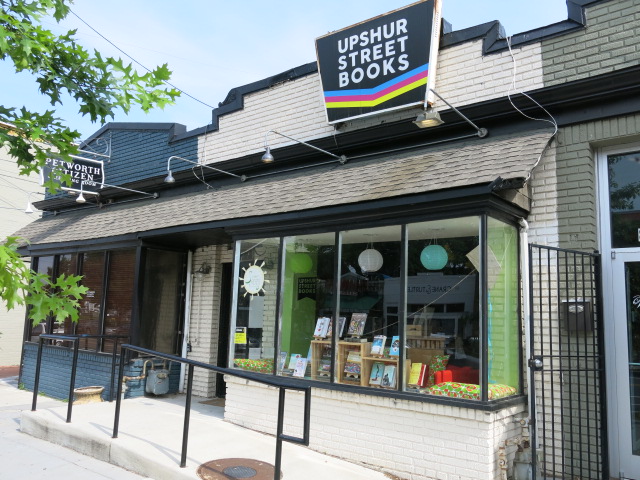
Willow, Steadfast Supply, Solid State Books and others (e.g., Upshur Street Books, the Big Bad Woof pet supply store in Takoma, etc.) are examples of the new small scale retail resurgence, which admittedly is a localized phenomenon. 

The development of this kind of retail can only happen in those areas with the right population and demographics.  But stores like Willow prove that there are more places that can support independent retail than was previously thought.

A couple of initiatives in DC.  From Mayor Muriel Bowser's weekly e-letter:
When Washingtonians share their talents and creativity with our city, we want to do all we can to support them. Last month, we celebrated the opening of Shop Made in DC, a new brick and mortar store and café stocked exclusively with DC brands and concepts. Tomorrow, I will celebrate Small Business Saturday on Minnesota Avenue, DC's newest Main Streets designee. And next week, the Council and I will host a variety of District-based entrepreneurs at the Wilson Building for a pop-up Made in DC: Holiday Bazaar.
Handwringing about the future of retail in New York City.  Crain's New York Business reports ("Local pols shop for solutions to retail's crisis") on legislation proposed by various City Councilmembers to provide support to independent retailers and restaurants, which have been caught between chain businesses and ever escalating rents.

Rents have been escalating in part over non-sales related objectives, or by property values being set in a fashion that is disconnected from the revenue potential of the space.

Proposals include tax cuts for retailers and rent control.  One program provides some discounted rent in a new development for four stores.

I still believe the best option is for New York City to create a commercial retail space community development corporation comparable to the SEMAEST group in Paris.  The Vital Quartier program has by this time supported 400 independent businesses and controls more than 500,000 s.f. of retail space.

From the Guardian article "Paris's new planning strategy: bookshops in, textile wholesalers out":
Devoted to "economic development and commercial diversity" in the eastern districts of the city, Vital'Quartier works in 11 parts of the city deemed stagnant or dominated by a single commercial activity.

In those areas, the Semaest targets premises, buys them, renovates them and then advertises for tenants who will be able to pay rent at affordable rates as long as their plans for the space concur with the authorities' vision. De Nuñez, who believed there was an "urgent" need for a Spanish-language bookshop, pays around €1,700 per month for his 60 sq metres in one of the priciest parts of the city.

"Normally you would have to pay a big sum of money up front, maybe €50,000 or €60,000," he said. 
The holiday window at 1z2z3z, a store featuring items for young children.

VCU Brandcenter students decorate store windows at Richmond's Westhampton shopping district.  VCU Brandcenter is the advertising program, and this year, students working on Project Holiday decorated the storefront windows of 28 stores on Libbie, Grove and Patterson Avenues ("VCU Brandcenter students create holiday window magic at shops," Richmond Times-Dispatch). From the article:
Their efforts are part of Project Holiday, a friendly competition for the students to come up with the most wonder-inspiring window display with a budget of just $100 per window and lots of creativity. The public will get the chance to vote on the windows they think are the most creative.

The project is a collaboration between the Westhampton Merchants Association and graduate students in the Experience Design track at the VCU Brandcenter. The participating businesses provided the $100 budget per window.
That's a great way for students to get practical experience in retail merchandising and builds on the idea of artisanal retail experiences.

Labels: , , , ,

Monday, November 30, 2015

President Obama and his daughters shop on Small Business Saturday

To the benefit of Upshur Street Books in Petworth (was there earlier last week to see Gabe Klein speak about his book, Start-Up City) and Pleasant Pops, a popsicle store, in Adams-Morgan ("For Obama, a new shopping haunt: Upshur Street Books," Washington Post).

Washington Post photo

President Barack Obama, joined by his daughters Malia, left, and Sasha, right, orders at Pleasant Pops on Small Business Saturday in Washington, Saturday, Nov. 28, 2015. (AP Photo/Carolyn Kaster)

20151129_122016.jpg
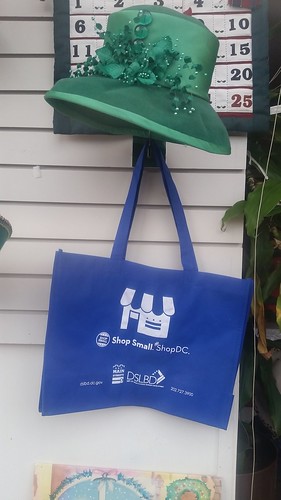
DC branded "Shop Small" shopping bag in the windows of the Bene hat shop on the 6200 block of 3rd Street NW.

In the Guardian ("Even my Furby knows it: our love affair with shopping is over"), Zoe Williams opines on a decline in consumerism and perhaps "the end of things."

I will say one of the problems with "commercial district revitalization planning" is that outside of convenience goods (food, pharmacy, etc.) and occasional purchase of shopping goods (furniture, appliances) and specialty goods (apparel), how much stuff do you really need?

(We go to estate sales on occasion, and you see a lot of stuff that will end up in landfills, which is a cautionary tale to us which discourages us from buying stuff we don't really need.)

Also see "As Americans Celebrate Thanksgiving, Black Friday Boycotts Gain Momentum" and "Black Friday Fever Cools as E-Commerce Trumps Brick-and-Mortar" from Brandchannel. The latter story reports sales down on Black Friday, in part attributed to more stores opening on Thanksgiving, but also because of a rise in online shopping.

Labels: ,

Friday, October 30, 2015

Bookstores and New Zealand Book Shop Day, Saturday October 31st

Bookstore days.  Riffing off the Independent Bookstore Day in the US, which in turn grew out of California Bookstore Day ("Independent Bookstore Day, May 2nd"), the inaugural New Zealand Book Shop Day is designed to promote patronage of independent bookstores.

According to Booksellers NZ, besides the US event, Australia holds National Bookshop Day and the United Kingdom holds Books are my Bag.

Bookstores as "third places."  Bookstores are great good places and are fundamental building blocks of community... even chain bookstores are great places to hang out, read, and hopefully from the standpoint of the managers and employees, for us to buy books and magazines..

Bookstore closures in DC.  I have to say I miss the Borders that was in Silver Spring before the company went out of business.   It was a major anchor and destination at the heart of their Downtown.

A couple years ago, the Barnes & Noble closed in Union Station ("Barnes & Noble closing in Union Station at end of year," Washington Post) in favor of an H&M, which outbid them for the lease.

More recently, Barnes & Noble announced they would be closing their downtown store ("DC Barnes & Noble closing, leaving no more big bookstores in the city"), their last location in the city.  I wish there would be an effort to support their reopening elsewhere in the central business district--even across the street from the Central Library or in a combination.  Their Georgetown store closed a few years ago, again because they were outbid by a company willing to pay a higher rent.

And pedaling through Dupont Circle, I noticed that the Books-A-Million store closed also, apparently that happened in July ("D.C. is losing another bookstore," Washington Post) although Kramerbooks & Afterwords Cafe is still going strong.

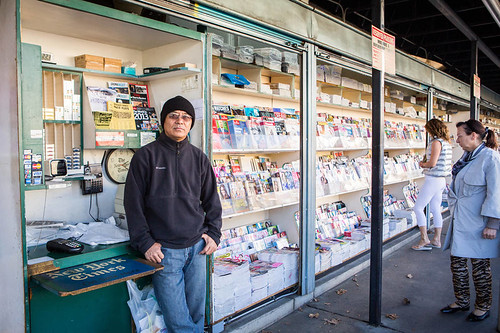
DC also used to have a number of stores dedicated to the sale of periodicals--magazines and newspapers--but with the rise of the Internet and the decline of newspaper economics, newspapers especially have significantly shortened their distribution chains, so it's very difficult to get "out of town" newspapers anymore, and people just use the Web or apps for news-gathering, so most of these stores have closed.  The Post had a story about this earlier in the month, "An old-school D.C. newsstand dies. Another rises to take its place."

Bookstore openings in DC.  But in a "bookstore light" kind of move, each new Busboys and Poets comes with a very small book section, now run by the award-winning DC bookstore, Politics & Prose.

Image from the Popville blog.

And as recounted in the blog entry cited above, Warehouse Industries, the restaurant-oriented local business group led by lifelong Washingtonian Paul Ruppert, last year opened Upshur Street Books, a small book store in the Upshur Street commercial district in the Petworth neighborhood, in a location adjacent to three restaurant properties that the company also runs.

Going forward, in big cities why not co-locate bookstores with main libraries?  Note that in some of my writings on planning for a new central library, I did suggest ("Civic assets and mixed use: Central Library edition") the possible co-location of "for profit" bookstores such as a Barnes & Noble, Baltimore's Red Emma's Bookstore (a business co-operative bookstore with a radical bent), a news-stand, a booksellers row like the backside of the National Library of Quebec in Montreal, or other independent operations.

In Montreal, the Bibliothèque et Archives nationales du Québec has set up the back side of its building to accommodate small booksellers, which they call the Allee des Bouquinistes.

DC doesn't have the population density necessary to support outdoor news-stand kiosks like they have in New York City (I remember the same types of stands in Detroit, when I was very young, back when Detroit had more than 1.5 million residents), but an "outdoor" newsstand would be really cool integrated into the facade of the Martin Luther King Library downtown, at the building corner at 9th and F Streets.
Marck's Brentwood Newsstand, Los Angeles
Marck's Brentwood Newsstand, Los Angeles.

Bookstores in France, the UK and Ireland.  According to the New York Times ("Assessing the Health of Independent Bookshops"), after a precipitous number of store closings in the US, the number of new shops is increasing, while in the UK and Ireland the number of bookstores continues to decline, while in France, bookstores remain successful ("French Bookstores Are Still Prospering," New York Times) supported by various government efforts, including maintaining "manufacturers suggested retail prices" for online booksellers ("France Takes Aim at Amazon to Protect Local Bookshops," New York Times).

Labels: , ,

Thursday, August 27, 2015

The time to plan for retail in and around the Convention Center was long before it opened in 2003 and certainly before 2015

WBJ photo by Joanne Lawton.

The Washington Business Journal reports ("Convention center tries to lease its retail space yet again") that the Convention Center is aiming to fix its retail. Granted the retail spaces within the building are a different issue from 9th and 7th Streets.
“We want to be able to connect Shaw and U Street all the way down to New York Avenue,” Brown said. “Right now it’s just sort of a gray-facade block, but we want to make it an exciting looking place.”  Brown expects the work on the building’s exterior and streetscape to begin in the next 12 months. He hopes Events D.C. will be announcing its first new retail and restaurant tenants before that, perhaps this fall.

It’s not the group’s first attempt to lease its retail space. Many of the storefronts in the convention center have been empty since it opened in 2003. Old Dominion Brewhouse was there for several years, but closed last fall. In March, the convention center announced that Sbarro has leased space there; it is currently the center's only retail tenant.
In the past I wrote some entries (e.g., "If you don't understand linkage and context then you have learned nothing" from 2007) about the failure of the DC Convention Center to spark "improvement" of 7th and 9th Streets NW abutting the center.    From that piece:
The interesting thing about today's Post articles about the Washington Convention Center, "Convention Center Not Living Up to Lofty Goals," subtitled "Declining Attendance Limits Economic Impact," and "Ninth Street Corridor Still Awaits Renaissance," was that before the Center was built, the paper ran little criticism, until the day it opened when the articles on the front page of the business section did offer some critical analysis. (You know the phrase, "a day late and a dollar short...")
The point of criticism is to bring about success. Too often, people focus on being criticized and not the message.
There are five primary reasons for the failure.

1.  The center was not built to be permeable on its west (9th Street) and east (7th Street) elevations. For the most part, entry occurs on the north and/or south sides of the building at K and L Streets primarily.

2.  Lack of a convention hotel for many years limited positive street activation along 9th Street especially, but also 7th Street.  The Washington Marriott Marquis convention center hotel opened in 2014 (pictured at right, photo from Marriott).

While I might normally be against public financial support of such facilities, which often don't work out so well (e.g., ">Hilton Baltimore's woes par for course for city-owned hotels," Batlimore Business Journal), the reality is that to better support large events at the convention center, large hotels are necessary.

I experienced this first hand with the 2004 American Planning Association national conference in DC.  The meeting was spread across two different hotels and the events at the secondary property experienced significantly reduced attendance, even though a shuttle service was provided.

While the convention hotel is focused on capturing restaurant and bar consumption from its guests and not sharing their customers with nearby businesses, not everyone limits their activity to on-site consumption, and some of them end up going to establishments nearby or elsewhere in Greater Downtown.

3.  The retail spaces within the convention center are poorly designed/subpar/badly situated.  And there is a lot of wasted space that could have been used as retail as well.

Most provide entry only from the outside of the building, and for the most part, most people enter the Convention Center from K Street, and secondarily from the Metrorail station/L Street.
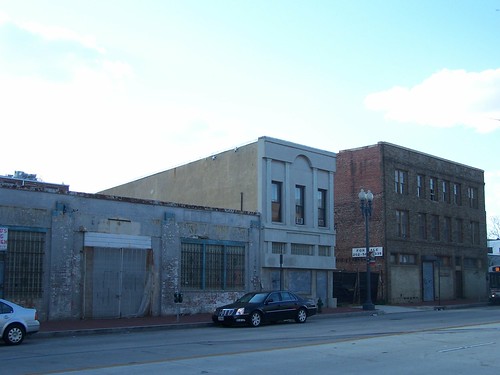
1200 block 9th Street NW, west side
1200 block 9th Street NW, west side, 2006.

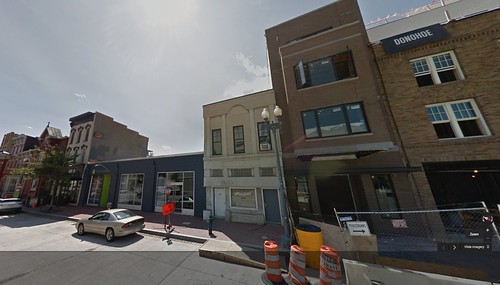
1200
1200 block 9th Street NW, west side, 2014, Google Street View.

4.  The Convention Center program didn't include a property and business development investment initiative focused on improving the commercial properties on 7th and 9th Streets in its catchment area.

Although it must be acknowledged that in 2003, when the Convention Center, this area was "emerging" at best in terms of the vitality of the commercial properties in those areas.  It would have been a stretch, even if the properties had been fixed up, to see--at least back then--the possibility of a thriving commercial district.  On the other hand, that a complementary investment program for the neighboring properties wasn't created ordained continued failure of the district.

Fortunately, in the past few years 9th Street around the Convention Center has begun to improve as the old Giant Supermarket on O Street has been redeveloped into O Street Market and from development efforts moving west from U Street and retail improvements in response to the addition of apartment and condominium buildings in the area, which has added population.

The more recent improvement of 7th and 9th Streets around U Street has little to do with the Convention Center, but has derived from new construction and rehabilitation projects there, which on 7th Street have centered around the Metro station and the fixing and reopening of the Howard Theater.

5.  The reality is that for conventions in DC, especially those focused on the federal market, many of the attendees are not visiting from out-of-town, but live in the area, and they aren't interested in spending time or money outside of facility.


It's not clear to me that the mistakes are well understood or that the new initiatives will have much positive impact.

As it is now 12 years after the opening of the Convention Center, what's incredible to me is that these problems weren't identified in the design phase of the project, from the 2008 entry "Another example of 'trickle down policy' and service failure":
It's not enough to "merely" build the big project. You've got to take simultaneous steps to ensure that the community outside the lot boundaries of the big project is ready to connect.

A classic example is 7th and 9th Streets NW abutting the Convention Center. There is a major disconnect. 7th Street is mostly housing. And 9th Street is mostly bombed out still. Is it a surprise that the Convention Center, which face it, mostly attracts people who stay inside the Center during their time there, leaving little time to patronize the local shops, hasn't jumped started neighborhood improvements?

In fact, on 9th Street the retail improvements are happening far to the north of the Convention Center, as if the Convention Center has little impact whatsoever. Although it is true that new housing is being developed around the Convention Center proper, plus eventually the Convention Center Hotel.

Labels: , , , ,

Wednesday, December 03, 2014

Economic development for small towns needs to include the development of cooperative stores

While the US has a strong co-operative business movement within agriculture, with groups serving farmers as businesses as well as marketing and distributing agriculture products to consumers.  For example, Land-O-Lakes, which produces dairy products, Ocean Spray, the distributor of cranberry-based products, and Sunkist Growers are all cooperatives.

But unlike countries like the UK, the US doesn't have as strong a record of retail and banking cooperatives operating on large scale.

Image from KAKE-TV.  

As US rural communities depopulate, and as retail firms focusing on rural markets run into financial problems--for example, Alco, a company serving small communities, has declared bankruptcy and all there stores, almost 200, will close and community residents will be left with big gaps in their retail options.


From "Former Kansas retailer Alco Stores seeks bankruptcy" (Associated Press):
Alco Stores Inc. has 198 stores in 23 states. The Coppell, Texas, company says most of its stores are in towns of fewer than 5,000 people and regions of fewer than 16,000 where there is no direct competition from national or regional broad-line retailers. Alco has 3,000 employees.

Alco had $474 million in net sales from continuing operations in its latest fiscal year. That represented a 2 percent decline from the year before. The company closed 14 stores early in the current fiscal year.
While the UK's Cooperative Group has had financial problems over the past few years because of the banking crisis' impact on their bank division, cooperatives can be a way for communities to step in and own and operate businesses that would otherwise fail.  The group has 4,900 stores and business locations, although they've sold off some divisions, like pharmacies, to raise capital.

I wrote about some of the independent "community serving retail" initiatives in the UK earlier in the year, "Community Owned Retail -- Resources from the UK." While the University of Nebraska Extension Service has an initiative on community retail, it pales compared to the efforts of the UK's Plunkett Foundation.

The Plunkett Foundation is focused on quality of life in rural communities and because of the shrinking population in many rural areas, they have developed programs promoting co-operatives, community shops, community pubs, and other enterprises.

-- Publications, Plunkett Foundation.

Similarly, I have been impressed with the European retail business network Spar, which functions similarly to how Ace Hardware or True Value Hardware organizations function in the US, as a wholesaler and business support group owned by and serving local retailers.  (Similar organizations and relationships exist in the US supermarket industry.)

This simplifies the ability to support stores at the local level when they would normally lack the resources of a national company or organization.

A similar model is the company Eurocash, which is a wholesaler supporting small independently owned shops in Poland ("The man who bet on tradition," Financial Times).

We need similar operations in the US to support store development in underserved communities.

Also see "Yoga, dance and microbrewery beer at UK's first community pub," (Financial Times).

Labels: ,

Thursday, August 22, 2013

Testing changes to zoning with demonstration projects

This coop in Ballard is tucked in the corner of the lot, against the back alley. 

One of the big problems with zoning is that it is an all or nothing phenomenon.  Usually there are a number of authorized uses, which triggers no significant review, unauthorized uses (such as chickens in DC), or uses that may be allowed depending on hearings or other changes.

While traveling this past week, I read a bunch of newspapers from the Pacific Northwest and there were a bunch of articles about how changes to zoning codes concerning matter of right use (such as a automobile dealership in a residential area) allowing discordant uses (commercial in solidly residential areas) in close proximity created problems.

A guy in my greater neighborhood had some chickens--DC hasn't legalized urban poultry even though many of the nation's largest cities have--and someone reported it (comparable probably to how someone stole the flowers I planted on the alley side of our property) and he has to get rid of them.

He's suggesting that they allow him to keep the chickens until the code is changed. 

While there is zero chance of that happening (see this 3+ year old story on the topic "D.C. residents fight to raise poultry in the city" from the Post, as well as Max Weber's writings on bureaucracy, James Scott Seeing Like A State, and John Friedmann's Planning in the Public Domain), it does raise a good point, that it is worth testing certain kinds of zoing changes on a limited basis, to get people to see how it will work, to make tweaks to proposals, etc.

We don't have that kind of iterative process in zoning.

But we need some type of demonstration process for at least five categories:

- urban poultry
- accessory dwelling units (it's actually legal now in some parts of the city, but it isn't really used much)
- apartments in houses
- "corner" stores (it was legal at one time so there are examples here and there across the city, especially in Capitol Hill)
- conversion of large houses to "rooming houses" (this is illegal now but could be allowed in certain situations).

This backyard has a small garden and is also used by the dog.  The family has four chickens.  In Seattle, the legal limit is 8 chickens for lots less than 10,000 s.f.

Otherwise, people think everything will be going to hell with the changes.  Ideally, if they saw such in action, knowledge might trump fear.

We were traveling this past week (a wedding) and saw some urban chickens in two different neighborhoods in Seattle, in Ballard, a neighborhood with escalating housing prices, and in a middle income area, Madison Valley.

The chickens have been at both those households for 10 years or more.  They, their neighborhoods, and the City of Seattle have survived.

-  Seattle planning tip memo: Urban Agriculture
- "An update on Block Supported (Poultry) Agriculture," a previous entry based on some experiences with chickens in Salt Lake City

Note also that Seattle had a demonstration project on accessory dwelling units in Southeast Seattle, which is captured in this document, A Guide to Building a Backyard Cottage in Southeast Seattle.

Labels: , , , , ,

Wednesday, July 03, 2013

Yes, much of DC's commercial real estate market is comprised of national and international actors

So the Washington Post reports, in "Foreign investors snap up Washington real estate at an accelerating clip." From the article:

Rather than waning as sequestration cuts began to hit Washington in March, interest from abroad appears to be strengthening. Foreign sales account for 75 percent of all investments in Washington commercial real estate this year, after not topping 30 percent in the previous three years and registering just 1 percent in 2006. On average, foreign firms accounted for 17 percent of all sales since 2001.

Companies from countries such as Korea, China, Germany and Saudi Arabia have been scouring the Washington market for fully leased downtown office buildings, said Bill Prutting, managing director at Jones Lang LaSalle.

In years past, when a building went up for sale, “the investor used to be the local family or the domestic pension fund,” Prutting said. “Now, we have a lot more exotic investors from overseas who are coming into especially our market and other markets as well.”

I have made this point for awhile, most recently here, "Revisiting the issue of neighborhood commercial district tax methodologies."

Like any city, DC is actually comprised of a variety of "submarkets" like Downtown or Takoma or Fort Totten or H Street NE, Capitol Hill, etc.

The reason the nature of the market is important is that the participation of global actors reshapes the market for commercial property across the city, even in submarkets that don't normally have international or national actors.

And if they buy in part on the basis of other criteria (such as a safe haven for investment vis-a-vis their home country), they bid higher and the prices rise beyond the normal vicissitudes of the market.  Which is why the "lede" of the story misses the point:

Foreign investors are pouring money into downtown D.C. office buildings even as many properties in the Washington suburbs struggle with stagnant leasing and growing vacancy.

Of course, foreign investors are buying properties in DC and not the suburbs, DC's central business district is recognized within the global market, while the suburban submarkets are not (Grosvenor, a British company, is active in the suburbs and likely Tysons will become a submarket with increasing global interest).

The submarkets comprising the Central Business District are decidedly global real estate markets, with nationally and internationally active developers, financing, and property owners.

Typically, the non-CBD markets in the city have been very much local, with small properties, local/regional owners with ties to the city, local developers, local tenants, and local patrons.

But because of the participation of global actors and how the city doesn't weight "global" vs. "local" property markets in terms of property tax assessment methods, prices in the non-global submarkets are higher than they would be on the basis of what the properties are worth as going businesses.

Left: a building up for lease on the main commercial street in Downtown Staunton, Virginia has an asking price of $10/s.f.  Not one building on this stretch of Beverley Street is substandard.  An equivalent price in a DC neighborhood commercial district would be $35 or more/s.f., for buildings that may in fact require many thousands of dollars for rehab, which the owner isn't usually willing to pay for.

This is why a lot of the property has been vacant or in sub-optimal use (storefront churches, office, etc.), because it is overvalued tax-wise compared to the revenue prospects for the space.

But now there is a second stage of development and change for submarkets in the city that hadn't before attracted global/national players.

As the Central Business District is built out, in order to stay active, some developers are taking on projects in secondary submarkets in the city, especially at sites near subway stations, mostly residential multiunit housing, often with retail on the ground floor, so it qualifies as mixed use.  Typically these locations aren't attractive for office use.

Typically the financing for these new projects in these districts is national.  For example, Pritzker family interests financed the construction of the Monroe and Market development in Brookland, adjacent to the subway station there as well as to the Catholic University of America campus.

And that will end up reshaping these secondary submarkets in other ways, because the retail space in these projects ends up getting plugged into national credit markets, likely this will lead to more chain and franchise outlets, and fewer independents.

So once your central business district is part of the global real estate market, expect other changes in other submarkets.  Better yet, anticipate the changes and take steps to ward off the negatives.

Labels: , , , , ,