Rebuilding Place in the Urban Space

"A community’s physical form, rather than its land uses, is its most intrinsic and enduring characteristic." [Katz, EPA] This blog focuses on place and placemaking and all that makes it work--historic preservation, urban design, transportation, asset-based community development, arts & cultural development, commercial district revitalization, tourism & destination development, and quality of life advocacy--along with doses of civic engagement and good governance watchdogging.

Friday, December 30, 2022

Revisiting Mott's Market corner store in Capitol Hill DC: residents buy the building after all

In April, this piece, "Saving urban corner stores needs public assistance: Mott's Market on Capitol Hill, Washington, DC," mentioned how the store closed seemingly forever, because the owner of the business and building wanted to cash out, and had no interest in keeping the store open as an ongoing concern.

A neighborhood group formed to try to buy the building but lost out to a higher bid, and I suggested that there need to be systems in place to help such stores stay open.

-- Mott's Neighborhood Market

It turns out the cost of renovating the building to become a house was too high for the purchaser, and the residents ended up getting another chance to buy the building which they did ("Neighbors Buy Mott’s Market Building: Community Bands Together and Saves Mott's Market," Hill Rag).  From the article:

The effort to save the store kicked off on Walter Street. Neighbors immediately banded together in an effort to purchase the building. The group was only days away from making an offer on the 3,313 square foot, two-floor building when it was sold April 25 for $1.25 million. 

But by June, it was re-listed for $100,000 more. When they heard they had a second chance, they immediately remobilized, holding meetings and beginning the formation of the Mott’s Neighborhood Market, LLC that will function as ownership.

'The group managed to gather a total of $475,000 for a down payment. That came from 30 or so different individual contributions of amounts ranging from $5,000 to $60,000. “There’s no giant benefactor in the background, saying “I’ll cover half of it.” “They’re putting their money where their mouth is, saying, “this is something I want to see succeed, so I’m willing to put down this money for that”,” Skinner said. 

Many of those who put money in for the successful August offer were not involved in the first April effort. Some have moved to the Hill since then and want to have a corner market in their neighborhood. The vast majority of investors live within four blocks, Skinner said, although a good number in the group live on the Hill writ larger. 

... Funding came from First Citizens Bank. Justin Wilson, business banker at First Citizens Bank, said the financial institution was proud to be a part of the project. “We know how important the store has been to the fabric of this community. Our bank has helped families and businesses with their financial goals for more than a century, and we’re grateful for the opportunity to finance the purchase of this landmark location.” 

It's a rare positive example.

The building is currently undergoing renovation.

Both this entry and the previous one on White's Ferry ("Revisiting the need for comprehensive transportation planning at the metropolitan and regional scales | For profit services, and White's Ferry, Montgomery and Loudoun Counties") involve protest and advocacy as a way to get better policy outcomes.

In the past I've discussed this in terms of remedies.  There are various forms:

But as I say in such pieces, without remedies or implementation mechanisms, it's very difficult for citizen initiatives to succeed in the face of resistance by property and capital.

Labels: , , , , , ,

Wednesday, April 13, 2022

Community land trusts as models for BTMFBA: Valley Floor Preservation Partners, Telluride Colorado

BTMFBA is "pathbreaking" only in that community-initiated retail ownership programs are rare, almost nonexistent in the US.  Arts-focused community development corporations aren't completely rare, but the kind of city or county wide program of space preservation that I propose through BTMFBA seems to be unheard of.

-- "BTMFBA: the best way to ward off artist or retail displacement is to buy the building," 2016
-- "The SEMAEST Vital Quartier program remains the best model for helping independent retail," 2018
-- "A wrinkle on BTMFBA: let the city/county own the cultural facility, while you operate it (San Francisco and the Fillmore Heritage Center)," 2021
-- "Saving urban corner stores needs public assistance: Mott's Market on Capitol Hill, Washington, DC," 2022 

But land trusts, focused originally on open space and farmland preservation, and more recently, on maintaining urban affordability, have been around for decades.

-- Origins and Evolution of the Community Land Trust in the United States
-- Smart Growth and Open Space Conservation, EPA
-- Farmland Preservation and Farm Transition, USDA

PBS stations are running a documentary "Forever Wild," about how citizens of Telluride, Colorado organized to preserve their "Valley Floor," formerly mining property, which had been purchased by a billionaire who intended to develop it ("PBS picks up ‘Forever Wild’ Valley Floor documentary airing in April," Telluride Daily Planet).

We watched it the other night, on the Utah state education television channel (separate from PBS).

-- Forever Wild video

Instead of agreeing to a partial preservation program, citizens agreed through a referendum to go forward, condemn the property, and purchase it for permanent preservation.  This was controversial in part because the land is outside of the city proper, located in San Miguel County, and lobbyists for the property owner successfully got legislation passed to make the condemnation illegal, retroactively.

-- Valley Floor Preservation Partners

But they managed to raise the $50 million needed to pay for the property, and eventually the Colorado Supreme Court ruled that the legislation barring condemnation (eminent domain) was illegal.

Their fight, and the documentary definitely illustrate the lengths that people have to go to in order to initiate and succeed in community-related property purchases.

The city had in the 1990s passed a law putting funds towards land preservation.  So they set the stage to go forward.  

But it wasn't easy.  It is a good example of putting large scale programs in place proactively.

(I don't know how it happened, but Ann Arbor has a similar program, which to reduce the possibility of sprawl, buys land in the townships around the city, in order to preserve open space.

-- Land Preservation Programs, Washtenaw County
-- Greenbelt Program, Ann Arbor

Note that there is a documentary on the Dudley Street Neighborhood Initiative in Roxbury, Boston, based on the book Streets of Hope, which was published in the early 1990s.  

-- "Holding Ground: The Rebirth of Dudley Street," New Day Films

It's inspiring, although I hesitated to show it in DC, because it championed eminent domain authority for community development corporations, and DC's CDCs hadn't proven they were trustworthy enough to have that kind of power ("The community development approach and the revitalization of DC's H Street corridor: congruent or oppositional approaches?," 2013, ""Falling up -- Accountability and DC Community Development Corporations," 2005).

Surprisingly though, in 30+ years, DSNI has amassed only about 200 units of housing, which doesn't seem like all that much.

Labels: , , , ,

Saving urban corner stores needs public assistance: Mott's Market on Capitol Hill, Washington, DC

===

No writing because I've been sick--my first cold since covid, and likely because I stopped being hardcore in precautions, I learned my lesson--and ongoing network problems, which I finally isolated to the network, not the computer.  Now I have to get Comcast to deal, which I'm not looking forward to.

======

Traditionally, we don't think of high income neighborhoods as needing extranormal assistance when it comes to community development, but it's not true.  Need is relative, and while such neighborhoods do well compared to low income neighborhoods, they can still have needs.

I wrote about this years ago in terms of why the Georgetown commercial district is deserving of such attention and support--not only because of its place within the retail landscape of DC proper, but in terms of its place in the regional retail landscape, and how it competes with destinations in Maryland and Virginia ("Turnabout is fair play: why Topher Matthews/GGW is wrong about TIF incentives for a department store in Georgetown," 2012).  

And even within DC, as DC government planning initiatives have led to the redevelopment of areas within the city like Navy Yard, CityCenter, and the Wharf, which in turn create new competition supported in part by tax incentives.  

This is an issue with Friendship Heights too ("Friendship Heights and the production of retail decay," 2020) as well as other neighborhoods like Golden Triangle, Adams Morgan as a nightlife district, and Capitol Hill/Eastern Market.

Occasional blog commenter Will brought to my attention the case of Mott's Market, a "corner" market near his house.  Mott's is one of many corner stores across the Capitol Hill neighborhood ("Farewell to Mott's Market," Hill Rag).  

Some, in locations on neighborhood arterials, seem to do reasonably well, while most seem to languish, and over the years, many (food markets, carryouts, other retail) have been converted to single family housing, because of the high demand for residential space.

Mott's has closed and the owner put the building up for sale.  

It reminded me of Sheele's Market in the Georgetown neighborhood of DC (pictured, left), which was saved as the result of neighbors coming together to pay the property owner a "fee" for opportunity costs, which kept the market open despite competition for conversion.

-- "Conservation easements to preserve commercial use," 2009

From the Georgetowner article, "Scheele’s Market Saved by Neighbors; Farewell Party for the Lees":

Malcolm “Mike” Peabody and his neighbors successfully rescued Scheele’s Market at 29th and Dumbarton through an agreement with property owner Jordan O’Neill to pay $70,000 for improvements and other covenant details. The neighborhood group, Friends of Scheele’s, has worked to keep the store, which served the town for 118 years, operating for another 15 years and with a new shopkeeper, Dougjuk Kim.

But the Sheele's story of success is based on four elements: (1) probably historic designation of the property, which made expanding it (not converting it) a nonstarter; (2) a property owner willing to keep the property as retail; (3) a large enough base of potential customers to enable the business to be successful, also including the element of limited direct competition; and (4) residents willing to put money into the project to preserve the commercial use.

A fifth element might be the institution of a conservation easement or covenant, but I think that a property owner might be unwilling.  They'd get a tax deduction, if they have a great enough income to be able to take advantage of it, but it would encumber the property forever.  (Just like with conservation easements for farmland and other types of open space.)

Neighbors attempt to save Mott's Market.  A group got together, creating the Save Mott's Market Coalition, to try to save the Market.

They came up with money for a downpayment, and the means to put in an offer, but they were outbid ("Neighbors Look to Save Mott's Market in DC," Commercial Observer, "How a ragtag team of neighbors is banding together to preserve DC history," Washington Examiner).

In some respects their attempt was doomed from the outset because the property was already being marketed for sale, they needed time to come up with money and a business plan,  and they didn't have a property owner willing to consider community-based offers.  

Unlike the Scheele's case, this is complicated by the fact that the building isn't historically designated, so it can be built upon--if it's zoned commercial and I think it might be, that means up to five stories, and the store site is pretty close to Safeway on Kentucky Avenue (0.4 miles), so the business value of a retail use is reduced, unlike the Scheele's where the nearest large grocery is about a mile away.  

So this makes the property especially attractive to a developer interested in adding to the property for its value as residential property.

To me the way to have maintained the retail use would have been to make it a market and prepared foods place possibly expanding to the second floor, but even then, not being on a major neighborhood street like East Capitol, it's more difficult for such a use to be successful, especially on the outer edges of the neighborhood, where previous attempts at such businesses have tended to fail.   

Even so they needed more time than they had to come up with a business plan that could convince a loan officer.

Plus, even if the organizing coalition gets everything perfect (and it doesn't appear that this group did), it's tough to come up with the money in a short period of time, especially when competing with investors who can make all cash bids.

Need for more proactive approaches: community foundations and banks.  Were I them, the first thing I would have done is reach out to Capitol Hill movers and shakers, and the Capitol Hill Foundation, to see if a joint bid could have been developed.  

But they weren't too clued into the nature of the community ecosystem in Capitol Hill, and frankly Capitol Hill as a community ecosystem isn't always forthcoming or proactive either.  

But even then it would have been difficult because it's likely that CHF hasn't thought much about this element of preserving and improving the neighborhood. 

It's not like they have a strategic plan to deal with these kinds of issues in a concerted way. And healthy neighborhoods don't really have "plans" or a good planning infrastructure to help them address issues that may come up (what I call the need to have a set of consensus neighborhood priorities.)

It would have been a big lift to convince CHF and/or the National Capital Bank to act in the short time frame the Save Mott's Market Coalition had to make an offer on the property.   

But there is no question that neighborhoods like Capitol Hill, Georgetown, and others have the resources to do this kind of community-initiated property development.  But even they need help to link "the means" to processes and programs to pull it off.

BTMFBA: By the M* F* Building Already.  But this isn't any different from my general point about BTMFBA ("BTMFBA: the best way to ward off artist or retail displacement is to buy the building") and the need to create community-wide institutions capable of buying and holding retail properties and subsidizing retail uses, to maintain retail uses generally, and creative uses specifically, but also being able to act quickly when the circumstances warrant to acquire and hold property.

I argue that the best model I've come across that does this is Semaest in Paris ("The SEMAEST Vital Quartier program remains the best model for helping independent retail," 2018).

Semaest controls more than 750,000 s.f. of retail space and has assisted more than 700 retail businesses.

While Semaest operates across Paris, there is the means to do this for Capitol Hill, if Capitol Hill Foundation were to make it a priority, and join with the neighborhood-based bank, National Capital Bank, to do so, creating a program to save neighborhood corner stores.  

But CHF and NCB need more than a couple weeks to come up with such a program...

DC corner store discussions in zoning.  As part of the 2007 zoning rewrite, encouraging corner stores was a priority.  A lot of residents were opposed.  But my point then (which Will disagrees with) is that for the most part it is a non issue, because most neighborhoods lack the population density necessary to support retail organized at that scale.  

I wrote about this recently, comparing my old neighborhood micro commercial district on the 6200 block of 3rd St. NW to the 15th and 15th district here in Salt Lake ("Thinking about the opportunities for success with neighborhood commercial districts: comparing Manor Park in DC to 15th and 15th in Salt Lake," 2021).

There are some successful corner stores in DC, mostly in Capitol Hill and Georgetown, plus Broad Branch Market in Chevy Chase ("Across DC, a resurgence of the small neighborhood grocery store," Washington Post).  Columbia Heights and Petworth and other places have such stores too, but they tend to be few and far between.  Where they still exist tend to be in more densely populated areas of the city.

But if zoning is supposed to support corner stores, at the same time the city ought to develop other congruent policies in support of corner stores.

Saving versus expansion.  But it's not just a matter of creating new corner stores, it's ensuring that the existing ones can survive and thrive.  I remember dealing with this in the early 2000s, having had discussions with the Korean American Grocers Association, but I don't remember why we didn't move forward with the initiative.

The "city" and other stakeholders ought to create a master inventory of the existing corner stores, determine their situations and identify those where property acquisition might be a necessary option, along with providing other supports to improve the success of the stores.

Such stores need help across the city, regardless of the income level of the neighborhood.

Conclusion.  All neighborhoods need plans.  Even well off neighborhoods.  The reason is to be able to address neighborhood priorities and to be able to have the funds in place to act with alacrity when necessary. 

-- "Systematic neighborhood engagement," 2007, updated in:
-- "The need for a "national" neighborhood stabilization program comparable to the Main Street program for commercial districts: Part I (Overall)," 2020
-- "To be successful, local neighborhood stabilization programs need a packaged set of robust remedies: Part 2," 2020

At the same time, cities need to be more proactive in building systems able to help retain the "third places" and other community assets--either nonprofit or for profit, like corner stores--that contribute to neighborhood place, community, etc. 

SEMAEST is the best model, and corner stores and other unique retail assets are elements that should be addressed by such planning processes.

Note that in Capitol Hill, a similar issue came up 7 years ago, the preservation of the neighborhood Boys and Girls Club, which was redeveloped ("Hill East Neighborhood Coalition Pushes to Reopen Bidding on Boys and Girls Club," Capitol Hill Corner).  

 I didn't agree necessarily with their position, but that doesn't mean it shouldn't have been considered ("Neoliberalism and DC's Capitol Hill, where residents continue to express opposition to a proposed affordable housing project for seniors," 2015).

If anything, the failure then should have been an indicator of the necessity of developing a plan and program for dealing with similar issues were they to come up again, as they did with Mott's Market.

Labels: , , , , ,

Friday, October 11, 2019

October is Co-op Month

I visited a food cooperative, Coopportunity Market and Deli.

The store in Culver City, California is part of a two-store group with the other in Santa Monica (which I haven't visited) and something in the store reminded me.

 -- 2019 Co-op Month

Part of a mixed use development with housing above, and proximate to freeways, major arterials but also across the street from the Expo Line Culver City Station and visible from the line, it was a knock out store.

The nicest (or another way to put it might be "the most upscale") food cooperative I've ever seen, with the way the store was organized being superior even to the group of PCC Community Markets food cooperative stores headquartered in but not limited to Seattle or the separate Central Co-op in the Capitol Hill neighborhood of Seattle. (Greater Minneapolis also has a preponderance of food cooperatives but I haven't been there in years.)

It had great deli, bakery, produce, and beer and wine sections, and fabulous indoor and outdoor seating areas.

Maybe because they had a traditional and well-respected retail design firm help them.

I haven't been to the Common Market co-op in Frederick, Maryland, but the store promotion materials they produce, including a regular bi-monthly newsletter called Spoonful, are excellent.

Most of the other food cooperatives I've been to merely distribute materials like the Delicious Living magazine which heavily hypes vitamins and supplements (natural foods markets make a lot of money off this stuff, even though research tends to indicate they don't have much positive effect).

So it's worth revisiting some past writings on food cooperatives:

-- "Food co-ops as potential anchors of "ethical commercial districts," 2011
-- "Pogue's Run Grocer food cooperative, Indianapolis," 2018
-- "The lost opportunity of the Takoma Food Co-op as a transformational driver for the Takoma Junction district," 2018

And on Cooperative Month in general, this round up piece from last year:

-- October is Co-operative Month

Saturday October 19th is Food Cooperative Day in Philadelphia ("Cooperative businesses foster human connection in an increasingly isolated world," Grid Magazine).

Labels: , ,

Wednesday, January 30, 2019

A great opportunity to see the value in including coffee/food/beverage as an element of "traditional" retail

Shop Made in DC is a retail shop in Dupont Circle selling locally made items, but it includes a coffee bar, and also sells artisan foods made locally as well ("Holiday Shopping, Small Business Saturday, etc.," 2017).

The firm is opening a new store in the new Wharf district on the Southwest Waterfron ("Shop Made in D.C. opening second location," Washington Business Journal) but without the coffee bar.  From the article:
The new location will give Shop Made in D.C. the chance to test a purely retail format, said Price. In Dupont Circle, the venue combines both traditional retail with a casual food and beverage component that highlights local food companies and beverage producers. ...

Price and Babin signed a one-year lease for The Wharf space to test the concept in a more tourist-heavy location.

“I think The Wharf will actually surprise us with the amount of people that live closer to there coming in,” Price said. “And of course, being in a neighborhood that is very tourist driven is of interest to us.”

Whereas the Dupont store opens early on weekdays for the coffee crowd and has more limited hours on weekends, Price expects The Wharf location to be much busier on weekends and in the evenings. It will be open from 10 a.m. to 8 p.m. daily to start.
My sense is that their retail sales will be significantly diminished by the failure to include a coffee bar.

People eat and drink every day.

OTOH, people buy retail stuff that is physical goods, especially artisanal produced items which tend to cost more (cf. The Arts and Crafts Movement), infrequently.

And the Wharf District customer base is likely to be visiting more for eatertainment purchases, and will be less inclined to buy physical goods.

Labels: , , , , ,

Friday, October 05, 2018

October is Co-operative Month

Only because I came across a recent edition of the Greenbelt News-Review community newspaper did I learn that October is 2018 CO-OP Month.

There is an exhibition on the National Mall in Washington DC this weekend called the

-- 2018 Co-op Festival

They expect 20,000+ attendees and more than 25 exhibitors.

From time to time I write about co-operatives in the context of retail, not so much in planning.  There are two types of co-operatives.  Business cooperatives organize people/firms together to conduct business, while community cooperatives organize individuals together to conduct joint activities on a non-profit basis.

-- Cooperatives for a Better World

1. Communities as cooperatives: Greenbelt, Maryland.  But with planning, Greenbelt, Maryland has an interesting history in both cooperative housing and the development and maintenance of cooperative businesses, such as the community supermarket.

-- The Greenbelt Cooperative: Success and Decline, Cooper and Mohn, University of California Center for Cooperatives, 1992

The Greenbelt Museum is a public museum interpreting the history of the community.

2. Housing cooperatives.  The University of Michigan in Ann Arbor has a strong co-operative housing network for student housing, which in turn has helped to support the development of non-student housing cooperatives elsewhere in the city. For a long time, the "trade association" North American Students of Cooperation (NASCO) was based in the University of Michigan Student Union, although now it's based in Chicago.

The famous Dakota "apartment" building in Manhattan is a cooperative.

Multiunit buildings organized as cooperatives are a form of high-income housing that tends to be present in larger cities like New York City.

It's also seen as an opportunity as a way to deliver permanently affordable housing.

-- National Association of Housing Cooperatives
-- "Housing cooperatives in the USA," NAHC
-- "Limited Equity Housing Cooperatives: A review of the literature

3. Utility cooperatives.  Some rural areas created utility cooperatives to deliver electricity and phone service.

4.  Business-to-business cooperatives.  In many places, farmers have organized cooperatives to conduct business activities on behalf of all the members. Land O Lakes butter is produced by a cooperative.  So are Sunkist citrus fruits.

The Bike Cooperative is an organization that supports independent bicycle retailers.

Retail buying groups are a form of business cooperative.

5.  Coops as a way to maintain retail businesses in rural communities.  In the UK, the Plunkett Foundation and in the US the Center for Cooperatives at University of Nebraska Extension have active programs promoting community cooperative organizing efforts as a way to maintain rural retail.

-- "The need for a new rural community cooperative movement," 2017

6.  Food cooperatives are probably the most widespread example of retail-community focused cooperatives.  Supermarket business organizations like Wakefern (Shoprite), IGA, and Associated Food Stores of Utah are examples of business cooperatives serving individual members, although sometimes these organizations own stores as well as supply members.

-- books

Retail/community food cooperatives that people think of when they think of such things are more like the Park Slope Food Co-op in Brooklyn ("History of the Park Slope Food Coop," Grub Street), Weavers Way in Philadelphia, etc.  Minneapolis-St. Paul and Seattle are known for having a large number of attractive and successful food co-ops. In Seattle, it's mostly the Pacific Consumers Co-p, although there are others.

-- National Cooperative Grocers Association

They aren't easy to organize.  I remember one effort that came to nought in the H Street neighborhood c. 2003-6.  A group is trying to organize one in Salt Lake City currently, the Wasatch Cooperative Market.

7.  Bike co-ops are another type of community organization effort, where people come together to operate programs to provide bike repair and service to community members.

8.  Co-ops as an option for retail delivery in urban underserved communities.  I've argued this can be a way to seed retail in revitalizing communities of all types, including large cities.

The Pogue's Run Co-op in the neighborhood of East Indianapolis and Mariposa Co-op on Baltimore Avenue in Philadelphia are examples.

-- "Pogue's Run Grocer food cooperative, Indianapolis," 2018

9. Food co-ops as anchors of mixed use development. Seattle, Rochester and Minneapolis in Minnesota, and other cities are prominent examples of food co-operatives as anchors of mixed use developments. Sadly, that's not likely to be happening with the Takoma Park-Silver Spring Food Co-op here.

-- "The lost opportunity of the Takoma Food Co-op as a transformational driver for the Takoma Junction district," 2018

10.  Food cooperatives as anchors for fair trade retail districts.  Although, generally, food cooperatives tend to be located in higher income neighborhoods as their organizers tend to be values-driven consumers.

I've written about Weavers Way Co-op in the Mount Airy neighborhood of Philadelphia and how it demonstrates that cooperatives can be anchors of fair trade oriented commercial districts.

-- "Weavers Way co-op looks back at 40 years in Mt. Airy," WHYY-FM/NPR
-- "Food co-ops as potential anchors of "ethical commercial districts," 2013

11.  Employee-owned retail business cooperatives: formal.  Interestingly, the Glut Food Co-op in Mount Rainier, Maryland is a business cooperative, organized by the original founders as an employee owned business functioning as a cooperative. Red Emma's Bookstore in Baltimore is organized the same way.

12.  Employee-owned retail business cooperatives: informal. It's no longer in operation, but the way that the old Silver Spring Bookstore was organized was like an employee owned coop.  Three people came together, recognizing that they couldn't mount a successful store on their own. What they did was coded each book to who "owned it" and shared responsibilities for operating the store during working hours, and split the proceeds depending on whose books sold.

13.  The National Co-operative Bank as a lender.  The NCB lends money to business coops, housing coops, etc.  I've argued they're a potential resource for mixed use developments involving food cooperatives.

-- "Strengthening Communities through the Power of Cooperation: National Cooperative Bank," Cooperatives for a Better World

Labels: , ,

Thursday, November 17, 2016

Main Streets Around The World | 2017 Report from Cushman & Wakefield

In the US, the five retail districts experiencing the greatest growth in rents are in San Francisco (Union Square and Post Street), Chicago's East Oak Street, Downtown Seattle, and the Georgetown district of DC, according to the annual report Main Streets Around the World by Cushman & Wakefield, a leading commercial real estate broker active globally.

In San Francisco, Macy's is consolidating their Union Square properties a block off the square ("Is your local Macy's closing? Department store lays out real estate plans," MarketWatch).
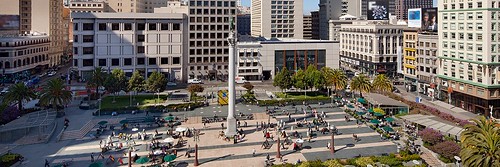
Union Square, San Francisco
Union Square, San Francisco.

Spatially, I've always thought that it would be possible to create a kind of Union Square effect around Farragut Square in Washington, which is between 17th, 18th, K and I Streets in Washington.  It's served by two Metrorail stations, Farragut West and Farragut North, but it isn't as big as its counterpart in SF, and the buildings aren't easily reconfigured into department stores, plus Macy's big store investment in the city's Central Business District is at Metro Center.

For DC, I don't think the report adequately distinguishes between retail and restaurants.  There is a lot of activity, even creativity, in the restaurant side of "retail" and commercial district development."

But I don't feel that's the case for retail.  Most commercial districts are weak in categories outside of convenience retail--groceries, pharmacy, hardware.  And there isn't a profusion of creative retail outlets.

There are many reasons for this.

(1) DC is still relatively small population-wise

(2) and has too much retail space that needs to be filled vis-a-vis demand

(3) and the phenomenon of what I call "intra-city sprawl" where new areas are being developed (The Wharf, CityCenter, Capitol Riverfront/Navy Yard, etc.) while other areas still languish

(4) plus rents are too high based on the revenue capacity of building footprints (see "Clevelad Park retail: my off hand assessment is that the rents are too high," 2009).

This has to do with how the commercial property market is shaped by the international market of Downtown real estate and how this creeps out and shapes submarkets across the city, even those that are decidedly local in their customer base, sales potential, and property ownership ("Avoiding the real problem with DC's property tax assessment methodologies," 2007).

(5) the way to address this is twofold; in terms of rents, DC could develop an initiative like that of SEMAEST, a community development corporation in Paris which has been charged with buying/leasing/holding prime retail properties and renting them to quality tenants at below market rates.

According to NextParis ("Opération Vital'Quartier: pour le commerce de proximité à Paris!") so far the initiative has supported 372 businesses in more than 500,000 s.f. of space.

(6) the other is the creation of an initiative to support the development of retail concepts and businesses as opposed to restaurants.  DC helped to fund a "Vibrant Streets Toolkit" produced by the StreetSense retail consultancy, but it doesn't seem to have had much effect on the "retail" aspect of DC's commercial district, although there are some exceptions where apparel, book stores, and other concepts exist here and there in retail districts across the city.

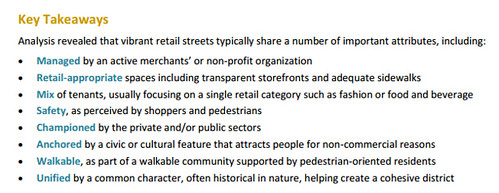
DC Vibrant Retail Streets Toolkit.  They've since gone on to develop the approach more broadly, and have produced a book on the subject, marketed on a separate Vibrant Streets website.

DC Vibrant Retail Streets Toolkit, eight elements, text

One best practice example I think about a lot is the Historic Downtown Los Angeles Retail Initiative, now no longer extant, which aimed to stoke retail development in the then languishing retail district.

Another is the development of the Second Street district in Austin, Texas where the city and the developer, wanting to create retail in concert with Austin's independent vibe ("Keep Austin Weird") made developing independent businesses the priority for a district that will eventually have 200,000 square feet of shops, restaurants, and other retail services.

In 2005, when I first wrote about it, they focused on clothing and housewares and furniture stores, but with a wider range including a scooter store and a day spa. The lease provisions included build out allowances, a graduated rent schedule so that precious working capital at the opening of a store could be spent on inventory, and the retailers contribute funds to a joint marketing program.

These days of course there are plenty of restaurants, galleries, and also well known design forward retailers like Design Within Reach (see "Another point about urban retail," 2012).
Various articles over the years in the Austin American-Statesman describe the Second Street District effort.  If you have a local library card and access the newspaper database, the articles are available to you.

Another example is the creation of "market spaces" as a kind of independent retail incubator.  One example is Building Character in Lancaster, Pennsylvania, or the Midtown Exchange in Minneapolis and the Mercado in Portland, Oregon.  Of course, public markets and food halls are the most well known example of this type.  Such spaces address the issue of access to space and concentration and focusing of a customer base.

(7) it's key how the Austin effort included joint marketing.  That's a major weakness for the various DC commercial districts.  Although it can be hard to market "retail" when there is very little of it (see "Why it's hard to (holiday) shop in DC's neighborhood retail districts," 2011).

Labels: , , ,

Wednesday, December 03, 2014

Economic development for small towns needs to include the development of cooperative stores

While the US has a strong co-operative business movement within agriculture, with groups serving farmers as businesses as well as marketing and distributing agriculture products to consumers.  For example, Land-O-Lakes, which produces dairy products, Ocean Spray, the distributor of cranberry-based products, and Sunkist Growers are all cooperatives.

But unlike countries like the UK, the US doesn't have as strong a record of retail and banking cooperatives operating on large scale.

Image from KAKE-TV.  

As US rural communities depopulate, and as retail firms focusing on rural markets run into financial problems--for example, Alco, a company serving small communities, has declared bankruptcy and all there stores, almost 200, will close and community residents will be left with big gaps in their retail options.


From "Former Kansas retailer Alco Stores seeks bankruptcy" (Associated Press):
Alco Stores Inc. has 198 stores in 23 states. The Coppell, Texas, company says most of its stores are in towns of fewer than 5,000 people and regions of fewer than 16,000 where there is no direct competition from national or regional broad-line retailers. Alco has 3,000 employees.

Alco had $474 million in net sales from continuing operations in its latest fiscal year. That represented a 2 percent decline from the year before. The company closed 14 stores early in the current fiscal year.
While the UK's Cooperative Group has had financial problems over the past few years because of the banking crisis' impact on their bank division, cooperatives can be a way for communities to step in and own and operate businesses that would otherwise fail.  The group has 4,900 stores and business locations, although they've sold off some divisions, like pharmacies, to raise capital.

I wrote about some of the independent "community serving retail" initiatives in the UK earlier in the year, "Community Owned Retail -- Resources from the UK." While the University of Nebraska Extension Service has an initiative on community retail, it pales compared to the efforts of the UK's Plunkett Foundation.

The Plunkett Foundation is focused on quality of life in rural communities and because of the shrinking population in many rural areas, they have developed programs promoting co-operatives, community shops, community pubs, and other enterprises.

-- Publications, Plunkett Foundation.

Similarly, I have been impressed with the European retail business network Spar, which functions similarly to how Ace Hardware or True Value Hardware organizations function in the US, as a wholesaler and business support group owned by and serving local retailers.  (Similar organizations and relationships exist in the US supermarket industry.)

This simplifies the ability to support stores at the local level when they would normally lack the resources of a national company or organization.

A similar model is the company Eurocash, which is a wholesaler supporting small independently owned shops in Poland ("The man who bet on tradition," Financial Times).

We need similar operations in the US to support store development in underserved communities.

Also see "Yoga, dance and microbrewery beer at UK's first community pub," (Financial Times).

Labels: ,

Friday, January 10, 2014

Community Owned Retail -- Resources from the UK

I have written about the rise of community owned retail/cooperative initiatives in rural areas of the US as a way to keep retail options available in communities with shrinking residential population.

The Village Shop, Feckenham, Worcestershire, UK

At the same time, I think community owned retail might be an option for impoverished urban areas, or some kind of hybrid social-public-private ownership scheme, because these areas have the same problems that rural areas have in terms of reduced economic circumstances making their areas unattractive to traditional retailers and restaurants.

I'm not saying it would be easy to do.  Urban stores have real problems in terms of attracting quality staff and have big problems with what is called "shrinkage" or stolen goods--not just by "patrons" but also employees.

But it's a way to offer retail coverage that might not otherwise be obtainable.  Combining public sector elements, like a community health clinic with a pharmacy, or a WIC/food stamps center and community kitchen with a supermarket, might be a way to pull it off.

Similarly, restaurants could be run by food service training programs as part of high school and community college vocational programs.  Etc.

The UK's Plunkett Foundation is focused on quality of life in rural communities and because of the shrinking population in many rural areas, they have a number of programs promoting co-operatives, community shops, community pubs, and other enterprises.

--  Community Shops, Plunkett Foundation
--  Community Pubs, Plunkett Foundation
--  Community Food Enterprises, Plunkett Foundation
--  Publications, Plunkett Foundation

These resources likely would prove useful in US settings.

The Plunkett Foundation offers a membership program for such shops, which includes bulk buying schemes and technical assistance.

Labels: , , , ,