Rebuilding Place in the Urban Space

"A community’s physical form, rather than its land uses, is its most intrinsic and enduring characteristic." [Katz, EPA] This blog focuses on place and placemaking and all that makes it work--historic preservation, urban design, transportation, asset-based community development, arts & cultural development, commercial district revitalization, tourism & destination development, and quality of life advocacy--along with doses of civic engagement and good governance watchdogging.

Thursday, March 02, 2023

Goodwill of Greater Washington to build Arlington affordable housing as part of a first-of-its-kind redevelopment + the Flint YMCA

The Washington Business Journal reports that in Arlington County, Virginia, Goodwill is working with the Arlington Housing Corporation, a nonprofit, to redevelop a store site where they will have their store on the ground floor, with affordable housing above.  From the article:

Goodwill, a nonprofit that provides job training, education and other services to people with disabilities or who face other employment challenges, has owned the 1.4-acre parcel at 10 South Glebe Road since 1999. The property includes a 1950s-era, 26,000-square-foot building and parking lot, where the charity collects and resells donated items to help fund its operations. Goodwill now aims, in a joint venture with a Arlington-based nonprofit developer AHC Inc., to demolish and redevelop that site with a multistory housing complex, including something like 100 affordable units over a new store and donation center.

Nonprofits tend to not be particularly innovative so this is a big thing.  But I don't understand why nonprofits don't think of themselves as more intrepid, as "social enterprises" and become more oriented to this kind of activity.

Some nonprofits run social enterprises as a way to generate income for their program.  In fact, Goodwill, which works with the disabled, has done this for decades with their thrift stores.  In the early 2000s, some Goodwill stores repositioned around higher end thrift and fashion, by differentiating among the goods that were donated.

The Orange County Register reports ("Tiyya Foundation expands culinary program to help young immigrant mothers begin careers") on an immigrant support group, that runs a catering operation and a one star Michelin restaurant in Los Angeles to raise funds and employ people.

By contrast, a church in my greater neighborhood in Salt Lake is dissolving, and rather than sell their property so it can be redeveloped for affordable housing, they've sold it to a developer who will build market rate housing.

In "When BTMFBA isn't enough: keeping civic assets public through cy pres review" (2016), I've suggested that Attorney General offices need to pay more attention to nonprofits and how they deal with their real estate.  There is the tension between getting the most money and doing "good works."  But it seems to me that the Church missed the boat, compared to Goodwill in Arlington.

Basically, I guess I'm saying apply the "transformational projects action planning" lens to nonprofits when it comes to opportunities for better using real estate resources, and for seeding projects like social enterprises that can contribute to communities in extranormal ways.

=======

The Flint Michigan YMCA building is beyond its useful life and needs to be replaced.  They are doing a development ("Downtown Flint YMCA project gets $1.5M grant, $5.5M loan from state," Flint Journal) that will include:

a 2,400-square-foot medical rehabilitation facility, 50 apartments and more than 7,500 square feet of office space.
YMCA officials have said their new facility is expected to include a competitive lap pool, family splash pad, basketball court, exercise studios, a running/walking track, men, women’s and universal locker rooms.

Years ago the Boys and Girls Club on 14th Street NW in Washington DC suggested a similar kind of project, with housing above, as a way to generate revenue from the land to support their programs but it was opposed by the Ward 1 City Councilman. Apparently, a development did occur on the parking lot later, but the facility still there, seems to be closed.  And the development doesn't look like it's affordable housing.

Labels: , , , , ,

Wednesday, August 02, 2017

One potential solution to the problem of "finding work" for homeless adults

The previous entry on SRO housing mentions the Orange County Register article, "Who are the homeless living in the shadow of the Big A? Here are 11 stories." 

Besides making it clear that Orange County needs a lot more single adult housing at lower than market rates as an affordable housing strategy, it occurs to me that creating structured, social-care type businesses might be a way to help people on the margins of the economy to participate in the workforce.

The article recounts how a number of the people in that particular economy had worked in the trades, but for various reasons they lost jobs and haven't been able to get new ones, because of their precarious situations.  From the article:
David Doan, 48, is a mechanical wizard. He built a neighborhood shower by tapping into a back-flow water supply for a drinking fountain. He’s set up a couple of solar panels to power two 12-volt batteries. Residents use it to charge their cellphones. ...

Bruce Bishop, 57, became a union iron worker in 1981. He says he once made $67.50 an hour. But a DUI led to a lost driver’s license. And DMV red tape, he says, led to a debt and the loss of his care registration and the money to pay insurance. When he couldn’t pay his dues, he lost his union card too. He’s working day labor jobs now, and someday hopes to get back both his driver’s license and union card. ...

Sher Stuckman, 59, says she once worked in a precious-metals refinery and in a diesel engine factory. “I’m handy with anything mechanical.”
A number of them seem to have "mad skills" and given the ever present need for skilled workers, the issue isn't so much their skill but their need to work in a more flexible and supportive work environment, rather than the typical "sink or swim" system that typifies construction.

Create social enterprises to provide structured, supportive work settings, and real work.  Instead of them hanging out at the Home Depot or other home improvement stores looking for casual employment as day laborers ("Day Laborer Battle Runs Outside Home Depot," New York Times, 2005), couldn't social service nonprofits create social entrepreneurship businesses that can do handyman-home improvement services, while also linking these businesses to SRO housing and other support services to help them keep it together?
Social enterprises are revenue-generating businesses with a twist. Whether operated by a non-profit organization or by a for-profit company, a social enterprise has two goals: to achieve social, cultural, community economic and/or environmental outcomes; and, to earn revenue.

On the surface, many social enterprises look, feel, and even operate like traditional businesses. But looking more deeply, one discovers the defining characteristics of the social enterprise: mission is at the centre of business, with income generation playing an important supporting role.

-- The Centre for Community Enterprise via the British Columbia Centre for Social Enterprise
We are seeing some of these kinds of businesses being created in DC, even if they aren't defined as social enterprises, to help ex-offenders better re-engage in society and the economy or to work with otherwise unemployed young adults.

For example, employing ex-offenders, Clean Decisions specializes in cleaning commercial kitchens and restaurants ("Once a violent offender, his company now keeps clean kitchens," Washington Post).

The Clean Green Team hires young adults to do landscaping ("All-black landscaping crew turns 'the look' into job opportunities," Post). From the article:
Little Lights Urban Ministries helps the team drum up business, much of it on Capitol Hill. There are 22 team members. D&A Dunlevy Landscapers provides the job training.

“It’s a small-scale operation, but people need to see that there are practical ways to create job opportunities,” said Steve Parks, who founded Little Lights 20 years ago. “You have to make it a priority, though. It takes more than just being concerned.”
The DC Department of Youth Rehabilitation Services does work skills training with clients in part by cutting lawns of senior citizens ("Juvenile offenders learn meaning of work through mowing lawns of the elderly," Post).

An often touted example is DC Central Kitchen, which provides culinary training and helps support it through commercial catering.

For Latino immigrants, CASA of Maryland has created a referral program for certain kinds of home projects.  And in Seattle there is a similar kind of program at Casa Latina ("The Seattle Woman Who Made A Home For Day Laborers," KUOW/NPR).

Work versus Workforce Development.  Similarly, I have had a running argument with this guy about "workforce development."  I keep saying the issue isn't the training but the workplace, and that people being integrated/reintegrated into the workforce typically need more help and ongoing support than can be supplied by a for profit business with limited resources, especially in this kind of "human resources/HR."

So using models like Push Buffalo's Push Green Western New York energy efficiency improvement business, and the Evergreen Cooperatives in Cleveland, I say construct the businesses that can employ people, albeit not exactly as full-time permanent employment, but as part of a multi-phase workforce training and development program.

Although that's not what Evergreen does, instead they create worker-owned cooperatives and they have three, a laundry, farm, and a solar panel installation firm.  According to their website, they actively focus on creating jobs, and the training programs follow:
The initiative was designed to create an economic breakthrough in Cleveland. Rather than a trickle-down strategy, it focuses on economic inclusion and building a local economy from the ground up. Rather than offering public subsidy to induce corporations to bring what are often low-wage jobs into the city, the Evergreen strategy calls for catalyzing new businesses, owned by their employees. Rather than concentrate on workforce training for employment opportunities that are largely unavailable to low-skill and low-income workers, the Evergreen Initiative first creates the jobs, and then recruits and trains local residents to fill them.
-- "The Cleveland Model—How the Evergreen Cooperatives are Building Community Wealth," Democracy Collaborative
-- "Worker-Owned Green City Growers is On the Path to Profits While Giving Refugees and Ex-Cons Gainful Employment," Cleveland Scene Magazine

Labels: , ,

Monday, July 10, 2017

The need for a new rural community cooperative movement

A shuttered Walmart store in West Virginia, Getty Images photo.

The Guardian has a story, "What happened when Walmart left?," about the impact of Walmart closing its store in McDowell County, West Virginia, not only in terms of jobs but in reduced access to food and other consumer goods. 

From time to time I've written about this issue and the very rare response in some communities to create community owned businesses to replace closed stores.

In terms of economic development planning, this is what I term the difference between "building a local economy" and "economic development planning."  Traditional economic development planning looks to others for solutions, and focuses on recruiting for profit businesses. 

By contrast, building a local economy focuses on building solutions that have greater local economic impact.  In the case of McDowell County, West Virginia, they shouldn't be looking to Walmart for their salvation.

Just last week, the Christian Science Monitor did an update ("A former exec at Trader Joe's grows another kind of grocery store") on the "salvage food store" Daily Table, created by Doug Rauch, former president of Trader Joe's, in Boston, aiming to bring more healthful food options to an under-stored neighborhood in Boston.

The article mentions there are eight "non-profit" food stores in the US, but didn't name them, although I am familiar with Fare & Square in Chester, Pennsylvania. A couple years ago, I came across a story of a for profit supermarket owner helping a low income community create a food store. 

And there is the UpLift Solutions consulting firm division of Brown's Supermarkets, a ShopRite member based in Philadelphia ("Why A Philadelphia Grocery Chain Is Thriving In Food Deserts," NPR). 

UpLift assists supermarket firms in working in urban markets, which are problematic because costs tend to be 30% higher than suburban stores ("Access to Affordable Food is Key for UpLift Solutions," AARP).

The CSM story didn't mention cooperative grocery stores, which are another category of community retail. The University of Nebraska agriculture extension program has a unit focused on helping communities create retail cooperatives.

When I read these kinds of stories, I keep wondering why there isn't a systematic response in the US to provide more focused rural retail economic development assistance--although I first thought about this in terms of under-stored low income urban communities--comparable to that of the UK's Plunkett Foundation.

The Plunkett Foundation is focused on quality of life in rural communities and because of the shrinking population in many rural areas, they have a number of programs promoting co-operatives, community shops, community pubs, and other enterprises.

--  Community Shops, Plunkett Foundation
--  Community Pubs, Plunkett Foundation
--  Community Food Enterprises, Plunkett Foundation
--  Publications, Plunkett Foundation

At the same time, I think community owned retail might be an option for impoverished urban areas, or some kind of hybrid social-public-private ownership scheme, because these areas have the same problems that rural areas have in terms of reduced economic circumstances making their areas unattractive to traditional retailers and restaurants.

I'm not saying it would be easy to do.  Urban stores have real problems in terms of attracting quality staff and have big problems with what is called "shrinkage" or stolen goods--not just by "patrons" but also employees.

But it's a way to offer retail coverage that might not otherwise be obtainable.  Combining public sector elements, like a community health clinic with a pharmacy, or a WIC/food stamps center and community kitchen with a supermarket, might be a way to pull it off.

But social entrepreneurialism on the part of nonprofits is rare, although it does exist, from the retail operations of Goodwill and Salvation Army, to a few nonprofit restaurants and the retail activities of NYC's Housing Works organization.

Similarly, restaurants could be run by food service training programs as part of high school and community college vocational programs.  Etc.

The Plunkett Foundation offers a membership program for such shops, which includes bulk buying schemes and technical assistance.

Food cooperatives have the advantage of being able to lean on the resources of the National Cooperative Grocers Association and the National Cooperative Bank.  But without strong support systems, food co-ops have a tough time in low income areas, since they are funded by capital from members.

Nonprofit supermarkets.  In Chester, Pennsylvania, a nonprofit supermarket called Fare & Square was launched by the Philadelphia area food bank Philabundance, and has been open for more than four years ("Nation's First Non-Profit Supermarket Is Picking Up Steam,"Next City; "Q&A: Fare & Square, an oasis in a U.S. food desert," FreshFruit Portal).


Unlike the fairly grim stores that are typical of PriceRite and Sav-A-Lot and other firms focusing on low income consumers, the interiors of the Fare & Square store are attractive, and the organization has strong branding and identity systems.

I believe it would make sense for other cities to work with Philabundance and create a platform out of this store that could be opened in other locations, a kind of franchise for social entrepreneurialism in the grocery sector.

According to the CSM article, cities like Providence, Rhode Island and the Bronx borough of New York City are clamoring for Doug Rauch to open Daily Table stores there.  But there are other options, as the Fare & Square and cooperative grocery models demonstrate.

Soft goods.  Selling other goods is tougher.  There aren't many models I don't think in the US, but working collectively, I don't see why such a model couldn't be created, comparable to Fare & Square.

Labels: , , , , , ,

Tuesday, February 02, 2016

DC, Anacostia, Skyland, and food deserts

Yesterday's Post discusses ("Without Walmart, the long wait for more groceries continues in east DC") the cancelling of two Walmart stores in Ward 7 as a continuation of those areas being under-stored with limited access to fresh foods.

The problem with this argument, and it is true that compared to higher income areas, the area has fewer options and a narrower range of the types of stores close by, the fact is that DC residents, "even" in Wards 7 and 8, are not limited to DC or their immediate neighborhoods when they choose to shop.

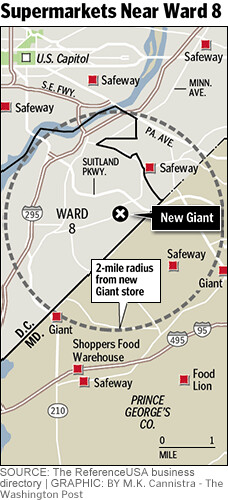
Supermarkets agdjacent to Wards 7 and 8
Note that most urban supermarkets plan for a "retail trade area" of a 3 mile radius, which covers an area of about 28 square miles.  This is out of sorts with advocate assertions that people should be able to buy groceries within a 3/4 mile walk from home.

In 2008, I wrote a blog piece in response to a similar article in the Washington Business Journal, written by the same journalist when he worked there.

"Food deserts are complicated places" discusses the reality that people's shopping options aren't limited to DC--for example, there are many grocery stores in the part of Prince George's County that abuts this part of DC, and there are Giant and Safeway supermarkets located within one mile of the Skyland location.

A follow up entry reprinted a Washington Post graphic from a story about the Congress Heights shopping center, showing how many supermarkets are nearby in PG County--although that graphic is 7 years old now and things have changed somewhat.

Eight options for supermarkets other than Walmart.  That being said, there are many options other than relying on Walmart to expand the array of choices available in under-stored areas that are distressed neighborhoods Anacostia.  Even if the Mayor believes that Walmart is the only choice.  From the Post article:
Days after the retailer’s announcement, officials said Mayor Muriel E. Bowser (D)– who described herself as “blood mad” upon hearing the news — tried a last-minute save by calling Greg Foran, president and chief executive of Walmart U.S., to “communicate frustration and the importance of these two projects” according to Brian Kenner, deputy mayor for planning and economic development.

Kenner said the mayor was told a reversal was unlikely.

“His response there’s really nothing he could do,” Kenner said. “It’s not like this is a cost issue. This has to do with their larger issue nationally in particularly paring down urban markets, which they have been very specific about.”
Some are discussed in this entry, "In lower income neighborhoods, are businesses supposed to be "community organizations" first?," from 2012.

Like the points made in the piece last week on how a ground up redevelopment approach would have ultimately worked a lot better for Skyland ("Ground up commercial revitalization and the Skyland Town Center project"), the problem for cities with "options other than Walmart" or other chain stores is that they are a lot more work and more risky--not that working with chains isn't time consuming or risky also.

Admittedly, fostering retail openings in underserved areas is risky.  And many independent grocery ventures fostered by cities do fail--one did on H Street NE back in the late 1980s.  Although I argue this happens most often because poor business fundamentals were ignored for political reasons, with various reasons--stores being opened in the wrong places, being underfinanced, paying high rents, etc.--leading to failure.

One example that comes to mind is the failure of a grocery in New Brunswick, New Jersey, which was opened in a business and transit district with limited business and transit activity and few nearby residents ("Fresh Grocer supermarket opens in New Brunswick, addressing 'food desert' challenge," NJBiz, "Owing $1 Million to NBPA, New Brunswick FreshGrocer Closes After Just 18 Months in Business," New Brunswick Today).

Part of a mixed use project, it was located on the ground floor of a parking structure adjacent to the NJ Transit station in New Brunswick, which is home to Rutgers University.

Other problematic examples include Portland ("Revitalization in impoverished neighborhoods can be very difficult because different "stakeholders" have different understandings of what's at stake") and Los Angeles ("How a South L.A. supermarket proposal fell apart, after a decade of effort," Los Angeles Times).

Revitalization in distressed and emerging commercial districts is very hard.

Create a "public market."  This would be similar to the old DC Farmers Market building that focused on serving the needs of low income consumers--that building is now the upscale Union Market food hall.

A public market could also be used as a business development initiative, because it's easier for individual entrepreneurs to run sections of a market (e.g., meat, seafood, produce, dairy, deli) but not able to take on, launch and run an entire store.

To spur local economic development in low income communities, communities elsewhere are adapting the public market/market hall model as a way to spur business development and retail offerings in otherwise underserved communities.

Image of La Marqueta from Manhattan Times.

The Thai Town Marketplace in Los Angeles and the Portland Mercado are examples of such efforts.  La Marqueta in Spanish Harlem is a repositioning of an older public market with a decided focus on business incubation and serving the otherwise underserved.

There is no reason why a public market couldn't be anchored by a vendor selling "center store" nonperishable products (canned, boxed, and bagged items).  Baltimore wholesaler B. Green could be the wholesaler supporting such a venture ("Changing with the times," Progressive Grocer).  For decades, Baltimore's Lexington Market has had such a store as part of the retail mix there.

The business development opportunities make this a good model.  And business development could be furthered by setting up a commercial kitchen/incubator to support small business food production and catering organizations, and this could also support pop up restaurants both as a business development and support effort and as a way to boost  customer activity during different dayparts.

Similarly, the school system could shift a high school culinary education program (and add an adult education component) to such a facility which would provide training opportunities, could support the provision of better and more equipment for the incubator, and could support a restaurant too with the students operating it, which is another way to extend the ability to open more diverse restaurant options to otherwise emerging commercial districts.

Franchise a Sav-A-Lot.  Many years ago, the Anacostia Economic Development Corporation indicated they were looking to open a supermarket, replacing the old Anacostia Supermarket independent store.

Sav-A-Lot, a division of Supervalu, is a mix of company-owned and franchised stores.  There is at least one Sav-A-Lot store in DC, although compared to a nearby location on Chillum Road in Hyattsville, the DC location has a hyper-limited selection of fresh fruit and vegetables.

-- Sav-A-Lot franchise information

Recruit PriceRite.  PriceRite is the discount supermarket banner of the Wakefern organization, which also supports traditional supermarket stores (ShopRite and Fresh Grocer).

Probably PriceRite has been developed as a way for the organization to compete with Sav-A-Lot and other discounters (Aldi, Walmart).

The company has been expanding in the region, and has stores nearby in Prince George's County ("PriceRite makes regional push with store in Prince George's," Washington Business Journal).  Also see "Price Rite to open grocery store in Syracuse 'food desert'," Syracuse Post-Herald.

Recruit ShopRite.  While there aren't ShopRites in DC, there are some in Maryland, and one Wakefern member, Brown's, operates stores in urban neighborhoods in Philadelphia.

Brown's has a consulting unit, UpLift Solutions, which works with supermarkets opening stores in center city locations.  The group facilitated the opening in Baltimore City of a unit by an otherwise suburban focused ShopRite affiliate ("City says it's largest supermarket to open in Howard Park," Baltimore Sun).

Create a member-owned food cooperative.  The Glut Food Cooperative in Mount Rainier, Maryland is owned by the workers, and so is a business cooperative, while the Takoma Park and Greenbelt Food Cooperatives are owned by members.  Either type qualifies for loans and business support from the National Cooperative Bank.

Philadelphia Weekly photo.

The Mariposa Food Cooperative, a member co-op in Philadelphia, was organized to mitigate "food desert" issues and has been in operation for going on six years ("Philly's Mariposa Food Co-op Focuses on Outreach Along Baltimore Avenue," Philadelphia Weekly; "Food co-ops on rise in Philly area," Philadelphia Inquirer).

But without strong support systems, food co-ops have a tough time in low income areas, since they are funded by capital from members.

For example, the Elm City Market Food Co-op was created in New Haven ("Food co-op to save New Haven's crisis?," Yale Herald), "Elm City Market Food Co-op - A Model for Downtowns") to deal with lack of supermarket options in the core of the city.

But poor decision making led to financial problems because the group agreed to large rent increases as sales rose, despite the fact that supermarkets have low profit margins (one to three percent) and in the short run, growth increases costs ("Elm City Market auctioned off," Yale Daily News).  The store faced closure, but was purchased by a private investor, and converted to a for profit enterprise.

Support the creation of an independently-owned supermarket.  Many independent grocers are affiliated with business cooperatives.  The business cooperative is owned by the members, and it supports their individual operation.  While there are many supermarket business cooperatives across the country, Wakefern is the major group operating in the Mid-Atlantic.

There is an alternative however. IGA is a supermarket business cooperative operating nationally and could support an independent operation operating East of the River, for a group not interested in working as ShopRite, but still wanted the advantages of a national brand and marketing support.  IGA affiliate stores operated in the city in various locations into the early 2000s.

-- Why IGA? marketing brochure for supermarket operators


Contact small supermarket firms already operating in the metropolitan area.  There are some small grocery companies operating in the area, focusing on ethnic communities, primarily Latinos (PanAm, Megamart, Bestway) that theoretically could be interested in opening a store in the currently under construction site on East Capitol Street that was abandoned by Walmart. A new Megamart at New Hampshire Avenue is more upscale than their nearby store on University Blvd. near Piney Branch Road.
Note that the old District Grocery Stores group of neighborhood corner store markets was a business cooperative supporting individually owned stores.  At one point there were 300 stores in the group, most serving DC, but also with locations in the suburbs.

The group had a warehouse allowing the organization to buy food more cheaply by amalgamating the orders of individual stores and provided marketing support.  In the face of changes in the city and the industry, the group dissolved in 1972. Note that the still extant Sniders Supermarket in Silver Spring started out as a DGS affiliate.

Note that technically, Yes Grocery is an independent and did open a store in Ward 7 which proved unsuccessful ("Organic Verses," Washington City Paper).  But I would argue that was because their business model was incongruent with the market demographics present in that location.

Image from the Chester City Blog.

Open a nonprofit supermarket.  In Chester, Pennsylvania, a nonprofit supermarket called Fare & Square was launched by the Philadelphia area food bank Philabundance, and has been open for more than three years ("Nation's First Non-Profit Supermarket Is Picking Up Steam,"Next City; "Q&A: Fare & Square, an oasis in a U.S. food desert," FreshFruit Portal).


Unlike the fairly grim stores that are typical of PriceRite and Sav-A-Lot and other firms focusing on low income consumers, the interiors of the Fare & Square store are attractive, and the organization has strong branding and identity systems.

I believe it would make sense for other cities to work with Philabundance and create a platform out of this store that could be opened in other locations, a kind of franchise for social entrepreneurialism in the grocery sector.

These suggestions only cover food: what about general merchandise categories?  Granted, Walmart is food+general merchandise, while the eight options discussed above only cover food.

WUSA-TV photo.

There are other discount store options too, but they are limited.  The locally-owned Discount Mart, which had already operated at Skyland is one.

Maxway operates in DC's suburbs and is owned by a company with a wide variety of discount merchandise stores active in the Southeastern United States.

The firm opened one of their bigger banners, Rose's, in Prince George's County ("Largest Roses store in the US opens in Prince George's," WUSA-TV).  Plus, there are big dollar stores.  Five Below.  Ollie's Bargain Outlet which operates as close as Baltimore.  Etc.

In other entries, I've mentioned that Kroger has a Marketplace model that adds general merchandise to grocery stores--like Walmart Supercenters but smaller.

Harris-Teeter is owned by Kroger but has no plans as of yet to open any of these kinds of combination stores.  In any case, my sense is that Kroger opens Marketplace stores as a way to ward off Walmart and other discounters from opening stores, and likely the company isn't interested in opening these kinds of combination stores in what we might call "retail deserts."

The Fred's discount store chain does not operate in Virginia or Maryland, but does operate as close as North Carolina.  The Beall's Outlet chain, operating as Burke's Outlet, does have stores in Virginia and West Virginia, but not Maryland.  The latter is focused on clothing, although they also sell home goods and electronics, while Fred's is more of a full line discounter.

Shoppers World is a general merchandise discount store based in the region also.  They have a store at the Boulevard at Capital Centre in Landover, Maryland (Prince George's County).  They could be an option too.

While the old Value City discount chain is no more, they still have the Value City Furniture company, selling furniture, but the store has suburban locations and isn't likely to be interested in a store location in DC, figuring that would merely cannibalize existing customers.

Labels: , , , , ,

Friday, January 10, 2014

Community Owned Retail -- Resources from the UK

I have written about the rise of community owned retail/cooperative initiatives in rural areas of the US as a way to keep retail options available in communities with shrinking residential population.

The Village Shop, Feckenham, Worcestershire, UK

At the same time, I think community owned retail might be an option for impoverished urban areas, or some kind of hybrid social-public-private ownership scheme, because these areas have the same problems that rural areas have in terms of reduced economic circumstances making their areas unattractive to traditional retailers and restaurants.

I'm not saying it would be easy to do.  Urban stores have real problems in terms of attracting quality staff and have big problems with what is called "shrinkage" or stolen goods--not just by "patrons" but also employees.

But it's a way to offer retail coverage that might not otherwise be obtainable.  Combining public sector elements, like a community health clinic with a pharmacy, or a WIC/food stamps center and community kitchen with a supermarket, might be a way to pull it off.

Similarly, restaurants could be run by food service training programs as part of high school and community college vocational programs.  Etc.

The UK's Plunkett Foundation is focused on quality of life in rural communities and because of the shrinking population in many rural areas, they have a number of programs promoting co-operatives, community shops, community pubs, and other enterprises.

--  Community Shops, Plunkett Foundation
--  Community Pubs, Plunkett Foundation
--  Community Food Enterprises, Plunkett Foundation
--  Publications, Plunkett Foundation

These resources likely would prove useful in US settings.

The Plunkett Foundation offers a membership program for such shops, which includes bulk buying schemes and technical assistance.

Labels: , , , ,

Supermarketing update

1.  Giant Supermarkets opening new stores in DC.  In DC, Giant's new store in Shaw is more urban than their other stores, including the new store on H Street, in that it has an extensive prepared foods section, more upscale items (in general, Giant has gone through a severe SKU rationalization program, cutting the range of items and specialty items carried at the individual store), and an eat-in cafe area.

Image from Popville.

I suggested that they could do something like this in a post a couple years ago ("Urban retail #4: how to prevent the coming failure of the DC region's Giant Supermarket chain").

I was shocked to see that for the most part, the store on H Street exhibited few urban-oriented changes ("360 Apartment building + Giant Supermarket vs. a BP gas station, which would you choose?"), although it is a step forward compared to Giant stores in Brentwood or Columbia Heights, which opened about 8-10 years ago.

But the new Shaw store is a step forward.  It will be interesting to see if they take further pro-urban steps with their upcoming store on Wisconsin Avenue in Cathedral Heights.

2.  A supermarket for Downtown Baltimore.  The company Fresh & Greens, which took over a bunch of stores in Maryland (and one in DC) when the A&P Superfresh division closed its stores, is now closing those stores.  One closing which will have significant impact is the store in Downtown Baltimore, the only supermarket store present there (full-line grocery stores are present outside of the core, a couple miles away).

I opined in email that maybe Eddie's, a local company with a store in Charles Village and Roland Park, Maryland's upscale Graul's chain, or even Shoprite could be enticed to taking over the location--Shoprite is moving into urban markets more and has recently acquired the Fresh Grocer banner, which is active in Philadelphia specifically.  A Carroll County Shoprite affilate has opened a couple stores in Baltimore already ("ShopRite opens at former Superfresh site in Parkville," Baltimore Sun).

3.  Market District Express by Giant-Eagle.  But now I wonder if Giant-Eagle, a Pittsburgh supermarket company, could be enticed into Downtown Baltimore.  The company is one of the strongest independently owned supermarket chains and has a segmented approach to the market (like the United Supermarkets company, mentioned in the piece on Giant, above), with their standard store, an upscale store called Market District, and a chain of convenience stores with two brands, featuring Giant-Eagle and Market District branded products along with gasoline.

Giant-Eagle is proposing a more urban sized store of about 30,000 s.f., called Market District Express, in Cleveland ("Giant Eagle plans small-format store," Cleveland Plain Dealer).  They have another store in Greater Pittsburgh about half the size ("Giant Eagle opens its first Market District Express," Pittsburgh Post-Gazette).  It strikes me as a great concept for urban centers.

(Note that there is a historic preservation controversy surrounding the Cleveland project.)

G-E has two stores in Frederick, Maryland, so outward wouldn't be a stretch.  Note that Wegman's, a company that opens behemoth stores, is already active in the region, and Giant-Eagle's Market District division is comparable to Wegman's.  However, Wegman's doesn't have much expertise in operating small footprint stores, unlike Giant-Eagle.

4.  Supermarkets need to sell more prepared foods to compete with restaurants for the millennial consumers.  Given that younger adults aren't cooking experts, many supermarkets are starting to see the need to carry more prepared items, to compete with restaurants.

Companies like Whole Foods and Harris-Teeter have responded, while many traditional supermarket chains have not.  The Ukrops chain of Richmond Virginia--since sold and consolidated into the Martin's brand--was a pioneer in prepared foods.

5.  Dominicks closure in Chicago and the city's response.  Safeway bought the Dominicks chain about 15 years ago and then proceeded to run it into the ground, destroying billions of dollars in value.  Now they are disbanding the company.  Some of the stores, 15 in total, have been acquired by competitors, leaving 57 stores that were shut down in late December.

Interestingly, the City of Chicago has created a task force to focus on the vacant stores, to try to get them back as supermarkets.  See "Chicago forming task force to market Dominick's stores left vacant" from the Chicago Tribune.  According to the article, the committee will include representatives from the labor unions, city agencies, City Council, and supermarket and retail experts.

It's an interesting step for a city to take. 

6.  Safeway's presence in the DC-Baltimore region.  There is a lot of speculation that the company will sell their stores here, and focus on their West Coast divisions, given their recent sale of their stores in Canada, what has happened in Chicago, and speculation that they will get out of the Texas market as well (similar to their foray in Chicago, they've wrecked the stores they bought in Texas).

If this is to happen, likely they would sell to a private equity firm, because the big companies are already engage.  Although it might be possible that a company like Giant-Eagle could be enticed, although they'd lose brand equity in having to run the stores under a different name, because Giant Supermarkets of Landover is a leading company already active in the market.

Unlike in other markets, Safeway is actively managing their real estate here--many of their store sites have or are being redeveloped more intensely as mixed use.  The ability to generate extranormal profits from real estate development is seen as a big enticement for a private equity firm.

7.  Selling past fresh date merchandise in Boston as cheaper food to lower income customers. The Boston Globe reports ("Putting expired foods to healthy use: Ex-Trader Joe’s head aims to fight poor nutrition, waste by creating meals for low-income customers") that the former head of Trader Joe's is looking to create a store for low income consumers that sells past-date merchandise. From the article:
“The number-one leading problem is affordable nutrition,” said Rauch, who worked for 31 years at the California-based Trader Joe’s grocery chain until he retired in 2008. “For the 50 million Americans who are food insecure, their solution is not a full stomach. It’s a healthy meal.”

The store would sell takeout items such as soups, salads, stews, casseroles, and wraps that are low in fat and high in nutrients, according to Rauch. The space would also feature a teaching kitchen where people can learn to cook quick, healthy meals. In addition, the shop would sell packaged chopped vegetables and offer milk at or past its sell-by date for as low as $1 a gallon — a price that makes it competitive with soda. ...

The Dorchester site would serve as a test model for the Urban Food Initiative, which he wants to replicate across the country. Rauch said he selected Dorchester because it is one of several Boston neighborhoods underserved by grocery chains and has welcomed innovative food ideas such as community gardens and farmers markets.
8.  Special supermarkets for low-income customers in Europe.  There is a form of food store mostly in Florida, California, and the Southwest, that sell only those products eligible for purchase by funds from the federal WIC program ("WIC-Only Stores and Competitive Pricing in the WIC Program," Center on Budget and Policy Priorities).

NPR reports ("Social Supermarkets A 'Win-Win-Win' For Europe's Poor") about a hybrid for profit-non profit in the UK that sells food at discounted prices, but is open only to lower income consumers.  From the piece:
Enter "social supermarkets," a European model that offers discounted food exclusively to those in poverty. The stores have grown in popularity across the continent, and this week, the U.K. opened its first. Dubbed Community Shop, the store is located in an impoverished former mining town in South Yorkshire.
Part discount grocer, part social service agency, the supermarkets are for members only. Membership is free, but it is limited to those who can prove they receive some form of welfare benefits. Members can save up to 70 percent on food that has been rejected by grocers because it might be mislabeled, have damaged packaging or be nearing an expiration date. That food is still edible, though, so instead of getting thrown away, it's donated with a waiver of liability.
Also see "UK's first 'social supermarket' opens to help fight food poverty" from the Guardian  and "Social supermarkets: Typology within the spectrum of social enterprises," by Holweg et al.

The difference between this model and the one to be launched in Boston is the integration in a formal way of social programming and infrastructure via the public sector.

I do intend to write about more hybrid social-capital market ventures ("social enterprises") going forward.

I think there is a lot of potential--years ago I suggested such a model for community health clinics ("Disruptive innovation once again")--for linking social programming with market approaches in certain situations, to provide for more option for transformation and dynamism in programming.

That piece was about community health clinics using retail principles, but what about combining a community health clinic with a pharmacy in a low income area?

9.  Walmart in DC.  While I have made the personal choice to not shop at Walmart because of how they treat labor ("Piling on City Council for Walmart") I did go in one of the stores that they recently opened in DC to check it out.  Some reports were that the stores weren't all that.  I thought the store was fine, about the same as a Target or other discount store in terms of its layout and merchandising.  It seemed put well enough together.

I did check out a bunch of grocery items.  We don't buy a lot of processed food items, which is where a discount store can show big price advantages.  I was surprised to see how limited their array of choices is in certain categories--for example, we buy turkey sausage not beef or pork sausage, and Walmart's choices were pretty paltry.  But some of their prices--like for red potatoes were really cheap.

The difference I guess is what is called "every day low pricing," and for some of the items they have lower prices.  But if you shop specials, except for red potatoes, you can still find better pricing on many items at Giant and Safeway.

That being said, having lower cost food buying options for residents is something that cities should aim to accomplish.

10.  Modern public markets as eatertainment and another way to provide food buying options in cities.  I push the idea that modern public markets could be brought back as a way to sell food in the city in underserved areas, while also providing support for business development.

I don't think we've really seen this happen yet in a poor neighborhood.  But it is happening in upscale areas. 

Baltimore's Belvedere Square redeveloped in large part as a privately owned "public market" more than 10 years ago.  And in New York City, Chelsea Market and now the Gotham West Market ("Gotham West Market, a New Food Hall, Opens on the West Side," New York Times), are using the same model.  Other variants are DC's Union Market (an upscaling of a market formerly focused on low income customers) and Manhattan's Eataly.


11.  And more cities are pushing forward mobile food sales to provide more options in low income areas.  I came across one such effort in Memphis that has some great branding.  See "Green Machine Brings Food to Neediest Areas" from the Memphis Daily News.

-----
Note that Supermarket News now identifies urban markets as a hot trend in the industry.  (I was writing about this 10 years ago.)

Labels: , , , , ,