Rebuilding Place in the Urban Space

"A community’s physical form, rather than its land uses, is its most intrinsic and enduring characteristic." [Katz, EPA] This blog focuses on place and placemaking and all that makes it work--historic preservation, urban design, transportation, asset-based community development, arts & cultural development, commercial district revitalization, tourism & destination development, and quality of life advocacy--along with doses of civic engagement and good governance watchdogging.

Wednesday, November 17, 2021

HBCUs and the city: Relocating Cheyney University to Philadelphia?

A follow up entry to this piece is "The other George Miller idea: creating multi-college innovation centers in (cities) Philadelphia | Creating public library-college education centers as revitalization initiatives."  

=========

HBCUs = historically black colleges and universities

Will Bunch, the awesome opinion columnist for the Philadelphia Inquirer, calls our attention to a proposal by George Miller ("Move Cheyney University to the Navy Yard") suggesting that Cheyney University of Pennsylvania--the nation's first HBCU, located in suburban Delaware County, 24 miles from Philadelphia--relocate to Philadelphia's Navy Yard and focus on educating the city's people of color from a far more convenient location.  From the article:

Cheyney, located about 30 miles from the city, is the oldest historically Black college or university in the country (though nearby Lincoln University was the first HBCU to offer degrees). 

Forty-three percent of the 1.5 million people in Philadelphia are Black or African American, and the vast majority of them do not hold college degrees. That limits their employment opportunities. Black students can attend any college, of course, but HBCUs tend to offer a greater sense of community and more support than students might find at predominantly white institutions. 

Only about 13% of Temple University’s undergraduates are African American and about 8% of the University of Pennsylvania’s students identify as Black or African American. Both schools have long-standing Black communities adjacent to their campuses, but the relationships with those communities are often tense. Those areas are among the poorest in the city. ...

Having a historic HBCU in Philadelphia would create affordable and appealing opportunities for people who might not otherwise seek higher education. That would be good for Cheyney, too.

I was thinking that was an incredibly great idea, and ruing how former mayor of Washington Anthony Williams' idea of relocating the University of District of Columbia to the St. Elizabeths campus east of the river was shot down 20 years ago ("UDC is focused on the wrong students," Forest Hills Connection). 

If you relocate it does it matter?  But then I thought, well, Baltimore has two HBCUs located within the city, albeit on the outskirts, Coppin State and Morgan State ("Morgan State University should move their architecture and planning school to Downtown/Station North Arts District"), and they aren't particularly central to the city and its ability to stoke educational attainment amongst the city's youth.  

Chicago State University was buffeted by funding issues sparked by a fight between the state's former Republican governor and the Democratic state legislature, which severely crippled the school's ability to function.

Just because you locate Cheyney in Philadelphia, if it's not capable of repositioning and becoming more innovative, and maybe with free tuition (like CUNY), would the relocation have all that much impact?  

Columbus, Ohio has just announced a program that will provide free tuition to the local community college for city school graduates ("New program offers Columbus City Schools graduates free tuition at Columbus State," Columbus Dispatch).  From the article:

The next three classes of Columbus City Schools graduates will be able to attend Columbus State Community College for free under a new initiative announced Wednesday morning. 

 "We are hoping to make Columbus the best city to learn, earn and achieve your dreams,” said Columbus City Council President Shannon Hardin. “For too many folks, they don’t see a pathway past high school. We are making a promise that we will support you in going after your dreams.” 

The program, called the Columbus Promise, is set to start with the district's current senior class and is being funded by the city of Columbus, Columbus schools, Columbus State and other local groups interested in seeing students succeed and go onto college.

In fact, the great 2018 series in the Atlanta Journal-Constitution on HBCUs had a story on Cheyney's problems, "Cheyney University: The oldest HBCU faces an uphill struggle."

I'm not sure the University of the District of Columbia is particularly noteworthy on this dimension either ("Speaking of planning for higher education: more on the University of the District of Columbia," 2012). 

And Howard University -- "The Mecca" -- is located in DC too, but doesn't necessarily have all that much impact on the city's minority student population and college attainment.  Not unlike Morgan State, it's a cloistered place separate from the rest of the city.  Plus, it has serious management issues ("‘We won’: Howard protesters reach deal with university and end month-long occupation," Washington Post).

Although cloister and location is central to Miller's recommendation that Cheyney be relocated to a central location within Philadelphia, at the Navy Yard, and as part of a broader initiative creating a special campus for multiple colleges to offer programs.

Urban universities and colleges and first generation college students.  How many city-based HBCUs and Predominately Minority Institutions (PMIs) have performed the way that City College did and does in New York City ("American Dream Machine: The City University of New York aggressively moves poor kids into the middle class.," City Journal) in educating first generation college students, contributing to the local economy (CUNY's Contribution to NYC, NYC Comptroller's Office), and boosting graduates into the nation's middle class?

There are other urban universities that had a similar place in their communities historically, although perhaps less so today, including the University of Baltimore, what is now Wayne State University in Detroit, City College of San Francisco, and Metropolitan State University in Denver, although for some cities community colleges have taken on this role, or state universities have created city units, like the University of Illinois Chicago, Cal State Los Angeles and the University of Colorado.

Not exactly the same, but some colleges like Dartmouth offer access to college classes to area high school students.  And some colleges have developed special integrated high school/college programs like the Bard College High School, which has multiple campuses.

-- Center for First-Generation Student Success
-- Degrees of Difficulty: Boosting College Student Success in New York City, Center for an Urban Future
-- "Why free community college is necessary but insufficient for true student success," University Business

HBCUs/Predominately Minority Institutions that are particularly successful.  Recently I wrote about the University of Maryland Baltimore County upon the announcement by its President that he will be retiring ("Freeman Hrabowski and "urban universities"").  UMBC has become the number one college in the country in educating minority students for entrance into graduate and professional schools.

And some of the HBCUs in Atlanta, like Spelman College ("A Culture of Success: Black Alumnae Discussions of the Assets-Based Approach at Spelman College," Journal of Higher Education), Morehouse College ("A prescription for more black doctors," New York Times), and Clark Atlanta University ("Applying IRSS Theory: The Clark Atlanta University Exemplar," Decision Sciences) have a similar kind of impact and could be models for similar initiatives elsewhere.

The AJC series reports on how Greensboro, North Carolina-based North Carolina Agriculture and Technical State University has set the stretch goal of being the best academic HBCU in the country ("A&T: An HBCU powerhouse rises in Greensboro").

Greensboro's economic development agenda is predicated in part on a focus of leveraging its multiple higher education institutions and NCA&T is a key element of the strategy ("Better leveraging higher education institutions in cities and counties: Greensboro; Spokane; Mesa; Phoenix; Montgomery County, Maryland; Washington, DC").

The University of Texas El Paso is widely known as being particularly successful for graduating first generation Hispanic students ("UTEP encouraging first-generation student success," KFOX14).  From the article:

UTEP's current initiatives are geared toward boosting retention rates by working closely with students. They include: 

  • A first-generation course — UNIV 1301 — designed to prepare students for internships, employment, undergraduate research, and community-engaged learning experiences. 
  • Summer bridge programs offered to entering students, freshmen, and sophomores targeted to help students continue their momentum between those years. 
  • Wraparound services including tutoring, advising, coaching, and mentoring to help students successfully complete their courses. 
  • First-generation peer leaders, instructors, mentors, advisors, and alumni will be accessible to students as part of the mentorship program. 
  • The program will prepare first-generation students for college by helping them develop writing, communication, and critical thinking skills through a variety of methods.

The first-generation program aims to work with students through their first 45 semester credit hours and improve student retention. The program focuses on celebrating student success by fostering students’ diverse backgrounds, strengths, and skillsets.

Conclusion.  While the idea is great, it needs a lot more than simply relocating Cheyney University and plopping it down in Philadelphia to have the kind of impact that Mr. Miller believes could result.  

1.  Relocating Cheyney University to Philadelphia would only be a first step.

2.  The second and most important step is rebuilding Cheyney University from the ground up, using schools like Spelman, Morehouse, UMBC, and NC A&T as models of HBCU/PMI best practices, along with other examples of premier education attainment for first generation college students.

3.  The third step is integrating the relocated and repositioned school into the community so that it can have the same kind of effect on the minority college student population within Philadelphia specifically, the way that colleges like UMBC do, but in a less place specific manner.

4.  Ideally with free tuition for residents of Philadelphia and adjoining counties, not unlike New York State's free tuition program for the State University as well as CUNY.

Labels: , , , , , , ,

Thursday, September 02, 2021

Freeman Hrabowski and "urban universities"

Baltimore Sun photo.

Freeman Hrabowski has been the president of the University of Maryland Baltimore County for a few decades.  

In that time, he has made it one of the nation's pre-eminent institutions in terms of preparing minority students for graduate and professional schools in the sciences and health professions ("Freeman Hrabowski's UMBC legacy grows as he celebrates 20 years as president," Baltimore Sun).

The Washington Post reports his announcement that he is retiring, and mentions in passing that he gave up opportunities to move to more prestigious institutions because he thought he was doing particularly important work at UMBC ("Longtime UMBC president, who turned school into top producer of Black scientists and engineers, to retire").  

Many past pieces discuss leveraging higher education for local economic development, like Elson Floyd, the sadly deceased president of the Washington State University campus in Spokane ("President of Washington State University dies: fostered development of the "University District" adjacent to Downtown Spokane," 2015) and Nohad Toulan at Portland State University ("Universities as elements of urban/downtown revitalization: the Portland State story and more") and how some communities have refocused their economic development policy around better leveraging of local universities ("Better leveraging higher education institutions in cities and counties: Greensboro; Spokane; Mesa; Phoenix; Montgomery County, Maryland; Washington, DC").

And have mentioned in passing in various articles about how some types of higher education institutions are more leverageable than others, engineering and business ("Cornell and Technion institute open high-tech campus in NY," Times of Israel), and medical and health ("University of Incarnate Word expanding its Brooks campus," San Antonio Express News), but not law ("Words of Hope for a troubled community," Washington Post).

Reading about Freeman Hrabowski again -- from the Baltimore Sun article ("UMBC’s Freeman Hrabowski, who turned school into a model for producing minority scientists and engineers, to retire in 2022"):

The campus now educates 14,000 students, up from 10,000, and includes a research park with 130 companies. ... 

UMBC’s graduation rate is now about 70%, up from less than 52% two decades ago. Investment in new construction has increased from $118 million to $1.2 billion over the last decade of his tenure, and the school’s annual spending on research each year — though still a fraction of the Johns Hopkins University or University of Maryland, College Park — has risen to $84 million from $10 million. UMBC now boasts research centers in such areas as computing, space and atmospheric sciences, and the social sciences. 

Between 2010 and 2019, UMBC had more Black graduates receive doctorates in the sciences and engineering — 146, according to federal government data — than any other university in the nation, eclipsing historically Black colleges and universities like Howard University and academic powerhouses like the Massachusetts Institute of Technology and Cornell University.

makes me realize that "all" major urban universities focusing on first generation college student education, especially with minority students, ought to be aiming to develop programs similar to those at UMBC.  

Also see "A prescription for more black doctors" from the New York Times Magazine, about a similar initiative at Morehouse College in Atlanta.

Note that this was the foundation of my series of articles about leveraging the United Medical Center rebuilding to seed a biotechnology and medical education initiative at the St. Elizabeths west campus in the Congress Heights neighborhood in East of the River section of DC.

-- "Community Health Improvement Planning," 2019
-- "Update on DC's plans to build a new United Medical Center," 2018

Interestingly, I would say that Baltimore County hasn't been particularly stellar in leveraging its universities (UMBC and Towson University primarily) for economic development, the same way that College Park and Prince George's County have not truly leveraged the presence of the University of Maryland.

-- "Revisiting past blog entries: College Park as a college town and economic development | PG County and Amazon," 2018

Labels: , , , , , ,

Thursday, August 13, 2020

DC as a case study in the debate over investments in place over investments in people and the recent mass shooting

This piece is sparked by the recent mass shooting in Southeast DC a couple days ago, where as many as four people shot into a large crowd of people at a community barbecue, shooting at least 20 people and killing one ("Shootings in District surge as officials confront mass shooting that killed 1, wounded 21 at block party" and "After a mass shooting at a block party, community leaders are left reeling, seething and pleading," Washington Post).


In Muriel Bowser's first campaign for Mayor, in the Fall of 2013 I had a long talk with one of her campaign staff about what I called "creating a Marshall Plan for East of the River," a social urbanism program for the city's two poorest wards (but should also be extended to parts of Wards 1 and 5).

I proposed that a new Deputy Mayor for East of the River be created to oversee such a program.

I never heard from them again, but later I read an article in the New York Times about her proposal for a "Deputy Mayor for Greater Economic Opportunity," which was her transmogrification of my concept.

The difference between my idea and what she implemented is investments in place versus investments in people ("human capital")--the Deputy Mayor for Greater Economic Opportunity position mostly focused on worker training and readiness programming.

While at the time I hadn't developed the concept in detail, these writings capture the thinking behind it:

-- "An outline for integrated equity planning: concepts and programs," 2017
-- "Social urbanism and Baltimore," 2019
-- "Outline for a proposed Ward-focused (DC) Councilmember campaign platform and agenda," 2015
-- proposal for an Ivy City Village Community Development Corporation, 2005
-- ",Lessons from Culture-based revitalization efforts in the European Union" Europe in Baltimore blog, 2014
-- "In lower income neighborhoods, are businesses supposed to be "community organizations" first?," 2012

What I was proposing was wide ranging investments and innovation and transformation in civic assets and programs in those communities, with the intent that the programs and facilities--what Klinenberg in Palaces for the People calls "social infrastructure"--would improve people's lives and their communities, including:

This is a big debate in urban economics.  Do you invest in people or places. Cities are fixed, they can't go anywhere. People are mobile.

-- City Success: Theories of Urban Prosperity, CEOs for Cities

So it's in the interest of cities to invest in place, to increase retention of residents and businesses, to spark and attract new businesses and residents, to increase property values, and property and sales taxes, to pay for the programs and quality of life that people want.

If you invest in people that supports the knowledge economy, which is what post-industrial capitalism is all about.  But people can leave.  (E.g., one of the downsides about a "nationally-focused" state university like the University of Michigan or the University of California-Berkeley is that many of the students do not stay in the state, and the state's investment in the university is wasted on those students who leave).

Imagine Your Business Name Here, Martin Luther King Ave. SE, Washington, DC
A lease sign on a vacant business property on Martin Luther King Avenue in Anacostia (2007), 

But if your "place" is severely deficient--wracked by crime, poor schools, poor health outcomes, deteriorated living conditions, poor mobility and access, etc.--do investments in people matter?

This is an especial issue of equity, as major center cities have proven that they can succeed as bifurcated places of both wealth and poverty ("'Two cities' collide as Chicago's social time bomb explodes," Guardian).

But success for some comes at the failure for others, and is costly socially, politically, economically, and morally.

Sure you're spending money on education, but a lot of K-12 reform efforts, especially DC's ("Fawning coverage of DC school "reform" doesn't push better practice forward") tend to be flawed and don't have great outcomes.

I've applied the Herzberg Motivation-Hygiene Theory to this, at least conceptually. Herzberg argued that in the workplace there are different factors concerning job satisfaction and dissatisfaction. That it isn't a continuum from dissatisfaction to satisfaction.

My take for cities is that you need to have great places to set the stage to best realize investments in human capital.

Like how what fuels dissatisfaction is separate from what fuels satisfaction, focusing investments on human capital while blowing off place conditions mean that your investments go for nought.

I think that's likely when it comes to the "Deputy Mayor for Greater Economic Opportunity."

When I had my Marshall Plan idea, it was engendered by my grand jury duty experience, and being aware of various poverty interdiction efforts in cities like Charlotte-Mecklenberg, Dallas ("Grow South"), Richmond, Virginia, and Toronto, social urbanism programs in Bogota but especially Medellin, and various innovative program delivery models in North America and Europe, the kind of stuff I've been writing about in the blog since the beginning.

Mayor Bowser's focus was jobs, jobs, jobs.  She always talked about jobs as "the gateway to the middle class," figuring that if people are employed that goes a long way towards addressing other problems. While that is true in many cases, when you're dealing with multi-generational poverty, usually it's not that simple.

Conclusion.  It's not that DC hasn't been or recently committed spending billions of dollars on civic assets like new or refurbished schools, libraries, and hospitals.  But for the most part the spending isn't particularly organized, integrated, coordinated, inspired and visionary, or transformational.

Granted, things are tough.  Addressing multi-generational poverty is difficult even in the best of times and takes a lot of money and time.

But I'd say the focus on worker training and "greater economic opportunity" hasn't moved the needle much in terms of community and human capital improvements in DC's most impoverished areas.

And these areas and households aren't particularly economically resilient when economic conditions change significantly, as they have as a result of the pandemic.  Hence, in pandemic times, we are seeing more shootings, more murders, continued poverty.

Place investments and not just "any old investment" but the right kind of investments are key.

Oklahoma City as a contrast.  Note that this is the fundamental lesson in Oklahoma City, which led to their capital investment program called "Metropolitan Area Projects," which former Mayor Mick Cornett (A Republican!) wrote about in his book The Next American City.

That to invest in (and attract) people a/k/a "human capital" you had to invest in place.

OKC kept trying to recruit big businesses to the city, offering great incentives packages, but they kept getting rejected. 

After many months of badgering one of the companies that turned them down told them why.  They said that the Downtown had no liveliness, no activity, the schools were bad, etc., that their executives couldn't imagine wanting to live there.

It took 6 years from that point to develop the program that became MAPS, and more than 10 years before the first projects started to come to fruition, but through four phases, they've made incredible investments in the community, from streetcars, an arena, improved canal, Canal District, and riverfront, a water sports complex, rebuilding of every school in the main inner city school district, etc.

They're making Oklahoma City a place that businesses want to locate and people want to live.

(OKC's Metropolitan Area Projects capital improvement program is an example of what I call Transformational Projects Action Planning.)

Labels: , , , , , , ,

Tuesday, October 24, 2017

Starbucks as an indicator: Anacostia edition

Yesterday's Washington Post has an article, "Starbucks opens its first standalone store in Anacostia," where people in the Anacostia neighborhood "east of the river" lament the entry of Starbucks as the harbinger of "gentrification."

It's true, it is. 

But Starbucks doesn't lead change, it follows it ("Not understanding how retail chains make property decisions," 2015), even if in this case the company chose this location as part of an initiative to open stores in otherwise economically lagging and underserved areas ("Starbucks Says Its New Stores in Low-Income Areas Are Profitable," Bloomberg).

But what this means is that the process of reproduction of space ("Sociology of Space: A Use-Centered View," City & Community, 1:4, 2002) in close-in neighborhoods "east of the river" that had typically been home to low income demographics is now evident despite continuing problems of public safety and lack of amenities.

In a piece I wrote in 2011, "Revitalization in stages: Anacostia," I made the point that successful revitalization requires the achievement of a critical mass of people committed to change, so that improvement can take on a momentum of its own.

The challenge in revitalization is how to move communities forward when the population is  predominately low income.  By definition, in a market economy, you need money to be able to participate, and the more money you have, the better your position.

In an economy that has shifted from cities to suburbs, to services (see the book When Work Disappears by William Junius Wilson), and to knowledge-intensive professions, there are few opportunities for high wage income jobs on the part of the less educated ("Why Young, Black Men Can't Work," Colorlines) which is accentuated by racism.

Cities need to do more to create more focused opportunities for job development through training programs and the creation of social enterprises and supportive work environments (see "One potential solution to finding work for homeless adults," 2017 and "a working document I wrote in 2005 proposing a community development initiative in DC's Ivy City neighborhood").

One example is how DC Water is supporting the development of "green jobs"--construction jobs involving street, landscape, and water infrastructure ("DC Water and District officials kick off green projects to improve the health of Rock Creek and the Potomac River," DC Water press release).  From the release:
“Over the past year, we joined the Water Environment Federation and several partners to develop a nationwide certification program to train workers in installation and maintenance of green infrastructure. Today we realize the promise of a greener city with good, professional green jobs for people who need them,” said DC Water CEO and General Manager George S. Hawkins. ...

Several graduates of the course are employed by Anchor Construction, the contractor building these green infrastructure projects. The hiring process is part of DC Water Works, a larger program aimed at identifying and developing qualified talent for in-demand jobs and to support community-based job creation in the District.
Construction jobs are not low skilled, but they don't necessarily involve school-based learning after a certain point. 

But for a variety of reasons, DC's black population over time has lost access to these types of jobs ("The Crane Drain: These days, office buildings and condos sprout faster than grass. So why isn't there more work for black hard hats?," Washington City Paper, 2002).

As someone who has lived in the city now for 30 years, starting back when what DC is today was completely unimaginable, there is no question that the influx of population has had many salutary effects--safer communities, more amenities--and some negative, hyper escalation of housing prices, displacement of those of lesser means.
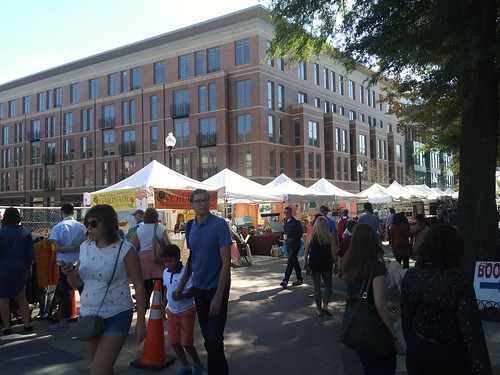
New building on the old Hine Junior High School site between C, 7th and 8th Streets, and Pennsylvania Avenue SE, and Sunday Flea Market
New building on the old Hine Junior High School site between C, 7th and 8th Streets, and Pennsylvania Avenue SE, and Sunday Flea Market.  The building includes a Trader Joe's (which seems particularly small to me.)

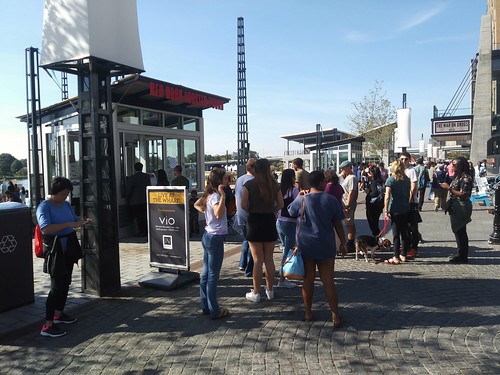
The line for the Red Hook Lobster concession stand at The Wharf, on the stone "boardwalk" on the Washington Channel
The line for the Red Hook Lobster concession stand at the newly opened The Wharf development, on the stone "boardwalk" on the Washington Channel.

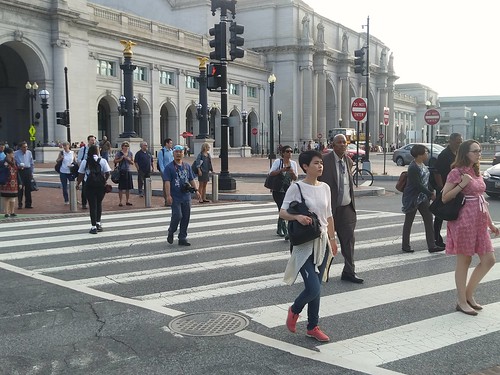
Pedestrians in the crosswalk outside Union Station
Pedestrians in the crosswalk outside Union Station.

But more and more neighborhoods have amenities--restaurants at least--that are walkable.  In the core especially you see many more bicyclists and people riding cargo bikes taking kids to school.

But the challenge of how to ensure that more people participate in significant ways within the local economy remains.

Labels: , , , ,

Wednesday, August 02, 2017

One potential solution to the problem of "finding work" for homeless adults

The previous entry on SRO housing mentions the Orange County Register article, "Who are the homeless living in the shadow of the Big A? Here are 11 stories." 

Besides making it clear that Orange County needs a lot more single adult housing at lower than market rates as an affordable housing strategy, it occurs to me that creating structured, social-care type businesses might be a way to help people on the margins of the economy to participate in the workforce.

The article recounts how a number of the people in that particular economy had worked in the trades, but for various reasons they lost jobs and haven't been able to get new ones, because of their precarious situations.  From the article:
David Doan, 48, is a mechanical wizard. He built a neighborhood shower by tapping into a back-flow water supply for a drinking fountain. He’s set up a couple of solar panels to power two 12-volt batteries. Residents use it to charge their cellphones. ...

Bruce Bishop, 57, became a union iron worker in 1981. He says he once made $67.50 an hour. But a DUI led to a lost driver’s license. And DMV red tape, he says, led to a debt and the loss of his care registration and the money to pay insurance. When he couldn’t pay his dues, he lost his union card too. He’s working day labor jobs now, and someday hopes to get back both his driver’s license and union card. ...

Sher Stuckman, 59, says she once worked in a precious-metals refinery and in a diesel engine factory. “I’m handy with anything mechanical.”
A number of them seem to have "mad skills" and given the ever present need for skilled workers, the issue isn't so much their skill but their need to work in a more flexible and supportive work environment, rather than the typical "sink or swim" system that typifies construction.

Create social enterprises to provide structured, supportive work settings, and real work.  Instead of them hanging out at the Home Depot or other home improvement stores looking for casual employment as day laborers ("Day Laborer Battle Runs Outside Home Depot," New York Times, 2005), couldn't social service nonprofits create social entrepreneurship businesses that can do handyman-home improvement services, while also linking these businesses to SRO housing and other support services to help them keep it together?
Social enterprises are revenue-generating businesses with a twist. Whether operated by a non-profit organization or by a for-profit company, a social enterprise has two goals: to achieve social, cultural, community economic and/or environmental outcomes; and, to earn revenue.

On the surface, many social enterprises look, feel, and even operate like traditional businesses. But looking more deeply, one discovers the defining characteristics of the social enterprise: mission is at the centre of business, with income generation playing an important supporting role.

-- The Centre for Community Enterprise via the British Columbia Centre for Social Enterprise
We are seeing some of these kinds of businesses being created in DC, even if they aren't defined as social enterprises, to help ex-offenders better re-engage in society and the economy or to work with otherwise unemployed young adults.

For example, employing ex-offenders, Clean Decisions specializes in cleaning commercial kitchens and restaurants ("Once a violent offender, his company now keeps clean kitchens," Washington Post).

The Clean Green Team hires young adults to do landscaping ("All-black landscaping crew turns 'the look' into job opportunities," Post). From the article:
Little Lights Urban Ministries helps the team drum up business, much of it on Capitol Hill. There are 22 team members. D&A Dunlevy Landscapers provides the job training.

“It’s a small-scale operation, but people need to see that there are practical ways to create job opportunities,” said Steve Parks, who founded Little Lights 20 years ago. “You have to make it a priority, though. It takes more than just being concerned.”
The DC Department of Youth Rehabilitation Services does work skills training with clients in part by cutting lawns of senior citizens ("Juvenile offenders learn meaning of work through mowing lawns of the elderly," Post).

An often touted example is DC Central Kitchen, which provides culinary training and helps support it through commercial catering.

For Latino immigrants, CASA of Maryland has created a referral program for certain kinds of home projects.  And in Seattle there is a similar kind of program at Casa Latina ("The Seattle Woman Who Made A Home For Day Laborers," KUOW/NPR).

Work versus Workforce Development.  Similarly, I have had a running argument with this guy about "workforce development."  I keep saying the issue isn't the training but the workplace, and that people being integrated/reintegrated into the workforce typically need more help and ongoing support than can be supplied by a for profit business with limited resources, especially in this kind of "human resources/HR."

So using models like Push Buffalo's Push Green Western New York energy efficiency improvement business, and the Evergreen Cooperatives in Cleveland, I say construct the businesses that can employ people, albeit not exactly as full-time permanent employment, but as part of a multi-phase workforce training and development program.

Although that's not what Evergreen does, instead they create worker-owned cooperatives and they have three, a laundry, farm, and a solar panel installation firm.  According to their website, they actively focus on creating jobs, and the training programs follow:
The initiative was designed to create an economic breakthrough in Cleveland. Rather than a trickle-down strategy, it focuses on economic inclusion and building a local economy from the ground up. Rather than offering public subsidy to induce corporations to bring what are often low-wage jobs into the city, the Evergreen strategy calls for catalyzing new businesses, owned by their employees. Rather than concentrate on workforce training for employment opportunities that are largely unavailable to low-skill and low-income workers, the Evergreen Initiative first creates the jobs, and then recruits and trains local residents to fill them.
-- "The Cleveland Model—How the Evergreen Cooperatives are Building Community Wealth," Democracy Collaborative
-- "Worker-Owned Green City Growers is On the Path to Profits While Giving Refugees and Ex-Cons Gainful Employment," Cleveland Scene Magazine

Labels: , ,

Wednesday, May 18, 2016

Better leveraging higher education institutions in cities and counties: Greensboro; Spokane; Mesa; Phoenix; Montgomery County, Maryland; Washington, DC

For more than one year, I've been meaning to write about Greensboro, North Carolina, and how one of the planks of their economic development and urban revitalization planning is to better leverage opportunities present within the myriad of higher education institutions in their community, ranging from two public universities, the University of North Carolina Greensboro and North Carolina Agriculture & Technical State University--an HBCU land grant college, a community college system, and six private schools.

The range of programs attracts students not just from North Carolina, but from across the US and many foreign countries, adding a level of cosmopolitanism and a research thrust that likely wouldn't be present otherwise.  The city still has a strong manufacturing sector and the colleges help to support that sector's continued relevance when in many communities manufacturing continues to diminish as a significant element of the local economy.

One example is how UNCG and NCA&T already share a science and research park, the Gateway University Science Park, anchored by the Joint School of Nanoscience and Nanoengineering, where the dean reports to both institutions.

One of Greensboro's inspirations has been how Spokane, Washington is creating a multi-institutional campus, called the University District, on a section of the waterfront no longer used by the maritime industry ("Campus evolution: WSU kicks Spokane development into high gear, Spokane Spokesman-Review), six institutions including Washington State University, which aims to create a medical school as part of their Spokane operation, are developing a mixed-function university campus integrating the normally distinctly separate schools and programs.

Note that Mesa, Arizona has done something similar as a revitalization initiative, focusing on attracting university operations to its city, although Arizona State University is based in Tempe, and there is multi-institutional graduate campus in Phoenix, where University of Arizona has various professional programs including a medical school ("University of Arizona expands footprint in downtown Phoenix," Arizona Daily Star), along with programs from ASU and Northern Arizona University.

Mesa's initiative hasn't been fully successful, likely because of the proximity of ASU  ("Mesa mayor hopes to attract more colleges to city" and "Do Mesa's branch colleges have what it takes to survive?," Arizona Republic).  But three of the five colleges originally recruited are successful..

Greensboro's universities move towards collaboration.  In an interview about Greensboro, Ed Kitchen, former city manager and now vice president of the Bryan Foundation--a local foundation that has invested heavily in a wide range of community improvement projects-- discussed how going forward higher education institutions especially when there are multiple institutions in a single community, need to rethink how they organize and deliver programs, with a much greater focus on collaboration and differentiation and sharing, and a de-emphasis on duplication.

Applying that idea to Greensboro, stakeholders figured their best opportunities were with nursing and business education.  Greensboro has a strong hospital group and nursing programs at many of the institutions.

Because of declining State appropriations, Greensboro's public universities are seeing the value of collaboration, because on their own it can be much more difficult to build new facilities and offer new programs.

Creating the Union Square Campus in Downtown Greensboro. That common interest has spurred the development of the Union Square Campus, a new urban mixed use higher education development on 7 acres (two to three city blocks) in the core of Greensboro.

According to the Triad Business Journal ("Impact of Union Square at South Elm in downtown Greensboro could reach $500M"), UNCG, NCA&T, Guilford Technical Community College, and the Cone Health system are partnering on a "105,000-square-foot collaborative health care training facility," which will cost about $40 million to construct.

The colleges will shift their nursing programs to that campus, and UNCG will launch a doctoral nursing program there.  Instead of competing for students and resources, the schools will collaborate and collectively offer programs, providing more options to students than any one of the schools could offer individually.

The Union Square Campus is a way to experiment with how to bring that about while simultaneously supporting the city's revitalization objectives.  From the article:
As Triad Business Journal reported last year, the Union Square at South Elm development is set to host nearly 1 million square feet of new construction, including: the second phase of the downtown university campus; a 93,000-square-foot mixed-use building with ground-floor retail; a 500-space and a 200-300 space parking deck; a 96-unit and a 60-unit apartment building; and an about 150-room hotel with 18,000 square feet of conference and seminar space.
Universities at Shady Grove, Montgomery County Maryland.  What motivated me to write this piece was the publication of an article in the Washington Post, "Shady Grove: 1 campus, 9 colleges," about the multiple university campus in Upper Montgomery County, Maryland, The Universities at Shady Grovewhich includes undergraduate and graduate programs from various Maryland state universities.

(Separately, Johns Hopkins University has a campus of its own in Upper Montgomery County, and both are primary anchors of a multi-site science and technology research and business development initiative once called Science City but now termed the Great Seneca Science Corridor.)

From the article:
But Shady Grove is a program unlike any other, with nine state universities converging at the Rockville, Md., campus, part of an effort that began 16 years ago to reduce college costs, produce an educated workforce and encourage college completion among populations that traditionally struggle to get their ­degrees.

Public universities and colleges are grappling with how to serve a growing population of students with limited resources in the face of paltry state investment in higher education. ­Cooperative programs, such as the one at Shady Grove, draw on the strengths of regional colleges and respond to demands for workforce development.

“It’s a very innovative model,” said Barmak Nassirian, director of federal relations and policy analysis for the American Association of State Colleges and Universities. “You have a public institution responding to market conditions in a way that expands access.”

Shady Grove offers a way for community college students to transfer into undergraduate programs at nine of the 12 schools in the University System of Maryland, including the University of Maryland Eastern Shore, Bowie State, Towson and the state flagship in College Park.
The campus is a way for universities to tap into the potential student population in the county as well as the business and research community and the scientific laboratories of the federal government, in particular the National Institutes of Health and the National Institute of Science and Technology.

But like the Union Square Campus in Greensboro, the University District in Spokane, and the Downtown higher education campus in Phoenix it is another model of co-location and collaboration that more communities need to consider when looking at ways to better leverage the presence of higher education institutions within their local economy.

Washington DC universities have more opportunity for collaboration.  When I was talking with Mr. Kitchen, I stopped for a moment, listed the major universities in DC (American University, Catholic University of America, Gallaudet University, Georgetown University, George Washington University, Howard University, Trinity Washington University, University of the District of Columbia) along with various other university programs active in the city, and made the point that there was plenty of opportunity for collaboration between the institutions, but for the most part, they each go their own way.

Since that conversation, both Howard and Catholic have done some downsizing, in the face of declining tuition revenue.

Recently, both Howard University and American University have sold some properties for redevelopment, and starting around 2004 Catholic University initiated a large commercial redevelopment on land they own that is south of Michigan Avenue, much of which is now open and has recentered the Brookland neighborhood around the Metro station and the new buildings there.

HU is considering selling its PBS station affiliate's wireless spectrum as a way to raise money, and has created a joint venture to run its hospital, to put it in a better place financially.  Georgetown and GWU have already done something similar with their hospitals, to reduce their financial exposure.

And GWU, partly as a positioning move has amongst the highest tuition in the US ("Stephen Trachtenberg Is Not Sorry: Students have more debt than ever before. But the university president who helped propel a tuition arms race says schools are just getting started," National Journal).

In terms of some collaboration, in the past I suggested that DC go in with Montgomery County on a joint community college, and that DC consider, comparable to how the State University of New York supports certain "state colleges" at Cornell and some other institutions, contracting with one of the city's universities to offer a liberal arts college rather than UDC.

Perhaps the city's universities could move to a more collaborative place, especially as financial considerations push some of the institutions to reorganize some of their functions.

Currently, the universities participate in the Consortium of Universities of the Washington Metropolitan Area which among other functions, allows students to take courses at other schools in the group, and they lobby on policies impacting colleges in DC.  It functions similarly to the Five College Consortium in Amherst, Massachusetts, but they don't operate at the level of the Committee on Institutional Cooperation that links the academic side of Big Ten conference members, along with the University of Chicago.

Universities at Shady Grove as a model for East of the River advanced education initiatives/initiatives in under-served communities. One of my laments about the redesign and reconstruction of the Anacostia branch library is that it was a like for like replacement, when it could have been relocated to a more prominent location and more education-related functions added.

One thread of this idea is how the Tower Hamlets borough of London merged their library and continuing education programs into a combined program called "Idea Stores," and located them prominently within commercial districts and activity centers, from less well located sites ("When is a library not a library? When it's an 'idea store'," Guardian).

But the other would have been something like the Universities at Shady Grove, having a higher education building-campus as part of the public library, that could be shared by the city's community colleges and other higher education initiatives, even workforce training programs supported by the Department of Employment Services.

Note that since the opportunity has been lost for at least one generation to do this with the Anacostia library branch, it could be done as part of the revivification of the St. Elizabeths east campus, although it has similar issues in terms of not being part of the Anacostia business district proximate to the Metro station.

Similarly, such as facility could be set up as part of redevelopment on the Congress Heights side of the St. E's campus, where a Washington Wizards practice facility will be located ("Plan For Wizards And Mystics Facility Has Some In Southeast D.C. Playing Defense," WAMU/NPR).

Labels: , , , , , ,

Monday, May 11, 2015

Demolition vs. Preservation as a neighborhood revitalization strategy: Baltimore, Muncie, Indiana, etc.

A couple weeks ago, national Washington Post columnist Eugene Robinson suggested in "Tear down Baltimore's abandoned buildings to help rebuild," that Baltimore needs to get its demolition on.  He made this point out of the belief that "blighted" properties are pernicious visually and have a negative impact on neighborhood and personal perception.

The problem with this belief is that an empty lot produced in the place of the disinvested building is an equivalent form of blight and equally uncorrectable, as pointed out by the Springfield (IL) State Journal-Register in "City demolition efforts continue, but vacant lots slow to fill in."

Vacant properties in Central Baltimore.  The Sandtown-Winchester neighborhood is on the left side of this graphic.

Baltimore is a weak market, but with strong market opportunities.  While Baltimore is quite impoverished, it does have the opportunity to attract new residents, because of its location on the East Coast, being served by the Northeast Corridor Amtrak line, and close enough and with significantly cheaper but historic housing, to serve as a bedroom community for DC.

And areas marked by a high degree of vacancies are centrally located.

I was going to write a letter in response to the Robinson column, but Michael Allen of the Preservation Research Office in St. Louis, beat me to it.  In "Bulldozers aren't the only answer" he wrote:
As I read Eugene Robinson’s May 1 op-ed column, “Ghosts that haunt Charm City,” I found myself both nodding and shaking my head with equal vigor. I know all too well that abandoned buildings can drag down the look of a city written off for its many problems. 
Once upon a time, St. Louisans looked to demolishing abandoned buildings to resolve social problems and improve appearances. The results, however, diminished the city: fewer buildings, fewer people, less tax revenue, degraded land values. In 1998, Missouri created a state historic tax credit, and ever since St. Louis has been finding that rehabilitation creates wealth in communities that assumed they had hit bottom. 
St. Louis has a smaller population than Baltimore, none of the proximity to other major cities and far lower demand for real estate. Yet we harnessed the economic power of what seemed like a dead weight: vacant buildings. 
Mr. Robinson might want to rethink his thesis to at least admit that rehabilitation is as viable a solution as demolition — and one with greater economic returns. Not everything can be saved, but not everything should be bulldozed either. 
But this shouldn't be news.  For example, see "Eyesore to Community Asset: Historic preservation creates affordable housing and livable neighborhoods" from Shelterforce.

Costs associated with vacant properties don't go away when you tear down a building.  Demolishing a building just creates a vacant lot.  So demolition ends up being an incomplete "solution."  Just like vacant buildings, vacant lots contribute to increased costs to cities and counties.

According to a GAO study, vacant properties have a negative impact on immediate properties of close to 10%, while a study in Pittsburgh attributes an overall decrease in city property value ("Costs of blight," Pittsburgh Quarterly).

Vacant lots can be loci for trash and illegal dumping.  Image: (Maryland) Daily Record.

The Chicago Tribune reported ("Crime in Chicago's vacant property soars 48% since 2005") that crime increases in Chicago neighborhoods with a significant number of vacant lots and buildings.

Similarly, a Government Finance Review article reports in a significant increase in emergency services expenditures associated with vacant buildings and lots.

Certainly in those cities that have the opportunity to attract new residents, demolition is an ill-considered strategy that seemingly makes sense in the short term, but has long term negative consequences.

The language of revitalization.  As an aside, it's important to remember the importance of language and message.  A so-called blighted building is the result of disinvestment.  The solution to blight isn't "demolition," but reinvestment in the property.

Market economics makes rehabbing disinvested properties expensive and sometimes uneconomic in the short and intermediate run.  In weak real estate markets, the high cost of renovating a building that has been disinvested in for decades often means that the cost of the renovations isn't immediately recouped by increased property value--except, perhaps over a many decade period (e.g., for example it took 30+ years for many DC neighborhoods to get to the point where they were 5-10 years ago, let alone, the market of today).  So at the scale of an individual property owner, it seems to make economic sense to demolish rather than to repair or rehabilitate.

In weak real estate markets, the value of stable neighborhoods is less captured by individual property owners and is more a function of the whole, as a public good, as opposed to the way the property normally works, at the lot by lot scale.

To stabilize improve neighborhoods,local governments are justified in making extra-normal public investments in such places, including a variety of tactics including tax credits, providing properties for no cost, technical assistance, grants, and other financial inducements.

The Muncie illustration.  In preparation for a forthcoming blog entry, I was reading the book Resilient Downtowns, by Michael Burayidi and in touting historic preservation as a neighborhood revitalization and resident recruitment strategy, one of the examples it gave was from Muncie, Indiana.

The city had intended to demolish a number of "blighted properties," but push back from historic preservation and neighborhood activists led the city to change its direction, and instead, money earmarked for demolition was shifted towards funding renovation.

The book highlighted the renovation of a property at 911 E. Jackson Street, but didn't include photos.

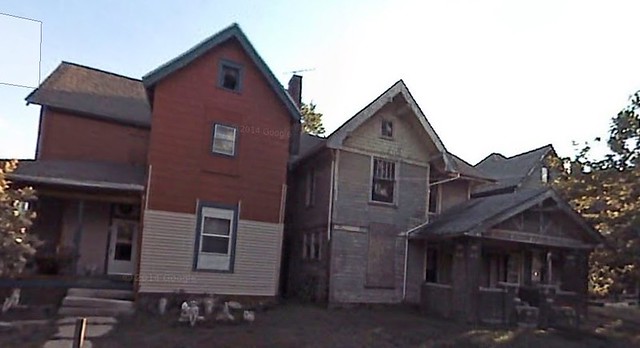
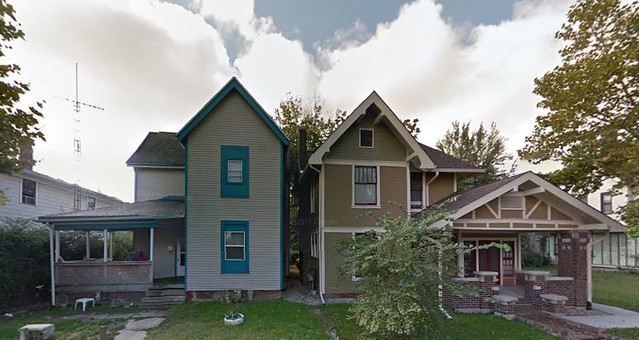
I looked up the building online, using Google Street View from the present and the past, and I was astounded at the transformation, and the visible proof that investment is the far better response to disinvestment, rather than demolition.

Of course, across the county, there are thousands and thousands of such examples which illustrate the benefits of making the choice to renovate rather than demolish.

The building on the right is 911 E. Jackson Street, Muncie, Indiana, before rehabilitation (2007)
house before

911 E. Jackson Street, Muncie, Indiana, after rehabilitation (2014)
house after

The building had been vacant for more than 25 years, and a few years before the city ordered the building's demolition, it had been purchased by a graduate of the Ball State University architecture school in Muncie, with the intention of renovating the property.  But given the high cost of renovation and the difficulties raising funds, the owner had not yet begun the project.

According to "HUD Grant to Turn Threatened Indiana House into affordable housing," from Preservation Magazine, the final cost was about $300,000.  HUD community development funds paid about 80% of the total.

You can argue that demolition would have been cheaper, and it would have in terms of initial cost, but over time, the reinvestment in the neighborhood will pay off--especially compared to the opportunity costs of a vacant lot not likely to be redeveloped any time soon.

Clearly, the house next door (on the left in the image), was renovated as well, although I don't know the genesis of that project.  Generally, improvements in one property help to spark private investment by others--the argument made in Building Neighborhood Confidence by Goetze.

Note that Baltimore has many excellent neighborhood revitalization programs, including the Live Baltimore residential recruitment program, while the Healthy Neighborhoods program focuses on strengthening late emerging and transitioning neighborhoods (see "Systematic neighborhood engagement").

Parks and urban farms as an alternative vacant lot absorption strategy.  While touted in many quarters, I am not a fan of adaptive reuse of vacant properties for farms and parks, except in selective situations where a neighborhood lacks such spaces.

Image above from "Extreme Green Makeovers for Vacant Lots," Public News Service.

Generally, an occupied house, with residents paying income, sales, and property taxes, and committed to living in and maintaining a viable neighborhood, is the highest and best use for such properties.

But in weak markets, it can be a way to landbank properties and as a lower cost maintenance strategy.

-- Vacant Lot Handbook: A Guide to Reusing, Reinventing and Adding Value to Milwaukee’s
City-owned Vacant Lots
, City of Milwaukee
-- Greening Vacanant Lots: Planning and Implementation Strategies, Nature Conservancy
-- Green Pattern Book: Using Vacant Land to Create Greener NeighborhoodsCity of Baltimore Growing Green Initiative
-- Cutting Through The Red Tape: How Baltimore's Vacant Lot Programs Have Made it Easier For Communities To Revitalize The Underutilized And Blighted Spaces In Their Neighborhoods, MIT

The best alternative to demolition: rehabilitation of vacant properties as a community and jobs development program.

But I would argue that Baltimore needs to go beyond the programs they have, as various neighborhoods remain in persistent poverty.

I recommend a two pronged program for distressed and emerging neighborhoods.  Instead of focusing on property demolition and tearing holes in blocks and neighborhoods which further destabilizes rather than improves communities, instead (1) focus on rehabilitating and getting houses occupied, (2) through a skills and workforce development and training program.

Model programs include:
  • the HUD-funded Youthbuild program, which teaches construction skills to young adults through classroom and field settings such as affordable housing developments, schools, and community centers;
  • Savannah Landmark Rehabilitation Project -- this 1970s initiative aimed to preserve the ability of lower income households to remain in the Savannah Historic District despite rising housing prices.  It did so by purchasing and rehabilitating 260 units of housing units and keeping them as part of a portfolio of permanently affordable housing;
  • PUSH (People United for Sustainable Housing) Buffalo's energy efficiency and conservation rehabilitation program, which is a community development social enterprise that develops green jobs, while doing energy efficiency upgrades;
  • housing rehabilitation programs for low income and senior residents by affiliates of the nonprofit organization Rebuilding Together
  • the Artist Relocation Program in Paducah, Kentucky targets a different demographic, but is a good model for demonstrating how selling for low cost or providing properties for no cost in return for significant investment into rehabbing disinvested properties can be a good way to recruit new residents to otherwise vacant properties and neighborhoods.  They did this in the city's Lower Town neighborhood. See "Artists to the rescue" from the Evansville Courier and Press and this presentation.
  • The Roots to Re-entry program of the Pennsylvania Horticultural Society trains prison inmates "in gardening and landscape management. This intensive hands-on training focuses on horticultural practices, landscape maintenance, greenhouse operations, carpentry, and masonry skill sets. The training also includes course work in workforce literacy, job readiness, health education, and occupational therapy. Upon completion, program participants will receive post release support from PHS and its partners including job placement helping inmates make the transition to life outside the prison walls."

Labels: , , , , , ,

Tuesday, December 04, 2012

Workforce housing and Menards, Minot, North Dakota

The Associated Press reports in "Menard sends state workers to staff booming Minot, N.D., store" (via the Green Bay Press-Gazette, the story is more complete than the version that ran in the Washington Post) that the Menards Home Improvement chain will hire workers in Wisconsin for their new store in Minot, North Dakota, and fly them in for weekly shifts, putting them up at hotels.  (The media has been full of stories about the boom in North Dakota, and shortages of workers and housing, due to the shale oil and gas boom there.)

From the article:

Menard, which has more than 200 stores in the Upper Midwest, said this would be the first time it has ferried in workers by airplane, but it believes jetting in employees for weeklong stints and housing them in hotels “is going to be a permanent solution for as far as we can see.” ...

Businesses struggle to attract workers throughout North Dakota, which has some 22,000 more jobs than takers and the lowest unemployment rate in the nation, at 2.4 percent, Job Service North Dakota data show. The unemployment rate in Minot is 2.3 percent.


Menards is really missing the boat by not building housing above their store in Minot, making the store a mixed use facility.

Years ago, I remember reading about Tesco Supermarket chain in the UK mentioning the cost of worker housing as a limiting factor in their growth, given the prevailing wage rates versus the cost of housing.  And they discussed how, as part of developing their sites, they could build housing above the store, although they wouldn't limit it to workforce housing.  (They have since moved into the mixed use development market, not unlike how retailers in the US often develop shopping centers.)

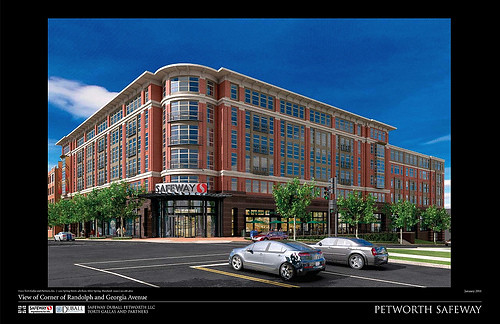
In DC, Safeway has redeveloped two sites where they'll be part of mixed use projects with residential housing above, and a third site was built this way, but where a Safeway store hadn't been located, at CityVista Downtown.  Plans are to redevelop other Safeway sites in upper northwest DC similarly.  Giant Supermarket will be opening supermarkets on the ground floor of mixed use housing developments in Cathedral Heights, H Street, and the Shaw neighborhoods.
Petworth Safeway rendering
Rendering of the new Safeway + housing development in Petworth, on Georgia Avenue.

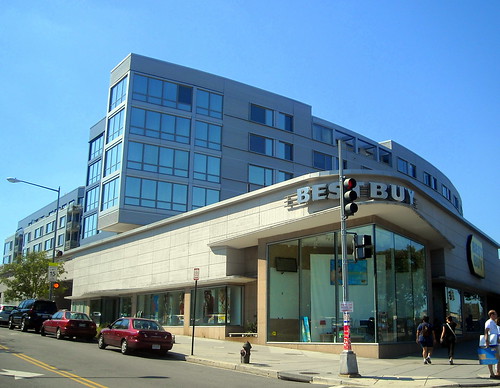
A Best Buy, Container Store, and a hardware store are in the old Sears in Tenleytown, and 400+ housing units were built on top of and adjacent to the building.
Old Sears
Flickr photo by NCinDC.

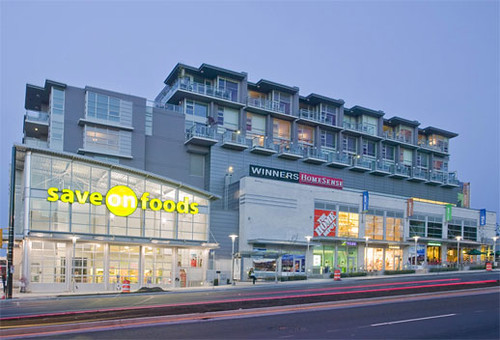
In the Vancouver development The Rise, a Home Depot and a Canadian housewares chain retailer, Winners HomeSense, are located on the first two floors, along with a supermarket, and there are apartments above.
Vancouver's The Rise mixed use development

Menards is missing an opportunity to be creative and innovative and solve problems.
Menards image from the Little House on the Corner blog.  I don't have an image of the Minot store.  I don't imagine it's any different from this one.  Granted building housing above would have been more complicated. But given the demand, from their own employees and more generally, they could have developed the project differently, and solved multiple problems simultaneously.

Labels: , , , , , ,

Wednesday, January 26, 2011

Making hard choices in the beginning makes programs more sustainable in the end (even if harder to create)

DC created a community college, to help the University of the District of Columbia better focus on job training type programs vs. traditional four year degree programs and graduate education. This was suggested in a 2009 report published by the Brookings Institution and was followed up by an op-ed and other coverage in the Washington Post.
The issue and links to coverage including an op-ed by Alice Rivlin and Walter Smith are in the October 2008 blog entry, "Thinking Regionally: Community Colleges."

At the time, I criticized the path taken by the University. I suggested that instead of creating a new community college, why not try to develop a community college jointly with either or both Montgomery College and Prince George's County Community College, comparable to how Northern Virginia jurisdictions have combined to offer one community college system across their geography in the Northern Virginia Community College system (Jill Biden is teaching there...).

This was suggested by the Brookings report (but not in the op-ed in the Post) which called for working with one or more suburban community colleges during the set up period, but along the path of creating a fully autonomous and independent exclusively DC institution. This was rejected because it would be hard to set up. From the executive summary:

While Options 2 and 3 both result in independence for CCDC, they differ primarily in the strategy by which they reach scale. The project team considered political realities, financial limitations, legal requirements, employer needs, community wishes, effects on UDC, and organizational interests to determine the best way forward to achieve the stated goals. The project team is also aware that, due to the rapid pace of change at UDC/CCDC, some of the details in the report may be out of date by the time the report is released but that the overall recommendations will remain valid.

This report concludes that the District should support CCDC's intention to separate from the flagship university, and encourage it to take the fast track to becoming an independently-accredited, autonomous community college with its own Board of Trustees and budget. The report also concludes that CCDC's move toward independence would be significantly advanced by developing appropriate partnerships with one or more of the DC area's three suburban community colleges (Northern Virginia Community College, Montgomery College, and Prince George's Community College) to take advantage of these institutions' resources and reputations and quickly expand CCDC's capacity. Such partnerships could be the start of a regional consortium of community colleges in the DC area. Accordingly, the report recommends that CCDC pursue Option 3, which we call the "Independence Plus Partnership Option."


Sure it would have been hard to create. But why create another administrative structure, deans, etc., and instead offer DC students the opportunity to study at multiple campuses that are already extant, and likely the opportunity to have a broader array of educational and technical opportunities, because of the greater total resources made available to students.

-- Montgomery College has three campuses (one is close by in Takoma Park-Silver Spring) with 60,000 full and part-time students.

-- PG County Community College has 37,000 students, with one main campus in Largo, and three extension campuses, including one at Prince George's Plaza Metro Station.

-- Northern Virginia Community College has 6 campuses, two centers (admittedly not easy for DC residents to get to) and 78,000 students, plus an online learning initiative

Today's Post has an article, "UDC says community college at risk of cuts unless it gets $8 million from District" about the financial problems faced by the DC Community College, because the cost of setting up the institution has been greater than expected, and has used up all the previously allocated monies in advance of the period (four years) that they were expected to be expended, not to mention that there has been heavy demand (which was also covered in this Post article from the summer, "Rising enrollment is a mark of success for new D.C. community college"). From the first article:

Since UDC launched a community college two years ago, enrollment has soared: More than 2,500 students attend two-year academic and job training programs at multiple locations in the city. But UDC officials say they have been forced to spend more than $18 million to get the community college off the ground, nearly depleting the flagship four-year college in Northwest of its reserve funds.

"We want people to know there is no more money in this piggy bank," said Allen L. Sessoms, president of UDC. "If they want to keep this going, we need money, and it's going to cost money."


For all its aspirations, DC isn't all that big. While a community college is vitally important to workforce development, rushing forward without fully thinking the project through is proving to be problematic. Most of the campuses are satisficed, and the college doesn't have the resources it truly needs to scale up, not to mention it's duplicative.

Labels: , , , ,