Rebuilding Place in the Urban Space

"A community’s physical form, rather than its land uses, is its most intrinsic and enduring characteristic." [Katz, EPA] This blog focuses on place and placemaking and all that makes it work--historic preservation, urban design, transportation, asset-based community development, arts & cultural development, commercial district revitalization, tourism & destination development, and quality of life advocacy--along with doses of civic engagement and good governance watchdogging.

Thursday, October 02, 2025

Going to the dogs

In the past I've written about dogs as an indicator of people feeling safe living in cities, and that dog walking provides the impetus for many to actually walk outside in a city.  Plus, dogs (and little kids) act as a "social bridge" (what William Whyte called "triangulation") in getting people who don't know each other to interact.

Some say, with justification, that dog parks are an indicator of reproduction of space and gentrification.  This study, "Dog Parks and Coffee Shops: Faux Diversity and Consumption in Gentrifying Neighborhoods" (Journal of Public Policy and Marketing) is based on DC.

-- "Dog Parks and Coffee Shops documentary about gentrification in DC," 2020

OTOH, how many times have you stepped in dog poop or narrowly avoided it?  Even people who do pick up the poop often toss it into recycling cans, contaminating the waste meaning it can't be recycled.

Suzanne was talking to people about my illnesses, and a person opined that I should get a dog.  That's the last thing I'd be interested in, even though health researchers think having a dog is a good thing ("Can’t commit to a dog? Have one for a day — science says it’s good for you.," Washington Post).  

Psychologist Kerri Rodriguez, who leads a group at the University of Arizona that researches animal-human interactions, said spending just five or 10 minutes with a dog can make people happier and decrease their stress.

In fact, research has shown that when people interact with dogs, oxytocin — known as the love hormone — increases in both species. This is true even if you’re petting someone else’s friendly dog.

Actually my response was "F* that."  I can walk and do things without a dog, and without the responsibility of dog maintenance.  Reading and writing makes me happier...

Note that for a long time, urban multiunit apartment buildings have been offering dog-related amenities to tenants ("Pet-Friendly Apartment Amenities Gather Steam Amid Societal Shifts," Commercial Observer).

1.  "America’s Most Dog-Friendly City Has Had Enough," Wall Street Journal

.  People aren't managing their dogs and feel entitled to take them anywhere.  From the article:

Rose Crelli loves dogs. The violinist grew up with sled dogs in Alaska. She stops to pet dogs on the street. If she had to rate her love on a scale of 1 to 10, it would be a 10.

But Crelli, 29, has started thinking maybe San Francisco is too dog-friendly. While she and a friend were having coffee at Alamo Square park, the pair were approached by five different off-leash dogs in an area that requires dogs be leashed. The final visitor, a golden retriever, sent Crelli over the edge. “It literally launched itself at my pastry and got its mouth all over it and covered it with drool,” she said. The dog’s owner saw the whole thing and kept walking.

I had something like this happen to me in DC.  It cost me a cup of coffee and the dog owner felt no compunction for recompense.

2.  "An Italian City Is Considering a Dog Tax for Tourists and Locals," New York Times.  It's to pay for the costs associated with errant dog owners who don't pick up dog poop, etc.

A bill in Bolzano, Italy, would mean that dogs bringing their owners to the Tyrolean Alps for some scenery and mountain air would face a new charge of roughly 1.50 euros ($1.75) per day, the Italian news media reported.

Local dogs won’t escape under the bill, which would come into force in 2026 if it is approved by the provincial council. Residents would be charged an estimated 100 euros per dog, per year, bringing back a dog tax that was abolished in 2008.

Flickr photo by Edgar Zuniga, Jr.  Sugar House Pond.

3.  Sugar House Park, Salt Lake.  We don't have a dog park, dogs are required to be on leash, but the vast open spaces of the park lead many to unleash their dogs.  For the most part it isn't a problem, and we don't have the resources to enforce the rule.

The board member representing the County Parks Department, which operates the park for us under contract, says if we had a dog park, then people would be more inclined to follow the rules.  

Note the dog park denoted at the lower right of the map for SLC's Fairmont Park.

For me, given that there is a city park a couple blocks aware with over 2 acres devoted to a dog park, I think it's unnecessarily duplicative to create one in our park.

4.  Great guidance offered by Salt Lake County Parks.

-- Salt Lake County Off-Leash Dog Park Master Plan

5.  "Chicago restaurants mixed on the prospect of dogs at the table," Crain's Chicago Business.  An alderman has put for legislation to allow dogs in restaurants, not just on patios.  Holy health department Batman!

6.  Private dog parks with bars and play areas are a new type of business on the rise across the country ("Detroit dog park and bar set to open a suburban outpost," Crain's Detroit Business, "Detroit’s first indoor and outdoor dog park with beer garden plans second location," Detroit Free Press).  Usually they have membership fees.  

The Southfield Barkside will have 5,000 square feet of indoor, climate-controlled, off-lease play space and 8,000 square feet of outdoor fenced-in space. The indoor space will feature wi-fi and TVs. The Southfield location will also have dedicated indoor and outdoor play areas for small dogs. The new dog park and bar will have space for 150-200 guests and a staff of 15-20.

Bark Social when it was operative, in Bethesda, Maryland.

I know one went out of business in DC ("Bark Social dog park, bar files for bankruptcy, shutters all DMV locations"), so I expect the market isn't that big.  Although Bark Social is relaunching on a much smaller scale.

7.  Dog parks issues in Boston ("Boston has few dog parks. It’s led to a pitched battle over public space," Boston Globe).  Apparently Boston is particularly dog friendly.  Many parks it's against the rules to walk dogs, even on leash.  

The article discusses how some park systems across the county have hours where off leash use is allowed, partly as a public safety measure, to crowd out negative uses.

8.  Apparently there is an issue with pet rescue sheltering in DC, which dropped its vendor without a new one on deck ("Inside the Year-End Scramble to Save More Than 100 D.C. Dogs," Washington City Paper).

Labels: , , , , , , , , , ,

Wednesday, November 11, 2020

Historic preservation battle in Baltimore

I have written quite a bit about the "architecture of its time" versus "architecture of its place" as the guiding principle of historic preservation regulation, based on the arguments of Notre Dame architecture professor Stephen Semes.

"Maintaining a broad stylistic consistency in traditional settings is not a matter of 'nostalgia,'" he says. "It's a matter of common sense, of reinforcing the sense of place that made a building or neighborhood special to begin with. But many academically trained preservationists want to impose their inevitably subjective notions of what the architecture 'of our time' is."

-- "An argument for the aesthetic quality of the ensemble: special design guidelines are required for DC's avenues," 2015
-- "Treating an entire city as a heritage area/conservation district, rather than a neighborhood by neighborhood approach," 2020
-- "Steven Semes: The Conservation Architect," Traditional Building


Generally, the Secretary of Interior guidelines recommend that new architecture look new, rather than try to copy historic architecture.  While that seems logical, the problem is that new architecture tends to significantly diminish the quality of the ensemble of historic architecture.  New architecture ends up being a gash in the quality of the whole.  

This exact dialectic is in play in Baltimore, where an execrable proposed design for an apartment building in the Clipper Mill district of Woodberry/Hampden (really Woodberry but close to Hampden) was rejected by Baltimore's design oversight body for historic districts and urban design matters, the Commission for Historical and Architectural Preservation ("Signaling conflict ahead, Baltimore historic preservation commission denies approval to Clipper Mill apartment building plans," Baltimore Sun).

-- Poole & Hunt Foundry Complex


The rendering of the proposed new building illustrates the issue quite clearly, especially compared to the historic buildings of the Clipper Mill complex.


This situation is a little more complicated, because another apartment building, shown in the rendering immediately above, was approved before the area received historic designation.  And because the proposal is from the owners of Clipper Mill.  And the owners sued the residents and groups opposing new housing projects ("Developer of Clipper Mill in Baltimore files $25 million lawsuit against residents opposing more housing," Sun).

The proposed building will replace a metal warehouse building next to this stone building that is part of the original complex.

Labels: , , , ,

Tuesday, April 21, 2020

Revisiting the entry: (The opportunity cost of) "Defining density down" | building for today's demand, not future demand

The piece "(The opportunity cost of) "Defining density down," is from February.

======
Also see:

-- "Yes the neighborhood will change, but it will take 10-25 years," 2020
-- "Why gentrification is visible now," 2018
-- "The nature of high value, strong residential real estate markets," 2017

======

It discusses once again the matter of "the opportunity cost" of not taking every opportunity to build more housing units where you have the opportunity to do so (aesthetically sensitively of course), and how this results in (1) a reduction in available housing units, (2) a continuing situation where demand is greater than supply, (3) forgone income, property, and sales taxes and (4) a smaller population less capable of supporting a wider array of community amenities and public goods.

The other day, a colleague asked me a question about whether or not adding density to cities was a good thing, and while writing my response, it occurred to me that answering the question has to do with the fact that what we build today also has to satisfy future demand, which is only going to grow, because the country continuously adds population.

Frequently I make that point that most of DC's single family residential building stock was constructed before 1930 when the US population was 40% of what it is today, and when--unlike industrial cities of the time such as Baltimore, Brooklyn, Chicago, Philadelphia, Pittsburgh, St. Louis, etc.--the city wasn't densely populated, so rowhouses and apartment buildings constructed in DC were small by comparison to those cities.

5 story tenements in Manhattan ("A NYC Tenement Legacy Persists, Despite Gentrification," American Conservative).
Lower East Side

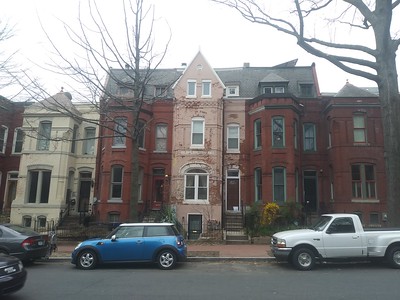
DC rowhouses.  Note that 3 story rowhouses are somewhat rare.  Most are two stories ("Building Styles in the Capitol Hill Historic District," Capitol Hill Restoration Society).
Grouping of three story rowhouses on Capitol Hill, Washington, DC

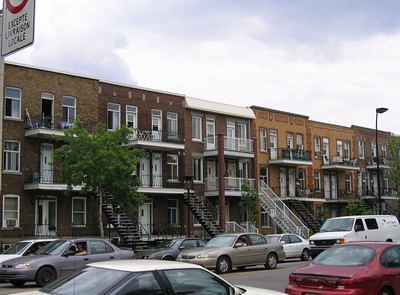
Montreal plexes have 5-6 units in the space of about 1.5 DC rowhouses ("Triplexes help keep city vibrant," Toronto Globe and Mail).
Rue St. Denis

Boston triple decker 3 unit house ("The anatomy of a three-decker," Boston Magazine).
Boston, Massachusetts NSP - Cameron St. Dorchester

Even DC's traditional commercial districts tend to have buildings no more than 2 stories.  This is East Ohio Street in Pittsburgh.
East Ohio Street, Pittsburgh

H Street NE, DC
S&S Shoe Repairing is still open, 1126 H Street NE

In normal circumstances, older housing is cheaper than new housing.  But when supply is constrained and may be especially desirable aesthetically ("historic preservation"), instead older housing is as expensive as new housing.

I look at current projects in cities like DC or Salt Lake City or South Salt Lake ("South Salt Lake's housing boom driven by its transit lines," Salt Lake Tribune) and say to myself, "why don't they build that at least two stories higher?"
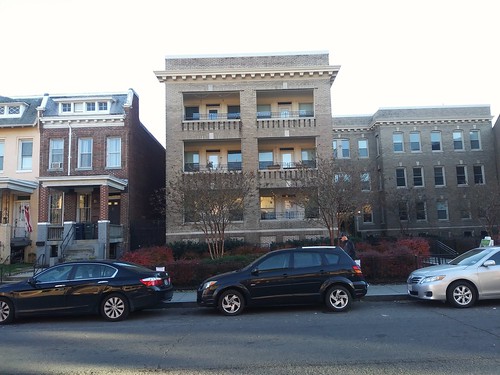
Small three story apartment building in the 9th and 9th district (on 900 South), Salt Lake City
This building is in one of Salt Lake's most popular neighborhoods.  Single family housing predominates but there are apartment buildings, but most are older and aren't much taller than two stories.  Elsewhere in the core, most multiunit buildings are being constructed of 3-5 stories.  I'd say 3 story buildings ought to be at least 5 stories, 5 story buildings should be taller still, etc.
Fort Totten Square
Fort Totten Square is a walk to the Fort Totten Metrorail Station.  It's a four story apartment building on top of retail.  Within the catchment area of the transit station, I'd say it should be at least two stories higher, with a hundred more units, as a way to build a more transit oriented district within an area that is otherwise dependent on the automobile.

And that's wrt current demand.

If we were to take into account the fact that the population of these cities is growing and will grow in the future, then the projects should be bigger still to better meet future demand at a more affordable cost.

For example, according to projections, DC is supposed to have over 842,000 residents in 2030 ("DC Still on Track for Nearly 1 Million Residents in 2045," DC Urban Turf) and one million by 2045.

If you underbuild today, the opportunity cost of underbuilding will only increase as the population increases.

Why is it that taller buildings were constructed more than 100 years ago, compared to today, when land, labor, and materials cost more now?

The Iowa Condominium Apartment Building, 13th Street NW, Logan Circle, Washington, DC., was constructed in 1901 and is 7 stories tall + the basement which has some units as well.

I guess too the issue is that as secondary markets experience the addition of multiunit housing, of course the height won't be the same as in Downtown and other high rise districts.

That being said, given 21st century conditions, the buildings newly constructed likely "should be" taller than similar legacy buildings, because of demand and supply conditions.

Labels: , , , , , , ,

Monday, March 23, 2020

Eviction during pandemic: National Multihousing Council recommends suspending evictions

The Washington Post has an article, "Facing eviction as millions shelter in place," about eviction actions during the pandemic.  Although many communities are mandating a stop to evictions.

(WRT commercial properties in DC, according to the Washington City Paper, in the DC area "Some Landlords Say They'll Help Tenants With Rent. Others Aren't Saying Much.")

There have been cases of severe tone deafness on the part of some landlords ("LANDLORD SAYS RESTAURANT INDUSTRY TENANTS BETTER ASK PARENTS AND RELATIVES TO PAY THEIR RENT OR RISK 'AGGRESSIVE' ACTION," Newsweek).  The opprobrium in response led him to backtrack and resign from his operating responsibilities at his firm.

And an acknowledgement, although not by the Trump Administration, that recently announced HUD initiatives don't pertain to renters ("HUD, Fannie, Freddie suspend foreclosures, evictions during outbreak," Politico).

That being said the National Multifamily Housing Council has recommended to its members to suspend eviction actions that may result from income loss as a result of the pandemic ("Apartment Industry Committed to Supporting Residents Impacted by COVID-19") and they have come out for financial support to renters ("NMHC Calls on Lawmakers to Provide Direct Financial Assistance to Renters").

Yes, you can say it's because of optics or self-interest, but it's important nonetheless.

Labels: , , , ,

Thursday, February 20, 2020

(The opportunity cost of) "Defining density down"

Another New York Times article, "Build, build build" or "California's Housing Crisis: How a Bureaucrat Pushed to Build," describes the difficulty of adding housing in communities because of resident opposition.

What often happens is that if a project can be built, to assuage opposition it becomes smaller or sometimes even more significantly different.

It's a few different kinds of actions:

-- reducing the number of floors
-- not choosing to build higher even if allowed
-- shifting from multiunit to single family
-- building too few units regardless, given existing supply and burgeoning demand.

For example, the site featured in the story went from 315 apartment units to 44 single family houses, a significant reduction in the addition to supply (if the project had gone forward, it did not).  From the article:
A developer had proposed putting 315 apartments on a choice parcel along Deer Hill Road — close to a Bay Area Rapid Transit station, and smack in the view of a bunch of high-dollar properties. This wasn’t just big. The project, which the developer called the Terraces of Lafayette, would be the biggest development in the suburb’s history. Zoning rules allowed it, but neighbors seemed to feel that if their opposition was vehement enough, it could keep the Terraces unbuilt.

In letters to elected officials, and at the open microphone that Mr. Falk observed at the City Council meetings, residents said things like “too aggressive,” “not respectful,” “embarrassment,” “outraged,” “audacity,” “very urban,” “deeply upset,” “unsightly,” “monstrosity,” “inconceivable,” “simply outrageous,” “vehemently opposed,” “sheer scope,” “very wrong,” “blocking views,” “does not conform,” “property values will be destroyed,” and “will allow more crime to be committed.”
In a metropolitan area short in housing supply by many tens of thousands of units, cutting 270 housing units is a significant loss, what economists call an "opportunity cost."

Other opportunity costs include not leveraging the multi-billion dollar investment in the transit system, foregone property tax revenues, etc.

In my 2017 piece, "The nature of high value ("strong") residential real estate markets," I called this process "Defining density down" when I wrote:
By severely limiting height and "defining density down" (e.g., "D.C. court rejects Brookland project for a third and possibly final time," Washington Business Journal) residents clamoring about housing affordability are eliminating opportunities to address the problem, albeit the results aren't discernable for multiple decades.
Clearly, I was referencing the concept expressed in Daniel Patrick Moynihan's article on social order in cities, "Defining Deviance Down."

It's a great term that I should use repeatedly.

Yimbyism.  Separately the article discusses a housing activist, Sonja Trauss, and her advocacy group San Francisco Bay Area Renters Federation, who argues in every case that housing should be built, regardless of the consequences.  Needless to say, she tends to be supported by people not living in the immediate area of proposed projects.

But her approach isn't nuanced either. And her lawsuit in favor of the project ended up costing the developer money too, and contributed to his walking away.

State proposals to mandate housing.  In any case, after this experience--a project that took 8 years and still didn't result in anything, Steve Falk the public official featured in the article, and a graduate of a Harvard class on negotiating, doesn't believe anymore that public processes for new housing construction can generate optimal results.

(See the past blog entry, "The Takoma Metro Development Proposal and its illustration of gaps in planning and participation processes," for a discussion about the flaws in planning processes that lead to such results, in this case a project that has been on the books for 20 years.)

That's why some states like Massachusetts and Maryland have created incentive programs to encourage communities to build housing.

But even then, it often doesn't work, which has led a California legislator to introduce legislation, Senate Bill 50, that mandates higher density in transit station catchment areas, but the legislation hasn't moved forward.

I think I agree that greater density should be mandated, given the disconnect between supply and demand, but I don't think the average state legislature is willing to take the heat and do so, even if real estate interests are primary donors.

Labels: , , , , , , ,

Yes the neighborhood will change, but it will take 10-25 years

The New York Times has an article, "A Luxury Apartment Rises in a Poor Neighborhood. What Happens Next?: Economists say rents would fall. Neighbors fear rents would rise. New research tries to find the answer," about the incursion of high priced apartments into what is otherwise a lower cost residential area.

I wasn't great at economics in college (math is pesky for me), but I am a pretty good observer and analyst and this is what I've learned* analyzing similar phenomena in DC.
  • Rents won't fall because the new housing being added is targeting a different market segment compared to the pre-existing property mix
  • Theoretically, over time, rents might stabilize, because supply has been added, if housing demand isn't greater than supply
  • But if housing demand is greater than supply, new additions don't reduce rents
  • More importantly, rents won't decrease, because a different phenomenon is occurring
  • Rents will increase because the neighborhood has been repositioned from one that was not desirable to one that is desirable.
  • Demand for housing in that particular neighborhood rises as a result, and so do rents.
(* What I have learned has been gained in part by incorporating apt insights by others, including commenters on the Greater Greater Washington blog, and on my own, especially from charlie.)

I've written about these issues a lot over the years.  It's what urban sociologists call the reproduction of space.

-- "The nature of high value ("strong") residential real estate markets" (2017)

Providing the right preconditions are present or can be created -- transit, accessibility, central location, attractiveness, amenities, walkability etc. -- this neighborhood will become newly integrated into the residential choice landscape at the metropolitan scale, whereas before the neighborhood hadn't been on the list of neighborhoods that people were willing to consider.

-- "The eight components of housing value" (2016)

Manayunk, Philadelphia.  There is a book on commercial district revitalization, in part about the Manayunk neighborhood of Philadelphia.

One incident he recounts is the impact of a Philadelphia Inquirer Real Estate section feature about the neighborhood, and how immediately, even the day it was published (on a Sunday), people started  visiting the neighborhood to look at houses, and how the velocity of neighborhood improvement changed.

But it takes a long time.  Over long periods of time, 10-25 years, if housing demand in the overall  market remains high, the neighborhood will change.

It takes that long, and it will wax and wane depending on the market.  E.g., on my street in DC, in 2008, houses cost under $400,000.  Now over $800,000.  But a couple years ago it peaked at even higher prices, since then it has waned a bit (and I am not exactly sure why--I think the Trump Administration's shrinkage of government has had some impact).

In 2003--when the Path and Pitfalls book was published, you could still buy a house in DC's H Street NE neighborhood for under $125,000.

Now houses cost $800,000 and up, are being subdivided into flats, etc.  There is a Whole Foods and other supermarkets, an awesome bookstore, restaurants and taverns galore, and plenty of new apartment and condominium buildings--note, mostly infill on commercially zoned property, not a change to pre-existing housing stock.

Prices will rise as neighborhoods become attractive at the metropolitan scale.  This piece is 8 years old, "Exogenous market forces impact DC's housing market" and it has some flaws.

I mixed up a couple different things going on, one of which isn't too relevant to DC.

But the basic issue is that the supply of housing is relatively fixed, especially for single family housing.  Obviously, if demand rises and supply doesn't move much, prices go up.

What I should have said succinctly is that as neighborhoods become attractive at the metropolitan scale, the highest income households seek to live there, bidding up prices, and outbidding people who make less money, even if on a relative basis, those households that are outbid are still high earners.

People outbid seek to live nearby, triggering a similar process of price appreciation.  As higher income, but not the highest income, households get displaced from the most attractive neighborhoods, in turn they move to nearby neighborhoods possessing similar characteristics, but not yet part of the metropolitan residential landscape.

They spark the process of "reproducing that neighborhood" and drive prices up.

Capital deepening.  University of British Columbia Emeritus Professor David Ley calls this process, "capital deepening."  From the Toronto Globe & Mail article, "An avalanche of money: An expert on how income disparities are reshaping Canada's metropolitan areas zeroes in on Vancouver":
"Because every time redevelopment occurs you get a substantial increase in the socio economic status of occupants … [market-rate] supply is only for high-income people. So, whenever redevelopment occurs, it means higher income people are occupying the space," says Dr. Ley. "Two things are happening: there is gentrification in the inner city, but then there's what I call 'capital deepening,' which is an area that is becoming richer."
One-over neighborhood.  Live Baltimore, the resident attraction and recruitment program, calls this the "one over neighborhood."  You can't afford to live in Federal Hill or Charles Village, so you choose to buy in the closest neighborhood to the most desirable neighborhood, the one that is most similar to it.

Displacement.  WRT displacement, there are a couple issues.  If people own and want to stay, they won't be displaced--most major cities have a dampening program on the speed at which property assessments increase taxes.

If people rent it's a different story.  Properties get upgraded or converted to owner occupied and lower income households get displaced.  But this plays out over long periods of time.

Plus long time owner households choose to cash out--it appears that they've been displaced, but they haven't, as they've chosen to leave.

In neighborhoods predominated by single family houses, displacement likely occurs more quickly.  If there is a mix of multiunits and SFH, it's a slower process.

Most cities don't have programs to maintain affordability in pre-existing multiunit buildings.  It can be abetted by portfolio investment in maintaining affordable multiunit properties, but most cities don't seem to be too active in trying to do so.

Separately, DC has a tenant right of purchase law, and some organizations exist to help apartment dwellers band together to buy properties.

The separate phenomenon of supergentrification.  New York City, San Francisco, Western Los Angeles City and County, and similar places also experience a different phenomenon, one Loretta Less calls supergentrification ("Applying the supergentrification thesis to San Francisco, Santa Monica, and other cities experiencing hyper-demand," 2014).

Super high earners, bankers, financiers, high tech start up equity participants earn multimillion dollar salaries or bonuses, and drive prices up in the most desirable areas much faster. It's not even about the one percent but the 0.1 percent, where houses are bid up from $5 million and above.

Labels: , , , , , , , ,

Friday, February 14, 2020

Housing Eviction

I haven't read the book Evicted: Poverty and Profit in the American City  It won the Pulitzer Prize for Nonfiction in 2017 and argues that eviction causes poverty more than it is a function of it.

-- NYT Book review by Barbara Ehrenreich

Smoking triggers eviction in Silver Spring, Maryland.  While I have no problem with smoking restrictions in multiunit housing, an article ("She was spotted smoking in ‘smoke-free’ rental housing. Now, she may be kicked out") in the Washington Post describes how a low income tenant in social housing was served an eviction notice for smoking in the common areas of the complex, which has a smoking restriction clause in the lease. 

One of the commenters made a good point, that the property manager, before taking the extreme action of eviction, could offer smoking cessation classes as a type of warning.

That makes sense to me.

The eviction machine.  In the vein of the book Evicted, the Guardian has an article on "America's eviction epidemic," focusing on Richmond, Virginia, North Carolina, and Atlanta.  In Richmond, the city housing authority is a major proponent of eviction.

Evading tenant protections in Toronto.  The Toronto Star reports ("This Toronto renter fought eviction from a man who bought just 1 per cent of the house. After 7 months, she’s giving up") on a workaround for property owners in markets with tight protections for renters, they can sell as little as 1% of the ownership of the house to a third party, who then can claim they will be moving into the unit. From the article:
... Jacky Bai Jun Liu, a first-time homebuyer in his early 20s, had acquired the landlord title after he was sold just a one per cent stake in the house in midsummer. McKenzie told the Star that Liu had told her during a phone call he was a Ryerson student and intended to move his friends into the house.

Almost immediately after the sale, Liu moved to evict seven tenants from two units, in June serving them with an N12 notice co-signed by one of the primary homeowners, informing them that Liu intended to exercise his legal right to take over the property for personal use.
On a "form versus substance" standpoint, such subterfuges shouldn't be legal because 1% ownership would normally not trigger control, and would qualify as a passive interest.

New York City special eviction protections.  In 2017, New York City passed a "Right to Counsel" law, which provides legal representation in eviction matters for people who are below the federal poverty line.  Currently, the program is limited to certain areas of the city with the highest need, because there isn't enough money and enough lawyers to fully fund and staff the program ("Year One of the NYC Tenant Right to Counsel Program," Next City).

New York State eviction protections.  With the recent progressive turn of the New York State Legislature, other protections were passed at the state level, which have had significant impact in NYC as well ("NYC evictions down almost 20% six months after state tenant protections enacted," New York Daily News). From the article:
In June, Gov. Cuomo signed off on a package of laws that made it more difficult for landlords to take apartments out of rent-regulated status and no longer allowed them to raise rents by as much as 20% when tenants move out of regulated units.
WRT rent control, in the 1950s NYC had over 2 million housing units covered by rent control, now it's less than 25,000 units.

Extending the "Right to Counsel" approach.  Just as issues raised by Moms 4 Housing are leading Bay Area jurisdictions to consider enacting tenant right to purchase laws, the "Right to Counsel" approach, providing additional assistance to impoverished households when facing eviction, in a system that is weighted to favor property owners, ought to be extended, as a way to reduce the overall human and social costs that result.

Labels: , , , , ,

Tuesday, February 26, 2019

Apartment List study of high income renters


Best Addresses by James Goode, published by the Smithsonian Institution Press, discusses the architecture of DC's apartment houses.

The rental search firm Apartment List has released its annual study of high income renters, "Rich and Renting: Understanding the Surge of High-Earning Renters."  It reports, no surprise, that rents are trending higher and that more higher income households are renting rather than buying.

It confirms a point that I've made in the past ("Applying the super-gentrification thesis to San Francisco, Santa Monica, and other cities experiencing hyper-demand," 2014), that the real estate market is driven by high income households not average income households, and as more neighborhoods (what real estate people call "submarkets") become attractive at the metropolitan scale, they get priced upward, as higher income households seek to live there.

In turn, as people, still with comparatively high incomes, get pushed out of the most attractive neighborhoods, they move to similar neighborhoods and in turn push those prices up higher.

Safeway and apartment building at 5th and L Streets NW, Washington DC
CityVista at 5th and K Streets NW is a mix of condominiums and rental apartments, with ground floor retail including a Safeway Supermarket.  It opened around 2009.

The rampant construction of new and therefore higher priced apartment buildings in cities like DC--and by definition new construction is always the highest priced because it is built at today's cost of land, labor, and materials--has extended the price range of housing upward.

Sure you've always had clusters of higher cost apartment housing in cities--in DC, think of the buildings out Connecticut, Massachusetts, and Wisconsin Avenues.

Island Press - Option of Urbanism Investing in a New American Dream - Christopher LeinbergerSomething I hadn't thought about in detail is how this construction is one of the contributors to the repositioning of urban markets as more attractive vis-a-vis the real estate development paradigm which previously favored the suburbs.

It's an argument extendable from Christopher Leinberger's The Option of Urbanism.

In that book he made the point that about 30% of the residential real estate market wants to live in cities, 40% wants to live in suburbs, and 30% is willing to live in either, but until recently most new housing was built in suburbs, so the people willing to live in either setting didn't have much choice and they ended up/stayed in the suburbs.

Now they do have choice and more willingly choose to live in the center city or more dense suburban town centers , not just in single family housing either attached or detached, but also in apartment buildings that aren't only new but also amenity rich, for which the supply previously had been relatively small, especially against the expansion of higher income segments of the population.

The options have grown.

Labels: , , , , , , ,

Sunday, December 16, 2018

Minneapolis to eliminate "single family residential zoning" classification

The City of Minneapolis, with an aim to increase the supply of affordable housing and the "lack of inventory of 'middle' housing" has voted to eliminate the single family residential zoning classification, in concert with the city's new comprehensive plan, Minneapolis 2040.  The change is expected to take effect next Spring, pending review by the regional planning agency.

-- "Minneapolis, Tackling Housing Crisis and Inequity, Votes to End Single-Family Zoning," New York Times

A sign opposing the “Minneapolis 2040” plan outside a home in the Kenwood neighborhood in Minneapolis.Credit: Jenn Ackerman for The New York Times.

From the article:

In Minneapolis, the decision came as part of a sweeping plan to propel the city into the future by addressing issues like housing, racial equity and climate change. The plan, called Minneapolis 2040, drew thousands of public comments, “Don’t Bulldoze Our Neighborhoods” yard signs and a last-minute lawsuit, but ultimately passed on a 12-to-1 vote.
Race and segregation embedded in single family zoning.  The article and the discussion of the issue focus not just on affordability but also addressing historic patterns of segregation.  Single family housing tends to be owned by people with more money and historically this meant white people.  Smaller houses cost less and therefore were more affordable for people of color.

(In fact, early 20th century planning policies restricted rowhouse zones in Upper Northwest DC with the aim of keeping out African-Americans.)

Moving into Levittown, Long IslandWhat is single family zoning.  Single family zoning refers to a housing zone category that is made up of only single family houses, usually with larger yards, etc., although not necessarily because rowhouses are also single family houses.

Levittown, New York.

Usually this means that a fair amount of land is used to house comparatvely small numbers of people.  In the 21st century with a much higher cost of land, such land is seen as lending itself to redevelopment for more intense housing because people are "overhoused" relative to the size of the property.

A sign in support of the zoning changes in the front yard of a duplex in the Kenwood neighborhood of Minneapolis.Credit: Jenn Ackerman for The New York Times.

Proponents of the change have been motivated by both the cost of housing and the cost of segregation.

Interestingly, there was an article in Governing Magazine recently, "Citizen Engagement Becomes Too Much," opining that public participation usually scuttles such fundamental change, especially in terms of zoning and comprehensive planning, because of hardcore opposition to substantive change.

What is middle housing?  On an ownership basis, "Middle housing" is usually termed rowhouses, alley dwellings, duplexes and triplexes.  For rental property, it includes small apartment buildings owned and rented out by individuals or small operators.

In the context of a city, changing "single family zoning" shouldn't be limited to making duplexes and triplexes matter of right.  It should also include small apartment buildings mixed into zones that are otherwise single family, especially in rowhouse districts.

c. 1920s three-story apartment building on the 1300 block of Park Road NW, Columbia Heights
c. 1920s three-story apartment building on the 1300 block of Park Road NW, Columbia Heights abutting single family rowhouses.

Rowhouses on Florida Avenue NW
Rowhouses on Florida Avenue NW.  (DC has small and large rowhouses, these are large.)

Single family houses across the street
Single family houses across the street.

Won't have much effect.  Personally, I don't think this is going to have the kind of effect that Minneapolis desires, although there will be some change on the margins.

Affordability.  In high value real estate markets, the missing middle isn't about the type of housing, but about the price of housing. In high demand markets, all housing is priced high, regardless of type.

The reason you have duplexes, rowhouses, etc. is to fit more housing units on smaller plots of land. But in a market where demand is greater than supply, housing size does(n't) matter when it comes to price, except relatively.

-- "The nature of high value ("strong") residential real estate markets," 2017
-- "The eight components of housing value," 2016

First, individual property owners likely don't have the motivation or capital to convert their properties.

Second, small developers will be motivated to take on this type of development, but it won't result in housing that is much cheaper than current market prices because:
  • the cost of land isn't cheap anyway
  • but will go up to take into account the build out opportunity present in adding one or two additional units
  • labor costs are at current prices
  • building materials costs are at current prices.
One example: ADUs.  For example, I used to think that accessory dwelling units (either separate units on a lot or converted basements or attics) were a great opportunity to add new housing to cities and to provide homeowners with an additional revenue stream to help pay for expensive mortgages.

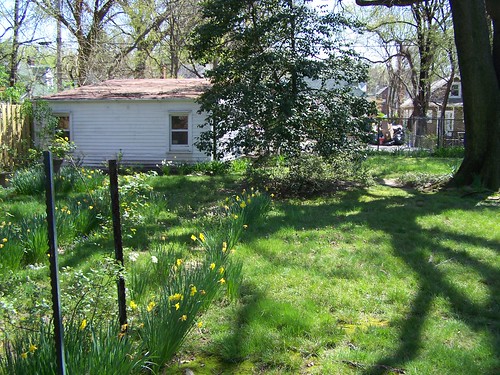
Backyard, our houseOur backyard garage could be rebuilt as an ADU, but it would take at least 12 years to pay off.

While I think there is opportunity to build many thousands of ADUs in DC, the cost of doing so is likely to be about $200,000/unit and because of the cost of capital, the average independent houseowner isn't likely to be willing to do it, without significant subsidy.  And rents for an 800 s.f. ADU are likely to be at least $1,500/month and likely higher, especially near transit.

Segregation.  Because the cost of housing is high relatively speaking, regardless of the size of the house, allowing houses to be converted to duplexes and triplexes likely won't have much impact on the racial make up of particular neighborhoods unless the community is already experiencing high rates of demographic change.

Mix of modern apartment building and traditional four square houses, Little Italy. Photo: Kent Sievers, Omaha World-Herald.

Omaha and integrating multi-unit housing into single family neighborhoods.  Interestingly, I came across some articles in the Omaha World-Herald the other day on development trends there, and one was about a community-initiated planning effort in the neighborhood, sparked by the insertion of apartments using the rowhouse building type into what had been a single family housing district ("10th Street​ development galvanizes residents").

Given today's development conditions in terms of demand--most cities were built up by 1930, when the US population was 40% of what it is today--and the cost of land, labor, and materials, communities are going to need to add apartment and condominium buildings, not duplexes, triplexes, and accessory dwelling units, if they want substantive and real impact.

Figuring out how to allow for this in the context of the prevalence of single family housing zoning categories is going to be a major challenge.

Labels: , , , , , , , , , ,

Tuesday, July 17, 2018

Why "gentrification" is visible now... the Diffusion of Innovations Curve of Everett Rogers

I haven't reached out for a review copy yet, but the new Island Press book by Alan Mallach, The Divided City: Poverty and Prosperity in Urban America, makes the point that there are three types of cities now:

(1) cities growing in population, especially of higher and middle income residents and probably losing lower income residents (DC, Seattle, Portland, Boston, New York City);

(2) cities that are shrinking, but still gaining higher income residents so some neighborhoods are experiencing "gentrification effects in the face of widespread poverty (Philadelphia, Baltimore, St. Louis);"

(3) cities that are shrinking and not gaining higher income residents (Cleveland).

He makes the point ("obvious" -- not a cut) that there needs to be differentiated policies depending on the specific dynamics of the city and/or neighborhood you're addressing.

(At a conference a couple years ago we were talking after a session and "scoffing" at a complaint by a local housing leader in Baltimore that Baltimore was behind because they didn't have an inclusionary zoning policy, while the city has more than 50,000 vacant properties.  IZ isn't what they should be worrying about now.)

The problem is that the national and local discussion of in-migration, neighborhood change, and displacement isn't particularly nuanced, and the general approaches like "inclusionary zoning" are a distraction for cities that are still shrinking, but cities -- gateway cities he calls them -- like DC have to deal with affordability at the city-wide and neighborhood scale because of the increased demand for housing by higher income segments of the market, which crowds out everybody else.

Which I've written about for years, e.g., "Applying the super-gentrification thesis to San Francisco, Santa Monica, and other cities experiencing hyper-demand," 2014. Also see "The nature of high value ("strong") residential real estate markets" (2017) and the use of the term "capital deepening" by University of British Columbia Professor David Ley:
… calls the process of high income (a variable indicating a neighborhood in high demand) neighborhoods becoming even higher income, "capital deepening," which I think is a better term than "supergentrification." From the article:

"Because every time redevelopment occurs you get a substantial increase in the socio economic status of occupants … [market-rate] supply is only for high-income people. So, whenever redevelopment occurs, it means higher income people are occupying the space," says Dr. Ley. "Two things are happening: there is gentrification in the inner city, but then there's what I call 'capital deepening,' which is an area that is becoming richer."
Getting residents involved in development review earlier, is that a solution?  NotionsCapital calls our attention to this Governing Magazine article, "One Woman's Quest to Fight Gentrification by Asking Residents How," which makes the point that the entry of Trader Joe's spurs gentrification.

The article opines that the professor featured, has a revolutionary idea, to get residents involved in the early stages of "developments" rather than later stages.

Technically, that's what planning is supposed to do to begin with, set the stage based on various principles, to produce the kinds of outcomes we say we want.

I don't think her ideas, while important for other reasons, which I will mention in a follow up post, will have much impact on the influx of higher income residents and the increased desire to live in cities. From the article:
But sociologist Cat Goughnour, a native Oregonian and an advocate for affordable housing, thinks more should be done -- and not just in Portland.

“People are being forced out by economic pressure,” she says. “It really resonates with me that tearing people out of these multigenerational communities has an impact, and there is still very little being done about gentrification."

Goughnour founded the Radix Consulting Group, which is lobbying the city to change its process of urban planning to involve community members upfront, rather than asking for their input toward the end of a project's development. She is also in talks with Detroit and Minneapolis to similarly alter those cities' processes for urban design.
Redesigning a project already being developed to attract higher income segments won't change the project very much.  So many decisions have been made by that point that you can only have impact on the margins, especially when it comes to big issues like market rate versus affordable housing.

What's going on in gateway cities like Portland is much different than what is going on in Detroit, although yes, there is inward investment in some places there.  But besides that, the issue isn't so much planning, but the stage of the market.

Population in-migration to the city and the concept of innovation diffusion.  In discussing this with NotionsCapital, I mentioned Everett Rogers and his "innovation diffusion curve," from the book Diffusion of Innovation, which I was fortunate to come across in college, although not for a class.

His work, originally in agriculture extension, looked at how long it took innovations to "diffuse" and become "adopted" on a widespread basis.


With demand for "living in the city" on the part of high value segments of the housing market, what happened is that for 40 to 50 years--staring with the 1950s era "Brownstoners" in Brooklyn, artists, etc. (immigrant groups looking for cheap housing were a variant)--year by year, small numbers of people moved to the city because they preferred urban living over the suburbs, even as residential housing trends were dominated by suburbanization.

People in Brooklyn in the 1950s were the innovators. People like me in 1987 were later to the game, but still early enough to qualify as "early adopters."

The earlier generations (1950s-1970s) people like Brooklyn's Brownstoners showed that it was possible to live in the city despite the problems and the continuing decline in population.

One of the stabilization strategies was historic preservation, assisted by the passage of the National Historic Preservation Act in 1966.

-- Who Lives Downtown, Professor Eugenie Birch, Brookings Institution, 2005. The back to the city movement was originally focused on center locations, hence the Downtown focus of this report.

-- Get Urban: The Complete Guide to City Living, out of print book by Kyle Ezell. I heard him speak about the book in Cleveland in 2002. His point was that you didn't have to move to NYC to have an urban living environment, that small cities like Cincinnati, Omaha, Columbus, etc. have similar neighborhoods providing the same kind of experience.

The cool coffee shop, Central Perk, in the Friends tv show.

Trends shifting towards favoring the city.  But helped by tv shows like "Friends" and "Seinfeld" (as opposed to the "Brady Bunch" etc.) which showed city life as exciting, around 2000, but really more like 2003, many American cities started seeing a change in perception of the value of urban living.

It helped that in many cities, public safety began improving, murder and crime rates began dropping, etc.

Hitting critical mass, entering the late adopter phase. What I argue is that while we didn't realize this at the time, because it was simultaneous with other trends, this year-by-year in-migration, after 40-50 years, finally hit critical mass, and reached the point where it could achieve a self-replicating momentum ("Revitalization in stages: Anacostia," 2011).

Rogers would have argued that around 2000 "in-migration of population to the city" hit "critical mass," consolidating the innovator and early adopter stages, and began the shift to the late adopter stage, where more than double the number of people would likely be interested in moving to the city.

In specific places, this general trend was also accelerated by other more local conditions, making changes particularly visible and apparent, such as with new construction of multi-unit housing or the entry of suburban retail chains to urban settings.

For example, in DC new in-migration was abetted by the move of the professional basketball and hockey teams to a downtown arena from a suburban location, as of 1997, Marion Barry was no longer mayor (although later he became a Councilmember), which revived the confidence of real estate investors, plus foreign investors looking for safer places to invest than their own country, and the post-9/11 growth in government which drew younger people to the metropolitan area and the city.

In Seattle and San Francisco, growth occurred in response to the tech boom. Not sure what was going on in West Los Angeles County. In Boston, leveraging the intellectual capital of MIT, Harvard, and other institutions in biotech and IT, etc.
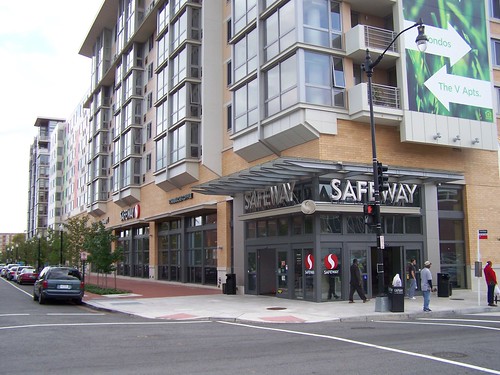
Safeway and apartment building at 5th and L Streets NW, Washington DCThis Safeway on the outskirts of Downtown DC opened in 2008, as part of a condominium-apartment complex with other ground floor retail.

Vertical mixed use building type.  The concept of vertical mixed use real estate development -- usually housing above ground floor retail; the mixing of retail and office was already extant; and there aren't many examples of mixing retail, office, and residential in a single building -- became associated with this renewal of interest in urban living.

Cities started gaining population, not losing it.  In 2000, DC's population was 580,000, steadily shrinking from a peak of 800,000+ in the 1950 Census.  Today the population is 693,000+, and next year it's likely to be 700,000.

Increase in demand paired with a minimal increase in housing supply = significant price appreciation.  With a much larger portion of the residential housing market interested in city living, given the relatively fixed supply of housing--most housing in major cities was built decades ago, when the US population was much smaller, so most cities aren't built with enough housing to meet current demand, especially single family housing, it has an extranormal impact on the housing market, and prices have risen precipitously, and more neighborhoods have been "reproduced" as attractive to these segments of the market.

More and new residents also bring newer types of retail. Plus with the new population and their being higher income, there is more demand for new retail and restaurants, especially more expensive options--carry outs being replaced by sit down restaurants.  Ethnic choices featuring Japanese, Thai, and Filipino cuisine, etc.

Multiunit housing, new residents, and new retail are very visible but "gentrification" isn't new.  It's the velocity of change that now is so visible, but was a phenomenon building over decades. And I argue that what people think they are seeing today as "the start of gentrification" is more like in-migration entering either the late adopter or early majority phases where it is highly visible.

It's too late (song by Carole King)...  Hence the concern about displacement and affordability. But to address the issue now, 15+ years into the process, is for the most part, too late.
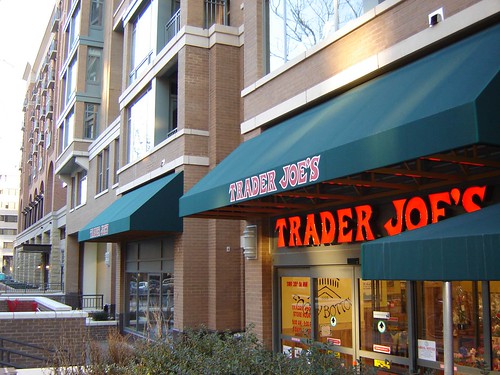
West End/Foggy Bottom | Trader Joe'sDiffusion of Trader Joe's within DC as an example of post-gentrification, not pre-gentrification.  Trader Joe's is a perfect example of my point. People think the company is "leading gentrification," when in fact, it's joined a party that has been in progress for a long time.

Despite all our clamoring and arguments for why such stores should be in DC, the first store, in Foggy Bottom, opened in 2006, 3-6 years after population in-migration hit the tipping point--and in return for a more than $1 million incentive payment made by the Foggy Bottom Association!, not the city's economic development department!

This was six years after the Whole Foods Supermarket on P Street NW opened in the Dupont Circle/Logan Circle neighborhoods ("Fresh Fields confirms lease for P Street site," Washington Business Journal, 1999). And previous to that, Fresh Fields, the local chain acquired by Whole Foods in 1996, had opened stores in a couple neighborhoods in Upper Northwest.

(To some extent, Fresh Fields was ahead of the curve, even if Whole Foods and Trader Joe's weren't. From the WBJ article "P Street: A Fresh Start":
What does it take to get Fresh Fields to build a store in an up-and-coming but still dicey neighborhood in Northwest D.C.? ...

The 1400 block of P Street NW hardly seems like a "natural" for any retailer. Dark, abandoned buildings dominate the streetscape, and few cars or people passed by on a recent evening when K Street and Georgetown were bustling.

But just blocks from the Fresh Fields site, developers have been snapping up aging town homes and apartments, converting them into luxury condominiums. Seeing that, Dickson's group decided a Fresh Fields not only could prosper but spur additional commercial growth in the neighborhoodsca.)
While it's likely the stores have received special rent pricing and other considerations from their respective developers, the new stores haven't required extraordinary incentives from the city or similar organizations.

The second store, at 14th and U Streets, didn't open until 2014. The third store, opened on Capitol Hill in 2017, and the fourth store, in Union Market, in 2018. A fifth store is slated for Upper Georgetown on Wisconsin Avenue  ("JBG Smith Lands Trader Joe's To Anchor Glover Park Development, Bisnow), likely to open in late 2019.

These stores haven't made 14th and U, Capitol Hill, Union Market, or Upper Georgetown "gentrified." These are already high income areas where TJ's wants to sell product.

By contrast, a store opening in Deanwood ("Three-bedroom, two-bathroom house in DC's Deanwoodlists for $375,000," Washington Post) would be an augur of "gentrification." Also see "Why is it news that houses are worth more when located near perceived high quality stores?," 2016.

=====
I guess my lesson from all this is two-fold.

1. More than 15 years ago, I came to the conclusion that without "visionary" master plans already in place, the velocity of development was too strong to be able to get control of the process and shape it for better outcomes.

So the lesson from this was to do planning before the onset of change, not after.  After the change process starts, you're always reactive.

With regard to individual projects, without master planning already in place, it's very difficult to change the trajectory of the developer (I can think of one process I was involved in that took 15 years, but that only came about because the earlier bad idea was discarded in the face of obvious changes in market opportunities--from a big gas station with a car wash to a 200+ unit apartment building with a grocery store on the ground floor and a streetcar station).

In response, I focused my energies on advocacy for better planning, identifying gaps in planning processes, coming up with great, but for the most part, ignored recommendations on how to do planning a lot better in the face of significant change, etc.

My joke is that I might not be a good planner but I am great at "gap analysis" and the replete and evident gaps in how DC does planning makes me an insightful planner.

For example, my testimonies and writings on changing the commercial property tax assessment methodology to support independent property owners and retailers date to 2005 ("Tax Policy Hurts D.C.'s Local Businesses," letter to the editor in the Washington Post, 2007), my writings on restructuring community benefits agreements have a similar timeline ("Community benefits agreements: revised (again)"), recommendations for artistic disciplines to "do their own planning" ("Arts, Culture Districts, and Revitalization," 2009) came out of earlier writings on cultural planning dating to 2003 ("Cultural resources planning in DC: In the land of the blind, the one-eyed man is king"), recentering neighborhood planning around ensuring high quality neighborhood schools ("Rethinking community planning around maintaining neighborhood civic assets and anchors," 2011), on Walmart (ANC4B Large Tract Review Report on Walmart, 5/2011, 2011), creation of metropolitan scaled mass transit organizations which integrate planning and operators ("The answer is: Create a single multi-state/regional multi-modal transit planning, management, and operations authority association," 2017), using infrastructure investments to leverage other complementary improvements ("Setting the stage for the Purple Line light rail line to be an overwhelming success: Part 2 | proposed parallel improvements across the transit network," 2017), etc.

2.  Now I believe that great plans are important, they need to be transformative, but they need to be paired with systems for implementation.

I think seeing the actions of the Portland Development Commission (now called Prosper Portland) at a conference in 2005 influenced me, plus reading an action plan for various State of Maryland "Community Revitalization Plans" and DC's adding action steps to plans.  Although, I was at some level somewhat hesitant maybe, because DC's community development corporations, which are a form of revitalization implementation, are so bad ("Falling up -- Accountability and DC Community Development Corporations," 2005).

I wrote about innovative delivery mechanisms and programs coming up with the concept of "action planning," in 2008 ("Social Marketing the Arlington (and Tower Hamlets and Baltimore) way") and then tried to bring about a similar kind of implementation in in the bicycle and pedestrian plan I wrote for the western district of Baltimore County in 2010 ("Best practice suburban bicycle planning using the action planning method").

Action Planning Steps

1. Design Method rather than Rational Planning
2. Social Marketing
3. Integrated Program Delivery System
4. Packaged through Branding & Identity Systems
5. Civic Engagement & Democracy at the foundation = citizen at the center

Not realizing these earlier influences, I outlined a six step process based on the series of articles I wrote about culture-based revitalization in 8 European cities for an EU project in Baltimore, in particular on Bilbao and Liverpool ("Why can't the "Bilbao Effect" be reproduced? | Bilbao as an example of Transformational Projects Action Planning"), after analyzing the processes in those cities which were particularly successful.

Best practice, large scale, revitalization planning framework
  1. A commitment to the development and production of a broad, comprehensive, visionary, and detailed revitalization plan/s (Bilbao, Hamburg, Liverpool);  [NOW I CALL THESE TRANSFORMATIONAL PROJECTS ACTION PLANS which can be an element of community master plans, a complete revitalization plan, or an approach to integrate into single project planning, to ensure all the opportunities for innovation are captured]
  2. the creation of innovative and successful implementation organizations, with representatives from the public sector and private firms, to carry out the program. Typically, the organizations have some distance from the local government so that the plan and program aren't subject to the vicissitudes of changing political administrations, parties and representatives (Bilbao, Hamburg, Liverpool, Helsinki);  
  3. strong accountability mechanisms that ensure that the critical distance provided by semi-independent implementation organizations isn't taken advantage of in terms of deleterious actions (for example Dublin's Temple Bar Cultural Trust was amazingly successful but over time became somewhat disconnected from local government and spent money somewhat injudiciously, even though they generated their own revenues--this came to a head during the economic downturn and the organization was widely criticized; in response the City Council decided to fold the TBCT and incorporate it into the city government structure, which may have negative ramifications for continued program effectiveness as its revenues get siphoned off and political priorities of elected officials shift elsewhere);
  4. funding to realize the plan, usually a combination of local, regional, state, and national sources, and in Europe, "structural adjustment" and other programmatic funding from the European Regional Development Fund and related programs is also available (Hamburg, as a city-state, has extra-normal access to funds beyond what may normally be available to the average city);
  5. integrated branding and marketing programs to support the realization of the plan (Hamburg, Vienna, Liverpool, Bilbao, Dublin);
  6. flexibility and a willingness to take advantage of serendipitous events and opportunities and integrate worthwhile new projects into the overall planning and implementation framework (examples include Bilbao's "acquisition" of a branch of the Guggenheim Museum and the creation of a light rail system to complement its new subway system, Liverpool City Council's agreement with a developer to create the Liverpool One mixed use retail, office, and residential development in parallel to the regeneration plan and the hosting of the Capital of Culture program in 2008, and how multifaceted arts centers were developed in otherwise vacated properties rented out cheaply by their owners in Dublin, Helsinki, and Marseille).I
But until recently, I don't think I've been direct enough about this second point, needing to have the implementation organizations in place to make what you want to happen actually happen.

IT'S NOT ENOUGH TO EXPECT THE MARKET TO DO THIS FOR YOU (a la neoliberalism). There still need to be public entities active in the field to shift development outcomes for the better.

I realized in talking with my Airbnb "landlord" in Hackney Wick, an artist, about these kinds of issues that my "Arts, Culture Districts, and Revitalization" piece (and others) need to be revised and republished to integrate this point, to specifically call for the creation of artist-specific community development corporations, etc., to bring about these kinds of policies into realizable projects.

I've written that in terms of arts spaces and artist housing (and in my comments on the draft DC Cultural Plan):

-- "BTMFBA: the best way to ward off artist or retail displacement is to buy the building," 2016
-- "When BTMFBA isn't enough: keeping civic assets public through cy pres review," 2016
-- "BTMFBA revisited: nonprofits and facilities planning and acquisition," 2016

and community housing and related development around transit infrastructure, especially the Purple Line light rail system in Suburban Maryland:

-- "To build the Purple Line, perhaps Montgomery and Prince George's Counties will have to create a "Transportation Renewal District" and Development Authority," 2015
-- "Purple line planning in suburban Maryland as an opportunity to integrate place and people focused initiatives into delivery of new transit systems," 2014
-- "Quick follow up to the Purple Line piece about creating a Transportation Renewal District and selling bonds to fund equitable development," 2014

Typically, traditional urban planning processes do not adequately integrate implementation. This is true for land use, and for transportation, other than the creation and maintenance of transit organizations.

The exception is revitalization planning, and like with Portland (or Salt Lake City, Baltimore and other places) the creation of revitalization corporations, like CDCs but often run by cities more directly, to bring plans into reality.  Their problem though is lack of money, complicated often by lack of demand--being too far ahread of market demand.
What to do now for the production of affordable housing.  DC has pumped lots of money into affordable housing production, but it's too late for the most part.  As an article, "Why more affordable housing in SC isn't getting built where it's needed most," in the Charleston Post & Courier said the other day:
For one thing, it's just as expensive to build affordable housing as it to build market-rate housing. The land costs are the same. Building codes are the same. Construction costs are the same.

To put it in the simplest terms: In a market-rate project, you can get a loan from a bank to build it if you can generate enough rent revenue to pay it off. You'll might even take a decent profit once you sell it off to an apartment company.

In an affordable housing project, your tenants will pay only a certain amount every month, and it's probably not going to be enough to cover the interest costs on a bank loan, much less the land, the construction and the property taxes.

To make it work, you've got to cut corners in a lot of different ways, and it's not like you can just hire a smaller construction crew or use inferior materials (there are laws against that). So what do you do?
DC is going to need to do some different things.

1.  Move away from focusing on producing a few affordable units in new buildings to building 100% affordable buildings.

2. The city is going to have to get over its opposition to infill development and allow the construction of bigger buildings.

Unfortunately, this opportunity is mostly being lost, because developers are cutting the size of projects from today's maximums to reduce opposition. But since these buildings are being developed as owner-occupied the likelihood of them ever being able to be redeveloped to be bigger is remote.

3.  The practice of "lopping off floors" of projects to placate opposition or "allowing" single use developments in multi-use areas (like the space above the Georgetown Safeway or the Georgia Avenue Walmart--that site had approved plans for retail + 440 apartments) is going to have to stop.

Not that it will be easy.

But there is a big opportunity cost both to affordability because of restrictions on inventory as well as a constriction of revenues to the city from property, income, and sales taxes not being expended by residents vaporized by the project becoming smaller.

4. There should be portfolio investment in current housing complexes to maintain their affordability and to ward off conversion to upper income housing.

5.  There needs to be a more active program of insertion of affordable housing developers--not a few units of inclusionary housing--into large scale new developments, where they build 100% affordable housing buildings in the midst of market-rate housing.

This is done in Helsinki and Hamburg. In Vienna, government planning shapes housing production much more closely than comparable processes in the US ("Housing in Vienna: Innovative, Social, Ecological," Exhibition catalog).

It would be a great opportunity to do this with the Armed Forces Retirement Home development ("15 Acres of Residences Off North Capitol: The Vision for the Armed Forces Retirement Home," UrbanTurf).

6.  Relatedly would be when institutional property is redeveloped, it could be for affordable housing.  The problem though is often these properties are not centrally located and the institutions tend to be desperate for cash, which is why they are selling/developing, so it's difficult for them to consider leaving money on the table by not developing market rate housing in favor of affordable housing.

Although Alexandria, Virginia has had some success with churches ("'A win-win': Using local church buildings to address the affordable-housing crisis, " Washington Post),  There are a couple of similar examples in DC, such as with Emory Beacon of Life Church on Georgia Avenue NW, or the Plymouth Congregational Church on North Capitol Avenue NE.  By contrast, many of the property sales by institutions in Brookland have been for market rate housing.

7.  ADU construction is going to have to be encouraged in traditional single family districts, which will add housing likely to be cheaper to rent than that in Class A+ new construction, and it will provide more residents capable of supporting neighborhood improvements.

It will be a marginal increase, but a lot cheaper to subsidize than for profit or nonprofit new construction, even at 25% of the likely cost ($200,000 or so for an 800 s.f. separate unit fully legal).

8.  Because DC is now what Alan Mallach would call a gateway city, programs to de-densify public housing are a mistake, which local activists are now challenging ("DC asks court to throw out $1 billion lawsuit" Washington Post"), instead the housing projects should be upgraded and intensified and improved.  Deliberately eliminating affordable housing is not a supportable public policy.

Note that I think the lawsuit is generally misguided but the point about de-densification of current projects is legitimate and should be addressed. But because the rest of the lawsuit is outlandish, this point will probably be lost.

Although my response to their general point would be:

"yep, that's why you have to have plans, strategies, implementation organizations, funding, and accountability mechanisms in place in advance of change, so you can be proactive, not reactive, both when change starts to happen and is visible, and as it catches momentum and speeds up."

Labels: , , , , , , , ,