Rebuilding Place in the Urban Space

"A community’s physical form, rather than its land uses, is its most intrinsic and enduring characteristic." [Katz, EPA] This blog focuses on place and placemaking and all that makes it work--historic preservation, urban design, transportation, asset-based community development, arts & cultural development, commercial district revitalization, tourism & destination development, and quality of life advocacy--along with doses of civic engagement and good governance watchdogging.

Monday, July 13, 2026

California’s first ADU condo sale offers another path to homeownership

Backdoor Revolution: The Definitive Guide to ADU Development

I have been interested in ADUs for years ("DC and accessory dwelling units," "There are plenty of lots capable of accessory dwelling units in Upper Northwest," "Will carriage houses destroy city life as we know it?."  

And for a time did alley tours in Greater Capitol Hill.

Article from the Orange County Register.  From the article:

San Jose is home to the first accessory dwelling unit sold as a separately owned condo in California, city officials said, setting a potential template for a more affordable path to homeownership. But a lengthy rollout raises questions about whether the model can become a scalable solution to the state’s housing crisis — the sale comes more than two years after the state made such transactions possible.

The 749-square-foot, two-bedroom ADU on Josefina Street near downtown closed last month for $530,000. That’s about a quarter of Santa Clara County’s eye-popping $2.1 million median single-family home price in May, according to the California Association of Realtors. Real estate brokerage Redfin last month listed San Jose among the 10 most expensive U.S. housing markets, based on the share of median income needed to afford to buy a home.

ADUs, also known as in-law units or granny flats, typically have up to 1,200 square feet of living space and must include a kitchen sink, cooking appliance and separate bathroom.

The sale was made possible by a state law passed in 2023, Assembly Bill 1033, which allows homeowners to convert ADUs into condos and sell them separately from the main property, rather than just renting them out. Under the law, ADU condos come with their own property tax bills, but require an HOA agreement with the primary homeowner for common elements, such as roofs or driveways.

Historicity.  I have been intrigued by alleys, historic carriage houses, and ADUs for a long time.  First in terms of historicity.   

  • and how on some properties there are historic carriage buildings that have been converted from horse stables to houses.  These are on regular house lots.  
  • There are also some carriage houses on their own lots separate from a street facing lot, developed when the interior of large blocks were "programmed" with buildings separate from the street--often for "industrial uses" like stables, machining, storage, drayage, etc., 
  • I learned from a guy I talked to once on a rear alley off of H Street NE who said that at the time (before DC liberalized ADU laws) it was legal for these buildings to have a "caretaker" apartment
  • Interior blocks often were developed with housing to use up the space, make it profitable, and  sometimes as a way to provide mixed income housing--for servants, lower income people, etc.  
  • (Later, instead of dealing with interior blocks, developers created intervening streets, such as Acker Place, Lexington Place, Morris Place, Morton Place, and Orleans Place between 6th and 7th Streets NE, Parker Street NE by Union Station, or blocks of rowhouses west of 5th Street NW in Manor Park like Quackenbos Street NW and Quintana Place NW)
  • President's wife Ellen Wilson's claim to DC fame was her work to rid blocks of this interior  housing, probably because often the people settled there were African-Americans.
  • Although some sections remained, like Millers Court NE and Brown's Court SE or on Capitol Hill and became models for building similar housing later 
  • And because in upper NW, such as the lots east of 4th Street in Manor Park, the deep lots often have free standing garages or nothing, and could accommodate an ADU.  Our lot could, which I'd like to take advantage of some time.
  • Transit access is key.  But I think it's best to focus ADU development within walking distance to a Metrorail station, to reduce the demand for driving.  Our house in Manor Park is about three quarters of a mile from Takoma Metrorail Station.
Affordable Housing.  Second in terms of the idea of adding "missing middle housing" and affordable housing. Missing middle housing is smaller types of housing vis a vis "normal sized" single family attached and detached houses.  In DC, it's not missing, it's just very expensive because all housing in DC is expensive.  And because there isn't a lot of it.  As noted above, it's mostly on interiors of blocks, and as a product of its time, pre-1900.


But the people who can afford to build an ADU might not necessarily want to provide AH.  According to a study in Greater Los Angeles ("The dark side of California’s backyard ADU boom: How much do they ease the housing shortage," LA Times):
He found that “ADU prevalence correlates with lower-income, renter-occupied, and younger households, denser populations, and areas with higher concentrations of non-white residents and registered Democrats.”
This type of housing is a form of what's being called "missing middle housing."  

In some weak markets like a neighborhood in Austin, Texas, ADUs are promoted to support multi-generational living and wealth generation through improving the value of a property by adding a unit, or to have a second income stream from the property to pay the mortgage ("Alley Flat Initiative fits small, green homes into unexpected places," CultureMap Austin, Alley Flat Initiative, Guadalupe Neighborhood Development Corporation). 

Some photos.

Parker Street NE -- the houses are narrow but still expensive because of the location.

Quintana Place NW -- the houses are more colonial, Tudor and not contiguous but in units of two because the National Capital Planning Commission ruled  sometime in the 1920s that rowhouses couldn't be contiguous (seen as an anti-African American policy decision)

Lexington Place NE -- the Queen Anne rowhouse style typified by the houses on Parker Street NE started to be succeeded by a more Craftsman form, often called Wardman style after the developer.  This transition started around 1907. ("What's in a Wardman? A Short Overview of DC's Most Prevalent Architecural Style," DC Urban Turf).

Millers Court SE is super well situated.  A block from the Supreme Court.  Two blocks from the Capitol.

Third, I've wanted to put one on our lot.  But ADUs aren't as cheap to build as people say.
  1.  everyone says "oh, they're cheaper because you don't have to buy the land."
  2. That's a little true, but the cost of permitting and new construction and financing is still high, over $250/s.f.
  3. Plus the cost of installing electricity and water/sewage (and maybe gas).
  4. They are hard to finance, although you can do it through a home equity loan I suppose.  And then the rents can't be super cheap because you have to pay off the cost of construction plus the various annual costs.
This is a garage on the rear of a lot on the 4400 block of River Road NW in DC.  It's a similar configuration to our lot in Manor Park.

The amounts of money cities offer to encourage ADU construction aren't very much and usually require renting out at less than market rates.

To facilitate this "the city" or nonprofit should create an ADU clearinghouse working with property owners to finance and build, and then with property owners and renters to facilitate rentals in a systematic way.


CDCs to build and finance at scale.  Gosh a good 12+ years ago I suggested the creation of a community development corporation that would operate city wide doing this.  Ideally, on our block you could build as many as 32 ADUs, they could go in on a block, with a city incentive too, and try to get multiple property owners to do it at the same time, to cut costs.

A number of firms do this now in the Midwest, such as ADU America, and in the Pacific Northwest and California (ADU Resource Center).

Pattern Books to make building ADUs easier.  Some cities have also created ADU pattern books to facilitate permitting and lower cost construction.  Often they include more modern buildings which don't appeal to me.  I prefer that ADUs match the prevailing neighborhood architectural style be it Queen Anne or Craftsman rowhouse, Colonial, etc.

-- ADU D.C. Homeowner’s Manual, Coalition for Smarter Growth
-- Philadelphia Rowhouse Manual (not on ADUs, but historic rowhouses, providing indirect guidance for how to do pre 1914 style ADUs)
-- A Pattern Book for Founders’ Place Neighborhood, Muscogee, Oklahoma, Oklahoma University-Tulsa Urban Design Studio
-- Accessory Dwelling Unit Guidebook, Boston Planning Department
-- A Pattern Book for Neighborly Houses, Habitat for Humanity, (I like the points about context sensitive development, it's not so much about ADUs)
-- Building an ADU, Salt Lake City
-- ADU Pattern Book, MB Architecture

Problems:  Some people don't want to share.  Granny flats/Yay or Nay.  Originally, were called "granny flats," with the idea that downsizing parents would relocate to an ancillary dwelling on their children's property

But some people don't want to share their lots.  "An Honest Conversation About Toronto Laneway Houses," Toronto Realty Blog.  From the article:
But why do people disagree on laneway housing? And what issues are at the forefront of the discussions? “An honest conversation,” i.s what I called this in today’s blog title, and that’s what I’m aiming for because I feel like the discussion about laneway housing in Toronto is merely getting started. 

 A client of mine remarked last weekend, “I have no problem if somebody else wants to build a laneway home on our street. But I don’t think I’d take one if it were free. I don’t want somebody living in my backyard with a window that looks out to where my kids play, and I don’t want to park my car under their living room.”
The LA Times has a series of articles on ADUs, and many involve multi-generational families, so sharing the lot isn't an issue.  And sometimes it's not for granny, but for the adult children. ("She couldn’t afford L.A. rent after law school. Her parents’ ADU came to the rescue").  

There are many in the Belmont Heights neighborhood of Long Beach.  We stayed in one as an airbnb.  A less than one mile walk to the beach...

For others, it's an ancillary studio not to be rented out ("Thanks to a tiny ADU, an L.A. home transforms into a stunning art gallery and studio," "Surprising ADU with tricked-out garage, rooftop deck matches family’s playfulness").  This is a big issue now with work from home.

But for unrelated people, if they aren't into the idea of having renters, an ADU may not be appealing.

Problems:  Financing.  It's still difficult to get traditional financing.  And adding an ADU if you have a mortgage, you have to notify the lender. ("Should I take a bridge loan to build an ADU?," LA Times); 

Problems:  Parking.  DC requires that building an ADU doesn't reduce parking on the lot.  In an area like Manor Park, this is dumb because there is plenty of street parking.  Less so in rowhouse neighborhoods in the core.  Basically, people can create "parking pads" that double as patios. Also see "A Koreatown parking protest: Tenants stage sit-in to protest loss of parking to make way for ADUs," LA Times.

Green Alley initiatives.  Separately, a number of cities are pursuing "green alley" initiatives where they are focusing on plantings, stormwater capture, and sometimes placemaking (" In Miles of Alleys, Chicago Finds Its Next Environmental Frontier," New York Times, "To Battle Floods, Cities Revive Their Long-Forgotten Alleyways,"JSTOR, "Cities Give Alleys New Life," Governing).  


In the early 2000s I read an article in (I think) Southern Living about Calder Loth, then State Architectural Historian for Virginia, and his initiative planting flowers in his alley in the Fan District ("The Self-Taught Gardener: Division Street," Berkshire Edge).

Alley repaving.  DC had a green alleys program but it never did much.  

Separately the Department of Transportation created a program still in operation that actively repaves alleys, many of which were in disrepair, with a polyglot of materials, using brick or asphalt block where it had been in use.  

Except that originally they only used red brick, and some alleys originally had yellow brick or other treatments.  I know I called for a change in this to be more historically accurate and they did change, according to this Instagram post.

This image shows yellow brick on the alley, and red brick fronting the sidewalk/apron to the street.

There is an alley off North Capitol SE, where one of the abutting property owners put in (or maintains) historically accurate cobblestones, with a brick track for "carriage wheels."  

Although, if you walk on cobbles, like some streets in Georgetown, it's not comfortable.

Placemaking and retail laneways initiatives.  ("Hidden in Plain Sight: Activating Urban Alleys," MRSC)


For at least 15 years, Melbourne has been reactivating alleys as retail spots.  In the US, larger real estate projects are often using the laneway concept as a way to activate interior spaces and add a fun element to the development.
Sydney, Austrailia

Retail laneways initiatives.   

Labels: , , , , , ,

Tuesday, February 25, 2025

WTF? Detroit News op-ed: Ease building secondary dwellings in Detroit | Is no solution to lack of housing demand

Before my life disintegrated with the death of my father, the middle house is where we lived in Detroit.  Our Congresswoman lived down the street.  The Zillow estimate is $242,000.

The op-ed ("Ease building secondary dwellings in Detroit," Detroit News) argues that the solution to Detroit's broken micro-economy is making it easier to build accessory dwelling units.  He suggests lowering permit fees, among other steps.

ADUs can pull double duty for the city. They build generational wealth for Detroiters, while supporting housing affordability. It’s a simple amendment that does not upend the general plan of the city and frees citizens to utilize their properties how they please. It’s time to start building back a city meant for everyone, not just the few who can afford it.

This is misguided.  Detroit has tens of thousands of vacant properties and lots ("Detroit Shrinks Itself, Historic Homes and All," Wall Street Journal, 2010).  From the article:

Mayor Dave Bing has pledged to knock down 10,000 structures in his first term as part of a nascent plan to "right-size" Detroit, or reconfigure the city to reflect its shrinking population. When it's all over, said Karla Henderson, director of the Detroit Building Department, 

This house, in the upscale Palmer Woods neighborhood, was demolished but looks recoverable to me.

"There's going to be a lot of empty space." Mr. Bing hasn't yet fully articulated his ultimate vision for what comes after demolition, but he has said entire areas will have to be rebuilt from the ground up. For now, his plan calls for the tracts to be converted to other uses, such as parks or farms.

Even when the demolitions are complete, Detroit will still have a huge problem on its hands. The city has roughly 90,000 abandoned or vacant homes and residential lots, according to Data Driven Detroit, a nonprofit that tracks demographic data for the city.

... "Neighborhoods that are considered stable are now at 20% vacancy," said Deborah Younger, a development consultant involved in the demolition effort.

Making ADUs a little easier to build isn't the answer to an "over supply" of recovarable properties.

At a conference a number of years ago, Alan Mallach and I had a conversation where we expressed incredulity that advocates in Baltimore were advocating for inclusionary zoning, when the city has thousands of vacant properties.  The same goes with ADUs in Detroit.

This op-ed discusses "gentrification."  Yes, some neighborhoods will experience inward investment and this brings sometimes unwanted change.  But the solution to disinvestment is investment, and that's part of the equation of gentrification.

Detroit has tens of thousands of vacant properties and lots.  It is in desperate need of increased demand for housing.  

In the meantime the city demolishes hundreds of buildings each year because of lack of demand ("City of Detroit demolished 6000 homes since 2020," CBS, Detroit Demolition Program, "Detroiters spent $49M on demolition. Where did the money go?," BridgeDetroit).  

The City of Detroit has spent more than $10 million demolishing blighted homes in District 7 on the city’s west side. Some residents say they are glad to see vacant properties being torn down, while others wonder how the money is being spent. (BridgeDetroit photo by Bryce Huffman)

Looking at images of distressed homes in Detroit is particularly depressing.  From the article:

2023 was as a special year for Detroit. For the first time in decades the city gained 1,852 new residents, reflecting a city finally out of its rut and ready to prosper again. True to Detroit’s commitment, property values across the city increased.

On paper, this seems like nothing but fantastic news, but if you ask Detroiters, they tell a different story of gentrification. Gentrification is a process where less wealthy neighborhoods have money invested into them. This can be advantageous for only those who can afford it. With rising property values come higher property taxes. High taxes can be a factor that pushes original residents out of the area, and it’s no secret that many Detroit neighborhoods are ripe for gentrification. 


The article argues that zoning is used to maintain segregation, although rather than term it race based, it expands the definition economically, according to income and the cost of a property.

Detroit, for example, still supports civil-rights era zoning codes that actively enforce segregation based on income. This is slyly done under the guise of mandating setback lines and density maximums to force builders into only one type of development: single-family homes. 

The article suggests that ADUs can help bring about affordability.  Detroit has decades of affordability ahead because of lack of demand and a huge overage of potential housing supply.

A single-family home is not a vice within itself, it is the overabundance and lack of affordable units that artificially spikes housing prices, leaving those less fortunate in the dust. This is not what Detroit needs.

Besides Detroit having lots of small lots, making it a bit harder for ADUs to have space, the reality is that they aren't "that cheap" to build.  Yes, you don't have to pay for land, but you do have to pay for utility hookups including sewer, water, and electricity, and that can be expensive.  A $300,000 or more new to build ADU is a lot more expensive than it is to renovate a $25,000 house.

Plus, in a weak market like Detroit an ADU is harder to finance.  Since it's possible in Detroit to buy and renovate houses for much less than $300,000, an ADU isn't likely to appraise at the cost of construction for a mortgage loan, because it is higher priced than the market.  So ADU builders will have to self-finance.

=====

By contrast, in Pittsburgh, Robert Fragasso recommends another course ("What the city of Pittsburgh can do with abandoned houses," Pittsburgh Post-Gazette).  It's nothing new, been done by cities over the decades.  But renovation is better than demolition.

Pittsburgh has 10,000 abandoned houses and empty lots, of which 1300 have reported code violations, and restoring these properties to the tax rolls would go far in helping to balance the city and school district budgets. Using the average city property tax of $2500 on those 10,000 properties, adding $25 million in new revenues.

Our political leaders seek governmental solutions to this problem, solutions the city cannot afford, when the private sector offers a potential answer. Here’s my proposal: Instead of expending scarce public funds for demolition and leaving empty lots behind, allow individuals to buy properties for $1 in return for a signed contract to demolish or gut the structure within 60 days (unless it can be successfully rehabbed), build a new residence within 12 months and agree to owner-occupy.

... Once renovation begins in a neighborhood more follows. We have seen this in areas that have been restored.

There is a conundrum.  If you offer such properties to lower income households out of the goal of equity, they may lack the capital necessary to fix the house in 12 months.  OTOH, if you focus on developers, the houses end up being rentals, disallowing individual homeowners the opportunity to build equity.

Note the math compared to an ADU.

The math for the buyer is compelling. The cost of home construction in Pittsburgh begins at around $150 per square foot. Remember the land was obtained in the original $1 transaction. The median home size in Pittsburgh is 1500 square feet, which equates to a construction cost of $225,000. /p>

If the buyer can do some of the work, the resultant cost could be less. That total cost would be much less if the existing structure could remain, be gutted and rebuilt from the inside out. Add $10,000 for demolition or gutting of the structure and the upward estimate of total construction would be $235,000. That is about the average cost of an existing home in Pittsburgh, but this would be a new home.

In Detroit, the cost of demolition is about $20,000.

Labels: , , , ,

Wednesday, April 20, 2022

Denver's Urban Land Conservancy as a BTMFBA implementer

The previous entry, "Nonprofits need to BTMFBA too," re-mentions that nonprofits have to have a real estate and facilities strategy as part of master planning, that just like artists, they can't expect real estate developers to plan for them, plus they need to be prepared in the face of strong, money-driven real estate markets.

Almost immediately after I published that entry, there was an article in my newsfeed, "How this nonprofit in Westwood is avoiding being gentrified out of the area," from the Denverite, about how the in the neighborhood is able to control its real estate destiny by partnering with the (Denver) Urban Land Conservancy.  From the article:

This month, Re:Vision, a Westwood nonprofit that focuses on improving food access and food security, and the Urban Land Conservancy, a real estate nonprofit that aims to preserve communities and prevent displacement, announced they’d be collaborating through a real estate partnership that allows each organization, especially Re:Vision, to continue benefiting the westside. 

“This partnership has been years in the making,” said Sarah Harman, ULC’s vice president of real estate. “I think it was around 2019 that ULC and Re:Vision really started talking about what we might do together. And that brainstorming resulted in this new partnership with Re:Vision and ULC’s continued and deepened engagement with the Westwood neighborhood.” 

Re:Vision, which started in 2007, owns and operates the RISE Westwood Campus, a community hub that hosts an urban farm, the nonprofit’s no-cost grocery, Cultura Chocolate, a commissary kitchen and several other businesses and community needs. The campus was previously a junkyard, and Re:Vision purchased the site with a $1.2 million loan from the city in 2014 with some stipulations, one being the nonprofit had to use the site for community use.

Typically, land conservancies and land trust deal with open space and farmland, although urban-focused land trusts tend to focus on multiunit housing.

And that's an issue here too, as it appears as if the Urban Land Conservancy is also focused on adding housing to the site over the long term.

But the ULC is also focused on providing and preserving "shared office space for nonprofits and mission-minded organizations."

While I still believe in the need for overarching organizations like SEMAEST and other types of community development corporations to focus on this kind of property preservation specifically, this is another model for accomplishing it.

Labels: , , , , , , ,

Monday, April 18, 2022

Nonprofits need to BTMFBA too

This isn't news.  Nonprofits, artists (Sharon Zukin, Loft Living, 1982), gays ("The 'gaytrification' effect: why gay neighbourhoods are being priced out," Guardian), churches ("Churchly blight," 2007), etc. held property because the areas weren't in high demand.  

When conditions, attitudes, and popularity changed--in particular wrt urban settings and urban living--the neighborhoods moved from being weak markets to strong markets, and only the people and organizations with the most money are able to compete.

The BTMFBA thesis--Buy the * * Building Already--makes the point that to be able to retain presence in the face of market pressures, you need to own the building.

-- "BTMFBA: the best way to ward off artist or retail displacement is to buy the building," 2016

My original piece, "Arts, Culture Districts, and Revitalization" (2009), made the point that artistic disciplines and organizations needed discipline-specific culture plans with a focus on facilities, because without facilities there is no arts district or space for artists and organizations.

The original piece didn't outline a mechanism--now I think it should be arts-focused community development corporations, operating at a city or county wide scale ("Reprinting with a slight update, "Arts, culture districts and revitalization"," 2018).

But it's about nonprofit uses of all types, not just the arts, which I do write about from time to time ("BTMFBA revisited: nonprofits and facilities planning and acquisition," 2016).

The Washington Post has an article, "A food pantry’s closure means more than lost meals for hundreds of families," about a food bank shutting down in Nashville, a particularly strong real estate market of late, because it lost its lease.

All nonprofits should have a real estate/facilities plan as part of strategic planning.

This is especially true for nonprofits operating in strong real estate markets.

From the article:

"Right now I’d say nonprofits are facing a confluence of crises,” said Tim Delaney, the president and CEO of the National Council of Nonprofits. “We’re out here fighting, trying to find some balance with increasing demand, rising costs, and declining donations — holy cow! It’s too much for a system to bear.” 

The Little Pantry met the increased demand, but it also had to deal with increased costs, on everything from food prices to rent and real estate. Downey realized her organization would be forced to close its doors late last year after failing to find an affordable new location in one of the nation’s hottest real estate markets. According to experts, the same pressures could soon shutter nonprofits everywhere, underscoring the shaky state of so much of the country’s charitable community. Free health clinics, child care organizations, prison reentry programs, domestic violence shelters — all could collapse under the same financial weight that brought down the Little Pantry. 

“All these things threaten the ability of nonprofits to serve people in their local communities,” Delaney said. “Policymakers at all levels of government are just assuming nonprofits make it work, but we can’t. God Almighty, we try, but at a certain point, the laws of economics take over.”  ...

Downey began renting her current building five years ago. It was a crumbling former school building owned by a church. The Little Pantry agreed to undertake repairs and renovations and put around $300,000 into the property. 

But by late 2021, Downey knew the owner would not be renewing the lease, and, despite working with real estate agents and friends, she struggled to find a new location. 

And local community foundations should take the initiative to work with nonprofits on such matters, create a facilities/real estate initiative, etc.

One example, although it works on the national scale, is the Kresge Foundation.  It funds buildings, usually up to half, with a required local match. 

In a recent entry ("Speaking of the need for arts-related CDCs to buy, hold, and operate arts facilities: Seattle and BTMFBA | The Inscape Arts building"), I mentioned how Seattle has created a city department, Cultural Space Agency, to work on this but only for arts groups, but it has minimal funding and expects the profit motivated private sector to take the lead.  From the article:

One building Downey toured — already outside the Little Pantry’s budget — was sold to an outside investment company before she had left the parking lot, Downey said. 

This type of function needs to be extended to nonprofits more generally. 

====

I am now on the board of a large public park that is semi-independent of the city or county park system.  There is a master plan, but not really a formal capital planning process, especially one that integrates tightly with city and county funding systems.  One of my major goals is to get a standing committee on capital planning and finance, a capital plan, etc.

Labels: , , , , , ,

Monday, August 24, 2020

Corporate real estate is a cutthroat business

I remember back during the Great Financial Crisis, when there was lots of writing and talk about the moral obligation to pay your mortgage ("Faced with an underwater mortgage: the moral choice to pay," Christian Science Monitor), about the contradiction of big firms like Related Companies "walking away" from loans, by "giving the keys to the property back to the loan holder" ("Commercial Property Owners Choose to Default," Wall Street Journal).

From the WSJ article:
Companies such as Macerich Co., Vornado Realty Trust and Simon Property Group Inc. have recently stopped making mortgage payments to put pressure on lenders to restructure debts. In many cases they have walked away, sending keys to properties whose values had fallen far below the mortgage amounts, a process known as "jingle mail." These companies all have piles of cash to make the payments. They are simply opting to default because they believe it makes good business sense.
From the CSM article:
Call it what you will – a “strategic default” or simply cutting one’s losses in a business decision – this trend to walk away is creating an erosion of trustworthiness, and not just for the financial industry. It is a creeping moral crisis that needs a solution soon.

Yes, under certain circumstances and in those states where lenders have limited rights to go after a walk-away’s assets, a default can make sense – in an amoral calculation of personal finances. A buyer took a risk by assuming a rise in home prices and failed, similar to a failed business or a speculator in commodities.

Yet if more Americans get used to being deadbeats in a heartbeat, it will lead to higher interest rates and create other hurdles for those want to buy a residence and honor their contract. It would also create more uncertainty for still-wobbly banks and put a drag on the economic recovery, helping keep unemployment high.
While a program to modify home mortgages was developed, most of the banks didn't handle it very well, many people didn't get modifications, and millions of houses went into foreclosure. 

And speaking of taking advantage of new investment opportunities, a number of capital investment firms bought single family houses in bulk from banks, and now rent them out, changing the nature of residential housing market more generally.

A lot of the anger that has affected politics since 2008 was the idea that regular people weren't helped very much during this time, that most of the government "help" went to corporations, and the officers of these corporations faced no consequences.

There's an article in Bloomberg about what's going on in the commercial property market now, with big firms walking away from some mortgages and properties, while still raising funds for new endeavors.   In these cases, "it's just business," proving that residential mortgage owners are treated much differently from big capital.

From "Real estate investors skip paying loans while raising billions":
Some of the largest real estate investors are walking away from debt on bad property deals, even as they raise billions of dollars for new opportunities borne of the pandemic.

The willingness of Brookfield Property Partners LP, Starwood Capital Group, Colony Capital Inc. and Blackstone Group Inc. to skip payments on commercial mortgage-backed securities backed by hotels and malls illustrates how the economic fallout from the coronavirus has devalued some real estate while also creating new targets for these cash-loaded investors.

"Just because a prior investment didn't work out doesn't necessarily mean that should tarnish the reputation for future endeavors," said Alan Todd, head of U.S. CMBS research for Bank of America Securities. "It's not like something was done in bad faith."

While cutting losers to buy winners is an age-old investment proposition, the Covid-19 pandemic may create even more openings than the past crises that became bonanzas for real estate investors. ...

Missing payments on CMBS debt is relatively painless, because it's typically non-recourse, meaning borrowers can hand over the keys to a property and lenders won't be able to come after other assets. Property owners are more likely to walk away when their equity has been wiped out by lower values. ...

Now these firms are raising money for their next round of bets, even as they skip debt payments on old obligations.

At least 11 Brookfield malls with more than $2 billion in CMBS debt are delinquent or seeking payment relief because of COVID-19. The company has already repurchased some of its former debt at reduced prices.

"The lenders are willing to sell us their loans or the mortgages back at a discount," Brookfield Property Chief Executive Officer Brian Kingston said during an Aug. 6 earnings call. "And so in that case we've been able to essentially reacquire the asset at an attractive basis."

Brookfield Asset Management Inc., the parent of the property firm, raised $23 billion from investors in the most recent quarter, including $12 billion in new commitments for a distressed fund.
The article discusses similar moves by other real estate companies including Colony Capital, Starwood Investment Trust, and Blackstone.

Conclusion.  I'm not saying that people shouldn't worry about paying mortgages and treat it as an important obligation.  I'm just pointing out the double standard.  I suppose someone will point out the difference between recourse and non-recourse loans.  In recourse loans, the lender has call on other assets owned by the mortgagee.

But given the impact of the coronavirus on the retail, hospitality, and entertainment industries, there's going to be a property bloodbath, and many communities will be harmed by it, just as they were in the real estate fallout from the Savings and Loan Crisis in the 1980s and 1990s and other times of overbuilding followed by crashes.

Labels: , , ,

Friday, July 10, 2020

News flash: Lack of housing supply causes gentrification | How to facilitate transit oriented development

This was in my Google News feed yesterday:


Well, it's lack of supply and high demand both...

-- "Why "gentrification" is visible now... the Diffusion of Innovations Curve of Everett Rogers," 2018
-- "Yes the neighborhood will change, but it will take 10-25 years," 2020
-- "The nature of high value ("strong") residential real estate markets," 2017

Link to the article.

There's been a few good threads on the topic of moderate cost housing in cities on the pro-urb e-list.

A person from Boston pointed out something that is too often forgotten, that because geographic and political boundaries are longstanding, cities can't really "grow" and add lower cost land opportunities to the development mix, in terms of infill and redevelopment.

And that land, especially single family detached, theoretically suitable for more intensive redevelopment is poorly placed.

Another writer made the point that as housing demand increases, allowable zoning intensities should increase as well.

That's a way to effectuate policy wrt the fact that since 1930, the US population has increased by 150%.

Montgomery County Metrorail Housing Initiative.  The other day, I mentioned the Montgomery County initiative to provide tax incentives to build housing at Metrorail sites ("A tax break isn't always the "right" priming lever for desired development").  The Council voted to move ahead.

I didn't realize that the intent is to foster high density housing, as indicated in this graphic from Councilmember Riemer's twitter and facebook feeds.

In any case, upzoning at rail stations--heavy rail, light rail, and commuter rail--ought to occur as a matter of course, although as discussed in the past, the ability to actually do this is dependent on a couple factors especially distance from the core.

Stations far from the core have less potential for successful intensity.  In polycentric transit networks, stations distant from the core don't have much potential for intensive, let alone super intensive housing density.

The interesting question is whether or not allowing for much higher than normal density is enough of an inducement for developers to build and potential residents to choose to live in it.

Another issue is that the farther you live from the core, even though there may be transit stations connecting to it, the less people are connected to the core, and therefore the less demand there is for transit use and connecting to the core.

The Purple Line and DC area lessons for transit oriented development (TOD) in Montgomery County.  One of the things that surprises me about the Montgomery County Council initiative is that it doesn't extend to the County's existing MARC railroad stations and the forthcoming stations for the Purple Line light rail line.  Will it take decades for such legislation to be passed for the Purple Line, like it did for the Metrorail stations (e.g., Glenmont opened in 1998; Shady Grove in 1984).

Passenger rail. In the 2017 Purple Line series and follow ups, I suggest:

(1) there be bi-directional passenger rail service on the Brunswick line which serves Montgomery County and DC (this is in various plans but hasn't moved forward, historically the line was inbound in the morning and outbound in the evening, and the areas around the stations were railroad suburbs; demand conditions have changed significantly in the last 60 years);

(2) the proposed infill station at the White Flint redevelopment site be accelerated; and

(3) a split off line/spur along 270 (or from the White Flint area) be developed to provide service to Bethesda, potentially Georgetown, and Northern Virginia ("Maryland HOT lane study versus "corridor management" and regional scaled transportation planning," 2018.

If you could build denser at the rail stations, would that help to get the State of Maryland to actually consider such developments.  (Transit planning is "all fouled up" in Maryland at present because the Republican Governor is for the most part anti-transit, which makes sense, because his previous career was homebuilding.)

Also see:

-- "A "Transformational Projects Action Plan" for a statewide passenger railroad program in Maryland," 2019

Light rail/Purple Line.  But there is no question that there needs to be a push to develop housing at transit stations. In earlier writings about the Purple Line, spurred by a couple conferences about it, held at the University of Maryland College Park, in 2014, I wrote some about this, and this piece from 2017 synthesized and updated it:

-- "Part 6 |  Creating a transportation development authority in Montgomery and Prince George's County to effectuate placemaking, retail development, and housing programs in association with the Purple Line"

I was surprised at the conference is that they were focused on "learnings" from other light rail systems, particularly in Minneapolis and Denver, because that is the same mode as the Purple Line, and didn't take the time to codify lessons from the DC area's own Metrorail.

Although I get that the key learning was that you line up financial support before the line opens, not after--in both cities it came from foundations, but all in all it wasn't a whole lot of money, and in the context of the DC area, not nearly enough to make a difference.

In Montgomery County, development at the Long Branch and University Boulevard stations in the eastern county could be spurred by inclusion in the new legislation.

Chevy Chase too, although that would be more controversial because the land use context currently is much less dense.  But as a high demand area of the county, adding housing there would be a no brainer.

Density bonuses and implementation mechanisms are necessary to facilitate transit oriented development.  AND STATION AREA PLANS.  The biggest lesson for me is to put in place design and intensity inducements sure. But also implementation mechanisms.

Because the reality is that at the outset, demand, economics, and real estate financing conditions don't favor such intensive development.

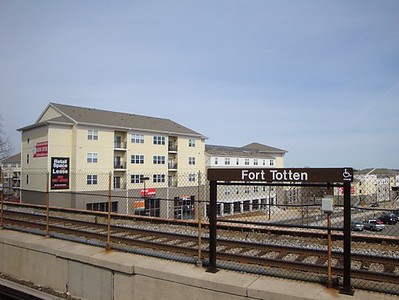
That's why you have four story housing at the Fort Totten Metrorail Station. It's an in-city location, but in a suburban patterned land use environment. Rhode Island Station is more urban (but with land pattern problems) and it still has four story apartment buildings, built relatively recently.

fort_totten_metro
I can't remember when this project was built, probably before 2008.  Since then, garden apartments a little further away have been or are being redeveloped into a much denser housing and retail development called Art Place at Fort Totten, and about half mile away is where JBG built housing with a Walmart on the ground floor (I've argued this should have been a bigger project, given its proximity to Metrorail.)  

Unlike with the West Hyattsville station, which has a station area plan, even if it's taken 15 years to start to see some response, DC didn't do a larger scale station area plan for either Greater Fort Totten or Greater Rhode Island Stations, so there are plenty of lost opportunities for not just more intense development, but the creation of a real center in a neighborhood that doesn't have one.

(Intensity is coming to the Rhode Island Station area, but it's taken decades longer because of the lack of a plan, and it comes with a lot of opposition and difficulty.)

Equity considerations/affordable housing.  These implementation mechanisms are more likely to be nonprofit, or at least to require a lot of subsidy, to be able to afford to build by leading the market.  And that sets the stage to include a lot of affordable housing in the projects.

While not included as a case study at those conferences, Phoenix might be a better example than either Denver or Minneapolis in terms of operating at a greater scale, especially in terms of lining up money in advance of the light rail's opening to fund affordable housing ("Light rail housing fund spurs 15 projects in metro Phoenix" and ""Why you don't see more vacant lots along light-rail route,"Arizona Republic).

The Phoenix program hasn't involved a lot of money, although none of the projects are particularly large.

Prince George's County.  Note that this entry has been about MoCo because of the current legislative initiative.  But all of these issues pertain to PG County too: the need to repattern land use around transit and transit stations; to add intensity; to provide ways to improve demand along at least one MARC rail line (Camden) and to add the opportunity for infill stations on or extensions from the Penn Line, etc.

For example, with an integrated rail passenger service on the Penn Line in Maryland and the Fredericksburg Line in Virginia ("A new backbone for the regional transit system: merging the MARC Penn and VRE Fredericksburg Lines"), it could be advantageous for PG County to add an infill station in Landover, etc.

Labels: , , , ,

Monday, July 06, 2020

A tax break isn't always the "right" priming lever for desired development

The Washington Business Journal reports ("Montgomery County eyes property tax breaks for projects on Metro-owned sites ") that Montgomery County Council is considering a 100%, 15-year tax break, to speed up housing development at Metrorail sites.  From the article:
Legislation on the subject is set to be introduced at the County Council Tuesday as part of an ongoing effort by a group of lawmakers to ramp up residential development in the Maryland suburb and help the county realize its housing production goals. This new tax incentive, along with a host of others, has been in the works for months.

This latest measure, authored primarily by Councilmen Andrew Friedson, D-Bethesda, and Hans Riemer, D-At large, would create a payment in lieu of taxes program for any private developer leasing land from Metro to construct new high-rise buildings.

The bill would abate 100% of real property taxes for these projects for up to 15 years, starting when use and occupancy permits are issued for the property. County staff would then negotiate some other form of payment with the developers in question, though the legislation does not set standards for that process.
Stations with the most opportunity for complementary real estate development tend to be closer in.  FWIW, I have written many times that there is no such thing as "automatic" TOD (transit oriented development).

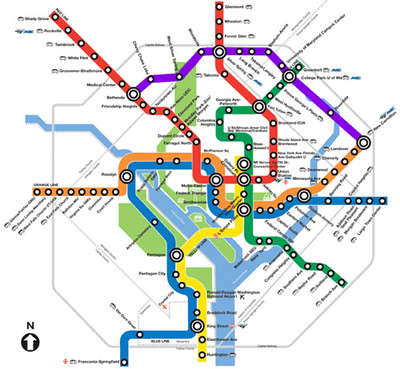
WMATA Map showing the Purple Line (but not the Silver Line)Metrorail Map showing the Purple Line light rail line, which is currently under construction.

For various reasons, especially stations farther from the core of a metropolitan area, housing is less attractive and still requires a car, even if it's located at a transit station. This is true for light rail, heavy rail, and commuter rail.

-- "Prince George's County still doesn't get "transit oriented development" and walkable communities: Greenbelt edition" (2012)
-- "With "transit-oriented development" urban design and/or planning is destiny" (2009)

Glenmont Station is about 12 miles from Downtown DC.  Forest Glen is closer, but is bracketed by the I-495, the Beltway Freeway.  Shady Grove is 24 miles from Downtown DC.

I don't think the issue is taxes.  Developing on transit agency land is really hard.  (1) Cost in terms of money and time is an issue, because the development process for transit agency land is super convoluted because it takes an inordinate amount of time, for example, the development at the Takoma Metrorail Station has been "underway" for 20 years !!!!!!!!!!!!! and is no way near any resolution.

(2) Besides the problems of contracting with a government agency anyway,  (3) it requires a federal review, since federal funds had been involved in the development and operation of the system; and (4) residents opposed to development seek various additional reviews and often the intercession of the Congressional representatives. 

Hard projects get developed once all the easy sites are taken.  If (5) the station isn't well located relative to housing demand, that makes it even more difficult.

While not in Montgomery County, but in Prince George's County, there has been a transit development plan for the West Hyattsville station for at least 15 years.  Although last year WMATA did sell land there, and a development program is apparently underway.

The problem is, more marginal development sites won't get developed til all the better sites are developed successfully.

Basically, the "problem" in Montgomery County is the stations that haven't been developed, in particular Shady Grove and Glenmont, are distant from the core and don't possess the characteristics that tend to draw "urban-oriented" residents who are the kind of people who want to live in housing at transit sites.

A tax break isn't going to change that reality.

More importantly, rather than offering a tax break willy nilly, I'd offer a tax break conditional on a plan and program for achieving multiple planning-related objectives.  The article says that's intended, but not defined in the legislation.  That's never good.

Purple Line and TOD tax breaks.  Because they'll be closer in, I'd say with the Purple Line, at the very least the Chevy Chase (Connecticut Avenue) station will be more in demand--also because it's in a much higher income area--than the outlying Metrorail Stations, while the Long Branch Station will not be, because it's in a lower income area--even though both stations will be located about 7 miles from Downtown.

I'd consider including stations like that, where the normal development timeline would be much longer, for tax breaks over a station like Shady Grove or Glenmont, because Purple Line stations are closer in, closer to the core, while Shady Grove and Glenmont are end of the line stations that are very suburban, and lack the pre-conditions for urban intensity.

Labels: , , , ,

Friday, February 14, 2020

Be afraid, be very afraid about the US's real estate centric economy

The latest post, "The Commercial Real Estate Future: Bankruptcy, Foreclosure, Workout, Value Added Reinvention and Redevelopment," in Larry Littlefield's Saying the Unsaid in New York blog is very disturbing (and the kinds of things that charlie has been saying for awhile about financialization of the economy).

Since local governments rely on property taxes for the bulk of their revenues ("The real lesson from Flint Michigan is about municipal finance" and "A correction (and update) to a March post on municipal finance: addition of land transfer tax to the list") this is "worrisome."

Labels: , , , ,

Thursday, January 16, 2020

"Real estate capital reproduction of space" in the Parkdale neighborhood of Toronto

-- "reproduction of space," urban sociology

Instagram image, davin.craig.

The Guardian has an article about "the gentrification" of the Parkdale neighborhood of Toronto ("'My Parkdale is gone': how gentrification reached the one place that seemed immune"), but I don't think the word "gentrification" adequately describes the process.

Basically, the neighborhood became identified as an opportunity for the international/national real estate ownership, management, and development, acknowledged as an economically significant  "node" or "submarket" within the system of international real estate capital. From the article:
But the lively streetscape here masks a threat to what could very well be the last island of diversity in a city swamped by the flood waters of global capital. Huge international real estate investment firms have embedded themselves in Parkdale’s urban fabric, buying dozens of apartment towers and thousands of rental units. Residents claim that threats, intimidation, rampant eviction notices and strategic neglect have become common. So too have tenant protests and rent strikes, where slick corporate offices find themselves occupied by hundreds of angry tenants demanding redress. ...

“There goes another community center,” quipped the Instagram account @parkdalelife about an infamous all-night McDonald’s being demolished to make way for a 700-plus unit luxury condo building, leeringly named “XO.” It was just the kind of hipster fatalism that infects neighbourhoods in the grips of late-stage gentrification.
That's a much bigger and more significant phenomenon than the "property value reproduction process" referred to as gentrification, which can be more of a ground up movement, where people see the value in place and location and the opportunity for property value appreciation.

Capital reproduction is on a much bigger scale.

On a much smaller basis, this kind of capital reproduction is what happened with the commercial district section of the H Street NE neighborhood in Washington DC ("H Street NE Commercial District Revitalization | H Street Festival" and "360 Apartment building + Giant Supermarket vs. a BP gas station, which would you choose?") where I was a co-founder of a neighborhood revitalization effort that so far has resulted in more than $1 billion in development either completed or underway (many other parallel efforts contributed to this).

But when I started I was pretty much a rube and outside of reading business sections of newspapers and magazines for 30+ years, I didn't have a fine-grained understanding of how things work.

Once the city released the revitalization plan for the neighborhood, recognizing that DC was a node within the international system of real estate capital*, national brokerage firms like Marcus & Millichap went in and inventoried every property, every opportunity, and put it in a database available to clients (that's what the real estate information firm CoStar does too).

Community anger is strong and has resulted in a number of protests and campaigns. Photograph: Rene Johnston/Toronto Star via Getty Images.

Once it was mapped and opportunities identified, it became much easier to redevelop.

But the difference in scale between Parkdale and H Street is significant.  Parkdale is bigger, denser--35,000 residents and a planning regime that allows for very large buildings, which DC does not-- and has dozens if not hundreds of very large buildings.

By contrast, H Street NE's opportunities are much smaller.  Still significant, especially at the scale of the neighborhood, district/submarket, and city, but by comparison to Parkdale, much smaller.

* In DC, outside of the center city and a few other submarkets, mostly development is a matter of regional players, not national or international players.

Parkdale has attracted big firms from Europe.  From the article:
... Akelius, the Swedish real estate juggernaut with some $8bn in global assets settled its gaze on Toronto in 2011, Parkdale was a low-income immigrant neighbourhood. But it was no longer a bleak urban sinkhole. Thanks to the Tibetan community, and the hipster incursion that the Tibetans’ stabilising presence had drawn, it was an opportunity.

In 2012, the firm started acquiring mid and high rise concrete slab apartment buildings in Toronto; by 2016, it had amassed 37, and more than 3,000 apartment units. ...

Akelius had already developed a successful business model in Sweden, Germany and the UK: identify neighbourhoods adjacent to fully gentrified districts – like Kreuzberg, a longstanding haven for Berlin’s Turkish population – and exploit the undercapitalization of its rental housing.
A Parkdale apartment building owned by MetCapital.  Image from the Toronto Star article "Parkdale rent strike over repairs, above-guideline increases ends with tenants declaring victory."

That's one firm. At this point, the entire H Street market for apartments might total around 3,000 units.  From "Akelius stocking up on Toronto and Montreal apartments":
Akelius Canada is a subsidiary of Sweden’s Akelius Residential Property AB, which was founded in 1994 and owns more than 51,000 properties valued at around $9 billion in Sweden, Canada, Germany and the United Kingdom.
The article describes the trajectory of change in Parkdale, how because it was outside the city center, and dealing with the aftermath of deindustrialization and the impact on the micro property market, it wasn't seen as a place where "gentrification" would really occur. From the article:
Gentrification, on the surface, seemed less of a threat than an impossibility. As the rest of Toronto surged upward in the early 2000s, Parkdale was forever “up and coming” – real estate code for a litany of social ills – and a target for only the heartiest of speculators. Some did come, sprucing up half a block here, a cluster of houses there, but Toronto’s real estate boom left Parkdale’s intractable poverty largely intact.
But the reality is that less than 4 miles from Toronto's downtown, in one of the nation's top two property markets, in a city that is a node in the international system of real estate capital, with large scale opportunities for portfolio investment, it was only a matter of time, as better placed development and acquisition opportunities in the primary market were absorbed.

Interestingly, because the scale is different, with large apartments, there is also the opportunity for tenant organizing, and Parkdale residents are protesting changes, and at least in terms of legally too large rent increases, they are having some effect, assisted in part by the neighborhood-based Parkdale Community and Legal Services nonprofit legal aid clinic.

But the article also discusses a nascent community land trust effort, which is too little too late. And maybe Toronto and Canada don't have community development corporations the same way that we do in the US. CDCs could have purchased properties in order to maintain permanent affordability.  (Not that CDCs do a lot of this in the US either.)

Then again, Toronto has found the need to provide assistance to "tower buildings" in terms of rehab support and other technical assistance to maintain the viability of such buildings as they are.

-- "The long term potentially negative aspects of condominium buildings as a dominant housing form in cities," 2016

Labels: , , , ,

Tuesday, November 06, 2018

Crystal City Arlington as Amazon one-half of HQ2 | Part 1: General + Housing impact

-- "Crystal City Arlington as Amazon one-half of HQ2 | Part 2: Leveraging Amazon's entrance for complementary economic development improvements"
-- "Crystal City Arlington as Amazon one-half of HQ2 | Part 3: Leveraging Amazon's entrance for complementary transit network improvements"
-- "Crystal City Arlington as Amazon one-half of HQ2 | Part 4: Pie in the Sky transit improvements"

=====

Communities want Amazon HQ2 because of evident economic development value, based on the real-life experience in Seattle ("12 HQ2 Numbers That Made Every North American City Hyperventilate," Seattle Business Magazine, "Amazon: Remaking Seattle in Its Own Image," Costar, 2014) where the city is experiencing a massive boom.


And unlike a lot of tax incentive deals ("Business Incentives are Ineffective and Wasteful," CityLab), based on the history of the positive economic impact in Seattle, it's fair to argue the proclaimed benefits will be realized, which is why I thought that providing tax incentives was a reasonable decision.  Although yes, this expansion has been complemented by a significant rise in housing prices.

-- "An example when I may disagree with Richard Florida: incentives for landing the Amazon HQ2"

But given that Amazon's HQ2 search hasn't focused on criteria I would have thought that mattered:

-- "The Amazon second headquarters "****show": Part 1 | Where could it go?"
-- "Amazon second headquarters list of finalists"

that is (1) lower housing costs for workers compared to Seattle, rather than equal to Seattle housing costs, and (2) providing revitalization energy for a center city that still languishes (e.g., Philadelphia, Newark, Baltimore, etc.)...

By splitting the expanded effort into two with one headquarters in Crystal City, across the Potomac River from Washington, DC, and the other in the Long Island City section of the Queens borough of New York City as has been reported by the Wall Street Journal and the New York Times ("Amazon Plans to Split HQ2 in Two Locations") they will reduce some of the worst effects on housing and commercial space costs that would come by locating in already expensive areas.

Queens is cheaper than Manhattan, and Crystal City is cheaper than DC, but they are still higher cost cities.

The DC area had three finalists: DC proper; Montgomery County, Maryland; and Northern Virginia

Relatively speaking, Arlington's commercial space is lower cost these days not only because they can build more densely compared to DC, but because they have a high vacancy rate, because of competition from other areas in Northern Virginia ("The state of Arlington County Virginia's commercial real estate market: 2012 and the future"), especially because of how the Silver Line has opened up parts of Fairfax and Loudoun Counties and lower cost land to "transit oriented development" ("Short term vs. long term thinking: transit, the Washington Examiner, Fairfax/Loudoun Counties vs. DC," 2011, and "Silver line reshaping commercial office market in Fairfax County," 2015).

Similarly, Queens is expensive relatively speaking, but Long Island City has long been utilized as a cheaper to lease "back office" location for Manhattan-based mostly financial businesses ("Citi consolidation opens a million square feet," New York Post), and it still has a lot of huge warehouse and distribution buildings able to be transformed, along with decent subway connections and inclusion within an expanding water ferry transit system.

Cloud computing as a regional competitive advantage.  With regard to Crystal City, as charlie has commented, it makes sense for Amazon to have a large presence there around Amazon Web Services ("All of Amazon's 2017 operating income comes from AWS," ZDNet), its cloud computing company that has amazing profit margins--AWS's profits subsidize the e-commerce operations--and an increasing amount of business with the government, plus Northern Virginia is one of the nation's main Internet backbone hubs.

Constrained build out opportunities in DC and Montgomery County.  With regard to previous announcements that DC, Montgomery County, and inner and outer Northern Virginia were all in the running, the choice of Crystal City for a smaller operation makes more sense to me too.

Both the White Flint area of Montgomery County and DC are not only physically constrained making it harder to grow the commercial space footprint over the long term, they have especially high housing prices.  The increased cost of commercial space expansion in Seattle ("Amazon has its eye on 3 more blocks of Denny Triangle," Seattle Times, 2012) is a primary reason for Amazon's choice to build a second headquarters.

And the outer fringes of Northern Virginia previously touted, such as along the Silver Line, didn't make sense to me except for Reston, because those areas don't have the kinds of urban design and place characteristics that are desired by the younger demographics likely comprising the employment recruitment audience of a firm like Amazon.

Housing costs.  The DC Policy Center ("How big of a deal is Amazon HQ2 for the DC Metro Region?") referencing an Urban Institute study argues that the impact of Amazon's entry won't be that significant on housing prices.

Definitely the halving of the size of the operation will make a big difference.  And it's true in the context of the Washington Metropolitan Area, which has 6.2 million residents and spans an area greater than 5,500 square miles, the theoretical effect of adding 25,000 high income households is spread out and won't make much difference in the economy as a whole.

But they miss a major point.  The point isn't the impact on the entire region as a market for residential housing, but the various housing sub-markets that are likely to be most desirable for newly arriving Amazon employees.  Likely these are going to be close-in neighborhoods with quality transportation connections allowing for relatively quick commutes to and from the workplace.

That means already high-cost neighborhoods in Arlington, Alexandria, and DC.

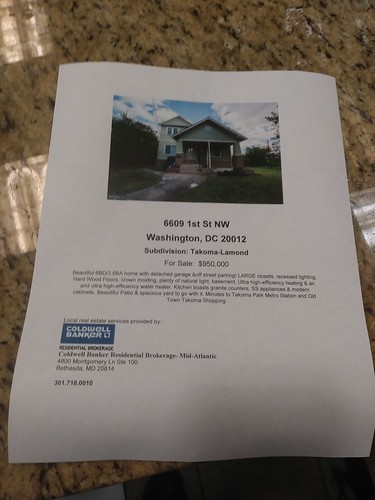
Residential real estate flyersThis flyer was posted at my voting precinct, a recreation center on the edge of DC.  And this area is almost five miles from the city's core.

I am not as familiar with the sub-markets in Arlington and Alexandria, but I know they are equal or higher in cost, and in DC the prevailing price for single family housing in many sub-markets throughout the city is close to $1 million ("The nature of high value ("strong") residential real estate markets" and "What people don't get about the DC housing market: supply is much less than demand, so prices keep rising (a/k/a basic economics)," 2017).  Last week, the Washington Post had an article on $2.5 million condominiums in DC neighborhoods.  Condominium prices will rise too.

Even a small increase in demand for housing in these neighborhoods, where demand is already greater than supply, will have extranormal impacts on prices.

It's those kinds of neighborhoods where the effect will be much more pronounced and more significant than is anticipated by the likes of the Urban Institute and the DC Policy Center.

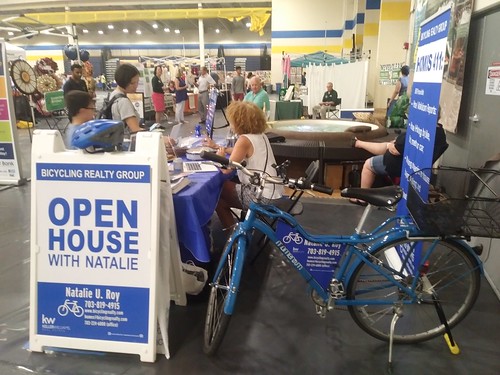
Natalie U. Roy, Arlington's Bicycling RealtorNeighborhoods in Arlington and Alexandria.  I called up Natalie Roy, of Arlington's Bicycling Realty Group, to get some insight from an Arlington-based Realtor.  Here's a summary of our conversation.

"While no one has a crystal ball, there is a visible 'Amazon bump' that is generating excitement already in terms of investment possibilities.

I am already getting calls from investors looking for rental properties, condominiums, etc."

"There will be a bump throughout Arlington--north, east, and south, on both sides of Arlington Boulevard (Route 50) and in close in areas in Alexandria too.  Other parts of Arlington--Clarendon, Rosslyn, especially those areas already on Metrorail lines, Shirlington will benefit."

"Arlington has a lot of small, nice little neighborhoods. Yes, housing prices are high already, but it depends.  There's a wide range of housing types, small houses, bigger houses, and condominiums."

This house in the Penrose neighborhood is for sale for $600,000 and has 3 bedrooms and 3 baths, in 1,684 s.f., on a 1,784 s.f. lot.

"In South Arlington, neighborhoods like Fairlington, Shirlington, Penrose, and Arlington Heights.  There are condo neighborhoods north of Pentagon City."

"The Columbia Pike Corridor--I would have loved to see the trolley built there. [Arlington cancelled the plans a few years ago.] It's an easy bus ride to Crystal City.  But it's difficult to find anything there now, house-wise."

"Arlington Ridge, Aurora Highland, Arlington View, Addison Heights are desirable neighborhoods right now."

"Neighborhoods off 395, like Oakcrest, and Clairmount and Columbia Forest are great places to live too."

"With interest rates likely to go up, we can't be sure how the market will react."

"Alexandria--so many of the neighborhoods, especially those close to Crystal City, not just Del Ray, even Mount Vernon, which is farther out," will get an Amazon bump too.

-- Zillow map of houses for sale in Arlington County, Virginia

My take.  My sense is that single family housing prices are going to top $1 million for the average house, in most if not all of these neighborhoods in Arlington and Alexandria likely to be affected by an "Amazon bump."  And DC neighborhoods too will continue to climb in price, with the influx of new high income residents adding more demand to a market already unbalanced, with more demand than there is supply..

Yes, at the metropolitan scale, the impact won't be so visible--prices in Loudoun, Prince William, Prince George's, Montgomery, and much of Fairfax will remain the same.  But at the micro-scale of individual neighborhoods within what I call the regional residential landscape, there will be significant impact in Arlington, Alexandria, and DC.

Too often, using gross-grained data misses variances that are significant when using a more finely tuned lens.

Labels: , , , , ,