Aaron Renn of Urbanophile has a podcast about Flint, based on a talk he gave in Midland, Michigan (home of Dow Chemical), and it reminded me that I have been meaning to write about the "real lesson from Flint."
--
watch on You Tube.
Well, there are actually more lessons, others being "if you run a water system be sure to properly treat the water," and "if you regulate water systems be sure to ensure they're doing what they are supposed to be doing."
A fourth would be "cover ups and misdirections come to light eventually, all you're doing is putting off the reckoning." (A fifth lesson is a lot of times there is no real reckoning, some resignations and Congressional hearings notwithstanding.)
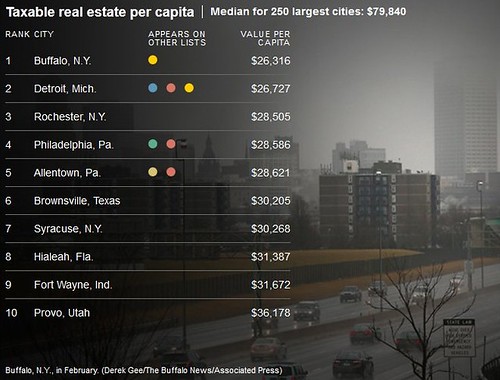
Just like I am sick of prognosticators writing about Houston's success being due to a lack of zoning when it was really a result of Houston's being the economic center of the oil and gas industry--which is why the economy there is tanking now, just as it has during other oil industry downturns dating to the 1980s-- I get tired of comments on newspaper articles about how urban governments run by Democrats have run their cities into the ground.
While there is a bit of truth to that when it comes to the pensions issue, and the way that municipal labor unions can dominate the local political agenda, the reality is much more complicated.
The political stripe of the people in charge doesn't matter all that much.
In a paradigm of suburban outmigration, cities were consigned to economic failure, as they lost population and business activity.
Flint, "Vehicle City" no longer.
Flint/Genessee County Michigan is a perfect example, as General Motors and parts suppliers provided the bulk of jobs and property and income tax revenues collected by the city and county, and as GM closed most of its plants--now employing 5,000 people from a peak of just over 82,000 employees in the city--how could the economy not tank?
Furthermore, the multiplier effect of an automobile industry job was calculated at 3.6, and while not all of those jobs would have been located in the immediate area, it's obvious that as the company downsized its Flint-area operations, non-company employment would also take a big hit
("
GM Weld Tool Center closing: [Timeline of] General Motors history in Flint," [2013]
Flint Journal; "
General Motors closes Buick City complex in Flint, Michigan [1999]," WSWS;
The Economic Impact of the Automotive Industry on Urban Communities)
How can local elected officials--Republican or Democrat--deal with that level of economic destruction?
The basic lesson is that the US developed a system of financing local governments that is an artifact of the period in which it was developed, that of significant economic growth of the US economy.
A now vacant GM plant. Flint Journal photo.
Local governments are typically funded from a few sources--property taxes are the largest source, sales tax revenues (usually shared with the state), fees (permits, rentals, etc.), and funds from state and maybe the federal governments--are the primary sources.
When a local economy tumbles, usually property tax and sales tax revenues tumble precipitously. And if the state economy is in free fall simultaneously, state transfers to local governments typically fall precipitously also.
The financing system for local government, primarily reliant on commercial and residential property tax revenue, works only when communities are growing or at least, stable.
When local economies are contracting and property values are dropping, and property is abandoned, it doesn't work. And it doesn't matter who is running the local government, Republicans or Democrats (although Democrats tend to be in charge in cities), they lack the tools to be able to respond, other than cutting government to the bone, which they can't do, because they still have to provide services like water, policing, schools, etc.
Photo: Thomas Simonetti, Flint Journal.
Putting off pension liabilities is one example of this. If your revenues continue to grow you can probably pay off future pensions. If you're in a phase of slow or no growth, or contraction, you can't.
In fact, from a financing and operating standpoint, many of the local government institutions that have been created work well only in times of growth, and since at best the economy is at a reasonable steady state, and massive growth is not likely to occur in most places, most local governments are seriously pressed economically.
It's even worse in those places, like California, which have laws (because of Proposition 13 in California) which seriously restrict the ability of local governments to raise taxes.
Sure, Flint's economics deteriorated to the point where the state appointed a receiver, and it was the receiver, seeking to save some money, who started the chain of decisions that resulted in the "
Flint Water Crisis" (MLive).
But Flint's economic disaster was pre-ordained, once GM began closing plants--ultimately 93% of GM's employee base in Genessee County disappeard..
Some solutions to provide more stable funding for local governments. Below I list seven solutions for better harmonizing local tax revenues:
1. Local income taxes.
2. Sales tax sharing.
3. Metropolitan tax base sharing.
4. Creating a consolidated "state/local" income tax.
5. State revenue sharing.
6. Multi-jurisdictional special service (tax) districts.
7. Sin taxes for the arts.
I recommend #4, #5 and #6 as a package. #3 is great, but it's better to do it at the scale of an entire state, which is what #4 does.
The problem though is that all of these solutions require state government approval, and as the writings of Gerald Frug point out, state legislatures aren't inclined to pass laws that help cities, and each of these solutions requires state authorization.
And note that these solutions are designed for communities that are functioning somewhat at a basic level. What happened to Flint's economy is the equivalent of the Great Depression or a Natural Disaster like a volcano eruption, earthquake, hurricane, or tornado that completely wipes out a community. A local income tax won't generate much revenue when the local economy is leveled.
1.
Local income taxes.
Counterproductive. Relatively "easy" to do if state authority to do so has already been granted. Very difficult if approvals aren't already in place.
This is a sort of solution, New York City has an income tax as do many other cities. The micro-city of Highland Park, Michigan had an income tax when Chrysler Corporation was based there. Philadelphia has a wage tax. Communities that are business centers, with lots of employment and where many of the employees don't live in the city, benefit from such taxes on non-resident earners.
But the problem with a local income tax is that if other area jurisdictions do not have the same kind of taxing system, businesses and residents are encouraged to relocate away from those communities with higher taxation regimes.
That is a particular problem for Philadelphia, which unlike other major cities on the East Coast (NYC, Boston, DC), has not been successful at maintaining its place as a headquarters for business, which instead continues to move to New Jersey (such as the Philadelphia 76ers), Suburban Pennsylvania, and Delaware (which doesn't have state or sales taxes--although this may change over time given the changes coming for the Dupont Corporation, which had the same economic impact on Delaware's economy that GM once had on Flint, and Michigan more generally).
From the
Philadelphia Inquirer article "
To see impact of wage tax, just look at City Avenue":
The office buildings spread along City Avenue starkly illustrate how Philadelphia's taxes hurt its economy.
The north side is packed with office buildings full of high-paid workers. On the south side, there are low-paying retail jobs and few offices.
Both sides of the busy commercial street are served by the same highways and public transportation. Workers have access to the same restaurants, gas stations and housing.
But the north side, where there is no wage or gross-receipts tax, has 93 percent of the avenue's office space - 2.6 million square feet. It is in Montgomery County.
The south side, in Philadelphia, has 7 percent - a mere 200,000 square feet, according to the Central Philadelphia Development Corp.
"Everyone would prefer to be on the other side of City Line," said George Goldstone, chairman of Herbert Yentis & Co., a Philadelphia development company on City Avenue.
"The only way we can sell a vacancy on the city side is by offering a lower rental to compensate for the taxes," he said. ...
By every measure, the tax burden on Philadelphians is 20 to 30 percent higher than in virtually every major city in the United States, including Baltimore, Detroit, Los Angeles and Washington.
2.
Sales tax sharing.
Good practice.
In states where the county, not individual jurisdictions, collects sales tax revenues, there may be instances where certain jurisdictions receive revenues from the county based more on need, rather than in terms of how much revenue was generated within the community.
This can't happen in Virginia, because cities are legally independent of counties. This creates significant competition between cities and between cities and counties for tax-generating businesses. A key example is between Colonial Heights and Petersburg, Virginia. Petersburg is the county seat and back in the day of traditional commercial districts, was the premier destination in the area. These days, Colonial Heights is where the major regional shopping mall is located, and it generates the bulk of sales tax revenues in the area, but there is no vehicle for tax sharing between the jurisdictions.
3.
Metropolitan tax base sharing.
Fair. Shares the value of growth. Few states have authorized this kind of tax sharing system. Does not work across state boundaries.
To counter income tax-spurred outmigration and intra-metropolitan competition for businesses generating high tax revenues, in Metropolitan Minneapolis, local governments agreed to create a pool of a portion of tax revenue derived from new growth, and to share the revenue with communities not experiencing growth. It is intended to minimize the negative impact of large employers/tax generators moving from one jurisdiction to another. From the book
Regional Planning from a Sustainable America:
... the Twin Cities Fiscal Disparities program ... places 40 percent of the growth in commercial-industrial tax base in each municipality in each year into a seven-county, regional pool and then distributes the tax base back to participating municipalities and school districts based on tax base and population. The re-distributed tax-base is then taxed by each location at its own tax rate.
While part of Hudson and Bergen Counties in New Jersey operate a similar program (NJ Meadowlands Tax Sharing Program), this type of program is exceedingly rare, and in any case, only works in areas that are still experiencing some level of economic growth, even if the pattern of growth is varied.
And judging by the experience in New Jersey, there can be plenty of discord amongst the municipalities participating in the program, both those communities paying in ("
Frustrated over Meadowlands tax-sharing program, Secaucus mayor shoots off letter to Gov. Christie,"
New Jersey Star-Ledger), and receiving harmonization payments ("
Meadowlands tax-sharing program modified after North Arlington protest,"
Bergen Record).
From the
Star-Ledger article:
Created in 1973, the Meadowlands District Inter-Municipal Tax Sharing program is designed to take money from municipalities within the 14-town district that reap benefits of development and share the wealth with towns with severe restrictions on development.
In his letter to the governor, Gonnelli said "we were told by the Meadowlands Commission Executive Director Marcia Karrow that while the issue was being taken seriously, the Governor's Office was having a difficult time understanding tax sharing."
Of the four Hudson County municipalities in the district, Secaucus and North Bergen pay into the shared pool, while Jersey City and Kearny receive annually. Secaucus is expected to pay nearly $2.7 million into the fund this year, while Kearny is expected to receive more than $4 million from the fund.
Last year some of the paying municipalities within the district temporarily withheld payments in an attempt to get state officials of focus on what they called the unfair tax-sharing program.
A program like this is impossible to create across state lines, and many metropolitan areas (New York City, Philadelphia, Washington, DC, Chicago, St. Louis among others) have multi-state boundaries.
4.
Creating a consolidated "state/local" income tax.
Probably the best solution, though still subject to decline in revenues in recessionary periods.
Most state governments assess an income tax (Washington State and Delaware are key exceptions). Maryland is one of a handful of examples where the state income tax is actually a combined state/local income tax,
where the counties and Baltimore City include a "piggyback" tax that ranges from 1.25% to 3.2% of the state tax obligation, depending on the jurisdiction.
A consolidated filing and collection process simplifies matters for taxpayers and the local governments.
While at the local level, the system favors counties over separately incorporated cities (e.g., citizens in cities like Rockville or Takoma Park are overtaxed compared to residents in unincorporated parts of Montgomery County), the local governments have a more diversified revenue stream compared to those places which rely on property taxes for the bulk of their revenues.
According to
the Tax Foundation, this kind of system, while rare, is also in place in Indiana, Ohio, Pennsylvania, Michigan, and Iowa, although depending on the state, not all jurisdictions, which can extend to school districts, assess such a tax.
5.
State revenue sharing.
A pretty good solution, though still subject to decline in revenues in recessionary periods.
Until the Reagan era, the Federal Government shared some tax revenues with center cities ("
Federal Revenue-Sharing - Born 1972. Died 1986. R.I.P.,"
New York Times).
Some states still have a form of intra-state revenue sharing. Probably the best known example is Minnesota's Local Government Aid program, which was created at the state level in return for localities agreeing to not assess local income or sales taxes ("
The basics of local government aid in Minnesota," Minnesota Public Radio).
While not all cities receive LGA, it massages the economic differences that otherwise might exist between localities, so that all communities can offer comparable services for its residents. Instead of there being a system of separate local income and sales taxes, Minnesota shares state income and sales taxes with localities.
--
City LGA Program, Minnesota House of Representatives
--
County Aid Program, Minnesota House of Representatives
To make up for severe disparities, like with Flint or other declining cities in a state, I'd recommend a system of "Local Government Aid/State Revenue Sharing" in addition to a consolidated state/local income tax.
6.
Multi-jurisdictional special service (tax) districts.
A pretty good approach, good for cost reduction, but not a game changer. Because costs rise over time, this creates a dynamic where some jurisdictions may opt out. In fact, seeking to lower costs in the face of legacy systems is the economic justification for outsourcing/privatization of services typically provided by government agencies, transit being a particularly common example.
These aren't new--utilities and regional park systems are typically funded in this way. Examples include the Huron-Clinton Metropolitan Parks Authority in Southeastern Michigan ("
13 parks of the Huron-Clinton Metropolitan Authority are made for fun all year," Woods-n-Water News) created in 1939 and funded by a property tax assessment covering multiple counties or the Northern Virginia Parks Authority--which started as a multi-jurisdictional effort to protect water resources.
Water service is a primary example. Baltimore City's water system also serves Baltimore and Howard Counties. Detroit's system is multi-county as well, serving most of Southeastern Michigan.
A problem that arises with these services is common to any system, legacy costs, aging facilities, pensions, etc., lead to higher costs over time, and so it is always possible that by opting out, the locality will start off at a new lower cost basis. (Note that the "Detroit" water authority has been transferred to a multi-county Great Lakes Water Authority--not unlike how the State of New York took over "New York City" transit--to spread out costs, although in the Detroit instance, some activists criticize this as the suburbs stealing the city's assets. See "
Great Lakes Water Authority takes over regional operations,"
Oakland Press.)
In fact that was what spurred Flint to seek "less expensive water" and is why Mid-Michigan governments are creating their own water authority, so that they don't have to pay towards maintaining the aging water service infrastructure emanating from Detroit ("
Karegnondi water system rooted in frustration,"
Detroit News).
Rising costs and beliefs that some cities pay more than their fair share for service is leading to discord within member jurisdictions of the Orange County Fire Authority in Southern California ("
Fire Authority faces financial deficit, pensions and Irvine threatening to drop it,"
Orange County Register) which could lead to opt out and the creation of new fire department operations in some Orange County cities, which will lead to higher costs for the Fire Authority.
Arts. Another example is the
Regional Asset District in Allegheny County, Pennsylvania, which is funded from a county-wide sales and use tax ("
How the Regional Asset District rode to the rescue of Allegheny County attractions,"
Pittsburgh Post-Gazette).
Historically, the City of Pittsburgh paid for and provided regionally-serving cultural assets (museums, zoo, etc.) without support from other area jurisdictions. As cities lost population and business activity, funding such facilities became an increasing strain. The RAD, also supporting cultural assets in the County, was a way to spread out the cost.
From the article:
In the early 1990s, the city was facing major financial troubles, he said, and was in no position to continue to fund attractions like the zoo and the aviary, particularly when studies showed that as many as 85 percent of those visiting them came from outside the city.
Ms. Masloff championed the asset district as a way of providing a stable source of funding for such assets while at the same time getting the many visitors from outside the city to help pay for them. It didn't hurt that surveys found that about 25 percent of the people who pay the sales tax in Allegheny County live outside the region.
In retrospect, the asset district has "done exactly what it was intended to do. It has funded the primary regional assets. It has added to that a large number of smaller regional assets. It's helped to bring into fruition other regional assets [like PNC Park and Heinz Field]," Mr. Turner said.
Greater Denver has a similar program ("
Another round in the tense battle over metro-Denver arts funding,"
Denver Business Journal). (Note that smaller organizations may not benefit as much as larger organizations from such funding streams, which creates discord.)
More recently, cultural facilities in Greater Detroit, such as the Zoo and the Detroit Institute of Arts, which had been funded solely by the City of Detroit, now are supported by a multi-county property tax. But in Detroit, by contrast to Pittsburgh, each facility seeks its own tax and approval process, whereas in Pittsburgh, the program covers a multitude of cultural facilities in a single funding system.
7.
Sin taxes for the arts.
I'm not a fan.
In a variant of the multi-jurisdictional special service (tax) districts, Cuyahoga County, Ohio (Cleveland) charges a special tax on tobacco, to fund arts programs ("
Cuyahoga cigarette tax for the arts grows in importance as other sources of government support shrink: new report,"
Cleveland Plain Dealer). I don't think it's a particularly fair tax, and instead recommend a property tax funding stream comparable to the Regional Asset District.
Labels: property taxes, provision of public services, public finance and spending, sales tax revenues, special tax districts, state and local income taxes