Rebuilding Place in the Urban Space

"A community’s physical form, rather than its land uses, is its most intrinsic and enduring characteristic." [Katz, EPA] This blog focuses on place and placemaking and all that makes it work--historic preservation, urban design, transportation, asset-based community development, arts & cultural development, commercial district revitalization, tourism & destination development, and quality of life advocacy--along with doses of civic engagement and good governance watchdogging.

Tuesday, December 19, 2023

WMATA Chief says it’s time to talk about a regional tax to help fund Metro (DC area)

Is an interview with WMATA CEO Randy Clarke (NBC Washington).

This pamphlet was an advertising supplement inserted in the Washington Star, 3/21/1976.

I get a kick out of this because this has been raised on and off for 20 years, such as in these reports from 2004-2006.

-- Washington Metro: Deficits by Design, Brookings, 2004
-- Keeping Metro On Track: The Federal Government's Role in Balacing Investment With Accountability at Washington's Transit Agency, Brookings, 2005
-- "Mass Transit: Issues Related to Providing Dedicated Funding for the Washington Metropolitan Area Transit Authority, GAO, 2006

Also a statement by a transit safety commission board member:

-- "DC area transit commission board member thinks he has a brilliant idea on how to fund Metrorail: sales taxes," 2022

It's not new.

In 2009 and a couple times afterwards, I said it was necessary for WMATA to rebuild the regional/metropolitan consensus about support for transit.  And later about various funding mechanisms.

-- St. Louis regional transit planning process as a model for what needs to be done in the DC Metropolitan region, 2009
-- "WMATA 40th anniversary in 2016 as an opportunity for assessment," 2014
-- "Funding WMATA by a regional sales tax," 2017

I also wrote that the best time to ask for money is when you're successful, not in crisis (e.g., "Creativity Helps Rochester's Transit System Turn a Profit," New York Times).  

The best time would have been in the 1980s, when the system ran well and was still expanding.  Although sales taxes aren't a cure because they fall during recessions.

Regardless of Rahm Emanuel's point about not wasting crises, my observation is that governments aren't good at decision making generally, and are particularly bad during crises.  So given there's been talk about this for at leas 20 years I'm not holding my breath.

WMATA has even more issues because if either Maryland or Virginia have Republican Governors, it makes it very difficult to develop consensus support for such a tax, because they see it, justifiably or not, as helping DC disproportionately.  Right now, Virginia has a Republican Governor.  But even Democrats like Terry McAuliffe weren't super helpful.

=== From past entries:

Transit financing.  I've written a lot about WMATA and financing.  It has a big problem in that the jurisdictions appropriate money on a year-by-year basis, not as a matter of course.  Yes, this does make it harder for the agency.  Especially because jurisdictions will put off capital expenditures as long as possible.  Many people make the point that lack of dedicated funding is why the system is in failure mode.  I disagree.

-- Getting WMATA out of crisis: a continuation of a multi-year problem that keeps getting worse, not better (2015)
-- What it will take to get WMATA out of crisis (2015)

As I've argued, the federal transit pass has historically disproportionately funded the system, alongside the practice of charging fares by mode--most systems charge one fare for a bus+rail ride.  Not WMATA.  They charge two.  And pass products lowering the overall cost of transit have historically been a low priority.

This let the system get sloppy in terms of finance, budgeting, and understanding why "WMATA is so successful at funding operations from farebox revenue."

My solution: Step 1: creating a regional transport association.  The fact that there are so many "mobility" services, even beyond transit (taxis, car sharing, bike sharing, scooters, etc.) is why I've argued that the DC area should adopt the German form of regional transport association (called a VV, Verkehrsverbund), which links planning, budgeting and operation into one overarching organization, even if many different entities provide actual transit service.    They have an integrated planning and transit fare media system.  But there are over 20 operators of the various services, including private operators of bus lines.

Step 2: Separate planning from budgeting.  Too many transit services in the DC area make planning subsidiary to budgeting.  I understand why this happens, but if there were true "mass transit planning," we would define the breadth and depth of the network that we want.  And then come up with the funding to make it happen.

Transit operators would come back and say: you've defined the network breadth and depth (level of service) as X.  But the funding won't support that.  Then there would have to be a discussion of how to address funding shortfalls in terms of raising revenues or cutting service.

Step 3: Fix the Funding.  Yep, it needs to be done, but not just for Metrorail, for all of the regional transit services.  

Step 4: WRT WMATA, declare force majeure, and contract out operation of the heavy rail system to Hong Kong's MTR.  Start over.  Force majeure allows the abrogation of all contracts and starting over. 

Note: WMATA seems to be getting its act together under Clarke.  Maybe this is no longer necessary.

Funding options.  I have other pieces about options for funding.  

-- "Metrolinx Toronto: 25 potential tools to fund transit-transportation infrastructure," 2013

suggests a more structured process for identifying funding than an interview published in the Post.

The best would be a transit withholding tax.  But if the federal government refused to participate, it would significantly reduce the revenues from it.  In France, this tax is key, called the versement transport.  But MTA in New York State, and a couple other transit agencies do a form of it as well.

The future of transit in cities.  I don't know.  Work from home has torn apart the transit business model.  Most major cities have seen a reduction by half in transit users.  And systems like WMATA have reached a ceiling in how much they can charge.  Suburban jurisdictions now truly see helping transit as helping the city at their expense, since many of their workers have been able to significantly cut back on commuting to the center city.

DC doesn't have the budget to be able to take on the full responsibility of WMATA, but that would allow it to manage it in a way that benefits the city.

Although federal agencies leaving the city for sites poorly connected by transit, and maybe sports teams too, doesn't help the transit financial model either.

Labels: , , , , , ,

Wednesday, April 26, 2023

Is the Growth Machine a casualty of the culture wars?

When business interests told the Tories in the UK that Brexit was likely to have many deleterious effects, Boris Johnson, who went on to become Prime Minister, was quoted as saying "F*** Business" ("Boris Johnson promised to “fuck business”, and that’s exactly what he did," New Statesman).

The Growth Machine thesis from urban sociology is focused on local government, and how political and economic elites, despite seemingly intra-elite competition, are united on a real estate focused pro-growth agenda, since real estate development is the primary source of revenue and economic activity for local governments.

"The City as a Growth Machine: Towards a Political Economy of Place" (American Journal of Sociology, 1976) lays out the concepts, which were expanded in a book, Urban Fortunes: The Political Economy of Place. 

Political science has its own theory, that of the Urban Regime ("Urban Regime Theory," The Wiley Blackwell Encyclopedia of Urban and Regional Studies).  

I argue that GM is better at explaining why, and UR the how.

Anyway, more recently, Republican culture wars, albeit more at the level of state government interfering in local economic development, but when there is some sort of state nexus, in some places, is triggering anti Growth Machine actions.

Florida and Disney.  The primary example is Florida, where Disney complained too late to make a difference, about Florida's various anti-gay legislative acts after being shamed and prodded by employees ("After protests, Disney CEO speaks out against Florida's 'Don't Say Gay' bill," NPR, 2022).  But it still enraged Governor DeSantis

Probably everyone in America has heard of Disney World, which is a major attraction in Orlando, which in turn has led to the placement of other attractions there (like Universal Studios Florida and SeaWorld), and is a major driver of Florida's economy--which doesn't have a state income tax.

Governor DeSantis attacked the special district structure Disney uses to operate its property there, which is massive, and spans two counties.  At the time of its creation, local government lacked the capacity to provide services to the level Disney required, so the Reedy Creek Improvement District was formed--like an urban business improvement district, but on a massive scale.

Last year, they changed the structure, not realizing it triggered $1 billion in bond payments by the two counties in which Disney World is located.  So they did a new bill this year.

They changed its organization and appointed political flunkies with no expertise but culture war bona fides to oversee the district.  Usually, in GM/UR politics, the people appointed to such boards work hand in glove with the business interests.  DeSantis appointed people who are oppositional.

But before that took effect, Disney had the board pass contracts making Disney pretty much impervious to DeSantis' political machinations.

He didn't take it well, and has been threatening all sorts of retaliation.

In the interim, Disney created a webpage outlining the economic impact of Disney in Florida ("Disney Shares ‘The Value of Reedy Creek’ Post on Community Outreach Site Outlining District’s History & Benefits for Florida," WDWNT) 

-- The Value of Disney Reedy Creek to Florida, Walt Disney World/Disney Connect

The firm pays more than $1 billion in taxes annually and employs 75,000 people directly and 16,000 indirectly.  Plus there is the multiplier effect of other jobs created as a result of the economic activity around Disney World. 

Today Disney announced it is suing Florida for what they've been doing on Constitutional) grounds of retaliation versus free speech ("Disney sues Gov. Ron DeSantis, alleging political retaliation," Washington Post).

I don't think this bodes well for Florida, because Disney's attorneys and facts are much better.  Plus, wrt DeSantis' political campaign for President, it will keep him in the news in negative ways.  Way more people like Disney than they like the culture wars.

Battery plants and red states.  If you don't believe in climate change, you don't want to encourage alternatives to fossil fuel consumption.  Electric cars are a threat to gasoline consumption.  Republicans, especially oil interests like Koch Industries, don't like that very much.

Electric vehicles need batteries, lots of them, and battery manufacturing plant are seen as a key element of the developing industrial ecosystem for electric vehicles.

Last year, Georgia's governor, Brian Kemp, got pushback for providing tax incentives to an EV plant ("Kemp, Perdue spar over planned Georgia electric car plant," AP).  

And in Virginia, Republican Governor Youngkin--with presidential ambitions--said no to a battery plant owned by a Chinese firm ("Youngkin blocked a battery factory from coming to Va. and an entire economic sector’s potential," Virginia Mercury).  Instead that plant and its estimated 2,500 jobs went to Michigan.

OTOH, the redistribution of manufacturing for electric vehicles will lead to more production in red states, which could have an impact on Red State government positions wrt electric vehicle production and climate change more generally ("The unlikely center of America’s EV battery revolution," "Battery factories could make red states a driving force for climate," Washington Post).

Bud Light beer.  Is excoriated because they did a promotion with a transsexual ("Anheuser-Busch InBev Executive Speaks Out About Bud Light Controversy," Newsweek).

M&Ms.  Trolled Tucker Carlson ("Tucker Carlson is once again enraged by "woke M&M's" lack of sex appeal," Salon) good ("M&M’s punked Tucker Carlson with Maya Rudolph Super Bowl fake-out," LGBTQ Nation).

Culture wars and the "natural" conservative alliance with business.  It will be interesting to see how this plays out.  Some donors are backing away from DeSantis on this issue.  

But at the end of the day, most big corporate donors are likely to acquiesce, so long as their particular companies remain on the conservative good side, and their primary issues--low taxes, minimal regulation--are covered.

Labels: , , , , ,

Thursday, October 06, 2022

Municipal finances face a shaky future

The entry, "The real lesson from Flint Michigan is about municipal finance" (2016) makes the point that in the US, financing systems for local government were created when the nation experienced rapid growth, and for the most part they've never been addressed in a substantive way since many cities have moved to a position of either equilibrium or shrinkage.

The problem with equilibrium or shrinkage is that personnel is the biggest cost for cities, and wages go up not down, not to mention the issue with retirees and pensions--typically local governments may stint on wages but in return offer great pensions often with health care, but these are underfunded creating significant financial overhang.

Center cities rely in large part on commercial property taxes, and the ancillary revenues that come in association with officer workers.

But the work from home phenomenon that has been driven by the pandemic is going to crash the value of commercial property, both in terms of office space and retail--which is worth a lot less when there are fewer customers ("Hold on tight: How NYC and state must prepare for the possible implosion of commercial real-estate values," New York Daily News).

The Philadelphia Inquirer has an article about this, "City finances, including Philadelphia’s, could go bad fast in this economy, bond expert says."  From the article:

Here are Kozlik’s observations on threats to city finance, many of which fell on his audience like a door slamming shut:

Scared borrowers. As recently as last spring, Kozlik and other analysts were predicting municipalities would borrow a record $500 billion this year by selling bonds to pension funds and other investors. But as interest rates have spiked, cities have been delaying commitments to long-term funding, and bond sales are unlikely to reach $400 billion, this year, or next, either. That translates into fewer jobs and business contracts, and a slower economy.

Rising interest rates. Pension funding, which has cost Philadelphia more than law enforcement in recent years, is no longer Wall Street’s main worry about local governments. Even though public pensions have been drained by the financial markets’ fall and many are badly underfunded, a recent survey shows analysts are even more concerned about rising interest rates and prices, the shrinking U.S. labor force, and divisive politics that prevents decisive policy, as causes for concern that cities will go broke.

Empty offices. Workers aren’t returning to office centers, including Philadelphia’s Center City. Nationally, restaurants, air travel, and apartment rentals have recovered, post-pandemic, but only half of workers have returned to office locations; in Philadelphia and San Francisco, it’s more like 40%.

Lower revenue. With offices shutting, property valuations and taxes are heading down, too.

Crime. Polls show Americans are more worried about crime, and less confident police will protect them.

Construction challenges. Labor and material shortages and cost increases have crimped construction to the point where, even if the federal government resumes billions in funding to cities, city managers have told Kozlik they would have a hard time spending it on projects in the near future.

Politics. Politicization of public policy, which has stalled Congress on immigration and other key issues since the 1980s, has been spreading among state and local governments. States like Texas are banning East Coast investment banks that have adopted anti-oil and anti-gun policies; in California, activists are pressing to punish banks that finance fossil fuels and weapons makers. What that means, in practical terms, is fewer banks available to sell public debt in those restrictive states, and, therefore, higher borrowing costs for taxpayers.

“The speed and magnitude of change, and the number of variables that are evolving is not being recognized by most people,” Kozlik said later in summary. “Most people across various industries are reacting to one or two changes in the landscape. Very few recognize the major transformation going on across the board with labor, technology, education, demographics, and politics.”

Communities growing have less at risk.  But rising prices and interest rates will press budgets, especially for capital planning.  

Constant pressure to reduce taxes is another risk.  But the other risk not mentioned is the constant pressure to reduce taxes.  For example, in Utah, the State Legislature does this every year "to share the benefits of growth."  But when you're growing you need to spend more money, not less, on infrastructure and other programs.  

Cities and counties face real pressure to provide the kinds of programs and facilities people want, as costs and demands rise.  

As conditions become more turbulent, cutting taxes increases risk.

The New York Daily News editorial suggests the following actions, to be proactive, in the face of declines in commercial property tax revenue:

  • rethinking zoning. There’s no good reason that in a modern city, buildings are so rigidly categorized into classes, with minimal flexibility between light industrial, commercial, residential, medical and other. A nimbler New York would end unnecessary distinctions to let people find the best uses for space with minimal regulatory hurdles.
  • budgeting smartly. Profligate spending that piles ever more recurring spending into the city’s $101 billion-and-growing fiscal plan risks throwing New York off a cliff if and when property receipts revenue plunges (personal income and related tax revenue is already expected to fall sharply this year). 
  • Building up reserves and responsibly dialing back bureaucracy are the wisest insurance policies against sudden downward shifts — especially if those coincide with a recession.
  • rethinking property tax collections, which have become unfair and incomprehensible over generations. Not only must New York rationalize levies on rentals, condos, coops and single-family homes; it must accept that golden-goose employers whose taxes have defrayed those from residences might not lay eggs forever.
  • more sensitively implementing statutes that inflict huge costs on commercial real estate, like the law that will soon start punishing noncompliant buildings with big fines. That’s likely to accelerate a commercial exodus.

Labels: , , , , , ,

Monday, May 23, 2022

Washington Football Team buys land in Woodbridge/Prince William County: A good opportunity to extend the Blue Line subway to Quantico and the Purple Line from New Carrollton to Springfield, Virginia

 I am no fan of providing lots of public monies to professional sports teams for stadiums and arenas ("Revisiting "Framework of characteristics that support successful community development in association with the development of professional sports facilities""), and I really am no fan of the now named Washington Commanders, because the team is run so poorly ("A new football stadium for the Washington "Commanders" | Virginia versus Maryland (and hopefully not DC)").  

I definitely don't want them to return to DC ("Been to Largo lately? Sports teams often aren't very good partners...," "Stadiums and arenas redux: Mayor Bowser still wants the area NFL team to relocate to DC").

Today's reports ("Commanders acquire 200 acres of land in Va. for potential new stadium," Washington Post) that the Washington Commanders bought land in Woodbridge/Prince William County, Virginia makes me happy that perhaps they won't be trying to return to DC, because DC could do so much better with redevelopment around RFK Stadium than via a football team with minimal activity.

The proposed site doesn't have high frequency rail transit and would be a crappy, long drive for a significant number of the patrons of the team, adding congestion to the I-95 freeway, which is already seriously congested.  

Frankly, I think sports teams should be required, in areas with decent transit systems, to locate where there is already high frequency rail transit.  But that isn't the way it is, at least in the DC area.

(Examples of stadiums and arenas with great transit service include Madison Square Garden and Barclays Arena in NYC, and to a lesser extent the Mets and Yankee Stadiums, Capital One Arena in DC and to a lesser extent Washington Nationals Stadium, AT&T Park in San Francisco, Wrigley Field in Chicago.  Other facilities may not be in transit meccas, but at least the transit agency plans for better service, like Metrolink in Southern California with special services for hockey and baseball teams. Etc.)

But, not that Metrorail is operated very well ("What to do about DC area Metrorail?") there is the opportunity if the Commanders were to move to this location, that the public transit system could be extended to Woodbridge.

Sure Woodbridge is 20 some miles from DC so extending the Blue Line Metrorail there wouldn't be so much about supporting intensive development as much as supporting polycentrism (see the book Cities in Full) and transit-enabled sprawl.

But it's an intensifying area and "deserves" better transit.  Why not use the stadium as a way to move transit there as well?

It would be good to provide PWC with intensification opportunities, and a more frequent public rail transit alternative to I-95 (yes, there is already the Virginia Railway Express, but heavy rail could operate more frequently).

In "A "Transformational Projects Action Plan" for the Metrorail Blue Line," which was a response to a 2020 Washington Post article, "Metro Blue Line extension into Prince William? Virginia lawmakers want a study," I said you could extend the Blue Line not just to Woodbridge, but to the Quantico Naval Base, which is a significant traffic generation in the I-95 Corridor.

It's about 14 miles from Downtown DC to Franconia Springfield Metrorail Station, the terminal station of the west end of the Blue Line.

And 23 miles from there to Quantico.  You could even do a short branch to Fort Belvoir.  

Note that separately, in a conceptual transit map of integrated and extended rail transit services in the Washington Metropolitan Area, created by Paul Meissner and myself, we proposed extending the Yellow Line to Fort Belvoir, but we didn't think of extending the Blue Line to Woodbridge and Daly City, where Potomac Mills is.

Fairfax County would probably like an extended Yellow Line down Route 1, and from a transit expansion planning standpoint, it'd make sense to do both or at least study both, with the Blue Line in two to three phases.  Phase 1/2 to Woodbridge and Potomac Mills, and Phase 3 to Quantico.

Note that wrt more comprehensive transit planning for Northern Virginia, see the 2017 piece:

-- "Using the Silver Line as the priming event, what would a transit network improvement program look like for NoVA?"

Since then, at least under the previous governor, Virginia made a significant commitment to railroad transit expansion across the state, but especially the I-95 corridor.

Now 37 miles from Downtown DC to Quantico is way longer than heavy rail should probably be.  

Then again, the BART system is being extended to San Jose and Santa Clara, which is 54 miles from San Francisco.  Both BART and increasingly Metrorail, function as longer distance commuter rail.

But theoretically, except that Congress because of Republican intransigence is dysfunctional, the federal government could chip in on this separately and as an addition to the normal federal transit funding process, because of the access provided to the Quantico Navy Base.

"A "Transformational Projects Action Plan" for the Metrorail Blue Line" suggested DC should go along with Virginia on this--despite the length and distance from the core--in order to get the funding to move forward either a Separated Silver Line or Separated  Blue Line in DC, to add service to Georgetown, extra capacity in DC's core, more service to Union Station and more stations on the H Street corridor further east.

Note that since I wrote that piece, WMATA came up with their own proposal, which focuses on extending blue line service more to National Harbor in Prince George's County ("Backwardness of transportation and land use planning: National Harbor, Prince George's County, Maryland | Why isn't high capacity transit access required from the outset?").

This is the WMATA proposal, which (1) does provide a Georgetown station; (2) redundancy and new stations in the core; (3) a new line connection to Union Station, which would support station expansion plans.  


But (4) instead of going further east, (5) instead it provides more service in Southeast DC, in areas that aren't particularly populated, (6) service to National Harbor; and (7) and then across the Wilson Bridge to Alexandria, creating a kind of interior circular line.

I still think that National Harbor service could be best met by further extending the Purple Line light rail from New Carrollton to Alexandria.  

Now I would say, with the possibility of a Blue Line extension because of an exurban football stadium in Prince William County, extend the Purple Line from New Carrollton to the Franconia-Springfield Station, which is already proposed.

Note that WMATA doesn't do light rail planning.  So they aren't doing cost comparisons between subway and light rail and service to National Harbor.

Again, it makes sense to do (1) an extended Blue Line to Woodbridge/Dale City/Quantico; (2) a separated Blue Line in DC; (3) but with service east of Union Station, rather than south of Union Station; and (4) an extension of the Purple Line from New Carrollton to Springfield, to provide service to National Harbor, while connecting the Purple Line to more segments of the Metrorail system as well as Virginia Railway Express.

Note too that the Silver Line network plan, the Purple Line network plan ("Codifying the complementary transit network improvements and planning initiatives recommended in the Purple Line writings") and this piece specifically, "A new backbone for the regional transit system: merging the MARC Penn and VRE Fredericksburg Lines," call for merging the Virginia based VRE and the Maryland based MARC railroad systems, starting with the Fredericksburg VRE Line and the MARC Penn Line .

MARC could also use this as the fulcrum to extend MARC connections in some way to Newark/Wilmington Delaware ("A "Transformational Projects Action Plan" for a statewide passenger railroad program in Maryland").

Labels: , , , , , ,

Wednesday, December 29, 2021

Special assessment districts for undergrounding utilities

 Over the years I've mentioned the issue of above ground utility lines in cities, which can be ugly and are subject to failure during storms.  DC is unusual in that above ground lines are banned in the core city (called the L'Enfant City) with an exception for streetcar wires.

12th Street NE, Brookland.  Photo: LoopNet.

When in 2007, I worked as a Main Street commercial district revitalization program manager in the Brookland neighborhood--located in DC's outer city, originally "Washington County", residents there wanted the lines undergrounded on 12th Street, the major commercial street of the neighborhood.

But they were wacked in the way they went about it.  Rather than working with area planning efforts by the city planning office and transportation agency, they argued with them, and the city wasn't interested in undergrounding, because the local utility, Pepco, quoted such high rates (10x the rate of other cities).  

Ideally a utility wire underground program would also have been extended to other major streets in the neighborhood like Monroe Street (pictured), Michigan Avenue, 4th Street, etc.  Photo: Elvert Barnes.

IN FACT, after the actual streetscape construction project was underway, then some litigious residents sued the city over this.  

But if they started out with an attitude focused on working together, focused on solutions, maybe change could have been effected ("Moving towards an underground utility line infrastructure in DC," 2008)

Newport Beach, California has special assessment districts for utility undergrounding.  I just found out that in 2016, Newport Beach passed legislation allowing for the creation of Utility Underground Assessment Districts, so that residents can pay off over time the high cost of burying the lines and re-connecting buildings to the grid from overground to underground ("Underground utility lines in Newport Beach to go to vote," Orange County Register).

Currently, at least six neighborhoods in the city are in the process of burying utility lines, using this method to ease the upfront cost.  Although not without difficulties ("Higher-than-expected bids prolong process of putting Newport utility lines underground," Daily Pilot).

Assessment districts.  

-- "Revisiting creating Public Improvement Districts in transit station catchment areas," 2020,  recommends creating PIDs in association with transit station catchment areas.  In DC, the Brookland commercial district is in the catchment area of the Brookland Metrorail Station

-- "Basic planning building blocks for urban commercial district revitalization programs that most cities haven't packaged: Part 1 | The first six". 2020.  Item #6 discusses "regularized funding" for improvements and discusses special assessment districts such as Business Improvement Districts (which San Diego also uses to fund Main Street programs), San Francisco's Green Benefits District, etc.  

-- "Public improvement fees as sales tax add-ons," 2016.  Colorado and other states have sales tax funded revenue streams for public improvements.

Conclusion.  Had Brookland residents focused on the outcome, getting undergrounded utility lines, instead of being obstreperous, maybe this method could have been adopted to facilitate the project.  Instead, they lost the opportunity for improvement for at least a generation.

Likely, the program in Newport Beach has influenced other Orange County communities, as Dana Point is considering launching a similar program ("Dana Point will consider undergrounding utility lines to improve views and safety," Orange County Register).  The city, at the instigation of residents, is looking into a very ambitious undergrounding program.  Probably, they'll end up with a less ambitious program, more like that of Newport Beach, where residents willing to make the change, agree to special assessments.

===

Also see "Paradise Valley Views Free of Utility Poles," Newport This Week, about a project in Greater Newport, Rhode Island where utility wires were undergrounded to preserve viewshed qualities.  There are nice before and after photos.

Labels: , , , , ,

Tuesday, April 14, 2020

Local (and state) governments face massive budget shortfalls as a result of the Covd-19 Depression

Local governments--cities and counties--rely on two major sources of revenue, property taxes and sales taxes. See the 2016 blog entry, "The real lesson from Flint Michigan is about municipal finance."

The basic problem is that the system of finance for local governments was created during a period of rapid growth in the United States. It doesn't work well when growth stops, businesses close, etc.

These problems are only accentuated by the drumbeat of tax reductions, and limits on how much communities and states can build "rainy day funds" to be drawn on in times of crisis and penury.

Local governments are required to run balanced budgets. With most retail and hospitality outlets closed as a result of public health orders aimed at "flattening the curve" of the coronavirus, local tax revenues are down severely and are likely to be for much of the rest of the year.

This is already leading to furloughs and RIFs in some communities (e.g., "Coronavirus leads to staff reduction in one of Utah's biggest cities," Salt Lake Tribune).

The Washington Post ("More than 2,100 U.S. cities brace for budget shortfalls due to coronavirus, survey finds, with many planning cuts and layoffs") and Wall Street Journal ("Coronavirus Hits State and City Budgets" and "Smaller Cities Cry Foul on Coronavirus Aid") have articles on the issue.

State governments have the same issue.  Requirements for balanced budgets and revenue reductions and many states are already addressing the likely budget shortfalls ("Coronavirus deals one-two financial punch to state budgets," Associated Press; "Northam freezes new spending in the state budget amid coronavirus pandemic," Washington Post)

The Federal coronavirus stimulus bill has some provisions for providing aid to local and state governments, but the demand for help will probably be much greater than the amount allocated.

Labels: , , , , ,

Thursday, March 05, 2020

Revisiting creating Public Improvement Districts in transit station catchment areas

Wikipedia photo.

An email blast from the Friends of White Flint organization says: "Tell WMATA You Want Them to Pay for a 2nd Metro Entrance at White Flint." From the message:
A second entrance for the White Flint Metro station is critical so the Pike District can continue its transformation into a walkable, transit-oriented, vibrant community. Montgomery County has officially asked WMATA to pay for this station, which has a price tag of $36 million.

MCDOT has asked all of us to tell WMATA that this station is important to our community. Not only will this new station entrance increase the walkshed and spur economic development, it will also dramatically increase passenger safety, enabling riders to evacuate the station almost twice as quickly in case of emergency.
Note that the 2010 White Flint Metrorail Station Access Plan does suggest a second entrance could be built, as did a follow up planning process last year, WHITE FLINT METRORAIL STATION NORTH ENTRANCE FEASIBILITY STUDY Final Report.

My response is the system is built out, if this is that important and valuable, pay for it yourself. 

By "yourself" I mean Montgomery County and/or the business district served by the transit station.  As part of the massive redevelopment of the "Pike District," for which Friends of White Flint is the primary coordination organization.

DC did something like this for the creation of the NoMA infill Metrorail station on the Red Line when they created a special purpose funding district to pay for the station, alongside contributions from the city government and the federal government.

But it turns out that the NoMA funding district was designed too narrowly, only to build the station the way it was originally designed, not to continue to fund improvements to that station, as needs changed, specifically better connections from the east side of the station, whereas the station was mostly focused to the west.

In response I wrote a post, "(In many places) Public improvement districts ought to be created as part of transit station development process: the east side of NoMA station as an example," making the point that:

(1) horizontal and vertical connections to transit stations need to be planned for robustly and updated as necessary; and

(2) to pay for it jurisdictions should create a system of "public improvement districts" that are ongoing funding sources not just for a particular improvement and nothing else, but for improvements more generally.

That's what White Flint/Montgomery County needs to do.

A PID can fund multiple improvements.  And such a funding district could pay for other improvements too, such as the needed infill MARC train station (see item #6, "Setting the stage for the Purple Line light rail line to be an overwhelming success: Part 2 | proposed parallel improvements across the transit network"), and other access improvements like improved biking accommodations, streetscape improvements etc.

This is what they want Rockville Pike to look like.
A revisioned Rockville Pike, Montgomery County, Maryland

This is what it looks like (Washington Post photo).
Rockville Pike, looking north, which Montgomery planners want to transform into a network of urban villages.

Alternatively, Montgomery County could create a "transportation renewal district" or PID for the entire Metrorail Red Line in the county, and use it overall to fund improvements to the various Metrorail stations.

Lyndhurst, NJ.  I had been thinking about something similar for New Jersey communities served by NJ Transit.

Justifiably, there are complaints in the community of Lyndhurst about the poor quality of train stations in their city--NJT has a plan to build a new station and replace and close the Kingsland and Lyndhurst stations, but at the present it is unfunded ("NJ Transit Commuters Frustrated By State Of Lyndhurst Train Stations," CBS New York).

But given the state of underfunding of the NJ Transit system ("NJ Transit needs a new funding model, Governor | Editorial," Newark Star-Ledger: NJ Transit to divert $511M from capital funds to pay for operating costs, POLITICO) it will be at least a decade before they get to this particular need.

Conclusion.  If it's a priority, and you want to move ahead of other higher rated capital projects, jurisdictions should be expected to come up with some of the funding.

Especially, because in the case of the White Flint station, it is so minimally used.

Create a special funding district -- a public improvement district or a transportation renewal district -- as a funding mechanism, to build your desired transit station access improvements.

Labels: , , , , , ,

Tuesday, February 26, 2019

Baltimore County to legalize/impose impact fees on new development

The only reason I am writing about this is in the draft document I created for the Western Baltimore County Pedestrian and Bicycle Access Plan, I had a section on potential revenue sources to pay for additions to pedestrian and bicycle infrastructure.

One of the potential sources I listed was development impact fees, which are assessed in other Maryland jurisdictions such as Montgomery and Prince George's Counties.

That section was excised in complete, from the document.

-- "Bills would let Baltimore County impose fees on developers to help build schools," Baltimore Sun
-- "Developer fees won't solve all of Baltimore County's problems, but that's no reason not to enact them," Baltimore Sun

====
Baltimore County is famed for it's "pay as you go" financing system for infrastructure.  They don't, although this is starting to change because of the redevelopment of the old Bethlehem Steel Sparrows Point facility, do "Tax Increment Financing" or the selling of bonds to pay for infrastructure, to be paid off by future revenues leveraged by development of lands "opened up" by the new infrastructure.

This also came up wrt a proposed redevelopment of an area near the Falls Road Light Rail Station, which was park proximate, with trail potential, of an area used for industrial purposes but was otherwise surrounded by residential.

I explained that without putting in the road network first, you'd never get it to happen.  The person who is now planning director discussed somewhat tangentially how $10,000 facade grants can lead to subsequent private investment...

The advantage of PAYGO is that when faced with recession, the County usually isn't encumbered by obligations it is then unable to pay. 

But now that the County's greatest period of economic growth is over, and the once successful industrial enterprises are closing as firms consolidate, go out of business, or relocate, the County has less money coming in, and will need to look to different funding sources to fund newly needed infrastructure, as well as to fund repairs and maintenance of existing infrastructure.

Labels: , , ,

Saturday, July 08, 2017

PL #6: Creating a transportation development authority in Montgomery and Prince George's County to effectuate placemaking, retail development, and housing programs in association with the Purple Line

Using the proposed Purple Line light rail project in Montgomery and Prince George's Counties in Maryland, this is the last piece in the series of posts on the topic of leveraging new transit infrastructure simultaneously to improve and extend the metropolitan transit network while also pushing forward placemaking and public realm improvements.

Subareas, Purple Line Transit Corridor, Montgomery and Prince George's Counties, Maryland
Purple Line catchment area

Purple Line routing and station map
Purple Line routing and station map.  Washington Post graphic.

The placemaking ideas use my "Signature Streets" concept, along with other approaches, and were more fully illustrated in the sub-series of posts applying the various ideas to Silver Spring, first focused on making Fenton Street and Wayne Avenue "mobility corridors," but then extended to thinking about Silver Spring as a Sustainable Mobility and Innovation District.

For Montgomery and Prince George's Counties to bring about and implement the kinds of ideas outlined in the series, they need money. 

After the "Purple Line" conference at University of Maryland in 2014, I wrote two posts, "To build the Purple Line, perhaps Montgomery and Prince George's Counties will have to create a "Transportation Renewal District" and Development Authority" and "Quick follow up to the Purple Line piece about creating a Transportation Renewal District and selling bonds to fund equitable development," suggesting that the two counties needed to create a bi-county development authority, funded by what I called a "Transportation Renewal District," which would sell bonds against future property tax revenue increases as a result of transit oriented development in the Purple Line "catchment area."

And last year I wrote a piece suggesting the creation of "public improvement districts" as a standard practice in association with the creation of transit stations and station area plans ("Public improvement districts ought to be created as part of transit station development process: the east side of NoMA station as an example").  That's another approach, but one more suited to larger cities, where the development potential around a heavy rail station can be many billions of dollars.

At the time I recommended the development authority and TRD approach, I wrote a related piece ("Purple line planning in suburban Maryland as an opportunity to integrate place and people focused initiatives into delivery of new transit systems") wondering why they didn't "harvest" the learning from DC's Metrorail system in terms of how to better foster improvements more quickly, unlike the "trickle down" practice in DC, more like Arlington's Wilson Boulevard "project" and compared to other examples such as Rosslyn in Arlington, and the differential impact of stations in existing conurbations vs. greyfield or greenfield locations as well as endpoint stations.

What motivated me in 2014 wasn't so much the placemaking improvements, and I hadn't yet conceived of the various transit network improvements at that time. 
Much of the talk at the conference concerned equitable development and warding off displacement. 

Unlike Denver or Minneapolis, the examples touted at the conference--there isn't a lot of fallow capital for "affordable housing" for Suburban Maryland, and there isn't a large group of philanthropic organizations ready to fund it either.

Note that the Purple Line conference in 2014 didn't reference the Phoenix Light Rail program.  It's a textbook example of lining up money in advance of the light rail's opening to fund affordable housing ("Light rail housing fund spurs 15 projects in metro Phoenix" and "Why you don't see more vacant lots along light-rail route," Arizona Republic).

The Phoenix affordable housing development program is an important advance in linking transportation infrastructure with equity considerations, as well as tighter integration between land use intensity and development and transit infrastructure.  Even so, it's not a lot of money, and wouldn't even be able to fund a single project in Suburban Maryland.

In addition to the affordable housing, mixed use development, and station area improvements I thought about originally, now I would add to the list of eligible funding an expanded set of projects as outlined in the current article series.

The article series

-- Setting the stage for the Purple Line light rail line to be an overwhelming success: Part 1 | simultaneously introduce improvements to other elements of the transit network
-- Part 2 |   the program (macro changes)
-- Part 3 |   influences
-- Part 4 |   Making over New Carrollton as a transit-centric urban center and Prince George's County's "New Downtown"
-- PL #5: Creating a Silver Spring "Sustainable Mobility District"
- Part 1: Setting the stage
- Part 2: Program items 1- 9
- Part 3: Program items 10-18
- Part 4: Conclusion
- Map for the Silver Spring Sustainable Mobility District
- (Big Hairy) Projects Action Plan(s) as an element of Comprehensive/Master Plans
- Creating the Silver Spring/Montgomery County Arena and Recreation Center
-- Part 6 |  Creating a transportation development authority in Montgomery and Prince George's County to effectuate placemaking, retail development, and housing programs in association with the Purple Line
-- Part 7 | Using the Purple Line to rebrand Montgomery and Prince George's Counties as Design Forward

======
Creating a Bi-County Redevelopment Authority with bonds (tax increment financing) sold "against" a Transportation Renewal District comprised of the catchment area of the Purple Line light rail line in Montgomery and Prince George's Counties, Maryland

1. The idea is to create a companion "Revitalization District" that wraps around the newly created transportation infrastructure, and create a "Tax Increment Financing" program to raise a very large fund, which could increase significantly the velocity of revitalization, and to purposefully fund the kinds of equitable development activities espoused by the Purple Line Corridor Coalition.

2. Rather than creating a variety of micro-TIF districts for various projects, this proposal is for a large single fund, but with a detailed program facilitating projects at various scales and locations, but using the large tax district as a way to realize projects across all parts of the catchment area, including areas where current demographics and economic conditions wouldn't normally support financing for such projects.

3. Originally I did not foresee using TRD monies to fund the construction of transit infrastructure per se, but to fund new property development by both for profit and nonprofit entities, property acquisition to maintain long term affordability, civic infrastructure, and community improvement programs of various types.

Now I would include transit network improvements as eligible for funding, and would even consider using a portion of the revenue stream to fund the actual construction of the Purple Line specifically.

4. The lessons from DC and Portland's use of an Urban Renewal District to fund most of the local match for the Yellow Line light rail is that it takes 30-40 years to see fully the investment, so the TRD needs to be set up to last a long time--typically an urban renewal district's funding is for a 20 year period and then ceases, although Portland has a process for extending the period.

5. Recognizing that new development results in new costs for existing systems like emergency services and schools, "all" of the forecasted increase in property taxes should not go to the TRD, some of the stream should be reserved and fund such services.

Our NZ e-correspondent Nigel calls our attention this article from The Hill on what the author calls "urban renewal abuse" over this very issue. Rather than focus on the various tranches and needs, the author paints all public funding of renewal as tainted, which is a simplistic take.

By contrast, see the example of Allentown, Pennsylvania discussed in the past blog entry, "State-level initiatives to support center city revitalization in smaller towns." In the Allentown initiative, the State of Pennsylvania allows the city to capture projected state personal income tax revenue increases as part of the TIF district.

6.  Action plans would need to be created, along with the right accountability mechanisms and marketing systems, along with some flexibility to respond to changes in market conditions, circumstances, and opportunities as they development.  A supra-prescriptive plan isn't the right course, but a set of "transformative projects" should be part of the program (see "(Big Hairy) Projects Action Plan(s) as an element of Comprehensive/Master Plans"--now I am calling such plans, "Transformational Projects Action Plans").

Labels: , , , ,

Friday, February 17, 2017

A brief comment on local government finance: Fairfax County, Virginia

In "The real lesson from Flint Michigan is about municipal finance," and other writings, I make the point that the system in the US for financing local governments was created during the time when the country was growing furiously, and since it was based on property taxes, local governments could rely on growing revenues.

Being dependent on property taxes is increasing risky.

Now, being reliant on property taxes puts many governments at financial risk, even if they are still successful and growing, because legacy programs cost more to maintain over time, and new programs cost more money, etc.

Earlier this week, the Washington Post had a story ("Fairfax, Va.’s largest county, again trims budget requests as revenues stay tepid") about financial issues in Fairfax County, Virginia. 

Fairfax County is economically successful, with more than one million residents.

According to the World Atlas ("Richest Counties In The United States") Fairfax is the second wealthiest counties nationally when rated by median household income (interestingly, Loudoun County is first, Howard County in Maryland is third, and Arlington County in Virginia is fifth).

But Fairfax's checkbook is not unlimited. From the article:
Long’s proposed $4.1 billion budget reflects a local economy still feeling the effects of the 2008 recession and 2013 federal sequestration cuts and a county bracing for the possibility of further reductions in government spending by the Trump administration.

County revenue — generated mostly by real estate taxes — increased by $88.2 million last year, not enough to cover rising pension costs, a growing public school student population and more elderly and low-income residents seeking government aid in a county of 1.1 million residents.

“Slow economic growth is, I think, here to stay,” Long told the county’s Board of Supervisors during a bleak presentation that also fell $13 million short of what agencies requested for disability services, public safety, maintenance of county trails and raises for nonschool county employees. ...

Long’s budget also leaves about $21.7 million in planned police department improvements unfunded, including $5.3 million for a “Diversion First” program that steers people with mental illnesses to counseling instead of jail.

It does not cover about $6.7 million in services for people with disabilities, and defers maintenance of county sidewalks and trails.
According to the article, property taxes make up 65% of the county's revenue stream. Even though parts of the county are booming, primarily those areas served by transit, other parts are not, and commercial property values are dropping in those areas that are more automobile-dependent.

When the nation's second richest county has problems financing local government, there is no question that the system of local government finance that we have created isn't working for today's conditions.

The article on Flint covers other potential revenue streams, including income taxes.

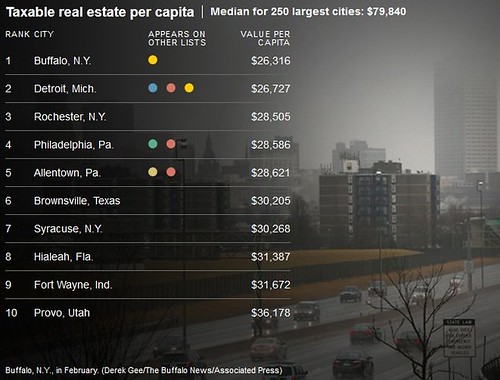
Cities with low property tax capacity.
Ten lowest per capita taxable real estate, out of 250 largest US cities
=======
Toronto.  Note that this is a problem in other countries.  Toronto Star columnist Edward Keenan wrote about that city's budget travails despite being a world city ("What happens to Toronto when things get tough?")  From the article:
Toronto is a fantastically prosperous city: growing faster than almost any other place on the planet, enjoying a period of sustained economic boom, able to brag of being home to “12 key business sectors” (it is the most tax-competitive city in the world according to KPMG) that keep the city “resilient” and its population relatively wealthy.

And for all that, Toronto is a city that expects to shutter 7,500 units of social housing in the near future because it will not spend the money to keep it from falling apart.
Furthermore, after giving signs of agreement, in January, the Provincial Government refused to give Toronto authority to charge tolls on the city's two locally-controlled expressways, instead giving cities more gasoline tax revenues ("No tolls? Tory wants provincial money for DVP, Gardiner," Toronto Globe & Mail).  This was done to placate suburban jurisdictions, whose residents would pay the bulk of tolls were they to be assessed.

But Toronto countered that this will raise less money than tolls, and that unlike locally-controlled tolls, they will not be able to do debt financing against monies handed down and controlled by the Province, thereby reducing the city's ability to finance transit infrastructure.

The UK.  And cities in the UK are totally screwed by the central government's austerity program. There, the national government provides most of the funding for local government, and mandates, and by contrast to property tax collection in North America, local governments don't have similar revenue streams.  Local governments are finding their budgets cut by 50% ("Britain's local councils face financial crisis," Economist).

Medicine Hat.  Interestingly, Medicine Hat, Alberta, which through a fluke of history maintained ownership of the natural gas resources underneath the city, is planning on creating the equivalent of a sovereign wealth fund to better reap the benefits of this revenue stream going forward ("A Canadian City Thrives on Gas, Like a 'Wealthy Little Country'" New York Times).

Over the decades, the city has used the revenues to keep taxes low, and to recruit industry, including providing free or reduced price natural gas.

Now, with industrial decline and a fall in the price of gas and oil, the city needs to be more judicious about the use of this revenue stream.  Hence the proposal to create a wealth fund.

Oklahoma.  The Governor, Mary Fallin, proposes adding a variety of services categories to the sales tax, which would raise almost $800 million for cities and counties, and $900+ million for the state ("Gov. Mary Fallin's tax plan clarifies choices in Oklahoma," Daily Oklahoman). From the article:
The proposal is based, in part, on a desire to overhaul Oklahoma's tax code so it reflects the modern economy. Fallin's budget plan notes that, according to Bureau of Labor statistics, in 1939 service industries employed more people than manufacturing by a ratio of 2-to-1. Today that ratio has grown to around 5-to-1.

This means a sales tax applied primarily to goods reaps far less money than in decades past. Yet the impact of addressing that discrepancy in a single year is jarring to many citizens.
The master list.  Expanding the activities eligible for sales taxes is another item that should be added to what I thought of as the master list in the Flint blog entry.  

Yet another item would be dealing with "payments in lieu of taxes" for properties held by certain nonprofits, such as colleges and universities (past blog entry, "Changing the structure of local government revenue generation," 2013).

Labels: , , , , ,

Saturday, June 11, 2016

A correction (and update) to a March post on municipal finance: addition of land transfer tax to the list

The piece "The real lesson from Flint Michigan is about municipal finance" from March listed seven solutions for better harmonizing tax revenues with the financial needs of local governments and to provide more stable funding for local governments in spite of economic conditions.

1. Local income taxes.
2. Sales tax sharing.
3. Metropolitan tax base sharing.
4. Creating a consolidated "state/local" income tax.
5. State revenue sharing.
6. Multi-jurisdictional special service (tax) districts.
7. Sin taxes for the arts.

The point of the article is that the system for funding local governments in the US was created when most places were growing, and it turns out the methods don't work well when communities aren't growing and/or face financial problems such as loss of local industry.

For example, it's tiresome to read about how Democrats ran Flint into the ground when the reality is that Flint's economy was destroyed by the shrinkage of the manufacturing operations of General Motors--which now has fewer than 1/10 the number of employees in the city than it did at its peak.

With loss of manufacturing plants comes loss of jobs and loss of personal and corporate income, and declining tax revenues from residential and commercial property as economic prospects wither.

That's not about "the Democrats" on the City Council, that's about economic depression at the local and metropolitan scale.

What about the land transfer tax? Royson James' column, Eventually, we'll all have to pay for this," in the Toronto Star about Toronto's coming financial predicament as the city has big demands on its finances and the lowest property taxes in the Toronto region mentions in passing how Toronto's land transfer tax, authorized in the 1990s, has boosted the city's revenues, allowing it to coast somewhat, especially because of the burgeoning residential property market, which generates a lot of revenue from this tax. (Like SF, Toronto also raids the transit agency revenues for monies for other purposes.)

DC is one of many jurisdictions that has this tax, assessing 1.1% of the sale price on both the buyer and seller for properties under $400,000 and 1.45% for properties over $400,000 and for commercial property.  Technically, the tax on the seller is the land transfer tax and the tax on the buyer is a Deed Recordation Fee.  There are variations in the tax when certain ownership conditions change.  The tax is not triggered on mortgage refinancings when the property owners do not change.

-- Real Estate Transfer Taxes assessed in the US, National Council of State Legislatures

Adding the land transfer tax to the list.

1. Local income taxes. (local jurisdiction)
2. Land transfer taxes.  (local jurisdiction)
3. Sales tax sharing. (county)
4. Metropolitan tax base sharing. (metropolitan)
5. Creating a consolidated "state/local" income tax. (state)
6. State revenue sharing. (state)
7. Multi-jurisdictional special service (tax) districts. (metropolitan)
8. Sin taxes for the arts. (metropolitan)

Issues with a land transfer tax. It made me realize that I forgot to include that tax in the list, but at the same time, it's a problematic tax.  Regardless of the situation, real estate interests complain about it as a disincentive.  And in order to be able to assess the tax, while not encouraging people and business to locate elsewhere where such a tax isn't charged, your community has to be highly desirable.

In terms of generating revenues, it's great in a booming economy, revenues crash in a falling economy when new construction declines, and in declining communities, like Flint, Detroit, or small towns, it can be seen as a disincentive to new development, when new development is desired but hard to "pencil out" financially--and were such a tax in place, waiving it as part of a package of incentives means that it isn't all that reliable a source of revenue.

Reordering into a more logical and hierarchical framework.  From a hierarchical standpoint, the list should be reordered, depending on what level of government or government cooperation is required to be able to assess, collect, and distribute the revenues.  Note that all the taxation forms have to be authorized by the state.

Changes have to be made at the local, metropolitan, or state level to effectuate any of these taxing methods.  Also I would argue that land transfer taxes could be assessed at the metropolitan scale and added to the monies shared through metropolitan tax base sharing systems, as discussed in the original post, which could be added to item 4.

1. Local income taxes. (local jurisdiction)
2. Land transfer taxes.  (local jurisdiction)
3. Sales tax sharing. (county)
4. Metropolitan tax base sharing. (metropolitan)
5. Multi-jurisdictional special service (tax) districts. (metropolitan)
6. Sin taxes for the arts. (metropolitan)
7. Creating a consolidated "state/local" income tax. (state)
8. State revenue sharing. (state)

Update: Kansas City-St. Louis earnings tax.  As an example of how state action is required to authorize the ability to tax at the local level, the State of Missouri authorized St. Louis and Kansas City to have earning taxes on residents and nonresidents.  As discussed in the earlier post, this can be a problem in terms of spurring some businesses to relocate out of the city.

In KC, the 1% tax on earnings generates 40% of the city's revenue and half the revenues come from nonresidents working in the city.

But it can be a problem because of outside forces focused on an anti-tax agenda.  In Missouri, St. Louis billionaire businessman Rex Sinquefield ("King Rex" POLITICO) argues that the tax is bad, and has successfully got the Missouri Legislature to pass legislation requiring that the tax be re-authorized every five years, and he helps to fund local campaigns seeking to overturn the tax.

But in the most recent vote in Kansas City last month, the tax was supported by voters overwhelmingly ("Kansas City voters overwhelmingly approve earnings tax renewal," Kansas City Star). After all, why wouldn't residents be supportive of a tax that generates a fair amount of revenue from non-residents?)  In April, the tax was reapproved in St. Louis.

In spite of failures to overturn the tax in local elections, anti-tax interests continue to lobby the Missouri Legislation to de-authorize the local earnings tax.

Labels: , , , , ,

Friday, May 27, 2016

(In many places) Public improvement districts ought to be created as part of transit station development process: the east side of NoMA station as an example

There are all kinds of "special service districts" that collect taxes to fund certain types of programs, from water systems to roads and sidewalks. I've advocated for what I call "Transportation Renewal Districts" or TRDs, as a transit focused version of an "Urban Renewal District."

Along the Yellow Line, TriMet’s joint development program in Portland, OR, helped build the Patton Apartments (above) on land once occupied by the dilapitated Crown Motel. Photo via SERA Architects.

Portland, Oregon sort of does that, although they are still called "Urban Renewal Districts," as the creation of an URD allowed them to sell bonds against the anticipated rise in property tax revenues, as a way to generate funds to pay for the construction of the Yellow Line light rail.

In Texas, they call these districts "Public Improvement Districts," which function as business improvement districts but unlike BIDs in cities like DC, Philadelphia, or New York City, where the focus is on managing and marketing, these districts are used as vehicles to fund significant infrastructure development.  (Similarly, Colorado has an add on sales tax called a public improvement fee, "Public improvement fees as sales tax add-ons") but the revenue streams are much lower than from property tax assessments.)

With the Purple Line, I suggested that Montgomery and Prince George's County should create a TRD covering the catchment area of the entire line, and create a development corporation to facilitate the development of areas around the station, and to fund other physical and placemaking improvements in association with the creation of that transit line, to reap benefits much faster than the more traditional "trickle down" approach that typifies the process.

-- "To build the Purple Line, perhaps Montgomery and Prince George's Counties will have to create a "Transportation Renewal District" and Development Authority," 2015
-- "Purple line planning in suburban Maryland as an opportunity to integrate place and people focused initiatives into delivery of new transit systems," 2014
-- "Quick follow up to the Purple Line piece about creating a Transportation Renewal District and selling bonds to fund equitable development," 2014
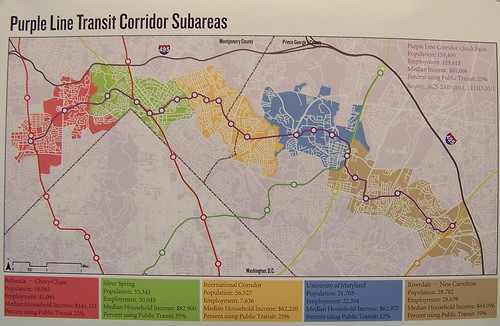
Subareas, Purple Line Transit Corridor, Montgomery and Prince George's Counties, Maryland

As mentioned in the previous piece, a special taxing district was created to raise money to pay for the creation of the NoMA Metrorail station (Project Profile: NoMA-Gallaudet University Metro Station, Innovative Project Delivery, Federal Highway Administration).

But the tax district was created very narrowly, with one purpose, to pay for the building of the Metrorail station. And they figured that improvements should only be paid for by the property owners on the west side of the station, because that's where the development impact was expected to occur.

But they didn't think about other improvements that might be needed in the district overall and how to pay for them. They didn't think about the eastern side of the station and the development impact and the possible need to expand the tax district to fund related needs ("The Development Wave on NoMa's East Side," Washingtonian Magazine).

Baring the failure to create a broader improvement-assessment district, the city doesn't make it easy to modify such districts.  And there is a vision failure too.  No one is talking about the need to modify the assessment district as a way to further extend the benefits of the station.

Photo: Dallas Morning News.

A counter example in Dallas is how PIDs can overlap.  For example the new Klyde Warren Deck Park PID--the park was constructed over the Woodall Rodgers Freeway--overlaps with the Dallas Arts District and Uptown PIDs ("One year after heated dispute, Klyde Warren Park and Arts District officials partner to expand improvement district," DMN).  They share some management.  (Interestingly, an attempt to create a similar district to support the High Line Park in Manhattan did not succeed.)

Besides the parks issue, there are at least two examples of necessary transportation access infrastructure improvements on the eastern side of the NoMA station that are expensive and there is no funding to build them.
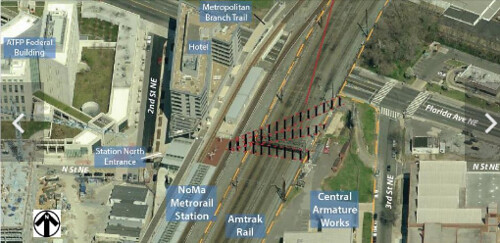
NoMA Metrorail station area


NoMA eastern pedestrian tunnel.  Washington Business Journal reports ("Huge NoMa project replaces 'insular' site with 'true mixed-use'") that the Central Armature Works site will be redeveloped.  It backs up to the tracks on the east side of the station, on 3rd Street NE.  From the article:
According to a planned-unit development application filed Tuesday with the D.C. Zoning Commission, High Street will develop a 200-key hotel, two residential towers totaling 650 units (50 affordable), and 50,000 square feet of retail "on a site that was formerly dedicated to motor and apparatus repairs, installation and distribution." The triangular parcel, 760 feet in length, is currently home to a warehouse and surface parking lot. ... 
The entire first level of the project, covering 96 percent of the lot, will contain a podium up to 22-feet high, according to the filings, a structure necessary to ensure each tower built above it will be exposed to daylight. Without it, the retaining wall between the property and the railroad tracks would block sunlight into the buildings.
The developers are fine with providing access to an eastern entrance--really a pedestrian tunnel, and WMATA has been studying this independently ("A tunnel would improve Metro access for thousands in NoMa, but at what cost?," WBJ).  But the cost is likely about $25 million and there aren't funds to pay for it. From the article:
In December, the Washington Metropolitan Area Transit Authority, the District and consultant AECOM released a 182-page feasibility study for a NoMa pedestrian tunnel, covering everything from alignment and engineering to existing subsurface conditions, tunnel materials and potential cost. ...

The ridership at the NoMa-Gallaudet station has increased much faster than expected. In 2008, a WMATA capacity study predicted average weekday ridership would hit 3,919 boardings by 2030, an 80 percent increase over 25 years. Except that by 2014, ridership had already hit 8,412. And 81 percent of its users walk. ...

From the west side of the tracks, the walk (or bike ride) is relatively straightforward via N or M streets NE or the Metropolitan Branch Trail. From the east side, the hike can be a challenge, as pedestrians and cyclists must navigate heavy vehicular traffic, sidewalk gaps, narrow sidewalks and poorly lit underpasses. ...

The cost, per AECOM, is estimated to be between $16.6 million and $23.7 million, depending on the tunneling method and alignment used. The consultant recommended that the project be advanced to the preliminary engineering stage, “to analyze the complex and detailed engineering required to select a preferred alignment and tunneling method, and develop a biddable and constructible design that will bring this project to reality, improve access to the Metro station and serve as a catalyst for continued area growth.”

Given Metro’s declining ridership, safety crisis and financial doomsday predictions, the transit agency is not expected to invest much if anything in this project. A WMATA spokesman has not answered our questions about whether this is on their radar, and the project is not found in Metro’s capital improvement program.

Instead, if this tunnel is to happen, it will likely be funded via a joint effort of the NoMa Business Improvement District, the D.C. government and the private sector.

The BID, Dix said, is taking the lead on identifying funding sources.

“We anticipate that this will be a public-private partnership similar to the funding of the original station,” he said.
Just expand the assessment district!

Create/Expand PIDs/TRDs for station catchment areas.  A pedestrian tunnel for the east side of the Metro will benefit multiple developments located east of the tracks, not just the Central Armature site, including the Union Market District and Gallaudet University.  It makes the whole area more accessible, which will be incredibly beneficial to DC, regardless of the support of continued ridership increases at that station.

Irrespective of WMATA's current troubles, while I argue in "Transit stations as an element of civic architecture/commerce as an engine of urbanism" and related pieces cited within that transit agencies need to address the place characteristics of stations as neighborhood gateways, the cost for doing shouldn't be seen as solely the responsibility of the transit agency.

Localities need to step up and provide additional funds to put in the kinds of place value enhancements that provide economic and placemaking returns.

PIDs/TRDs should be created as a matter of course to accomplish this, not just for the NoMA station but for most station catchment areas, depending on the access needs, development capacity, and the ability to generate new property tax revenues.

(Also see the example of Allentown, Pennsylvania in the past blog entry, "State-level initiatives to support center city revitalization in smaller towns."  It's not a TRD but the funding process is comparable.)

Access to the New York Avenue and Florida Avenue bridges from the Metropolitan Branch Trail. The MBT is a bike and walking path connecting Union Station to Silver Spring in Montgomery County, parallel to the rail line.

While the trail was conceived primarily as a long distance bikeway between Silver Spring and Union Station, in the area south of Rhode Island Avenue, it is also becoming a "protected" way for residents--mostly on foot--to cross New York and Florida Avenues to get to NoMA, Union Station, and even Downtown.

Separately, the NoMA Business Improvement District commissioned a study, Metropolitan Branch Trail Safety & Access Study, to study opportunities for improvement.

One of the proposals is for a bridge over the railyard to connect to the Union Market district ("A bridge from Eckington to Union Market? It could happen," GGW).

In my opinion that is a difficult project to pull off, not particularly attractive, and expensive.

Other proposals aim to address the significant grade and height difference between the trail and surface connections to New York Avenue and Florida Avenue.

The Washington Gateway development takes up the odd triangle between the MBT and the two avenues.

Part of it is developed and they have a stairway connection to New York Avenue to the rear, while the project fronts Florida Avenue at grade.

Additionally, they have an entrance to the MBT on the portion of the property that is not yet developed, and they plan to maintain access to the trail when the new buildings are constructed.

Public escalator in Commune 13, Medellín. AP photo by Luis Benavides.

Vertical transportation infrastructure as an alternative and an element of a city's mobility system.  In cities like New York, vertical transportation infrastructure--elevators and escalators--is essential to mobility in tall buildings.  It's discussed in the late 1960s study from RPA (Urban Design Manhattan) as a key element of the mobility system, which they defined as below ground, at ground, at the mezzanine level, and up and down within buildings.

Monaco has public elevators and escalators to provide an easier way to get up the steep hills on which the city is built, up from the waterfront ("Vertical infrastructure in Monaco, Pop Up City).

Hong Kong also has a similar system of public escalators, to provide better access up steep hills.

More recently, as a way to improve access in economically disadvantaged communities located on steep hillsides, Medellín has created a system of public escalators ("Medellín, Colombia offers an unlikely model for urban renaissance," Toronto Star) which were constructed in hilly areas to provide access and connection to areas of the city that because of topography took hours to travel to and from the main city.

In this particular case I recommend that public access elevators--elevators are preferred over stairs for ADA reasons--be installed within the final phase of the Washington Gateway project to provide access to the New York Avenue and Florida Avenue bridges.

These wouldn't be WMATA projects, but DC Department of Transportation projects.  And they should be funded by an expanded PID/TRD.

Somehow there would have to be a public-private partnership to do this, and regular maintenance provided (probably contracted out by DDOT to the BID or the building).

Cool design as an important feature.  From the standpoint of "vertical transportation infrastructure" that is an element of the public mobility system and an element of civic architecture, were such elevators to be constructed, aesthetically forward designs would be ideal.

The closest we have to public elevators are the elevators in the WMATA system.  While most of the elevators in the legacy system can be somewhat dismal, it happens that the elevators in the NoMA station are pretty nice (but slow).

Aesthetically forward elevators could make a big difference in defining the value of this particular type of infrastructure as part of the public mobility network.

Underground and aboveground walkway systems as comparable examples.  Other relevant examples of creating atypical pedestrian mobility networks and infrastructure include the underground passageway systems in Chicago and Toronto ("Hong Kong needs to create a formal and planned pedestrian mobility system," "Toronto's PATH wanderers need direction," Toronto Star) and the above-ground skyway systems in St. Paul and Minneapolis, Minnesota.

What's important is planning for an integrated mobility system.  In cities where topography is an issue, aerial trams, escalators, inclines, walkways, stairs, and elevators can be key elements of a complete mobility system focused on facilitating movement in what we might call the Walking-Transit City, using the sustainable mobility platform concept as the primary organizing principle.

Labels: , , , , , ,