Rebuilding Place in the Urban Space

"A community’s physical form, rather than its land uses, is its most intrinsic and enduring characteristic." [Katz, EPA] This blog focuses on place and placemaking and all that makes it work--historic preservation, urban design, transportation, asset-based community development, arts & cultural development, commercial district revitalization, tourism & destination development, and quality of life advocacy--along with doses of civic engagement and good governance watchdogging.

Thursday, October 06, 2022

Municipal finances face a shaky future

The entry, "The real lesson from Flint Michigan is about municipal finance" (2016) makes the point that in the US, financing systems for local government were created when the nation experienced rapid growth, and for the most part they've never been addressed in a substantive way since many cities have moved to a position of either equilibrium or shrinkage.

The problem with equilibrium or shrinkage is that personnel is the biggest cost for cities, and wages go up not down, not to mention the issue with retirees and pensions--typically local governments may stint on wages but in return offer great pensions often with health care, but these are underfunded creating significant financial overhang.

Center cities rely in large part on commercial property taxes, and the ancillary revenues that come in association with officer workers.

But the work from home phenomenon that has been driven by the pandemic is going to crash the value of commercial property, both in terms of office space and retail--which is worth a lot less when there are fewer customers ("Hold on tight: How NYC and state must prepare for the possible implosion of commercial real-estate values," New York Daily News).

The Philadelphia Inquirer has an article about this, "City finances, including Philadelphia’s, could go bad fast in this economy, bond expert says."  From the article:

Here are Kozlik’s observations on threats to city finance, many of which fell on his audience like a door slamming shut:

Scared borrowers. As recently as last spring, Kozlik and other analysts were predicting municipalities would borrow a record $500 billion this year by selling bonds to pension funds and other investors. But as interest rates have spiked, cities have been delaying commitments to long-term funding, and bond sales are unlikely to reach $400 billion, this year, or next, either. That translates into fewer jobs and business contracts, and a slower economy.

Rising interest rates. Pension funding, which has cost Philadelphia more than law enforcement in recent years, is no longer Wall Street’s main worry about local governments. Even though public pensions have been drained by the financial markets’ fall and many are badly underfunded, a recent survey shows analysts are even more concerned about rising interest rates and prices, the shrinking U.S. labor force, and divisive politics that prevents decisive policy, as causes for concern that cities will go broke.

Empty offices. Workers aren’t returning to office centers, including Philadelphia’s Center City. Nationally, restaurants, air travel, and apartment rentals have recovered, post-pandemic, but only half of workers have returned to office locations; in Philadelphia and San Francisco, it’s more like 40%.

Lower revenue. With offices shutting, property valuations and taxes are heading down, too.

Crime. Polls show Americans are more worried about crime, and less confident police will protect them.

Construction challenges. Labor and material shortages and cost increases have crimped construction to the point where, even if the federal government resumes billions in funding to cities, city managers have told Kozlik they would have a hard time spending it on projects in the near future.

Politics. Politicization of public policy, which has stalled Congress on immigration and other key issues since the 1980s, has been spreading among state and local governments. States like Texas are banning East Coast investment banks that have adopted anti-oil and anti-gun policies; in California, activists are pressing to punish banks that finance fossil fuels and weapons makers. What that means, in practical terms, is fewer banks available to sell public debt in those restrictive states, and, therefore, higher borrowing costs for taxpayers.

“The speed and magnitude of change, and the number of variables that are evolving is not being recognized by most people,” Kozlik said later in summary. “Most people across various industries are reacting to one or two changes in the landscape. Very few recognize the major transformation going on across the board with labor, technology, education, demographics, and politics.”

Communities growing have less at risk.  But rising prices and interest rates will press budgets, especially for capital planning.  

Constant pressure to reduce taxes is another risk.  But the other risk not mentioned is the constant pressure to reduce taxes.  For example, in Utah, the State Legislature does this every year "to share the benefits of growth."  But when you're growing you need to spend more money, not less, on infrastructure and other programs.  

Cities and counties face real pressure to provide the kinds of programs and facilities people want, as costs and demands rise.  

As conditions become more turbulent, cutting taxes increases risk.

The New York Daily News editorial suggests the following actions, to be proactive, in the face of declines in commercial property tax revenue:

  • rethinking zoning. There’s no good reason that in a modern city, buildings are so rigidly categorized into classes, with minimal flexibility between light industrial, commercial, residential, medical and other. A nimbler New York would end unnecessary distinctions to let people find the best uses for space with minimal regulatory hurdles.
  • budgeting smartly. Profligate spending that piles ever more recurring spending into the city’s $101 billion-and-growing fiscal plan risks throwing New York off a cliff if and when property receipts revenue plunges (personal income and related tax revenue is already expected to fall sharply this year). 
  • Building up reserves and responsibly dialing back bureaucracy are the wisest insurance policies against sudden downward shifts — especially if those coincide with a recession.
  • rethinking property tax collections, which have become unfair and incomprehensible over generations. Not only must New York rationalize levies on rentals, condos, coops and single-family homes; it must accept that golden-goose employers whose taxes have defrayed those from residences might not lay eggs forever.
  • more sensitively implementing statutes that inflict huge costs on commercial real estate, like the law that will soon start punishing noncompliant buildings with big fines. That’s likely to accelerate a commercial exodus.

Labels: , , , , , ,

Tuesday, April 14, 2020

Local (and state) governments face massive budget shortfalls as a result of the Covd-19 Depression

Local governments--cities and counties--rely on two major sources of revenue, property taxes and sales taxes. See the 2016 blog entry, "The real lesson from Flint Michigan is about municipal finance."

The basic problem is that the system of finance for local governments was created during a period of rapid growth in the United States. It doesn't work well when growth stops, businesses close, etc.

These problems are only accentuated by the drumbeat of tax reductions, and limits on how much communities and states can build "rainy day funds" to be drawn on in times of crisis and penury.

Local governments are required to run balanced budgets. With most retail and hospitality outlets closed as a result of public health orders aimed at "flattening the curve" of the coronavirus, local tax revenues are down severely and are likely to be for much of the rest of the year.

This is already leading to furloughs and RIFs in some communities (e.g., "Coronavirus leads to staff reduction in one of Utah's biggest cities," Salt Lake Tribune).

The Washington Post ("More than 2,100 U.S. cities brace for budget shortfalls due to coronavirus, survey finds, with many planning cuts and layoffs") and Wall Street Journal ("Coronavirus Hits State and City Budgets" and "Smaller Cities Cry Foul on Coronavirus Aid") have articles on the issue.

State governments have the same issue.  Requirements for balanced budgets and revenue reductions and many states are already addressing the likely budget shortfalls ("Coronavirus deals one-two financial punch to state budgets," Associated Press; "Northam freezes new spending in the state budget amid coronavirus pandemic," Washington Post)

The Federal coronavirus stimulus bill has some provisions for providing aid to local and state governments, but the demand for help will probably be much greater than the amount allocated.

Labels: , , , , ,

Tuesday, February 18, 2020

Two interesting examples of supermarket firms bucking traditional political forces

1.  In Texas, the supermarket chain HEB (ranked #1 in the country by some evaluators) challenged an electricity rate increase petition by the state's major utility, because they said it was undeserved given the level of frequent power outages.

Because it is a respected firm and "not some wooly-eyed anti-business advocacy group" they were taken seriously and the rate increase was mostly denied, in turn providing benefits to Texas residents independent of the firm ("How H-E-B helped reduce CenterPoint’s request for electricity price hike," Houston Chronicle).  At the end, the rate increase allowed was less than 10% of what the CenterPoint utility originally asked for.

But the reality is that HEB didn't buck the system that much. It is typical for "industrial" users of electricity to challenge utility rate schemes.  At the end of the day, HEB was just another utility customer challenging rates.

2. What Harmon's Supermarkets, a 19 store independent grocery chain in Greater Salt Lake City that manages to hold its own against one of Kroger Company's strongest divisions, did in December and January was a much greater challenge to good old boy politics.

Gay Pride flag flying at Salt Lake City Hall, 2013I was shocked one year to see the Gay Pride flag flying at the City Hall in Salt Lake. While many cities have solid bona fides when it comes to LGBTQ issues, I've never seen the flag flying in front of city facilities, which is a very direct communication.

While Salt Lake City is an increasingly progressive city--even in otherwise conservative states, metropolitan areas tend to vote Democratic--Utah is a very conservative state politically.

The Republican Party has a super majority in the Legislature, Legislators are mostly white men, and 90% of the Legislature members practice the Mormon religion.

Last year, after a special session that wasn't particularly deliberative, the State Legislature passed a tax reduction plan that (1) reduced income taxes, which by law are the sole source of school funding; (2) increased sales taxes on food without overhauling the sales tax revenue stream, which funds other government operations; (3) said that by changing the tax structure of school funding it would force school districts and cities to work together to increase local property taxes to fund schools, with no guarantee that school funding would be maintained.

Utah has certain referendum laws that in some cases, allow for petition campaigns to challenge actions by the Legislature, although petitioners are only provided a very short time, maybe 45 days maximum, and there are complicated requirements for a certain number of signatures from a majority of counties, tabulated by county, etc.

Rarely do such referenda work, and the pundits all said the referendum effort would fail.

Petition table inside a Harmon's Supermarket. Photo:  Ben Winslow, Fox13 SLC.

Then Harmon's Chairman, Bob Harmon, stepped in out of belief that an increased sales tax on groceries would be hardship to its customers and Utahns generally, and in early January let the petition campaign set up tables in each of their stores to gather signatures ("Harmons grocery stores join tax referendum effort," Salt Lake Tribune).  From the article:
“Food is essential and should be affordable,” Bob Harmon, the company’s chairman, said in a prepared statement. “Increasing the tax on food hurts everyone, but especially those in our community who are already struggling.”
In turn, this led their supplier, Associated Food Stores, a grocery business cooperative operating in the Intermountain States, to do the same at their corporately owned stores, and many of the independent store groups supplied by the chain ended up providing similar support.

Harmon's was roundly criticized by elected officials, including the Governor.   From the article:
The Governor’s Office issued a statement saying it was “disappointed in Harmon’s actions.… As a corporate citizen in the state, they have a right to engage in the political process, but they also have the responsibility to do so in a way that elevates the public’s discourse and is based on facts and not emotion."

Herbert’s Office then went on to suggest that Harmons’ opposition, like that of other tax reform critics, was based on lack of understanding.

“Harmon’s has not contacted the governor to express their concerns. If they took the time to meet with the governor and/or legislative leadership, they would understand both the need for tax reform, and the viability of the policy enacted by the Legislature and signed into law by the governor,” the statement said.
But by the end of the month, the petition campaign secured enough signatures ("Tax referendum signature validation rate at 94%, stunning elections officials," Fox13) and in only 3 of Utah's 29 counties were not enough signatures collected to meet statutory requirements ("After Success Of Tax Referendum, Summit and Wasatch Counties Still Lag Behind In Signatures," KCPW/NPR).

Rather than go through the process of a public vote on the referendum, the Governor and the Legislature caved, and repealed the changes ("Utah Legislature repeals tax reform in pair of overwhelming votes," SLT).

Elected officials continue to criticize opponents of the measure, while failing to acknowledge that the process was poorly handled and executed, and the measure incompletely addressed the structural problems within the current tax system.

Conclusion.  Arguably, both firms made "business decisions" not moral-ethical decisions, to take the position that they did on these issues.  But still, both companies deserve recognition for standing up in the face of what they considered to be negative actions by other actors, for acts that would not only affect their businesses, but their customers as well.

But at least for Harmon's, they took heat for not going along, not being a good "corporate citizen" at least according to the definition of the state's leading elected officials.


As it happens, both companies are market leaders in the supermarket profession.  One interesting thing about this though is that both companies are leaders in their respective markets.

Selling AuthenticityIn the very competitive Texas market, HEB is #1 for grocery sales and they are quite innovative ("Why are HEB flour tortillas so dang good?," Bon Appetit) with a supercenter offering, Central Market, an upscale offering, great branding, a focus on selling local products, etc. ("HEB: The Smartest Supermarket You've Just Heard Of," Forbes Magazine).

Harmon's has differentiated the company by shifting away from competing on price and instead offering quality, an emphasis on local products, great branding, differentiated store sizing, offering a wide array of prepared foods, an impressive loyalty program (the rewards are based on how much you buy, not so much focused on providing discounts on purchases), Cooking schools in many of their stores, and supermarket dietitians covering all of their stores and offering programming (see the entry for Harmon's in "Wonder Filled," Progressive Grocer).

There is no real equivalent of Harmon's in the DC area.  And none of the major supermarket chains in the DC area operates with the agility and innovativeness of HEB.

Labels: , , , , ,

Wednesday, March 20, 2019

One big lesson from the failure of the Gwinnett County MARTA Referendum

Justin Hart, an opponent of Gwinnett's MARTA contract, holds a 'Vote No' sign as cars drive past the polling precinct at the Collins Hill library branch Tuesday. (Gwinnett Daily Post Staff Photo: Curt Yeomans)

It seems as if the no votes have it, about 55% no and 45% yes.  Not terrible for the pro-transit forces but a defeat just the same.

When you have funding referenda in "off-elections," that is, outside of the more typical primary and general election cycle associated with elections for state and federal offices, the electorate tends to be more conservative and is more likely to vote against tax increases.

-- "Gwinnett MARTA referendum has failed," Atlanta Journal-Constitution

So (1) getting the election cycle right and (2) having enough time to build support are the two key factors, especially in regions where the automobility paradigm is so dominant.

Cars drive past a 'Vote Yes' sign put up by pro-MARTA group Go Gwinnett on West Pike Street in Lawrenceville on Tuesday. (Staff Photo: Curt Yeomans). "Gwinnett back at square one after MARTA rejected in key vote," Gwinnett Daily Post.

For whatever reason the decision was made to not have the election last fall in the general election cycle.

Rather than have a special election, they should have waited two years for the next general election cycle.

Labels: , , , , ,

Tuesday, March 19, 2019

Today there is a transit referendum in Gwinnett County (Greater Atlanta)

When the compact was developed for the MARTA heavy rail transit system in Greater Atlanta, most suburban counties, including Gwinnett, opted out.  So the rail and bus system mostly serves Fulton and DeKalb Counties, except that in 2014 Clayton County voted to join.

While Clayton County didn't have much of a transit system or service before joining MARTA, Gwinnett Couny has developed its own transit system in the interim, although there is no rail service and limited connections to other counties.

At the time of the vote in 1971, it was pretty typical for suburbs to be against regional transit out of fear of the other, especially center cities and what were perceived as predominately African-American populations.

Frankly, this is still a problem, such as in Suburban Detroit, where elected officials in Macomb and Oakland Counties haven't favored taxes for regional transit ("Hackel on regional transit efforts: Macomb voters "don't want this thing'," Michigan Public Radio)..

Chris Hahn, who confronted an intruder in his home near the Cromwell rail stop. Photograph: JM Giordano for the Guardian.

And even in Anne Arundel County outside of Baltimore, some residents are still agitating for closure of light rail stations which they see associated with crime derived from Baltimore ("Addicts, crooks, thieves’: the campaign to kill Baltimore's light rail," Guardian).

To their credit, local and state officials haven't been supportive. From the article:
The Hahns had moved to the working/middle-class suburb seeking a quiet, safe environment away from the crime and strife of Baltimore, 10 miles away. But, like many in the neighbourhood, they say the city’s woes have seeped into the area via public transport. Specifically, they believe criminals are coming into the suburbs by light rail.

Data does not bear that out, but that hasn’t stopped some residents from campaigning for the service, which started 25 years ago, to be reduced. The Hahns have just returned from a protest demanding the closure of a light rail stop around the corner from their home – a stop activists have linked to an increase in crime in the area.
(When I worked in Baltimore County, that's when I first heard the term "Loot Rail," where it was said that people from Baltimore would take the light rail to Lutherville to steal from the big box stores near by.)

Transit funding in Georgia has been problematic.  The state has a disproportionate role, and state-initiated votes in the past were put forward on too accelerated of a time frame to be able to succeed ("Failure of the transit-roads sales tax measure in Metro Atlanta") as was the case in 2012

Now, counties have the ability to set votes on a longer time frame.  And over the last two directors of the MARTA system, elected officials have become more comfortable with transit, recognized that transit is important in attracting business ("Atlanta hopes transit expansion could be edge in Amazon HQ2 hunt," Atlanta Journal-Constitution)) and have had their fears assuaged that the "monies will be wasted."

GoGwinnett is a pro-transit advocacy initiative.

The Atlanta Journal-Constitution has been running a series of articles on the Gwinnett vote for the past few months.  The depth of coverage reiterates the value of local media.

-- Gwinnett MARTA referendum coverage, AJC
-- Pro and con coverage, Gwinnett Forum

By late tonight, we'll know what happens.

===========

From "Here’s a voice against Gwinnett ever joining up with MARTA," Gwinnett Forum:
The first vote I ever cast was against MARTA. And the last rapid transit vote I cast in 1990 was against MARTA. And the next vote I cast will go against MARTA.

Friends ask, “Why would we want to be like DeKalb and Fulton?” I say we already are, but what they’re really saying is, “We don’t want to be like Atlanta.” How do I know? Well, the second letter in MARTA stands for “Atlanta.” And the last time I looked at a map of Gwinnett, nowhere did I find a city called by that name.

Gwinnett has long resisted any merger, association, or jurisdiction with the big city to our south. Why are we starting now? Our commissioners know MARTA won’t solve our traffic problems. Has it solved DeKalb’s? Or Fulton’s? The answer is no.

Consider this: Gwinnett County has a population of nearly a million strong. Why aren’t we dictating to Atlanta what we want instead of it dictating to us what it thinks we need?

Given the virulence of the automobility lobby, oil and car manufacturing interests and the Sprawl Lobby, it's probably more amazing than we realize when transit referenda do pass.

Labels: , , , , ,

Monday, August 28, 2017

Funding WMATA by a regional sales tax

I haven't been writing about WMATA, the DC area subway and regional bus system, and its financial issues because it's been overwhelming. 

The steady drumbeat of bad news about the Metrorail system has overwhelmed my capacity to write about it.  There are just so many countervailing and conflicting issues that it makes it difficult to write the kind of supra-authoritative pieces that I tend towards.

Fortunately, even though the situation is complicated, I can fall back on a large body of work on the topic that I have produced over the years, including these broad themes:

1.  Needing to rebuild a regional consensus about what transit means, its importance, and how to go about achieving it

• St. Louis regional transit planning process as a model for what needs to be done in the DC Metropolitan region, 2009
• TriMet (Portland): CHALLENGES & CHOICES A Budget Discussion Guide, 2012
• WMATA 40th anniversary in 2016 as an opportunity for assessment, 2014

2.  The failure of the area's Metropolitan Planning Organization, tasked by the federal government to do and coordinate transportation planning to execute that role to its logical extent, so that by default WMATA ends up being the primary metropolitan transit planner by default

• Metropolitan Mass Transit Planning: Towards a Hierarchical and Conceptual Framework, 2010
• Without the right transportation planning framework, metropolitan areas are screwed, and that includes the DC area, 2011
• Route 7 BRT proposal communicates the reality that the DC area doesn't adequately conduct transportation planning at the metropolitan-scale, 2016

3. Various pieces about WMATA's current conditions in operation, financing and governance shaping today's crises

• Defining service standards down as an indicator of breakdown in metropolitan transit planning, 2012
• Getting WMATA out of crisis: a continuation of a multi-year problem that keeps getting worse, not better, 2015
• What it will take to get WMATA out of crisis, 2015
• What it will take to get WMATA out of crisis continued and 2016's 40th anniversary of WMATA as an opportunity to rebuild, 2015
• WMATA and two types of public relations programs, 2015

4.  Related to point #2, it is possible to redesign the metropolitan and regional transit system in ways that achieve more and better service, but I am not holding my breath:

• Will buses ever be cool? Boston versus the Raleigh-Durham's GoTransit Model, 2017
• One big idea: Getting MARC and Metrorail to integrate fares, stations, and marketing systems, using London Overground as an example, 2015
• The answer is: Create a single multi-state/regional multi-modal transit planning, management, and operations authority association, 2017

Competing recommendations.  There have been a variety of competing recommendations for its management and funding ("Metro GM proposes 'new business model' and $500 million a year in extra funding to save D.C.-area transit agency," Post), Virginia has organized a review led by former Secretary of Transportation Ray LaHood, and now there are proposals to enact a regional sales tax ("Regional Officials Call For Sales Tax To Fund Metro," WAMU/NPR).

For me, the various proposals and reports illustrate once again the reality that our region doesn't do true "regional transportation planning."

Ideally, the organization tasked with transportation planning responsibilities for the DC region, the National Capital Region Transportation Planning Board, would have led an impartial effort to figure things out.  What the problems are, what potential solutions could be, what the options are.

THAT hasn't happened.  At least not the way that I would do it.

The MWCOG did do a study, which recommended a sales tax, but the report ("COG analysis of Metrofinds more than $7 billion shortfall in capital and maintenance funding, presents options to close the gap," MWCOG press release) did not lay out all the possible options in the way that the Metrolinx report does.

The result is suboptimal outcomes.

Although in fairness to the Council of Governments, the fact that the system is in crisis now--the report outlines major funding gaps and argues that an additional revenue stream provided by dedicated funding is necessary by 2019--precludes a judicious consideration of the issues, and lining up support for the best funding program, which in the best of circumstances, takes years.

Crises are a bad time for innovation and measured thought.  While Rahm Emanuel has a famous quote about not letting crises go to waste, my sense is that crises are terrible times for innovation, because people are too confused and desperate to consider and reason clearly.
"You never let a serious crisis go to waste. And what I mean by that it's an opportunity to do things you think you could not do before." -- Rahm Emanuel
The debacle with WMATA--managing it, funding it, operating it--is proof that most places aren't capable of rising to the occasion of a crisis.   Furthermore, even in the best of times, it takes jurisdictions a long time to create the necessary consensus to support big projects, big funding initiatives, etc., especially in a region that does do big projects, but in a one-off rather than a coordinated fashion.

Report for Metrolinx lists 25 options.  I'm fond of a report done for Greater Toronto's Metrolinx, which listed 25 different funding options.  By including the full list, I don't mean to suggest that we need to enact every one of those taxes, I just like being able to see a complete list.

Personally, I think the best option would be to do a transit withholding tax--something that is done in parts of Oregon, in the area served by MTA (railroads and transit in New York City) in New York State--which was pioneered by the French with what they call the versement transport.

In France, governments are not exempt from the versement transport.  In Oregon and New York, governments are mostly exempt, in particular the federal government.  For this to work in the DC area, the Federal Government would have to agree both to allow their employees to be taxed and to pay the tax. In the current political environment, this will never happen.  Therefore, while ideal, it's not practical.

The WMATA sales tax proposal.  The sales tax proposal is controversial because:

(1) some jurisdictions don't want to participate

(2) certain advocacy groups argue that a sales tax is paid disproportionately by the less well off, who are more dependent on transit, but don't ride the subway as much and so they don't support a sales tax surcharge for transit ("Ahead of regional summit, left-leaning policy groups say 'No' to a sales tax for Metro," Post; Triple Whammy: A Regional Sales Tax for Metro, Like Fare Hikes and Service Cuts, Would Fall Hardest on Struggling Families, joint report by the DC Fiscal Policy Institute, Maryland Center on Economic Policy, and The Commonwealth Institute)

(3) DC Council Chairman Phil Mendelson argues that the funding formula for WMATA should be revised because DC pays disproportionately in terms of population ("New dispute over cost of fixing Metro pits District against Virginia, Maryland," Post)

(4) but the Washington Post disagrees with Mendelson ("The District’s death wish for Metro"), accusing the city of threatening Metro's success by complicating approvals for a dedicated funding stream.

Meanwhile, I lament that a reasoned approach to analyzing the options and making recommendations wasn't taken.

For example, counter to the Post's assertion, it is reasonable to make the regional funding system for WMATA to be "more equal," because DC pays more than it should based on the fact that many of the daily users are commuters and their income tax revenue goes to Maryland and Virginia.

Originally, too I was somewhat concerned about "a sales tax for WMATA" because I think it should be a "sales tax for transit," with the funding stream opened up to other transit investments.  That bothers me still, but a little less, because a recent Caltrain sales tax initiative--which would be assessed in addition to sales taxes that fund the Bay Area Rapid Transit (BART) system--is moving forward ("Poll: Caltrain sales tax hike draws huge voter support," San Jose Mercury News).

But since the desire for funding has been driven by crisis--the need to get WMATA to a place where they can do large scale debt financing--a reasoned consideration of the options hasn't occurred.

My recommendation: a combination of sales and property taxes.  Personally, I think a combination of sales taxes and a graduated property tax surcharge is in order.  By graduated tax, I'd argue that properties within the defined "transit shed" of the Metrorail system should pay at a rate reflecting the proximity to the network.  Closer in properties should pay more than those farther out.

(Note that we must recognize that when the economy undergoes recession these funding streams aren't impregnable--they drop too as many transit agencies relying on such tax streams were driven to the brink of disaster during the Great Recession.)

Tennessee does what Washington should have done: creates a transit funding calculator.  Nashville doesn't have rail transit, and they are considering it, along with other boosts to transit including bus rapid transit.  As part of the process of consideration of transit expansion and how to fund it, the Nashville Tennessean reports ("How much could different taxes generate for transit in Nashville region? There's now a calculator"):
... there's now an easy way to calculate the transit funding potential of four tax possibilities: increasing to sale tax, property tax, hotel/motel tax and wheel tax.

On behalf of the Nashville Area Chamber of Commerce, William Fox, professor of business and economic and the University of Tennessee, has created new revenue forecast models, Nashville Transit Revenue Forecast Model, that projects funding capacity over time for each of these taxes.

"We've developed the capacity for you to develop and create your own revenue estimates," Fox said at a Wednesday meeting hosted by the chamber to roll out its Moving Forward transit group's latest report. "It is so easy to use. Anybody can run this model easily and quickly." ...

There are different models for 10 counties including Davidson based on historic patterns and growth forecasts. It allows anyone to go online and see the potential of raising one of the four taxes by a certain percentage. The tool also allows one to see the impact of raising a combination of the four taxes.
The advantage that Tennessee has though is that they are at the start of their process.  Similarly, the BART system is funded in part by a sales tax assessed in participating jurisdictions. Same with Greater Atlanta, some counties opted out of participating in MARTA, which they mostly now regret.  Creating a dedicated funding system for WMATA should have been done at the start of the project, not 40+ years in after the system opened, and 50+ years if you start counting the planning, design, engineering, and construction period before the system opened.

26 ways to tax to fund transit
(Based on the report, Big Move Implementation Economics: Revenue Tool Profiles, produced for Metrolinx Toronto by AECOM and KPMG)

• Auto Insurance Tax
• Car Rental Fee
• Carbon Tax
• Cordon/Congestion Charge
• Corporate Income Tax
• Development Charges/Impact Fees
• Driver’s License Tax
• Employer Payroll Tax (Versement Transport)
• Fare Increases
• Fare Surcharges (There is a fare surcharge to use the SFO Airport via the BART system; "BART cuts surcharge for SFO workers," San Francisco Chronicle; Boston's Logan Airport is considering surcharges for passenger drop off and pickup to encourage use of transit, "Dropping off a friend at Logan? It could cost you," Boston Globe)
• Fuel Tax
• High Occupancy Tolls
• Highway Tolls
• Hotel & Accommodation Levy (Hawaii is about to approve this type of tax to help fund the commuter rail system in Honolulu, "After reaching deal, lawmakers to meet for special session on Honolulu rail funding," Hawaii News Now)
• Income Tax
• Land Transfer Tax
• Land Value Capture
• New Vehicle Sales Tax
• Parking Sales Tax
• Parking Space Levy
• Property Tax
• Sales Tax
• Tax Increment Financing (Special Assessment Districts)
• Utility Levy
• Vehicles Kilometers/Miles Travelled Fee
• Vehicle Registration Surcharges (this is allowed in Washington State, through what is called a Transportation Benefits District, and in the Puget Sound, a Regional Transit Authority fee for Sound Transit)

Labels: , , , , ,

Friday, February 17, 2017

A brief comment on local government finance: Fairfax County, Virginia

In "The real lesson from Flint Michigan is about municipal finance," and other writings, I make the point that the system in the US for financing local governments was created during the time when the country was growing furiously, and since it was based on property taxes, local governments could rely on growing revenues.

Being dependent on property taxes is increasing risky.

Now, being reliant on property taxes puts many governments at financial risk, even if they are still successful and growing, because legacy programs cost more to maintain over time, and new programs cost more money, etc.

Earlier this week, the Washington Post had a story ("Fairfax, Va.’s largest county, again trims budget requests as revenues stay tepid") about financial issues in Fairfax County, Virginia. 

Fairfax County is economically successful, with more than one million residents.

According to the World Atlas ("Richest Counties In The United States") Fairfax is the second wealthiest counties nationally when rated by median household income (interestingly, Loudoun County is first, Howard County in Maryland is third, and Arlington County in Virginia is fifth).

But Fairfax's checkbook is not unlimited. From the article:
Long’s proposed $4.1 billion budget reflects a local economy still feeling the effects of the 2008 recession and 2013 federal sequestration cuts and a county bracing for the possibility of further reductions in government spending by the Trump administration.

County revenue — generated mostly by real estate taxes — increased by $88.2 million last year, not enough to cover rising pension costs, a growing public school student population and more elderly and low-income residents seeking government aid in a county of 1.1 million residents.

“Slow economic growth is, I think, here to stay,” Long told the county’s Board of Supervisors during a bleak presentation that also fell $13 million short of what agencies requested for disability services, public safety, maintenance of county trails and raises for nonschool county employees. ...

Long’s budget also leaves about $21.7 million in planned police department improvements unfunded, including $5.3 million for a “Diversion First” program that steers people with mental illnesses to counseling instead of jail.

It does not cover about $6.7 million in services for people with disabilities, and defers maintenance of county sidewalks and trails.
According to the article, property taxes make up 65% of the county's revenue stream. Even though parts of the county are booming, primarily those areas served by transit, other parts are not, and commercial property values are dropping in those areas that are more automobile-dependent.

When the nation's second richest county has problems financing local government, there is no question that the system of local government finance that we have created isn't working for today's conditions.

The article on Flint covers other potential revenue streams, including income taxes.

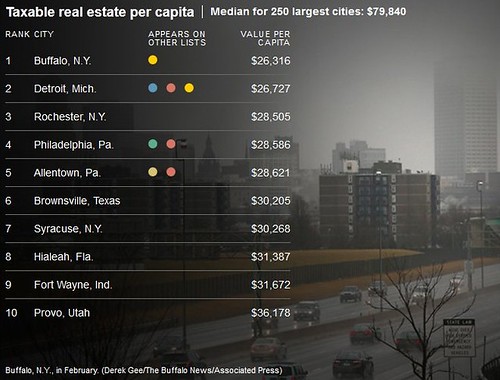
Cities with low property tax capacity.
Ten lowest per capita taxable real estate, out of 250 largest US cities
=======
Toronto.  Note that this is a problem in other countries.  Toronto Star columnist Edward Keenan wrote about that city's budget travails despite being a world city ("What happens to Toronto when things get tough?")  From the article:
Toronto is a fantastically prosperous city: growing faster than almost any other place on the planet, enjoying a period of sustained economic boom, able to brag of being home to “12 key business sectors” (it is the most tax-competitive city in the world according to KPMG) that keep the city “resilient” and its population relatively wealthy.

And for all that, Toronto is a city that expects to shutter 7,500 units of social housing in the near future because it will not spend the money to keep it from falling apart.
Furthermore, after giving signs of agreement, in January, the Provincial Government refused to give Toronto authority to charge tolls on the city's two locally-controlled expressways, instead giving cities more gasoline tax revenues ("No tolls? Tory wants provincial money for DVP, Gardiner," Toronto Globe & Mail).  This was done to placate suburban jurisdictions, whose residents would pay the bulk of tolls were they to be assessed.

But Toronto countered that this will raise less money than tolls, and that unlike locally-controlled tolls, they will not be able to do debt financing against monies handed down and controlled by the Province, thereby reducing the city's ability to finance transit infrastructure.

The UK.  And cities in the UK are totally screwed by the central government's austerity program. There, the national government provides most of the funding for local government, and mandates, and by contrast to property tax collection in North America, local governments don't have similar revenue streams.  Local governments are finding their budgets cut by 50% ("Britain's local councils face financial crisis," Economist).

Medicine Hat.  Interestingly, Medicine Hat, Alberta, which through a fluke of history maintained ownership of the natural gas resources underneath the city, is planning on creating the equivalent of a sovereign wealth fund to better reap the benefits of this revenue stream going forward ("A Canadian City Thrives on Gas, Like a 'Wealthy Little Country'" New York Times).

Over the decades, the city has used the revenues to keep taxes low, and to recruit industry, including providing free or reduced price natural gas.

Now, with industrial decline and a fall in the price of gas and oil, the city needs to be more judicious about the use of this revenue stream.  Hence the proposal to create a wealth fund.

Oklahoma.  The Governor, Mary Fallin, proposes adding a variety of services categories to the sales tax, which would raise almost $800 million for cities and counties, and $900+ million for the state ("Gov. Mary Fallin's tax plan clarifies choices in Oklahoma," Daily Oklahoman). From the article:
The proposal is based, in part, on a desire to overhaul Oklahoma's tax code so it reflects the modern economy. Fallin's budget plan notes that, according to Bureau of Labor statistics, in 1939 service industries employed more people than manufacturing by a ratio of 2-to-1. Today that ratio has grown to around 5-to-1.

This means a sales tax applied primarily to goods reaps far less money than in decades past. Yet the impact of addressing that discrepancy in a single year is jarring to many citizens.
The master list.  Expanding the activities eligible for sales taxes is another item that should be added to what I thought of as the master list in the Flint blog entry.  

Yet another item would be dealing with "payments in lieu of taxes" for properties held by certain nonprofits, such as colleges and universities (past blog entry, "Changing the structure of local government revenue generation," 2013).

Labels: , , , , ,

Tuesday, November 08, 2016

A few transit referenda I'm watching

I've taken on a new project so it's hard to find time to write about everything I'd like to be blogging about, including even national politics or the latest issues with WMATA, as well as testimonies and other submissions.

But we can't avoid today's election.  IN San Francisco, to encourage voting, the Zipcar car sharing service is offering free reservations for this evening, from 6pm to 10pm ("Zipcar offers free vehicles in Bay Area to get out the vote," San Francisco Chronicle).

According to the American Public Transportation Association,  there are 45 transit ballot proposals across the country, with a total spend of $200 billion. NPR ("On November Ballots: $200 Billion For Transit, Roads, Buses") and the Center for Transportation Excellence cover the transit "all" of the measures.  These are the ones that interest me.

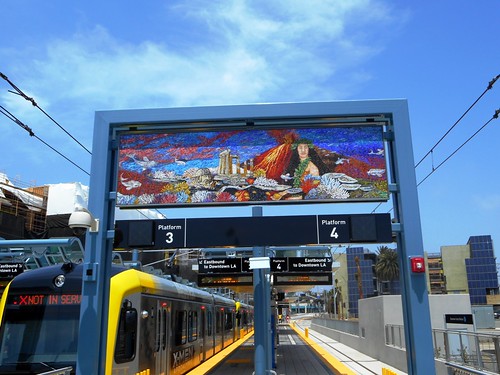
1591 MTA Expo Line Santa Monica Sta 20160513 AKWLA MTA Flickr photo.

- Measure M in Los Angeles County is a transit expansion program which would authorize an increase in sales taxes and an indefinite extension of the current dedicated sales tax.  It requires a supermajority so it is very difficult to pass.   (It has failed once already.)

Some parts of the County feel they will be disserved by the program, so the vote may not succeed.

-- "Why these southeast L.A. cities are banding together to fight Measure M, the transportation tax," Los Angeles Times

Recent expansions, especially to Santa Monica, have given the agency even more visibility recently. The "subway to the sea" extension is adding significantly to ridership.

- Sound Transit 3 in the Puget Sound provides for expansion of transit there, mostly light rail, but also streetcar, rapid bus, and other transportation improvements.  They are coming off a "high," recent light rail expansions, especially within Seattle, have led to a doubling of light rail ridership.

New Link Rail stations have large scale public art works.  Capitol Hill Station, Sound Transit photo.

But even with the success, people criticized the agency for expensive publicity activities around the expansions, and the local newspaper tends to be not as pro-Growth Machine when it comes to taxes, unlike most other newspapers, which understand the value of rail transit to real estate development, which is the primary economic engine at the city-county scale (cf. "Developers are building more around Metro" and "Metrorail's true value could lead to a badly needed funding fix," Washington Post).

-- "Sound Transit puts $54 billion light-rail plan on ballot," Seattle Times
-- "Reject Sound Transit 3 and demand a better plan," Seattle Times

It is a multi-jurisdictional ballot measure, so it is harder to pass, because some of the areas such as Seattle, are much more transit-positive than other areas.

- Measure RR in the San Francisco Bay would pay for rehabilitation -- not expansion -- for the Bay Area Rapid Transit commuter rail-subway system.  It's noteworthy because it's a repair "bond," and is situationally comparable to the financial needs of the Washington area's Metrorail system, where because it is multi-state, it's much harder to take similar action.  It also requires a supermajority for passage.

-- "Yes on Measure RR: The Bay Area can't work without BART, San Francisco Chronicle
-- "BART's future on line: Can transit system gain voters' trust?," San Francisco Chronicle
-- "Past decisions haunt BART as it seeks voter OK for $3.5 billion bond," San Francisco Chronicle
-- "Vote no on Measure RR: $3.5 billion BART infrastructure bond," San Francisco Chronicle

Interestingly, like here, some question whether the agency has the capacity to carry out the proposed program ("Politicians, citizens doubt Measure RR can fix BART," KGO-TV/CBS

- Proposition J in San Francisco would dedicate funds to transit improvement -- many people in San Francisco complain that the city's Municipal Transit Agency, because it generates revenue, is saddled with other programs and costs that aren't fully related to the agency's mission.

But the ballot measure includes funding for homelessness, and another measure, Proposition L, calls for more involvement in the MTA by the Board of Supervisors.

- Wake County, North Carolina transit sales tax.  I have been meaning to write about how the transit agencies in the Raleigh-Durham region are developing an incredibly intricate "integration" program where the individual agencies are still independent but increasingly coordinated.  They are a national model of best practice that needs to be closely considered by other metropolitan areas.

For example, all but one of the agencies uses the same branding program ("Go Transit" and a shared graphic communications framework, with different colors adopted by the different agencies), with mostly integrated fare media including a multi-agency pass system, A SINGLE CALL CENTER PROVIDING CUSTOMER SERVICE FOR ALL OF THE TRANSIT AGENCIES, and transportation demand management initiatives organized under the same branding system.

They have a transit referendum on the ballot to fund various projects ("Wake adopts transit plan, will seek voter approval of half-cent sales tax," Raleigh News & Observer). Given the bifurcated nature of politics in the State of North Carolina these days, it will be interesting to see what happens with this measure, and other election results there.

-- Detroit area transit referendum. Detroit used to control a regional streetcar system, but the system was shuttered over time, as the automobile reigned supreme in the local mobility paradigm. Detroit and the counties ran their own transit systems, with the counties especially Oakland seeing transit as something for poor people, and not wanting to fund transit as a way to keep Detroiters from moving there.

But over the past couple years the State Government has forced the consolidation of transit services through the creation of regional transit agencies and funding referenda.

While putting a measure on the ballot failed initially ("Plan for Metro Detroit transit millage fails," Detroit News), it made it eventually, after various machinations focused on placating Oakland and Macomb County ("Metro Detroit will get to vote on transit funding after all," Michigan Radio/NPR). Hopefully those compromises won't make for a bad process.

While for all intents and purposes, Washtenaw County, with progressive Ann Arbor and an existing transit service anchored by Ann Arbor, is not super integrated with the "Detroit area"--Wayne, Oakland, and Macomb County--it was forced to be integrated with the other counties.  This might help the measure pass.

Separately, Detroit is readying a new streetcar line on Woodward Avenue ("First M-1 Rail streetcar arrives in Detroit," Crain's Detroit Business) scheduled for service next year, and already has a intra-city People Mover system Downtown ("Making the case for intra-city transit planning").

====
Other election matters are also very interesting and terrifying. I have a couple of half written pieces about that. Of course, the national election, what will happen with the Senate, whether or not Democrats will pick up seats in the House of Representative. Whether people like John Mica will stay in office or L. Brooks Patterson, County Executive in Oakland County, Michigan, and some other ballot measures here and there.

We will know tomorrow and throughout the week.

Labels: , , , ,

Wednesday, July 20, 2016

The death of former Minnesota Governor, Wendell Anderson and the Minnesota Miracle

1973 Time Magazine cover featuring Minnesota Governor Wendell Anderson.

Commonly called the "Minnesota Miracle,_ it was under Wendell Anderson that in 1971 the Minnesota State Legislature passed a pathbreaking financing system for local government, sharing tax revenues between the state and local governments, restricting local governments from passing local add-on taxes in return, and equalizing revenues between wealthy and poorer jurisdictions for municipal and school system functions.

-- Wendell Anderson, former Minnesota governor, dead at 83," Minneapolis Star-Tribune
-- "Wendell Anderson and the Minnesota Miracle," Minneapolis Star-Tribune
-- Minnesota scrutinizes 40-year-old 'Miracle'," Minnesota Public Radio, 2011
-- Overview - Public Education Funding Reform: The "Minnesota Miracle," Minnesota Historical Society
-- Minnesota's Miracle: Learning from the Government That Worked, University of Minnesota Press, 2012

Labels: , , ,

Saturday, June 11, 2016

A correction (and update) to a March post on municipal finance: addition of land transfer tax to the list

The piece "The real lesson from Flint Michigan is about municipal finance" from March listed seven solutions for better harmonizing tax revenues with the financial needs of local governments and to provide more stable funding for local governments in spite of economic conditions.

1. Local income taxes.
2. Sales tax sharing.
3. Metropolitan tax base sharing.
4. Creating a consolidated "state/local" income tax.
5. State revenue sharing.
6. Multi-jurisdictional special service (tax) districts.
7. Sin taxes for the arts.

The point of the article is that the system for funding local governments in the US was created when most places were growing, and it turns out the methods don't work well when communities aren't growing and/or face financial problems such as loss of local industry.

For example, it's tiresome to read about how Democrats ran Flint into the ground when the reality is that Flint's economy was destroyed by the shrinkage of the manufacturing operations of General Motors--which now has fewer than 1/10 the number of employees in the city than it did at its peak.

With loss of manufacturing plants comes loss of jobs and loss of personal and corporate income, and declining tax revenues from residential and commercial property as economic prospects wither.

That's not about "the Democrats" on the City Council, that's about economic depression at the local and metropolitan scale.

What about the land transfer tax? Royson James' column, Eventually, we'll all have to pay for this," in the Toronto Star about Toronto's coming financial predicament as the city has big demands on its finances and the lowest property taxes in the Toronto region mentions in passing how Toronto's land transfer tax, authorized in the 1990s, has boosted the city's revenues, allowing it to coast somewhat, especially because of the burgeoning residential property market, which generates a lot of revenue from this tax. (Like SF, Toronto also raids the transit agency revenues for monies for other purposes.)

DC is one of many jurisdictions that has this tax, assessing 1.1% of the sale price on both the buyer and seller for properties under $400,000 and 1.45% for properties over $400,000 and for commercial property.  Technically, the tax on the seller is the land transfer tax and the tax on the buyer is a Deed Recordation Fee.  There are variations in the tax when certain ownership conditions change.  The tax is not triggered on mortgage refinancings when the property owners do not change.

-- Real Estate Transfer Taxes assessed in the US, National Council of State Legislatures

Adding the land transfer tax to the list.

1. Local income taxes. (local jurisdiction)
2. Land transfer taxes.  (local jurisdiction)
3. Sales tax sharing. (county)
4. Metropolitan tax base sharing. (metropolitan)
5. Creating a consolidated "state/local" income tax. (state)
6. State revenue sharing. (state)
7. Multi-jurisdictional special service (tax) districts. (metropolitan)
8. Sin taxes for the arts. (metropolitan)

Issues with a land transfer tax. It made me realize that I forgot to include that tax in the list, but at the same time, it's a problematic tax.  Regardless of the situation, real estate interests complain about it as a disincentive.  And in order to be able to assess the tax, while not encouraging people and business to locate elsewhere where such a tax isn't charged, your community has to be highly desirable.

In terms of generating revenues, it's great in a booming economy, revenues crash in a falling economy when new construction declines, and in declining communities, like Flint, Detroit, or small towns, it can be seen as a disincentive to new development, when new development is desired but hard to "pencil out" financially--and were such a tax in place, waiving it as part of a package of incentives means that it isn't all that reliable a source of revenue.

Reordering into a more logical and hierarchical framework.  From a hierarchical standpoint, the list should be reordered, depending on what level of government or government cooperation is required to be able to assess, collect, and distribute the revenues.  Note that all the taxation forms have to be authorized by the state.

Changes have to be made at the local, metropolitan, or state level to effectuate any of these taxing methods.  Also I would argue that land transfer taxes could be assessed at the metropolitan scale and added to the monies shared through metropolitan tax base sharing systems, as discussed in the original post, which could be added to item 4.

1. Local income taxes. (local jurisdiction)
2. Land transfer taxes.  (local jurisdiction)
3. Sales tax sharing. (county)
4. Metropolitan tax base sharing. (metropolitan)
5. Multi-jurisdictional special service (tax) districts. (metropolitan)
6. Sin taxes for the arts. (metropolitan)
7. Creating a consolidated "state/local" income tax. (state)
8. State revenue sharing. (state)

Update: Kansas City-St. Louis earnings tax.  As an example of how state action is required to authorize the ability to tax at the local level, the State of Missouri authorized St. Louis and Kansas City to have earning taxes on residents and nonresidents.  As discussed in the earlier post, this can be a problem in terms of spurring some businesses to relocate out of the city.

In KC, the 1% tax on earnings generates 40% of the city's revenue and half the revenues come from nonresidents working in the city.

But it can be a problem because of outside forces focused on an anti-tax agenda.  In Missouri, St. Louis billionaire businessman Rex Sinquefield ("King Rex" POLITICO) argues that the tax is bad, and has successfully got the Missouri Legislature to pass legislation requiring that the tax be re-authorized every five years, and he helps to fund local campaigns seeking to overturn the tax.

But in the most recent vote in Kansas City last month, the tax was supported by voters overwhelmingly ("Kansas City voters overwhelmingly approve earnings tax renewal," Kansas City Star). After all, why wouldn't residents be supportive of a tax that generates a fair amount of revenue from non-residents?)  In April, the tax was reapproved in St. Louis.

In spite of failures to overturn the tax in local elections, anti-tax interests continue to lobby the Missouri Legislation to de-authorize the local earnings tax.

Labels: , , , , ,

Friday, April 01, 2016

Public improvement fees as sales tax add-ons

The entry on municipal finance discussed wide-scale funding mechanisms, including county and regional sales taxes.

It didn't discuss community specific sales taxes, which are quite common.  For example, in Georgia they have what are called SPLOSTs, which stands for Special Purpose Local Option Sales Taxes, which communities mostly use to fund infrastructure and revitalization programs.  The state legislation authorizing the program limits the charge to a maximum of 1%.

Interestingly, an airport improvement program in Lafayette, Louisiana was funded by a temporary sales tax upcharge of less than one year's duration, which raised the $32 million needed ("Temporary Sales Tax Raises Funds for New Terminal at Lafayette Regional," Airport Improvement Magazine).

In Colorado they have a program called Public Improvement Fees, which are sales taxes that aren't called sales taxes.  What's interesting is that they can be assessed at either a community-wide or sub-community district scale .

-- "Public Improvement Fees as a Development Finance Tool, Brownstein Hyatt Farber Schreck
-- Special District Association of Colorado

For example, in Denver, the Larimer Square district has a "Historic Preservation and Restoration Fee," a 1% surcharge on retail and restaurant transactions.  The monies are used to fund physical improvements in that commercial district.

Instead of providing tax increment financing to the redevelopment of the Garden on Havana shopping center in Aurora, the city allowed the development to assess a PIF on sales transactions there, as a more direct way to fund improvements.

This is done by creating a special purpose taxing district.  Colorado has many types of special districts because counties are legally limited in the services they offer.  Mostly, this funds programs such as water, libraries, or parks.  But one type, "metropolitan districts," are used to support site/area/district specific programs which can provide either public or private benefits.  Metropolitan districts are the entities which collect and manage the fee revenue.

 Except for the funding method, sales taxes instead of property taxes, it's comparable to how cities allow for the creation of business improvement districts, which are funded by a property tax surcharge agreed to by a majority of property owners.

Labels: , , , , ,

Sunday, March 27, 2016

The real lesson from Flint Michigan is about municipal finance

Aaron Renn of Urbanophile has a podcast about Flint, based on a talk he gave in Midland, Michigan (home of Dow Chemical), and it reminded me that I have been meaning to write about the "real lesson from Flint."

-- watch on You Tube.

Well, there are actually more lessons, others being "if you run a water system be sure to properly treat the water," and "if you regulate water systems be sure to ensure they're doing what they are supposed to be doing."

A fourth would be "cover ups and misdirections come to light eventually, all you're doing is putting off the reckoning."  (A fifth lesson is a lot of times there is no real reckoning, some resignations and Congressional hearings notwithstanding.)

Just like I am sick of prognosticators writing about Houston's success being due to a lack of zoning when it was really a result of Houston's being the economic center of the oil and gas industry--which is why the economy there is tanking now, just as it has during other oil industry downturns dating to the 1980s-- I get tired of comments on newspaper articles about how urban governments run by Democrats have run their cities into the ground.

While there is a bit of truth to that when it comes to the pensions issue, and the way that municipal labor unions can dominate the local political agenda, the reality is much more complicated.

The political stripe of the people in charge doesn't matter all that much.  In a paradigm of suburban outmigration, cities were consigned to economic failure, as they lost population and business activity.

Flint, "Vehicle City" no longer.

Flint/Genessee County Michigan is a perfect example, as General Motors and parts suppliers provided the bulk of jobs and property and income tax revenues collected by the city and county, and as GM closed most of its plants--now employing 5,000 people from a peak of just over 82,000 employees in the city--how could the economy not tank?

Furthermore, the multiplier effect of an automobile industry job was calculated at 3.6, and while not all of those jobs would have been located in the immediate area, it's obvious that as the company downsized its Flint-area operations, non-company employment would also take a big hit

 ("GM Weld Tool Center closing: [Timeline of] General Motors history in Flint," [2013] Flint Journal; " General Motors closes Buick City complex in Flint, Michigan [1999]," WSWS; The Economic Impact of the Automotive Industry on Urban Communities)

How can local elected officials--Republican or Democrat--deal with that level of economic destruction?

The basic lesson is that the US developed a system of financing local governments that is an artifact of the period in which it was developed, that of significant economic growth of the US economy.


A now vacant GM plant.  Flint Journal photo.

Local governments are typically funded from a few sources--property taxes are the largest source, sales tax revenues (usually shared with the state), fees (permits, rentals, etc.), and funds from state and maybe the federal governments--are the primary sources.

When a local economy tumbles, usually property tax and sales tax revenues tumble precipitously.  And if the state economy is in free fall simultaneously, state transfers to local governments typically fall precipitously also.

The financing system for local government, primarily reliant on commercial and residential property tax revenue, works only when communities are growing or at least, stable.

When local economies are contracting and property values are dropping, and property is abandoned, it doesn't work.  And it doesn't matter who is running the local government, Republicans or Democrats (although Democrats tend to be in charge in cities), they lack the tools to be able to respond, other than cutting government to the bone, which they can't do, because they still have to provide services like water, policing, schools, etc.

Photo: Thomas Simonetti, Flint Journal.

Putting off pension liabilities is one example of this.  If your revenues continue to grow you can probably pay off future pensions.  If you're in a phase of slow or no growth, or contraction, you can't.

In fact, from a financing and operating standpoint, many of the local government institutions that have been created work well only in times of growth, and since at best the economy is at a reasonable steady state, and massive growth is not likely to occur in most places, most local governments are seriously pressed economically.

It's even worse in those places, like California, which have laws (because of Proposition 13 in California) which seriously restrict the ability of local governments to raise taxes.

Sure, Flint's economics deteriorated to the point where the state appointed a receiver, and it was the receiver, seeking to save some money, who started the chain of decisions that resulted in the "Flint Water Crisis" (MLive).

But Flint's economic disaster was pre-ordained, once GM began closing plants--ultimately 93% of GM's employee base in Genessee County disappeard..

Some solutions to provide more stable funding for local governments.  Below I list seven solutions for better harmonizing local tax revenues:

1.  Local income taxes.
2.  Sales tax sharing.
3.  Metropolitan tax base sharing.
4.  Creating a consolidated "state/local" income tax.
5.  State revenue sharing.
6.  Multi-jurisdictional special service (tax) districts.
7.  Sin taxes for the arts.

I recommend #4, #5 and #6 as a package.  #3 is great, but it's better to do it at the scale of an entire state, which is what #4 does.

The problem though is that all of these solutions require state government approval, and as the writings of Gerald Frug point out, state legislatures aren't inclined to pass laws that help cities, and each of these solutions requires state authorization.

And note that these solutions are designed for communities that are functioning somewhat at a basic level.  What happened to Flint's economy is the equivalent of the Great Depression or a Natural Disaster like a volcano eruption, earthquake, hurricane, or tornado that completely wipes out a community.  A local income tax won't generate much revenue when the local economy is leveled.

1.  Local income taxes.
Counterproductive.  Relatively "easy" to do if state authority to do so has already been granted.  Very difficult if approvals aren't already in place.

This is a sort of solution, New York City has an income tax as do many other cities.  The micro-city of Highland Park, Michigan had an income tax when Chrysler Corporation was based there. Philadelphia has a wage tax.  Communities that are business centers, with lots of employment and where many of the employees don't live in the city, benefit from such taxes on non-resident earners.

But the problem with a local income tax is that if other area jurisdictions do not have the same kind of taxing system, businesses and residents are encouraged to relocate away from those communities with higher taxation regimes.

That is a particular problem for Philadelphia, which unlike other major cities on the East Coast (NYC, Boston, DC), has not been successful at maintaining its place as a headquarters for business, which instead continues to move to New Jersey (such as the Philadelphia 76ers), Suburban Pennsylvania, and Delaware (which doesn't have state or sales taxes--although this may change over time given the changes coming for the Dupont Corporation, which had the same economic impact on Delaware's economy that GM once had on Flint, and Michigan more generally).

From the Philadelphia Inquirer article "To see impact of wage tax, just look at City Avenue":
The office buildings spread along City Avenue starkly illustrate how Philadelphia's taxes hurt its economy.

The north side is packed with office buildings full of high-paid workers. On the south side, there are low-paying retail jobs and few offices.

Both sides of the busy commercial street are served by the same highways and public transportation. Workers have access to the same restaurants, gas stations and housing.

But the north side, where there is no wage or gross-receipts tax, has 93 percent of the avenue's office space - 2.6 million square feet. It is in Montgomery County.

The south side, in Philadelphia, has 7 percent - a mere 200,000 square feet, according to the Central Philadelphia Development Corp.

"Everyone would prefer to be on the other side of City Line," said George Goldstone, chairman of Herbert Yentis & Co., a Philadelphia development company on City Avenue.

"The only way we can sell a vacancy on the city side is by offering a lower rental to compensate for the taxes," he said. ...

By every measure, the tax burden on Philadelphians is 20 to 30 percent higher than in virtually every major city in the United States, including Baltimore, Detroit, Los Angeles and Washington.
2.   Sales tax sharing.
Good practice.

In states where the county, not individual jurisdictions, collects sales tax revenues, there may be instances where certain jurisdictions receive revenues from the county based more on need, rather than in terms of how much revenue was generated within the community.

This can't happen in Virginia, because cities are legally independent of counties.  This creates significant competition between cities and between cities and counties for tax-generating businesses. A key example is between Colonial Heights and Petersburg, Virginia.  Petersburg is the county seat and back in the day of traditional commercial districts, was the premier destination in the area.  These days, Colonial Heights is where the major regional shopping mall is located, and it generates the bulk of sales tax revenues in the area, but there is no vehicle for tax sharing between the jurisdictions.

3.  Metropolitan tax base sharing.
Fair.  Shares the value of growth.  Few states have authorized this kind of tax sharing system.  Does not work across state boundaries.

To counter income tax-spurred outmigration and intra-metropolitan competition for businesses generating high tax revenues, in Metropolitan Minneapolis, local governments agreed to create a pool of a portion of tax revenue derived from new growth, and to share the revenue with communities not experiencing growth.  It is intended to minimize the negative impact of large employers/tax generators moving from one jurisdiction to another.  From the book Regional Planning from a Sustainable America:
... the Twin Cities Fiscal Disparities program ... places 40 percent of the growth in commercial-industrial tax base in each municipality in each year into a seven-county, regional pool and then distributes the tax base back to participating municipalities and school districts based on tax base and population. The re-distributed tax-base is then taxed by each location at its own tax rate.
While part of Hudson and Bergen Counties in New Jersey operate a similar program (NJ Meadowlands Tax Sharing Program), this type of program is exceedingly rare, and in any case, only works in areas that are still experiencing some level of economic growth, even if the pattern of growth is varied.

And judging by the experience in New Jersey, there can be plenty of discord amongst the municipalities participating in the program, both those communities paying in ("Frustrated over Meadowlands tax-sharing program, Secaucus mayor shoots off letter to Gov. Christie," New Jersey Star-Ledger), and receiving harmonization payments ("Meadowlands tax-sharing program modified after North Arlington protest," Bergen Record).

From the Star-Ledger article:
Created in 1973, the Meadowlands District Inter-Municipal Tax Sharing program is designed to take money from municipalities within the 14-town district that reap benefits of development and share the wealth with towns with severe restrictions on development.

In his letter to the governor, Gonnelli said "we were told by the Meadowlands Commission Executive Director Marcia Karrow that while the issue was being taken seriously, the Governor's Office was having a difficult time understanding tax sharing."

Of the four Hudson County municipalities in the district, Secaucus and North Bergen pay into the shared pool, while Jersey City and Kearny receive annually. Secaucus is expected to pay nearly $2.7 million into the fund this year, while Kearny is expected to receive more than $4 million from the fund.

Last year some of the paying municipalities within the district temporarily withheld payments in an attempt to get state officials of focus on what they called the unfair tax-sharing program.
A program like this is impossible to create across state lines, and many metropolitan areas (New York City, Philadelphia, Washington, DC, Chicago, St. Louis among others) have multi-state boundaries.

4.  Creating a consolidated "state/local" income tax.
Probably the best solution, though still subject to decline in revenues in recessionary periods.

Most state governments assess an income tax (Washington State and Delaware are key exceptions). Maryland is one of a handful of examples where the state income tax is actually a combined state/local income tax, where the counties and Baltimore City include a "piggyback" tax that ranges from 1.25% to 3.2% of the state tax obligation, depending on the jurisdiction.

A consolidated filing and collection process simplifies matters for taxpayers and the local governments.

While at the local level, the system favors counties over separately incorporated cities (e.g., citizens in cities like Rockville or Takoma Park are overtaxed compared to residents in unincorporated parts of Montgomery County), the local governments have a more diversified revenue stream compared to those places which rely on property taxes for the bulk of their revenues.

According to the Tax Foundation, this kind of system, while rare, is also in place in Indiana, Ohio, Pennsylvania, Michigan, and Iowa, although depending on the state, not all jurisdictions, which can extend to school districts, assess such a tax.

5.  State revenue sharing.
A pretty good solution, though still subject to decline in revenues in recessionary periods.

Until the Reagan era, the Federal Government shared some tax revenues with center cities ("Federal Revenue-Sharing - Born 1972. Died 1986. R.I.P.," New York Times).

Some states still have a form of intra-state revenue sharing.  Probably the best known example is Minnesota's Local Government Aid program, which was created at the state level in return for localities agreeing to not assess local income or sales taxes ("The basics of local government aid in Minnesota," Minnesota Public Radio).

While not all cities receive LGA, it massages the economic differences that otherwise might exist between localities, so that all communities can offer comparable services for its residents.  Instead of there being a system of separate local income and sales taxes, Minnesota shares state income and sales taxes with localities.

-- City LGA Program, Minnesota House of Representatives
-- County Aid Program, Minnesota House of Representatives

To make up for severe disparities, like with Flint or other declining cities in a state, I'd recommend a system of "Local Government Aid/State Revenue Sharing" in addition to a consolidated state/local income tax.

6.  Multi-jurisdictional special service (tax) districts.
A pretty good approach, good for cost reduction, but not a game changer.  Because costs rise over time, this creates a dynamic where some jurisdictions may opt out.  In fact, seeking to lower costs in the face of legacy systems is the economic justification for outsourcing/privatization of services typically provided by government agencies, transit being a particularly common example.

These aren't new--utilities and regional park systems are typically funded in this way.  Examples include the Huron-Clinton Metropolitan Parks Authority in Southeastern Michigan ("13 parks of the Huron-Clinton Metropolitan Authority are made for fun all year," Woods-n-Water News) created in 1939 and funded by a property tax assessment covering multiple counties or the Northern Virginia Parks Authority--which started as a multi-jurisdictional effort to protect water resources.

Water service is a primary example.  Baltimore City's water system also serves Baltimore and Howard Counties.  Detroit's system is multi-county as well, serving most of Southeastern Michigan.

A problem that arises with these services is common to any system, legacy costs, aging facilities, pensions, etc., lead to higher costs over time, and so it is always possible that by opting out, the locality will start off at a new lower cost basis.  (Note that the "Detroit" water authority has been transferred to a multi-county Great Lakes Water Authority--not unlike how the State of New York took over "New York City" transit--to spread out costs, although in the Detroit instance, some activists criticize this as the suburbs stealing the city's assets.  See "Great Lakes Water Authority takes over regional operations," Oakland Press.)

In fact that was what spurred Flint to seek "less expensive water" and is why Mid-Michigan governments are creating their own water authority, so that they don't have to pay towards maintaining the aging water service infrastructure emanating from Detroit ("Karegnondi water system rooted in frustration," Detroit News).

Rising costs and beliefs that some cities pay more than their fair share for service is leading to discord within member jurisdictions of the Orange County Fire Authority in Southern California ("Fire Authority faces financial deficit, pensions and Irvine threatening to drop it," Orange County Register) which could lead to opt out and the creation of new fire department operations in some Orange County cities, which will lead to higher costs for the Fire Authority.

Arts.  Another example is the Regional Asset District in Allegheny County, Pennsylvania, which is funded from a county-wide sales and use tax ("How the Regional Asset District rode to the rescue of Allegheny County attractions," Pittsburgh Post-Gazette).

Historically, the City of Pittsburgh paid for and provided regionally-serving cultural assets (museums, zoo, etc.) without support from other area jurisdictions.  As cities lost population and business activity, funding such facilities became an increasing strain.  The RAD, also supporting cultural assets in the County, was a way to spread out the cost.

From the article:
In the early 1990s, the city was facing major financial troubles, he said, and was in no position to continue to fund attractions like the zoo and the aviary, particularly when studies showed that as many as 85 percent of those visiting them came from outside the city.

Ms. Masloff championed the asset district as a way of providing a stable source of funding for such assets while at the same time getting the many visitors from outside the city to help pay for them. It didn't hurt that surveys found that about 25 percent of the people who pay the sales tax in Allegheny County live outside the region.

In retrospect, the asset district has "done exactly what it was intended to do. It has funded the primary regional assets. It has added to that a large number of smaller regional assets. It's helped to bring into fruition other regional assets [like PNC Park and Heinz Field]," Mr. Turner said.
Greater Denver has a similar program ("Another round in the tense battle over metro-Denver arts funding," Denver Business Journal).  (Note that smaller organizations may not benefit as much as larger organizations from such funding streams, which creates discord.)

More recently, cultural facilities in Greater Detroit, such as the Zoo and the Detroit Institute of Arts, which had been funded solely by the City of Detroit, now are supported by a multi-county property tax.  But in Detroit, by contrast to Pittsburgh, each facility seeks its own tax and approval process, whereas in Pittsburgh, the program covers a multitude of cultural facilities in a single funding system.

7.  Sin taxes for the arts.
I'm not a fan.

In a variant of the multi-jurisdictional special service (tax) districts, Cuyahoga County, Ohio (Cleveland) charges a special tax on tobacco, to fund arts programs ("Cuyahoga cigarette tax for the arts grows in importance as other sources of government support shrink: new report," Cleveland Plain Dealer).  I don't think it's a particularly fair tax, and instead recommend a property tax funding stream comparable to the Regional Asset District.

Labels: , , , , ,