Rebuilding Place in the Urban Space

"A community’s physical form, rather than its land uses, is its most intrinsic and enduring characteristic." [Katz, EPA] This blog focuses on place and placemaking and all that makes it work--historic preservation, urban design, transportation, asset-based community development, arts & cultural development, commercial district revitalization, tourism & destination development, and quality of life advocacy--along with doses of civic engagement and good governance watchdogging.

Saturday, April 06, 2024

Good quote on arenas and stadiums as "performing arts centers" attractions for cities

 Right now there's a lot going on in stadium and arena deals:

  • Chicago: the White Sox MLB and Bears NFL teams want new stadiums
  • Boston: the Revolution soccer team aims for a stadium in Everett, just outside Boston
  • Dallas: the Mavericks NBA team along with the Stars hockey team wants a new arena, preferably with a casino, which isn't yet legal in Texas
  • Kansas City: the Chiefs football team and the Royals baseball team just lost a sales tax extension which many attributed to a poorly defined program for use of the money
  • Las Vegas/Oakland: the Athletics MLB team is moving to Las Vegas with an interim stop in Sacramento 
The Las Vegas Athletics aren't interested in a throwback stadium design
There's an article in the Fort Worth Star-Telegram, "America's future sports stadiums finally at a cross roads," suggesting that the KC vote indicates voters are tired of paying subsidies to billionaires for sports teams.  
Any proposal for a new home of the Stars and Mavericks should serve as a litmus test where America sits with its tolerance to subsidize venues for teams that take a disproportionate share of the revenue. As the valuation of sports franchises continues to shatter logic, perhaps citizens will have a hard time justifying giving them more money.  
I'm not sure I agree.  I think the KC vote was more about not getting enough information to make a good decision, with a foundation of a bit of lack of trust ("Why Royals and Chiefs need to say we heard you, not act out ," Kansas City Star).  

And as I blogged, the Virginia Governor sprung the arena proposal on the public and the Legislature, giving them only 14 weeks to decide ("Wizards and Capitals teams staying in DC after all and the failure of the mansion tax referendum in Chicago have one thing in common: failure to take the time to build consensus").

In Oakland, the city was willing to provide a fair amount of money, but the MLB team owner wanted even more.

The S-T article quotes Ron Kirk, mayor of Dallas when the American Airlines Center was built, opening in 2001, and he has some interesting points.

1.  30 year maximum life for the facility

Ron Kirk knew going in what the lifespan would be for a replacement for Reunion Arena. “Thirty years,” he said. 

Kirk was the foremost political figure to lead the American Airlines Center project from its conception to construction. The AAC cost $420 million to build, and it opened in October of 2001. 

No one in any rational state who builds a house, or even an office space, thinks before they sign the necessary 43 million documents required for construction, says, 

Area around the Dallas arena, 2001.

“Thirty years and she’s done.” “That’s the reality of modern sports,” said Kirk, the former Dallas mayor, in a recent interview. “You build a building and when it’s life span is over, you build a new one. That’s what these owners want.”

2.  Sports stadiums and arenas as performing arts/cultural facilities

You either play, and operate, the glorified museum-stadium, which is a tourist attraction, or you “need” the new one complete with an assortment of new-age amenities. “The argument is always you never need to build it; we battled that when we did it here,” Kirk said. 

“We put in $125 million, and there’s been over $3 billion in private investments around (the AAC). It worked spectacularly.” 

Before the construction of the AAC, the area was an industrial hazard site. Literally. Since the building went up, it’s morphed into a mixed-use site for offices, residential space in the form of condos, and retail space with bars and restaurants. 

Area around the Dallas arena today 

“What drove a lot of energy then, in the ‘90s and not just in Dallas, all o.f the urban areas had been hallowed out by families fleeing and businesses going to the suburbs,” Kirk said. 

“The one thing that brought people back into the urban areas were arts, culture, sports, museums, and concerts. “It’s a performing arts building; that’s what you need to think of it as.”

Response.  

  1. How did Dallas get so much spillover development around the arena?  Those before and after photos are startling.  Did they have a plan, an implementation organization or did it just happen?  Few arenas or stadiums generate this level of change.  It could be location (I've never been to Dallas) because a lot of arena and stadium placements have flawed locations.
  2. Chicago.  The baseball team owner chose a bad location for the current stadium, and had no interest in embedding it in a neighborhood commercial district, despite the example of Wrigley Field a few miles a way.  While the new "stadium city" initiatives like Ballpark Village in St. Louis, District Detroit, or the area around the Braves stadium aren't city embedded per se, creating a mini city of development around them is what they do.
  3. Chicago.  The Bears are vacillating between a suburban location and the Chicago waterfront.  They propose a domed stadium, and placing such facilities in parks is very controversial in Chicago.  The Chicago Tribune editorialized, "The Bears have yet to say why they need the lakefront. Why even think of saying yes without that?," stating the Bears haven't provided a good rationale for a waterfront location, that a dome would hide the water, and that it would change the park with a museum and cultural center (there are 10 such facilities) to a sports and entertainment district. (Similar to the issue in KC about lack of definition.)
  4. Dallas.  The interesting thing is that Mark Cuban's sale of a majority of the basketball team to Las Vegas Sands with the aim of a casino means that sports betting/casino ("Mark Cuban has Vegas-like vision for Dallas, new Mavs arena if Texas OKs casino gambling," "Mark Cuban: ‘I’d like to see resort casino gambling,’ plans for making Texas a destination," and "Mark Cuban, the Mavericks and the great plan to bring a casino to Dallas," Dallas Morning News) or "ballpark village" (ULI case study, "Stadium anchored mixed-use development," Realogic, "It takes a ballpark village: stadiums, coalitions, and growth in two cities," MIT thesis) are the two future paradigms for boosting revenues.    

  5. Kansas City.  Probably better to have the baseball team downtown, but it's not a city with well developed transit.  For example, the 76ers argue by changing locations, instead of the 30% getting to the arena by transit now, it will be 60% on Market Street.  That won't happen in KC.  Plus you still need to do tons of marketing etc. to make the stadium work for other actors.  If games are scheduled early, people won't eat off site.  And increasingly, baseball patrons aren't interested in anything but eat and drink, so they won't help adjacent retail.
  6. Nashville.  Business doesn't care much about non business metrics.  Some of the residents are skeptical that the "wealth creation for the black community" objectives are reachable ("Some North Nashville Residents Wary of MLB Pitch," Nashville Scene).
  7. Philadelphia.  Probably Market Street is a better location and needs the jump in interest.  Plus more people will take transit to get to the games, comparable to the numbers for Madison Square Garden and Barclays Center in Brooklyn, which are the highest for transit using nationally.  The trick is to integrate the arena better and improve the street, while arenas tend to have deadening effects.
  8. Salt Lake.  Many years ago there was a study by American Business Journals about the capacity of metropolitan areas to add professional teams ("American City Business Journals calculates the capacity of North American metropolitan areas to support new/additional professional sports teams" 2015, archive.ph original article), also taking into account college sports (college football especially is big in Salt Lake).  Salt Lake didn't have a lot of financial capacity to add beyond NBA, soccer and Utes football.  It's smaller in population than most of the smallest teams in the professional sports landscape. But billionaires are billionaires and they don't think economics applies to them.

Labels: , , , , , , , ,

Saturday, March 30, 2024

Wizards and Capitals teams staying in DC after all and the failure of the mansion tax referendum in Chicago have one thing in common: failure to take the time to build consensus

 Change is hard.  My experience in the civic arena is that it takes "a couple rounds" of putting the idea out there before there is consensus to go forward.

I wrote a bunch about failures of transit referenda in Tampa Bay and the State of Georgia in the 2010s.  Georgia introduced a new way to create transportation districts, then expected people to vote up or down in less than a year ("Failure of the transit-roads sales tax measure in Metro Atlanta," 2012).  

In Tampa, the two counties can't figure out how to work together on transit, nor can they build support within their counties (Voters reject Greenlight Pinellas," Tampa Bay Times, "My Ride/My Road: Polk County Voters Reject 1-Cent Sales Tax Increase," Lakeland Ledger, 2014).

There are plenty of other examples.

My point was that to do breakthrough initiatives, you have to build the support for it, people are conservative, and that takes time.  The other way I put it is that the more time you spend on the front end, with civic engagement and a slew of meetings and other activities, the faster it goes on the back end.  Finally, I hate losing. So I'd rather set myself up for success by taking the necessary time to build support.

1.  Sports Arena in Alexandria.  Virginia has a Republican Governor and a Democratic State Legislature.  Announced in December ("Lawmakers vote in favor of plan to bring Capitals, Wizards to Virginia," Washington Post), he wanted to move the Capitals hockey team and Wizards basketball team to an arena in Alexandria, claiming billions of dollars of benefits and many thousands of jobs("$730 rooms, $75 parking: Youngkin’s own report calls arena forecasts rosy").

Note while Downtown DC benefits from CapitolOne Arena, it's not like it drives the economy.

To stoke development in that area, a process that has been going on for about 20 years--giving the rights to develop to the team owner, which is the trend in stadium and arena development.  Team owners say they need the extra money to spend on the team, especially with the decline in broadcast revenues and minimal revenues from streaming.

-- "Capital One Arena, Wizards and Capitals may move to Alexandria | Why not the RFK campus?," 2024
-- "Framework of characteristics that support successful community development in association with the development of professional sports facilities," 2021

The deal called for at least $1.35 billion in tax incentives ("Caps, Wizards complex in Virginia could get largest arena subsidy ever").  

It was a shocking move.  And not all the state, especially State Senator Caroline Lucas, was on board ("Leonsis finally met arena nemesis Lucas, but maybe too late to save it").

Other issues also brought more opposition ("Plan to move Capitals, Wizards to Virginia draws transportation worries," "Plan for new Caps, Wizards arena in Va. stirs up its would-be neighbors") including a casino proposal ("JBG Smith blames Tysons casino conspiracy for derailing Potomac Yard deal," Alexandria Now).

Governor Youngkin just sprung this on everybody.  And "everybody" needed more than 3 1/2 months to get on board.  Let alone vote on it.

An article about the aftermath in the Post , "Va. Gov. Youngkin arrived like a GOP star, but arena failure clouds legacy," made the point about Youngkin, on most new initiatives he proposes, doesn't attempt to build support for them in advance, therefore fails.  (Also see "After Va. arena plan collapses, politicians and dealmakers trade blame" and " Proclamation: Governor Glenn Youngkin Statement On Monumental Sports & Entertainment Project.")

But Holsworth, the political analyst, said he saw a significant difference in the way Youngkin approaches big initiatives compared with previous governors. When Republican George Allen wanted to impose new education standards in the 1990s and had a Democratic legislature, he said, the governor appointed prominent Virginia educators to key administration roles and mounted a campaign around the state to build support from lawmakers and local officials — all before any votes were taken. 

Similarly, in the 2000s, Democrat Mark R. Warner logged miles around the state and made endless PowerPoint presentations to persuade business groups and a GOP legislature that Virginia had to raise taxes to preserve its high bond rating. 

Youngkin made no such broad effort to pave the way for the arena ... “It’s just not a very keen understanding of the political dynamics of Virginia,” Holsworth said.

So it failed and the teams are staying in DC ("Caps, Wizards will stay in D.C. under deal announced by Bowser, Leonsis," Washington Post) getting $500+ million from the city to do so, and getting the rights to redevelop the adjacent Gallery Place development to add some revenue streams ("MRP Realty to buy Gallery Place, make room for Monumental Sports & Entertainment," Washington Business Journal).

Under the terms of the deal signed Wednesday, pending expected D.C. Council approval next week, the District will send $515 million over three years to finance Capital One Arena’s modernization. In addition, the agreement provides for 200,000 square feet “of newly programmed space throughout Capital One Arena and in the Gallery Place building next door.” The terms also call for a new downtown practice facility for the Wizards, with “options including top floors of Gallery Place,” per Monumental’s release.

Campaign flyers for the Bring Chicago Home referendum at a march to the polls event March 9, 2024, in Chicago. (Vincent Alban/Chicago Tribune)

2.  Real estate transfer tax in Chicago.  In Chicago, new mayor Brandon Johnson proposed a higher transfer tax rate on properties selling for more than $1 million, to pay for affordable housing.  

Called "Bring Chicago Home," he proposed it in September ("Chicago mayor introduces real estate transfer tax plan to combat homelessness," Axios) for a vote this March.   That's 6 months!

It was estimated the tax could raise $100 million per year.

Naturally, the business community especially the real estate development community was against and could spend a lot of money fighting it.  Plus a lot of citizens were indifferent.

A number of cities, including DC, have such a tax, so it's not novel (Local Mansion Taxes: Building Stronger Communities with Progressive Taxes on High-Value Real Estate, report, Institute for Taxes and Economic Policy), the issue is getting it passed.

  • As of early 2024, 17 cities and counties have progressive taxes on high-price real estate sales, also known as “mansion taxes.” Several others are currently considering adopting these policies.
  • Together these taxes raise nearly $3 billion in annual revenue, equipping communities with resources to make progress on critical priorities of local and national concern including housing, education, and infrastructure. 
  • Local mansion taxes have been around since 1982, but the momentum for them has built in recent years. 
  • Nearly all of today’s mansion taxes were enacted or expanded between 2018 and 2023. 
  • Local mansion taxes play an important role in rebalancing upside-down tax codes, advancing racial and economic equity, and raising new revenue to build more resilient and inclusive communities. 
  • Mansion taxes have proven popular with voters: When put on the ballot, measures to enact or expand mansion taxes have succeeded 86 percent of the time.

Which they didn't.  It was also challenged in court by real estate interests, who didn't even want the votes to be counted ("Real estate group appeals Bring Chicago Home to state Supreme Court," Chicago Tribune).  The court said no, count the votes.  

But it didn't pass anyway, losing roughly 54% to 46%, a 21,000 vote difference in a low turnout election ("Chicago Voters Reject Mansion Tax in Blow to Mayor Johnson," Bloomberg).

Some electeds are chastened ("City Council’s Progressive Caucus responds to ‘Bring Chicago Home’ defeat with ‘we heard you’ humility," Chicago Sun Times). Not the mayor ("Johnson, defiant after 'Bring Chicago Home' loss, vows agenda push will 'get stronger'," Crain's Chicago Business).

But they shouldn't be so chastened, just recognize that they mishandled the initiative, by trying too soon for a vote without building the consensus for the need.  From the Axios article, "Why the Bring Chicago Home ballot measure failed"

  1. People not affected by homelessness don't understand it
  2. Voters fear rising residential taxes if the measure further hurts commercial real estate
  3. People worry that the tax could stifle future development
  4. Citizens have little faith in city leaders
  5. Voters were confused by the measure's changing legal status and swayed by opponents' commercials
  6. The measure lacked spending specifics
Conclusion.  My point is pretty clear.  Losing sucks.  So take the time necessary to build the consensus and coalition so you can win.  I don't understand why elected officials can't figure this out.

Especially in Chicago when you know from the outset that monied interests, in this case the commercial real estate industry, will fight you hard.  Or in Virginia, where the governor was asking to subsidize a billionaire with $1.35 billion, based on dubious claims about the economic value of doing so.

When I used to work in restaurants, there was a woman who was really fast but made mistakes and I would say "speed kills."

In this case, "Speed kills good ideas."

Labels: , , , , , , ,

Monday, March 07, 2022

A new football stadium for the Washington "Commanders" | Virginia versus Maryland (and hopefully not DC)

 "Framework of characteristics that support successful community development in association with the development of professional sports facilities" and "Revisiting "Framework of characteristics that support successful community development in association with the development of professional sports facilities" and the Tampa Bay Rays baseball team + Phoenix Coyotes hockey" are reactions to the reality that despite advocacy against public funding for sports stadiums and arenas, with rare exceptions (California, Seattle) public funding is almost always provided as a matter of course.  

Therefore, instead of fighting funding--which admittedly is still the preferred course of action--instead we should be focusing on getting the best possible array of benefits in return for the public funding, including a kind of virtual ownership interest, to share in the value added to the team from its stadium/arena as platform.

Washington Commanders jerseys are displayed at an event to unveil the NFL football team's new identity, Wednesday, Feb. 2, 2022, in Landover, Md. The new name comes 18 months after the once-storied franchise dropped its old moniker following decades of criticism that it was offensive to Native Americans. (AP Photo/Patrick Semansky)

This comes up again, because the woefully dreadful Washington football team, recently renamed the Commanders ("Washington selects Commanders as new NFL team name after two-season process," ESPN) want a new stadium.

Right now Virginia especially, but also Maryland, are vying for the privilege of raining money on the team, even though the team is incredibly unsuccessful on the field and is a lackluster "partner" to the community that hosts it, and the state that funded the stadium.

-- "Been to Largo lately? Sports teams often aren't very good partners...,"2019
-- "Stadiums and arenas redux: Mayor Bowser still wants the area NFL team to relocate to DC," 2019

Currently the football team plays at a stadium located in a desolate part of Prince George's County, about 1.5 miles from the Largo Metrorail Station, with a lease that ends in 2027.  That stadium was built by the Maryland Stadium Authority, with limited benefits for the locality and zero ancillary development.

Parking lots aren't good generators of economic activity.
FedEx Stadium

It replaced a since demolished stadium in DC, the RFK Stadium, and because of the team's one time success there, there is still a strong drumbeat of support especially amongst elected officials like DC's Mayor Bowser, to "bring the team back."

The RFK Stadium in DC has since been demolished.
It too was not great for ancillary development, 
because of its non-central location and parking lots.

The big thing in stadium and arena proposals these days is creating an active development around the facility.  

The latest example is the district being built up around the new SoFi Stadium in Inglewood, California (Los Angeles County), which was just home to the recent Super Bowl.

-- LASED - LA Stadium & Entertainment District at Hollywood Park
-- "Inside Inglewood stadium's massive model," Los Angeles Times

The stadium opened last summer, and the area around it is beginning to be built out ("The Lot at Hollywood Park near SoFi Stadium will host drive-in concerts and movies," Daily Breeze).

SoFi Stadium.  
Photo by Mark Holtzman, West Coast Aerial Photography, Inc.

But my belief is that for the most part, such stadiums won't work well as destinations outside of football (spillover benefits), because professional football has so few regular games in the home stadium, 8-9, and maybe a few concerts, unless they are programmed super well.  The LA Stadium might be an exception, but we'll see.

Professor Frank Guridy of Columbia writes about how Inglewood is choosing to be all in on professional sports as economic development, which may have limited benefits for the city's predominately majority minority population ("A home Super Bowl is good for the Rams. But is SoFi Stadium good for Inglewood?," also see "The Rams might be winners, but two communities know what has been lost," Post).

Note that arenas home to basketball and/or hockey have a better chance at successful ancillary development because they are smaller, tend to be centrally located, and have many more events.  

The District Detroit development, home to the Detroit Red Wings and Pistons teams, and near to the baseball and football stadiums, is perhaps the premier example for arenas.  And Ballpark Village adjacent to the St. Louis Cardinals baseball stadium for that sport.

This is especially the case for facilities far from the core of the central city.  The sites proposed in Virginia are at least 27 miles from DC ("Commanders eye three possible sites in Virginia for new stadium, entertainment complex" and "Virginia’s bills to lure Commanders could offer unlimited tax dollars for ‘mini-city’," Washington Post).  (The Atlanta Braves stadium is an exception, but it was inserted into an already thriving edge city.  The strong real estate development conditions there exist independent of the baseball stadium.)

The Washington Nationals stadium is an element in the redevelopment of the Navy Yard.  But interestingly, the ancillary business from patrons is almost exclusively for food and drink, making it almost impossible for retail establishments to succeed.  And that's at a center city location.

Decades ago, a close in stadium was proposed for Potomac Yard in Alexandria/Arlington.  And interestingly, now that area is being developed just fine without a stadium ("Crystal City Arlington as Amazon one-half of HQ2").  Even before Amazon.

The current Virginia proposals are for sites in Prince William and Loudoun Counties.  One of the three sites is proximate to the Loudoun Gateway Silver Line Metrorail station, although legislators state the Metrorail system could be extended to the stadium if service doesn't exist.  

(We already know that hasn't happened for PG County's National Harbor, which has been open for 14 years.  See "Backwardness of transportation and land use planning: National Harbor, Prince George's County, Maryland | Why isn't high capacity transit access required from the outset?.")

Although Maryland wants to remain in the race for the new stadium location ("Eager to compete, Maryland developing multimillion-dollar deal for Washington Commanders," Post).  Note that despite the success of the Baltimore Ravens, the football stadium there hasn't been particularly noteworthy in terms of spurring center city economic revitalization.  Nor will the city's renovated Pimlico horse racing track, where hundreds of millions of state dollars were spent on renovation ("More sports and revitalization: Pimlico Race Course in Baltimore").

Despite the fact that Prince George's County is renaming the Metrorail station Downtown Largo ("Downtown is not a word without meaning: renaming the Largo Town Center to Downtown Largo is without meaning" and "Despite survey results, Largo Town Center Metro Station will become Downtown Largo Station," ), there is no there there, even though the stadium has been there for 25+ years.

Why would a new stadium be any different?  Why would you expect a football team owner who hasn't evinced any success at running the team to be good at real estate development?  

Although the team can hire a top notch developer, but then they'll have to share the proceeds.  (The LA Rams and SoFi Stadium are owned by a real estate developer--he married into the Walton family, and he had a sweetheart deal to develop shopping center developments around Walmart stores).

Why should a community gift the football team owners with the wealth coming from such a development?  Especially in a city like DC, which has the capacity to do a development at that location independent of a stadium and especially football.

====

End tax breaks for stadium municipal bonds.  Separately, something I've argued for years, there is legislation proposed in Congress to eliminate the use of tax free bonds for stadium funding ("Lawmakers seek to end lucrative tax breaks for pro stadium construction," Post).

But like how fighting public financing of stadiums and arenas is a losing game, teams are owned by billionaires with good connections to elected officials, plus lobbyists, plus the teams can organize their fans also to lobby Congress against bills that the teams disfavor.

The legislation is justified in part because of lost federal tax revenues.  But at about $200 million/year, that's not very much.

So I don't see this going anywhere.

Labels: , , , , , ,

Wednesday, November 17, 2021

Property tax exemptions and local hospitals: the Tower Health example

Photo: Ben Hasty, Reading Eagle.

Reading, Pennsylvania-based Tower Health, which started with Reading Hospital but like most hospitals grew into a larger network, including a misguided attempt to expand into Philadelphia and its suburbs by buying a set of community hospitals from a for profit hospital firm, which has been a financial disaster ("Tower Health records massive loss on St. Chris and other hospitals it bought in Philadelphia region," "Tower is selling Chestnut Hill Hospital, closing Jennersville, as it digs out from massive losses," Philadelphia Inquirer), is also dealing with a series of property tax cases.

When the hospitals were owned by a for profit firm, they weren't eligible for a tax exemption.  That changed when Tower Health, ostensibly a nonprofit, purchased them, costing localities including school districts a significant amount of tax revenue.

Chester County challenged the tax exemption for three hospitals which Tower Health is now selling or closing, while Montgomery County challenged the tax exemption for Pottstown Hospital, which is still operating ("Tower Health fights for its tax-exempt status, and local governments are watching," Reading Eagle).

The Chester County court ruled that Tower's exemptions were unjustified, although Tower is challenging the ruling, while Montgomery County's ruling was the opposite.

One of the points made in the Chester County case was that the hospital system doesn't really function much differently from a for profit hospital chain in that funds are redirected to the parent, and that the hospitals don't provide all that much free care for charity patients, merely provide care to people who have Medicaid or Medicare coverage anyway.  The judge relied on these points in making the decision.

The Montgomery case was based on compensation and incentives being based on for profit hospital metrics and were significantly out of line for nonprofits.

Separately I came across an article ("Sanford reports $65 million in payouts to former executives," Sioux Falls Business) about the "tie off" compensation being provided to the former CEO of South Dakota based Sanford Health which has multiple facilities in South Dakota and surrounding states, but as far afield as California.  

It's $46 million!!!!!!!!!!!!!!

Sanford Health is a nonprofit.

This definitely reiterates the point made by Montgomery County, Pennsylvania in its challenge of the property tax exemption for Pottstown Hospital.

2.  Payments in lieu of taxes/PILOTs.  Cities tend to have a preponderance of nonprofit institutions with property tax exemptions, which has a serious impact on municipal finance.  Some nonprofit institutions make an annual payment to cities to cover some of the costs that they impose.  

-- Payments in Lieu of Taxes: Balancing Municipal and Nonprofit Interests, Lincoln Land Institute
-- "PAYMENTS IN LIEU OF TROUBLE: NONPROFIT PILOTS AS EXTORTION OR EFFICIENT PUBLIC FINANCE?," NYU Environmental Law Journal

But most officials complain that the payments generally come nowhere near compensating communities for costs incurred.

3.  Not all nonprofits may be tax exempt when it comes to property.  Generally, state law dictates whether or not nonprofits are entitled to property tax exemptions.  In most states it's categorical and an exemption is provided automatically.

By contrast, in DC, to receive a property tax exemption, the organization has to provide a high degree of service within the city, to the city.  For example, national trade associations or think tanks (Heritage Foundation, etc.) generally are deemed to not provide services to DC residents proper, so they aren't entitled to a property tax exemption.

It would be reasonable to create a "table of authorities" on the criteria for which nonprofits are entitled or not entitled to property tax exemptions, by use category/type of organization, for example hospitals, universities, etc.

The analogy would be how nonprofits can be taxed on "unrelated business income" which is generated by activities not related to the nonprofit purpose.

Labels: , , , , , , ,

Sunday, July 05, 2020

Regional/local income tax initiatives in Portland, Seattle are focused on high income households/businesses

The reason that Amazon was "all in" on last fall's local election in Seattle ("Today's local elections in Seattle: the clash between progressive and business interests") was because Socialist Kshama Sawant had pushed forward a head tax on employees. It was later rescinded because of threats by the business community, but Amazon still decided to move a big division to suburban Bellevue, and then put a lot of money into the local elections, with the aim of electing more business friendly candidates, but except for one seat, they lost in every instance.

But one of the criticisms of the tax was that certain kinds of businesses with lots of employees but low margins, like supermarkets or restaurant groups, would be stuck with big costs that would make doing business unaffordable.

In May, voters in Greater Portland, the Portland Metro government covers three counties--Multnomah, the location of Portland, Clackamas, and Washington--passed a regional tax to pay for the support services for the homeless ("Portland Region Voters Approve a Tax on Wealthy Households to Fund Homeless Services: The $250 million-a-year measure aims to end chronic homelessness," Willamette Week).  It's a companion measure to a previously passed bond issue to pay for the construction of housing.  From the article:
[Put on the ballot] Before the COVID-19 pandemic devastated the Portland economy,Measure 26-210 was projected to raise $2.5 billion with a 1 percent marginal tax on couples earning more than $200,000 and a 1 percent tax on profits for large businesses.
This is a step forward because the reality is that housing and homeless issues are regional, not just a matter for the center city to deal with on their own.

Of course, having a multi-county government, a step beyond the merged city-county form that I often advocate, and which is in place in cities such as Indianapolis, Lexington and Louisville, Kentucky, and Macon, Georgia, makes this achieveable.

Seattle hasn't given up on taxing high income corporations like Amazon, and now they've introduced a new kind of withholding tax, levied only against high income jobs, paying at least $150,000. From the Seattle Times article "Call it the ‘boss tax:’ Seattle finally finds a potent way to tax the rich":
It’s the work of Council member Teresa Mosqueda, and the premise is simple enough: Instead of tilting at windmills to try to tax wealth or high incomes, which is legally questionable in our backward state, this plan instead puts a levy on high employee salaries and compensation packages.

Call it a CEO tax — or more accurately, a management or boss tax. Oh and throw in the millionaire pro athletes, too. ...

Mosqueda’s plan, which passed a city committee this past week and is expected to pass a full council vote Monday, would place a 0.7% tax on pay in the city higher than $150,000, assessed on the company’s payroll. The rate goes up to 1.7% for pay above $400,000. Then it tiers even higher for the biggest businesses — in other words, Amazon would pay up to a 2.4% levy on compensation north of $400,000. All smaller businesses with payrolls below $7 million are excluded, and no business would pay anything for any worker making less than $150,000.
Washington State doesn't have an income tax and laws make adding straight up income tax levies virtually impossible.  The head tax proposal was a workaround.  A withholding tax on high incomes is a workaround.

Interestingly, I didn't realize that Washington State laws on income taxes prevented the city and state from levying taxes on visiting athletes.  Most states do this.  In part it helps pay for public funding of stadiums and arenas.

DC is unable to do this because Congress forbids the city to tax nonresidents ("Bryce Harper's move to Philly will generate at least $5 million in wage taxes for the city, more if he lives there, compared to zero for DC when he played for the Washington Nationals").  Most every athlete for the city's baseball, hockey, basketball, and soccer teams lives in the suburbs.

There was one soccer player who lived in Greater Capitol Hill, when the team played at RFK ("D.C. United's Clyde Simms has embraced city living," Washington Post) and a hockey player or two ("Former Caps defenseman Mike Green puts a renovated D.C. rowhouse on the market," Post), but they are outliers.

(In the 2018 Stanley Cup winning run by the Washington Capitals, player T.J. Oshie rode Metrorail to Games 3 and 4, "So, what would T.J. Oshie’s Metro card look like?," NBC Sports.)

Separately, Portland Metro has a mobility withholding tax on wages, to support transit.  Elsewhere in Oregon, Eugene has a similar tax.  So do the New York counties with MTA transit service, as do a couple of other places in the US.

The past entry "The real lesson from Flint Michigan is about municipal finance" (2014), outlines various types of city/county taxes.

But I was focusing on local government funding specifically and didn't include a section on transit taxes. This entry, "Metrolinx Toronto: 25 potential tools to fund transit-transportation infrastructure" (2013) covers transit funding mechanisms.

Labels: , ,

Monday, February 16, 2015

Pennsylvania has a stricter interpretation of the justification of nonprofit property tax exemptions

If you read the section of the Internal Revenue Code about the justification for a nonprofit tax exemption, one of the key elements is "reducing the burden on government."  For example, a hospital provides uncompensated health care to indigents, saving money for the social welfare system.  A commercial district revitalization organization helps improve the building stock, economic success of property owners and business proprietors, and generates more property tax revenue for the city, etc.

But for the most part, groups engaged in activities "serving the public" don't necessarily have to simultaneously "reduce the burden on government" to be able to get a federal tax exemption.

Generally, local governments follow this interpretation, although I have noticed in DC that nonprofits engaged in national activities with no local service elements tend to not get property tax exemptions, although they might be eligible for sales tax exemptions.

In Pennsylvania, there is a five-part test that organizations must meet to justify a tax exemption, and it is focused on providing services to the indigent, not to the general public.  According to an article on the legal case, Hospital Utilization Project v. Commonwealth, 487 A.2d 1306 (Pa. 1985) ("HUP"):
The institution must: (i) advance a charitable purpose; (ii) donate or render gratuitously a substantial portion of its services; (iii) benefit a substantial and indefinite class of persons who are legitimate subjects of charity; (iv) relieve the government of some of its burden; and (v) operate entirely free from private profit motive.
As a result, more Pennsylvania nonprofits are losing property tax exemptions because the primary beneficiaries are not the indigent.  See "Small non-profit groups losing property-tax exemptions in first wave of county's review," from the Pittsburgh Post-Gazette.

-- previous entry, "Proposal to eliminate nonprofit property tax exclusion in Maine"
-- interesting paper, PILOTs and SILOTs Revisited, National Association of Independent Schools

Labels: , , , ,

Wednesday, October 24, 2012

Local taxes on guns, bullets, hotels, gasoline and...

So in the previous entry on automated traffic enforcement-related fines, Charlie makes the comment that it would be fairer to raise taxes than to use automated traffic enforcement-related fines to generate a significant amount of revenue for local jurisdictions--and note that 10% of the Town of Chevy Chase's budget comes from enforcement camera-related fines generated on Connecticut Avenue.

Well, I think he's right from a revenue standpoint, but I favor enforcement cameras because violations--IN THE CITY--can have catastrophic negative impact on pedestrians and bicyclists, and DC has far more pedestrians and bicyclists than other cities in the metropolitan area.

But there is no question that hotel taxes, parking taxes, parking meter revenues, and traffic enforcement tickets are seen as primarily raising revenue from non-residents, and because this is so--except for the hotel association and the pesky representatives from the American Automobile Association Mid-Atlantic Chapter (see ""War on cars" lives as AAA knocks L St. bike lane" from Greater Greater Washington)--it's seen as a pretty safe way to raise revenues.

But the problem with this is that generally--except for hotel taxes--you need the taxes to be assessed on a wide area, in order to be effective and have the kinds of public policy results that are desired.

Otherwise people will shift their purchases, to the extent that they are able, to neighboring jurisdictions that don't assess similar taxes (this is a big issue with Native American reservations and gasoline and cigarette excise taxes, among others).

How about assessing certain taxes at the scale of a metropolitan area (or larger)?

We had a conference with our bike sharing business partners today, and we learned (to be announced soon enough) that with one European country, they are negotiating a framework agreement for bike sharing with the national government, and in turn any local or metropolitan government or transport agency in the country will be able to get the same terms, regardless of the size of the system.  I thought that was quite interesting and of course, couldn't work at the same way in the U.S., but is relevant to this tax issue.

It ain't gonna happen anytime soon, but we really need certain planning and tax policies to be enacted and levied at the metropolitan scale.

And if that isn't hard enough, it's likely impossible in terms of levying the same tax over multiple states, in this area's case, between DC, Maryland, and Virginia, when in Northern Virginia (and the Hampton Roads area--instead they are getting a big tunnel project to be funded by tolls), they can't even get approval from the state legislature for a local transportation tax.

Of course other metropolitan areas cross state boundaries and would have similar issues, such as in Greater Philadelphia, Kansas City Missouri and Kansas, Portland Oregon and Vancouver Washington, Greater Chicago, and Greater New York City.

Just like I argue that the Metropolitan Planning Organization should actually be the region's transportation planner (they probably say they are, but in terms of substance vs. form, they aren't, at least in the way I think they should operate, see "Metropolitan mass transit planning: more thoughts" and "A clear signal of a failure in "metropolitan" transportation planning: a proposal to eliminate a subway station from Dulles Airport") and make transportation policy, the same goes for other actions.

(And yes, a similar attempt failed for the most part in Georgia, for reasons I have already discussed.  See "Failure of the transit-roads sales tax measure in Metro Atlanta.")

Now in metropolitan Minneapolis, the Metropolitan Council does transportation planning, runs the transit agency, runs a regional park network, and does water resources planning and management too.

And in Portland, the MPO is part of the (Portland) Metro Government, and people are elected to the Metro Government from the various jurisdictions, and they do a bunch of policy and operational programs at the metropolitan scale.

And many metropolitan areas have various agencies that might operate and tax on a metropolitan scale, such as for transit, parks districts, museum districts, or the Allegheny Regional Asset District in the Pittsburgh area.

But for the most part, true metropolitan governments--the exception being those places where the city and county have merged, such as Louisville or Lexington in Kentucky and Indianapolis in Indiana or Jacksonville in Florida, Nashville in Tennessee, and Kansas City, Kansas (not KC, Missouri)--don't exist very much in the United States.  (There are more examples than these, see the Wikipedia page on Consolidated city–count[ies].  And this story from Governing Magazine, "Cities, Counties and the Urge to Merge.")

Gasoline taxes

DC and Maryland charge a gasoline excise tax of 23.5 cents/gallon, and Virginia's is 17.5 cents/ gallon.  So people in the metropolitan area can tax shop to save money.  This makes Montgomery County's exploration of assessing a separate local gasoline tax ("Berliner seeks Montgomery County tax for transportation" from the Gazette) somewhat problematic.

It's not a bad idea.  It will raise some revenue.  But it will be easy for people to buy gas in neighboring jurisdictions for less, defeating the purpose.

But if there were the same level of "local" gas tax assessed across the metropolitan area, the problem for the most part is solved.  More money for transportation, harder to evade.

Hotel taxes

Well, every jurisdiction does its own thing.  DC's problem is the cost of land makes offering cheaper rooms at the core quite difficult.  That's why many people visit DC but stay in Maryland or Virginia.  Since the visitors are already paying premium rates, you might as well tag them for the tax too.  But there is no question that National Harbor in Prince George's County in particular uses higher hotel tax rates in DC as a competitive brickbat.  We have to live with it I suppose.

The Wall Street Journal has a general article on the topic, "Best and Worst Cities for Travel Taxes,"based on a study ("GBTA Reveals Best and Worst Travel Taxes in Top 50 U.S. Destinations," press release) from the Global Business Travel Association.

According to the study, DC ranks #10 on the highest discriminatory travel tax rates.  But we can take comfort in the fact that there are 9 other jurisdictions that are worse.


Restaurant taxes

In DC and probably other tourist cities, sales taxes in restaurants can be pretty high, for the same reason that hotel taxes are high.  We can't tax commuters, so we make up for it in restaurant taxes.

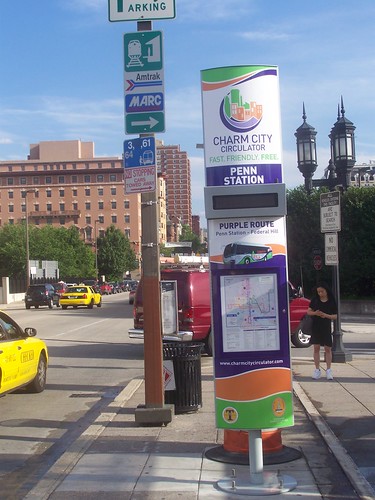
Charm City Circulator sign, Penn Station, BaltimoreParking taxes

 Lots of people park at places in the suburbs that don't charge.  While in the suburbs parking taxes could be assessed on parking lots and they should, regardless of whether or not they charge, in some respects charging for parking puts DC at a competitive disadvantage compared to the suburbs. 

So we have to make up for that by making DC totally awesome and worth coming to whether or not you have to pay to park.

Of course, we want parking to be charged for to encourage people to get here by transit (except for the fact that now a transit trip is so damn expensive).  These fees, and part of a proposed transportation withholding tax could be directed towards the transit system to help to reduce fare escalation.

In Baltimore, the Charm City Circulator bus is free, paid for by a tax on parking structures.  See "Baltimore Hotel Tax | Increases in hotel, parking taxes draw complaints" from the Baltimore Sun

Left:  Walmart's urban strategy hasn't fully percolated down to their advertising circulars.  I am amazed at how the circulars in the Washington Post prominently feature guns.  Fortunately the murder rate has been dropping for years.  Still, I think they need to better "zone" their advertising message for urban markets.


Guns and bullets

A few weeks ago, there was a column in the New York Times, "If Guns Do Not Kill, Tax the Bullets," suggesting that a way to reduce gun violence would be to make guns and bullets expensive, through taxation.

I thought that was pretty interesting, since we're not likely to get Congress to back off of being the NRA's lapdog, that might be the best way to go.

Ideally, such a tax would have to function at a multi-state scale or nationally (which isn't likely to happen anytime soon).  Chicago is proposing such a tax ("Chicago Area Proposes First Local Tax on Guns, Bullets" from the WSJ) and while some of the caveats of such a law is that lawbreakers tend to purchase guns and bullets illegally anyway, it might not have much impact.  But without such a tax operating on a scale broader than the city (in DC there are fewer than two places where you can buy guns I think), people will merely avoid the tax by purchasing items somewhere else.

Car taxes/higher registration fees

This is another area that bears consideration.  I used to think such a tax was onerous--I never heard of such a tax, as I was from Michigan and they would never treat cars as taxable property for residents, but when I first moved here I learned that they were common in Virginia at the state level and locally--but the reality is that such taxes help to pay for transportation infrastructure, just as property tax on buildings pays for the operation of local government.  (Image of the Arlington County car tax decal from the 12 Circle blog.) 

Such taxes and fees if they exist are generally pretty low.  In DC though, people may try to avoid local registration, because there is a high transfer fee when you first register.

-- Arlington County Vehicle Personal Property Tax webpage.  The tax rate is $5/$100 of assessed value, prorated by the number of months the car is registered in the county.

In Washington State, jurisdictions can add a fee for transportation improvements of $20 without having to get voter approval.  A higher rate can be assessed if voters approve.  So far, after having been put to the voters in many jurisdiction, no jurisdiction has successfully done won a higher fee.  An attempt in Seattle failed last year.  See the past blog entry "Seattle car registration supplemental charge not likely to be approved today by voters." 

--Washington State Licensing: Local transportation benefit district fees

Since the cost on the road system for maintenance is a minimum of 6 cents/mile or $600 for 10,000 miles, $20 + gasoline excise taxes don't go very far, especially when considering the cost of adding new infrastructure.  If you bought all your gasoline in DC or Maryland, you'd pay 41.9 cents/gallon in federal and state gas taxes.  If you get 22 mpg, you'd pay a total of $190 in excise taxes. 

Probably the property tax on vehicles is a better bet.

Note that the current 25th anniversary issue of Governing Magazine has a story, "What Will Government Look Like in 2037?,"  where they ask various people what they think will be the most pressing and biggest changes in state and local issues over the next 25 years.  Joshua Schank, President of the Eno Center for Transportation, believes that we won't have VMT-based excise taxes nor a high gas tax, that instead, monies for transportation will mostly come from general funds.

Labels: , , ,