Rebuilding Place in the Urban Space

"A community’s physical form, rather than its land uses, is its most intrinsic and enduring characteristic." [Katz, EPA] This blog focuses on place and placemaking and all that makes it work--historic preservation, urban design, transportation, asset-based community development, arts & cultural development, commercial district revitalization, tourism & destination development, and quality of life advocacy--along with doses of civic engagement and good governance watchdogging.

Saturday, June 25, 2022

Gas tax holiday versus free transit: policy versus politics

Earlier in the week I got into an argument with a friend, a teacher, who made the point that renewal of the child tax credit ("Joe Manchin is choking off one of America’s best anti-poverty programs," Washington Post) would have a lot more impact on people than a gasoline excise tax holiday ("Oil dependence | The US as a Petro-state and gasoholic," "Will Biden's Gas Tax Holiday Make a Difference?," New York Times).

I was pretty spirited, making a couple points:

1.  As a "transportation planner" obviously I think a gas tax holiday is a mistake, because it "defunds" transportation improvements, and frankly the federal gas tax should be much higher and indexed to inflation anyway--it hasn't been raised in 30 years ("How the gas tax could help pay for a $1 trillion infrastructure proposal," Washington Post).


Editorial cartoon, Mike Luckovich, Atlanta Journal-Constitution

2.  But that given the President is being blamed for inflation and high gas prices ("Wonking Out: Lies, Damned Lies and Gasoline Prices," NYT), even though the entire world is experiencing inflation and high gas prices in the same way, and the primary reason for high gas prices in the US is not "Biden not approving that pipeline" but reduction in the supply of refinery capacity ("US May Never Build New Refinery Even With Surging Gas Prices, Chevron CEO Says," Bloomberg), he "needs to do something to show he cares and 'feels the pain'" of the average citizen ...

ESPECIALLY AS THE MIDTERM ELECTIONS APPROACH AND VIRTUALLY EVERY PREDICTION IS THAT THE DEMOCRATS WILL LOSE THE HOUSE FOR SURE AND PROBABLY THE SENATE.

3.  I explained to her about Senators Sinema and Manchin who are functioning as Republicans and are holding back the achievement of any significant Democratic Party initiatives, and how even if the child tax credit "is more important" Biden can't get it passed without Sinema and Manchin.  That's reality. 

Not policy purity.  So he has to do what he can.  And I can be a purist, or I can be pragmatic.

Which is why I find this point by transit advocates, "Suspend transit fares instead of the gas tax, climate advocates tell Biden" as reported by the Washington Post, equally frustrating.

Similarly, it's fair to say that I am a fervent proponent of transit.

BUT THE MIDTERMS ARE COMING.

ALMOST 83% OF TRIPS IN THE UNITED STATES ARE MADE BY CAR.  

2.5% OF TRIPS ARE MADE BY TRANSIT.

Total Trips, National Household Travel Survey, 2017
Private Vehicle    
Transit Walk Other*
82.6% 2.5%10.5% 4.4%

 * Other includes biking.  Source: pages 30/31.

HOW MUCH EFFECT ON PEOPLE'S VOTING DECISIONS ARE WE GOING TO GET FROM FREE TRANSIT, IN A NATION WHERE MOST PEOPLE HAVE ZERO USE OF AND MINIMAL EXPERIENCE WITH TRANSIT?

Sure I think we should have free transit, but the politics of it, in a nation that is so dominated inextricably with automobility and automobile dependence to the point where people aren't even capable of recognizing it, are impossible.

I understand and appreciate the pureness and zealotry of advocacy, but what's more important:

- free transit now versus a gas tax holiday

or 

- the Democrats not getting totally destroyed in the midterm elections?

======

Because our mobility system is so automobile dependent, most people can't substitute one form of mobility for another, say transit for a car, because the transit network--especially outside of historical legacy cities--isn't particularly wide or deep.

I consider myself fortunate to have lived in DC for 32 years, where a dense sustainable mobility network exists--at least in the center city--so that I could experience the reality that it is possible to live without being car dependent.

-- "What matters isn't "transit oriented development": what really matters is compact development and integrating transportation and land use," 2011
-- "Further updates to the Sustainable Mobility Platform Framework," 2018 
-- "DC is a market leader in Mobility as a Service (MaaS)," 2018

Labels: , , , , ,

Thursday, July 20, 2017

Oregon's excise tax for bikes: bring it on!

=======
Update:  Great piece with a similar argument, from the Tempe Bicycle Action Group, "On Portland’s Bike Tax & Pittman-Robertson (But for Bicycling)"

From the conclusion:
I’ve long thought that the cycling industry should employ the strategies and tactics that the hunting and firearm industries use. This is a simple persuasion play using their exact tactics – we pay for our own stuff and thus we deserve it. This is so powerful that it cannot be outflanked and there is no city department or politician who can say you don’t get use your ear marked tax dollars. It was so successfully in the hunting industry that, 13 years after it was passed, a similar law was passed to benefit fishing and the fishing industry begged for it to pass!

The cycling industry can lead the way here. However, it will take a leadership change along with advocates who understand that most of the arguments against cycling are based on perception. Instituting a C-PR type bill would immediately swing the tide in transportation funding and wipe out the largest perception: Cyclists don’t pay their way.

The recent tax on bikes in Portland has immediately put the cycling community on the same plane as motorists. Some say the the tax was instituted as a punitive measure by non-cyclist groups intended to punish cyclists – even it it is, it was a grave tactical error. We’ll soon see whether the business owners and advocates in PDX embrace their new found power or continue to look this gift horse in the mouth.
=======

I consider it hypocritical to advocate for stuff like bicycle infrastructure or arts facilities and not think about how to pay for it. 

WRT arts and cultural facilities, I've written about this extensively and am a fan of systematic tax assessment districts (sales and/or property) creating arts and parks districts that function at the metropolitan scale, such as the Huron Clinton Metropolitan Parks Authority in Southeastern Michigan, the Regional Asset District in Allegheny County (Pittsburgh), Pennsylvania, the Zoo, Arts, and Parks Tax in Salt Lake County, Utah, and the Science, and the Science and Culture Facilities District in Metropolitan Denver.

The advantage of metropolitan scale funding streams is that typically major arts anchors are located in the center cities, but many of the attendees come from the suburbs so a metropolitan rather than a city-exclusive tax makes funding more congruent.

I am not a fan of "sin taxes" on tobacco to fund the arts, like what Cleveland does ("Cigarette tax helps arts achieve twice the attendance," Cleveland Plain Dealer) because the tax doesn't target likely users of what the funding stream will support.

Today's Washington Post has a story ("Bicyclists fear that Oregon's controversial bike tax could spread") about Oregon's new excise tax on bicycles making the point that anti-taxers and some cycling advocates don't favor it.

First, I'd say the excise tax on bicycles isn't a lot different than the stream of taxes on fuels and outdoor equipment that fund certain land and water conservation activities or excise taxes on cars or gasoline.

Sure, excise taxes on cars should be a lot higher than they are to better compensate for the costs imposed on government for maintaining the road network.  The same goes for gasoline taxes, which I have written about ad infinitum.

Second, although you can make the argument like how there are tax credits for renewable energy, electric cars, etc., to encourage and incentivize optimal behavior and consumer choices, bikes shouldn't be taxed because as a choice of transportation, it is an almost incalculably better form of transportation compared to motor vehicles.

Third, the last thing I'd want to do is call myself an intellectual hypocrite, the way I criticize arts groups that seek exemptions from admissions taxes on tickets for performances while asking for public funding.

Anti-tax advocates are lying if they state their arguments are about government overreach because they don't appear to be concerned much about or believe in "society" as a separate from government, and how government is the means by which we organize to provide "public goods."  Instead, they abhor people coming together to fund projects that improve quality of life calling it a form of "collectivism."

It's hard to come up with many situations when I would be on the same side as such folk.  This isn't one of them.

Fourth, I do agree it won't raise much money, and that makes it questionable.  Yes, it's more likely that the tax was created as a sop to motordom, as many motorists complain about bicyclists not paying their fair share for roads, forgetting the reality that since half the cost of roads are paid by general funds, bicyclists do pay their fare share anyway. 

Frankly, given that I purchase a new bike only every 7-10 years, I can't see this being a huge funding source.  But every little bit helps.  (Actually, an excise tax on tune ups would probably raise more money.) 

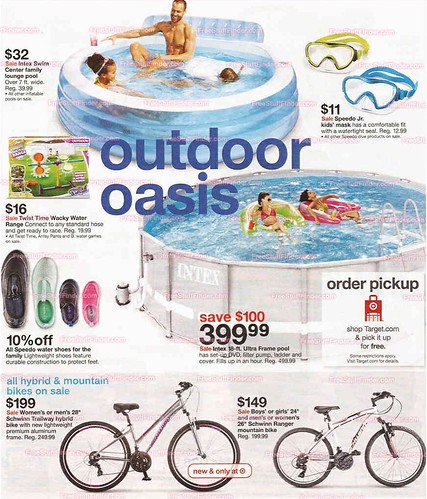
And by having a $200 floor at which the excise tax would be imposed, too much money would be left on the table, because most bikes sold at discount stores like Walmart or Target cost less than that.
Target-Weekly-Ad-Scan-61817-f
Target Weekly Ad, 6/18/2017

This would negatively impact bicycle-exclusive and outdoor equipment stores vis a vis large chain retailers, which would not be particularly supportive of independent retailing and building a local economy.

Fifth, rather than complain about bike excise taxes and subject bicyclists to criticism that we aren't interested in paying "our fair share," it would behoove us to come up with the right and better agenda for promoting biking for transportation/sustainable mobility as a part of taxing and other government  policy and action.  A bike sales excise tax is but one element. 

Here is a by no means complete but bigger set of issues where I would like to see action by federal, state, and local legislators:
  • Higher federal and state/local excise taxes for motor vehicle purchases
  • Getting higher commuter tax benefits for biking as right now it is $20/month, versus $255/month for transit or parking
  • Allowing the combination of transit+biking benefits to be used together, rather than forcing a choice of one or the other, which would be particularly useful for bike sharing
  • Payroll deduction plans for buying bikes (the UK does this)
  • Creating a national system of "versement transport" (transit withholding) taxes, like France (a form is used in Oregon and in Greater New York City 
  • Reducing local taxation on car sharing (When Sharing is Taxing: Comparing the Tax Burden on Carsharing in Major U.S. Cities, Chaddick Institute of Metropolitan Development, DePaul University)
  • Higher prices for residential car parking permits
  • requiring that bikes typically used for transportation have as original equipment on the bike, front and rear lights
  • create a standard for turn signaling lighting for bicycles and include such lights as original equipment 

Labels: , , , , ,

Wednesday, February 22, 2017

LOL Quote of the Day: fuel prices have little effect on gas consumption (Letter to the editor of the New York Times)

Yesterday's New York Times has a set of letters to the editor ("Conservatives' Plan for a Carbon Tax") on the carbon tax proposal offered by a number of Republican luminaries calling themselves the Climate Leadership Council ("Carbon Tax- Not Perfect, But Good Enough," Forbes Magazine).

One, by Scott Edwards, co-director of the Food and Water Justice Program at the advocacy group, Food and Water Watch, made me laugh good and hard:
It is promising to see conservatives finally suggesting ways to protect our planet from the effects of climate change. But their proposed solution of a carbon tax is built on a false premise: that economic pressure will attach itself to fossil fuels as readily as it does to some other consumer products.

For example, their presumption ignores the fact — as documented by the Energy Information Administration and experienced by anyone who must drive regularly regardless of cost — that fuel prices have little effect on gas consumption. This is partly why a carbon tax in British Columbia in 2008 has failed to reduce carbon emissions.

Carbon tax schemes are supported by Democrats, Republicans and even oil and gas giants like Exxon Mobil because they avoid stricter environmental regulation and allow for corporate business as usual. Only reining in the extraction of fossil fuels at their source — keeping fossil fuels in the ground — will limit greenhouse gas emissions and looming climate catastrophe.
It should be obvious why I laughed.

How amazing is it that under the Trump Administration, the Secretary of State is Rex Tillerson, former Chairman of ExxonMobil?

Because the U.S. is a major producer of oil ("The Petro States of America," Businessweek; The petrostate of America," Economist), its land use and transportation planning paradigm promotes the consumption of gasoline.

To facilitate this, it means keeping the cost of gasoline relatively low.

In keeping with the promotion of oil consumption, for 70+ years, US land use and transportation policy has prioritized "sprawl," the form of land use that requires an automobile to get around.

After so many decades of developing the built environment in a manner that requires a car, of course in the short term--which over the course of 70 years can be a minimum of a decade--gas price increases of a "medium" amount won't change consumption that much, because it is very difficult to change the built environment in ways that support a reduction in gasoline use.

And in fact, on an inflation-adjusted basis, gas prices are still pretty cheap--the 30 cents/gallon I remember from just before "the gas crisis" would be $1.75 today.

Even if on the margins, price rises do lead to increased transit use ("Lower Gas Prices Test Transit Ridership Models," Wall Street Journal) and a shift from larger to smaller automobiles, with improved efficiency ("better gas mileage").

These days, as gas prices have declined, the US auto industry is selling a higher proportion of SUVs and larger automobiles ("Low gas prices boost SUV and pickup sales," CNN).

On the other hand, as discussed in David Owen's book Green Metropolis and the extensive writings by Jamie Kenworthy and Peter Newman (e.g., "Australian Peter Newman: To make a sustainable city, boost rail and reduce driving," Portland Oregonian), it is possible to create a different kind of land use and transportation planning paradigm.

In some US and Canadian legacy cities, a robust transit network and high density development means that many households aren't automobile-dependent and per capita energy consumption is significantly lower than the national average.

-- "Earth Day," 2015

The inflection point on the price of gasoline between North America--Canada is also a major energy producer--and Europe came with the "Gas Crisis" of 1973, when Saudi Arabia expropriated its oil industry and raised prices.

The US did respond to the change in oil pricing by promoting energy efficiency, in many elements of the economy, including cars, but it didn't change the land use planning paradigm, nor did the Federal Government institute high excise taxes on gasoline.

So while energy efficiency has improved for cars, appliances, trucks, manufacturing, etc., overall use has risen, partly because of the rise in population, but also because of the continued dominance of an automobile-dependent land use and transportation planning paradigm.

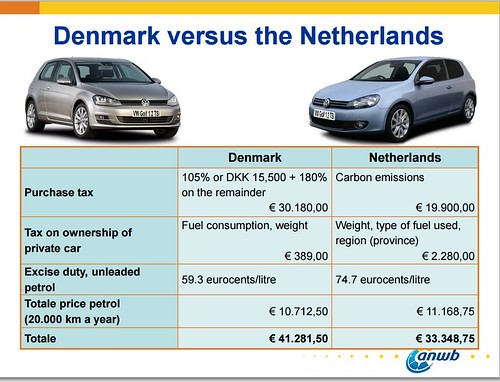
Cost of owning a car in Denmark and the Netherlands
The cost to own a car both to purchase and to operate on an annual basis is significantly higher in most European countries than it is in the US.  Slide from a presentation on car taxes in the Netherlands. 

By comparison, in DC a 6% sales tax is applied, as well as an additional purchase excise tax of 6-8% depending on car weight, and a small registration fee.  The sales and excise taxes on a  car costing $50,000 would be as little as $6,000--less than 1/3 the cost compared to the Netherlands and about 20% of the cost in Denmark. 

Europe is the opposite.

Out of a desire to increase their political and economic resiliency, by contrast most European countries responded to the quantum change in the price of oil by choosing to prioritize policies, practice, and investments that reduced dependence on oil.

That meant shifting to sustainable mobility when possible and to emphasize this change in policy, most of these countries significantly raised the price of gasoline, which by contrast to today's price in the U.S. of say $2.50/gallon, in Denmark, today, the price is $5.54.  And such pricing has been the norm for decades.

These countries also significantly raised the excise tax on a car purchase, equal to as much as 100% of the cost of the car, and made it much more expensive and difficult to qualify for a driver's license.

In Europe, there is no question that "fuel prices have had a big effect on gas consumption."

That's why diesel engines are popular there--because they get significantly better gas mileage, but at a severe cost to air quality.  It's why electric trucks are competitive with diesel engines, because the excise tax on fuel means that despite the higher cost of an electric motor, the overall cost is still cheaper.  It's why transit networks in many European cities are deep and wide.  It's why when people buy cars, they buy smaller ones rather than bigger ones.  It's why they try to live close to work, and in denser quarters.  Etc.

Is a carbon tax enough to change long term policy that prioritizes automobility?  In North America, the truth is that a $40 tax per ton of carbon is probably not enough to shift the land use and transportation planning paradigm towards the kind of built environment and transportation system that isn't reliant on gasoline and the automobile.

That's why Food and Water Watch can say that British Columbia's carbon tax isn't having much effect--they are one province out of many in Canada, and policies like these need to be coordinated at a very large scale, maybe even larger than the nation--at the scale of the continent.

If you want to shift energy and land use development policy and practice, raise the price of gasoline, in steps, to levels comparable to those in Europe.  Or do both.  But as long as gasoline prices stay low, it is too difficult to shift behavior and practice in a structural fashion.

Instead, change comes very slowly at the household, community (many cities and counties have sustainability plans), and state/province scale, not being coordinated in a comprehensive fashion at the scale of a state, nation, or continent.

-- "Quote of the day: "it isn't the place of the government to push people out of their cars and into alternative transportation"," 2015

Labels: , , , , , ,

Wednesday, July 27, 2016

Transport Politic's definitive piece on the Republican and Democratic Party Platforms positions on infrastructure

Last week, I wrote a very short piece on the Republican Party Platform on city-related issues ("A missed opportunity to focus on the Republican urban agenda at the Republican National Convention") focusing on what could a Republican urban agenda look like, recognizing that Republican representation at the federal and state level tends to skew rural and exurban.

I haven't yet looked at the Democratic Party Platform or the position statement on infrastructure of the Democratic Nominee, Hillary Clinton.

Transport Politic has gone through and compared both platforms, created a handy table, etc.  The entry, "Both parties claim support for investing in infrastructure. But how will they do it?" needs to be read widely.

Thank you, Yonah Freemark!

Summary of the respective positions -- from Transport Politic

Democratic Party and Hillary Clinton Republican Party and Donald Trump
Federal role in transportation Expand to emphasize multimodalism; encourage connections between transportation, cities, climate, and social equity Reduce to only encompass highways (GOP); or fund all types of transportation (Trump)
Funding for transportation Roughly double overall spending using business tax reform, create infrastructure bank Do not adjust funding to inflation (GOP); or expand massively through unknown means (Trump)
Transit and intercity rail Increase support to build social equity and combat climate change Eliminate federal role (GOP); or improve (Trump)
Non-motorized modes Improve funding for biking and walking projects Eliminate federal role
Climate change Orient transportation investments toward responding to climate change Do nothing to address climate change; invest in coal
Project management Support union requirements Eliminate union requirements

The need for national transportation mode plans.  One of the things that hurts is not having federal or national transportation plans that Congress acknowledges.

Although for the most part, Congress accepts and lauds the National Highway System comprised of the Interstate Highway System and other road networks.

But they won't adequately fund the system, which is now mostly reaching the end of its useful life and needs money for rehabilitation and improvement.

But other modes often don't have plans, including shipping and ports, biking, transit, and walking.  Of course, even if we had plans, would Congress care?
Amount of space required to transport the user the same number of passengers by car, bus, or bicycle

National Rail Plan.  For example, Congress passed legislation, the Passenger Rail Investment and Improvement Act of 2008 (PRIIA), requiring the creation of a National Rail Plan, complemented by plans created by each state.  (States that pass rail plans can then create regional plans crossing state boundaries.)

But even though there is a National Rail Plan, the Republican-controlled Congress tends to be anti-Amtrak and anti-National High Speed Rail, but pro-privatization, even though most observers consider Britain's rail privatization -- the most significant example of such a program -- to be highly problematic and one that has experienced many setbacks

With regard to the capacity of Interstate freeways, diverting freight movement from trucks to freight rail can add significantly to throughput.

Biking (and pedestrian) planning
.  Other countries demonstrate that in urban areas, bicycling can comprise a significant proportion of daily trips, albeit mostly in cities.

I have a piece discussing "What should a US national bike strategy plan look like?" which outlines setting goals for sustainable mode splits for biking that are much higher than the current national average.  But for the most part, Republicans in Congress--even if they bike themselves--deride biking as an activity for children, not as a serious transportation mode.

Other countries, such as Germany, the Netherlands, Denmark, and the UK, have national cycling plans.  The UK, with low rates for trips by cycling--like the US--sets a goal for a doubling of trips by bike by 2025. 
Bicycle Traffic as a system, diagram, German National Bicycle Plan, 2002-2012

The organizing principles for such a plan:

1. Urban Form and how it shapes transportation choices. Include section discussing urban form based on the concepts of Peter Muller (Walking City, Transit City, Recreational Auto Era, Metropolitan City) and how it shapes transportation choices, how we got to where we are today, etc.

2. Transportation Physics and Mobility Throughput. This is pretty basic, that you can move more people by walking or transit or biking in the same amount of space used by cars.

3. Other policies that shape mobility choices and current practice. There was a great piece, "The Petro States of America," in Businessweek about how the US is a major petroleum production nation (that should be obvious) and how that shapes economic and other national policy in multiple ways that support oil production and consumption.

4. Bicycles as toys/bicycles for recreation vs. bicycling for transportation.

5. Creating social and behavioral change through structural-systemic change, social marketing and other processes.  Consider how this article, "Gentle Nudges Work to Get People Exercising" (Wall Street Journal) discusses the adoption of positive health behaviors as routine practices and apply it to sustainable transportation practices.

6.  Differentiating sustainable transportation policy and practice according to spatial form, specifically whether the predominate land form is urban, suburban, or rural.  My piece "Ideas for making bicycling irresistible in Washington DC" discusses this with regard to the urban setting, and the work I did in Baltimore County focuses on suburban oriented practices ("Best practice bicycle planning for suburban settings using the action planning method").

Transit planning.  Similarly, instead of deriding transit as being widely used only in six cities (as Yonah points out, they are incorrect, as the top 10 most populous cities comprise 47% of the base of transit users), transit's effectiveness where it works superlatively should be celebrated!

Because transit is so much more efficient in moving significant numbers of people, Congress needs to learn and acknowledge the factors that lead to success.  Instead, like with the recent hearing on WMATA--the transit system in the DC area--and its safety failures, the House Republicans take the opportunity to denigrate transit whenever they can.

Because transit is so expensive to build and fund, and because metropolitan areas are the most significant economic units and producers in the national economy, there is a justifiable federal role in transit funding and planning.

Ports and shipping.  It's incredible to me that we don't have a national ports planning process.  Because of the expansion of the width of the Panama Canal, ports across the country are expanding.  But there isn't enough business to go around.

Tough choices should have been made to limit wasted investment ("Panama Canal expansion exposes US infrastructure, shipper woes," Business Insider; "The Post-Panamax Effect: How the Panama Canal Expansion is Reshaping America’s Ports," CBRE; "East and West Coast Ports To Battle for U.S. Region After Panama Canal Expansion," C.H. Robinson).

Airports.  I don't know much about airport planning.  I know that there are negatives about the push by Congress to privatize the air traffic control system ("Shuster wants to turn air traffic control over to a nonprofit," Pittsburgh Post-Gazette; "Privatizing air traffic control will increase traveler costs," USA Today).

But there are many flaws in the way the airport system works, especially in the limitations on the use of airport-derived funds to fund transit connections that also benefit non-airport users. Similarly, shorter distance airport trips, such as between DC and NYC, would be best shifted to faster rail, were the US to have a high speed rail system.

A framework for national transportation planning
.  I define regional as either multi-state and as two or more metropolitan areas.  I delineate transit networks from this blog entry "Second iteration, idealized national network for high speed railpassenger service"

-------
this is based on thinking about transportation networks in five overarching dimensions:

1. International -- connections between countries. (The map above shows a couple connections between the U.S. and Canada, and one connection from San Antonio to Monterrey, Mexico through Laredo.)

2. National -- anchors of a national transportation system, current anchors are the Interstate Highway system, the freight railroad system, and airplane travel. We do not have a robust national passenger railroad network presently, although Amtrak complemented by state support, has a number of heavily used corridors.  Commuter systems operate separate from Amtrak, and don't benefit from its preferred access to freight railroads.

3. Regional -- multi-state connections -- for the most part these don't exist for transit, but do for freight railroad, airplane travel, and the Interstate highway system. The Northeast Corridor railroad passenger service offered by Amtrak is an example of such a transit network.  Inter-state bus services operate more on a regional footprint.

4. Metropolitan -- transit systems like the WMATA subway and bus system, the combined railroad, subway, bus, and waterborne transit services in the NYC or Boston regions.

5. Sub-metropolitan transit systems (in the DC region, locally provided services such as RideOn in Montgomery County Maryland or the Downtown Circulator in DC are examples of services within the subnetwork category of the Metropolitan Transit Network).

Labels: , , , , ,

Thursday, April 21, 2016

Earth Day #2: The US should drop the ethanol requirement for gasoline

In a recent piece about the difference between "investment" and "spending" I used federal policies concerning ethanol as an example, writing:

Ethanol as an energy source for automobility is another example of spending vs. investing -- although good for corn farmers -- it takes 1.53 gallons of ethanol to generate the same amount of energy as 1 gallon of gasoline.  So adding any ethanol to gasoline reduces the miles per gallon that is achievable.

Again, I suppose you could argue that spending money on creating an ethanol energy-based infrastructure sets the stage for the move towards cellulosic ethanol, which is predicted to have an energy density up to 3 times greater than that of corn-based products.  But in the meantime the ethanol interests get entrenched and instead of moving towards better energy returns they lobby for the continued use of corn, even expanding it.

I don't know if it's the right topic for Earth Day, but ending the use of corn-based ethanol as an element of gasoline fuel stream needs to be addressed.

1.  Corn-based ethanol doesn't generate as much energy per gallon compared to gasoline.

2.  Producing corn for fuel diverts land from supporting food production and increases food costs.

3.  While from a climate change perspective it's not good to encourage the consumption of fossil fuels, it probably makes more sense to "let gasoline be gasoline" and "let corn be corn."  According to FactCheck, it's not clear that gasoline containing ethanol ends up producing significantly less greenhouse gas emissions compared to "pure" gasoline ("Ethanol: higher emissions or lower?").

4.  It would also increase consumption of gas a bit, which would help producers and those communities in the middle of the country that have been getting wrecked by the fall in the production of oil.

5.  There is a tradeoff between supporting gasoline consumption and US-based producers vs. foreign producers.  I'd say support the US producers.

6.  But only institute the change in association with an increase the federal gasoline excise tax, which would encourage sustainable mobility, a shift to more efficient vehicles, use of electric vehicles, etc.

Labels: , ,

Wednesday, January 13, 2016

With sustained reduction in gasoline prices, will suburban transit systems lose ridership and revenue?

Suburban bike, walking, and transit trips are longer than comparable trips in cities. I was in Southern California over the holidays, and thinking about our traveling and the difficulty for biking to accomplish the same kinds of trips, it made me realize that I had missed an important element when I wrote a pretty good Pedestrian and Bicycle Access Plan for Baltimore County, Maryland (also see the past blog entry "Best practice bicycle planning for suburban settings using the "action planning" method").

Whereas the National Household Travel Survey found that 51% of trips are three miles or less--with 29% one mile or less, and 13% three to five miles in distance--seemingly a good distance for capture by biking, the averaging of the data masks a likely fact, that trip distances for the average trip are likely to be significantly longer in the suburbs compared to center cities.

I haven't been able to track down definitive data on this, but there is a definite need to see this kind of data.

In short, while I live five miles from Downtown, but within the center city, I can get to many places within a 30 minute bike ride--besides Downtown and Capitol Hill and destinations in between, I can get to College Park, Silver Spring, and Bethesda in Suburban Maryland, and Friendship Heights, Tenleytown/American University (the library primarily), and Georgetown outside of the city's core.

Sustainable mobility is less efficient over long distances.  It's much harder to reach many places within a five mile trip/bike ride/transit trip in the suburbs, except within conurbations (e.g., within Bethesda but not between Bethesda and Rockville, within Silver Spring, or within Wheaton, but not so much in-between), not to mention that the riding conditions tend to be much more comfortable in the city as opposed to the suburbs, something that Montgomery County is addressing in their current bike planning efforts ("Making way for bicycles in a sprawling suburb where cars have always ruled," Washington Post ).

This is relevant to transit use obviously, because middle distance trips can take a long time on transit, and even longer trips may or may not be efficient depending on how the transit is delivered (commuter bus, railroad, regular bus, heavy rail, light rail).

Not to mention that most suburban transit systems deal with vast deconcentrated areas, and dispersed destinations and origins, making it hard to create an efficient transit system. Cities are advantaged by transit because of short distances between activity centers and origins, and concentration of both population and employment centers.

Image from PotomacLocal.

Prince William County transit system to raise fares and cut service.  I bring this up because the Potomac and Rappahannock Transportation Commission, operators of the OmniRide transit service in Prince William County, Virginia, which is about 30 miles from DC and to my way of thinking exurban, although it is decidedly a part of the Washington metropolitan area, is planning service cuts and fare increases.

PRTC provides intra-county transit services as well as commuter bus service to DC and other destinations, and is one of the owners of the Virginia Railway Express commuter railroad service,

Even though the transit system is benefitting from reduced cost of motor fuel, their ridership is dropping too, as people switch from transit to driving because of drops in gasoline prices, and the price/value equation of transit and driving in terms of not only dollar cost, but time.

-- PRTC SERVICE CUTS AND FARE INCREASE PROPOSED FOR JULY 2016

Four hearings are scheduled for February. Cuts involve longer distance commuter bus service as well as intra-county transit service. Documents accessible at the webpage discuss the budget proposal and conditions shaping the agency's funding in more detail.

Besides revenue losses, Prince William County's portion of the budget comes from state gas taxes, which isn't enough to cover the county's subsidy, and the county hasn't provided additional funds outside of the gas tax revenue stream.

Virginia reset its gasoline tax formula, so when prices go down, so do tax revenues.  The funding decline is accentuated by the fact that when Virginia moved to its present form of gasoline tax--a percentage of the total cost--it wasn't anticipated that the price would decline significantly, and a base or "floor" level amount wasn't prescribed by the legislation.

While the drop in fuel prices helps the agency a bit, it also cuts significantly into revenues from the fuel tax. (Note that this potential problem was identified before the legislation was passed.)

Conclusion. There are two different issues in Prince William.  The drop in ridership from substituting trips with a motor vehicle, because of falling gasoline prices.  And the drop in revenues from the gas tax revenue stream.

Other communities outside of Virginia won't have the latter issue to worry about, but should be impacted by the former--motor vehicle trips substituting for transit trips in lockstep with gasoline price decreases.

And loss in ridership generally makes a transit system less efficient, which makes it that much harder to garner support for transit in communities where the car is the predominate transportation choice.

Labels: , , , , ,

Tuesday, December 15, 2015

Top DC area transportation stories of 2015

[At some point, the numbering becomes arbitrary.]

1.  Gasoline/oil price drop.  While this started as a 2014 story, as the price dropped in half from June 2014 to the end of the year ("Oil Prices: What's Behind the Drop? Simple Economics"), now forecasters argue that low prices are here to stay, given drop in demand, increase in supply.

This impacts the cost-effectiveness of electric vehicles, increases vehicle miles traveled ("VMT Increases 19th Straight Month, Federal Report Shows") and reduces the demand for transit.  VMT has been decreasing on a per capita for some time.

2.  WMATA (DC area Metrorail subway service) tunnel fire at L'Enfant Station in January results in one death, continues to demonstrate safety and other operational failures.  Ridership continues to drop, while nationally, transit ridership is increasing.

In the fall, the US Department of Transportation assumed safety oversight for WMATA.  Later, Secretary Foxx of the US Department of Transportation, said that WMATA has no business working on expansion until it gets its operations right

Washingtonian's December cover story is on Metrorail ("The Infuriating History of How Metro Got So Bad").

3.  Continued degradation of the quality of WMATA's transit service/financial problems/ difficulty in hiring a general manager.  Paul Wiedefeld, who held various top jobs in Maryland, was finally chosen.  During the search process, top USDOT personnel took jobs elsewhere.  Elissa Knove is Deputy CEO of Metrolink in Southern California and Peter Rogoff is the new GM for Sound Transit in Seattle/Puget Sound (New Sound Transit CEO excited by big light-rail expansion," Seattle Times).

4.  In Maryland, Republican Governor Larry Hogan drops the Red Line light rail program for Baltimore City and County and reshapes the state's commitment to and the cost of the proposed Purple Line light rail program in Montgomery and Prince George's Counties.  A few months later, plans to improve Baltimore-area bus service are put forward to make up for the dropping of the Red Line.

5.  The May Amtrak crash in North Philadelphia kills 8 and injures more than 200, leading to more calls for Positive Train Control, and problems on the Northeast Corridor line, at least for awhile.  The investigation for causes continues.

6.  The ongoing debacle of the DC Streetcar, in testing for more than one year, when cities like Dallas manage to complete the test phase and start revenue service in 6 weeks, gives automobility opponents of transit a lot to cheer about and anti-government folks the ammunition they need to denigrate the ability of government to perform generally and to construct infrastructure specifically.

Still, more than $500 million in new development is underway or planned on the H Street corridor, which can be attributed to the forthcoming streetcar.

By comparison, the Cincinnati Streetcar construction and launch project has entered its testing phase, although it is not scheduled to launch until September 2016 ("City: 'Live-power' streetcar tests in Downtown Tuesday," Cincinnati Enquirer).  Construction started in 2012.  This is ironic because the Cincinnati project is managed by John Deatrick, former chief engineer for DC Department of Transportation.

Photo by Sarah Ann Jump, Fredericksburg Free Lance-Star.

7.  Tolling expansion.  In Virginia, the commitment is made to extend the I-95 lanes two miles further south to facilitate merging, although some believe it should be extended even further ("Stafford Supervisor rents billboard to get commuters views on traffic," Fredericksburg Free Lance-Star).

Plans to extend HOT access on I-395 ("Virginia to extend I-95/395 HOT lanes north to D.C. line," Washington Post).

Proposals put forward to toll I-66 ("State Approves I-66 Inside the Beltway Plan: Tolls Begin in 2017," Fairfax County) also used by Republican candidates in the 2015 election cycle to lambaste Democratic opponents.  New tolls and proposals for tolls in more places in Hampton Roads (Tolls articles archive, Norfolk Virginian-Pilot).

In Maryland, Governor Hogan cuts toll rates ("Governor Hogan Rolls Back Tolls Statewide," press release) the Inter County Connector begins to see increase usage, and the I-95 ETL toll lanes north of Baltimore experience more usage after opening in December 2014.

8.  Silver Spring Transit Center  (at right) finally opens in late September, without any ribbon cutting, because of the many year delays in opening ("Multiple missed opportunities in the creation of the Silver Spring Transit Center"). It's another example of transit infrastructure construction problems calling into question government performance.

9.  Death and violence associated with Metrobus service in DC (stabbing death at 8th and H Streets NE, shooting death of community journalist Charnice Milton at Pennsylvania and Minnesota Avenues SE while waiting for a bus, shots fired leads to a period of re-routing night-time bus services away from Elvans Road SE).

10.  Dulles Airport continues to lag National and BWI Airports.  Virginia Governor McAuliffe wants to put more money into marketing and other improvements ("Virginia Gov. McAuliffe proposes a $50M boost for Dulles Airport," Washington Post).  WMATA decides not to drop the 5A bus to Dulles, since the Silver Line won't serve the airport for a few more years.

11.  Railroad passenger service expansion moves forward.  Plans to expand Union Station and to improve rail service between DC and Richmond continue to move forward.  DC launches a "State Rail Plan" planning process ("State Rail Planning Initiative in DC"). Virginia Railway Express grows.  Why doesn't the Virginia Department of Rail and Public Transportation DC to Richmond Southeast High Speed Rail planning process hold a meeting in DC?  C100 lawsuit against the Virginia Tunnel CSX expansion project fails.

12.  Biking.  DC proposes legalizing the Idaho Stop for bicycling.  Former Episcopal Bishop gets serious jail time for killing a bicyclist while drunk ("Former Episcopal bishop Heather Cook sentenced to seven years for killing cyclist," Baltimore Sun).  In DC, fines are supposed to go up for certain traffic infractions ("Violate DC traffic laws? It's gonna cost you — a lot," Washington Post).

After 12 years, Andy Clarke steps down as president of League of American Bicyclists (Q&A: The League's outgoing president on state of biking," BikePortland), goes to work for Toole Design, the transportation planning consulting firm based in Silver Spring, Maryland.  Greg Billing succeeds Shane Farthing as director of Washington Area Bicyclist Association.

13.  Richmond hosts UCI Road Racing world championships in September to such success that Discover Richmond Magazine and Richmond Magazine name bicycling as "Richmond's person of the year in 2015." The Virginia Capital Trail, a 55-mile path between Williamsburg and Richmond, is almost fully completed, over a ten year period, along with other bike infrastructure improvements spurred by the Road Championships.

14.  More transit oriented development in Fairfax County in the catchment area of the Silver Line, accompanied with belated acknowledgement of the need to improve pedestrian access around Silver Line transit stations ("U-Va. professor takes steps to measure Tysons’ path to a pedestrian paradise," Washington Post, and ridership below projections ("Silver Line ridership in Tysons well below Metro estimates," WAMU-FM).

15.  Car sharing.  Car2Go expands to Arlington County, Virginia.  Zipcar loses the franchise for car sharing exclusivity on WMATA station grounds to Enterprise Rent-a-car.  In DC and other locations, Car2Go adds a $1 surcharge per trip, capped at $90/year.

16.  More bike infrastructure improvements and planning.  More bikes and stations for bike sharing as Motivate, the successor firm to Alta Bike Share, invests in capacity, improvements, and innovation.  More bike lanes.  DC starts using brighter green paint in bike lanes.  The Potomac Yard trail in Alexandria and Arlington opens.

Montgomery County starts a new bike master planning process, focusing on "comfort."  Prince George's plans the Central Avenue Corridor trail ("Comments on Central Avenue Connector Trail concept") and looks to join in on bike sharing ("Prince George's considers connecting with Capital Bikeshare," Washington Post).  Baltimore, after some failed attempts, looks to launch bike share service as well.  Richmond too.

But why does DC continue to install bike non-compliant sewer grates?  Why was the opportunity to build a cycle track on Military Road missed? ("Lost opportunity to build cycletrack on Military Road").

A Split vehicle on Dupont Circle.

17.  New mobile-enabled transportation services continue to be launched in DC including jitney type services by Bridg and Split, carpooling via Uber, etc.  I don't think they are the "game changers" claimed by the firms, but they do expand choices and facilitate mobility.

Local firm TransitScreen deploys transit information media presentations around the country.

18.  More bike capacity on trains: weekend Penn Line MARC train service and simplified bike service now available on Amtrak along the C&O Canal National Park and Great Allegheny Passage trails between DC and Pittsburgh ("Amtrak Offers More Bike Service on the Capitol Limited").

19.  Gabe Klein, former Director of DC Department of Transportation authors a book, Start-Up City, published by Island Press.

 20.  People continue to die in traffic accidents.  In DC, more pedestrians die than motor vehicle operators and passengers ("Crossing a street in DC can be a dangerous undertaking," Washington Post).

But that makes sense to me, given that the nature of DC's road network means that extremely high speeds--a factor common to a preponderance of accidents nationally--are much less of an issue compared to driving conditions in the suburbs and exurbs.

Labels: , , , , , , , ,

Saturday, October 10, 2015

Quote of the day: "it isn't the place of the government to push people out of their cars and into alternative transportation"

(Technically the line is part of the text of a San Diego Union-Tribune article, not a quote.)

San Diego County has just approved a long rang transportation plan ("Sweeping transportation, growth plan approved" and "SANDAG’s transit plan meets opposition," San Diego Tribune), that mixes road improvements equally budget-wise with various sustainable transportation projects.

The plan is interesting because it is required to meet State of California goals and objectives for reducing greenhouse gas emissions.

Critics raise two objections on the plan, which covers the next 35 years (and will be regularly updated on a four year cycle), that: (1) the sustainable mobility improvements (rail, skyway gondola, bicycle, pedestrian) are staged towards the very end of the planning period and (2) because of this, and because of the plan's focus on road improvements, GHG reduction targets won't be met.

-- 2050 Regional Transportation Plan, San Diego County Association of Governments
-- The Circulate San Diego sustainable mobility advocacy group argues that the plan doesn't go far enough

But I was struck by the comments by the Mayor of El Cajon:
Others, like El Cajon Mayor Bill Wells, said it isn’t the place of the government to push people out of their cars and into alternative transportation. He said the people who spoke at the meeting in favor of a greater emphasis on mass transit were a special interest group representing one percent of the population, he said.

“The people of El Cajon drive cars. I’m guessing that some of the people in your cities drive cars as well,” he said.
Of course people drive.  Over the last 60+ years we've built a transportation system that prioritizes and privileges the automobile.

As pointed out in a Businessweek article from last year, this is a result of the fact that the US is such a large producer of oil, "The Petro States of America." Note that it turns out that The Economist made the same point a couple weeks earlier.

Mayor Wells' belief is neither new nor surprising, but it's a constant reminder that people aren't considering the consequences of their beliefs and statements.

Choices have consequences.

Irrespective of the reality of path dependence--we've built a transportation system that prioritizes automobility, therefore most people "choose" to get around by car--the mobility choices people make impose greater or lesser costs on society and government is left holding the bag and has the responsibility to plan, build, maintain, and pay for the system that enables the mobility choices that people make without heed of the cost.

Because of the reality that choices impose costs, I always counter that arguments promoting sustainable mobility using "choice" -- it's better to have more choice on how to get around -- miss the point, because our arguments should instead be focused on achieving optimal mobility, and one of the measures of optimality includes the costs to "the taxpayers" to build and maintain the transportation system that enables the mobility system we have.

It's even worse because in the current political environment, it is a struggle to raise the necessary funds for the maintenance of the freeway system through increases in the gasoline tax, which most elected officials oppose, especially at the federal level.

This is further complicated because the average citizen believes that they are paying for the full cost of the road system through gas taxes, even though this isn't the case, not by a long shot.  It is estimated that to maintain a state of good repair as well as to pay for new projects, the federal gasoline excise tax should be at least 60 cents/gallon.
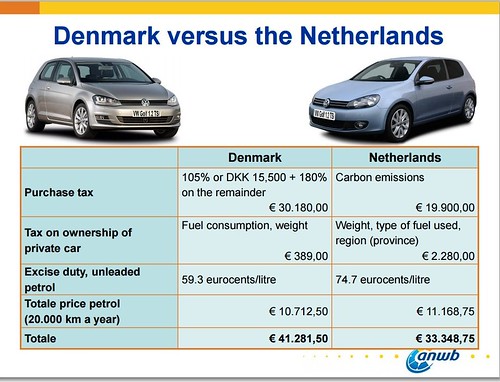
Cost of owning a car in Denmark and the Netherlands
The cost to own a car both to purchase and to operate on an annual basis is significantly higher in most European countries than it is in the US.  Slide from a presentation on car taxes in the Netherlands.

By contrast, in Europe the national government gasoline excise taxes are 20 to 25 times greater than in the US--although this includes what in the US is a separate state and local gasoline excise tax.  The federal excise tax is less than 20 cents per gallon.  Some countries impose excise taxes on car purchases that are as much as 100%.  And it's much more difficult and more expensive to get a driver's license.  Even in Norway, which like the US is a "petro state" although North Sea oil production is in serious decline, the combination of "road tax" and a tax on greenhouse gas emissions is 68 cents/liter or about $2.60/US gallon.

Labels: , , , , ,

Wednesday, June 03, 2015

Reduction of gas prices as a lost opportunity to increase federal gas taxes "significantly"

It is predicted that because of worldwide recession, significantly increased supplies, and Saudi Arabia's continued sale of large amounts of oil despite low prices (but also because a byproduct collected from oil production is natural gas, which is used to generate electricity and for heating and this requires a minimum production of 8 million barrels/day) as a strategy to retain market share, gasoline prices will remain low for a long time.

-- "Prices Are Down, but Saudis Keep Oil Flowing," New York Times
-- "Petro States of America," Businessweek

Image from InvestmentMine.

Now the price for oil is around $60/barrel, which is not quite half the cost compared to the same time last year.

In Europe, gas prices are very high because of massive excise taxes.  The funds don't necessarily fund only transportation.

For example, the price of gasoline is almost $10/gallon in Norway--even though the country is a large producer of oil--and the revenues help fund the nation's social programs.  In other European countries, the price per gallon ranges from about $5.50 to $8.00.

High gasoline prices discourage car use, encourage use of sustainable transportation, especially transit, and the use of electric vehicles--e.g., when a gallon of gas costs close to $8, electricity-fueled cars and especially trucks, despite the high cost of batteries, are still a cost effective choice.

The federal gasoline tax is about 18 cents per gallon and has been the same price for more than 20 years.

The Federal Highway Trust Fund is supposed to be generated solely by the gasoline tax.  The budget is about $45 Billion, but revenues from the gas tax are short by at least $10 Billion.

-- Highway Trust Fund projections, Congressional Budget Office

Between inflation and increased costs of maintaining aging infrastructure, the expenditures should be increased to at least $60 Billion total.

-- $2.756/gallon  Today's average gas price, AAA
-- $3.65/gallon, average price, Memorial Day, 2014, AAA
-- "Gas Prices Have Probably Peaked for the Year," Time Magazine

Doubling the federal gas tax, and indexing it to inflation to address future needs, maybe with an additional inflator based on a projection of ongoing increased demands for maintaining aging infrastructure would be "economically easy" now, given that gas prices look to stay comparatively for a few years.

... yes, circumstances can and will change.  In the meantime, the roads aren't fixing themselves.

Labels: ,

Wednesday, January 07, 2015

Slight update to New Year's Post #3: top transportation stories

-- New Year's Post #2: DC area top transportation stories of 2014

In the discussion, commenter h st ll made the point wrt item #27. While high speed rail development continues to be controversial and languish in California, that I was selling the state of California high speed rail short, that it was about to start construction.

Item 27 is listed in the section of "Other/National" matters.

Dignitaries and VIP's line up to sign a portion of the rail at the California High Speed Rail Authority ground breaking event, Tuesday, Jan. 6, 2015 in Fresno, Calif. The $68 billion project faces challenges from Republicans in Congress eager to reduce government spending and Central Valley farmers suing to block the train from crossing their fields. The train would whisk travelers at 200 mph between Los Angeles and San Francisco in less than three hours. (AP Photo/Gary Kazanjian)

He's right of course.  Yesterday, the first (ceremonial) groundbreaking, highlighting the start of construction occurred in Fresno.  See "Groundbreaking at Fresno for high-speed rail ,"from the Sacramento Bee.  From the article:
"Everything big runs into opposition," Brown said, calling the project's critics - some of them protesting at the fence line - "weak of spirit."
The Other/National section has another 9 items, ending at #30.

But there should be at least one other item added, numbered around 24 or 25, which would make the total number of items at 31.

The veto by Governor Cuomo of New York and Governor Christie of New Jersey of reform and accountability legislation for the Port Authority of New York and New Jersey.  The legislation grew out of investigations concerning the 2013 lane closure scandal on the George Washington Bridge, which was done to "punish" a Democratic mayor who didn't endorse Republican Governor Christie for reelection.

The scandal touched off greater consideration of the way the authority, a bi-state authority where the board members are appointed by the governors of each state, and certain executive positions are "allocated" between the states, operates and the misuse of funds, especially by New Jersey, for projects not related to the mission of the agency.  That led to the accountability legislation, unprecedentedly passed unanimously by the legislatures of each state.

But not wanting more checks on their power, the governors vetoed the legislation.  It's not clear if the legislatures will be able to override the vetoes ("Opinion: Port Authority reform is needed now," Bergen Record).

Separately, at the behest of the governors, a commission was formed to review the operations of the authority, and they released the report last Saturday, when the veto actions were announced.

-- Keeping the Region Moving, A report prepared by The Special Panel on the Future of the Port Authority for The Governors of New York and New Jersey

 From "Port Authority transformation will take time, top appointees say" (Bergen Record):
Those include selling the recently completed One World Trade Center in lower Manhattan, handing over operation of the PATH train system to NJ Transit or another operator, and shuttering a small port on the Brooklyn waterfront and turning it over to commercial developers.
The Port Authority generates most of its revenues from tolls on area bridges and from its operation of the region's airports in NY and NJ.

Part of the financial problems faced by the Port Authority concern PATH, the subway system connecting Newark, Harrison, Hoboken, and Jersey City to lower Manhattan. The system has an annual deficit of $300 million.

PATH is both railroad and subway, because in some places the tracks interlock with Amtrak and NJ Transit commuter railroad services.

Therefore PATH is regulated by the Federal Railroad Administration, not the Federal Transit Administration.  Not only does that make regulation more expensive, PATH ends up not being eligible for funding from FTA for the provision of urban transit services.

Among the report's discussion is the suggestion that PATH should be priced as a railroad service rather than a subway service, pegged to the pricing of the NYC Subway ("Doblin: The road less traveled is called the PATH," Bergen Record; "What's the real reason the Port Authority is targeting the PATH," NJ.com).

Meanwhile Hoboken and Jersey City have successfully positioned their cities as an extension of New York City, but cheaper, because of PATH service (not unlike how Rosslyn and Crystal City in Arlington County are positioned vis-a-vis Downtown DC).  It happens that Hoboken has the highest rate of transit ridership of any city in the US.

Now, Harrison too is experiencing a building boom because of proximity to NYC and PATH's connections to Manhattan.

Another Port Authority financial burden is the $4 billion transit center in lower Manhattan, built to replace the station that had been at the World Trade Center. ("How Cost of Train Station at World Trade Center Swelled to $4 billion," New York Times). For a variety of reasons beyond setting "a reasonable expense based on ridership" (30,000 people daily), the choice was made to construct an "iconic station" which ended up costing billions.

A future financial burden is the extension of PATH to Newark International Airport, duplicating service provided by the NJ Transit commuter railroad.  Construction is expected to start in 2018.

(Were I the transit czar there, I'd probably merge PATH into the MTA/New York City subway system, excepting that $300 million financial burden.  PATH accepts MetroCards already, but not MTA passes.  That creates different problems sure, but the PATH system, formerly the Hudson and Manhattan Railroad, is about leveraging access to Manhattan.)

Labels: , , , , ,

Sunday, January 04, 2015

New Year's Post #2: DC area top transportation stories of 2014

Every year the Post's Dr. Gridlock, Robert Thomson, has a column ("Top 10 traffic, transit stories of 2014 in the D.C. region") on the top transportation stories of the year.  Here is his list:

- 95 Express Lanes open
- Silver Line starts
- Streetcar dumped [in Arlington]
- ICC finished
- Metro fare [increases]
- DC willingness to close part of I-395 to facilitate a construction project
- Rebuilding of the Route 50 interchange with Courthouse Road and 10th Street in Arlington County
- expansion of bike lanes in DC
- construction on the expansion of the Georgia Avenue and Randolph Road interchange in Montgomery County
- continued problems with the Silver Spring Transit Center

I had begun preparing such a piece, but was sick much of the month of December, and mislaid the notes.  (Note also that Dug Begley, transportation columnist for the Houston Chronicle, has a particularly good sum up piece of transpo issues in Houston, "Fifteen transportation things to watch in 2015," which is a model for such writing.)

Mike Neibauer from Washington Business Journal also has his contribution ("in Review 2014: The Silver Line is our top local story of the year").

Here's my list, but after a certain point, the ordering is pretty subjective:  This one from 2009 is pretty good, "29 of the DC region's top transportation stories of the decade."

1.  The Silver Line opening in Fairfax County.  This is important not so much in terms of eventually providing subway access to Dulles International Airport, but in enabling Fairfax County particularly to repattern and intensify land use along more "urban" lines.  Reston is already a strong competitor to other major activity centers-submarkets in the metropolitan area and this will only intensify with subway access.
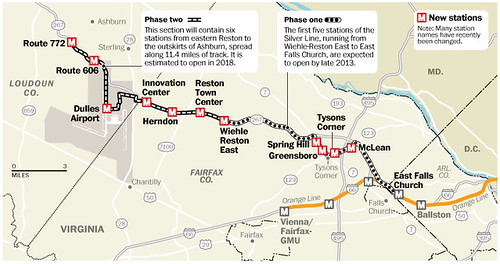
Silver Line heavy rail, WMATA, line alignment and routing map
Silver Line heavy rail, WMATA, line alignment and routing map.  Washington Post graphic.

The Silver Line extension is particularly damaging to Arlington County, because it provides Metrorail access to a great number of office buildings priced more cheaply than comparable space in Arlington.

Sure the buildings are farther out, but with Metrorail access that becomes less of an issue.  This will also lead to more federal offices locating further from the core outward in the metropolitan area attracted by lower prices and Metrorail access, adding to sprawl even as certain other trends have favored centralization ("Companies Say Goodbye to the 'Burbs," Wall Street Journal).

In the short run, ridership increases haven't been particularly significant, and it is unclear how many riders have merely been diverted from the Orange Line.  Biggest use has been at the Wiehle Station, the end station of the first phase, and weekend use of the station serving the Tysons shopping centers.

2.  Arlington County drops plans to introduce streetcars.  This is significant for many reasons (I have a separate piece in preparation on Arlington and its economic future).  The biggest is in how it leads to a crisis of confidence for the County and calls in question its identity and definition as one of the nation's leading jurisdictions committed to smart growth.

Columbia Pike Smart CodePlanning for improvements in Columbia Pike started around 2000 and were kicked off by a big public planning event in September 2002.  From the Columbia Pike Smart Code.

What's happened is that residents in North Arlington, already enjoying great transit access are balking at paying more money to improve transit access elsewhere in the county, failing to recognize that to maintain the county's identity as a smart growth-transit focused community, they must continue to strengthen and extend transit and land use planning actions that enhance walkability and intensity and activity.

Rendering, streetcar service on Columbia Pike, Arlington and Fairfax Counties, VirginiaSo much for the streetcar in Arlington and by extension, in Fairfax County too.

As demand for office space in the region declines (organizations merge, more people telework, organizations reduce the square feet per worker), and as more submarkets/activity centers become more competitive and seek to recruit the same potential residents and businesses, Arlington County can't backslide, instead it has to up its game just to remain in the same place on the same playing field as other jurisdictions.

As alluded to in the previous point about the Silver Line, other jurisdictions are upping their game as evidenced by the redevelopment of the White Flint district in Montgomery County, Alexandria's poaching of the National Science Foundation (abetted by Congressional unwillingness to authorize higher lease rates for federal agency office space), and the continued addition of population and improvement of neighborhoods in DC.

By ceasing planning on the streetcar, Arlington County takes a big step backwards towards the future, reminding me of DC more than a jurisdiction nationally renowned for its robust land use and transportation planning.

3.  The election of Larry Hogan as Governor of Maryland and his campaign planks to drop light rail plans for Suburban Maryland (Purple Line) and Baltimore City and County (Red Line).  The relative success of Maryland's suburban counties in the DC metropolitan area comes from access to Metrorail.  The relative decline of Baltimore comes from its lack of a well defined and expansive transit network (I am preparing a separate piece on this particular topic).
Purple Line map
Purple Line map.  Washington Post graphic.

The election of a Republican as Governor of Maryland was unexpected and caught the transit community by surprise.   While exurban Maryland resents the urban sections of the state, the reality is that Rural Maryland is dependent on state funds derived from Montgomery County taxpayers.  And much of the economic success of Montgomery and Prince George's Counties has a lot to do with transit access.

Governor-Elect Hogan has to realize that hopes for reelection (it's funny to think that far in advance when he hasn't even been inaugurated) are dependent on not "disrespecting" those counties--Montgomery and PG Counties are the two most populous counties in the state--and their economic and mobility priorities.

Depending on who Governor-Elect Hogan appoints to be Transportation Secretary, he could in fact drop light rail plans, not unlike Arlington, although the costs would be great.  However, some of the potential candidates for the Secretary position are in fact pro-transit, not unlike how Republicans in Utah support transit or former Mayor of Charlotte, now Governor of North Carolina Pat McCrory is a transit proponent (although he's backslided as Governor).

In any case expect at least a one year delay in the Purple Line planning, and there is a good chance that the Red Line--which doesn't have the best business case anyway, and Baltimore County is not super-committed--will not move forward under a Hogan Administration.

4.  Millennials as a cohort making different transportation choices (Uber and competition with traditional taxi services, etc.). Maybe this is more of a national story but I do think it's important as an indicator of different age cohorts being more willing to use "new" services and less willing to use "legacy" services.

 For example, younger cohorts appear to be more willing to use transit, car sharing, and mobile-enabled ride services like Uber rather than traditional taxi services, which have tended to be laggards for innovation depending on how innovative the regulatory regime of particular cities.

I'm old (54) and I see no reason why Uber shouldn't be regulated like taxi services.  While I think having a demand upcharge is reasonable (what Uber calls "surge pricing") I can't in a million years see how a surge pricing upcharge should produce fares equal to the cost of an airplane trip but for a 13 mile trip on the ground.

The fare breakdown for a 13-mile trip via Uber in Houston.  See "Almost $250 for 13 miles: Uber’s ‘surge pricing’" from The Highwayman blog/Houston Chronicle.

That isn't even getting at Uber's neoliberal anti-government hardball approach to regulation, the failures in vetting drivers, an unwillingness to take responsibility for driver failures, and the reality that the only reason that the company--probably not the drivers--makes money is because they take 20% of the fare.  Without surge pricing they'd make no money.

5.  Steep fall in gasoline prices/fracking.  With as much as a 50% drop in the price of oil, gasoline prices have dropped by as much as 1/3, and it's likely that more people will be induced to drive, given the rise in cost of public transportation, especially in the DC metropolitan area, which has subway fares that are about the highest in the U.S. (with the exception of the BART system in San Francisco).

Fracking and the increase in US oil production (it has increased 80% over the past few years as a result of use of hydraulic fracturing techniques in production) has led to the drop in prices and also has international implications as many oil producing nations need high prices to generate the revenue needed to maintain current political and social commitments.  There could be greater social unrest internationally as this shakes out.

Plus, states like Texas and North Dakota that have experienced an economic boom because of oil production increases will in the intermediate term, experience economic decline from reduced revenues and reduction in investment in oil production in the face of lower prices.  See "The Petro States of America" from Businessweek.

6.  WMATA ridership is falling.  While bus fares are in line, if not lower than other cities, subway fares--based on distance--are amongst the highest in the country, comparable in some cases to railroad commuter fares (which makes sense because in the outer parts of the metropolitan area, Metrorail service is more comparable to railroad passenger service than to an inner city subway).

The quality of service has declined significantly in the face of reconstruction, especially on the weekends, and as subway cars age.

Fares are high and the reduction of the federal transit benefit and impacts of the Federal shutdown and budget cuts have reduced federal employment which are the major reasons for the decline ("Metro ridership down over the last two years," Washington Business Journal).

Ridership is down one-ninth, to 200 million trips per year.

7.  But APTA reports that nationally, transit ridership is still increasing ("Five signs America is falling in love with public transit," CNN) and maybe what that means is that we are moving towards a more pronounced differentiated land use/transit paradigm, where transit ridership in those cities that have developed a reasonably robust sustainable transportation infrastructure may maintain and rise, despite gasoline prices, because of substantive shifts in behavior between metropolitan cores and their outskirts.

In those communities with walking city/transit city spatial urban design patterns--cities like DC, San Francisco, New York City--and where transit, walking and biking trips are often competitive with trips by car, transit can hold its own.

However, transit expansion will be hard, as proven in DC and Arlington, because even in areas with robust transit systems, a great many people and often the most vocal of civic activists, are automobile-centric in their approach to urban questions, especially as they age and feel unable to walk, bike, or use transit.

8.  Meanwhile, WMATA is seeking more funds from local jurisdictions to pay for various increased costs, without having to increase fares.  See ""Let's Talk" -- What to do when your transit authority needs more money?: Washington region edition."

9.  Increased transportation taxes in Virginia and Maryland.  Virginia and Maryland's increase in transportation taxes went into effect last year.  Maryland focused on a gas tax increase, while Virginia mixed things up, shifting more of the funding stream to non-transportation sources.  In November, Maryland residents voted in favor of restrictions on the ability of state government to borrow money from the Transportation Trust Fund for non-transportation purposes.

Sadly, the initiative promoted by President Obama to increase federal transportation funding calls for general fund sources too, like Virginia, rather than just a hefty increase in the gas tax and calling it a day ("FACT SHEET: President Obama Lays Out Vision for 21st Century Transportation Infrastructure," White House press release).

However, the recent decline in gasoline prices is a good example of the economic implications of not having different indexes for gas tax calculation.  As prices fall, taxes could increase, generating more money for transportation infrastructure, without causing as much economic dislocation.

10.  Various developments--good and bad--concerning transportation policy and practice in DC.

- Councilmember Mary Cheh proposes a deconsolidation of transportation functions in the city, which is a step backwards and counter to best practice transportation management in world class cities ("Rival bureaucracies are not the way to manage traffic," Washington Post).

- DC finishes the MoveDC transportation plan, but the City Council hasn't yet adopted it as a master plan.  (Interestingly, the city's new parking planning policies seem to copy recommendations I made in the blog and privately in communications to DDOT higher ups.)

- DC didn't manage to launch the streetcar in 2014.  Service is now supposed to start the week of January 19th.  See "A crisis in confidence and the capacity of local government to execute transit projects."

(I am preparing an entry on the impact of the streetcar on H Street in terms of sparking hundreds of millions of dollars of new development, an effect that can't be ignored.)

- the lesson is that you can't punt on having quality leadership in important agencies like the Department of Transportation.  The person likely to be nominated by Mayor Bowser to be the agency director comes from Maryland's DOT and has a lot of project management experience.

11.  Poorly articulated arguments about streetcars "not being transit" rather than focusing on how streetcars are better at short trips, or what I call intra-district transit, rather than long trips. See "The argument that streetcars are "good enough" but "imperfect transit" is flawed" and "STREETCARS ARE ABOUT TRANSIT, just in a different way from how most people are accustomed to thinking about it." People writing that stuff "aren't helping" and need to up their game.

12.  Decline in Dulles Airport usage relative to National and BWI Airports ("Dulles International Airport struggles to find its footing," Post). Partly the problem is too much capacity, relative to demand, because Dulles was created to focus on international travel, which isn't growing at the same rate as domestic airline travel, and its far out location from the core.  I've argued that we need a real regional airport plan (""Economic impact of National and Dulles Airports") which we don't have.
Dulles at Dusk
Dulles at Dusk by Andrew Rhodes, on Flickr.

Personally, I think Dulles is fine for international travel but isn't well positioned to increase its share of the domestic travel market all that much given the existence of other airports in the region and the fact that other airports in the Mid-Atlantic, like Newark, are more significant hubs.

The State of Virginia has to think really hard about how much it wants to invest in Dulles, how much ability it has to become an aerotropolis compared to BWI Airport, which is better positioned to serve industry because it is proximate to the Port of Baltimore and a more significant proportion of the region's manufacturing base.

Plus there is the issue of the management of the Metropolitan Washington Airports Authority.  It has "broken trust" with residents who use the Dulles Toll Road, because rates have been jacked up significantly to fund the Silver Line.  (The State of Virginia did this deliberately, but MWAA gets the fallout.)  But there are other management issues.  Plus Virginia wants more control because the airports are located in Virginia, even though they were built with federal funds.

13.  Expansion of High Occupancy Toll lanes in Maryland and Virginia.  In December, HOT lanes went operational on I-95, in Virginia, from Springfield to Gainesville (photo below), and in Maryland, north of Baltimore.   They join existing HOT lanes on I-495 in Virginia, and tunnel and bridge tolls in Norfolk, Virginia, which were imposed to pay for the construction of a new tunnel.

While HOT lanes add capacity at a price--tolls--are they a harbinger of increased privatization of public infrastructure?  Probably.

The criticism of HOT lanes is that they promote single occupant vehicle trips, automobility, rather than sustainable transportation.

14.  Problems with tolling systems for HOT lanes (and bridges).  With the system for 495 and the Elizabeth River Tunnels in Norfolk, Virginia, there are many examples of drivers being screwed "ERC: Toll problems have improved, but work remains," Norfolk Virginian-Pilot).

To speed up throughput and to reduce costs, tolling is now being implemented without tollgates.  It's done automatically.  But the companies can assess fines, big fines, and they aren't really taking responsibility for prompt billing.

And there needs to be some consideration for people who are low income users of the facilities, and providing assistance in acquiring transponders at the very least.  For example, this piece from a tv station in Norfolk, "Unpaid toll bills land family in court," discusses a family facing many thousands of dollars of charges (they claim they didn't receive notice) but the tolls would have been cheaper by half if they would have had an EZPass transponder.  Although they were crossing the South Jordan Norfolk Bridge, a different facility from the tunnels. Locally, WTTG-TV has reported on problems with tolling on I-495.

15.  DC resident opposition to reconstruction of the Virginia Avenue Railroad Tunnel abetted by lawsuit by the Committee of 100 on the Federal City ("Committee of 100 files lawsuit to derail rail project," WJLA-TV).   Related are other examples of organized, ongoing, vociferous opposition to transit:

- aforementioned opposition to streetcars in Arlington
- and in DC  ("D.C. should hit the brakes on any streetcar expansion," Post).  For both, see "A crisis in confidence and the capacity of local government to execute transit projects."
- and the Town of Chevy Chase's retention of a law firm to continue to oppose the Purple Line ("Town of Chevy Chase extends contract with controversial law firm," Post)


Cars parked along 26th Street in Baltimore fell onto CSX rail tracks when the road bed collapsed. (Photo credit: Stacey Mink via Associated Press.)

I believe in infrastructure investment and I do believe that certain types of state-regional-national infrastructure shouldn't be held hostage to local planning concerns.  (There are some provisions in federal law, such as for railroads, that limit local oversight.)  On the other hand, you do need to ensure that local interests are protected.

That being said, there is little negative impact on the city for CSX Transportation expanding the capacity of the Virginia Avenue Tunnel to facilitate freight transportation.

 DC residents benefit from access to freight transportation as does the nation. And the collapse of a tunnel in Baltimore earlier in the year ought to communicate to us that we should be fostering such investments rather than hindering them.

So residents fighting the tunnel project, which will have minimal impact on them, offering spurious suggestions such as waiting for a DC railroad transportation plan--which wouldn't make recommendations any different concerning the expansion of this tunnel--seem pretty pointless.

But the city's only long term citizens planning organization sees things differently, and is suing over the agreement to move the project forward.

Seems like a waste of time to me. However, it reminds me of a long ago email conversation, where the point was made that when cities get sued it often cows officials in terms of actions on other projects in the future--they become more timid.

Maybe the intent of the suit isn't to win on the Virginia Avenue Tunnel but to cause grief on transportation officials, so they won't have the audacity to support other important projects which may cause some short term discomfort while they are being constructed, but which people concerned with short term gratification don't want to put up with.

But it's also a reminder of what I see as the biggest problem in public participation in planning, where residents tend to take on circumscribed responsibility, only for what we might call "neighborhood concerns," while discharging their responsibilities as citizens to acknowledge constraints and to be concerned simultaneously with the need to resolve "citywide" and "regional" or "national" concerns as well.

16.  Bike share.  This is more of a national issue.  Bike share systems continue to launch across the country.  Expansion in NYC has run into budget issues. Seeking working capital, Alta Bike Share sold itself to a much better funded outfit ("Alta Bicycle Share sold to New York firm," Portland Business Journal,").  But I don't see the new company putting money out in system expansion, except in NYC where they are required to do so.

Bike shed as an element of station maps. I haven't yet got a screenshot of an entire map, but in a "new development" in urban wayfinding mapping, the area map at each Seattle Pronto bike share station distinguishes between the walk shed and bike shed within a neighborhood, making very clear that in the same amount of time as walking, you can cover more ground by bike. Photo from Geek Wire.

But I think that bike share will only be successful in cities that already have a significant level of interconnected sustainable mobility options (walking, biking, transit, car share, bike share) supported by density and a walking-transit city urban design spatial pattern.

And financial success defined as "without significant subsidy" will only come in odd situations, like in DC, where tourists generate extranormal revenues from what we might call "late fees." Regular members don't rack up such fees. But without such revenues it's hard for a system to break even on operations.

That's why we see much higher membership fees being imposed in systems where there is no local subsidy, like in NYC and San Diego.  Perhaps in San Diego the high fees will hinder ridership, but the system will be able to operate on a break even basis.

DC was innovative the past year by buying some "used" stations at a good price from Ottawa, which switched to a different system, to be able to add more stations while new equipment is not being manufactured.  (For example, Seattle uses non-Bixi equipment in their bike share program because of this problem.)  That's resulted from the bankruptcy and change in ownership of the organization that developed the Bixi system originally.

And I think it's interesting that Jersey City, NJ, rather than joining in a Hudson County effort, prefers to join in the Citibike system in NYC, to further cement the mobility interconnections between Hoboken and Manhattan ("Jersey City snubs North Hudson bike-share program for NYC's Citi Bike program," Newark Star-Ledger).

2012-2013 actions that became more significant in 2014

17.  The Washington Post ran a big section on plans for Union Station's expansion ("Reimagining Union Station | The Washington Post") which is derived from the 2012 Amtrak Master Plan ("Union Station Master Plan, Washington, DC.  Note that in the next couple months I plan to have a big piece/position paper on this, in part shaped by a trip to Germany, especially to Hamburg and my experience with how they deliver integrated transit service operations.

18.  MARC weekend rail service on the Penn Line launched in 12/2013.  Ridership and service expanded over the course of 2014 and MARC has just added facilities for bicycles for weekend service ("MARC Bike Car Now on Select Penn Weekend Trains," MARC press release).

Renderings of a gondola bridging the Potomac River in Washington, D.C., connecting the Georgetown neighborhood of Washington, D.C., with the Rosslyn neighborhood of Arlington County, Virginia.

19.  In 2013, the Georgetown Business Improvement District came out with a 2028 Vision Plan, which is heavily focused on transportation (Final Georgetown 2028 Plan | Georgetown DC).  In 2014, I became more enamored with their idea of aerial tram service between Rosslyn and Georgetown.  More on that within the next few months.See the ULI article, "Transit Planners Look to the Sky with Cable Cars, Gondolas."

20, The Silver Spring Transit Center continued failure to open, but I think the bigger issue is its uninspired design.  See "Maybe the ideal solution for the Silver Spring Transit Center would be to start over."

Other/National Issues

21.  Various efforts around the country, many failed (e.g., in Florida), to increase transportation funding for local transit expansion.  As well as efforts (e.g., Michigan, Missouri) at the state level, etc.
22. Failure to increase the Federal Gasoline Excise Tax.
23. Failure to invest in infrastructure when interest rates are so low.
24. Vision Zero traffic safety initiatives.
25. Successful transit expansion
in Seattle (streetcar, light rail), Portland (streetcar, light rail), Salt Lake City (streetcar as part of a larger system), Los Angeles, Tucson (streetcar), Atlanta (streetcar), San Francisco (light rail/streetcar + BART in the Bay Area), Denver, Minneapolis
26. Privately funded high speed rail projects move forward in Texas and Florida
27. While high speed rail development continues to be controversial and languish in California.
28. The transportation of oil in the face of high volatility of the shipments (train car safety) and the failure to have adequate national regulations.  (It's a state function, sort of.)
29,  Amtrak's ridership is increasing.  But the quality of train cars is low.  You can see this in those systems where the state, such as California's funding of the Pacific Surfliner, provide extra funds for better equipment.  The Surfliner is a much better ride than the regional cars on the Northeast Corridor.

In San Diego.

30.  Calls in Chicago and Toronto for changes in how those metropolitan areas organize, operate, and fund transit.

Labels: , , , , ,