Basically, the story of Virginia in terms of transportation funding is that they will try anything to avoid dealing with the most obvious policy choice, which would be to raise the gas tax.
The proposal from Governor McDonnell: dump the state gas tax for a sales tax increase
The proposal from Gov. McDonnell of Virginia to find monies for the state's transportation needs (which are considerable in part because except in two instances, the Virginia Department of Transportation is responsible for all roads in the state, including those roads typically built and maintained by local jurisdictions) somehow escapes "having to raise the gasoline tax" by instead proposing to raise the sales tax to 5.8 percent from 5 percent, with a raise in the registration fees, and some other sundry fixes. See "
McDonnell proposes eliminating Virginia's gas tax" from the
Washington Post.
Also see "
Gov. proposes getting rid of gas tax, raising sales tax" and "
Poll: Virginians favor tolls over gas tax for roads" from the
Norfolk Virginian-Pilot.
Why don't they just raise the gas tax, or better yet, index it to inflation?
As the Tax Foundation writes in this piece on that matter, "
Virginia Regional Divides Lurk Behind Transportation Financing Debate," if Virginia had made the state gasoline tax indexed to inflation, the original 3 cent tax would now be 40 cents per gallon, raising much more money than the state does currently.
The article has a good discussion of how much money Virginia actually spends on transportation, as much as $5 billion/year, but the gas tax raises less than 20% of the total. It suggests that the sales tax idea is seen as more palatable, because a statewide gas tax would "subsidize" Northern Virginia where more of the demand for new transportation spending lies. Using a sales tax would localize more where the money comes from--other parts of the state would pay less, NoVA would pay more.
Will lower gasoline prices result from eliminating the state gas tax? Probably not.
There has been some discussion of how this type of change could result in lower gasoline prices, but as this article, "
Commonwealth's phantom gas tax," from the
V-P points out, even though there is a 21.4 cent difference in state gasoline taxes (North Carolina charges 38.9 cents/gallon, Virginia 17.4 cents/gallon), the per gallon prices of gas in the two states are about the same.
Leaving money on the table
Besides the obvious fact that this doesn't raise more money, let alone enough money and various other issues concerning gasoline taxes (also see the
Post editorial, "
Virginia Gov. Bob McDonnell’s bold and paltry transportation plan, it seems ill-advised stupid because all the through drivers buying gas along the Interstates (I-95; I-81) won't pay anything towards the roads since the proposed changes won't be accompanied by a sales tax on gasoline.
Does Virginia's somewhat odd state governance structure doom any real solution?
I wonder if Virginia's transportation financing issues are in fact intractable as a result of their governance system:
- elections for state offices are held outside of the election cycle for national offices (even years, e.g., 2012, 2012), which significantly depresses and makes more conservative, voter turnout, the Virginia state election cycle is held in odd years (e.g., 2011, 2013, 2015);
- and the district geographies are shaped through manipulation (called "Gerrymandering") to favor rural constituencies at the expense of urban constituencies, specifically the influence of Northern Virginia and the Hampton Roads, the most populated areas in the state, is reduced;
- the Virginia Governor cannot serve consecutive terms;
- the State Legislature is very part time, meeting only 45 to 60 days/year ("
Six weeks to make Virginia better" from the
Virginian-Pilot); (note that there are other issues like the Dillon Rule, and the fact that the state controls virtually all the local roads, which make the problem even more difficult to solve).
All of these factors combine to create a political environment where there is very little consequence for failure.
Because it's not like if the Virginia Governor fails and then s/he can't get reelected. S/he can't get reelected anyway. And residents of Northern Virginia and Hampton Roads have little ability to shape the political environment in RoVA (the rest of, or rural, Virginia), where the bulk of the legislators come from.
Past attempts at crafting financial solutions for transportation funding by avoiding raising the gas tax
Although it's not like Governors don't attempt to "fix," positively or negative, the lack of enough revenue for transportation.
While this wasn't a fix, but a contributor to the problem, Governor Gilmore--"No Car Tax" was his campaign theme--by
eliminating the state personal property tax on the first $20,000 of motor vehicle value (
Personal Property Tax Relief Act (PPTRA) Summary, State MVA) further reduced the potential for dedicated vehicle-related funds available to the state to pay for transportation. . Sure the tax was/is (it's still levied by some counties) hated, but if you're going to be funding roads mostly through general funds, it makes sense to tax cars. You can do it through a personal property tax, or through higher registration fees.
Governor Warner attempted to
create transportation districts to assess a local option sales tax, which were later overturned by the courts (I don't know the specifics). And while a small sales tax was passed by residents in Northern Virginia, it was turned down in Hampton Roads although now some people believe such a tax could pass now ("
Supporters see changed sentiment on sales tax" from the
Norfolk Virginian-Pilot) and ultimately the NoVA sales tax was ruled unconstitutional for other reasons.
Governor Kaine got a law passed to
fund transportation through onerous fines related to motor vehicle violations, but once the system went into effect, rebellion on the part of citizens quickly got the State Legislature to reverse the law ("
Va. Traffic 'Abuser Fees' Spur Backlash" from the
Post).
Or in 2007, rather than raising the gas tax, state legislators were going to allow Hampton Roads jurisdictions--if all agreed--to
assess a $5/night hotel room tax for transportation funding. See "
House OKs plan for local roads" from the
V-P.
And all along, in keeping with the State's conservative notions, it's been one of the national leaders in
privatization of roadway infrastructure funding, such as through the Dulles Toll Road, other toll roads, high occupancy toll roads, and now tunnels and related infrastructure in Hampton Roads. See "
Virginia tops in getting private cash for roads" from the
Examiner. Ultimately privatization makes money for the private sector at the expense of the public.
Conclusion: will this proposal pass or is it a stratagem to build momentum for substantive change?
I wonder if it is impossible to pass this measure because it is so different and because 45 days isn't a long enough period probably to get the Legislature to agree.
But might it touch off a process and build momentum towards a more substantial solution?
I don't think so. Those structures of governance--one term Governors, a rural-dominated legislature, very short sessions to conduct business by the state legislature--doom a real solution, so long as rural and conservative interests continue to dominate the state and reduce the impact and power of the urbanized areas. (It's much different in Maryland. There, Washington's suburban counties and interests of the Baltimore metropolitan area have significantly more influence in the Governor's Office and the State Legislature than the rural parts of the state.)
----
Addenda
1. Why not allow "federalism" within states, giving more authority to cities and counties to raise funds from registration fees and other local taxes?
Why conservatives who believe in "federalism" and letting states go their own way don't feel similarly towards regions and counties and cities and rural areas within a state is beyond me, because it's intellectually inconsistent. (I do understand actually, it's about control.)
Although I do have to say that one problem with such taxes is that they don't necessarily generate enough money on a sub-metropolitan level. See for example my comments on the Montgomery County proposal for a county-level gas tax, "
An opportunity to raise the gas tax?"
Registration fees
I do like the concept in the McDonnell proposal of doubling the car registration fee to in part pay for transportation improvements including transit. Considering that general funds are the largest source of funding for roadways, motor vehicle owners come nowhere near paying enough of the cost to maintain and extend the system.
It made me think of David Engwicht's point (from
Reclaiming our cities and towns: better living through less traffic) that motor vehicles should pay a kind of penalty tax or reparation for their negative impact on transit systems.
Note that
Washington State allows localities to create "transportation benefits districts" and assess a local registration fee of $20 to support local transit and transportation projects. Higher fees can be assessed, up to $100 in total, provided that voters agree, in a referendum held in a general election. Thus far, no attempt to assess a higher fee has been passed by voters anywhere in the state.
--
Seattle Transportation Benefits District
Regional transit tax
Washington State has also authorized a
Regional Transit Authority Tax, which is 0.3% of the value of a motor vehicle. Yes, it's basically the same as a personal property tax on vehicles assessed by localities in Virginia.
2. Fees for alternative vehicles
Since alternative fuel vehicles don't buy gasoline, they don't pay gas taxes. Some places, including in the Virginia proposal, suggest a flat fee. Others argue that these vehicles help reduce Greenhouse Gas Emissions compared to gasoline and diesel fuel powered vehicles and therefore should be rewarded for being different, but GHG emissions are a different issue from paying for road use.
Image of an electric car and charging station from Virginia's Dominion Energy.
The $100 annual fee for alternative fuel vehicles isn't enough, although if gasoline powered cars aren't going to be paying a state gas tax equivalent, why should alternative vehicles? Not paying the federal tax is a different issue.
The $100 price is roughly equivalent to how much state gasoline taxes cost in a year for a Virginian driving about 12,000 miles getting 24mpg, and buying all their gas in the state.
Congress screwed online music, why not screw alternative fuel vehicles similarly?
Radio stations pay a royalty to the song writer for playing a song. But they don't pay a royalty to the label. When the Digital Millennium Copyright legislation was passed by Congress, an additional royalty fee going to the record label was added to the cost of legally broadcasting music online.
Of course, it's unfair, it creates an unlevel playing field since radio stations don't have to pay it. Plus, online music broadcasters actually have fewer opportunities to generate revenue to pay such fees than do radio stations. But that's the law.
Using this example, policymakers could "use" alternative vehicles as a way to push through a tripling say of the charge per mile for gasoline taxes or their equivalents. So in the Virginia case, alternative fuel vehicles should pay maybe $100/quarter, if only to be equivalent to the indexing of Virginia's original 3 cent/gallon state gas tax, which today would be 40 cents/gallon if indexed.
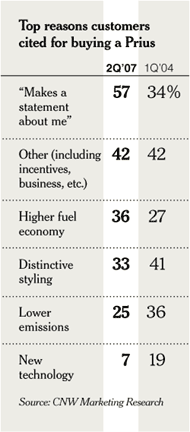
I wouldn't recommend it, except that alternative vehicle operators, who already feel more virtuous because they drive such cars, could feel even more virtuous because they would be paying their way/their "fair share" more than gasoline-powered vehicles. (Left:
New York Times graphic, 2007.)
Labels: electoral politics and influence, gasoline excise taxes, transit funding, transportation funding







.jpg)


.jpg)






