Rebuilding Place in the Urban Space

"A community’s physical form, rather than its land uses, is its most intrinsic and enduring characteristic." [Katz, EPA] This blog focuses on place and placemaking and all that makes it work--historic preservation, urban design, transportation, asset-based community development, arts & cultural development, commercial district revitalization, tourism & destination development, and quality of life advocacy--along with doses of civic engagement and good governance watchdogging.

Tuesday, August 30, 2016

Back to school #2: education unions should create multifaceted public education "meeting halls" comparable to AIA chapter "architecture centers"

In talking with a friend who is a teacher and had been active in her teacher's union, we got to talking about "labor" and "management" and the difficulty of engaging "the community" on education matters in a neutral setting.

While depending on how it would be organized it could be neutral or not, I came up with an idea for teacher's unions to create multi-faceted "community education centers" modelled after the "architecture centers" that have been set up in many US cities as "chapter houses" for the local affiliate of the American Institute of Architects.

AIA Bookstore and Design Center, Philadelphia. Review by Inga Saffron, Philadelphia Inquirer.

Typically these centers have exhibit halls, meeting rooms for lectures and presentations, and a bookstore, as well as chapter offices, sometimes a library, etc.

Other examples of multi-faceted centers with some of these functions are the Red Emmas Bookstore and Cafe in Baltimore, the way that Teaching for Change had run the bookstore in Busboys & Poets, a cafe with meeting/presentation space (now the book operation is run by a local bookstore), the Book Table, a wild "bookstore" in Logan, Utah that has a large bookstore with a big toy section too, a big section for teachers (a "teacher store"), a large musical instrument sales and rental operati, and art and craft supplies, and the old Provisions Library, which when it was in DC, was a membership library with a focused collection on progressive topics.

Classroom, Honolulu Center for Architecture.

I was thinking local teacher's unions could set up similar kinds of centers, with exhibit and meeting areas, and a regular program of lectures and meetings on education topics, complemented by:

- cafe (which could be the face of a culinary teaching program)
- teacher store
- retail book store focused on education, children, and family topics with the depth and creativity of the range of books carried by the former Teaching for Change operation or Red Emmas
- lending library and reading room for "members"
- educational toy store
- an ATM sponsored by a teachers credit union
- classrooms suitable for professional education/continuing education instruction
- space for organizations active on education related issues


Red Emmas, Baltimore.

The idea is creating a multi-function “union hall/mixed use space” supporting K-12 education engagement between teachers, stakeholders, and citizens, as a focal point for teacher and community organizing on local educational matters—a place to put forward and draw attention to the union position (which hopefully would be pro-education, not merely pro-teacher), but also to be able to discuss community education matters in an engaged, thoughtful fashion.

I guess this has been on my mind for a long time because of how the DC teachers union has been so bad at articulating a position on educational improvement counter to the narrative put out by Michelle Rhee, and the lack of a space for a community to organize around education topics and issues.

Other models
  • Union Halls. Many unions have offices/meeting halls. Typically there is not public access. No programming focused on communicating the union/profession message to the broader public. Police union “lodges” often have bars.
  • Social halls/fraternal organizations.  Used to be ethnic specific, like the German American Society. The tradition continues through “fraternal organizations” like the Elks and Moose, which have “private bars and function halls”. Sometime these facilities are open to the public, especially in the face of membership declines and the need to raise money to maintain owned buildings.
  • American Legion/VFW membership halls. For people with military ties. Often have bars, and limited public access.
  • Art museum libraries. Some art museums have libraries and reading rooms with special access for members. Phillips Gallery in DC has such a program.
  • Community Writing Center, Salt Lake Community College, Salt Lake City. The community college has a writing assistance program targeting youth and adults who are not SLCC students, in space on the SLC Central Library campus.
  • Mestizo Coffeehouse and Gallery, Salt Lake City. This nonprofit coffeehouse and art gallery also serves as a presentation space, and offers free use of meeting spaces to community nonprofits. 
  • Nonprofit Centers Network. This is an organization that links nonprofit co-location spaces across the US. 

Labels: , , , ,

Thursday, April 21, 2016

Tortured logic in development law case?

The Washington Post editorialized ("Dear Labor Department: Give up on meddling with CityCenterDC already") in favor of a recent federal court decision on wage rates on for profit construction projects involving DC Government owned land (that is, land owned by the citizens of the City of Washington).

Over the last 10 years, DC has initiated development of various parcels through multi-decade leases.

The city still owns the property, usually planned how it would be developed (it sure did with CityCenterDC and helped to find a financier), sought proposals for development, chose a developer and entered into a contract to develop the land and collect "payments in lieu of taxes" on the land since technically the land isn't subject to property tax since it is owned by the city.  Usually these contracts and projects involve city-provided funds and inducements as well.

How can these not be city-involved "undertakings" thereby justifying the triggering of the Davis-Bacon Act and the higher wage rates the act imposes?
CityCenterDC shopping ad, Washingtonian Magazine, 2/2016

One line in the Post article seems to indicate to me very clearly that this is a city undertaking, and therefore the holding--I AM NOT A LAWYER--may well in fact be "wrong."
At stake for the District was far more than the estimated $20 million in additional CityCenterDC costs taxpayers would have been on the hook for because of the federal regulations requiring reimbursement to the developers.
But the Post doesn't explain why "federal regulations" require that the city reimburse the developers for the higher wage rates, so maybe I'm wrong.

If I am right that it has to do with the underlying contract between DC and the developer than I am right that it very clearly is a city undertaking.

Then again, the Federal Court of Appeals which covers DC is considered to be conservative and like the Supreme Court under Chief Justice Roberts, quite pro-business.

A Home Rule based counterargument.  For a counter-interpretation see "Davis-Bacon CityCenterDC Case" from the Labor & Employment Law blog.from the ShepherdMullin law firm.

Note that DC is a special case because DC is considered a federal agency by the Federal government and therefore it is subject to federal laws like the Davis-Bacon Act.  Other cities are not subject to its provisions, unless the project uses federal funds.

So you can argue that on matters not involving federal action, local DC actions shouldn't be subject to federal laws that wouldn't apply to other cities as a matter of course.

But the Post editorial wasn't basing its arguments on Home Rule.  It was arguing an anti-labor, lower wages position.

Reading the blog entry, I'd argue that the Department of Labor used the wrong arguments--they should have argued along the lines of my paragraphs two and three above, that the property is owned by the city and ultimately controlled by the city, not that the public benefits from the end result of the privately constructed development. As long as the city is subject to Davis-Bacon provisions, if it's city property that the city still controls, it's a city undertaking. (However, from a legal standpoint, I don't know if this element of property control is interpreted differently by the Courts as it relates to long term leases.)

And the city should have argued a Home Rule position, that local undertakings shouldn't be subject to the Davis-Bacon Act, only local undertakings involving federal funds, like transit or road construction.

Likely then the Court would have come to the same decision, but with a far more logical argument.

As public-private partnerships between government and the private sector, should past legal interpretations be revisited?  According to the ShepherdMullin piece:
Judge Jackson’s decision questions a number of the Administrative Review Board’s findings, but it ultimately rests on a rejection of the Administrative Review Board’s conclusion that CityCenterDC is a public work. She reasoned that the “text, history, and purpose of the Davis-Bacon Act reveal that Congress used the term ‘public work’ in its traditional sense: work that is either funded by public dollars or used by the public, and usually both.”
What is the definition of a "public work" when the private sector becomes much more intertwined with the development, delivery, management, and lease of public buildings and projects?

Labels: , , ,

Monday, September 07, 2015

Labor Day

I don't have the time to write a detailed post doing this topic justice, but here are some issues to think about.  Also see "At last, workers are pushing back" and "If Labor Dies, What's Next?" by Harold Myerson.

-- Wage inequality, and the impact of inequality on a consumption-based economy.

- US Economics: Inequality and Consumption, Morgan Stanley

-- Various minimum wage initiatives at the city and county level across the country.

- Campaigns | Raise The Minimum Wage

-- The state of labor unions as a potential check on inequality, power, relationships to progressive urban policy agendas, and the negative impact at times of police unions on crime and public safety policy.

-- For cities and states, the pension and health insurance cost "crisis."

- The pension crisis in Chicago and Illinois, Chicago Tribune

-- The "Gig" or "independent-contractor"/consultant based economy and how this puts more responsibility for risk onto the individual.

- Risk Shift and the Gig Economy, Economic Policy Institute

-- The New York Times published a piece on Friday about labor-related art. "Take a Labor Day Tour of Blue-Collar Art" in the New York region and earlier in the summer, about labor-related poster art in an exhibit at the New-York Historical Society, in "Seeing the Power of Political Posters."

Labels: , , , ,

Friday, May 16, 2014

Gainesville Florida transit union pays for one day passes to focus attention on the Federal transportation bill

According to "Transit union paying for daily bus passes next week to bring attention to transportation bill" in the Gainesville Sun, the local union is paying the cost of those using daily transit passes on Wednesday next week, as a way to promote the importance of transit and the federal transportation bill authorization process. From the article:
ATU Local 1579 President Mary Frances Folz-Donahue said the union is funding a fare-free rider appreciation day to highlight the ongoing talks in Washington, D.C., on whether to reauthorize the Moving Ahead for Progress in the 21st Century Act (MAP-21) and, more broadly, how significant federal funding is for the operational and capital needs of RTS.
I have always wondered why the local transit union doesn't seem to inclined to manage and focus on the relationship with riders, to build a broader base of support for transit and transit workers.  See:

-- Sunday March 18 is International Bus Driver Appreciation Day
-- "When the union label may be terrifying: transit edition

By contrast, in San Francisco, the local transit workers unions are vociferously focused on maintaining financial support for transit--sometimes with criticism because their policies tend to support modes like buses that require more personnel rather than modes like rail which require fewer people to run. But as a result the local transit service in San Francisco is funded about as well as it could be, given various constraints and other financial commitments.

But they do strike, and transit strikes don't build support for unions amongst the riding public.

Labels: , , , , , ,

Monday, December 09, 2013

More Walmart in DC

The Post had an article in yesterday's paper, "How Wal-Mart brings took Chicago -- and DC," about this week's opening of the two stores and how "Walmart is learning from its urban forays," especially Chicago.

This kind of article is a bit frustrating for me because the Post seems to have a history of running such articles after something opens, and not acknowledging such concerns during the development process, when activists are raising questions.  I remember being struck by this when the Convention Center opened in 2003 I think, and only afterwards was criticism really included in the newspaper's coverage.

Such after the fact reporting doesn't help us ensure that new projects yield the greatest possible benefit or that problems are adequately mitigated, etc.

That's the case with Walmart.

One of the things that the article mentions, is that the entry of big box stores like Walmart brings other chain stores as followers. 

But what is missed in this article and in some of the research on the subject is how changes in the store composition of commercial districts from a mix of locally owned stores and national chains to being more dominated by national chains also changes the district and has other economic effects.

Money spent in nationally-owned chains has less of a multiplier effect or the amount of money that recirculates within a community from subsequent transactions than money spent in locally owned stores, because national chains typically do not purchase goods and services locally, except maybe for some advertising.

Also, because chain stores typically don't get involved in local commercial district promotion and community participation, at least not to the extent that "may be warranted based on sales," this has the effect of diminishing local economic activity and community capital.  From the article:
said Maureen Martino, executive director of the Lakeview East Chamber of Commerce ... Once the stores opened, she was disappointed not to see the retailer play a more active role in sponsoring public schools or charities: 'I don't see them giving back without asking for anything back.'
That type of business calculus shouldn't be surprising to anyone the least bit familiar with how retailers operate.  And it's something that elected officials need to be concerned about when they recruit chain businesses to their communities.

And as pointed out in the article, in Chicago research hasn't demonstrated that the stores necessarily increase overall sales and tax revenue or employment, just change how it is organized and generated.

And I continue to argue that people are learning the wrong lesson about Walmart choosing to have stores in some horizontal mixed use projects in DC and Los Angeles as representing some change in how Walmart develops stores.  From the article:
But it also learned from Chicago and other urban markets like Los Angeles, said Virginia Parks, associate professor at the University of Chicago School of Social Services Administration.  Wal-Mart enhanced its store design further, agreeing to build two stores on the ground floor of apartment complexes.
Where Walmart is more of a tenant, they seem to be willing to take space in some mixed use projects, if the projects are in desirable locations. 

By comparison, where the Walmart real estate team is more involved in driving the project, they seem to be doing suburban-oriented single use buildings, even if the store may have structured parking or other more urban-appropriate design elements.

Cities need to have the right planning processes in place before Walmart comes calling, because after the process starts, it's too late to do anything--unless the elected officials are truly motivated to protect the interests of their community completely and delay the process while putting into place better and more complete planning controls.

In Hercules, California, the city used eminent domain power not to give land to Walmart, but to prevent them from entering the city ("Vote goes against Wal-Mart/ Council OKs using eminent domain to block retailer," San Francisco Chronicle).  Few cities have such fortitude.

It's another example of what I call "chance favoring the prepared city."  Without a plan, it's tough to ensure the best possible results.

Past blog entries

-- Lessons from Walmart's foray into DC
-- Wal-mart plays hardball with DC 
-- What community benefits are supposed to be versus what people think they are about

Labels: , , , ,

Friday, November 22, 2013

DC Government at-will employees need protections to tell the truth

Today's Post reports ("US Park Police Chief Teresa Chambers announces her retirement") on the retirement of US Park Police Chief Teresa Chambers, who had been fired by the Bush Administration for publicly stating that post-9/11 her department lacked the resources to protect all the federal installations under her purview, given the increased threat from terrorism.  After many years of legal action, she was able to return to her job.

Yesterday's Post has an op-ed column, "Egypt looks for a path toward democracy," about Egypt's stumbling path towards democracy and the recent action by the ruling military government to remove comedian from television after he made some jokes about the state of politics in Egypt.

Earlier in the week, in "The trope about the benefit of "Telling truth to power is mostly" is mostly B.S.: DC edition," I wrote about how Mayor Gray fired William White, the DC Insurance Commissioner, for criticizing a policy action by President Obama, aimed at quelling criticisms of the Affordable Care Act, but the action will occur in a manner that it makes it harder for the state insurance exchanges to function.

That blog entry also mentioned how in 2012, Mayor Gray similarly fired another agency head, Christophe Tulou, then of the Department of Environment, for communicating concerns about DC policy direction to the EPA.

While I understand that agency heads serve at the pleasure of the Mayor and are "at-will" employees, I don't believe that they should lack job protections for telling the truth, even if the truth is something that the Mayor doesn't want to hear or perceives as "embarrassing" (also see "killing the messenger").

The Mayor of a local government ought not to be allowed to restrict truth telling amongst high level personnel and to countenance the restriction of vital communications to the citizens and relevant stakeholders.

Regular government employees have some protections for telling the truth, because section one of the 14th Amendment of the US Constitution holds that state (and indirectly, local) governments have to uphold the Constitution, and this includes the First Amendment concerning freedom of speech.

Note that many people do not understand that "freedom of speech" is a right between the citizens and government, it is not a right between citizens and their place of work--unless their place of work happens to be a federal, state, or local government agency.

Labels: , , , , , , , ,

Tuesday, September 17, 2013

The Living Wage Bill and the 2014 DC elections

It's been reported locally and nationally--especially in the business press---that Mayor Gray vetoed the Large Retailer Accountability Act legislation.  The major provision in the bill was to impose a "minimum wage (including benefits) of $12.50 per hour on stores that have at least $1 billion of sales in the US, and are 75,000 s.f. or larger.

This was seen as a bill specifically directed at Walmart, because the bill has an exclusion for unionized employees, which would end up exempting chain supermarkets like Safeway or Giant.

I wasn't in favor of the bill, not because I think that retailers should be able to pay their employees poorly, but because I think that DC needs to have a much better set of regulations in place for the land use review of big box store projects, to ensure that the projects are well integrated into the urban fabric and to mitigate possible negative effects.  See "Lessons from Walmart's foray," "Walmart: in the city, vs. of the city" and "DC's proposed legislation on large retailers is misguided."

But that wasn't the bill that the Council passed.

I probably am in support of the bill, as a recognition that minimum wages should be higher, and that with the hollowing out of the middle ground in available jobs, "Walmart" or "McDonald's" jobs (fast food workers have been "striking"--they don't have unions--for better pay over the summer, see "Fast-food workers strike for higher pay" from USA Today) are no longer entry jobs, a rung in the ladder of "moving on up" job-wise, they are permanent, especially for less well educated employees.

Just as cities and corporations are going bankrupt because of material changes in how local economies work as a result of the US being connected within a global economy, the world of work is in the process of changing as well.

Living Wage bills are on the agenda of more and more cities.  It's an issue in the Seattle election right now as well ("Seattle mayor wants to block Whole Foods because of its low wages" from Grist Magazine and "Can city stop Whole Foods over pay? Lawyers differ" from KOMO News) and it's even on the ballot in the Puget Sound community of SeaTac ("Appeals court says SeaTac voters can decide on $15 minimum wage" from the Seattle Times).

When travelling abroad, compared to the US, I am always struck by how much more expensive food costs in supermarkets and at restaurants.

It's because employees are paid a living wage (+ taxes are higher on businesses, which pays for national health programs).  In the US, our low food prices come at the expense of labor.

Going forward that may be changing.

The impact on the DC elections.  Mayor Gray will make the case that he vetoed the bill to prevent Walmart from leaving the city, and two of the stores that they propose to build are in lesser served areas of the city (plans for a sixth store fell through more recently, see "For what it's worth"), and they will be large employers.

004Call out quote from the Black Commentator article "Cover Story: A 'Movement' Against Wal-Mart."
 
I have written before that Walmart, typically, treats employees pretty badly ("Piling on City Council") and so it is an issue of "is any job better than nothing?"

As a city, as a community, we should be concerned about the businesses we attract and actively recruit to the city and in turn, the kind of environment and opportunities that these businesses provide to their employees.

Regardless, I think this will be a big election issue in the Mayoral campaign.  I think Gray's veto means that he has already decided that he won't run for re-election.

But, I could be wrong.  Maybe he will run again.  But it's going to be hard for him to not be implicated in election fraud around his successful primary win in 2010.  So maybe that is an influence too.

And he thinks that Walmart is the right choice to define his Mayoralty, for his legacy.

Labels: , , , , , , ,

Friday, July 19, 2013

Piling on City Council for Walmart

DC recently passed legislation forcing large big box retailers to pay higher wages. The bill is focused on Walmart, which has plans for 6 stores in the city, but the legislation applies to other stores as well. Three of the stores are underway and the stores not currently being built would not be, according to Walmart, if the law is upheld.

Now I wasn't in favor of the law because it was misdirected. I prefer to see the city pass a comprehensive big box review ordinance that would focus on urban form, development, and other elements.

Left: Walmart was a sponsor of last September's H Street Festival and at their booth they were gathering names of supporters for their entry into the city.

What gets me about the campaign by Walmart, and now I understand why they have been organizing continuously since they began the process (see "If you don't know urban political theory, it's likely that you don't understand local land use: St. Louis: DC; etc."), in order to be able to ward off efforts such as this, is that "the other side" hasn't been articulate about Walmart's two biggest weaknesses.

1. In virtually every consumer satisfaction study, on every element except price*, they are ranked very low (see "Who's right about Wal-Mart's customer satisfaction?" from MSN Money).

2. The way that Walmart treats non-managerial staff is horrid, horrid, horrid, at least according to this series of articles from Gawker (e.g., "Life at Wal-mart, Vol. 3: Welcome to Hell").  Also see "Wal-Mart Relies On Taxpayers To Subsidize Low Wages" from Business Insider.

3.  Related to both customer satisfaction and labor treatment-management, Wal-mart's primary priority is managing for stock price, and in the face of sales drops they have been continuing to cut labor, about 50 people per store.  This has resulted in highly significant levels of "out-of-stocks" on the weekends ("Customers Flee Wal-Mart Empty Shelves for Target, Costco" from Bloomberg).

Why would we want to roll out a red carpet for such a company's entry into DC?

Anyway, Walmart continues to gather support, according to this article, "Major retailers urge Gray veto of living wage bill, threaten to table expansion plans," from the Washington Business Journal. From the article:

A half-dozen major retailers have signed a letter to D.C. Mayor Vincent Gray urging him to veto the large retailer living wage bill, threatening to "revisit" expansion plans if the legislation is enacted.

Here's the irony about this statement. Walgreen's and Autozone stores are small, they will never be subject to the legislation. Macy's is not likely to ever open a second store in DC, maybe a Bloomingdales, but probably not. Neither Target nor Home Depot is likely to open a second store in DC. Lowe's has been listed as coming to the city, probably, to a development on New York Avenue.

And the companies are not in the business of wanting to ever help Walmart.

But the companies must be so against local regulations concerning labor relations and wages that they would join forces, with concern that such regulations could end up being extended to other types of businesses.

I even saw an on-air broadcast editorial in favor of Walmart on the wage bill issue, on Fox5 (WTTG-TV).  I've never seen them do an on-air broadcast editorial--maybe they do them all the time and I just am never watching at the right time? 

Walmart plays very hard ball, as I wrote about last year, about how they successfully got a big box review ordinance overturned in San Diego, and I expect they are likely to win on this issue in DC.

* There is a report from Zenith Management Consulting, How To Exploit Wal-Mart's Weaknesses, that makes the point that the reality is that only 20% of the products that Walmart sells are significantly less than the prices at other retailers.

But they use these products as a way to shape a consumer's overall impression about Walmart as always being the lowest priced store.  From the piece:

• Wal-Mart’s business model is not really low-price, it is creating perceptions that
prices are lower than they really are.
• All retail customers have five core needs that must be met.
• Low prices matter more to consumers because they think Wal-Mart’s are so much lower.
• Consumers forgive Wal-Mart’s poor quality, service, and convenience because they think Wal-Mart’s prices are so low.
Consumers who shop at Wal-Mart become caught in a self-reinforcing loop that makes them keep shopping there.
• Wal-Mart’s buying practices injure its vendors.
• Wal-Mart actually serves well only one stakeholder group: shareholders.
• Wal-Mart’s great weakness is that it serves poorly four out of five stakeholders.
• Wal-Mart is so successful nonetheless because it creates perceptions that it is actually serving all its stakeholders well.
• The only way to recapture market share from Wal-Mart is to interfere with the
mis-perceptions.
• This cannot be done by individual organizations, but must involve groups of
organizations acting together.
 --
Walmart's total sales include 55% grocery sales ("Walmart's Grocery Segment Accounts for 55% of U.S. Sales" from Retail Leader; "Wal-Mart Fattens Up On Poor America With 25% Of U.S. Grocery Sales" from Forbes).  And because people eat every day, food purchases drive a lot of store traffic.

One of the company's campaigns is price comparisons ("Walmart Gets a Boost From Local Price-Comparison Ads" from Advertising Age), which they have been running in this market.  The ads typically cherry pick products for the comparison and they go head-to-head with the company that they are most likely to compete with--in this case, Giant Supermarkets.

In some other markets, supermarkets like Publix ("Publix swats back in Walmart price war" from the Tampa Tribune) and HEB ("H-E-B beats Wal-Mart on advertised claim of big savings" from the Houston Chronicle) have successfully run counter-advertising ("interfering with the mis-perceptions") that has led Walmart to back off on the campaign in those markets, because these companies can successfully compete.

Labels: , , , , , ,

Wednesday, July 10, 2013

DC makes the Wall Street Journal twice in one week: big box retail wages and zoning changes on parking

With an editorial (and a mention in today's real estate section) against the big box retailer wage bill ("Every Day High Unemployment") and more importantly, with an article, "Cities Cut Parking Mandates," on initiatives by cities, leading with DC, to reduce the amount required for parking provision in new housing developments. 

From the article:

District of Columbia planners intend to present the proposal to the city's Zoning Commission in late July as part of the first comprehensive overhaul of the city's zoning in more than 50 years.

The changes would allow developers to determine how much parking, if any, is needed for projects in the District's downtown and within a one-quarter-mile radius of any of its Metro stops.

It is a profound shift that several other U.S. cities have made in recent years. In 2010, Denver reduced its parking requirements near light-rail stops. Last year, Philadelphia did the same for residential projects downtown. Los Angeles last month waived parking minimums around certain transit stops. New York City in May reduced its maximum allotments of parking for residential projects in downtown Brooklyn.

Urban planners, who have pushed for years for cities to become less car-dependent, say such rules will encourage more residents to embrace mass transit, biking and walking. They also argue that freeing developers of the steep cost of parking can help reduce real-estate prices and rent levels in some cases.

It also features quotes from opponents to the change, by Nancy MacWood and Meg Maguire.  From the article:

Yet some question whether that goal is realistic. Nancy MacWood, chairwoman of the Committee of 100, a citizen-planning organization that monitors District of Columbia zoning proposals, said the goal of waiving minimum parking requirements "is to try to…convince new residents that they don't need a car. But there isn't much comfort that this is actually going to be the result." .

Right: photo by Melissa Golden  for The Wall Street Journal.  Ekaterina Solovieva, who like many Washington, D.C., residents doesn't own a car, rode her bike to shop at the DC USA mall on Saturday.

It happens that this issue is being discussed in an entry in GGW, "Curb parking and garage parking aren't the same."

And the entry and the comments illustrate the problem of dealing with one element of parking and mobility policy without simultaneously considering the other elements that shape and affect such a change.

I have argued that at the same time the city changes zoning requirements concerning parking, it needs to change other practices concerning the management of parking and curb space, including

(1) publishing a census of parking and curb space inventory;
(2) creating "transportation management districts" (not "parking districts") to implement and manage multi-modal transportation planning at the sub-city scale;
(3) incorporating off-street parking facilities into the parking planning mix and inventory;
(4) creating integrated parking wayfinding systems; and
(5) increasing the price for residential parking permits.

Changing one element without the others likely will have limited positive impact on reshaping mobility towards optimality.  See "Testimony on parking policy in DC" for more discussion.

DC is two cities: the inner city core and the outer city and their respective spatial patterns and distance from activity centers shapes mobility choices

Mobility practices differ significantly in the core of the city which is best served by transit and has a traditional grid of streets and blocks that makes transit, walking, and biking efficient methods for getting around.  In the core people walk, bike, and use transit more than they drive.

Outside of the core, this is less the case, and households are more likely to rely on automobiles to get around.

That doesn't mean that a car is required, but people often argue that getting around by sustainable methods is impossible, when it isn't.

But even the outer city is two different mobility landscapes, one is well served by transit, especially the subway, and the other part isn't.  I discussed this in the blog entry "Understanding why Upper Northwest DC residents don't buy into the sustainability mobility paradigm."

Opposition to the change is centered in the outer city and opponents tend to be older as well.

DC's political environment is dominated by the outer city: and the inner vs. outer city dynamic shapes the discussion on parking policy (and everything else)

Not unlike how the State of Virginia legislature or the US House of Representatives are dominated by rural interests because of the way that political district boundaries are drawn, DC's political culture and the model of how elected officials represent the city and/or their wards tends to favor the outer city over the core. 

Ward 1 and Ward 6 are fully located within the "inner city."  Ward 2 is split between the inner and outer city, perhaps more attitudinally and demographically rather than spatially (Georgetown residents, lacking a Metro station, tend to have higher rates of car ownership than rowhouse neighborhoods in the core). 

While they have sections that have housing patterns and transit service comparable to the inner city, Wards 3, 4, 5, 7, and 8 comprise the "outer city," although Ward 8 being poorer than Ward 7, is more focused on access to transit than the other wards.


That's why despite the fact that the city is decidedly an urban place, politically it has more of a suburban shaped agenda when it comes to resident attitudes about land use, development, and transportation--fostered by the fact that most residents who weren't born here tend to have moved to the city from suburban locations, and even without realizing it, they bring the suburban planning paradigm to bear on these issues.

---------

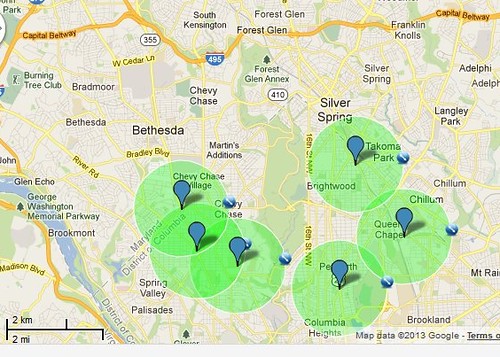
Below is a map of Upper Northwest DC, showing 1 mile radius distances from the Takoma, Petworth, and Fort Totten stations on the eastern side (east of Georgia Avenue) and the Friendship Heights, Tenleytown and Van Ness stations west of Connecticut Avenue.  (Although this is augmented by high frequency bus service on 14th and 16th Streets, plus Georgia Avenue.  The 16th Street line is now the highest ridership bus line in the city, approaching 20,000 daily riders.)
Upper Northwest DC subway station, 1 mile catchment areas
As you can see, large swathes of Upper Northwest--Ward 3 and Ward 4--lie more than 1 mile away from a subway station and from a decent commercial district, although they tend to be served by bus service, but it may not be be frequent.

Labels: , , , , , ,

Thursday, March 21, 2013

DC's proposed legislation on large retailers is misguided

Left: sign up sheet at the Walmart booth at the H Street Festival in September 2012.

See "DC Council panel hears testimony on 'living wage'" from the Post and "D.C. could force huge wage increase on city's big retailers" from the Examiner.

Obviously, opposition to this bill is why Walmart has been in full-time organizing mode since last summer, which I wrote about a couple times.  See "Wal-Mart is among 'Don't block D.C. Progress' backers" from the Post.

The legislation misguided because it focuses mostly on how the business treats its workers, and ignores the urban design and business district impact of large scale retailers on streetscape, urban design, commercial district revitalization, and small retailers.

That's because the legislation is being driven by labor interests--and I can't fault them for it--since typically large grocery chains like Safeway and Giant in the Washington region are unionized and chains like Walmart and Target (but not Costco) are not and this impacts prevailing wage rates and leads (generally) to the failure/consolidation of weaker supermarket companies when Walmart in particular enters a market.

Big box retail zoning ordinances, to my way of thinking, should be focused on the business and urban design impacts primarily, and less so the labor impact, although that does matter.

In the approval process for the coming Walmart store on Georgia Avenue, the DC Office of Planning declined to consider "economic impact" as a "neighborhood impact" within the context of the Large Tract Review regulation.

From "ANC4B Large Tract Review Report on Walmart, 5/2011":

The large tract review process is designed to ensure that extra-normal demands are not made of DC Government resources, including infrastructure, through the process of inter-agency review and
coordination. Specifically the process is designed:

• To minimize adverse environmental, traffic and neighborhood impacts;

• To avoid unnecessary public costs in terms of new services or facilities required of city agencies; and

• To carry out the policies of the District Elements of the Comprehensive Plan for the National Capital. (Section 2300.2 of 10DCMR23)


Without considering the potential for negative economic impact (what in the California Environmental Quality Assessment process they call "urban decay") it becomes impossible to mitigate in advance potential negative effects.

Then what is the point of the Large Tract Review regulation anyway?

I wrote about this here: "Lessons from Walmart's foray into Washington, DC" and "Walmart: in the city vs. of the city."  From the foray piece:

What interests me most is what are the lessons, for planners, elected officials, and citizens?

1. Walmart isn't driven by ethics, the decisions they make are business-based. 

2. Walmart wants to be in the city, in "urban" markets, but they are agnostic about building and project form. If the site they want is what they want, they just want to be there, they won't push the developer to do an urban-appropriate or better project.

3. Communities are in position to get their clocks cleaned, unless they have the right ordinances in place before Walmart comes knocking, and has already lined up support behind closed doors long before it's reported in the media.

4. The Respect DC Coalition acts as if they lost, but they really won, sort of..., as Walmart negotiated a community benefits agreement in DC, just that Respect DC wasn't part of the negotiation.  

5.  A big lesson is that advocates should focus. If you don't, your opponents set the agenda. 

6.  Setting the agenda for negotiation is key and it should be focused on the long term best interest of the city and impacted neighborhoods, not anything else.  

a. What matters to me is the research that says for every job that Walmart creates, 1.5 jobs is lost.

Instead of monies paid out to charities, mitigation of the potential negative impact of Walmart on independent businesses and commercial districts should have been the foremost priority of any financial "contributions" by Walmart.

b. The other thing that matters to me is whether or not the stores will support urbanism and appropriate urban design.

But by focusing on jobs issues, and money for charities, substantive urban-related issues end up getting completely ignored.
   
I wrote about similarly misguided regulatory efforts on "big box" regulation in Montgomery County Maryland here: "What community benefits are supposed to be versus what people think they are about."

The proposed DC legislation has all of the same defects as the Montgomery County proposal.

This might also be useful, "If you don't know urban political theory, it's likely that you don't understand local land use: St. Louis: DC; etc."

Labels: , , , , , , ,

Tuesday, February 19, 2013

Toronto Transit Maintenance Workers Union promotional video

It's actually a decent ad. Not perfect. But still pretty good. I can't imagine seeing an equivalently decent video done by the local transit unions in the Washington region, or the transit operators either, for that matter. See "Toronto transit union seeks to build public support with new ad" from the Toronto Globe and Mail.

From the article:

... a publicity campaign aimed at building public support for the workers. The video, which currently has more than 100,000 hits on Youtube, will also be shown in cinemas starting this week. In addition, Amalgamated Transit Union Local 113 is putting up placards around the system, launching a website – www.protectingwhatmatters.ca – and running draws for free Metropasses.

“Our maintenance workers are the biggest secret in Toronto,” union president Bob Kinnear said Tuesday. “We have people out there working every night, and people don’t know that.”

The 3,500 maintenance employees include cleaning staff, mechanics and crews that fix streetcar track. Their jobs can be deadly at times: last month, 49-year-old Peter Pavlovski was hit by a train and killed while working in a subway tunnel.

Labels: , ,

Thursday, December 29, 2011

Police unions and municipal decision-making

It's very hard for politicians to criticize police officers (and fire fighters) and it's hard not to acquiesce to their wage and pension demands--after all, they put their lives on the line.

Plus, the unions make donations to political campaigns.

But at the same time, the union represents police officers as laborers, and they aren't usually focused on police department management and managers as working to reduce crime and improve public safety as much as they think of them as evil overseers.

In Stockton, budget cuts to the police department are being fought by the police officers union with incendiary billboards and other very direct tactics. See "Debt-ridden Stockton a battleground for police union, City Hall" from the Los Angeles Times.
Steve Anderson from Anderson Signs installed one of five signs depicting Stockton as a dangerous place around Stockton for the Stockton Police Officers association
Steve Anderson installs one of the billboards the police union is using in its fight over cutbacks. The police union also bought the house next to City Manager Bob Deis. (Craig Sanders, The Record / December 29, 2011)

Labels: , , , , ,

Tuesday, November 29, 2011

What community benefits are supposed to be versus what people think they are about

The Post editorialized against the proposed "Walmart" ordinance in Montgomery County last week, "Montgomery’s big-box bill sends the wrong signal to retailers," and today has another article about it, "Montgomery big-box bill is unconstitutional, county attorney says," where the County Counsel argues the bill is unconstitutional.

I started a blog entry about this last week, but didn't finish it. Here goes.

The proposed law in MoCo isn't unconstitutional, it's just flawed in concept and proposed execution.

I wouldn't even call it a big box bill, because it doesn't systematically focus on mitigating systematic negative economic impacts of such stores on independent retailers and commercial districts.

1. The point of community benefits agreements generally is that a developer/tenant receives monetizable benefits from density increases, zoning changes, and exceptions and variances from zoning regulations, and that the community should receive something in return for the positive changes to the economic value of the property received by the developer.

2. The point of big box review ordinances is to weigh the potential negative impact against positive impact, and ensure that the projected costs of the entry of the business are appropriately weighed in the review process, and plans and programs for mitigation provided.


-- In California, as part of environmental reviews, new developments are supposed to address issues of "urban decay" that they might cause.

From the Urban Decay Study, City of Sacramento Railyards Development Plan:

For the purpose of the assessment and consistent with the intent of the court decisions, “urban decay” is defined as the closure of retail and other stores in the surrounding area as a result of market competition and disinvestment - leaving decaying building shells in a state of sustained vacancy, long-term abandonment, repeated property damage, and/or deteriorated conditions that significantly impair the proper and safe use of the real estate. Properties in areas with higher than normal market vacancies and which have been empty and/or unused for at least three years or more are assumed to be in prolonged or sustained vacancies. An example in Sacramento would be the K-Street Mall, which has suffered urban decay – and is only now being transformed by coordinated public/private investment back to a state of economic vitality.

The point of big box ordinances is to address the potential for urban decay and mitigate it as part of the approval/disapproval process.

3. On the other hand, businesses aren't "eelemosynary" organizations--they aren't charitable.

Although there is this new kind of for profit organization called a "social benefit corporation." One is open in Takoma Park, Maryland ("Blessed Coffee in Takoma Park offers perks to community" from the Gazette). To me, there is too much effort and risk involved in creating, managing, growing, and maintaining a business to be able to sustain the effort while giving away all the profit. (It's also why member cooperatives have a difficult time staying in operation also.)

That doesn't mean you can't have a social orientation in doing your business. In fact, the underlying business/marking approach I am using for BicyclePASS is based on social change theory along with social marketing and collaborative consumption and product models. (See
"Professor Sarah Soule Explains Effective Social Movements" and "How Markets Are Made and Broken by Social Activists" from Stanford Business School Magazine.)

But, typically, wage rates and many aspects of how a business operates wouldn't be covered by the review process deriving from either one of these building regulation process.

I know that as I participate in the development of a business focused on "bicycle facilities systems integration" I don't want "the government" legislating various aspects of how we are to run our business either, as it can hamstring us.

Just as Eastern Market in DC isn't run very well based on the law that governs it, nor is the Post Office well served by being micromanaged by the U.S. Congress...

4. The proposed MoCo ordinance is flawed because it isn't construed as a law based on planning and zoning regulations based on government's "police powers" focused on maintaining the health and well being of individuals and communities so much as it is based on a belief that "businesses need to give back to the community."

Planning and zoning regulations shouldn't be about buying off community groups--giving some dribs and drabs to selected organizations (which is why various groups in DC have been bought off in favor of Walmart, because they've received charitable contributions and other benefits), it's to mitigate in a substantive manner the potential negatives generated by the entry of the business, and to monetize the value of the zoning "relief" received by the developer/tenant.

5. Communities need strong frameworks for community benefits agreements -- I've written about this in the past, "Community benefits agreements (revised)" from 2008, although in a recent conversation I had with Robin Diener of the DC Library Renaissance Project, she makes an argument that I need to write about, that community benefits processes are typically very localized, focused on the neighborhoods where the projects are being constructed, and instead should be focused on providing benefits captured by the city as a whole--and big box ordinances, as I wrote last week ("Lessons from Walmart's foray into Washington, DC").

6. The intent of the MoCo legislation is admirable, but lacks a strong basis in planning "theory" and therefore distracts from what really matters--mitigating negative impacts and ensuring a level playing field for businesses.

The process in DC is a perfect example of the failure to have strong zoning regulations, because the community "partnership" agreement negotiated with Walmart fails to provide any substantive mitigation programs and monies, even while it buys off various community groups through charitable contributions.

Labels: , , , , ,

Monday, February 14, 2011

What part of due process is hard to understand?

Today's Washington Examiner story "Fired teachers backed by judge" on the recent arbitrator's ruling calling for the reinstatement of teachers fired by Michelle Rhee, when she was in charge of DC Public Schools, has the tone of incredulity.

If you have ever been fired from a job--by people who were more enamored of their power than fairness- as I have been, more than once (note that it is b.s. about the value of "telling truth to power")-you can understand why due process is an important concept. But there is no fairness clause for firing--unless it's part of a union contract or you work for the government, as generally, because government agencies are under the authority of the U.S. Constitution, workers have a few more protections.

DCPS didn't follow the procedure called for in the Union contract. If Michelle Rhee wanted to fire the people so bad, _and she had cause_, all she needed to do was follow procedure.

Obviously, no one wants to retain as employees people who aren't fit for the job. That's the point of a probationary period, where the employer has the option of not continuing employment for people who are deemed to be unsatisfactory. The Examiner article discusses cause, but at the level of hearsay.

Labels: , , , ,

Wednesday, December 15, 2010

Constraints vs. values, focusing on practical organizing opportunities regarding Walmart in DC

One of the reasons I can't get all that worked up about the Walmart issue is that the projects as proposed fall into the category of "matter of right." In other words, as long as the projects proposed meet the basic land use and building requirements of the zoning classification, they will get approved. That's the case despite all the reasons for not favoring the company and their business practices

-- Walmart Movie: The High Cost of Low Price from Brave New Films
-- Confessions of a Wal-Mart Hit Man

• Sure, DC has a large tract review process which provides "an additional level" of review, but the review process is pretty narrow, sticking to questions concerning building and transportation impact.

The Georgia Avenue site is zoned C3A. (See Chapter 11 of the DC Zoning Regulations.) It's possible that the LTR will mention how a single use project at the Missouri Avenue-Georgia Avenue site doesn't meet many of the stated objectives in the Georgia Avenue Great Streets program, but it probably won't, instead it will focus on adding destination retail at a key node on the corridor.

- Georgia Avenue Great Streets Planning reports

• Although the negative transportation impacts are likely major, because unlike say DC/USA where probably at least 50% of the customers come by transit (bus or subway), on foot, or by bicycle, the proposed Walmart location on Georgia Avenue is only served by bus transit (Walmart should be required to provide shuttle service from Petworth and/or Fort Totten Metro stations) and the neighborhood is not highly populated, meaning that foot traffic is likely to be minimal. That means thousands of additional car trips per day, in a congested location, and the possibility of through trips to the store via neighborhood streets.

Now, if DC had another zoning review process for retail projects larger than say 75,000 square feet, it would be a different story. We don't.

• But that is something to advocate for, in theory at least, going forward.

So I am not likely to be out there demonstrating at the house of Foulger-Pratt principal Dick Knapp this Thursday, because it's a symbolic act that can't accomplish much.

• Even though my big problem with the project to come on Georgia Avenue is that at least initially, it isn't mixed use. So the thing to lobby for with the developer is doing the Walmart project in a way that doesn't encumber other positive development opportunities on the parcels, as well as "on top of" the Walmart store.

• The big thing that I think various anti-Walmart Union organizations are forgetting is that by Walmart entering urban markets (Chicago, Baltimore, DC, and NYC to start), Walmart is presenting unions with the opportunity to organize their workers, in a way that stores located in suburban, exurban, and rural locations do not.

I'd be focusing on that. And just as supermarkets are hiring consulting firms like Saint Consulting to help fight off Walmart (see "Rivals Secretly Finance Opposition to Wal-Mart" from the Wall Street Journal), unions ought to be seeking out the most able resources to help them organize urban Walmart workers.

Although Walmart is notoriously anti-union. When a group of butchers in one store were successful in getting union representation, Walmart closed the meat cutting operation at that store (and many others to preclude further organizing efforts), and trucked in prepackaged meat. See the story from 2000, "Wal-Mart pins butcher reductions on consumer, industry changes" from the Oklahoma City Journal-Record.

Labels: , , ,