Rebuilding Place in the Urban Space

"A community’s physical form, rather than its land uses, is its most intrinsic and enduring characteristic." [Katz, EPA] This blog focuses on place and placemaking and all that makes it work--historic preservation, urban design, transportation, asset-based community development, arts & cultural development, commercial district revitalization, tourism & destination development, and quality of life advocacy--along with doses of civic engagement and good governance watchdogging.

Tuesday, February 17, 2015

Everything you need to know about urbanism in four blog posts from Larry Littlefield

I was reading an entry on the NYC transportation blog Second Avenue Sagas about the proposed AirTrain to LaGuardia Airport in response to a not very informative press release from NYC's Global Gateway Alliance--business advocates for the city's airports--about transit connections to the world's 30 busiest airports, and some of the comments were by Larry Littlefield, the back and forth patter congratulated him on a letter he had published in the Economist, so I dug a bit deeper into his oeuvre.

He appears to be an investment analyst, maybe a couple years older than I. Lives in Brooklyn. He focuses a lot on urban economics, the real dynamics of the housing market, and municipal finances, especially pension liabilities (in fact, his reasoning reminds me a lot of blog commenter charlie). His blog is called Saying the Unsaid in New York.

These four posts are the rough equivalent to reading Cities in Full by Belmont, but much more dark.

His writings make me appreciate more that DC proper is an outlier in that its economic future is rosier than most cities--because we are a true city-state.  Even if Congress controls some of the city's destiny, having control over most of the tax revenue stream (with the exception that we can't tax nonresident income earned in the city) puts DC ahead of most others.  Although, we still have the municipal worker pension overhang in the city and in the transit system, which will handcuff the city quite a bit still, especially as we can only grow our revenue streams intensively, not by annexation.

1. "The (New) Urban Crisis"

2.  "Can The Urban Archipelago Be Recreated?"

3. "How Then Shall We Live: Housing in the Wake of Generation Greed

4. "How Then Shall We Live: Transportation in the Wake of Generation Greed"

FWIW, the section of his blog, Helpful Background and Greatest Hits, is even more dark. We're f*ed. And maybe it's better I don't have kids, as it's that generation who are stuck with the consequences of what they're being left by the previous generations--what Mr. Littlefield calls "Generation Greed" and  the policies and practices they have begat, to their financial benefit now but at a mortgaging fo the future.

It's not just about crony capitalism, but pensions, housing policies that supported suburban development, and other policies that supported automobile dependence, etc., which happened to be sustainable only in the immediate conditions after World War II, when the US emerged, temporarily but we didn't know that at the time, as the globe's richest country.

Labels: , , , , , ,

Monday, July 22, 2013

It's a bad idea to treat customers badly and then turn around and ask for their support: transit union workers edition

The transit union (ATU Local 689) being worked up about DC's talk about moving to privatizing intra-city bus service (something that all the other area jurisdictions have done) and getting residents on their side, well I wonder if such a campaign will have any juice.  See "Metro union aims to block DC plan to privatize buses" from the Washington Post.

-- ATU publication, Ten Reasons Why Transit Privatization is Bad for the District
-- ATU publication, Circulator Privatization Map
-- ATU publication, I'm in with Local 689 campaign sign up

From the article:

Metro’s biggest union is trying to rally support from pro-union groups and local community organizations to stop the District from privatizing some of its bus routes now run by the transit agency.

The District’s Department of Transportation is seeking a private contractor to take over about two dozen bus routes that Metro runs for the city and the popular D.C. Circulator bus system.

Operating the buses would be part of a larger deal in which a private contractor would also build and operate a streetcar system in Anacostia and along the H Street corridor.

City officials said the move is meant to create a more unified, efficient transportation system under one contract that could be worth at least $1.5 billion over 30 years.

Although I will say that "one unified transportation system" has at least three different elements:

1. The scheduling system and the integration of service between separately operated bus services;

2. The branding and positioning and service;

3. The contract to operate it.

Customers don't care about the contract to operate it. They do want the system to be "legible" and understandable and easy to use.

But there is no question that the private operators, such as Veolia Transportation, which runs the local bus service in Baltimore (as opposed to the service run by MTA), and First Transit, which operates the DC Circulator bus system, as well as the various operators running transit systems for other Washington-area jurisdictions, would like to run the intra-city bus services in DC too.

I had an interesting conversation with a DDOT staffer a few weeks back who had worked for awhile in California.  We were talking about how strong the transit workers unions are in San Francisco and in the Bay Area too, BART suffered a strike a few weeks ago, see "Second BART strike looms as labor talks resume and workers lash out at management" from the San Jose Mercury News).

He made the point that one advantage of a strong transit workers union/movement is that they end up being a strong interest group in favor of the continued provision of transit funding.  That matters, especially in bad times.

(This came up in Phoenix too.  There the privately operated bus service wasn't meeting their service obligations and they racked up big fines.  The union struck, because the operator claimed that the fines got in the way of giving raises.  See the past blog entry "Sunday March 18 is International Bus Driver Appreciation Day."  The city changed the contract in favor of reduced penalties.)

Image from the article " Jeter Re-Elected at ATU 689" from the AFL-CIO Metro DC Labor Council website.

I've never had the sense that the transit workers unions representing WMATA transit workers have that much of an outreach orientation focused on the voters (a/k/a "taxpayers").  I think from time to time the unions do some polling, because I recall answering a phone survey on the subject of transit, funding, etc., that seemed to be a union-related endeavor, based on the tenor of the questions. 

But the other problem is that as far as worker-customer relations go, the unions go to the mat to protect workers who get reprimanded/fired for treating customers poorly.

And that doesn't make me all that willing to extend support to the Unions specifically.  Also see the past blog entry, "When the union label may be terrifying: transit edition," "Metro derailed by culture of complacence, incompetence, lack of diversity: ‘Inept get promoted, … capable get buried’" from the Washington Times, and "ATU Local 689 answers your questions" from GGW.

It's like the police officers union in DC.  They are busy all the time bashing management in their public statements (and they must miss the Examiner, which was a convenient mouthpiece for them when it published as a daily newspaper), but I don't feel like the union advocates for crime reduction and public safety in a concerted way.

The transit union has justified poor attitudes of their workers as a result of bad and oppressive management.  Well, then advocate for a better work environment in order to better treat customers, who ultimately, are responsible for the employment of both management and workers.

Until then, it's hard for me to be motivated to go out of my way to be supportive, because it is rare to see the Union take a position of being pro-customer.

THAT BEING SAID, I am the first to say that driving a bus is one of the hardest jobs there is.

Labels: , , , ,

Tuesday, February 19, 2013

Toronto Transit Maintenance Workers Union promotional video

It's actually a decent ad. Not perfect. But still pretty good. I can't imagine seeing an equivalently decent video done by the local transit unions in the Washington region, or the transit operators either, for that matter. See "Toronto transit union seeks to build public support with new ad" from the Toronto Globe and Mail.

From the article:

... a publicity campaign aimed at building public support for the workers. The video, which currently has more than 100,000 hits on Youtube, will also be shown in cinemas starting this week. In addition, Amalgamated Transit Union Local 113 is putting up placards around the system, launching a website – www.protectingwhatmatters.ca – and running draws for free Metropasses.

“Our maintenance workers are the biggest secret in Toronto,” union president Bob Kinnear said Tuesday. “We have people out there working every night, and people don’t know that.”

The 3,500 maintenance employees include cleaning staff, mechanics and crews that fix streetcar track. Their jobs can be deadly at times: last month, 49-year-old Peter Pavlovski was hit by a train and killed while working in a subway tunnel.

Labels: , ,

Wednesday, September 19, 2012

Clackamas County Oregon referendum requiring citizens vote in favor to participate in light rail projects passes

The failure of successful votes in favor of a sales tax transportation measure in most of Georgia wasn't a surprise as the measure was overly broad, mixed road and transit projects--generally transit measures pass at a 70% rate which is pretty good in an anti-tax climate, and didn't provide enough time to build support, less than two years from the passage of the enabling legislation to the election.  ("Failure of the transit-roads sales tax measure in Metro Atlanta")

Image of 3-401 supporters from the Portland Oregonian article, "Oregon Secretary of State's Office dismisses elections complaint against Clackamas County light rail opponents."

But the successful passing of a seen as anti-transit referendum in Clackamas County, Oregon one of the three counties included in the "Tri"-Met Transit District surrounding Portland is definitely troubling, although it is another example of the downside of referenda being voted on in primary, rather than general, elections, as primary voters tend to be fewer and more hard core (either positively or negatively depending on the issue).  See "Clackamas County anti-rail measure passes comfortably; effect could resonate for decades" from the Portland Oregonian.

From the article:

Clackamas County light rail opponents scored a convincing victory Tuesday night that could resonate for decades.

Initiative Measure 3-401, which passed 60 to 40 percent, requires countywide voter approval before officials can spend money to finance, design, construct or operate any rail lines in the county.

It's unclear what effect the measure will have on the controversial Portland-Milwaukie light rail extension, the $1.5 billion project at the heart of the battle. The line is already under construction, and on Friday county officials obtained a private loan from Bank of America to pay TriMet $19.9 million for its share of the project.

But if left intact after possible legal challenges, the measure could severely limit the future development of rail in the county, including possible high-speed passenger rail connecting Seattle and Eugene.

Note that like with the initiative in the Atlanta area, the center city and inner ring suburbs favored the measure and favored transit, while outer suburbs and exurban areas did not.

Perhaps a similar dynamic is working in Oregon, which overall, isn't always as "progressive" as people from outside the region believe, as there are cleavages between the eastern and western part of the state, cities and rural areas, Portland and the rest of the state, coastal issues vs. agriculture, and general property rights concerns.

In the DC-Maryland-Virginia multistate region, a transit referendum--nonbinding--is up for vote in Virginia Beach, Virginia this November, and will consider whether or not the new Tide light rail system will be extended from Norfolk to serve Virginia Beach.

It's possible that anti-toll fervor could shape the outcome, not to mention that municipal workers unions are against the measure because they see new transit services as competition for raises in tight and constrained municipal budgets.  See the past blog entry, "Virginia Beach municipal workers unions taking positions against against transit: see budget as either/or choice."

Labels: , , , , , , ,

Saturday, July 28, 2012

More mendaciousness about school reform: Joel Klein

Joel Klein, former chancellor of the New York City Public Schools, put on the job by Mayor Michael Bloomberg to improve scholastic performance, but more focused on interpreting the school reform agenda in terms of demonizing teachers, has an op-ed in the Wall Street Journal, "New York's Charter Schools Get an A+," where he calls out the success of charter schools there.

But his argument is flawed and misdirected.

1.  Klein says that when people point out poverty as a key problem in improving student performance that they are making excuses for not trying to improve scholastic performance.

2.  But really they are saying, deal with the impacts of poverty on students, otherwise you won't yield much in the way of substantive improvement in scholastic performance by lower income students ("the achievement gap").

3.  Klein calls out the achievement of the Success charter schools, where students "are performing at tthe same level as NYC's gifted and talented schools..."

4.  But he fails to acknowledge that part of the program in those schools is acknowledging poverty and its impact on students and addressing the impacts in ways that enhance the student's ability to learn.

5.  And he ignores the fact that most of the prominent efforts in "school reform" (NYC and Washington, DC in particular) are mostly focused on demonizing teachers (and teachers unions, sometimes justifiably) rather than addressing how poverty shapes underlying persistent achievement gaps and coming up with programs of support and development selectively targeting students, families, teachers, principals, and schools as necessary.

Basically, the school reform effort as articulated by Klein generally is to address poverty by "improving" teachers, rather than simultaneously improving teaching AND addressing poverty, educational deficits, etc.  Evaluation systems for teachers advocated by the "reform" movement are designed in ways that mostly ignore poverty and expect that exceptional teachers can always overcome this and any other problem that individual students might have.

Labels: , , , , , , ,

Tuesday, May 29, 2012

Virginia Beach municipal workers unions taking positions against transit: see budget as either/or choice

When planning for light rail started in the Hampton Roads region of Virginia, the original intent was to have the system connect Norfolk and Virginia Beach, the two largest communities in the metropolitan area, and the home of the largest military bases there.

For various reasons, Virginia Beach opted out of the system, and Norfolk went ahead with it.  Now that the Tide light rail system is operational, it's easier (albeit more expensive to construct) to make the case for the extension of the system to Virginia Beach.  There will be a referendum this fall on the matter and so far it is expected to pass.

However, municipal unions in Virginia Beach are coming out against the light rail referendum, because they see the municipal budget as an either-or choice.  As has been relatively common with municipal budgeting across the country since the economic downturn, Virginia Beach's police officers, fire fighters, and teachers haven't received wage increases.

They want wage increases--and I don't blame them.

But they see the light rail transit system as a competitor for scarce monies available within local government budgets, that if the rail system is extended to Virginia Beach, the local share for construction (as much as 10% of the cost probably) plus funds for annual operations will crowd out the opportunity for wage increases.

So the police union and the firefighters union have come out against the light rail referendum.  The teachers union is likely to do so if they don't see wage increases on the horizon.  See "Virginia Beach to hold light rail referendum in Nov.," "Virginia Beach police groups also say no to light rail," and "Virginia Beach firefighters union opposes light rail" from the Norfolk Virginian-Pilot.

This is a very interesting development, one that I haven't come across before. 

It's chilling because other than real estate related interests (developers, lawyers, parking), municipal unions tend to be the biggest contributors to the campaign funds for local politicians, so they are major players in local politics everywhere.
Signs at the Hine School polling site
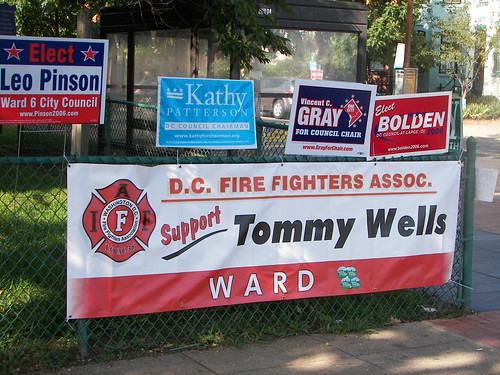
Fire fighters union endorsement sign, DC election, 2006.


If municipal workers unions take on anti-transit positions as a matter of course, it will set up some interesting dynamics.

Police unions tend to be "conservative" in terms of who they support politically and they seem to be more focused on bashing "management" than anything else, although it  is always couched as being focused on keeping communities safe. 


Fire fighters are a little less doctrinaire, but in either case these public safety unions care mostly about wages and work rules, always positioned in terms of supporting first responders.  (Even in Wisconsin, Gov. Walker felt empowered to eliminate bargaining rights for non-public safety related unions, but didn't eliminate such rights for police and fire fighters.). 


Teachers unions tend to be "progressive" and progressives tend to support teachers/teachers unions in the face of the incessant campaign by conservatives to demonize teachers as the sole reason for failing schools.

(Note that the transit workers unions too tend to be focused more on their wages, less on the impact that wages and hefty pensions have on current budgeting and fares, and seem to be totally unconcerned with the quality of customer service that their workers provide.)

It would be a shame if self-interest on the part of municipal workers unions led them to take anti-transit positions.  I know the choices I would make if I were to have to choose.

Labels: , , , , , , ,