Rebuilding Place in the Urban Space

"A community’s physical form, rather than its land uses, is its most intrinsic and enduring characteristic." [Katz, EPA] This blog focuses on place and placemaking and all that makes it work--historic preservation, urban design, transportation, asset-based community development, arts & cultural development, commercial district revitalization, tourism & destination development, and quality of life advocacy--along with doses of civic engagement and good governance watchdogging.

Wednesday, March 07, 2018

The false promise of ride hailing as a pro-city transportation mode

=====
Reprinted from Monday with new date because of the addition of the experience with parking in San Diego.  I meant to write about it, but I forgot.  It's very interesting.
======

Except for one thing, measurable impact on demand for parking as reported by Ace Parking of San Diego, there really isn't anything new here, as I have written many times about these issues already.  But it's nice to sum it up.  The SD item is the new #1, and the other points have been renumbered.

1.  The San Diego Union-Tribune reports ("Ace Parking says Uber, Lyft have cut parking business up to 50% in some venues") on analysis by Ace Parking, the major private parking firm operating in San Diego, a company that is also active in other markets including DC, of the impact of ride hailing services on their parking business.  From the article:
In a September email buried deep in an environmental report, Ace Parking CEO John Baumgardner laid out the ugly truth facing the parking business. At San Diego hotels serviced by Ace Parking, overnight parking has declined 5 percent to 10 percent. At restaurant valet stands, business is down 25 percent.

And, most dramatically, nightclub valets are seeing a 50 percent drop off.

Homegrown Ace Parking — one of the largest parking companies in North America and also a fixture in San Diego’s political and business scene — is feeling the impact from Uber and Lyft, the wildly popular ride-sharing services that allow people to leave their cars at home.

For consumers, the bright side may be lower parking prices. In downtown San Diego, city planners are looking at the decline as they update parking guidelines — which could lead to changes in how much future parking is built.

Will parking companies go away? “Is this an existential threat to my business model? Or, is there a way to pivot and continue to provide a necessary service?” said Keith Jones, the third-generation managing partner of the Ace Parking empire, in a recent interview.

Jones likes to talk about “journey management.”

“Ace is hyper-focused on integrating new technology within our parking operations so we help consumers and cars,” he said. “We are pushing the parking and transportation industry to be connected in a way that makes parking smart.”
I like the point about shifting to "journey management."

2.  Most people driving ride hailing vehicles make less than minimum wage according to an MIT study ("MIT study reveals sad reality for majority of Uber, Lyft drivers: Median income far below minimum wage," WCVB-TV). From the article:
Drivers make a median hourly profit of $3.37 before taxes, the study found.

The report said that drivers incur a median cost of $0.30 per mile and that nearly a third of drivers incur expenses exceeding their revenue. At tax time, the standard mileage deduction could mean that there is untaxed revenue in the billions of dollars for these drivers.
-- The Economics of Ride-Hailing: Driver Revenue, Expenses and Taxes, MIT Center for Energy and Environmental Policy Research

NOTE THAT UBER DISPUTED THIS STUDY AND THE RESEARCHER RE-RAN THE NUMBERS. NOW HE SAYS THE FIGURE IS $8.55 HOUR WHILE UBER'S NUMBER IS $13.05.  See "Uber drivers per hour profit revised in disputed MIT study," San Jose Mercury News.

This shouldn't be a surprise.  Taxi driving is mostly resorted to by people with limited options.  Having to pay a good chunk of your earnings off the top to the software firms that run the service reduces margins.

Interesting, GM's Maven car sharing program is offering a high cost e-vehicle rental for people offering ride hailing services ("Maven Gig, GM’s car-sharing service for Uber and Lyft drivers, comes to Austin: Just in time for SXSW," GM Verge blog), after Uber made the decision to get out of the rental business because it was a money loser. From the article:
Someone who’s interested in driving for any of these on-demand services, but doesn’t own a vehicle, can rent an electric Chevy Bolt through Maven Gig starting at $229-a-week. The weekly price includes insurance, maintenance, and electric vehicle charging. There is no membership fee.

Maven first launched its gig worker product in 2016 in San Diego and San Francisco. Since then, it has been introduced in Los Angeles, Boston, Phoenix, Washington, DC, Baltimore, and Detroit. Maven says its customers have logged 170 million miles driving for various on-demand apps.

What’s different here is how closely Maven says it will be working with the city of Austin to ensure there’s an adequate electric car-charging infrastructure in place for drivers to use this service.
3.  Ride hailing reduces the use of transit. ("Ride-hailing is pulling people off public transit and clogging up roads," Technology Review). From the article:
A study by the Boston-based Metropolitan Area Planning Council found 42 percent of trips taken via ride-hailing services in Boston would have been completed on public transit had the option not been available. Another 12 percent of people would have walked or biked. Plus, most people use ride-hailers end-to-end, rather than mixing the service with other modes of transport.
4.  Ride hailing use is induced by venture capital subsidies which makes the cost of a ride less than actual cost ("You're not paying enough for Uber," Boston Globe). From the article:
A new study of 944 Boston-area passengers by the Metropolitan Area Planning Council shows that ride-hailing apps are adding to vehicular traffic; people are using them for lots of trips that they otherwise would have made by transit or bike.

This isn’t just happening because Uber and Lyft offer efficient service. It’s because the fares that customers pay don’t come close to covering the ride-hailing companies’ costs — much less the external costs to society of drawing more passenger cars into an already congested road network. ... In 2015, according to one transportation consultant, Uber passengers were paying only 41 percent of the cost of each ride.
5.  Ride hailing is a form of "inducing demand" and therefore increases congestion ("Studies are increasingly clear: Uber, Lyft congest cities," Associated Press).

6.  Chicago has instituted a fee per trip on ride hailing, which they use to fund sustainable mobility improvements ("Emanuel says Uber, Lyft fee hikes will pay for better transit cameras," Chicago Tribune; "Emanuel claims ride-hailing industry costing Chicago taxpayers $40 million per year," Chicago Sun-Times).

This seems like a reasonable mitigation measure.

7.  Transit consultant Jarrett Walker argues that there is less than meets the eye with microtransit ("Microtarnsit: What I think we know," Human Transit blog). The key point is the cost of labor to run a vehicle, and the ratio of passengers to drivers. The fewer the passengers, the more costly the service. He makes the point as I have that microtransit isn't new, in terms of either being an on demand service or contracting it out, and having an app doesn't make scalar changes to the mode.

David Aragon, an operation manager and one of the drivers for Free Ride Everywhere Downtown (FRED) waits at a local apartment building for his next pick up in the downtown area. (Nelvin C. Cepeda / San Diego Union-Tribune).


... speaking of San Diego, I do think there is a place for microtransit along the lines of the FRED e-shuttle operating in the Downtown ("Revisiting stories: FRED Downtown shuttle in San Diego," 2017) and supporting "park once, visit many places" consumption within the district.

8.  Meanwhile Uber takes aim at medical transportation ("Uber, Lyft try solving one of medicine's biggest problems: getting people to medical appointments," Chicago Tribune).

Again, not much new, and typical of firms aiming to make a good deal of money from government contracting (like Electronic Data Systems, the firm founded by H. Ross Perot, which had preponderate amount of business from state governments for IT systems).

Labels: , , , , , , , ,

Saturday, October 12, 2013

Lawsuits against government actions

In a thread on a list I am on there is a discussion how about residents in one monied community in California continue to fight the restoration and expansion of an elementary school--the school had been sold off but decades later it has been bought back for re-use as a school, because of enrollment increases.

The architect leading the design effort made the point that this kind of litigation discourages public bodies from taking up similar battles in the future, and can get them to fold, even if they are right.

2.  On GGW there is a discussion of the 5333 Connecticut Avenue NW/Cafritz battle ("Fight over 5333 Connecticut reveals dysfunctional process").  Some residents--people who fought off having a historic district (sad irony)--are suing over the project, which was mostly matter of right, on the basis of how certain heights for the project are being calculated.

Based on my experience with similar cases, I can't see how the residents will win, because the practice for measurement of allowable height is pretty well defined.

3.  Taxi drivers have sued the city ("D.C. cabbies file lawsuit over new requirements" WTOP radio) about certain aspects of new regulations that guide their operations, based on Constitutional grounds.  Based on my limited experience with jury duty, I learned why they will lose.

I didn't know that Constitutional rights are limited mostly to our person and where we live, but not to other objects, like cars, which we operate as a privilege and with a license from government.  This came up in a bunch of cases where we learned that the Supreme Court--for good or bad--has ruled and agreed to limits on Constitutional protections with regard to automobile use, etc.

By extension, this includes professions which require licensing and regulation, such as operating taxis on a city's street and selling the services, as a common carrier, to the public.

They choose to participate in a licensed profession.  Within the authority of the regulators is the power to impose standards of operation.   (And other cities have similar requirements.)

4.  In the discussion about the case in California, we talked about putting limits on the ability to sue.  There's a fine line between restricting speech and rights and limits.  People can sue even if their grounds are weak.

The problem is that deep pocketed plaintiffs can win because of their deep pockets, and not the merits.

So I can see having the possibility of having to pay for the legal costs of the winning side by the losing side to be a worthwhile check.


Labels: , , , ,

Wednesday, August 28, 2013

One point about taxi drivers who don't own their own vehicles: the regulatory system isn't set up to protect them


photo

In the previous blog entry I wrote:

The regulatory system should provide:

 for taxi operators
- a testing regime for drivers
- an application and monitoring service over the companies and individuals licensed to offer taxi services
- a system of inspection for vehicles and general operations

for customers
- a system to handle and rectify customer complaints

in general
- a set of customer service standards and metrics
- a benchmarking-research function to ensure that DC taxi services are best-in-class (cf. "Pr. George's cabbies complain about pick-ups at Gaylord National," Post, about how National Harbor is offering its own taxi service because they claim that PG County taxis are substandard)
- a system for ensuring vehicle and service quality (inspections, inspectors, including operation at all times of day and days of the week)
- a system for being able to innovate and offer new services (also see the recent blog entry "Testing changes to zoning with demonstration projects").

2.  This framework leaves out the taxi drivers who aren't owner-operators.  Who protects them?  No one really.

3.  That's what I was referring to when I made the point in other writings that because a preponderance of drivers come from demographics with fewer opportunities, there may not be "barriers to their entry" to the occupation (other than passing the drivers test), but the oversupply of interested drivers because of factors exogenous to the industry means that the workplace isn't very stable or supportive, and it can be hard to make a living, especially if the taxicab operators who are licensed charge drivers a lot of money to operate ("rent") a cab.

4.  It only gets worse with "ridesharing" services being added to the mix, because the providers in those cases again have different, non-industry related factors influencing their decision making and how they account for the cost of providing the service.

This expands the supply of vehicles without necessarily increasing demand (it probably does lead to a demand increase somewhat).  Further pressuring the traditional taxi industry.

5.  I mention this because the economic stability of the taxi industry is in part at risk in more marginal markets, as a result of ridesharing services.

It "feels" comparable to me to how traditional commercial districts declined in response to the creation of suburban shopping centers and the chaining up of retail sectors.

With fewer tenants seeking space in TCDs, landowers would rent to anyone, rents went way down, usually below the amount necessarily to properly maintain the building(s), so the district declined further and further, because at the microeconomic level, its fundamentals were broken.

The same goes for taxi services.

Labels: , , , , ,

Friday, July 19, 2013

Piling on City Council for Walmart

DC recently passed legislation forcing large big box retailers to pay higher wages. The bill is focused on Walmart, which has plans for 6 stores in the city, but the legislation applies to other stores as well. Three of the stores are underway and the stores not currently being built would not be, according to Walmart, if the law is upheld.

Now I wasn't in favor of the law because it was misdirected. I prefer to see the city pass a comprehensive big box review ordinance that would focus on urban form, development, and other elements.

Left: Walmart was a sponsor of last September's H Street Festival and at their booth they were gathering names of supporters for their entry into the city.

What gets me about the campaign by Walmart, and now I understand why they have been organizing continuously since they began the process (see "If you don't know urban political theory, it's likely that you don't understand local land use: St. Louis: DC; etc."), in order to be able to ward off efforts such as this, is that "the other side" hasn't been articulate about Walmart's two biggest weaknesses.

1. In virtually every consumer satisfaction study, on every element except price*, they are ranked very low (see "Who's right about Wal-Mart's customer satisfaction?" from MSN Money).

2. The way that Walmart treats non-managerial staff is horrid, horrid, horrid, at least according to this series of articles from Gawker (e.g., "Life at Wal-mart, Vol. 3: Welcome to Hell").  Also see "Wal-Mart Relies On Taxpayers To Subsidize Low Wages" from Business Insider.

3.  Related to both customer satisfaction and labor treatment-management, Wal-mart's primary priority is managing for stock price, and in the face of sales drops they have been continuing to cut labor, about 50 people per store.  This has resulted in highly significant levels of "out-of-stocks" on the weekends ("Customers Flee Wal-Mart Empty Shelves for Target, Costco" from Bloomberg).

Why would we want to roll out a red carpet for such a company's entry into DC?

Anyway, Walmart continues to gather support, according to this article, "Major retailers urge Gray veto of living wage bill, threaten to table expansion plans," from the Washington Business Journal. From the article:

A half-dozen major retailers have signed a letter to D.C. Mayor Vincent Gray urging him to veto the large retailer living wage bill, threatening to "revisit" expansion plans if the legislation is enacted.

Here's the irony about this statement. Walgreen's and Autozone stores are small, they will never be subject to the legislation. Macy's is not likely to ever open a second store in DC, maybe a Bloomingdales, but probably not. Neither Target nor Home Depot is likely to open a second store in DC. Lowe's has been listed as coming to the city, probably, to a development on New York Avenue.

And the companies are not in the business of wanting to ever help Walmart.

But the companies must be so against local regulations concerning labor relations and wages that they would join forces, with concern that such regulations could end up being extended to other types of businesses.

I even saw an on-air broadcast editorial in favor of Walmart on the wage bill issue, on Fox5 (WTTG-TV).  I've never seen them do an on-air broadcast editorial--maybe they do them all the time and I just am never watching at the right time? 

Walmart plays very hard ball, as I wrote about last year, about how they successfully got a big box review ordinance overturned in San Diego, and I expect they are likely to win on this issue in DC.

* There is a report from Zenith Management Consulting, How To Exploit Wal-Mart's Weaknesses, that makes the point that the reality is that only 20% of the products that Walmart sells are significantly less than the prices at other retailers.

But they use these products as a way to shape a consumer's overall impression about Walmart as always being the lowest priced store.  From the piece:

• Wal-Mart’s business model is not really low-price, it is creating perceptions that
prices are lower than they really are.
• All retail customers have five core needs that must be met.
• Low prices matter more to consumers because they think Wal-Mart’s are so much lower.
• Consumers forgive Wal-Mart’s poor quality, service, and convenience because they think Wal-Mart’s prices are so low.
Consumers who shop at Wal-Mart become caught in a self-reinforcing loop that makes them keep shopping there.
• Wal-Mart’s buying practices injure its vendors.
• Wal-Mart actually serves well only one stakeholder group: shareholders.
• Wal-Mart’s great weakness is that it serves poorly four out of five stakeholders.
• Wal-Mart is so successful nonetheless because it creates perceptions that it is actually serving all its stakeholders well.
• The only way to recapture market share from Wal-Mart is to interfere with the
mis-perceptions.
• This cannot be done by individual organizations, but must involve groups of
organizations acting together.
 --
Walmart's total sales include 55% grocery sales ("Walmart's Grocery Segment Accounts for 55% of U.S. Sales" from Retail Leader; "Wal-Mart Fattens Up On Poor America With 25% Of U.S. Grocery Sales" from Forbes).  And because people eat every day, food purchases drive a lot of store traffic.

One of the company's campaigns is price comparisons ("Walmart Gets a Boost From Local Price-Comparison Ads" from Advertising Age), which they have been running in this market.  The ads typically cherry pick products for the comparison and they go head-to-head with the company that they are most likely to compete with--in this case, Giant Supermarkets.

In some other markets, supermarkets like Publix ("Publix swats back in Walmart price war" from the Tampa Tribune) and HEB ("H-E-B beats Wal-Mart on advertised claim of big savings" from the Houston Chronicle) have successfully run counter-advertising ("interfering with the mis-perceptions") that has led Walmart to back off on the campaign in those markets, because these companies can successfully compete.

Labels: , , , , , ,

Thursday, May 09, 2013

Food truck issue revisited (DC)

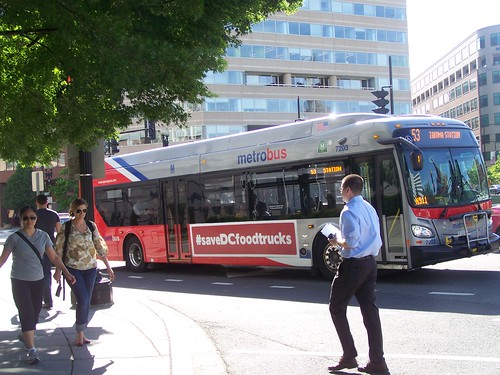
Save food trucks ad on the side of a busThe food truck legality question is of issue now in DC, because the city's Department of Consumer and Regulatory Affairs has prepared regulations that are pretty constricting.

See "Curbed: Could New Regulations Kill DC's Food Truck Culture" from the Washington City Paper.  The anti-regulation oriented Washington Examiner has editorialized on the subject, "To protect restaurants, D.C. may curb food trucks."

The very restrictive DCRA approach is mostly in response to advocacy by the Restaurant Association of Metropolitan Washington (DC legislative advocacy page) and the various Business Improvement Districts, who rather than plan for the overall vitality of their commercial district area, tend to represent the interests of property owners first and foremost.

Although I agree that there are some logistic issues, and nuisance issues (cleaning up after food trucks), taxation questions--originally food trucks just paid a flat fee rather than 10% on actual sales--that needed to be addressed, which the regulations also address.

Ethiopian food truckI have written a bunch of posts about the issue over the years, focused on how food trucks and outdoor markets allow for vitality, capital formation, business development, and methods for serving a greater variety of consumer market segments.

Some of the entries include:

-- Value of food trucks (Portland Oregon study), 2012
-- Food trucks as a way in, 2011
-- Another scale of planning failure: neighborhood vs. city-wide interests and food trucks, 2012

But the broader issue of whose interests are being represented foremost by a commercial/business improvement district represent led me to write the entry below, "Business improvement districts and boundary spanning," which I am reprinting, from January 2011.


Business improvement districts are created by property owners (and businesses) as a management mechanism to provide services that collectively improve the commercial district and thereby the economic value of property. They are paid through a "tax" assessed on property which is collected by the city and passed on. The districts are self-managed and don't have board members representing stakeholders (i.e., residents, customers, etc.) that are "served"* by the property owners and businesses located in the properties.

At the same time, BIDs are supposed to manage the commercial district overall in ways that maximize its popularity and success. Sometimes this means that the BID should make decisions that might anger individual business owners. This ought to be the case with regard to vending. The Post had articles in October and December with regard to food trucks angering bricks and mortar businesses, especially in Adams-Morgan ("D.C. restaurant owners pushing for tighter restrictions on food trucks"), as well as Latino vendors in a nearby plaza being seen as competition as well ("D.C.-backed weekend Latino food market upsets some restaurateurs.

From the food truck article:

For years, the District has sought to diversify its street-food scene, and rules proposed by city regulators in June were designed expressly to attract unique vendors like Fry Captain, the truck that parked near Bennett's shop.

But brick-and-mortar restaurants are pushing back against the proposed rules, saying they fail to protect existing businesses that make bigger investments in their neighborhoods and pay higher taxes. In response, food truck owners, fearful of the power of restaurant lobbyists, are busy drumming up popular support for the proposed rules.

Jake Sendar, the Fry Captain himself, felt the pressure in Adams Morgan. On his first night doing business, he found himself defending his rights to two angry restaurant owners and several police officers. Sendar decided enough was enough. His Fry Captain food truck now sticks to places where other food trucks have found a welcoming audience, mainly around Farragut West and L'Enfant Plaza.


(Note that this is an issue in Eastern Market as well.)

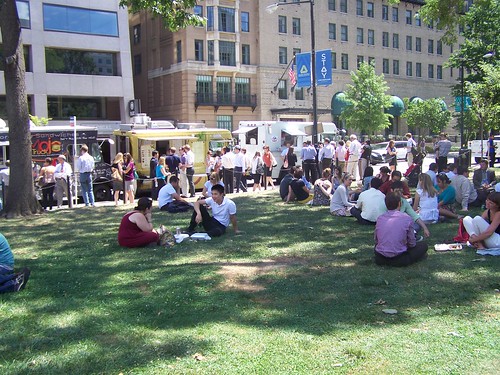
People lined up for Food Trucks, Farragut SquareIn each case, individual business owners aren't thinking about the need for the overall commercial district to continue to be vital and interesting and able to serve many different market segments--and not all market segments are able to or going to be served by particular merchants and their offers because what they offer isn't what some segments want.

Some people want the quick bite, something interesting, maybe less expensive and faster than going into a restaurant or standing in a long line. And as someone said in the discussion about food trucks and Eastern Market -- "you ought to be happy that food trucks want to be here, as it's a sign that the area is considered vibrant."

In Prince George's County, food trucks, often run by Latinos, were seen as blight, and banned, whereas Montgomery County is interested in food trucks in terms of the vibrance and vitality issue.

But the business improvement districts rarely take on the merchants for the greater good.

Last night at a Ward 4 ANC subcommittee meeting on the "Square 2986" issue (a/k/a "Walmart") I mentioned that I didn't like doing "Main Street" type work with property owners and merchants because in my experience, they were too self-interested and unwilling to be reflective about their offer--that they are independent businesspeople for a reason, and that by definition their independence makes them underappreciative of "help."

A sociologist graduate student's blog, A (Budding) Sociologist's Commonplace Book, has some interesting discussion about Adam Smith:

Smith devoted several extensive passages to showing how merchants (and others) often colluded to act in their own interests and against that of the public (think of: “People of the same trade seldom meet together, even for merriment and diversion, but the conversation ends in a conspiracy against the public, or in some contrivance to raise prices.” from Book I, Ch. X). And Smith’s hatred of corporations was evident, as noted by Polanyi. In the famous invisible hand passage, Smith notes that some merchants prefer to safeguard their capital and thus invest locally rather than abroad, in spite of the higher possible returns in foreign trade:

By preferring the support of domestic to that of foreign industry, he intends only his own security; and by directing that industry in such a manner as its produce may be of the greatest value, he intends only his own gain, and he is in this, as in many other cases, led by an invisible hand to promote an end which was no part of his intention. Nor is it always the worse for the society that it was no part of it. By pursuing his own interest he frequently promotes that of the society more effectually than when he really intends to promote it. (Book IV, Ch. II)


So, his point is that most merchants are most of the time out for themselves and do all sorts of terrible things that are not at all in the public interest to get their way. But, some merchants, those that out of fear (and not civic-mindedness) support domestic over foreign industry, end up promoting the interests of society by accident. Hence the irony of the joke.


People lined up for Food Trucks, Farragut SquareI think Smith's comments are relevant to how merchant interest groups make recommendations about vendors. The recommendations and preferences of merchants and their BID representatives need to gauged in part with regard to their self interest. And BID organizations need to be admonished to carry out all of their mission--managing the commercial district overall, for the greatest public good, not just for particular interests.

Labels: , , , , , , ,

Saturday, March 16, 2013

Farewell Fung Wah

Because of persistent safety violations and an unwillingness to correct them, the Federal Motor Carrier Safety Administration unit of the US DOT has shut down most of the so-called "Chinatown" bus services.  See "Bus riders: This wait is no Fung!" from the Boston Herald.

New Yorker Magazine has produced a Dylanesque parody song about the closure of these services, specifically Fung Wah Bus Company, which operated between New York City and Boston.

Labels: , ,

Tuesday, November 06, 2012

Uber, taxi regulation, UPS and FedEx and the unlevel playing field

In some of the discussions ("Cheh would limit regulation for Uber and taxi apps" from Greater Greater Washington) that have arisen over the Uber car service ("Uber Closes Yellow Taxi Cab Service In New York City" from Forbes), especially in view of pro-Uber legislation before the DC City Council, I am troubled by at least four things.

1.  Uber and pro-sharing forces claim that regulating such services somehow is a destruction of all that is good from the use of shared resources. See "Now New York City is giving Uber a hard time" from the Washington Post and "Will Regulations Kill The Sharing Economy?" from TechCrunch.

Uber is a mobile-app based car service that claims it is an application of the principle of collaborative consumption (see the excellent book What's Mine is Yours: The Rise of Collaborative Consumption).

Carsharing or car sharing (in the UK known as car clubs) is a model of car rental where people rent cars for short periods of time, often by the hour. They are attractive to customers who make only occasional use of a vehicle, as well as others who would like occasional access to a vehicle of a different type than they use day-to-day.

Typically, users are "members" of such services, each car supports the use by multiple households, thereby supporting car-lite living, and reducing the demand for car storage in the public space, and encouraging sustainable transportation practices.

Uber is not carsharing.

Uber is a system that allows greater utilization of "car service" vehicles by providing an application so that they can operate as reservation-based taxi-like services some of the time, when they aren't already booked.

The Uber app provides a way to monetize slack resources, and often, provides better service than what taxis normally provide, for a higher price, but the provision of the service doesn't necessarily contribute to broader sustainable transportation goals and objectives, just as High Occupancy Toll lanes may encourage single occupancy vehicle use rather than discourage it.  (See the Resources for the Future Paper Are HOT Lanes a Hot Deal? The Potential Consequences of Converting HOV to HOT Lanes in Virginia.)

2.  So of course it bothers me that services such as Uber are being promoted without adequate consideration of the transportation planning implications of the service.

3.  As importantly, Uber wants the benefits of being able to sell its services, such as selling services on an auction basis (e.g., "Surge Pricing: One NYC Uber User Paid $219 For 7-Mile Ride" from the Gothamist) with none of the requirements that must normally be met by transportation services acting as common carriers, including a standard and public pricing system and provision of service to all potential users without discrimination.

Definition of common carrier from the Free Dictionary:

An individual or business that advertises to the public that it is available for hire to transport people or property in exchange for a fee.

A common carrier is legally bound to carry all passengers or freight as long as there is enough space, the fee is paid, and no reasonable grounds to refuse to do so exist. A common carrier that unjustifiably refuses to carry a particular person or cargo may be sued for damages.

The states regulate common carriers engaged in business within their borders. When interstate or foreign transportation is involved, the federal government, by virtue of the Commerce Clause of the Constitution, regulates the activities of such carriers. A common carrier may establish reasonable regulations for the efficient operation and maintenance of its business.


4.  Uber is seeking through legislation the creation of an uneven playing field.  Claiming the need for such a system "to support innovation and creativity" is subterfuge.

It occurs to me that the desire of Uber to be treated differently from taxi services is no different than the competitive advantages that FedEx enjoys over UPS because FedEx is regulated as an airline while UPS is regulated as a common carrier and therefore subject to the requirements of the National Labor Relations Act.  Therefore, UPS workers are represented by unions and FedEx's aren't, giving FedEx various cost advantages over UPS.  See "FedEx and UPS Clash Over Legislation" from the Wall Street Journal.

Interestingly, UPS's campaign for the two companies to be treated equally under the same set of regulatory rules is not seen as a question of fairness, but as one of unfairness (e.g., "A Special Delivery for UPS That Could Change FedEx Overnight" from the Heritage Foundation) no doubt because FedEx spreads a lot of funding around and conservative organizations don't want to be seen as helping foster union membership.
----
That being said, plenty needs to be done to improve taxi services and their competitiveness and availability.  Uber is not it.  (Just like the creation of charter schools doesn't necessarily improve the provision of education in traditional public schools.)

Labels: , , , ,

Friday, June 08, 2012

Getting your business model right or wrong: the Chinatown buses

People waiting to board a Chinatown bus in the Lower East Side of Manhattan, NYC.  Image from The Lo-Down blog.

 Last week, the Federal Motor Carrier Safety Administration (a unit of the US Department of Transportation) "busted" the so-called Chinatown bus "system," shutting down the three main companies that were operating 26 different subsidiaries, because of persistent safety and operating violations.  See "U.S. cracks down on Chinatown bus operations; Philly firm targeted" from the Philadelphia Inquirer.

The publisher of Next American City had a post at GGW ("Deregulate our streets!") about how the crackdown was regulatory over-reach, that innovation needs to be supported.  Fast Company has a piece, "Business Lessons from Chinatown Buses," focused on failures in the business model.  Both articles miss key points, although the GGW piece is probably worse.

From the Fast Company piece:

In the end, Chinatown buses were victims of an inability to adapt to a shifting business environment. Although several lines--most notably the NYC-BOS carrier Fung Wah still appear to be running, most carriers were knocked out by the mass raid. Perpetual price-cutting, an unwillingness to submit to expensive (and necessary) inspection and safety standards, and unfamiliarity with American lobbying did them in. 

The article states that the "bus lobby" persistently lobbied the regulator to act against the Chinatown buses, and how the Chinatown companies weren't members of the trade association, so they were caught flatfooted and unable to compete.

I don't agree.  The biggest issue was the companies unwillingness to follow the safety and operating rules, providing the primary reason to and necessity of the regulatory authorities to act.

There are many types of ethnic businesses that start up focused on serving their compatriots, and then jump into and cross over to the mainstream.  But to serve those markets, the companies have to adapt, to be able to respond to and serve the new segments.  As the FC article points out, for the most part the Chinatown buses never did make those adaptations. 

Once people had other options (Bolt Bus, Megabus), the "chaos" of the Chinatown buses, seemingly justified because of the low price, was no longer a selling point, i.e., difficulty of communicating with the ticket sellers and bus drivers, the scrum at boarding and not knowing if you would actually be able to ride--a real problem in cities like Philadelphia which by comparison to DC or NYC had more limited service, etc. In short, people were willing to pay more money to Bolt Bus, Megabus, and other independent carriers (e.g., DC2NY)--it only cost a little more--for more predictability and better service.

Obviously, the safety issue was paramount.  If the Chinatown bus companies had followed the rules and provided safe operations, all the lobbying in the world wouldn't have impacted them (probably).  Instead, they continued to flout the rules not just in terms of safety but in how they operated their companies (form and substance issues).

Many people use the line "it's better to beg for forgiveness than ask for permission."

That's not how it works with transportation safety regulations (it is a problem in other fields, see oil drilling in the Gulf of Mexico and underground mining regulation in West Virginia as counter examples) and government contracting generally.  You follow the rules.  If you act out of turn, you will always be subject to extra-normal treatment going forward, with the simplest provocation at the ready to shut you down.

Combine the chaos of the Chinatown bus operating model (hard to get tickets, no guarantees, difficulties at boarding, overbooking, uncleanliness of the buses, limited and often uncleanly waiting facilities) with the safety violations, and likely they were doomed.  (Me, I Iiked that you could take a Chinatown bus from DC at 3:30am and get to NYC at the start of the day and have a full day there.  Suzanne hates the chaos and refuses to ride them.)

Probably too there is a different lesson in the problem of "perpetual price cutting" than alluded to in the Fast Company story.

In my experience, lowest price often comes at the expense of being able to fund improvements in your business.

The owners thought price, specifically the lowest price, was the most important product differentiation they could offer.  They didn't realize that while price is an issue, by comparison to train, plane, and higher priced bus services, they were cheap enough, and rock bottom pricing underfunded their ability to improve their operations and fund regulatory compliance. 

Predictability and quality of the service, and from the standpoint of the business, the management of risk, were basic business requirements and far more important to their continued operation than offering the lowest price.

The bottom line is that by not following safety and operating rules the Chinatown bus companies irreparably damaged the ability of their businesses to be able to continue to operate in a regulatory environment.

---------
Government contracting/government regulation

Some of you know that my business is focused on what I call "bicycle facilities systems integration" and that means competing for government contracts.  It's hard.  Especially going up against better funded competitors and companies that have been in operation longer.

While there are many problems with steering and other issues in the contracting process, at the end of the day, your ability to complete the application/proposal, format and print it, submit it on time, get insurance, get a performance bond, etc., indicates your capacity to fulfill the contract.  When you can't it creates problems all around.

(Of course, the way contracting and procurement is set up usually posts significant barriers to entry when those requirements, along with license to operate in that particular venue, have to be met upon submitting the contract, rather than before signing the contract.)


While I think that most regulatory authorities are more focused on rules and compliance, and even licensing as a revenue generating function, the more forward-thinking organizations have a focus not so much on preventing a business from operating but towards getting them compliant--they will make recommendations on how to operate, suggest firms and consultants that can help them build capacity and technical competence, etc.

Presuming the Chinatown bus companies had insurance, I am surprised that the insurance companies they used didn't work with them to ensure compliance with safety and operating rules, because to operate counter to the rules and regulations increases risk of failure and claims.  (Although if the companies aren't operating according to the rules and regulations, usually clauses in the contract give the insurance companies a reason to deny the claim.)

The US DOT/Federal Motor Carrier Safety Administration was forced to act because of persistent unwillingness to follow the rules.  That's not about being against innovation--the idea of "Deregulat[ing] our streets" is terrifying when that means putting the public at extreme risk of accident and death.

At the end of the day, protecting the people who use the streets is more important than serving the companies that intend to profit from their use of streets.

I first recall a conversation about Chinatown buses in 2002, although I might have read about them earlier.  So the companies had at least 10 years to get their acts together, after their services became known, used by the general public, and on the radar.  That they didn't communicates a lot about their ability to conduct business properly.

Labels: , , , , , , ,