Rebuilding Place in the Urban Space

"A community’s physical form, rather than its land uses, is its most intrinsic and enduring characteristic." [Katz, EPA] This blog focuses on place and placemaking and all that makes it work--historic preservation, urban design, transportation, asset-based community development, arts & cultural development, commercial district revitalization, tourism & destination development, and quality of life advocacy--along with doses of civic engagement and good governance watchdogging.

Thursday, July 14, 2022

Uber: criminal?

Uber app (many years ago).

Ride hailing has never really made sense as a business.  The people who serve as taxi drivers tend to have limited work choices which is why they did/do type of work.

It wasn't particularly remunerative but it paid the bills.  But the costs (car, gas, labor, maintenance) were expensive enough that it wasn't a good competitor to public transit.

Uber (and Lyft and others) inserted themselves (intermediaries) between rider and driver to capture a significant portion of the transaction. Making it even less profitable for drivers.

And they lowered the ostensible cost of the trip through venture capital subsidization, driving traditional taxi companies out of business. 

Making it easier for them to reduce reimbursement rates to drivers, who had few alternatives since local providers were now out of business.

These firms evaded regulation, but were able to mobilize their customers as advocates and pay for campaigns to support what they were doing, making it difficult for elected and appointed officials to challenge their narrative.  (If they even had the understanding to be able to do so, they'd lose. Mostly.)

And they did this at the expense of the success of public transit as well as adding to traffic and congestion even while arguing they did the opposite.

124,000 files from Uber were leaked to the Guardian and they found that "Uber broke laws, duped police and secretly lobbied governments, leak reveals."

It's merely proof for what I had been writing on and off for years.

-- "Misunderstanding Uber, Taxi regulation and what we might call the "Overground Economy"," 2013
-- "App based ride services and creative destruction and plain old destruction," 2014
-- "The false promise of ride hailing as a pro-city transportation mode," 2018
-- "What a terrible idea: deregulating taxi fares in DC for mobile-based hails," 2014
-- "Taxi fares in DC and not planning," 2011
-- "DC and taxis: need for a comprehensive plan,"2012
-- "Taxis," 2011

Although one thing that was brilliant from ride hailing was the creation of a unified (inter/)national mass market for "taxi" type trips.  

Before the rise of the app you had to know who was the taxi provider in every city and contact them to get a ride, unless you hailed a cab on the street or went to a taxi stand. Plus, without an app it was more sticky and less efficient.

The app even built in payment capabilities.  No more finding cash or using your credit or debit card.  It was all built in.

With Uber and Lyft, one app worked not only across the US, but in most countries across the globe.

Hailo had an office in the U Street district of DC.

A startup called Hailo tried to do this for taxi companies independently of firms like Uber, but they didn't have the capital and ability to compete--plus many taxi companies were technologically laggard and didn't understand they ought to jump on the Hailo bandwagon.  

Hailo didn't last long ("Hailo Shuts Down: How Taxi Drivers Sabotaged a Golden Opportunity and Handed Uber and Lyft the Keys," Frommers, 2014).

That's the advantage of "disruptive innovation," you just do it, rather than trying to convince existing firms to join up.

Guardian has many stories based on the leaked documents.

-- "The Uber Files" 

Labels: , , , , , ,

Sunday, June 25, 2017

Wall Street Journal special section on the "Future of Transportation"

On Wednesday, June 21st, the Wall Street Journal ran a special section on transportation issues, with some thought provoking articles.

-- "The End of Car Ownership" challenged some of my thinking on this issue.  I have argued that autonomous vehicles aren't likely to be institutionalized within my lifetime, because while they are touted on being most useful in cities, the cost and time and technological complexity of creating the necessary "intelligent transportation infrastructure" is astronomical.

Comparatively, it will be easy to set up such operations on interstates, especially for trucks.

From the article:
"By 2022, 2023, the majority of transportation in urban cities with temperate weather will be on demand, shared, and likely autonomous," says Aarjav Trivedi, chief executive of Ridecell, a San Francisco company that provides the back-end software for car sharing.
I think that's optimistic.

Car sharing is an analogue for on demand car usage, as are taxi and "ride hailing" operations.  Clearly, more people are willing to transport themselves in these ways, without having to own a car.  But reaching critical mass and then a majority of users in this fashion will take a long time

Still, I had to accept that I look at car sharing/ride hailing the wrong way sometimes--the issue isn't whether or not "it's cheaper" compared to transit, but is about convenience and whether or not it's cheaper than "owning a car."

An indicator of the increased acceptance of "not owning" or "fractional ownership" is how upper income segments of the market are starting to participate, such as with the BMW "ReachNow" car sharing service, or how Tesla owners, through an app called Turo, can "rent out" their cars, helping them to cover the purchase cost.

The article also discusses "subscription services" for car use and providing access to different types of cars. (Zipcar already provides access to different types of vehicles, including trucks and vans, and Car2Go recently added 4-door Mercedes vehicles to their fleets in some cities, allowing car sharing users to satisfy more types of trips than can be accomplished by the 2-door Smart car.)

-- To me, the article "Public Transit Learns From Uber," doesn't really break new ground.  It shouldn't be a surprise that the same kinds of IT/telecommunications advances that support car sharing can support "shared mobility" transit services on a scale smaller than buses.

There is a place for such services, and it will always be cheaper for the private sector to provide them, perhaps in conjunction with transit agencies.  It's cheaper because Uber-Lyft-Via drivers make less than union wages, and it's cheaper to operate their personally-owned car compared to an institutionally-owned vehicle, plus the administrative overhead is cheaper, etc.

Although the discussion of advances in mobile payment technologies is interesting, as this will eventually mean "one medium" can pay for all "mobility services," rather than there being separate methods for each different service.

However, Capital Transit in Austin, Texas is offering microtransit service themselves, using an app and branded vehicles called "Pickup" ("Cap Metro Brings Ride-Hailing to Public Transit").

-- "Technology vs. Traffic Congestion" discusses forms of congestion pricing.

-- "Car Interiors for a Driverless Era" outlines ways that car design will refocus on the interior and the experience it provides for riders ("a living room on wheels"), as opposed to the current paradigm where the exterior is made particularly "cool" (or not: see Volvo, Subaru) to push sales

-- "The Future of U.S. Train Travel," featuring comments from representatives from the US High Speed Rail Association, Eno Center for Transportation and the Reason Foundation wasn't particularly interesting, except in that the Reason representative believes that transit is only for the poor and disabled, and that trains shouldn't be subsidized, in the belief that roads and airports aren't subsidized.

Robert Puentes of Eno made a useful distinction in discussing Amtrak's footprint as being the high use network and the "geographic equity" service which provides services to various states without high ridership.  The "geographic equity" service has less than 20% of the total ridership and almost 50% of the costs.

-- "Rickshaws Plus Technology Equals a Better Commute In Developing Countries" makes a similar argument as the article on public transit. Advances in information technology, big data, and telecommunications can make "informal transportation" "systems" work better.

Labels: , , , , , , ,

Saturday, June 10, 2017

Uber ads

Similarly there was an Uber commercial, promoting driving for the firm to make extra money.  In the past, I've received direct marketing promotions from Uber mostly but also Lyft, pushing driving for them.

But this is the first time I noticed a tv commercial, although according to the iSpot television commercial website, Uber has a number of different tv commercials.  This is the one I saw today, although its production dates to 2016.

I do think if drivers were making money, they'd have better retention, and wouldn't need to advertise so much for drivers.

Labels: , ,

Wednesday, September 28, 2016

A product in search of a problem: getting the right mobility product for the right market segment (The failure of the Slide mobility service and the introduction of Zipbike bike sharing at colleges)

WBJ reports ("D.C.-based ride-sharing service Split ends operations") that the equivalent of a "shared taxi," Split, which operates in the core of DC is shutting down its service.

I've written about it a few times, just as I write about shared taxi/taxi collectif services, mostly the examples I use are from Montreal, or the recent FRED service that has been introduced in Downtown San Diego.

Like how I believe that e-bikes are mostly mis-marketed to core inner city residents when they are best for longer distance trips ("(Still) tired of mis-understanding of the potential for e-bikes," 2015), shared taxi services tend to work at the ends of transit systems, not in the core, or in areas underserved by transit ("Underserved in transit, Mattapan wants a lift," Boston Globe).  (The FRED service in Downtown San Diego is subtly different, a service for people unfamiliar with or slightly fearful of the inner city core.)

In the core, people can walk, bike, use transit, or take one-way car share.  Destinations are close and close to transit obviating the "need" to drive.

Split CEO Ario Keshani and strategy and biz dev director Dan Winston. Photo from Bisnow.

Therefore, I am not surprised that the Split service is shutting down.

Shared taxis often need subsidy in part to operate because of relatively low passenger loads.  The reason to provide the subsidy is to meet public policy goals concerning the breadth and reach of the transit network.

Some transit services are working with ride hailing services like Uber and Lyft to provide so called "last mile" services from and to transit stops at the edge of transit service areas. That's the market segment Split should have focused on, but it isn't nearly as visible as a service is in the center city and negotiating subsidies from public agencies for a new service is very very difficult.

Zipbike.  Last week, Zipcar and Zagster announced a new bike sharing system they'll be marketing to colleges and universities ("Zipcar and Zagster Launch Zipbike, the First National, Sponsored Bike-Share Program for Universities," press release). From the release:
Zagster, which operates 140 bike-share programs across North America — including nearly two dozen on college campuses — will manage the Zipbike systems at all participating universities. Zipcar, which is the largest and most longstanding campus car sharing provider with operations on more than 500 college and university campuses, will launch at participating Zipbike campuses if they don't already have Zipcar programs.

"We know that today's mobile-first, app-centric students value on-demand access over ownership," said David Piperno, vice president of finance and strategy at Zipcar. "Zipcar programs on campuses improve the quality of life for students, faculty and staff alike by making it easy to access a car only when they need one, and our partnership with Zagster will allow us to offer that same access to bikes."
To me, this is another example of the wrong product being offered to colleges and universities.
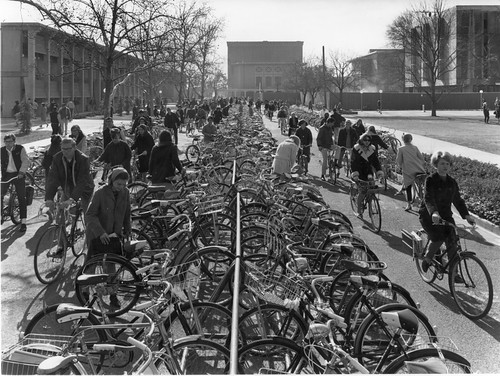
Bicycle racks at the University of California, Davis, 1963, by Ansel Adams
Bicycle racks at the University of California, Davis, 2963.  Photo by Ansel Adams.  When the UCD campus was constructed, it prioritized walking and biking, and didn't include roads within the campus.

What colleges should want is to prioritize and reify "sustainable mobility." Rather than doing it fractionally, they need to encourage as many students as possible to use bikes, all the time. And it's much easier and cheaper "to give them a bike" rather than to buy a limited number of bikes and have them be shared, but to be used only occasionally.

Universities like UCLA have "bike rental" programs (some call this a "bike fleet" or ""bike library,"  I call it "bike provision") where students get a bike for full-time use for an entire semester, along with a lock and helmet, and access to a bike repair shop on campus.

Some charge a small fee (UCLA seems to have doubled their fee since I last was looking--to the point where it's probably best to just buy a bike), while other colleges, like North Central College, recognizing this is a transportation demand management initiative, don't charge anything.

The other type of program is giving students free bicycles to own, in return for an agreement to not bring a car to campus and/or other responsibilities.  Ripon College is one of the pioneers of such programs, and they did it because they realized that land is too valuable to use it all up for parking instead of buildings (Ripon College gives freshmen free bikes for no-car pledges," Milwaukee Journal-Sentinel).

Other colleges offering similar programs include the University of Dayton, the University of New England, and the University of Louisville ("UofL forges path to change how students commute," Louisville Courier-Journal; "With Free Bikes, Challenging Car Culture on Campus," New York Times).

Technology heavy fractional use bike sharing programs make sense when people only occasionally use bike.  By contrast, on a residential-based college campus, where students can conduct upwards of 90% of their typical trips by walking and biking--augmented by transit and car sharing, bike provision programs are the cheapest and easiest to administer and get much greater return on investment, ,

Note that UCLA also has a free bike program for staff and faculty.  In return for giving up their parking permit they get a $400 credit towards buying a bike at a local bike shop.

Depending on the length of the typical commute trip, the university should consider adding e-bikes to the mix and providing more funds towards the program, or doing a payroll deduction program to assist with the purchase.

Labels: , , , , ,

Thursday, October 23, 2014

Hollaback! International Survey on Street Harrassment

Hollaback! is an organization focused on ending street harassment.  They have teamed up with a professor at Cornell University and have launched a survey on people's experiences with street harassment for which they want respondents.

-----
Separately, a women-based taxi service in Greater New York City, modeled after the service in Mexico City ("Mexico launches fleet of pink cabs - driven by women, for women," New York Daily News) which was launched in 2009, is not quite ready to open.

-- "New Service Offers Taxis Exclusively for Women," New York Times
-- Needing More Drivers, Taxi Service for Women Delays Start," New York Times

Labels: , , ,

Tuesday, June 17, 2014

DC taxis to be used for paratransit service: why has it taken so long?

In the DC metropolitan area, paratransit services are a rising cost that is one of the influences on rising transit fares (for subway and bus).

-- Review of MetroAccess Ridership, Cost, and Policy and Extension of Contracting Authority, WMATA

DC just announced an agreement to utilize existing taxis to provide paratransit services.  See "Bringing more wheelchair-accessible cabs to D.C. streets—and saving the city millions" from the Post.

I don't understand why the Taxi Commission is patting itself on the back about this, why a special agreement was necessary, and why it took so long.

It's obvious that using already existing taxis for this purpose would save money over the present system of funding a dedicated service, and if the taxis were allowed to carry unrelated passengers on the same run (like in the days before the current meter system), probably this would enable greater taxi access and service outside of the core of the city, where taxi service tends to "congeal."

Plus it would provide more income to taxi drivers, which helps to support the industry and the provision of quality cars.

Generally speaking, private taxis used for paratransit service is a best practice--for single trips that aren't easily grouped with others--that has been clear for many years, if not decades.

-- Transit Cooperative Research Program (TCRP) Synthesis 31: Paratransit Contracting and Service Delivery Methods

Labels: , ,

Friday, April 11, 2014

How other cities deliver transportation functions (Part 3 of the series, Proposed changes to DC's transportation agency structure as another example of acting without solid planning)

I woke up realizing I should/could have written more extensively about peer cities when it comes to comparing and contrasting how transportation functions are delivered within DC.

DC is unique across North America in that it is a city-state, and while a city, it is not subsidiary to state or county regulatory and legal requirements concerning the delivery of public services.  In theory, this provides to the city an incredible opportunity to be innovative in all of its governmental functions and services, including transportation.

The two previous entries used San Francisco and London as the best examples of peer cities for comparison purposes.  I still stand by that, but would also include Philadelphia, Seattle and Toronto.  So those cities are the best examples although not necessarily best practice, but other communities are still worth a look for comparison purposes.

New York City isn't included, but it's a judgement call.  Its situation is most comparable to DC in terms of the level of control that the city has over its street and transportation planning, while most of the city's transit services are provided by other agencies.  But it is so much bigger than DC--NYC is 302 square miles of land plus another 160 square miles of water and has 8.337 million residents--that most people will get hung up on the size and density differences, rather than focus on how the respective agencies are organized and how they function.

I would argue that by proposing a separate sustainable transportation agency, a separate parking agency, and a separate streets (transportation) agency, DC City Council Bill B20-0759,  Transportation Reorganization Act of 2014 is a major step backwards in municipal best practice as it relates to the delivery and integration of transportation services and functions.

Most communities run streets, biking, and walking within one agency.  Parking is usually separate.  The bulk of transit services are usually provided by a different agency run at the state or regional level.  Transportation planning may be handled by the transportation department or by the planning department.  If transportation planning is handled by an agency also containing land use planning responsibilities, usually transit planning is handled separately.  In a couple places, such as Minneapolis, the transit agency is run by the Metropolitan Planning Organization, but that is extremely rare.

If transit services cross state lines, mostly they are delivered by separate authorities that are state-based.  If transit services cross city-county lines, they may be delivered by different agencies.

Parking.  Because of how government accounting systems are set up and parking generates revenue, it is called an "enterprise" activity or "enterprise fund," and most cities and counties that run parking lots, structures, and meters organize these activities in a separate department--in Maryland parking is one of the activities within "Revenue Authorities," which may run other "enterprise" activities, like golf courses. 

Chicago and Indianapolis, to raise money or for ideological reasons, have sold off the city's parking concession on long term leases. 

Most cities charge a parking tax on commercial parking, at a rate which is typically higher than regular sales tax.  The revenues typically go into the general fund.  (In DC, parking taxes are used to pay off the bonds for the Convention Center.)

So the number of cities that integrate parking with other transportation functions is more limited for historical reasons, and  the organizational structures are very difficult to change.  With the exception of communities that have been influenced by the work of UCLA Professor Donald Shoup, most municipal parking authorities are not particularly innovative.  Separating parking from DDOT would be a step backwards.

Transit.  Because transit is usually delivered at the metropolitan scale and because it is beyond the funding capacity of even comparatively wealthy cities, with two significant exceptions--San Francisco and Toronto--most city transit services in the US and Canada are provided by county, regional, or state authorities.

Advertising in the public space.  For the most part, this hasn't come up in the context of the proposed reorganization, but from the standpoint of comprehensiveness could be addressed.  Like how most cities have separate parking agencies, most cities contract the sales of advertising in the public space separately from transportation, and the money goes into the general fund.  In return for advertising, the city receives street furniture, mostly bus shelters.  In New York City, this includes bus shelters, some information kiosks, news stands, some public toilets, and some covered bike parking (repurposed bus shelters).

Some cities, such as Baltimore, do not allow advertising within the public space.

However, these contracts are usually pretty restrictive, limiting the opportunity for integration and innovation because without exception the contracts have not been written to allow for changes as opportunities develop, such as digital advertising.  And most cities haven't been too good at tracking the revenue, especially if they are to receive royalties rather than lump sum payments.  Contracting can also be subject to suasion and corruption and other issues.

Restrictive contracts that favor the vendor have prevented most cities from being able to include advertising as a revenue source within bike sharing systems, and is a major reason why bike sharing in Los Angeles has not launched.  Paris included the provision of bike share as a key element in its public space advertising contract.

Coordination of freight delivery.  We won't discuss it, but it's important, and under-addressed for the most part.

Taxis.  San Francisco and London are exceptions where taxi regulation is handled by the city transportation authority.  In most jurisdictions, taxi licensing and regulation is handled separately.  In some places it is well managed, especially in New York City, but often it is a regulatory backwater.

Not part of this series sort of, taxi innovation was discussed in a piece earlier in the week, "What a terrible idea: deregulating taxi fares in DC for mobile-based hails."

The five peer cities: London, Philadelphia, San Francisco, Seattle and Toronto

San Francisco and London are the best examples of integrating all transportation services into one agency, including parking.  Seattle is a pretty good example of this, but while it provides some transit services--streetcar--most transit service is delivered by county or regional agencies.  Toronto is a good example of political meddling, limited budgets, and multiple city agencies delivering services in ways that at times are innovative, but aren't necessarily integrated and transformational, because they are not housed within a single agency.

Unlike San Francisco, Philadelphia isn't a good example of integrating transportation services at the city level, but is a good example of the creation of a cross-agency coordination program, the Mayor's Office of Transportation and Utilities in a situation where it is very difficult to reorganize government agencies and functions in a comprehensive way.

In London, transportation operates at the metropolitan scale, and Transport for London runs everything--streets, parking, taxis, transit, etc.--but the railroad system, including subways, but even certain railroad services do involve TfL, because it works better because of TfL's expertise in marketing, operations, and fare media.  However, while the agency runs the subway system, other transit services are delivered on a contract basis by private operators, even though the services all use the TfL brand.  The boroughs also have significant input into streets matters.  The Oyster fare card can be used on most transit services, with some exceptions for railroad service.

London Cyclist Campaign is one of the best cycling advocacy groups in the West, and they have an extensive ward-based cycling promotion and advocacy program.  But they are assisted by Sustrans and various city and borough advocates.  The London Cycle Design Manual is one of the best (I relied upon it when I was doing planning in Baltimore County).  They have bike sharing, called Barclays Cycle Hire, etc.

Philadelphia is a city-county 141 square miles in size (more than double the size of DC) with 1.5 million residents.  It doesn't run any of its transit services.  Within the city they are handled by SEPTA, a regional agency serving Philadelphia with bus, streetcar, subway, and commuter railroad services.  The city is also served by NJ Transit, PATCO, and Amtrak.  The city is hurting financially and its transportation functions are distributed across a huge number of city agencies, including the Philadelphia International Airport.

The city has some great public spaces but doesn't really stand out as an example of local level best practice in transportation at the scale of New York, San Francisco and Seattle, with a few exceptions, including the reinstitution of streetcar service on Girard Avenue in 2005.

What is most relevant to the DC situation is that while the city still delivers services through a variety of agencies, including the Philadelphia Parking Authority, Mayor Michael Nutter created a new unit, the Mayor's Office for Transportation and Utilities, headed up by a deputy mayor, to begin the difficult process of coordinating the agencies and making their policies, practices, and operations more congruent.  From the MOTU website:
Mayor’s Office of Transportation and Utilities (MOTU) was charged with building a shared vision and coordinating decision-making among agencies and departments - Streets, Commerce, Public Property, Traffic Police, City Planning, the School District, Parks and Recreation, the Airport, the waterfront and port agencies, SEPTA, PATCO, PennDOT, Amtrak, and DVRPC in order to save money and improve conditions throughout the City’s transportation system. 
The other exception is that the city has some great "public-private partnerships" and civic groups.  The Center City Business Improvement District is one of the best BIDs in the country and it has pushed forward Philadelphia's public space planning and improvement program, including wayfinding signage, street furniture improvements, and transit history interpretation.   The University City District is working similarly in its area of interest, which includes the 30th Street Station, and there are many interesting public space improvements happening there.  The city's Mural Arts Program is a national best practice which adds value to the public spaces across the city.  The Design Advocacy Group works with neighborhood groups on public space and land use planning initiatives.  And these are only some of the examples of the great non-governmental programs that operate there.

San Francisco has organized its transportation functions, including transit and parking, into one agency, called the San Francisco Municipal Transportation Agency.  San Franciscans always complain about the system, vociferously, but I think it's pretty remarkable.  The agency's placemaking programs are very good and the city is particularly innovative now with parking policy.  Note that bike sharing is delivered through a multi-jurisdictional program not unlike how bike sharing operates in the DC region.  Bridges are run by a regional authority as is the Caltrain commuter railroad.

SF is unusual in that the city runs an extensive transit system--MUNI includes bus, light rail, streetcars, and cable cars--that operates only within the city, called MUNI, which is separate from the BART heavy rail system that operates at the regional scale, with 8 of the system's 44 stations serving San Francisco.

By comparison, Chicago, Montreal, New York City, Philadelphia, and Toronto also have extensive transit systems that mostly operate only or mostly within the city limits, but except for Toronto, those transit systems are run by state or regional authorities.

(San Francisco's heritage streetcar operation has influenced the proposal I made for a similar kind of operation on DC's National Mall.  See "A National Mall-focused heritage (replica) streetcar service to serve visitors is a way bigger idea than a parking garage under the Mall.")

BART and MUNI don't have integrated fare media systems, although the region has developed an integrated fare card system with the intent of full integration.

Left:  Port-a-park: A temporary park was set up in a parking space on Mission Street by Rebar, an art collective. The group declared Sept. 21 "Park(ing) Day" and installed this temporary park in a parking space on Mission St. in downtown San Francisco, CA. The group moved the park to several different parking spaces throughout the day. San Francisco Chronicle photo by Laura Morton

San Francisco is also where in 2006 the Re:Bar design collective innovated the concept of the "parklet," as a way to challenge how people conceive of public space and parking spaces in terms of quality of place.  What distinguishes the SFMTA is that the parklet initiative led to a significant reconceptualization of how the city deals with public space and streetscapes, and the Livable Streets program developed out of the parklet initiative. 


Re:bar isn't the only vital civic-advocacy group either, SF Planning and Urban Research Association is an important group and there are many others.

Seattle controls most local transportation matters including parking within the Seattle DOT, but other than streetcar, land-based transit is provided by two different agencies, King County Transit for buses and Sound Transit for light rail and railroad commuter service. The State of Washington delivers most ferry services, with a couple of exceptions.

The city is better than most at integrating land use and transportation planning and is very active in expanding biking and livability infrastructure, and streetcars, while Sound Transit is expanding light rail service.  The city's parking policies and planning are particularly innovative.  The Orca fare media system can be used on all of the different transit systems (Sound Transit, King County, Seattle, Washington State Ferries).


The Feet First citizen group is a national best practice example of walking promotion, integrating mapping into planning and walking and biking promotion, Safe Routes to School development, etc.  The State of Washington's requirements concerning Safe Routes to School planning means that Seattle is way ahead of most cities when it comes to SRTS initiatives.  

Like San Francisco, Seattle has been a pioneer in "right-sizing" parking requirements within building regulations, eliminating parking minimums in the Downtown area in the 1990s and extending similar requirements to transit station zones and "urban villages" in 2006.

Toronto is so f***ed up right now in terms of its local politics, especially all matters concerning transportation in particular the management of the city transit agency, planning for transit expansion, and bike policy and infrastructure, but it does run its city transit agency along with other transportation matters, including parking, and has an incredibly robust planning department.   The city transit agency is run separately from other transportation and planning departments.  The Mayor is pro-car and had bicycle lanes removed from some city streets and the expansion of biking infrastructure has stalled.

Toronto charges significantly more for street parking permits than any other jurisdiction in North America.  Recently, the transit authority took control of the bike sharing system and contracted out its day-to-day operations.

The city is an amalgam of city and suburbs and delivering transit service to the suburbs within the City of Toronto has created various problems.  The cost of expanding Toronto's heavy rail transit infrastructure is so expensive that the province will become more directly involved in financing.  Road and railroad commuter services are provided by a provincial agency for the region, called Metrolinx.  The fare media system used in Greater Toronto is run by Metrolinx and can be used in multiple jurisdictions across Ontario.


Bike and pedestrian planning in Toronto is very good.  The city's guidance on bicycle parking is amongst the best in North America, as is the Toronto Walking Strategy.  The city's "BUG" program provides small grants to "Bicycle User Groups."  Cycle Toronto probably has the best "ward-based" initiatives (organized at the Council District scale) of any such group in North America.  

The Toronto Centre for Active Transportation deserves a shout out too as does the Spacing Collective, which focuses on public space matters of all types.

Other jurisdictions worth studying but they aren't necessarily full peers


I would write about Arlington County, Virginia if I hadn't done so much writing previously about their best practice transportation planning and programming initiatives...

In Baltimore, parking is managed by the separate City Parking Authority, most transit services (bus, light rail, subway, railroad) are run by a state agency, the Maryland Transit Administration, and the local Transportation Department handles an intra-city bus service called the Circulator, planning, and all street-related matters, even for what are "state roads"--the major arterials that usually connect communities across jurisdictional lines--which would normally be managed by the State Highway Administration anywhere else in the state.  

The Circulator bus service is free, and is funded through a city tax on parking.  The Charm Card transit media is a version of the DC metropolitan area's SmarTrip card, so it works on most transit services in DC and Baltimore, except for railroad passenger services.

Most of Boston's transit service is delivered by a regional agency, but the city has a robust bike infrastructure and programming initiative separately branded as Boston Bikes, and is the major player in the regional bike sharing system, called Hubway.  The director, Nicole Freedman, has pioneered important equity initiatives.  

WalkBoston, a citizen advocacy group, is a national leader in pedestrian advocacy.  The city has decent enough transportation planning, and other public space improvement initiatives.  But it is Boston Bikes that really stands out.

In Chicago, the Daley Administration sold off (on a multi-decade lease) municipal parking structures and street parking meters to get some quick cash to balance the budget and it has been a disaster, costing the city as much as $1 billion or more in lost revenue and angering residents.

A regional-state agency runs all transit within the city and region, organized in three different agencies, one for Chicago, one for railroad service, and one for suburban bus service.  Heavy rail service is mostly limited to Chicago.  The city runs the streets, including biking and walking and is extremely short of money for transportation infrastructure, but has been very much focused on bicycle infrastructure expansion and pedestrian safety improvements under Mayor Emanuel.  The city has considering licensing sponsorships of prominent infrastructure like bridges, to raise cash.  The transit media card doesn't work on railroad passenger services, but does work on city and suburban bus and rapid transit.  The city also owns and operates O'Hare and Midway Airports.  


Former Mayor Richard Daley was a strong supporter of biking and public space improvements, including the creation of Millennium Park.  The Active Transportation Alliance addresses all forms of sustainable mobility.

Hoboken, New Jersey is across the Hudson River from New York City.  It's only two square miles, has 50,000 residents, but they are doing very innovative work on sustainable transportation and parking policy.  Taxi services are handled by an agency separate from the Parking and Transportation department. The waterfront trail is run by the Hudson River Waterfront Conservancy.  The city runs an intra-city bus shuttle system ("The Hop") but inter-jurisdictional transit services are provided by either NJ Transit or the Port Authority of New York and New Jersey.


Hoboken has the highest public transportation use of any city in the United States. Hoboken Terminal is served by six New Jersey Transit railroad lines which terminate at Hoboken Terminal, with private ferry service and the PATH subway system providing service to Manhattan.  PATH connects to Jersey City, Harrison, and Newark on another line. The Hudson-Bergen Light Rail has three stations in Hoboken out of 24 total and NJ Transit offers bus services.

One way where the city has been very innovative is their use of car sharing as a way to reduce parking demand and manage street parking inventory (past blog entry, "Car sharing as a method for managing the demand for on-street parking: Hoboken, New Jersey").  The city tested bike sharing and will expand this into a program with Hudson County and other municipalities.

If the NYC Transit 7 line were extended to New Jersey, Hoboken could possibly get a subway station that connects to the NYC Transit system.

New Jersey Transit does not have an integrated transit media program with New York State's MTA, and the NYC Transit Metro Card doesn't work with the MTA railroad services, although there are some functions that work on the PATH system.

Minneapolis is also a great example on many levels.  Transit is provided by the Metropolitan Council, the regional metropolitan planning organization tasked by the US DOT for transportation planning, and the city is benefiting from an expanding light rail system, bus rapid transit initiatives, great bike and walking promotion initiatives, including a safe routes to school plan for the entire city.  The city has one of the highest numbers of bike commuters in the US and an extensive trail network.

Minneapolis and St. Paul benefited from a special non-motorized transportation grant program from US DOT when James OBerstar was in Congress, St. Paul is pursuing streetcar service, the main train station is getting Amtrask service again, and the city soon will be served by light rail connecting to Minneapolis.  The Twin Cities has many great civic and nonprofit groups including Transit for Livable Communities and Twin Cities Streets for People.  Right now, they have a pathbreaking program working to integrate equity initiatives into the new light rail program.

Montreal
is much larger than DC in population and size and its transit agency operates mostly within the city of Montreal, but is a division of the regional transportation agency.  The city is organized as boroughs, and transportation services are delivered at both the city and borough scales.  The Plateau-Mont Royal borough is particularly committed to sustainable transportation policy and practice.  

The transit authority runs subway and bus services, has many innovative programs linking sustainable modes, such as transit passes that include car sharing and bike sharing memberships.  A separate agency runs the railroad system, which has many lines and many stops within Montreal not only located downtown.  STM is also integrating a variety of incentive and discount programs into its transit card program, which appears to be unique ("Cloud-based analytics keeps Montreal's buses full and ridership growing," Government Computing News).

Montreal has one of the best bicycle promotion programs in North America and the most extensive network of cycle tracks of any city.  They benefit from good research by engineering and transportation professors at McGill University also (something mostly lacking in DC, even though DDOT funds transportation research at Howard University).

Through its separate parking authority, the city innovated at a global scale, creating the modern system of bike sharing using solar powered kiosks, although being a division of a government agency ended up being the downfall of the bike sharing group because its financing requirements couldn't be met by the municipal financing system, and the Province of Quebec ruled that it was illegal for the City of Montreal to fund the technology development and sales arms of the organization.

Montreal was one of the first major cities in North America to introduce a motor vehicle speed reduction program comparable to the program in Graz, Austria, although implementation varies by borough.


Left:  Catchment area of public transit stops for pedestrians and cyclists.  From Planning and Design for Pedestrians and Cyclists: A Technical Guide, published by VeloQuebec. 

And VeloQuebec, the provincial advocacy group, has its headquarters on a busy cycle track in Montreal, and spurred the development of cycle path networks throughout the province, has an active research and publishing program, including a thick monthly magazine, and promotes bike tourism throughout the province also.

New York City, has the highest rate of walking and transit use and the lowest per capita energy and gasoline use in the US and biking is rising as well.

All transit except ferries, is delivered mostly by the Metropolitan Transportation Agency, which runs most cross-borough bridges and tunnels too.  Heavy rail and bus services in the city are delivered by the New York City Transit Authority, which runs the subway system, a separate railway on Staten Island, and bus services within and between the boroughs.  Two different MTA railroad agencies serve mostly suburban commuters but also provide some service within the city. A different state agency, the Port Authority, controls some other bridges and runs a subway service between Newark, Hoboken, and Manhattan and runs the inter-city bus terminal (and the major airports).  NJ Transit provides railroad and bus service to Manhattan, and Amtrak is used for commuting purposes also.  

The Staten Island Ferry is run by the city Dept. of Transportation while most of the other ferry services are provided by private contractors.


Left: a Neighborhood slow zone with 20 mph speed limits in Brooklyn's Carroll Gardens neighborhood.  Generally, the posted speed limit in NYC is 30 mph.

Streets, including parking, biking, and walking matters, are run by the city's transportation department.  


Under former mayor Michael Bloomberg, NYC's transportation function has focused on improving the quality of place in transformational ways, which has culminated in massive expansion in biking infrastructure, the launch of a bike sharing program, the creation of the Neighborhood Slow Zone traffic calming program, and tremendous public space expansion, improvement, and road diet initiatives including along Broadway and in Times Square, but across the city, and a variety of innovative public programs including "Sunday Streets" road closure programs in Manhattan and Brooklyn.   

New wayfinding information systems are being launched and a variety of public-private initiatives, including the High Line park, have delivered high quality public spaces to NYC residents and visitors.  The city has also published various best practice manuals on urban design and active living design.

Taxi services are regulated by a separate Taxi and Limousine Commission which has a robust research capacity.  The city's taxis were amongst the first in the nation to require credit card access with integrated tourist information tablets.

Right:  Edison Parking billboard near the High Lane in the Chelsea District of Manhattan. 

While the city runs some off-street parking operations, the majority of off-street parking is privately owned and managed.  NYC doesn't require residential parking permits for on street residential parking, but limited parking inventory helps to restrict demand.

And of course, Transportation Alternatives is a national best practice example of a sustainable transportation advocacy group, but there are so many other initiatives active in the city that are great.  TA has some borough based initiatives as well but not as extensive as those by groups in Toronto and London.

New York City is also an important example because its adoption of transformational transportation practices has been anything but painless.  First, the State Assembly denied the city the ability to impose a congestion charge for vehicles entering Manhattan, in part because suburban and outer borough residents have more representation in the Assembly than residents in the core--NYC has similar urban and suburban dynamics within the city as does DC.

Protesting against the Prospect Park West cycle track in Brooklyn.  WNYC image ("Residents Prepare Lawsuit on Brooklyn Bike Lane").

Second, many bike infrastructure initiatives have met opposition by Community Boards and other stakeholders.  For example, some residents (goosed by a former Transportation Commissioner) sued the city over the creation of the Prospect Park West cycle track, even after the DOT demonstrated that the lane helped reduce accidents.  The opponents lost, but it still demonstrates that the forces of automobility are ever present. 

There was some opposition to the public space expansion initiatives along Broadway in Manhattan which came at the expense of roadway, but the improvements garnered wide support and opposition quietened, especially as some businesses experienced increases in revenue as a result ("Times Square Pedestrian Makeover going permanent," City Clock).

What is important to note through all of this that the Mayor didn't back down and kept supporting Janette Sadik-Khan, the Transportation Commissioner and the department's initiatives, and improvements kept moving forward and additional initiatives were launched.  

This is a big difference compared to DC, where City Council and the Mayor tend to fold in the face of opposition with regard to changes in parking and other transportation policies.


Pasadena, California doesn't provide transit services, but it's where Donald Shoup of UCLA innovated many of his ideas about how to handle street and off-street parking, to use revenues from parking for streetscape improvements, etc.  Like many of the independent cities in Los Angeles County, Pasadena is also innovative in how it handles improvements to biking and walking infrastructure, and can be a bit ahead of DC in terms of implementing best practice intersection treatments.  

Portland Oregon is an obvious example but it may turn some people off because it's so widely touted.  Portland still has a commissioner form of "city council," which combines executive, legislative, and some judicial functions.  The public safety commissioner also oversees the "Bureau of Transportation." This is separate from the Metro Council and the Tri-Met transit agency.

To start, we must note that despite all of Portland's great planning and initiatives, DC has much higher total practice of sustainable transportation modes--almost double the rate of Portland.  For that we have to acknowledge L'Enfant's Plan and the concentration of federal government agencies and the transit benefit.  

Right: streetcar near Portland state University.  Photo by Miles Hochstein, Portland Ground.

But Portland is so much better than DC at being innovative.  Modern streetcars and the creation of an aerial tramway--both owned by the city but managed privately, separately from Tri-Met--are perhaps the best known projects.  

It all started with a decision to tear down a waterfront highway in the early 1970s and was soon followed by a pathbreaking Downtown Plan.  Portland continues to build on those pathbreaking decisions incrementally, so that "to be like Portland," requires a long term commitment, vision, and continuous improvement (the entry "A summary of my impressions of Portland Oregon" dates to 2005).

The continuous incremental improvements include developing a transit mall for buses (which can be somewhat hulking from a public space standpoint), improvements to public spaces like Pioneer Courthouse Square, launch of light rail in the mid-1980s, promotion of biking and walking, and sustainability, and great civic initiatives such as the Community Cycling Center of Portland, which has a variety of path breaking programs including support of biking by women and commuting by low income residents.  Of course, parking is handled by the City Department of Transportation.

While parking is handled by the Dept. of Transportation, one legacy of "government fund accounting" is that taxi services in Portland are managed by the "Revenue Department" of the Office of Management and Finance, which is under the Mayor.

And Portland's City Repair "street takeover program" preceded the tactical urbanism initiatives of Re:bar by 10 years since City Repair launched in 1996.
 
Orange County, California's Transportation Agency runs county transit (bus and paratransit only, no fixed rail), local roads--which can include pedestrian and bicycle infrastructure, and highways including tolled roads and does some planning.  Parking is handled by separate cities located within the county and OCTA is one of the partners in the Metrolink railroad passenger service that links San Diego, Orange, and Los Angeles Counties.  Taxis are under a different agency, the Orange County Taxi Administration Program.

Savannah is a good example of linking parking and local transit services, especially for serving visitors.  See the past blog entry, "
Need for a comprehensive visitor transportation plan in DC."

Vancouver, British Columbia is similar to DC with about the same population (they have 603,000 residents) and size (they are 70 square miles including water, DC is about 62 square miles including water).  Like DC, most of Vancouver's transit services are delivered by a regional agency, TransLink.  It happens that TransLink has some of the best transportation planning functions of any metropolitan area in North America (their bike strategy and parking documents are the best!).


Even more vociferously than DC, residents prevented the extension of freeways into Vancouver City.  (DC has a couple freeways, but mostly prevented freeways from being built in the city.  Instead, the city's transportation budget for freeways went into WMATA.  See "End of the Roads" by Bob Levey and Jane Freundel Levey from the Washington Post Magazine, published in 2000.)

Most of Vancouver's non-transit transportation services, including parking, are handled by the City Dept. of Streets and Transportation.  But taxis falle under the police department.

Other programmatic best practices

Ciclavia tattoo, photo by Rosemary Zonni.

There are other specific programs deserving to be called out, for example, Los Angeles' CicLAvia program gets as many as 200,000 people coming out when they close streets for their quarterly events, but this entry is already long enough.

Labels: , , , , ,

Tuesday, April 08, 2014

What a terrible idea: deregulating taxi fares in DC for mobile-based hails

=============
Originally posted on April 7th, but significantly revised and reposted on April 8th
=============

See the press release "Grosso and Cheh introduce legislation deregulating fares for taxis dispatched through mobile applications." From the press release:
Last Friday, Councilmember David Grosso (I-At Large) and Councilmember Mary Cheh (D-Ward 3), Chair of the Committee on Transportation & the Environment introduced legislation that makes significant enhancements in safety and consumer protections for mobile dispatch and ridersharing services passengers by mandating them to (1) perform background checks on their drivers; (2) maintain commercial insurance for drivers; and (3) establish and maintain zero-tolerance policies for drugs and alcohol. Additionally, the legislation seeks to enhance fair and equitable competition between Transportation Network Applications Companies (e.g. Lyft and Sidecar), mobile-dispatch services (e.g. Uber and Hailo), and taxicabs by deregulating the fares for taxicabs dispatched through mobile applications.
-- B20-0753: "TRANSPORTATION NETWORK SERVICES INNOVATION ACT OF 2014"
-- past blog entry, App based ride services and creative destruction and plain old destruction
--  past blog entry, Misunderstanding Uber, Taxi regulation and what we might call the "Overground Economy
-- past blog entry, Taxi fares in DC and not planning
-- past blog entry, DC and taxis: need for a comprehensive plan
-- past blog entry, Taxis

Apparently the main impact is to legalize "surge pricing," the Uber practice which raises prices to 6-8 times greater than the standard rate, in times of high market demand.  See "Proposal would allow DC cabs to embrace 'surge pricing'" from the Washington Post.

I think this is a terrible idea for many reasons.

Mobile dispatch services aren't fundamentally different from other types of hails.  Despite all the blather, getting a taxi by using a mobile phone isn't a significantly different process from using a land-line telephone or accessing a webpage by desktop, laptop, or tablet computer.  It doesn't justify offering a deregulated service.  Riders (consumers) deserve the normal common carrier regulatory protections afforded to consumers that come from regulation.

What can be different is the type of car and quality of the service as "car service" is often an upgraded service compared to traditional taxis.  The biggest thing that services like Uber illustrate is that there is room for two types of taxi service, regular and premium.  Traditionally, "black car" or livery services have been available in cities as an upgraded service compared to traditional taxis.

In New York City, taxis aren't dispatched in response to calls, they are exclusively obtained through street hails.  Livery cabs were a response for people who wanted the security of calling for "car service" for a specific trip.  (Now livery cabs can be dispatched through a "street hail" but only at specific livery cab stands.)

Services like Uber "democratize" the availability of upscale taxi or livery services.

The proposal creates unequitable competition not equitable competition: if you're going to deregulate, deregulate everything.  Allowing one form of taxi service to charge a lot more (or theoretically, less) doesn't create an equal playing field, it preferences the under-regulated service. Since taxi companies have to meet the same requirements--insurance, background checks on drivers, etc.--why not just deregulate all the services?  I don't agree with that position, but I don't see any justification for a portion of "taxi and dispatch services" being regulated and another portion being unregulated.

Uber pricing can appear to be arbitrary.   The biggest problem with Uber now is that trip pricing appears arbitrary and capricious both for regular fares (see "The Uber Hangover: That Bar Tab Might Not Be the Only Thing You’ll Regret in the Morning" from New York Magazine) and in times of high market demand, when Uber imposes what they call "surge pricing" which they justify as an inducement for drivers to work. 

From the New York Magazine article "Here’s How Uber Should Fix Its Surge Pricing Problem":
Over the weekend, it snowed in New York, and a lot of New Yorkers tried to take Uber cars home from their night activities. Those New Yorkers got upset when the Uber cars cost seven or eight times as much as normal, because of the company's dynamic "surge pricing" scheme, whereby it gets more drivers to come out on the road during busy times by making rides much more expensive.
What is the justification for stratospheric pricing of rates as much as 8 times normal pricing?  I don't think there is any, other than allowing people to spend money conspicuously (also see "limo surfing").  Note that The Economist Magazine disagrees, see "Free exchange: Pricing the surge," suggesting some changes to how Uber charges drivers, but mostly favoring the idea of surge pricing despite critics like me complaining about price discrimination.

On the other hand, allowing surcharges for high demand evenings like New Year's Eve could be worth considering more generally (for regular taxes too).

Solution One: set up a separate set of regulations.  NYC doesn't deregulate livery cabs, in fact they have an extensive set of regulations governing their service and operation (rules page, NYC Taxi and Limousine Commission).  DC should be no different.

Solution Two: set up separate rate tiers.   In NYC, for taxis there are four rate tiers for taxi  service: regular; service to LaGuardia, JFK, and Newark International Airports; and service to Westchester and Nassauc counties.  Rather than deregulate rates for mobile dispatch services, create a separate rate tier for livery cabs, and an additional rate tier for times of high market demand.

This is one more example of needing a taxi and ridesharing element within a master transportation plan.  Councilmembers come up with a lot of crazy a** proposals.  Some of that could be reduced--although they'd be likely to ignore recommendations--by having a transportation master plan.

Other forms of taxi service innovation are more important and are being neglected.  The biggest dearth of service occurs in the outlying part of the city and the poorer neighborhoods.  Uber and similar services are mostly for higher income riders, but can be expected to improve service coverage in the outer city somewhat. 

Ridesharing programs like Lyft or Sidecar do allow for the shifting of some types of underground economy activities to what I called the overground economy, but the people offering gypsy cab services in poor neighborhoods aren't likely to be inclined "to go legit."

Other forms of innovation include shared taxis or jitneys ("The (Illegal) Private Bus System That Works," Atlantic Cities; "Ending the Jitney Menace," Newark Star-Ledger).  Such innovations aren't being pursued at the moment.

NYC's Boro Taxi as an initiative to expand service in underserved areas.  To add service to the city outside of Manhattan's core, New York City added a "second class" of taxi service called "Boro Taxis," that operate primarily in the boroughs outside of Manhattan, although they can also pick up riders north of 110th Street in Manhattan.  (Mostly this was a conversion of livery cabs.)

These taxis are colored green, as opposed to the standard yellow of the traditional medallion taxis, which can pick up a fare anywhere in NYC, but tend to operate in Manhattan and certain parts of Brooklyn and to a lesser extant Queens.

The Boro taxis can't pick up fares at the airports or in the "Manhattan exclusionary zone" south of 110th Street.

-- "With Street-Hail Service Set to Expand, Some Drivers Are Skeptical," New York Times
-- Boro Taxi Market Study, NYC Taxi & Limousine Commission

Cab sharing.  When DC cabs were on the zone system, drivers used to be allowed to pick up multiple unrelated fares along the way.  When the traditional meter system was introduced, this was disallowed and is the biggest reason why taxi cab driver income is down.

Cab sharing is also a better use of scarce resources.   NYC allows cab sharing only from a few specific points (such as LaGuardia Airport).  Reinstituting the legality of cab sharing can increase driver income and increase service to underserved areas.

Labels: , , , , , ,

Sunday, February 02, 2014

App based ride services and creative destruction and plain old destruction

I've argued before that e-commerce ride service applications like Uber aren't some revolutionary business, but (1) a better version of taxi dispatch service and (2) but also a form of premium taxi service, (3) in a service system that hadn't offered a form of premium taxi service before.

Uber has argued, successfully in some cases, that they are so revolutionary that they shouldn't be regulated like a traditional taxi service, while I argue that the e-commerce enabled platform doesn't justify an exception from this form of dispatch service being treated as a "common carrier" with all the regulatory requirements that are designed to protect the public interest.

This law review note, "Is a Taxicab Company a Common Carrier?," University of Pennsylvania Law Review and American Law Register , Vol. 66, No. 1/2 (Dec., 1917) , pp. 71-73, almost 100 years old, summarizes the basic definition.  Interestingly, the article discusses a case where the courts ruled a taxi company wasn't a common carrier, and therefore not liable for the impact of an accident which injured a passenger.  That wouldn't be how it would be ruled today.

This is the last paragraph of the note:
Both on principle and by analogy to hack and transfer companies, taxicab companies operating from stands on the street or otherwise holding themselves out to serve the public should be held to be common carriers in all instances.

Common carrier law is definitely the issue in a lawsuit against the company in San Francisco, where a family was hit by an Uber-related vehicle driven by someone paying more attention to his smartphone for fares and not the street.  One person died.  See "Uber faces lawsuit over girl's death in S.F." from the San Francisco Chronicle.

Uber claims that they aren't a taxi service, and that drivers are independent contractors and they shouldn't be liable. Plus if a driver is "waiting" for Uber fares but not actually engaged in a trip, the company claims that means that Uber isn't responsible for the actions of the driver anyway. 

I don't see how that will hold up.

2.  Separately, in "App-based ride services lure drivers from S.F. cab companies," the San Francisco Chronicle reports that SF cab companies are losing drivers to dispatch services like Uber. 

I had speculated ("Misunderstanding Uber, Taxi regulation and what we might call the 'Overground Economy'") that this will end up reducing the overall level of taxi service available in a community--not that there aren't problems with taxi service as it is currently provided.  Seems like this is beginning to happen. 

3.  I will say that I do find the idea of creating premium taxi services interesting, as well as a tariff schedule of higher pricing justifiable.  I don't think that Uber's surge pricing model is fully justifiable.

4.  One advantage of Uber type services is that they are more likely to be willing to pick up fares in areas of the city that are underserved.  But there is no guarantee.  So dealing with providing access to taxi service in underserved areas is something that still needs to be addressed.

Uber is for the well-off and/or smartphone-enabled, it's not about access and equity.

Labels: , , , , , ,

Saturday, October 12, 2013

Lawsuits against government actions

In a thread on a list I am on there is a discussion how about residents in one monied community in California continue to fight the restoration and expansion of an elementary school--the school had been sold off but decades later it has been bought back for re-use as a school, because of enrollment increases.

The architect leading the design effort made the point that this kind of litigation discourages public bodies from taking up similar battles in the future, and can get them to fold, even if they are right.

2.  On GGW there is a discussion of the 5333 Connecticut Avenue NW/Cafritz battle ("Fight over 5333 Connecticut reveals dysfunctional process").  Some residents--people who fought off having a historic district (sad irony)--are suing over the project, which was mostly matter of right, on the basis of how certain heights for the project are being calculated.

Based on my experience with similar cases, I can't see how the residents will win, because the practice for measurement of allowable height is pretty well defined.

3.  Taxi drivers have sued the city ("D.C. cabbies file lawsuit over new requirements" WTOP radio) about certain aspects of new regulations that guide their operations, based on Constitutional grounds.  Based on my limited experience with jury duty, I learned why they will lose.

I didn't know that Constitutional rights are limited mostly to our person and where we live, but not to other objects, like cars, which we operate as a privilege and with a license from government.  This came up in a bunch of cases where we learned that the Supreme Court--for good or bad--has ruled and agreed to limits on Constitutional protections with regard to automobile use, etc.

By extension, this includes professions which require licensing and regulation, such as operating taxis on a city's street and selling the services, as a common carrier, to the public.

They choose to participate in a licensed profession.  Within the authority of the regulators is the power to impose standards of operation.   (And other cities have similar requirements.)

4.  In the discussion about the case in California, we talked about putting limits on the ability to sue.  There's a fine line between restricting speech and rights and limits.  People can sue even if their grounds are weak.

The problem is that deep pocketed plaintiffs can win because of their deep pockets, and not the merits.

So I can see having the possibility of having to pay for the legal costs of the winning side by the losing side to be a worthwhile check.


Labels: , , , ,

Wednesday, August 28, 2013

One point about taxi drivers who don't own their own vehicles: the regulatory system isn't set up to protect them


photo

In the previous blog entry I wrote:

The regulatory system should provide:

 for taxi operators
- a testing regime for drivers
- an application and monitoring service over the companies and individuals licensed to offer taxi services
- a system of inspection for vehicles and general operations

for customers
- a system to handle and rectify customer complaints

in general
- a set of customer service standards and metrics
- a benchmarking-research function to ensure that DC taxi services are best-in-class (cf. "Pr. George's cabbies complain about pick-ups at Gaylord National," Post, about how National Harbor is offering its own taxi service because they claim that PG County taxis are substandard)
- a system for ensuring vehicle and service quality (inspections, inspectors, including operation at all times of day and days of the week)
- a system for being able to innovate and offer new services (also see the recent blog entry "Testing changes to zoning with demonstration projects").

2.  This framework leaves out the taxi drivers who aren't owner-operators.  Who protects them?  No one really.

3.  That's what I was referring to when I made the point in other writings that because a preponderance of drivers come from demographics with fewer opportunities, there may not be "barriers to their entry" to the occupation (other than passing the drivers test), but the oversupply of interested drivers because of factors exogenous to the industry means that the workplace isn't very stable or supportive, and it can be hard to make a living, especially if the taxicab operators who are licensed charge drivers a lot of money to operate ("rent") a cab.

4.  It only gets worse with "ridesharing" services being added to the mix, because the providers in those cases again have different, non-industry related factors influencing their decision making and how they account for the cost of providing the service.

This expands the supply of vehicles without necessarily increasing demand (it probably does lead to a demand increase somewhat).  Further pressuring the traditional taxi industry.

5.  I mention this because the economic stability of the taxi industry is in part at risk in more marginal markets, as a result of ridesharing services.

It "feels" comparable to me to how traditional commercial districts declined in response to the creation of suburban shopping centers and the chaining up of retail sectors.

With fewer tenants seeking space in TCDs, landowers would rent to anyone, rents went way down, usually below the amount necessarily to properly maintain the building(s), so the district declined further and further, because at the microeconomic level, its fundamentals were broken.

The same goes for taxi services.

Labels: , , , , ,