Rebuilding Place in the Urban Space

"A community’s physical form, rather than its land uses, is its most intrinsic and enduring characteristic." [Katz, EPA] This blog focuses on place and placemaking and all that makes it work--historic preservation, urban design, transportation, asset-based community development, arts & cultural development, commercial district revitalization, tourism & destination development, and quality of life advocacy--along with doses of civic engagement and good governance watchdogging.

Wednesday, June 14, 2017

A new thought about Uber and Lyft as mobility/transportation services operating on a national footprint

One of the things that's problematic with "learning" how to ride transit is that transit is organized at the local, metropolitan, and regional scale, alongside a couple of nationally branded services (besides airlines, Amtrak, and the Greyhound and Trailways national bus lines), plus airlines.

Besides transit agencies all having different names for service, e.g., the T in Boston, the NYC Subway in NYC, the L in Chicago, Metrorail in DC (and many other places use the same name, or its variant, Metro; local and circulator and express bus services), with various names depending on how transit is organized in a particular area, most use different names, processes, transit media cards, machines, etc.

Tourists, Karlsplatz, Munich, Bavaria, Germany.
Karlsplatz, Munich, Bavaria, Germany

The Germans make it a little easier, having standard logos used across the country to denote the main types of services: Underground/Subway service; the U-Bahn; and local commuter rail, the S-Bahn; and a standard logo for bus services too.

But even Germany is a bit inconsistent in a common designation for light rail/streetcars, which in Europe are called trams either as light rail or streetcars.  Light rail services are called Stadtbahns, but there isn't a consistent logo like there is for the U- and S-Bahn services.  As shown above, in Munich they label these services as "tram."

You Besides knowing what it's called, you need to know what operates where, where bus stops and stations are located, have the right payment medium, etc.  Transit agencies may not have well integrated the ability to get information and transit cards at places like airports, etc.  (WRT airport transit information Chicago at O'Hare and Cleveland at its airport are particularly good at explaining what's up.)

WRT payment media, most metropolitan areas now have an integrated fare media card and system that works across most or even "all" of the services. For example, while most transit media systems don't include commuter railroads, the systems in the SF Bay and Puget Sound areas do include railroads (Caltrain, Sounder) and ferries too.

While it's true that if you know how to use one multi-faceted transit system well, you can usually figure out how to use it elsewhere, perhaps most people, especially "younger people" (often called "digital natives") aren't interested in spending the time and energy figuring it out.

Instead, they often use an app on their phones to "hail" or order a taxi, but not a "local" taxi -- local taxi services can be even more balkanized than transit services -- but a so-called "transportation network company" ride hailing service like Uber or Lyft.

And the advantage is that as long as these companies have their service available where you are at or are going to--other major cities--you can use the same app and process "universally," at the scale of the entire nation.

(In Ontario, with a couple exceptions, all transit agencies use the same fare card system, which was created by the Province.)

Perhaps that's some of the attractiveness of ride hailing services, despite the fact that they usually cost more than transit, especially if cost isn't the main concern, but convenience and ease of use is.

Note that Zipcar and Car2Go operate at the national scale too, although you have to switch the app to the right city (and it's pretty cumbersome to do in Zipcar).  When it works, it works great.  We've used Car2Go in Seattle, San Diego, and Brooklyn, and Zipcar in Seattle and San Francisco.

Labels: , , , ,

Wednesday, August 28, 2013

One point about taxi drivers who don't own their own vehicles: the regulatory system isn't set up to protect them


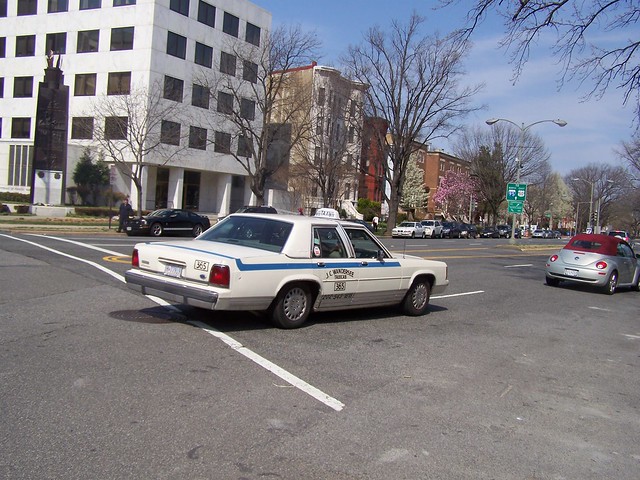
photo

In the previous blog entry I wrote:

The regulatory system should provide:

 for taxi operators
- a testing regime for drivers
- an application and monitoring service over the companies and individuals licensed to offer taxi services
- a system of inspection for vehicles and general operations

for customers
- a system to handle and rectify customer complaints

in general
- a set of customer service standards and metrics
- a benchmarking-research function to ensure that DC taxi services are best-in-class (cf. "Pr. George's cabbies complain about pick-ups at Gaylord National," Post, about how National Harbor is offering its own taxi service because they claim that PG County taxis are substandard)
- a system for ensuring vehicle and service quality (inspections, inspectors, including operation at all times of day and days of the week)
- a system for being able to innovate and offer new services (also see the recent blog entry "Testing changes to zoning with demonstration projects").

2.  This framework leaves out the taxi drivers who aren't owner-operators.  Who protects them?  No one really.

3.  That's what I was referring to when I made the point in other writings that because a preponderance of drivers come from demographics with fewer opportunities, there may not be "barriers to their entry" to the occupation (other than passing the drivers test), but the oversupply of interested drivers because of factors exogenous to the industry means that the workplace isn't very stable or supportive, and it can be hard to make a living, especially if the taxicab operators who are licensed charge drivers a lot of money to operate ("rent") a cab.

4.  It only gets worse with "ridesharing" services being added to the mix, because the providers in those cases again have different, non-industry related factors influencing their decision making and how they account for the cost of providing the service.

This expands the supply of vehicles without necessarily increasing demand (it probably does lead to a demand increase somewhat).  Further pressuring the traditional taxi industry.

5.  I mention this because the economic stability of the taxi industry is in part at risk in more marginal markets, as a result of ridesharing services.

It "feels" comparable to me to how traditional commercial districts declined in response to the creation of suburban shopping centers and the chaining up of retail sectors.

With fewer tenants seeking space in TCDs, landowers would rent to anyone, rents went way down, usually below the amount necessarily to properly maintain the building(s), so the district declined further and further, because at the microeconomic level, its fundamentals were broken.

The same goes for taxi services.

Labels: , , , , ,

Wednesday, February 13, 2013

Washington, taxi livery, design and branding

Today's Post has a story, "Faint praise for D.C.'s taxicabs of the future: 'They're not that ugly'," about DC's plan to have all of the taxicabs in the city painted the same way, so that people can easily and quickly identify a taxi, and the problems coming up with an acceptable design.  From the article:

“Taxis are our ambassadors,” Cheh explains. Tourists chug into Union Station, and taxis are the part of Washington that comes out to greet them. “It’s like,” Cheh explains, “how you turn up on your first date.”

DC has more taxicab companies operating than any other city (this is a good thing, which means that the industry is less monopolistic or oligopolistic) and therefore more different painting schemes on cabs, making it harder to identify a cab--actually I don't think it's hard at all because of the bubble top on the top of the cab, but then I am into transportation.

The point of the common design is to make it very easy to identify a cab.

I wrote about this when it first came up in the entry "The taxi livery debacle as a lead in to a broader discussion of the importance of "design" to DC's "brand promise"."  Also related, but about transit is the entry "Design as a city branding strategy."

Cab livery design is "tricky" because "Yellow" Cab was the first main operator in the industry, active in multiple cities in the country, and they painted their cabs yellow.  So people got accustomed to seeing yellow cabs.

And in the 1970s, New York City required all cabs to be painted the same color with a common logo, deemphasizing the importance and labeling the identity of the actual owner.  In short, the taxicabs are "New York City's taxicabs" not the taxicabs of X or Y or Z owner or operator.  It was also done to make it harder for illegal cabs to operate, because they would not be sporting the common design.

I have been bothered by the DC process and the "Taxicab Commission Service Improvement Amendment Act" because neither was based on an actual plan-study of the industry (as I have mentioned before, the Transportation Element of the Comprehensive Plan doesn't even mention the word taxi or taxicab), and the problems coming up with a decent design are not just the result of the lack of a plan but also general questions about what "Washington" wants to communicate about what it is to the audience of cab users.

The thing about the NYC design is that it isn't subtle.  Both the color and the logo are very direct.  Here are the key elements of the design:

1.  Color (yellow)

2.  A unified logo identifying both New York City and the taxicab service.

3.  Fare information on passenger door

4.  Cab number and trailing design at the rear, starting at the passenger door.

Even so, some designers weren't happy with the "new" design for the taxi logo as released in 2007.  Some designs proffered were even more direct.

The image (right) from the NYT City Room blog entry, "X Marks the Spot and Back to ‘Bullets’" shows an even more direct design, which makes a lot of sense.


The next generation NYC taxicab (a competition won by Nissan) and design tweaks those four elements, making the "T" element larger, and adds other graphic embellishments to the rear of the vehicle.

Another design I've seen makes the T even bigger and more prominent, but pushes it back onto the sliding door.


By contrast the DC process has been more about "attractiveness of design" (I guess) and not about making the process of identifying a taxi very clear, even if that means being very direct and unsubtle rather than "attractive."

Note that in and of itself a common design isn't enough to fix the problems with the provision of taxicab service in DC, which ought to be the primary point of dealing with the taxicab industry.

I think this is in part a failure about not knowing what the point of a redesign is supposed to accomplish.  Is it the federal city and that taxicab users are mostly visitors, or is it a local city that wants to communicate its own identity.

Actually, there is a mural on 14th Street NW just north of Spring Street NW that captures this dynamic, showing both rowhouses and federal monuments.  Could this dynamic be captured in a taxicab design.
Mural showing the local and the national, 14th Street NW, North Columbia Heights

Although another way to be unsubtle would be to use the red, white, and blue and American flag motif, which reminds me of a post I wrote in 2005, "Town-City branding or "We are all destination managers now"," which in part discusses Fayetteville, NC wanting to brand itself as the most patriotic city in the US, and do things like have daily parades, requiring restaurants to sell hot dogs and apple pie, and painting the streets to look like the American flag.

I was derisive of this because a city's identity is something deeper than hot dogs and apple pie.

Then again, there is something to be said for incorporating American flag design into DC's standardized taxicab livery.

It would make the taxicabs very distinctive and identifiable and leverage the branding value (albeit which is diminishing fast) of being the National Capital of the United States of America.

It would also come at the expense of communicating something--if you want to--about the local identity.

Labels: , , , , ,

Tuesday, November 06, 2012

Uber, taxi regulation, UPS and FedEx and the unlevel playing field

In some of the discussions ("Cheh would limit regulation for Uber and taxi apps" from Greater Greater Washington) that have arisen over the Uber car service ("Uber Closes Yellow Taxi Cab Service In New York City" from Forbes), especially in view of pro-Uber legislation before the DC City Council, I am troubled by at least four things.

1.  Uber and pro-sharing forces claim that regulating such services somehow is a destruction of all that is good from the use of shared resources. See "Now New York City is giving Uber a hard time" from the Washington Post and "Will Regulations Kill The Sharing Economy?" from TechCrunch.

Uber is a mobile-app based car service that claims it is an application of the principle of collaborative consumption (see the excellent book What's Mine is Yours: The Rise of Collaborative Consumption).

Carsharing or car sharing (in the UK known as car clubs) is a model of car rental where people rent cars for short periods of time, often by the hour. They are attractive to customers who make only occasional use of a vehicle, as well as others who would like occasional access to a vehicle of a different type than they use day-to-day.

Typically, users are "members" of such services, each car supports the use by multiple households, thereby supporting car-lite living, and reducing the demand for car storage in the public space, and encouraging sustainable transportation practices.

Uber is not carsharing.

Uber is a system that allows greater utilization of "car service" vehicles by providing an application so that they can operate as reservation-based taxi-like services some of the time, when they aren't already booked.

The Uber app provides a way to monetize slack resources, and often, provides better service than what taxis normally provide, for a higher price, but the provision of the service doesn't necessarily contribute to broader sustainable transportation goals and objectives, just as High Occupancy Toll lanes may encourage single occupancy vehicle use rather than discourage it.  (See the Resources for the Future Paper Are HOT Lanes a Hot Deal? The Potential Consequences of Converting HOV to HOT Lanes in Virginia.)

2.  So of course it bothers me that services such as Uber are being promoted without adequate consideration of the transportation planning implications of the service.

3.  As importantly, Uber wants the benefits of being able to sell its services, such as selling services on an auction basis (e.g., "Surge Pricing: One NYC Uber User Paid $219 For 7-Mile Ride" from the Gothamist) with none of the requirements that must normally be met by transportation services acting as common carriers, including a standard and public pricing system and provision of service to all potential users without discrimination.

Definition of common carrier from the Free Dictionary:

An individual or business that advertises to the public that it is available for hire to transport people or property in exchange for a fee.

A common carrier is legally bound to carry all passengers or freight as long as there is enough space, the fee is paid, and no reasonable grounds to refuse to do so exist. A common carrier that unjustifiably refuses to carry a particular person or cargo may be sued for damages.

The states regulate common carriers engaged in business within their borders. When interstate or foreign transportation is involved, the federal government, by virtue of the Commerce Clause of the Constitution, regulates the activities of such carriers. A common carrier may establish reasonable regulations for the efficient operation and maintenance of its business.


4.  Uber is seeking through legislation the creation of an uneven playing field.  Claiming the need for such a system "to support innovation and creativity" is subterfuge.

It occurs to me that the desire of Uber to be treated differently from taxi services is no different than the competitive advantages that FedEx enjoys over UPS because FedEx is regulated as an airline while UPS is regulated as a common carrier and therefore subject to the requirements of the National Labor Relations Act.  Therefore, UPS workers are represented by unions and FedEx's aren't, giving FedEx various cost advantages over UPS.  See "FedEx and UPS Clash Over Legislation" from the Wall Street Journal.

Interestingly, UPS's campaign for the two companies to be treated equally under the same set of regulatory rules is not seen as a question of fairness, but as one of unfairness (e.g., "A Special Delivery for UPS That Could Change FedEx Overnight" from the Heritage Foundation) no doubt because FedEx spreads a lot of funding around and conservative organizations don't want to be seen as helping foster union membership.
----
That being said, plenty needs to be done to improve taxi services and their competitiveness and availability.  Uber is not it.  (Just like the creation of charter schools doesn't necessarily improve the provision of education in traditional public schools.)

Labels: , , , ,