Rebuilding Place in the Urban Space

"A community’s physical form, rather than its land uses, is its most intrinsic and enduring characteristic." [Katz, EPA] This blog focuses on place and placemaking and all that makes it work--historic preservation, urban design, transportation, asset-based community development, arts & cultural development, commercial district revitalization, tourism & destination development, and quality of life advocacy--along with doses of civic engagement and good governance watchdogging.

Wednesday, August 03, 2022

SmartCar as a city car

The Mercedes produced SmartCar has been discontinued, because the company is undertaking different initiatives to meet US fleet mileage requirements.

This car was used in the Car2Go one way car sharing program that Mercedes launched in the North America and Europe.  

It was a great program but in reality, would only work in a few places ("Car2Go dying: further effects from the rise of ride hailing and damage to the sustainable mobility platform/mobility as a service paradigm"), so it could never scale the way a large corporation like Mercedes would want, and they shut it down, although it still operates in some cities in Europe.

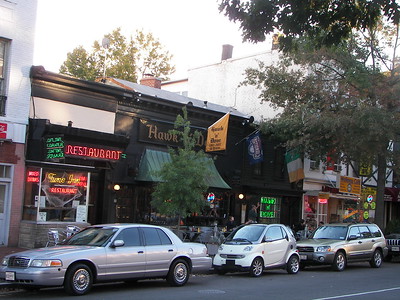
This photo of the car in a local supermarket parking lot in South Salt Lake City shows one of the key advantages of the SmartCar as a city car--it's small and easy to park.  It got great gas mileage and the electric versions were a dream.

The problem with the market for cars in the US is that it isn't particularly differentiated, with different vehicles for different purposes.

So sure a small car makes sense "for the city."  On the other hand, people tend to buy "one car" to meet a maximal number of their likely and intended uses.  So people aren't going to buy a small car for the city uses when they want a bigger vehicle to accomplish longer trips, carrying more people, etc.

Plus, car dealers aren't motivated to sell small cars because they don't make much money off them (not unlike how bicycle shops aren't motivated to sell low cost city bikes compared to expensive road bikes).

But then that's why the one way car sharing application was so great for cities like DC and Seattle.
 

Labels: , , , , ,

Monday, January 13, 2020

In DC and Seattle could Car2Go (ShareNow) be converted to a nonprofit and remain in business? (Or could it be sold to Zipcar?)

Even in bankruptcy some individual retail stores still succeed.  One of the things with retail bankruptcies, pretty much, is that even though a company is failing overall, there are various stores that are quite successful.  But there isn't a system to preserve those existing stores, and the momentum for closure is too great, so all the stores end up shutting down, regardless of their individual profitability.

Leading one way car sharing platform to exit North America.  Recently, Car2Go, the one-way carsharing service originally created by Daimler Benz, and later merged with BMW, and renamed ShareNow, announced that it would be shutting down all of its remaining operations in North America: Montreal; New York City; Seattle; Vancouver; and Washington, DC/Arlington County, Virginia ("Share Now, formerly Car2Go, is leaving North America," The Verge).

-- "Car2Go dying: further effects from the rise of ride hailing and damage to the sustainable mobility platform/mobility as a service paradigm"

I haven't used Car2Go in Canada or New York City. I have used it in Seattle (and San Diego, where it used electric cars, which were awesome).

Granted I don't have access to their financials, but I wonder if one or more of these cities could still be successful with one way car sharing, were the Mercedes-BMW venture willing to consider other business models, or weren't primarily interested in Europe, where they are better positioned to succeed as opposed to North America, which is a market very much cluttered with other operators going for the same market segment.
Car2Go vehicles bunched up on Hawaii Avenue NE
Plus as charlie mentioned, with a change in US CAFE requirements, and Dieter Zetsche no longer being the CEO of Mercedes, the company is no longer interested in the SmartCar ("Daimler's incoming CEO considering killing Smart, report says," CNET)

Planners need to have scenarios in place to deal with situations like this.  In some of my writings on parks and cultural planning, where there are multiple actors, I recommend that localities do some basic planning for all the parks or cultural assets in their community, especially if they are provided by state, federal, county, or for profit entities, in order to be able to respond when conditions change--e.g., in the aftermath of the 2008 recession many state park agencies closed park units, with devastating impacts on localities relying on these parks for tourism and other benefits.

The same now goes for transportation planning, because of the recent rise in the number of for profit actors in the space including micromobility--e-bikes, e-scooters, dockless bike share, micro-transit; ride hailing; and even train service in Florida and eventually Las Vegas (Brightline/Virgin Trains USA).

I recommend using the German Transport Association model as a way to coordinate and integrate mobility services across a region as well as providing a place at the table for for profit providers:

-- "The answer is: Create a single multi-state/regional multi-modal transit planning, management, and operations authority association" (2017)
-- "Another example of the need to reconfigure transpo planning and operations at the metropolitan scale: Boston is seizing dockless bike share bikes, which compete with their dock-based system" (2018)
-- "Branding's (NOT) all you need for transit" 2018

I argue that one-way car share is a key element in the sustainable mobility platform ("Further updates to the Sustainable Mobility Platform Framework") and within DC's platform for mobility as a service ("DC is a market leader in Mobility as a Service (MaaS)").

Could one-way car share, with microcars, still be viable in DC (and/or other cities) in a nonprofit or subsidy scenario?

-- Would it be worth continuing in terms of the SMP and MaaS?

-- Could it be worthwhile for Zipcar to buy it? (They weren't successful in coming up with one-way car share on their own).

-- Or would the Free2Move operation by Groupe PSA which operates in DC be willing to take on Car2Go's customer base?  (At least in DC, you can just join Free2Move.  But the other cities don't have that option.)

-- Just as DC jumped on Arlington County's negotiation of a bike share contract to relaunch bike share in DC in 2010, could DC and Arlington County somehow work together to continue to keep Car2Go alive, and even expand it in the DC area?

-- Is there a place for some kind of subsidy?  E.g., DC makes a lot of money per car, say $2,000, in annual licensing fees, in part to cover the opportunity cost of lost car revenue.  That's over $1 million per year.  Could a higher excise tax on ride hailing vehicle trips be used to support a subsidy program?  Etc.

-- Granted a big problem with nonprofit car share is having to reinvest in new vehicles as existing vehicles age out.

For this to be explored, cities would have to come together and ask ShareNow to keep the service going for a few more months, to explore alternatives.

-- ShareNow announced that the service would cease at the end of February 2020.

Perhaps NACTO, the National Association of City Transportation Officials, could get involved?  And the Shared Use Mobility Center of Chicago (funded through the sale of a nonprofit car sharing system to Enterprise Car Share).

I fear there is neither the time nor the creativity to be able to explore this kind of option.

Labels: , , , , , ,

Wednesday, December 18, 2019

Car2Go dying: further effects from the rise of ride hailing and damage to the sustainable mobility platform/mobility as a service paradigm

I have written about what I call the sustainable mobility platform and its various components.

An element of the SMP is the concept of "mobility as a service" and I have suggested that DC is a world leader in the implementation of MaaS.

One way car share is a key element in the Sustainable Mobility Platform.

Business mergers often result in failure.  There are many many stories in business about failed mergers, because the dominant player in the merger lacked the finesse to deal with the acquired company, maybe it was really a different line of business, e.g., consumer focused instead of business focused, like Flip camera bought by Cisco ("Why Cisco killed the Flip mini camcorder," CNET).

Or it was in the same line of business and the purchaser thought they knew everything and they didn't.  Like how Safeway destroyed companies it bought in Chicago ("Dominick's owner Safeway exiting Chicago market," Crain's Chicago Business) and Philadelphia, and significantly "impaired" companies it bought in Texas.

GM's purchase of Saab.  Ford's purchase of Jaguar, Land Rover, Volvo...

Etc.

What motivated the merger of Daimler and BMW's smart mobility ventures?  I wonder if it was desperation not expertise that was going on when Daimler and BMW merged their "smart mobility" assets into one business? ("BMW Group and Daimler AG combine mobility services," Daimler press release) in 2018.

Maybe it wasn't about expertise, but about two companies not knowing what to do and figuring they should join and muddle through together, but without much of a strategy on how to move forward?

This comes up because of how the merger has handled the car sharing operations of the two companies, DriveNow and Car2Go, the latter now called ShareNow, have been or are being killed off, not unlike what happened with Safeway's supermarkets in Philadelphia and Chicago.

In July BMW's DriveNow operation was shut down, after it was put in a division different from Car2Go ("BMW ReachNow car-sharing service shuts down in Seattle," GeekWire).

In September, Car2Go shut down a number of operations in the US ("Sustainable mobility platform in view of Car2Go's dialing back of one-way car sharing in the US").

Now, they've announced they are shutting down all North American operations effective in February 2020 (plus a few in Europe), to focus on Europe ("Share Now, formerly Car2Go, is leaving North America," The Verge). From the article:
Share Now, the car-sharing service formerly known as Car2Go, is leaving North America. Daimler and BMW, the two global automakers that share ownership of Share Now, said it would cease service on February 29th, 2020. Share Now currently operates in New York City, Montreal, Seattle, Washington, DC, and Vancouver.

The decision was based on “two complicated realities,” Daimler and BMW said in a joint statement: the “volatile state of the global mobility industry” and rising infrastructure costs associated with operating a car-sharing service in North America.

While we had remained hopeful that we would be able to come to a solution — especially these last few months — we are ultimately not in a position to commit to the level of investment necessary to make the North American market successful both in the near and long term,” the companies said.
Awhile back, commenter charlie made the succinct point that probably it has been ride hailing that's had the most significant negative impact on car sharing.  I think that's true, because many people would rather be driven than drive themselves, even if driving yourself is cheaper.

That's true, sure.  Ultimately though, there are too many companies operating in this space, ride hailing will always drive "taxi service" in a race to the bottom, because even as income drops there will always be desperate people willing to drive.

And if they have to make a choice, a European company is less likely to remain committed to the US market.

Venture capital effects.  Of course, the other element of "ride hailing killing car share" is venture capital ("Is there too much venture capital?," Brookings).

Venture capital subsidization of ride hailing trips below cost not only impacts transit ("New research on how ride-hailing impact travel behavior," UC Davis) but car sharing too.

Being listed on stock exchanges, having to be more concerned about the cost of capital and the rate of return, for profit companies owning car share companies can't afford the same level of subsidy compared to ride hailing companies like Uber and Lyft ("Uber fares are cheap, thanks to venture capital. But is that free ride ending?," Los Angeles Times).

Free2Move/Peugeot.  Note that a couple years ago, Peugeot created a one way car sharing company, called Free2Move ("Peugeot owner chooses DC for Free2Move car sharing launch," WTOP-radio).  First it was an app integrating the various services into one interface.

Then it added an actual car sharing service, which at this time it only operates in DC.  Now it will be the only "major" operator of one way car share in the US. 

I wonder if they will seek to expand to some of the markets that Car2Go is abandoning?
A Smart Car in DC!, 500 block Pennsylvania Avenue, SE
The difference between Free2Move and Car2Go is the use of extremely small vehicles.  In places where parking supply is extremely tight, the smaller car is a "killer app."  Free2Move uses Chevrolet Equinox and Chevrolet Cruze vehicles, which are comparatively larger.


Labels: , , , , , ,

Saturday, July 20, 2019

Private capital not a reliable "partner" in sustainable mobility when it comes to affordability

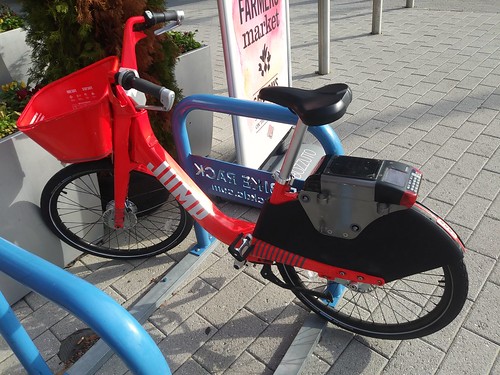
A Jump bicycle sharing bicycle in BrooklandWhen the Jump dockless e-bike program was introduced, in DC and a handful of other cities, comparatively speaking it was a good deal, $2 for 30 minutes, with a per minute charge after 30 minutes.

Last year the firm was purchased by Uber.

This past week they introduced new pricing, which varies by market ("Uber says it's raising prices on its dockless e-bike fleet in several US cities," Business Insider). From the article:
"We want to build a viable e-bike and e-scooter operation that allows us to serve riders for years to come," an Uber representative said in an emailed statement.

"To support that we have introduced new pricing in our cities that brings us in line with the market so we can continue to deliver clean and reliable bikes and scooters with a sustainable business model."
In Providence, where the rate is now 30¢/minute, that 30 minute ride now costs $9. The LA prices is also 30¢/minute. In Denver, 25¢/minute. To find the rate by city, you need the app, which I don't have.

That pricing probably makes it not sustainable from the standpoint of a user, although they do have a $5/month rate for low income users. Otherwise, these prices are higher cost than bus rides, but faster, and comparable or more expensive than subway and light rail trips.

This shouldn't be a surprise. If providing bikes or transit or taxi service was super profitable, then cities or people with limited job prospects wouldn't be doing it.

I think it's important to have bike sharing, even the option of scooters, and definitely transit. I'm just not expecting that venture capital will be in it for the long term.

Abandoned bike share bicycles in China.  Getty Images photo.

cf. Ofo ("Bike-sharing firm Ofo's dramatic fall from grace a warning to China's tech industry," South China Morning Post) and Mobike ("The rise and fall of China's cycling empires," Foreign Policy).

... I have an Ofo bike in my garage if you want it.

2. And besides adding e-bikes to traditional bike share programs, it would be awesome if the US had a similar program of payroll deductions for buying bikes for transportational uses, comparable to the UK.

This is important, because unlike how scooters and ride hailing and pedal bike share mostly merely capture trips that likely would have been made by transit, e-bikes do have the potential to shift trips from cars ("E-Bikes Mean Fewer Car Trips and More People on Bikes," Bicycling Magazine

 Although such requires massive market development. But employer transportation demand management programs providing purchase supports could begin to change the equation.

Labels: , , , ,

Wednesday, May 29, 2019

Superforecasting/Don't Believe the Hype and 1 million robo taxis, Uber/Lyft trips 1/5 the current cost, and the Boring Company's tunnels or "Cities and mass transit versus personal transit"

At a Little Free Library I came across an "Instaread" (like the back in the day "Cliffs Notes" on the book Superforecasting by Tetlock and Gardner, which was quite interesting.  While I wouldn't call myself a superforecaster, I do constantly seek new information and experiences to better hone my analysis and understandings as they relate to transportation and urban revitalization.

Coming across some recent "forecasts" by businesses and stock analysts and the general hype that has accompanied them for some time, I just can't believe how much money must be sloshing around in the capital markets, to fund concepts that are not necessarily nonsensical, but are disconnected from "the market" or "how things work" in practice.


As far as cities and transportation go, there are three elements to keep in mind.

First, the road network (miles of roadway and number of lanes) is pretty much fixed (unless you add tunnels).  In turn this puts a limit on the number of vehicles which can be accommodated.  (Zurich is one of the few cities that takes this to the logical endpoint, by "metering" how many vehicles can enter the city.  See , which means that there is only so much capacity for vehicles.

The advantage of a (40 foot_ bus over a car is that while it takes up the space of three cars it carries up to 60+ people while the three cars carry 3-5 people.  Heavy rail does even better in dedicated above-ground or underground service, carrying tens of thousands of people per hour.

Various images produced that show people throughput by mode illustrate the point.
Amount of space required to transport the user the same number of passengers by car, bus, or bicycle

This graphic shows corridors, so the "mixed traffic" mode it is referring to is freeway driving, which doesn't correspond to driving within cities, where lane capacity ranges from 600 to 1,500 cars per hour (the latter on fast moving very wide arterials and one way streets), less than a freeway, because there are many more intersections crossing the street.
corridor capacity by different modes (transit/automobile)

Second, limited road capacity means that the more cars you have, the fewer number of people you can move through a constrained system.

Ride hailing doesn't substitute for a transit vehicle, which can carry 60 or more people at one time, it substitutes from a single occupant automobile vehicle.  It doesn't improve throughput even if it reduces the number of owned cars and the number of cars that are parking in on-street or off-street parking.

The third element concerns market demand, and whether or not there is enough demand to sustain a working business model. Transit/shared vehicle users are clustered in the largest center cities. Most of the rest of the US is car dependent, and people drive a lot and long distances. To get to the point of sustainable market demand may not happen in my lifetime, and hopefully I still have 30+ years to live.

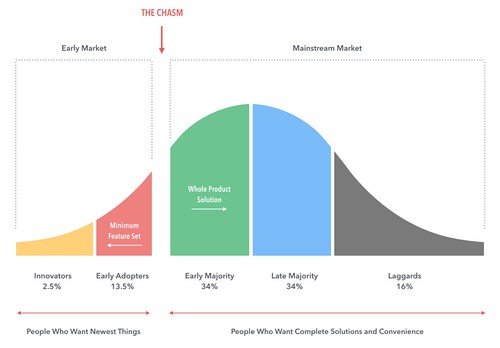
In the book Diffusion of Innovations, Everett Rogers explained the "take up" of new technologies and ways of doing things. It takes some time before the amount of use reaches level that make business operations economic.
Diffusion of innovation theory, Everett Rogers

Building on this work, Geoffrey Moore has written many books on the trough in business after innovators and early adopters have taken up new technologies, and before late adopters. In the book Crossing the Chasm: Marketing and Selling High-Tech Products to Mainstream Customers he terms this trough, "the chasm." From Wikipedia:
Moore begins with the diffusion of innovations theory from Everett Rogers, and argues there is a chasm between the early adopters of the product (the technology enthusiasts and visionaries) and the early majority (the pragmatists). Moore believes visionaries and pragmatists have very different expectations, and he attempts to explore those differences and suggest techniques to successfully cross the "chasm," including choosing a target market, understanding the whole product concept, positioning the product, building a marketing strategy, choosing the most appropriate distribution channel and pricing.

When Diffusion of Innovation theory meets the Chasm of Geoffrey Moore
Image from "Models for Predicting the Future: Geoffrey Moore’s 'Crossing the Chasm'”, Smith House Design.

"Visionaries" include financiers and stock market analysts, and like with Chinese free floating bike share, scooters, and the like, they are "touts," not necessarily independent analysts.

While concepts such as shifting from ownership to fractional use have been around for awhile (e.g., "timeshares") and in sectors now ranging from clothes to travel stays to car sharing substituting for car ownership and taxis, the idea is that the cost of fractional use renting should be less than what one pays to own and/or operate and maintain the items. For some of these markets, they don't need a "mass market," because they can charge premium prices.

Given the present cost structure, for ride hailing to work, people will have to be willing to pay more than the alternatives (transit, car ownership).  That's not how you make a mass market.

-- "Disrupting The Car: How Shared Cars, Bikes, & Scooters Are Reshaping Transportation And Cannibalizing Car Ownership," CB Insights

Note that I think the metrics are off in the CB Insights analysis, but their segmentation of the mobility market by trip length is the way to go. And the headline should be "Disrupting The Car... [in a handful of cities]."

Note that as the cost to purchase an automobile continues to rise, and if capital supporting car leasing shrinks somewhat, the cost curve can shift, for some segments of the market, to ride hailing and other alternatives.

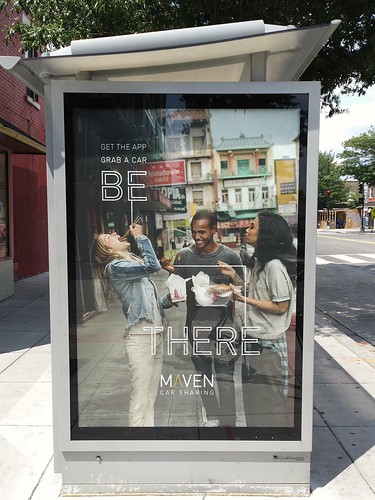
Maven car sharing (General Motors) ad on a bus shelter
Maven ad in a DC bus shelter.

In the meantime, Uber and Lyft don't forecast moving to profitable operations anytime soon and car sharing companies are merging (BMW and Daimer now jointly operate ShareNow) and GM's Maven has just downsized significantly ("GM's Maven exits show tough road for mobility," Automotive News). From the article:
General Motors and other automakers envision bringing in significant profits from alternative ownership models such as car-sharing and subscription programs. Someday.

But for now, such mobility services are generally big money losers. And executives are increasingly discovering that they don't have the stomachs to let those businesses hemorrhage so much cash while they wait for technology and demand to reach the point where the services help the bottom line instead of hurt it.

GM, after expanding its Maven mobility brand to 17 metropolitan markets in the U.S. and Canada since January 2016, last week announced a "shift in strategy" that included exiting eight U.S. cities to concentrate on areas with "the strongest current demand and growth potential," the company said.
An op-ed in the Financial Times jokingly described venture capitalists funding Uber and Lyft as "transportation philanthropists" since each trip is heavily subsidized and users don't pay the real cost--irrespective of the constant pressure on reducing driver earnings to lower costs. (Although note, Maven is a late entrant to the market.)

Extra credit.  These initiatives are still focusing on stoking automobile sales, not in shifting people to more optimal mobility ("Further updates to Sustainable Mobility Platform Approach" and "DC as a market leader in Mobility as a Service (MaaS") choices.

=======
Tesla's one million robo-taxis by 2020

Obviously, Elon Musk has to keep up interest in Tesla to stoke the stock. But that doesn't make a market.

Tesla Model 3 in a city setting.

This has two elements.  The first is demand for "taxis/ride hailing vehicles."  Data I saw from the University of Minnesota said that the base cost for an automated vehicle are likely to be $1 per mile, which doesn't include a profit margin for the operator.

Given the type and number of trips people make and the cost of gas, most people aren't going to find switching from owning a vehicle to paying per use to be cost effective, especially given the average car is driven 12,000 miles/year, and the cost to own and operate a vehicle is about $9,000 year. 

Longer suburban trips are going to be more expensive. And cities don't have the road capacity to sustain a switch from transit to the car. As Jane Jacobs said once when asked 'why aren't there enough roads?', she responded "you're asking the wrong question. The right question is why are there so many cars?"

The second is the ability of autonomous vehicles to be used legally.  While the demand "for taxi rides" is in the city, the easiest place for AVs to work is on limited access freeways. But AVs are far away from being approved for use in mixed traffic.

UBS says the cost of ride hailing trips will plummet by 80% 

According to Business Insider, investment bank UBS, in a research report, claims that in 10 years, ride hailing trip costs will decline by 80% because of robocars, making the trip cost competitive with transit.

Cost to operate a motor vehicle/automobile, autonomous versus conventionalI think the important thing is to distinguish between variable trip costs and the additional cost of buying/leasing and maintaining the vehicle.

This article, "Cost-based analysis of autonomous mobility services," from Transport Policy (64:1 2018) argues that driver wages makes up 88% of the cost of a typical trip.  Although these costs don't include the overhead of "access to app" charges and profit margins.

And the current model, relying on independent contractors to provide vehicles, offloads the cost of maintaining large vehicle fleets to the drivers.

Irrespective of the cost per trip dropping or not, as discussed above, the transportation system in cities doesn't have the capacity to expand to accommodate significantly more trips by motor vehicle.  Taking on that burden will be significant.

But the UBS simulations didn't consider another factor: per trip "sales" taxes.

For example, to encourage sustainably modes, gasoline excise taxes are very high in European countries, and the cost of a gallon of gas ranges from $6 to $8 dollars.

Slap a $5 or more ride tax on what would be a $2 ride hailing trip as a transportation system management fee and we have little to fear.

Boring Company Tunnels

While I do think we need to consider underground tunnels as an option in more places, as a way to shift commuter traffic from city-serving streets:

-- "Tunnelized road projects for DC and the Carmel Tunnel, Haifa, Israel example--tolls," 2011
-- "London Mayor proposes roadway tunnels to divert surface motor vehicle traffic and congestion." 2016
-- "Maryland HOT lane study versus "corridor management" and regional scaled transportation planning," 2018
-- "Who knew? There's been a freeway deck in Oak Park, Michigan over I-696 for almost 30 years," 2018

I doubt that Elon Musk's Boring Company has come up with a way to build tunnels more cheaply, as transportation officials from Virginia recently confirmed ("Virginia transit officials drove through Elon Musk’s tunnel. They say they’ll stick with railways and roads." Virginia Mercury).
“It’s a car in a very small tunnel,” Michael McLaughlin, Virginia’s chief of rail transportation, told members of the Commonwealth Transportation Board’s public transit subcommittee...
But as a significant capacity enhancer, mostly Musk is talking about using these tunnels as fast tracks for single cars, or for small shuttles, such as for the project just approved in Las Vegas ("Elon Musk Company To Build Las Vegas People Mover," Engineering News Record).

That doesn't add very much capacity to the transportation system, especially with his idea for connecting the tunnels to the surface through elevators, which will significantly reduce throughput.

Labels: , , , , ,

Sunday, December 09, 2018

Luxembourg to become first country to make all public transport free

===========
Revised with new date -- Sunday, 12/9 because of new information

In the comment thread, charlie wrote: "Ironic, because Luexembourg is well known as a gas-tax haven for locals -- drive there to fill up."

That changes "everything" in terms of recommendations.

This new point is #6 below with subsequent renumbering.

(this is one of the problems of arm chair pontificating from great distances without on the ground knowledge, sometimes you miss key points.)

=========

NotionsCapital calls our attention to this article about Luxembourg--a very small country--moving to a free transit paradigm. From the article:
Luxembourg is set to become the first country in the world to make all its public transport free.

Fares on trains, trams and buses will be lifted next summer under the plans of the re-elected coalition government led by Xavier Bettel, who was sworn in for a second term as prime minister on Wednesday.

Bettel, whose Democratic party will form a government with the leftwing Socialist Workers’ party and the Greens, had vowed to prioritise the environment during the recent election campaign. ...

Luxembourg City, the capital of the small Grand Duchy, suffers from some of the worst traffic congestion in the world.

It is home to about 110,000 people, but a further 400,000 commute into the city to work. A study suggested that drivers in the capital spent an average of 33 hours in traffic jams in 2016.
2.  1. Interestingly, I just happened to come across this paper, "Fare's fair? Concessionary travel policy and social justice," from the Journal of Poverty and Social Justice published by Policy Press at Bristol University UK.

I still need to work through it. It has a nice summation of the existing literature but points out there isn't a lot published on the topic.

3.  Getting back to Luxembourg, for this to really work, since much of the traffic is commuting traffic originating in France and Belgium ("Cross-border workers provide nearly half of Luxembourg's workforce," Luxembourg Times), for free transit to have a substantive dampening effect on motor vehicle traffic, they'd need to have cross-border free transit with transit authorities in France and Belgium participating.

4.  They could do this by setting up a cross-border German style transport association, which links transit planning and operations and is often agnostic when it comes to borders between states or countries:

-- "Verkehrsverbund: The evolution and spread of fully integrated regional public transport in Germany, Austria, and Switzerland," Ralph Buehler, John Pucher & Oliver Dümmler, International Journal of Sustainable Transportation (2018)
-- Transport Alliances -– Promoting Cooperation and Integration to offer a more attractive and efficient Public Transport, VDV, the association of German transport companies

and by having a fare media system like that of Talinn, Estonia, where transit is free for registered residents, when using a specially issued transit card  ("The Tallinn experiment: what happens when a city makes public transport free," Guardian). Non-residents pay for transit.  From the article:
The capital of Estonia introduced free public transport at the beginning of 2013 after their populist mayor Edgar Savisaar called a referendum on the decision, dismissed by critics at the time as a political stunt that the city couldn’t afford. ... the city remains committed to the programme – claiming that instead of it costing them money, they are turning a profit of €20m a year.

To enjoy Tallinn’s buses, trams, trolley buses and trains for free you must be registered as a resident, which means that the municipality gets a €1,000 share of your income tax every year, explains Dr Oded Cats, an expert who has conducted a year long study on the project. Residents only need to pay €2 for a “green card” and then all their trips are free.
5. Instead of being free for residents only, to work it would also have to be free for commuters, not unlike the free transit pass recently provided to Downtown employees in Columbus, Ohio, instituted as a transportation demand management measure ("Downtown workers getting free COTA passes," Columbus Business First).

6.  Perhaps most importantly, charlie pointed out in a comment on the original piece that Luxembourg is known for having cheaper gas than Belgium and France, so that people make a point of going there to buy gasoline.  This obviously encourages (induces) motor vehicle based trips to Luxembourg.

Price per gallon of gas

Luxembourg €4.30/$4.89
Belgium €5.26/$5.99
France €5.45/$6.20

Increasing gasoline excise taxes so that prices are more comparable to Belgium and France may have as important effect on transit use and motor vehicle trip reduction as providing free transit.

7. Free transit on Whidbey Island in Washington State ("Next Door to BC, the Bus Is Free: Fare-free transit on Whidbey Island is a 20-year success story") among others is discussed in The Tyee series, "No Fares," and follow up article, "Free Transit? Experts Are Wary."

8. Major cities in Germany might move to a free transit paradigm as an air quality improvement measure ("Germany considering free public transportation to take on air pollution," Die Welt).

8. Some small cities based on a tourism-focused economy, like Park City, Utah, also have free transit systems, as a transportation demand management measure for visitors, residents, and employees.

-- Visitor Transportation Study: Report on Urban Visitor Transportation Services, Volpe Transportation Center, USDOT

10.  Salt Lake City, Pittsburgh, and Calgary, Alberta still have "Downtown free fare zones."  Seattle and Portland--the nation's most prominent example--used to, but dropped them after the Great Financial Crisis of 2008, which led to massive drop offs in tax revenues for governments and transit agencies ("TriMet board kills Portland's Free Rail Zone, raises fares, cuts bus service," Portland Oregonian, 2012).

11.  With financial support from a casino and sports team, the Pittsburgh free fare zone was extended to the North Shore Casino and Sports Stadium district ("Free North Shore T service expected to survive without Steelers as sponsor," Pittsburgh Post-Gazette).

Although to make up for lost funding when the Pittsburgh Steelers declined to continue their participation after the initial three year period, revenue from parking fees kept the service free ("Downtown Pittsburgh to North Shore light-rail service not charged; lot parking rates rise," PPG).

=====

I've written about this issue concerning DC at times, including:

-- "Is making surface transit free the best transit investment DC can make?," 2016

Labels: , , , ,

Tuesday, October 16, 2018

Brief comment on e-scooters: "personal mobility" versus "mass mobility" versus "mass transit"

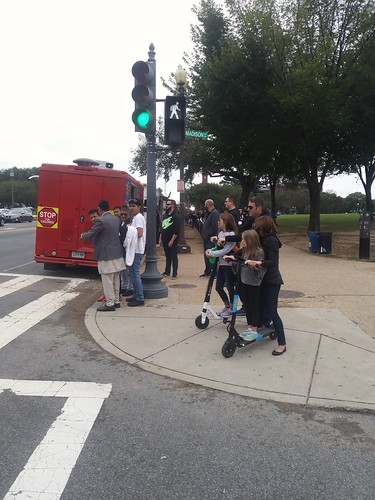
Adult e-scooter users carrying children in the vicinity of the National Mall

charlie in a comment on another thread asked:
I'd be curious on your response to Alon Levy's point as well that transit rich cities can afford to do bikeshare scooter as a last mile, but it isn't a substitute for transit.
My response (edited and expanded and also infused with some articles shared by NotionsCapital):

I haven't read Alon Levy's post.

In these kinds of discussions often people mistake personal mobility vehicles, and by personal I mean a vehicle that can only move one person, or maybe 2-4 people at a time -- cars, scooters, bikes-- for "transit," when what they really mean is individual transportation versus moving large numbers of people at once, to wit, "mass transit" which moves large numbers of people at the same time on the same vehicles, e.g. bus, light rail, streetcar, train, etc.

WRT Alon's point, it depends on the trip.

As we were discussing recently, with increased density and higher income residents more amenities become present over shorter distances, reaching a kind of critical mass capability of negating the need to travel farther, maybe negating the need to use mass transit. Instead you can substitute by walking, biking, scootering, or delivery.

This likely is influencing the decline of Metrorail ridership in Metrorail's theoretically best markets of DC and along the Rosslyn-Ballston corridor in Arlington County.

When bike share was first introduced in Montreal they found it substituted for transit in something like 15% or more trips. There, where the subway vehicles are small, unairconditioned and the system is running close to capacity shifting that number of people helps to add capacity back to transit...

Mass mobility versus mass transit.  Definitionally, there's a difference between the term "mass mobility" versus "mass transit." And we should think about this. I don't think I've used this term before.

I haven't coined it but there aren't many examples of its usage if you do a Google search, but there are some, and interesting ones at that.

What I mean is moving a lot of people at the same time but not by car and not by transit--specifically walking or biking, what are sometimes called "nonmotorized transportation."

Think lots of people walking in New York City or London or Paris or Tokyo, Chinese cities, etc.
World's busiest pedestrian crossing - Large panorama of the Shibuya Crossing
World's busiest pedestrian crossing - Large panorama of the Shibuya Crossing, Tokyo.

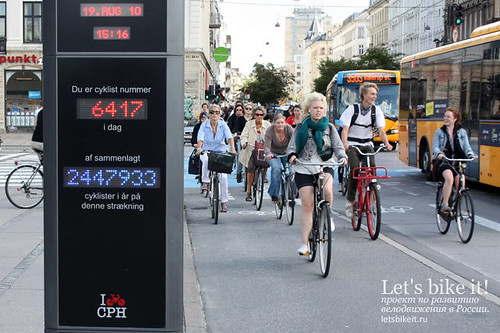
Or in Amsterdam or Copenhagen the large number of bicyclists, where in an average day they have have mode splits up to 40% of people traveling by bike for a wide variety of short, medium, and longer distance trips.
Bike counter, bicyclists, buses, in Copenhagen, Let's Bike it! poster, Copenhagen

That's definitely mass mobility. But it's not transit. And there it does substitute for "local transit."

Are e-scooters capable of being "mass mobility"?

Photo from "Unfortunately, the Electric Scooters Are Fantastic: But can they succeed despite their essential dorkiness?," The Atlantic Magazine

In DC, theoretically, I can see personal mobility -- walking, scooters, biking, e-biking -- having the potential of accomplishing 30% or more of certain kinds of trips, but not for longer distance trips normally undertaken on transit.

A majority of trips in the US are three miles or less.  Remember that in the US, 51% of trips are 3 miles or less, and another 13% are 3-5 miles. A significant number of those trips can be accomplished by personal mobility modes that are also sustainable (walking, biking, scooter, one-way car share). In short, it's complicated. Yes, I agree with Alon's point generally.  Scooters complement but don't substitute for transit.

But last mile/first mile as an element of transit trips is probably not the primary segment of users for e-scooters.

This is the case for bike share too.  It appears that the primary users of transit in DC are nonresidents, using transit to get to and from work.  Either their station is pretty close to their final destination and walking suffices, or they are not knowledgeable about complementary bike and scooter share options, and unlikely to use them.  This is different from how bike share is used in Europe.

Thinking about intra-district versus inter-district trips versus intra-district versus inter-district transit.  Instead, in the US context, scooters are (1) more likely to be used in "walking and transit cities" ("Transportation and Urban Form: Stages in the Spatial Evolution of the American Metropolis," Peter Muller>)  rather than in suburban and spread out cities.

(2) These are likely what we would call "intra-district" trips and relevant concepts are my old mobility shed concept and intra-district mobility, which I had applied to thinking about  transit modes, but not so much for walking/biking/scooters/e-bikes for intra-district trips starting and ending within the district.

-- "Further updates to the Sustainable Mobility Platform Framework," 2018
-- "Updating the mobilityshed | mobility shed concept," 2008
-- "Mobility hubs and next generation transportation planning," 2008
-- "Modern streetcars are transportation projects,not merely economic development augurs: but intra-district not inter-city services," 2017 which is built on this post, ""Making the case for intra-city versus inter-city transportation planning," which dates to 2011

Not "Talking About Revolution."Just as I don't believe Autonomous Vehicles will save the world either because even if it gets used more, and remember 50% of the time ride hailing vehicles are in use they are empty, it's still using a car to move people around in a congested place with constraints on road space, I don't think scooters will do much except on the margins.

-- "Bird unveils custom electric scooters and delivery," TechCrunch
-- "Bird Will Soon Start Delivering Electric Scooters To Users' Doorsteps," The Drive
-- "Long Beach Scooter Reviews: I crashed so you don't have to," Long Beach Press-Telegram

E-scooters are evolutionary not revolutionary, because they substitute or complement a narrow range of trips.

Unless DC is an outlier. It's not like you see dozens of people on scooters at one time in what I am now calling an example of "mass mobility." I've seen maybe 5-6 scooters in use at one time. And that's then, 6 people... and in the great scheme of things, that has little impact, although tremendous impact for the users.


Photo from a Vespa rally in Urbino. Photo: Urbino Project.

Two-wheeled sitting scooters as mass mobility: in Italy.  Now that we have standing e-scooters, I guess we can call the Vespa type scooters "sitting scooters."  They are more a substitute for cars, especially in Mediterranean climates.

According to the Daily Telegraph article, "Ban on Vespas in Italian city has scooters riders in revolt," there are 180,000 "sitting scooters" in Genoa, out of 600,000 people.

Apparently the gasoline powered Vespa type scooters are significant sources of air pollution (like lawn mower engines).
====
I guess we're going to have to change the term "bicycle and pedestrian planning" to "bicycle, pedestrian, and scooter planning."

Labels: , , , , , ,

Wednesday, September 19, 2018

Dockless Bikes/Why We Can't Have Nice Things/Ignoring Past Experience

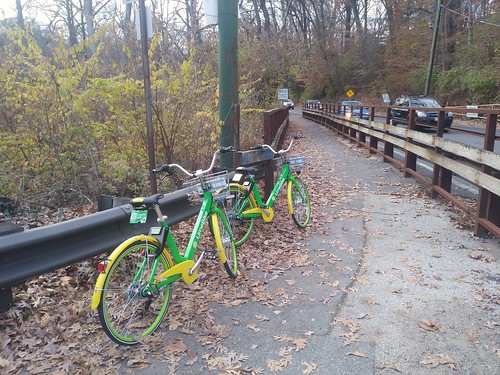
Dockless bicycle share bicycles (LimeBike) left on the Sligo Creek Trail, Montgomery County, MarylandI know I am beating a dead horse here, as it appears that most of the traditional (non-electric powered) dockless systems that were deployed in the US over the last year seem to be disappearing ("Theft and destruction of dockless bikes a growing problem," Washington Post).

-- "Bike sharing data from Seattle," June
-- "Maybe New York City just needs to invest in public secure bike parking (re: dockless bike sharing)," April
-- "I finally figured out why mobility services are buying other mobility services: they're acquiring customers already familiar with smart mobility," July

Over the weekend, my brother who lives in South Florida sent me this article, "The bike in the middle of Biscayne Bay: Why we can't have nice things in Miami," from the Miami Herald). It laments that vandalism etc. makes it impossible for dockless bike share to succeed there.

Yes, it does.  And everywhere.  Even with the very first attempt at bike share in the late 1960s in Amsterdam.  After a few weeks, the bikes were all gone, either stolen or wrecked ("How this Amsterdam inventor gave bike-sharing to the world," Guardian).

That's why the response in later iterations was both sound locking systems (second generation, Deutsche Bahn's Call-A-Bike) and later third generation systems with relatively impregnable dock-based systems in Europe with particularly hardy bikes.  (I say the "fourth generation" is dock-based systems that are solar powered.)

The dockless systems unleashed over the last year, but previously in China and elsewhere, ignored those lessons.  Cheap bikes.  Cheap locks pretty much (not for the Jump e-bikes).  No docks.  In a place like Singapore where crime is taken very seriously, people won't vandalize bikes.  That's not the case in major cities in the US or the UK ("Mobike no more: dockless bikes could soon be gone from UK streets," Guardian), or elsewhere.

I am reminded once again of a story told by Olmsted when he was creating Central Park.  He was at the garden party of a grandee, who complained to him that the landscaping and accountrements Olmsted was installing in Central Park was nicer than his own garden.  Olmsted replied that far more people would be using Central Park and it had to be built hardier in order to withstand all the use it was going to get.

Even systems with higher order checks on use, like Airbnb have had problems with vandalism by "guests" ("$5.3 million home in San Francisco wrecked after Airbnb rental," KGO-TV)  to the point where stays now come with $1 million of protection for the property owner (What is the Airbnb Host Guarantee? | Airbnb Help Center).

And it's not like car sharing systems leave the cars unlocked.  You go through a driver's license check first, each use must be authorized by the credit card before you have access to the car, there is a hardcore unlocking procedure.

I have zero "sympathy" for the failed dockless bike schemes, because they ignored past experience with "free range" bike sharing.  In places where people can vandalize, that small percentage of the population that has that propensity to violence will act it out, wrecking the system for others.

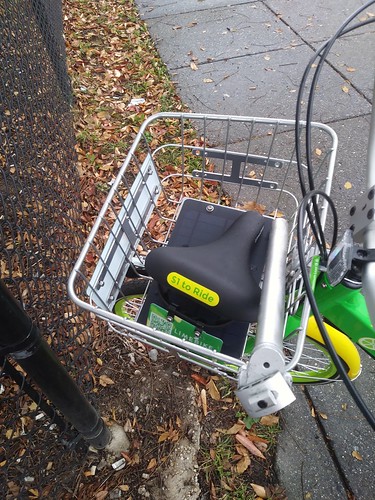
Broken seat, LimeBike dockless bicycle shareAlthough, not all of the problems with the bikes are due to vandalism.  The bikes are cheap and break easily, even when not being pushed to the edge.

=======
Separately, I've come to believe, at least in the US, that the issue about people not biking for transportation isn't access to bikes.  If access had been the issue, then you'd have seen lots of people using the dockless bikes for non-recreational purposes.  That wasn't the case.

Capital Bikeshare dock station in Takoma Junction, Takoma Park, MarylandInterestingly too, the visibility of the dock stations for bike share might aid as a marketing device, but also as a branding and community building element--potentially, if that aspect is developed by the system.

I'd figure out a way to encourage "super users" to become brand ambassadors, volunteer trail ranger programs, to expand the user base.  In the case of DC, the system grows in membership from year to year but not hugely.  Other systems, like Divvy in Chicago, do a lot more marketing and community building.

Labels: , , , ,

Monday, July 16, 2018

DC is a market leader in Mobility as a Service (MaaS)

Over the past few months, writing various pieces concerning various elements of sustainable mobility and what I am now calling the Sustainable Mobility Platform, I came to realize that while it has transpired incrementally, and while neither the industry nor the city planners may realize it, DC is a market leader in smart mobility/mobility as a service/transportation as a service.

And so far, it has nothing to do with "autonomous vehicles."  E.g., "How Driverless Cars Are Going to Change Cities," Wall Street Journal
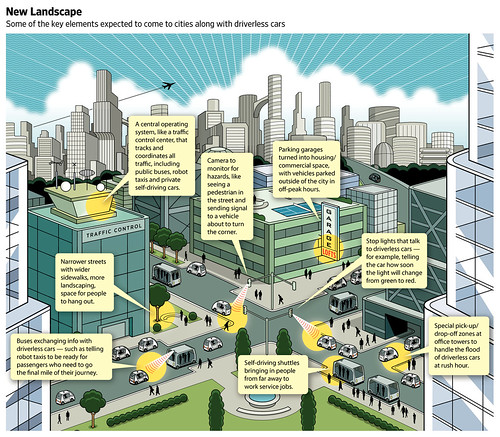
Changes in urban mobility infrastructure will come with driverless cars
Changes in urban mobility infrastructure will come with driverless cars. Wall Street Journal graphic by Peter and Martha Hoey.
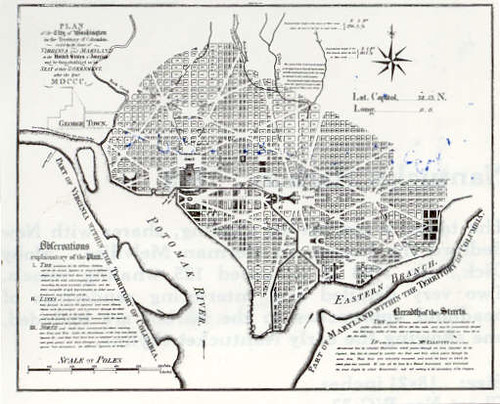
123.11_McClelland_DC_Map.jpg

A lot of it comes from leveraging the urban form of the city--the grid of blocks and streets bisected by radial arterials.

This is the benefit of the L'Enfant Plan, laid out during the era of the "Walking City"--which bequeathed to the city an urban design that fosters the use of sustainable modes--first walking, then transit, then biking, the short distances between residential areas and employment centers, overlaid by a heavy rail and bus-based transit system.

-- "Transportation and Urban Form: Stages in the Spatial Evolution of the American Metropolis," Peter Muller

While the metropolitan area has access to many MaaS services, DC is premier because of how the services are layered and intertwined by users within the city and as a result it comprises a deeper and broader service platform within the city, enhanced by the city's urban form.

DC is the MaaS superstar, not the Washington Metropolitan area.

However, Bethesda and Silver Spring in Montgomery County, the Rosslyn-Ballston corridor and Crystal City in Arlington County, and probably a couple districts in Alexandria possess similar characteristics or have the potential, although not to the same degree of breadth and depth.

In presentations on bike planning, I make three related points:

1. Mobility is a system. And just like we built a system to support driving, we need a similar kind of deep system to support biking, if we want high usage, like in European cities like Copenhagen.
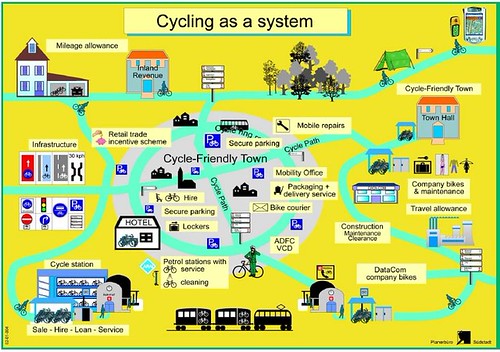
Bicycle Traffic as a system, diagram, German National Bicycle Plan, 2002-2012


2. While the US land use and transportation system preferences automobility, it took 60+ years to build the system that supports it.
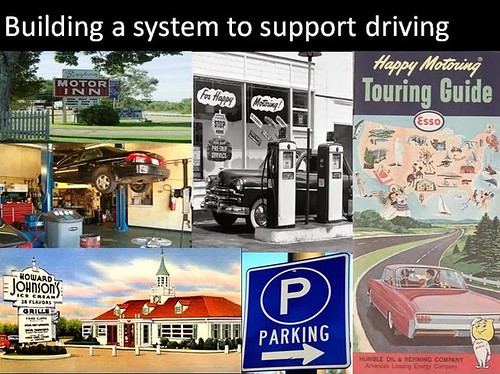
Automobility as a system (slide)
From my presentation "Best practice suburban bicycle planning".
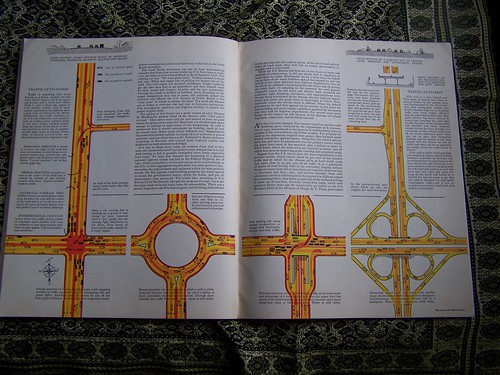
Spread on ideal highway construction, Fortune Magazine, August 1936
Fortune Magazine, August 1936, article on how to create a highway system.

3.  As an example of the length of time required to create successful new mobility environments, the sustainable mobility environment present in today's Portland, Oregon has taken 50 years to construct.
When people look to Portland, Oregon as a sustainable mobility leader and lament that their own community isn't comparable, they fail to recognize that the sustainable mobility platform in Portland present today has been constructed out of both incremental and visionary decision making that has built and reinforced the platform, starting in late 1960s ("A summary of my impressions of Portland Oregon," 2005) with the first decision, to demolish the freeway along the waterfront.

This is not the image of what people think when they think about Portland today.  But it was accurate until the very early 1970s.
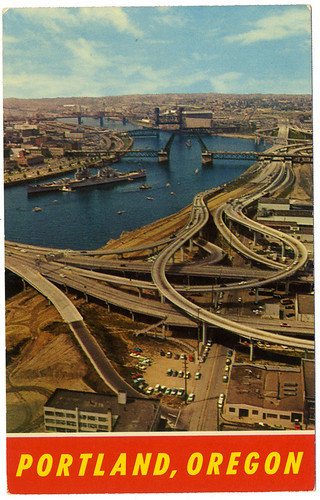
Portland's waterfront used to be scarred with freeways

The move to mobility as a service is mostly a big city phenomenon, and even so, most big cities aren't well positioned to prioritize and preference sustainable mobility/MaaS.

When it comes to smart mobility/MaaS, DC is and in fact has been a leader, at least in North America, even if the system is being developed more incrementally and less purposively.

(I'd say that Seattle is co-equal to DC, except that DC is ahead when it comes to having a heavy rail system. Arguably, Seattle has a better bus system.  Its stored value transit card is a bit more versatile and they have water-based transit services too.  Community Transit, serving Snohomish County with service to Seattle, uses some double deck buses.  And their area MPO is more innovative.)

The components of DC's Shared Mobility Platform/MaaS environment

The map, really a diagram, of the WMATA Metrorail system.

1. Multi-modal transit system (Metrorail, 1976).  DC had train service, streetcars dating to the 1860s (and ending in 1962), buses.

The Metrobus system was created out of local transit lines that went bankrupt, a few years before the then under construction Metrorail subway system began operating in 1976.

The Metrorail system now has 6 lines and 102 stations serving DC, Maryland and Virginia.

42 stations serve DC and 31 stations in the core of the city form a kind of "monocentric system" for DC proper, comparable to the MUNI system vis a vis BART in San Francisco, within the polycentric transit system that is Metrorail.

That sub-network is bounded by Foggy Bottom on the Southwest, RFK on the Southeast, Navy Yard and L'Enfant Plaza on the South, Van Ness on the Northwest and Brookland on the Northeast.

It's no surprise that not only is that section of the city the most prosperous, much of it includes the original L'Enfant City, for DC it is quite populous, and has the shortest distances between residential and activity centers.

Area jurisdictions also have their own bus systems.  Montgomery County's RideOn system is considered a national best practice for suburban systems.  Maryland took over commuter railroad services in the 1980s from Conrail and in the 1990s, Virginia launched the Virginia Railway Express.  Both systems focus on bringing commuters into Washington, but at least with Baltimore, there is some reverse commuting.

The railroad services were Monday-Friday services, although in December 2013 MARC added weekend service to the Penn Line.
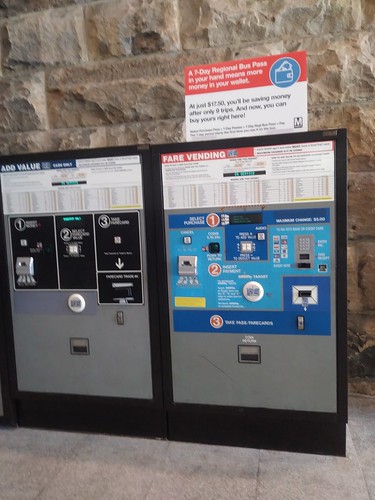
WMATA metrorail fare card machinesWMATA is unusual in that it charges fares by mode.  A trip with both subway and bus legs is two fares, with a slight discount.  (Although bus to bus transfers, even between systems, are free.)

Two stations extended the blue line further into Maryland and opened in early 2004 while an infill station on the Red Line was built in DC's NoMa district and opened later that year.

Separately, Maryland is building a light rail system in Montgomery and Prince George's County that will intersect with Metrorail and MARC and open in 2022.

An extension to the Silver Line with 6 stations including service to Dulles Airport will open in 2020.  An infill station is being developed for the Potomac Yard section of Alexandria and will open in 2022.
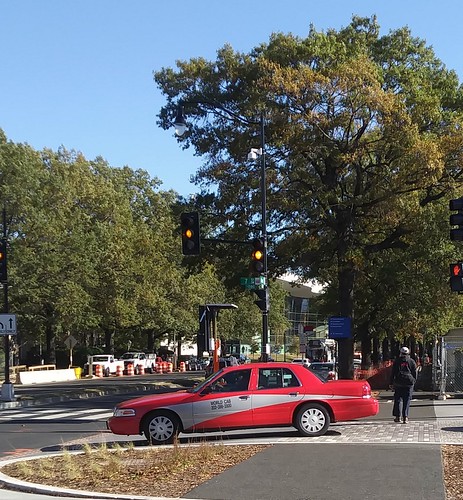
DC taxi at the Wharf, Water Street SW2. Taxis. In various forms, taxis have served DC for more than 150 years.

For a long time DC used a flat rate zone fare system preferencing short trips in the core.  Under the zone system, taxis could carry separate parties and charge each a separate fare.

In 2008, they switched to a distance based system and could no longer take multiple fares in a single trip ("D.C. Cabs Told to Switch From Zone Fares to Meters," Washington Post).  With the change, taxis were also required to accept credit card payments.

Unlike many cities, DC does not charge "medallion fees" to own/operate a taxi so the barriers to entry were few, although taxi licensing is not unlimited and there are periods when the city does not issue new licenses. In 2012, DC City Council passed a law requiring that all taxis display a red-based color scheme, similar to the DC Circulator bus.
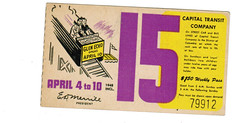
capital transit weekly pass featuring Glen Echo Amusement Park

The DC streetcar system sold weekly transit passes.  The story is that on weekends, parents would give them to their children for them to use.

3.  Discounted transit passes.  Compared to other metropolitan areas, monthly subway passes are quite expensive in the DC area. But bus passes are a bit cheaper than 10 fares, and include reciprocal use of local transit services.  MARC train passes are a good deal and include free bus transit in Montgomery County and DC and free local transit in Baltimore.

DC supports a Youth Transit Pass that covers Metrorail.  Metrorail also offers a discount pass for seniors.
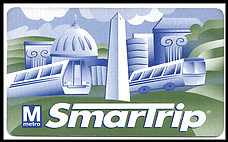
SmarTrip card, WMATA4. Stored Value Transit Fare Card (1999).  SmarTrip card was introduced by WMATA in 1999, first for subway, then bus (2002) and parking (2004).

Over time, most area transit agencies (not railroads) have moved to the system.  The Baltimore area adopted a branded version called CharmCard in 2010.

Money is added to the card at machines, online, or at certain stores set up with the proper equipment.

It hasn't been integrated with non-transit modes, although in Montreal, the STM transit agency has integrated bike share access and car share access into their fare card system.

In London, the Oyster Card can be used on local and commuter railroads and on ferry services.  Seattle's card can be used on ferry, water taxis, and railroads.  In SF Bay, on ferries and trains too.  There, the fare card system is run by the local transportation planning organization, not a transit agency.

Recently it has been reported that DC and Baltimore area transit agencies are looking at bailing on the SmarTrip system because of problems dealing with WMATA ("Greater Washington Partnership issue brief on mobility (transit) fare systems," 2018).
Untitled5.  Two-Way Car Share (2004).   Around 2004, the Flexcar and Zipcar car sharing services entered the DC market, starting out in Arlington County.

Members reserve cars in advance and access cars through smart cards and wireless telecommunications connections.

Payment is made through a credit card connected to the account. Users pay sales tax of 10% on each trip.

Two-way car sharing requires that you keep/pay for a car for the entire trip without relinquishing control of the car and it must be returned to the same place where you picked it up.

Zipcar created a preferred vendor relationship with WMATA putting cars at Metrorail stations.  (Enterprise later bought that privilege.)  Cars are available from a variety of locations throughout the city (and elsewhere in the metropolitan area), some on the street, some on private property.  The Zipcar fleet has a variety of vehicles including pickup trucks and vans, to accommodate a range of trip needs and types.

Public participation processes were required for the authorization of the use of public spaces for this "private" service ("The high cost of free parking and car sharing in DC," 2005).

Flexcar and Zipcar merged in 2007.  Zipcar was acquired by Avis Car Rental in 2013.  Other companies, Enterprise and GM-owned Maven, have since entered the DC market, but Zipcar remains predominant.

For some people, two way car share substitutes for traditional car rental.  Over time, special rates for all day, multiple day, and overnight use have been added, as well as customer benefits in association with participating retailers.


6.  DC Circulator Bus (2005)/Metrobus limited stop bus services (2007).  For decades, Metrobus has provided high frequency service for almost 24 hours on a number of DC routes on key arterials such as 16th Street, H Street/Benning Road, and Wisconsin Avenue, although these routes aren't called out as a high frequency network the way that Portland or Minneapolis brands such routes. The high frequency routes each serve 13,000 to 25,000 riders per day.

Separately, DC started its own bus service in the core of the city, with the idea that the routes would encourage people to not use cars to get around in the most congested part of the city (it's like a "fareless square" but with a charge).

The concept is that the headways would be so frequent a posted schedule wasn't needed.

The DC Circulator service started out with Van Hool buses, which were "cooler" than the clunkier buses used by WMATA, done up in a more forward design scheme.  The fare is $1, now half the cost of a Metrobus fare.  And now the Circulator uses the same buses as Metrobus, but with the Circulator livery.

Over time, bus routes have been added to the Circulator system in farther reaches of the city, and routes outside the core tend to be less efficient in terms of usage and cost.
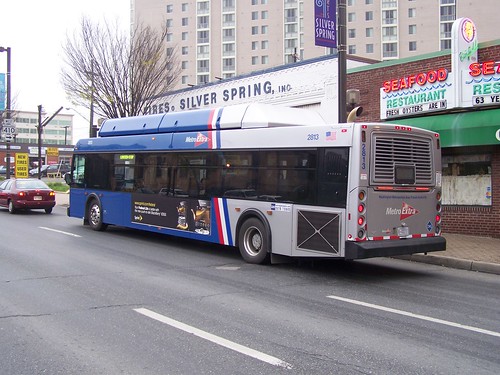
Route 79 Express bus, Georgia Avenue, Silver SpringIn 2007, Metrobus introduced the first limited stop "faster" bus service on Georgia Avenue, the Route 79, called "MetroExtra."  The buses are blue, as opposed to the red buses that denote they serve all stops.  Subsequently, similar routes have been introduced to other lines.

7. Transit information displays and apps (2009/2010).   Metrobus introduced NextBus real time bus information via phone in 2009.  

While still not implemented in a systematic way, in 2010, DDOT introduced a pilot digital transit information screen, similar to a setup previously deployed by Arlington County.  Since then, others including the independent firm TransitScreen has developed and deployed similar products, in DC and elsewhere.
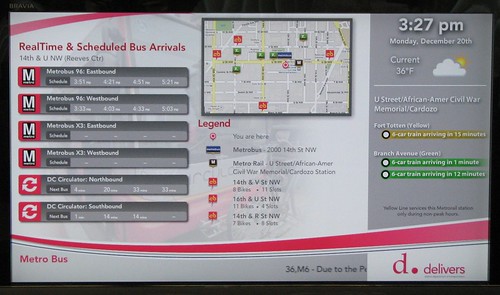
DDOT Multimodal Display

This is an area with a great deal of opportunity for growth.  Screens with this information can be displayed in office building lobbies, at bus stops, in restaurants, etc.  Geographically-set apps can display the screen on computer screens and smart phones.
Real time transit information via TransitScreen and the Orange Barrel Media digital billboard outside Capital One Arena
Real time transit information via TransitScreen and the Orange Barrel Media digital billboard outside Capital One Arena, on 7th Street NW in the Gallery Place neighborhood.  August 2017.
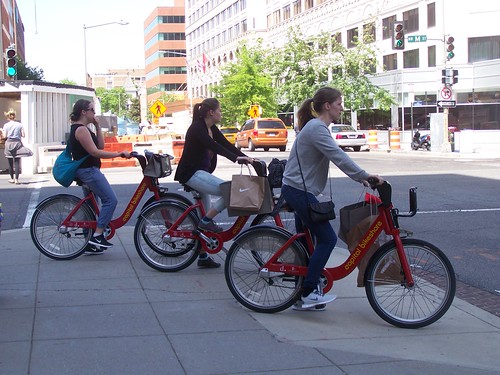
3 people riding Capital Bikeshare bikes on M Street NW, after shopping8.  Dock-based Bike Share (2010).  While an earlier pilot (2008) had been done with Clear Channel, the bus shelter contract did not require a rollout of bike share across the city and it was a 10 station system, hardly widespread.

Instead of renegotiating, DC partnered with Arlington County and launched a different system in September 2010, called Capital Bikeshare, based on solar-powered equipment developed in Montreal.

Originally, members needed a key fob to access the system.

(One of the problems with the Clear Channel system is that it used hardwired electricity connections, which made the system more costly and much slower to deploy.)

Membership includes unlimited rides for no additional charge provide that the trip is less than 30 minutes.  Longer trips trigger additional fees.

An undiscounted membership is $95/year and monthly and shorter term periods are also available.  Later the additional fee structure was changed to reduce the cost for annual members, and a single trip option for $2 was added.  The bulk of operating revenues come from fees charged to short term users.

Over time, the system has expanded to Alexandria and Montgomery County, and soon Prince George's County.
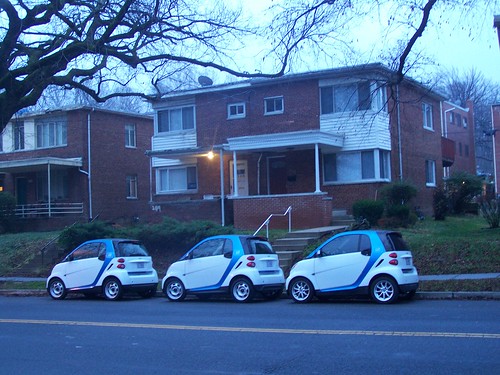
Car2Go vehicles bunched up on Hawaii Avenue NE9.  One-Way Car Share (2011).  Car2Go, using small cars, introduced one-way car share to DC.  Rather than in half hour increments with a one-hour minimum, cars are charged by the minute. Users are also charged sales tax on each trip.

Over time, a per trip fee was added and in 2015 the system switched from a card-based access system to smartphone-based systems. Payment is made by credit card connected to the account.

Paying a hefty access fee per car to the city means that the cars can be parked in most legal spaces, even resident priority areas and at meters without having to pay for no extra charge.  In 2014, Car2Go service was extended to Arlington.  In 2016, cars could be driven from one city to the other and left in either zone.  2017, Mercedes vehicles were added to the fleet.
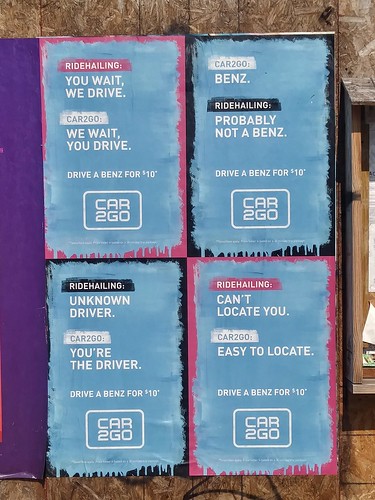
Car2Go paste up poster ads, New Hampshire Avenue NWThe advantage of the smartcars is that they are super easy to park in an environment of constrained parking supply.

To be competitive with one-way car share, Zipcar added "free parking" on DC streets to its service in 2014 ("Car Share Users Guaranteed Free Parking on D.C. Streets," NBC4).  Zipcar introduced a clunky form of one way car sharing in 2016, but dropped it earlier this year ("Zipcar drops one-way rentals in DC region," WTOP radio). Unlike Car2Go, Zipcar still uses card-based access systems.

Car2Go home zones only cover DC and Arlington County, so cars can only be used one-way when driving in those areas.

10.  Ride Hailing (2011). To me, ride hailing is no different than a taxi.  That being said, app-based ride hailing services utilizing a mix of professional and nonprofessional drivers, using personally-owned vehicles, were pioneered by Uber and Lyft.  Uber argued that somehow because they used a phone-based app system that it wasn't a taxi and shouldn't be regulated.  In many communities they won that argument.  Dispatching and payment is handled through e-commerce solutions.
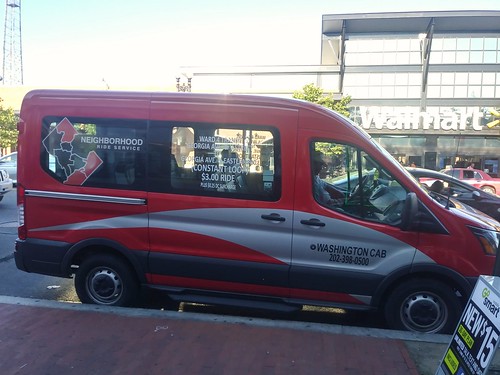
Ward 4 DC Microtransit serviceDC Government supports a taxi-based microtransit service in some portions of the outer city.

11.  Microtransit services (2015/2016).  Microtransit is the term now being used to refer to small-scale, sometimes on-demand jitney or "shared taxi" services.

STM in Montreal, and other communities in Quebec have offered shared taxi services for decades, in certain parts of its territory, usually at the edges, where traditional fixed route transit service isn't cost effective or doesn't meet the needs of its riders. Other communities in Quebec also

Most other transit systems in North America do not provide similar services.  A number of for profit services were launched, focusing not on distant areas, but in core areas, but most (Split, Bridj) have failed.

Elsewhere, Ford continues to own one service called Chariot, and UberPool, LyftShuttle and the Via service remains operative in cities like New York and Washington DC.  Payment is app based.

This Via screenshot claims that Via users reduce greenhouse gas emissions.  Probably not.  In DC, they are likely to be shifting trips from other more efficient modes like walking, biking, and transit.

My sense ("Where's the revolution?: Bridj microtransit service shuts down (a/k/a "Mobility as a Service")," 2017) and not only mine ("Microtransit: What I Think We Know," Human Transit) is that core-focused microtransit services will fail as people will have to pay a premium price for short trips, and this isn't economically viable, nor is it justifiable for such trips to be subsidized by transit agencies.

However, contracted out "shared taxi" services comparable to those of STM, serving transit systems and riders on the edges of service areas likely have upside but will require subsidy ("Beyond the Bus: 'Microtransit' Helps Cities Expand Transportation," Governing Magazine). In 2016, working with taxi companies, the city launched a microtransit service operative in some wards called the Neighborhood Ride Service. This service is more comparable to services in Montreal and is focused on parts of the city outside of the core.

In 2018, Via introduced a new membership program including four rides/day and access to dockless bike share for $159/month.

12.  DC Streetcar (2016).  The streetcar isn't particularly noteworthy yet, but it adds another mode to the city's transit mix. So far, the line is truncated, 2.2 miles long, serving H Street NE with a connection to Union Station.  The line is supposed to be extended east and west to Georgetown and perhaps Rosslyn, which would make it much more useful.
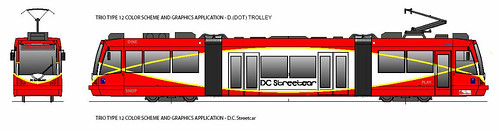
DC Streetcar vehicle proposed paint scheme
Presently, it's free to ride and advocates could use that as a way to press for the creation of a "fareless square" type of operation in the city ("Is making surface transit free the best transit investment DC can make?," 2015).

Unlike Kansas City ("Kansas City Tries to Go from Smart Strip to Smart City, Digital Trends), the streetcar hasn't been used to "drive" "smart city" improvements in that transit corridor or across the city.

I argue that such services need to be thought of as "intra-district" services ("Making the case for intra-city versus inter-city transportation planning," 2011).  Instead, streetcars are often compared to longer route services and found wanting.

13. Metrorail stops using paper farecards, shifting to exclusive SmarTrip usage (2016). The system stopped issuing and accepting paper farecards, although cash can still be used on buses, but is discouraged in favor of the SmarTrip card. This doesn't speed up Metrorail but does reduce the cost of processing payments, and strengthens the use of the stored value transit fare card as a primary MaaS payment device.
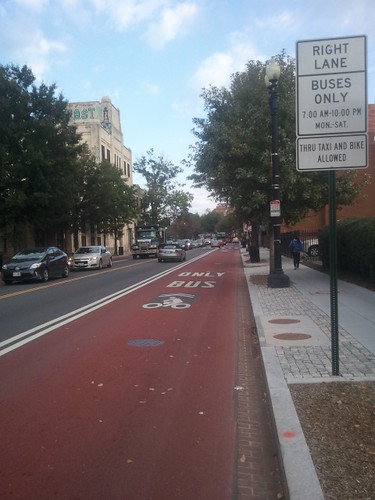
Red painted bus lane on Georgia Avenue NW, DC14. Dedicated bus lanes (transitways) painted red (2016).  Exclusive bus lanes painted red were introduced to a section of Georgia Avenue ("Georgia Avenue boasts bright red bus lanes," Washington Post).

Into the 1970s, the area had a number of dedicated busways, but over time they were removed.  Earlier in the decade an exclusive bus lane was installed on 7th Street NW but it isn't painted red and there is minimal enforcement.  More dedicated transitways are in planning.

Making bus service faster through transitways increases throughput and is the equivalent of adding new bus trips to the service. The red paint makes this noteworthy and worth listing as a MaaS element as would other bus prioritization initiatives such as traffic signal preferencing (in place for the DC Streetcar, but not buses).

15.  Dockless bike share including e-bikes (2017).  Dockless bike share was introduced on a pilot basis last fall. Multiple firms, some from China, are involved in the business.
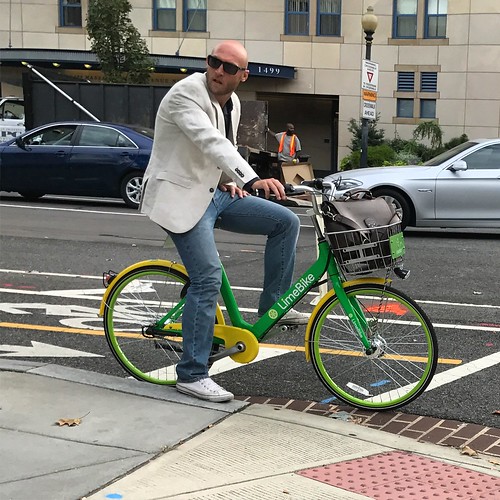
dude makes LimeBike look coolThe original trial period which was to end in April, has been extended. The advantage of dockless is like one-way car share, it is point-to-point and you can leave the bike "anywhere," including right at the endpoint of your trip.

Riders join the system through an app, which is used to pay for individual trips through a credit card link.

Interestingly, these services mostly charge per ride, $1, but $2 for the e-bike from Jump, so that regular riding would cost significantly more--ten times more or higher--than traditional dock-based bike share and at least 3 times higher than the cost of buying a bike. Likely such systems only appeal to occasional users.

They are only cheaper to use when compared to a transit ride, which is $2-$4 on a single trip basis.

Given that dock-based systems were developed for bike share in response to vandalism and theft experienced with early versions of what we would now call dockless bike share, not surprisingly many of the bikes have been vandalized ("Theft and destruction of dockless bikes a growing problem," Washington Post).  And many bikes are improperly parked.

To compete with Jump, which was recently acquired by Uber, LimeBike added e-bikes in 2018.  Note that e-bikes are overkill in the core of the city, but make sense in the outer city ("(Still) tired of mis-understanding of the potential for e-bikes," 2015).
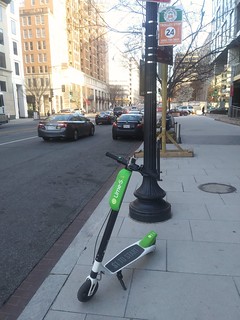
A Lime dockless electric scooter on 6th Street NW, Washington, DC16.  Dockless e-scooters (2018).  Bird, a company focused exclusively on dockless scooters, introduced e-scooters last year in Santa Monica, and after raising venture capital to fuel expansion ("Dockless scooters as an example of a lot of money sloshing around in venture capital," 2018), they and LimeBike, which added e-scooters to their program, launched e-scooters in DC in late Spring.

There is a flat fee of $1 plus a per minute use charge.  (Spin is also getting into the e-scooter market.)

E-scooters may have some advantages over bikes because they are faster and people believe they are trendy when they ride them ("The invasion of the scooter bros: A new tribe," Washington Post).

17. Transit card only bus service (2018).  Route 79, the first Metro Extra limited stop bus route, has just shifted to a card-only usage profile, no longer taking cash fares ("Metro's cash-free bus pilot aims to speed up trips, but some riders worried," WTOP-radio).  This is to speed up boarding.  (DC buses still do front-door boarding exclusively).

Surely this is a pilot with the hopes of being able to do this across the system.  But in order to do so, WMATA needs to make it a lot easier for people to put cash money on the cards ("What's remarkable about this storefront?," 2018).  I've thought for years they should put Metrofare machines in public places but that would create a security and collections cost problem.


The difference between the Sustainable Mobility Platform and Mobility as a Service.  In my SMP framework, I list elements like Barnes Dance intersections and cycle tracks.

But Mobility as a Service is about trips, usually costing money.  It's a sub-set of the SMP, not co-equal to it.

In this listing I did include items like transit information screens and transitways because they have a significant impact on the utility of certain services, or provide the kind of information that people need to make sense of their options.

Arguably, I could have included some other items.  What have I missed?

The MaaS underlying infrastructure: streets and traffic signals + computing and telecommunications.  One thing we don't think about is that almost none of this can work without roads, rights of way, and signaling systems. Those are controlled by local and state transportation departments.  In DC, they are mostly controlled by the DC Department of Transportation, although here and there certain roads and signals are controlled by federal agencies such as the National Park Service.

They are the enabling/foundational infrastructure, coupled with high quality computing applications, telecommunications systems and cloud-based hardware systems, accessed by smartphones and other computing/telecommunications devices.

What's missing or problematic

Do we need a master app integrating all services?  I don't think the lack of integrated apps pulling all the services together is a deal killer.  If it were just public agencies, it might be possible to create a master app, like the Oyster card.  But those are geographically bounded systems.

The for profit providers operate in multiple markets and it is less valuable for them to participate in regionally-specific fare systems.  It's problematic for the user too, who wants to be able to use these modes in other places--e.g., I've used Car2Go in San Diego and Seattle and Zipcar in San Francisco and Seattle.  Most Uber users use it when they travel, etc.

Nevertheless, area transit agencies must commit to using an integrated payment system.  That being said, there should be one unified fare card system for metropolitan area transit agencies, and ideally it should be managed and supported by the metropolitan transportation planning organization.  By shifting responsibility from WMATA to the Transportation Policy Board/Metropolitan Washington Council of Governments, perhaps the current problems and enmity between actors can be assuaged.

The fare card system (recognizing its moving towards being exclusively contactless or including contactless options) should work diligently to include commuter railroad services. If London, Seattle, and San Francisco can do it so can other places, including DC.

-- "One big idea: Getting MARC and Metrorail to integrate fares, stations, and marketing systems, using London Overground as an example," 2015

Don't confuse tourist water transportation services with transit.  The DC area has a developing water taxi system, but it's for tourists and shouldn't be represented as transit.  That being said, it's worth integrating the service into the SmarTrip system as one element in moving towards adding water-based transportation services to the transit mix.

Do you need a subscription covering all or a basket of services?  Anyone out there wanting to pay almost $600/month to Whim?  Whim, which started in Helsinki, is doing pilots in the West Midlands, UK, Antwerp, and Amsterdam.

To me, the point of mobility as a service is to pay less than you would if you owned a car, which is $7,000 to $9,000/year.  Whim doesn't seem to provide much in the way of savings.  I don't think the trade off of simplicity--using one app, is worth the loss of savings.

Washington Post graphic.

Gondola as a mode.  The Georgetown Business Improvement District aims to create a gondola system to connect Georgetown to the Rosslyn Metrorail Station, thereby "capturing" that station and making it serve DC more directly despite being in Virginia, across the Potomac River, and accessible currently only by the traffic engorged Key Bridge ("The case for the Georgetown-Rosslyn gondola").

Interestingly, the gondola service is more important for night-time and weekend transportation, not for day-time commuter use, although that would be served by the mode as well.

That would extend the transit network/MaaS/SMP.

==========
Writing all this, I still haven't read the various Los Angeles DOT reports on MaaS.  That city aims to be a leader in the field.

-- Strategic Implementation Plan: A Plan to realize the visions outlined in the Urban Mobility for a Digital Age and Blueprint for Autonomous Urbanism document, Los Angeles DOT
-- Urban Mobility in a Digital Age, Los Angeles DOT
-- Blueprint for Autonomous Urbanism, National Association of City Transportation Officials

Labels: , , , , , ,