Rebuilding Place in the Urban Space

"A community’s physical form, rather than its land uses, is its most intrinsic and enduring characteristic." [Katz, EPA] This blog focuses on place and placemaking and all that makes it work--historic preservation, urban design, transportation, asset-based community development, arts & cultural development, commercial district revitalization, tourism & destination development, and quality of life advocacy--along with doses of civic engagement and good governance watchdogging.

Thursday, July 11, 2019

US federal tax code as a political weapon

=====
Revised 7/12:  I forgot the changes to the historic preservation and low income housing tax credit programs, which are negative.
=====

Yes, the tax law changes passed when Congress was fully under control of the Republican Party favored the wealthy and the growth promised has not materialized.

And yes, various tax code provisions, not just in this particular version, represent political choices and the interests of various groups that are able to influence the bill drafting process.

But this bill took weaponization to a new dimension by including a number of provisions specifically targeting "blue states" and "progressive interests."

1. Reductions in deductibility on SALT, "state and local taxes."  This specifically targets high cost states like California and New York, which tend to support Democrats ("
It's over: States lose fight against SALT deduction cap in tax law," Accounting Today; "Democrats said a GOP tax law provision would devastate blue states: that's not happening," Washington Post).

As Paul Krugman points out in a recent column ("The Moochers of Middle America"), the net beneficiaries are actually red states like Kentucky, who get back way more money in federal spending than they pay in taxes, while for blue states like New York and California, they are paying more out than they are receiving.

2.  Massive reductions in the corporate tax rate make historic preservation and affordable housing tax credits less attractive.  Cities tend to benefit "disproportionately" from the use of historic preservation and affordable housing tax credits.  Cities tend to vote Democratic.

3.  Changes to the historic preservation and affordable housing tax credit programs make participation more difficult and less attractive ("Understanding the New Historic Tax Credit," Architecture Resources Group; "How the Tax Cuts and Jobs Act puts affordable housing production at risk," Urban Institute).

Cities tend to benefit "disproportionately" from the use of historic preservation and affordable housing tax credits.  Cities tend to vote Democratic.

(I suppose you can argue that the Opportunity Zone program created in the new tax law is supposed to help cities.  But it is really focused on helping investors avoid capital gains taxes.  See "I figured out why Opportunity Zones won't amount to much: no planning.")

4.  Endowment tax on universities.  … universities being the bastion of academics who question things, aren't hospitable to conservatives, etc. ("Feds release long-awaited rules on college endowment tax," Washington Post; "Endowment Tax Picture Becomes Modestly Clearer," Inside Higher Education).

5.  Taxes on benefits and other changes making nonprofits pay federal taxes.  … while all nonprofits are not "left" or progressive, imposing such taxes to fund tax cuts for the wealthy and corporations hurts such groups ("The New Tax Law and Its Impact on Nonprofits – Part 2," Nonprofit Law blog).

6.  Limitations on charitable tax deductions.  New reporting ("Americans slashed their charitable deductions by $54 billion after Republican tax-code overhaul," MarketWatch) says the changes in deductibility for charitable contributions has led to a $54 billion decrease in contributions.  I'm sure the Republicans figured that good conservatives would still donate to their churches and causes despite the changes, but intended for charities to be hurt by the change.

Labels: , , , ,

Thursday, May 17, 2018

DC proposes ride hailing tax of 6%: It's not enough--car share users pay 10%

The Washington Post reports that DC ("D.C. Council would hike tax on Uber and Lyft more than Mayor Bowser"), like other cities are considering or have instituted ("Council Passes Ride-Share Tax to Fund Transit, CTA Announces $23M in Cuts, Reforms," Streetsblog Chicago; "Uber, Lyft taxi rides into Manhattan get slapped with a new surcharge," The Drive) a tax on ride hailing. 

DC charges a "gross receipts tax" of 1% on these services now.  This is not a per trip tax.  The Mayor proposed a raise to 4.75%, while the City Council is aiming for a 6% tax.

It's reasonable to regulate and tax to shape more desirable outcomes. Ride hailing imposes costs on transit by capturing riders, and also increases traffic congestion.

-- "When Calling an Uber Can Pay Off for Cities and States," New York Times
-- "The false promise of ride hailing as a pro-city transportation mode," 2018
-- "Public fees/taxes/charges on ride hailing trips," 2018

As new mobility services come into play, taxation and regulation may vary compared to legacy services, often in ways that are seemingly less fair to users of the new modes.

DC imposes higher taxes on car share users.  For example, as a car share user in DC, it seems unfair that each trip comes with a 10% local tax charge when we are already paying a good chunk of the minute or hourly use fees indirectly to the city for licensing and access to street parking.

By comparison, DC car owners pay a minimal annual registration fee (from $72 to $155, depending on the weight of the car) and if they live in an area of the city requiring residential parking permits, a $35/year fee.

-- "Car share users are getting abused by the cities that ostensibly support car sharing as a form of sustainable mobility," 2016

Considering the impact of ride hailing services on transit and congestion, of course the rides should be taxed.  And they shouldn't be taxed at a rate less than what car share users are forced to pay, when research shows that each car in a car sharing system ends up "removing" 7 to 11 cars, thereby reducing demand on parking inventory, rather than increasing demand for road space, like ride hailing.

Labels: , , , , ,

Sunday, November 04, 2012

Urban agriculture run amok: marijuana production in Arcata, California

The Associated Press reports, in "Pot town pushes back against industrial growers," that Arcata, California is looking to impose a 45% tax on "excess" (3 times normal) use of electricity by households, as a way to reduce how houses are used not as dwellings but as indoor farms.

Above:  This  Arcata Police Department photo shows the inside of a marijuana grow house in Arcata, Calif.


This reduces the number of residents in neighborhoods (not unlike how second home ownership in globally popular neighborhoods, such as Charleston, ends up creating "ghost towns" devoid of residents much of the year) and has various negative effects.

From the article:

Even Arcata residents who support legalization of marijuana have become fed up with high-volume indoor growing operations that take over much-needed housing and take advantage of the state's loosely written medical marijuana law.

The neighbors of these clandestine pot farms — operated behind curtains, shutters and alarm systems — complain of the skunk-like stink of cannabis, fire hazards, rising rents, vicious guard dogs, caches of guns, illegal pesticides, roadside dumping of unwanted growing gear, and late-night visits from shady characters.

Rather than throw more cops at the problem, the City Council is fighting back in a way befitting this liberal outpost that would rather be known for its pioneering community forest and sewage treatment marsh than marijuana.

Measure I on next week's ballot would impose a 45 percent electricity tax on households — with medical and other exceptions — that use three times the amount of power a typical family home does. 

The measure takes aim at commercial growers who maximize production by packing homes full of high intensity lights and irrigation systems that gobble electricity and sometimes cause fires from overloaded circuits.  Our hope is to drive the large-scale growing operations out of town," said Shane Brinton, a city councilman and vice mayor who has pushed the novel idea.


Labels: , , ,

Wednesday, October 24, 2012

Local taxes on guns, bullets, hotels, gasoline and...

So in the previous entry on automated traffic enforcement-related fines, Charlie makes the comment that it would be fairer to raise taxes than to use automated traffic enforcement-related fines to generate a significant amount of revenue for local jurisdictions--and note that 10% of the Town of Chevy Chase's budget comes from enforcement camera-related fines generated on Connecticut Avenue.

Well, I think he's right from a revenue standpoint, but I favor enforcement cameras because violations--IN THE CITY--can have catastrophic negative impact on pedestrians and bicyclists, and DC has far more pedestrians and bicyclists than other cities in the metropolitan area.

But there is no question that hotel taxes, parking taxes, parking meter revenues, and traffic enforcement tickets are seen as primarily raising revenue from non-residents, and because this is so--except for the hotel association and the pesky representatives from the American Automobile Association Mid-Atlantic Chapter (see ""War on cars" lives as AAA knocks L St. bike lane" from Greater Greater Washington)--it's seen as a pretty safe way to raise revenues.

But the problem with this is that generally--except for hotel taxes--you need the taxes to be assessed on a wide area, in order to be effective and have the kinds of public policy results that are desired.

Otherwise people will shift their purchases, to the extent that they are able, to neighboring jurisdictions that don't assess similar taxes (this is a big issue with Native American reservations and gasoline and cigarette excise taxes, among others).

How about assessing certain taxes at the scale of a metropolitan area (or larger)?

We had a conference with our bike sharing business partners today, and we learned (to be announced soon enough) that with one European country, they are negotiating a framework agreement for bike sharing with the national government, and in turn any local or metropolitan government or transport agency in the country will be able to get the same terms, regardless of the size of the system.  I thought that was quite interesting and of course, couldn't work at the same way in the U.S., but is relevant to this tax issue.

It ain't gonna happen anytime soon, but we really need certain planning and tax policies to be enacted and levied at the metropolitan scale.

And if that isn't hard enough, it's likely impossible in terms of levying the same tax over multiple states, in this area's case, between DC, Maryland, and Virginia, when in Northern Virginia (and the Hampton Roads area--instead they are getting a big tunnel project to be funded by tolls), they can't even get approval from the state legislature for a local transportation tax.

Of course other metropolitan areas cross state boundaries and would have similar issues, such as in Greater Philadelphia, Kansas City Missouri and Kansas, Portland Oregon and Vancouver Washington, Greater Chicago, and Greater New York City.

Just like I argue that the Metropolitan Planning Organization should actually be the region's transportation planner (they probably say they are, but in terms of substance vs. form, they aren't, at least in the way I think they should operate, see "Metropolitan mass transit planning: more thoughts" and "A clear signal of a failure in "metropolitan" transportation planning: a proposal to eliminate a subway station from Dulles Airport") and make transportation policy, the same goes for other actions.

(And yes, a similar attempt failed for the most part in Georgia, for reasons I have already discussed.  See "Failure of the transit-roads sales tax measure in Metro Atlanta.")

Now in metropolitan Minneapolis, the Metropolitan Council does transportation planning, runs the transit agency, runs a regional park network, and does water resources planning and management too.

And in Portland, the MPO is part of the (Portland) Metro Government, and people are elected to the Metro Government from the various jurisdictions, and they do a bunch of policy and operational programs at the metropolitan scale.

And many metropolitan areas have various agencies that might operate and tax on a metropolitan scale, such as for transit, parks districts, museum districts, or the Allegheny Regional Asset District in the Pittsburgh area.

But for the most part, true metropolitan governments--the exception being those places where the city and county have merged, such as Louisville or Lexington in Kentucky and Indianapolis in Indiana or Jacksonville in Florida, Nashville in Tennessee, and Kansas City, Kansas (not KC, Missouri)--don't exist very much in the United States.  (There are more examples than these, see the Wikipedia page on Consolidated city–count[ies].  And this story from Governing Magazine, "Cities, Counties and the Urge to Merge.")

Gasoline taxes

DC and Maryland charge a gasoline excise tax of 23.5 cents/gallon, and Virginia's is 17.5 cents/ gallon.  So people in the metropolitan area can tax shop to save money.  This makes Montgomery County's exploration of assessing a separate local gasoline tax ("Berliner seeks Montgomery County tax for transportation" from the Gazette) somewhat problematic.

It's not a bad idea.  It will raise some revenue.  But it will be easy for people to buy gas in neighboring jurisdictions for less, defeating the purpose.

But if there were the same level of "local" gas tax assessed across the metropolitan area, the problem for the most part is solved.  More money for transportation, harder to evade.

Hotel taxes

Well, every jurisdiction does its own thing.  DC's problem is the cost of land makes offering cheaper rooms at the core quite difficult.  That's why many people visit DC but stay in Maryland or Virginia.  Since the visitors are already paying premium rates, you might as well tag them for the tax too.  But there is no question that National Harbor in Prince George's County in particular uses higher hotel tax rates in DC as a competitive brickbat.  We have to live with it I suppose.

The Wall Street Journal has a general article on the topic, "Best and Worst Cities for Travel Taxes,"based on a study ("GBTA Reveals Best and Worst Travel Taxes in Top 50 U.S. Destinations," press release) from the Global Business Travel Association.

According to the study, DC ranks #10 on the highest discriminatory travel tax rates.  But we can take comfort in the fact that there are 9 other jurisdictions that are worse.


Restaurant taxes

In DC and probably other tourist cities, sales taxes in restaurants can be pretty high, for the same reason that hotel taxes are high.  We can't tax commuters, so we make up for it in restaurant taxes.
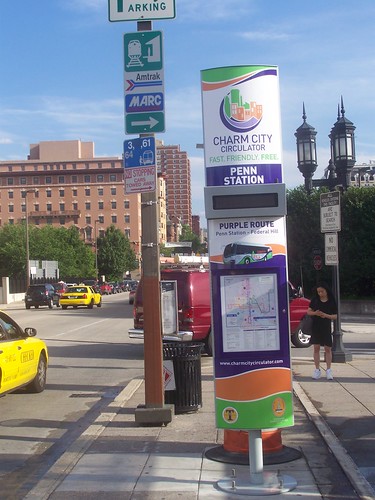
Charm City Circulator sign, Penn Station, BaltimoreParking taxes

 Lots of people park at places in the suburbs that don't charge.  While in the suburbs parking taxes could be assessed on parking lots and they should, regardless of whether or not they charge, in some respects charging for parking puts DC at a competitive disadvantage compared to the suburbs. 

So we have to make up for that by making DC totally awesome and worth coming to whether or not you have to pay to park.

Of course, we want parking to be charged for to encourage people to get here by transit (except for the fact that now a transit trip is so damn expensive).  These fees, and part of a proposed transportation withholding tax could be directed towards the transit system to help to reduce fare escalation.

In Baltimore, the Charm City Circulator bus is free, paid for by a tax on parking structures.  See "Baltimore Hotel Tax | Increases in hotel, parking taxes draw complaints" from the Baltimore Sun

Left:  Walmart's urban strategy hasn't fully percolated down to their advertising circulars.  I am amazed at how the circulars in the Washington Post prominently feature guns.  Fortunately the murder rate has been dropping for years.  Still, I think they need to better "zone" their advertising message for urban markets.


Guns and bullets

A few weeks ago, there was a column in the New York Times, "If Guns Do Not Kill, Tax the Bullets," suggesting that a way to reduce gun violence would be to make guns and bullets expensive, through taxation.

I thought that was pretty interesting, since we're not likely to get Congress to back off of being the NRA's lapdog, that might be the best way to go.

Ideally, such a tax would have to function at a multi-state scale or nationally (which isn't likely to happen anytime soon).  Chicago is proposing such a tax ("Chicago Area Proposes First Local Tax on Guns, Bullets" from the WSJ) and while some of the caveats of such a law is that lawbreakers tend to purchase guns and bullets illegally anyway, it might not have much impact.  But without such a tax operating on a scale broader than the city (in DC there are fewer than two places where you can buy guns I think), people will merely avoid the tax by purchasing items somewhere else.

Car taxes/higher registration fees

This is another area that bears consideration.  I used to think such a tax was onerous--I never heard of such a tax, as I was from Michigan and they would never treat cars as taxable property for residents, but when I first moved here I learned that they were common in Virginia at the state level and locally--but the reality is that such taxes help to pay for transportation infrastructure, just as property tax on buildings pays for the operation of local government.  (Image of the Arlington County car tax decal from the 12 Circle blog.) 

Such taxes and fees if they exist are generally pretty low.  In DC though, people may try to avoid local registration, because there is a high transfer fee when you first register.

-- Arlington County Vehicle Personal Property Tax webpage.  The tax rate is $5/$100 of assessed value, prorated by the number of months the car is registered in the county.

In Washington State, jurisdictions can add a fee for transportation improvements of $20 without having to get voter approval.  A higher rate can be assessed if voters approve.  So far, after having been put to the voters in many jurisdiction, no jurisdiction has successfully done won a higher fee.  An attempt in Seattle failed last year.  See the past blog entry "Seattle car registration supplemental charge not likely to be approved today by voters." 

--Washington State Licensing: Local transportation benefit district fees

Since the cost on the road system for maintenance is a minimum of 6 cents/mile or $600 for 10,000 miles, $20 + gasoline excise taxes don't go very far, especially when considering the cost of adding new infrastructure.  If you bought all your gasoline in DC or Maryland, you'd pay 41.9 cents/gallon in federal and state gas taxes.  If you get 22 mpg, you'd pay a total of $190 in excise taxes. 

Probably the property tax on vehicles is a better bet.

Note that the current 25th anniversary issue of Governing Magazine has a story, "What Will Government Look Like in 2037?,"  where they ask various people what they think will be the most pressing and biggest changes in state and local issues over the next 25 years.  Joshua Schank, President of the Eno Center for Transportation, believes that we won't have VMT-based excise taxes nor a high gas tax, that instead, monies for transportation will mostly come from general funds.

Labels: , , ,

Monday, October 08, 2012

Urban planning and the difference between "economic development" and "building a local economy"

Applebee's is a national restaurant chain, although stores are typically owned by regional-scale sub-chains.  The company's advertising and signage stresses the local nature--"your neighborhood grill and bar"--of the locations.  Photo: 

One of the points I have made about the general process of creating a "Comprehensive" or "Master" Plan for a city, town, or county--most states require that localities have and regularly update such a plan--is that the "Economic Development" element of the plan is often incomplete in terms of how it considers what economic development is and the recommendations made in the plan.

I say that such elements are "incomplete" because they often have a somewhat simplistic approach in that they treat any and every economic action as a good thing, without more deeply considering the long term impacts and effects and the multiplier effects of particular economic activities.

The reality is that some economic activities contribute a lot more to local activity than others.  And those are the activities that should be supported and courted, and less effective "economic development" activities should be accorded less support, attention, and priority.

This more nuanced approach I think of as "building a local economy" versus "economic development." And I think such elements within Comp/Master Plans should be renamed and reconceptualized accordingly.

For example:

- compared to new construction, restoring a building spends more money on labor (usually locally sourced) and less on materials (which rarely are manufactured locally).  So demolition of properties, depending on their nature, should be discouraged, and restoration encouraged.

- events like an All Star sports game are seen as a local boon, but most of the money spent on hotels leaves the local economy, except for a small portion on labor.  So accommodations planning should be developed to encourage local ownership.

- while incentive payments made to entice firms to locate in a particular jurisdiction are tied to employment goals, they are numerical goals that usually are not tied to residential location, and few of the employees may live in the jurisdiction reducing the overall return from increased property, sales, and income taxes.  So business attraction programs should be devised to focus on the entire package of potential benefits to the city.

- in DC, tax abatements are often provided for properties without provisions for recapture if the business leaves the city (such as the Bureau of National Affairs) or sells the property in a very short time frame (CoStar).

The local economic impact of retail: chains versus locally-owned stores

Another big economic development category is the retail element of commercial real estate. 

It's complicated because in states localities compete for sales tax generators, because typically localities split sales tax revenues with the state, so adding retail does increase tax revenues.

On the other hand, as the nature of the retail mix changes, more towards chain establishments and away from locally-owned independent businesses, this has other negative economic impacts that aren't always properly calculated.

The economic consulting firm Civic Economics has done a number of studies on the difference in economic benefits resulting from locally owned businesses versus chain businesses.

One of their most recent studies was done in Salt Lake City, Utah, and the results shows stark differences in the overall gain in economic activity between locally-owned businesses and chains, illustrating the difference between building a local economy and "economic development."  The economic multiplier effect is significantly greater for locally-owned retail vs. chain retail and for locally-owned restaurants versus chains. 

(Note that it would be interesting to see if there is an economic multiplier impact difference between locally owned franchised operations, such as Dunkin Donuts or a McDonalds store or a hardware store under the Ace or True Value banner, versus fully chain owned stores like Kohls, Target, Walmart, or Bed, Bath & Beyond versus single or chainlet local operators.)

The differences are so significant that local government campaigns focused on attracting chain retail businesses like Walmart need to be called into question.  Or at the very least, much more detailed economic analysis needs to be performed beforehand to ensure that economic gains are obtained and negative impacts mitigated. 

Economic impact of chain retailers vs. locally owned retailers, Civic Economics

Economic impact of chain restaurants vs. locally owned restaurants, Civic Economics

Tax revenue capacity of different types of land use patterns

Another important and more nuanced economic impact analysis technique is to look at the tax revenue generating capacity, along with cost to serve, of various types of land use patterns.  Typically, mixed use development is the most economically successful, from the standpoint of local government revenues and costs.

The economic consulting firm Public Interest Projects did such a study for Sarasota County, Florida, demonstrating this factually (see "Mixed Use Reduces Infrastructure Costs and Increases Tax Receipts," SvR company blog).

This type of analysis should be incorporated into the zoning approval process, to limit the negative impact of single use projects, which are mostly enabled, not made more difficult, by zoning policies and regulations.

Conclusion

Only by developing more accurate and complete methods for valuating the economic impact of different types of development can local jurisdictions truly protect their interests.

Changing the calculus and philosophy behind how communities produce the "Economic Development" element in Comprehensive-Master Planning processes is the first step.

Also see:

- "Urban decay and sprawl: one community's gain at the expense of another"
- "Lessons from Walmart's foray into Washington, DC"

Labels: , , , , , ,

Sunday, August 26, 2012

More thoughts on transportation district funding

So the same day that I wrote about transit withholding taxes, a judge in New York State ruled that the creation of the mass transit district that included outlying counties was not an appropriate act by the state government.  See "MTA payroll tax ruling met with joy; transit authority plans appeal" from the Poughkeepsie Journal. From the article:

In his ruling Wednesday, Nassau County Justice R. Bruce Cozzens Jr. called the payroll tax a “special law” passed by a 60 percent majority vote in the Assembly and 52 percent majority vote in the state Senate that does not serve the entire state’s interest. “This law should have been, according to the state Constitution, passed with either a Home Rule message or by message of necessity with two-thirds vote in each house. This did not occur, therefore this law was passed unconstitutionally,” Cozzens wrote.

I don't agree with the judge as transit/transportation is not a legitimate state interest and because services typically cross jurisdictional boundaries, higher level governmental coordination is an appropriate state function and action, but then, I am not a lawyer, and maybe on technical grounds, the law wasn't passed properly.

We'll see what happens in the appeals process.

2.  I have been meaning to write yet again about the Allegheny County Regional Asset District in the context of the successful initiative in the Detroit area, where voters in Wayne, Oakland, and Macomb counties agreed to a small property tax to fund the Detroit Institute of Arts.

While other arts institutions are interested in pursuing something similar ("Why Arts Managers Short of Cash Are Looking At Detroit " from the Wall Street Journal), for the most part they are looking at this issue in a piecemeal fashion.

Instead, the RAD as a concept addresses arts and cultural uses and funding in a very systematic manner, which for the most part is unprecedented at the center city-county level (Chicago has a Park District, but it's only operative within the city).

From  "Transit bailout with RAD funds does not pose threat to arts, Allegheny County executive says" in the Pittsburgh Post-Gazette.

For 2012, RAD allocated $84.1 million to 89 groups and amenities. About 32 percent went to libraries, another 31 percent to parks, 17 percent to sports venues, 10 percent to arts and cultural groups and 9 percent to big regional attractions such as Phipps Conservatory and Botanical Gardens.

(Sacramento City and County have a combined Sacramento Regional Arts Facilities Financing Authority that funds capital improvements, not programs, in a similar fashion.) 

Because transit in Allegheny County has been barraged by massive cuts in funding and service since the 2008 real estate crash, it has been proposed that the Regional Asset District, which is funded by a 1% sales tax, also begin providing some bridge funding to the transit agency.  Also see "Pittsburgh Mayor Ravenstahl cautious about idea to fund transit via asset district" from the Pittsburgh Post-Gazette.

Obviously, transit is a regional asset, and combining it with arts/culture/parks funding mechanisms isn't unreasonable.  Although arts groups, justifiably, are concerned about competition and likely over time the sales tax amount dedicated to the RAD would have to increase.


Michael Henninger/Post-Gazette.  Old and new arenas in Pittsburgh.  The old arena, and the 28 acres of land it takes up, will be redeveloped.  (From "Hiring in the Hill District: the new arena and hotel are meeting goals: A community benefits agreement places Hill District residents, minorities in jobs at Consol Energy Center and Cambria Suites hotel.")

3.  Many places have parking districts, and I argue that such districts should be termed "transportation districts" and that systematic plans for improving transportation and streetscape infrastructure be devised and funded over time with revenues from these districts.  When they are parking districts, for the most part (DC's performance parking districts are an exception) monies are only spent on parking.

Anyway, the neighborhood association in the Hill District in Pittsburgh is arguing that some of the revenues from parking at the Consol Energy Center Arena should also be to fund neighborhood improvements.   See "Hill District seeks more arena-area parking money for development" and "SEA urged to use a portion of parking revenue to support Hill" from the Pittsburgh Post-Gazette.  (The creation of special taxing districts for such improvements are not unusual.)

From the second article:

Carl Redwood lobbied the SEA board Thursday to get behind his "A Dollar A Car For The Hill" campaign and to ensure that the plans to redevelop the former Civic Arena site include affordable housing and space for Hill businesses.

This is a great point, and one that should become part of standard practice when it comes to the placement of sports arenas and stadiums.

A parking tax fee could be part of a mitigation package related to the insertion of stadiums and arenas into neighborhoods.

Of course, when those facilities are inserted somewhat seemlessly into the urban fabric, like the Verizon Center in DC or Madison Square Garden in Manhattan, it might be harder to justify this as a parking tax, because most people get there by other means.

Therefore, a general mitigation tax on each ticket--not just on parking--is something to consider as well.

4.  Given how the Washington Nationals continue to refuse to consider paying towards the extension of subway service for patrons attending late games that go beyond the time the system normally closes ("Nationals ask District to pay to keep Metro open late for fans" from WTOP Radio), it's worth rementioning how, also in Pittsburgh, Alco Parking, Pittsburgh Stadium Authority, the Pittsburgh Steelers Football Team, and Rivers Casino are subsidizing the provision of free T transit to the new transit stops there, the Allegheny and North Shore stops on the new North Shore Connector, which opened up a few months ago.  See "Trips on North Shore T will be free" from the Pittsburgh Post-Gazette.  (Pittsburgh has a free transit zone where riding on the T is free within Downtown.  This zone used to cover bus service as well, but that was ended in the face of revenue losses.)

Labels: , , , , , ,

Thursday, August 23, 2012

Commuter/mobility tax discussion for DC

I didn't write about this when Congressman Darrell Issa, a Republican, said that a commuter tax on nonresidents working in DC should be on the table ("Rep. Darrell Issa proposes hearing on D.C. commuter tax," Washington Post) because I intended to write a letter to the editor to the Post to the effect that a commuter tax likely is a nonstarter (and yes, that's what happened, see "Proposed D.C. commuter tax dealt another blow" from the Examiner and "Talk of D.C. commuter tax finds opposition in Maryland" from the Baltimore Sun), but instead the city should focus on proposing a tax on commuters that likely could pass.

Such a tax would be a mobility withholding tax.  It would be charged to employers, not employees (although you could argue it could slightly depress wages as employers would make up for the cost by reducing paid wages).

Parking garage sign image from CBS Philadelphia.  

I call it mobility because it could support more than just transit improvements.

Currently, while many transit systems are supported by sales and real estate taxes of various sorts and fees on car registration as a part of the creation of transportation benefits districts (Washington State, e.g., in Seattle), or parking taxes (the Baltimore Circulator bus service, which is free to riders, is paid for by a tax on parking, see "Baltimore Hotel Tax | Increases in hotel, parking taxes draw complaints" from the Baltimore Sun), I am aware of transit withholding taxes only in two places, Oregon, in Portland and Eugene, and in New York State, in the MTA service area, to pay for transit services a withholding tax of 33 cents/$100 of wage income was instituted after the precipitous fall in tax revenues associated with the financial crash which was particularly acute in New York City.

Besides the difficulty in getting such taxes approved, the big problem with transit withholding taxes is that so many employers get exemptions or in the case of state and federal government agencies, are exempt from local withholding taxes.  In the case of DC exempting federal employees from the tax would significantly reduce revenues, making the exercise somewhat futile. 

But if Congressman Issa could push such a tax forward, and get the federal government to accept paying such a tax, it could happen.

I wrote a paper in 2007 on creating a linked transportation and land use planning paradigm in DC and this was one of the funding sources I wrote about (blog entries:  "A payroll tax to fund transit" and "More on funding subway improvements within DC").

I didn't think a congestion tax was a good way to go because it would displace commerce to the suburbs and more importantly, many more areas in the suburbs are congested than are roads in DC, with some exceptions of course, mainly the main entrypoints into the city, along with some roads downtown.

I don't remember the numbers off hand, but I calculated that as much as $250 million/year could be generated from such a tax, which I proposed could be used both to support improvements of the current system as well as transit system expansion such as the separated blue line, streetcars, etc.

I suggested that possibly, surface bus transit could be free, but that would absorb a huge proportion of the revenue and at least in the intermediate run, it wouldn't be a good use of funds--besides current system improvements, my biggest priority would be the creation of the separated blue line.

Note that separately, there is a review of DC tax policy ("Tax-reform panel aims to untie D.C. code's 'knot'," Washington Times).   From the article:

Among other priorities, Mr. Gray wants the commission to consider a decrease in commercial real estate taxes to fill vacant space and drive up values.

Many of the mayor’s proposals ask the commission to weigh the loss of direct revenue from lower tax rates or abatements against the added revenue gained by retaining or attracting residents and businesses to the District.

Former D.C. Council Chairman Kwame R. Brown had been a vocal supporter of the commission, arguing a piecemeal approach to tax policy was inappropriate.

His successor, Phil Mendelson, said the board should look at whether everyone is paying his or her fair share under the tax code of the city. He also asked the commission to look at whether the city’s tax system actually drives people away from the District, since that long-standing belief seems to be “more anecdotal than evidence-based.”


Image from study for Sarasota County, Florida on the tax yield per acre by different types of development.  In DC, income taxes on residents generate additional income.  

But I expect very little from this review, which ought to be very expansive in terms of how it considers:

1.  Tax revenue generating capacity of various types of development ("Mixed Use Reduces Infrastructure Costs and Increases Tax Receipts," SvR company blog);

2.  Commuter tax issues;

3.  Tourism taxes and the systematic planning and funding of visitor and cultural services (blog entry: "Cultural resources planning in DC: In the land of the blind, the one-eyed man is king");

4.  Taxes that fund mobility (parking tax, tax on parking benefits, mobility withholding tax, etc.);

5.  How the commercial property tax methodology negatively impacts properties in neighborhood commercial districts because the national-international property market in the central business district drives up prices across the entire city (blog entries: - Testimony -- Historic Neighborhood Retail Business Property Tax Relief Act (2006); - A solution for the overtaxing of properties in neighborhood commercial districts  (2009); Displacement of retail businesses through increasing property tax assessments (2005); Forcing Displacement by the disconnection of tax assessment models from public policy goals (2005); Globalization of the DC real estate market catches neighborhood commercial districts up in the wake (2006); Avoiding the real problem with DC's property tax assessment methodologies (2007)).

It's unclear that these more fundamental questions will even be asked, based on the Mayor's stated interest in various commercial property tax reduction schemes.

Labels: , , , , ,

Friday, August 05, 2011

"Small town" reasoning on better gas mileage

2010 01 12 - 5632 - White Flint - Montrose Pkwy approaching MD 355
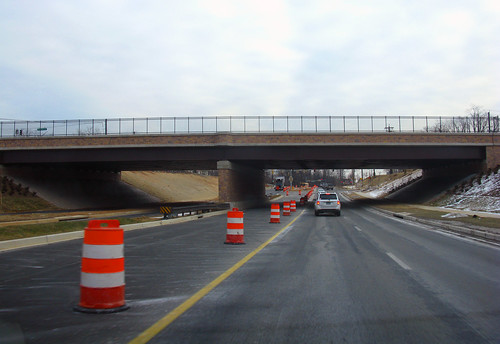
Road construction in Montgomery County Maryland, Flickr photo by thisisbossi.

In Ann Arbor, there used to be a local newspaper called the Ann Arbor News. I always found the letters to the editor column to be interesting, because you'd have a mix of erudite letters from college professors and wacked out semi-illogical letters from residents of Washtenaw County who probably had "less" education.

Major metropolitan newspapers like the Washington Post aren't expected to have the same range of letters to the editor, instead you read community newspapers (like the Northwest Current, the Gazette newspapers in Prince George's and Montgomery Counties, or the Sun-Gazette in Arlington) for the same kind of range, including borderline nutty. The "big" newspapers are only supposed to run smart, intelligent, completely logical letters.

Given that today's headlines are all about whether or not the US and Europe are about to enter another period of deep financial crisis and recession/depression, the letter to the editor today by Matthew Jeanneret, senior vice president for communications of the American Road & Transportation Builders Association qualifies as borderline nutty or at the very least gutless, "Sipping away at gas-tax revenue."

Jeanneret argues that improving efficiency standards for automobiles, requiring more miles per gallon is potentially bad because it will reduce the revenue from gasoline excise taxes.

The solution is easy, federal gasoline excise taxes haven't been raised since 1993. He alludes to this, but he just can't be direct as he writes:

It’s irresponsible to advance such proposals without acknowledging and attempting to mitigate the adverse effect they would have. Let’s improve fuel efficiency standards, but not at the expense of shortchanging the nation’s crumbling infrastructure.

Mitigate is too weaselish a word (except when you're talking as a planner) if you don't outline the potential mitigation measures at the outset.

Note that the letter is based on another ARTBA piece, "New Fuel Efficiency Standards = $65+ Billion in Lost Revenue for Highway & Transit Improvements Between 2017-2025" which states:

Per gallon federal gasoline and diesel taxes collected at the pump are deposited into the federal Highway Trust Fund (HTF). By law, these excises are the primary revenue source for financing road, bridge and transit projects. The less motor fuel used by drivers, the less revenue generated for improvements financed through the HTF.

Not if the tax per gallon is increased...

ARTBA may be more irresponsible than the government officials Jeanneret is admonishing because by reducing demand for gasoline through improvements to motor vehicles reduces the amount of oil purchased and consumed by the U.S.--since about half of the oil consumed by the U.S. comes from foreign sources, capital outflows from the U.S. are considerable ("balance of payments") negatively impacting the economy overall--not to mention how military policy is shaped by maintaining access to oil, which further drains the U.S. economy.

Fixing the U.S. economy is more important than road builder profits, which can be maintained if ARTBA and others step up and demand increases in the gasoline excise tax.

I've dealt with letters staff in the past, they pay attention to every clause, every sentence, the right punctuation, etc. There's no way they didn't discern the logic gap from sentence to sentence. (And in fairness to the Post, every time they editorialize about the gas tax issue, they do argue for increases.)

Labels: , , ,

Thursday, December 30, 2010

Something that won't happen any time soon in the DC area: a green tax on cars


Image: car sales in the U.S. From the Washington Post, using data provided by Autodata.

In Europe, one of the ways that car use is discouraged is by charging tack on fees that help to capture some of the externality costs that are produced by automobiles but not otherwise captured in fees. Actually, the hated personal property tax on cars in Virginia is a form of this, although undoubtedly the tax revenues weren't directed towards transportation related projects.

I think the fee in the Netherlands is something like 20% of the sticker price of the vehicle.

Today's Post has an article, "SUVs lead U.S. auto sales growth despite efforts to improve fuel efficiency," about how despite a seeming focus on fuel efficiency, it is the larger cars and trucks that are selling, consideration of a green tax on automobile purchases is definitely in order, even though it is politically unlikely.

It's interesting that a couple days before, the Post ran a story, "China to raise sales tax on small cars Jan. 1" about how the government is instituting a variety of measures to reduce car sales and overwhelming automobile congestion in Beijing. From the article:

Exactly how China handles its rapidly growing demand for automobiles and the pollution they cause is of keen interest to environmentalists and automakers across the globe.

Last year, for the first time, there were more cars sold in China than in the United States, and the magnitude of the nation's demand has made it a key point of reference in discussions of greenhouse gas emissions and world economics. ...

Combined, the end of the sales tax break and the Beijing limit on autos are expected to put downward pressure on sales in China. But automakers said they expect that the market will nonetheless continue to surge in the rapidly growing country. ...

Last year, China cut in half the sales tax rate on vehicles with engines of 1.6 liters or less. The measure was viewed as a means of stimulating the economy and encouraging smaller, more fuel-efficient engines. But China will restore the sales tax on small cars to the full 10 percent beginning with the new year, the Ministry of Finance said Tuesday.

The limit on new cars in Beijing arises from a new traffic plan for the city. The plan involves miles of new underground highways, higher inner-city parking fees, a new bicycle-sharing plan, and, as its most controversial element, a limit of 240,000 license plates next year for the car-congested capital, or about a third of the new vehicles registered for 2010.

Beijing authorities defended their plan, saying Shanghai and Hong Kong have even stricter controls on the number of new vehicles allowed to be registered each year. Shanghai allows 10,000 and Hong Kong 1,000, Li Xiaosong, vice director of the Beijing Municipal Commission of Transport, said on the radio.


Meanwhile, "Ex-Shell president sees $5 gas in 2012" according to CNN.

Also see "A Green Detroit? No, a Guzzling One" from the New York Times.

Labels: , , ,