Marion Barry and the missed opportunity for eradicating (or at least systematically addressing) poverty East of the River
While most of the articles on the death of Marion Barry have discussed his personal and professional failures, the best of the obituaries highlighted his early efforts and successes--a bus fare strike, advocacy for home rule, being on the school board, etc. as well as successes during his first administration. His biggest achievement was black empowerment (also see "Black Power and the Pyrrhic Victory" from Corner Side Yard).

The old phrase about never speaking ill of the dead makes it difficult to sit back and do a sober assessment of Marion Barry's career, although I would say that the Post's obituary in yesterday's paper did so ("Marion Barry's death stuns D.C. politicians and residents").
But the thing is, I think it's fair to ask what could have been done to help DC's ever-downtrodden "East of the River" area to improve, considering Councilman Barry's representation of the area since 2004 and his unparalleled political skills.
For example see "Marion Barry: As good a negotiator as D.C. has ever seen" from the Washington Business Journal, although the story was more about the Growth Machine/real estate development angle.
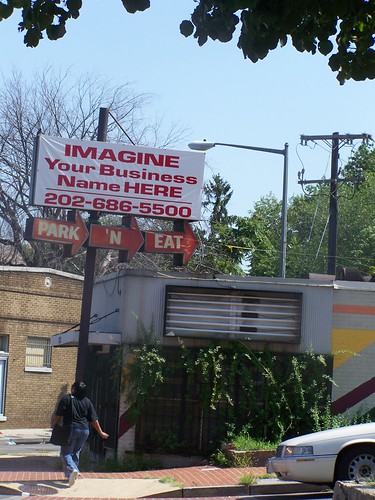 DC could have developed a substantive and pathbreaking anti-poverty agenda for the area that focused more than on real estate development (and the city and private company WC Smith have done many great and successful projects EOTR aimed at improving the community, "Why Did Developer WC Smith Buy Up Most of Congress Heights," Washington City Paper).
Other local governments are working to do so, even as DC continues to focus on real estate driven projects, while typically failing to leverage the value of city projects to accomplish multiple objectives ("Public buildings as vehicles for community improvement").
It's fair to ponder on the lost opportunity.
- The Grow South initiative in Dallas (see the searing series "The gap behind the gleam: Prized projects mask growing poverty that challenges the city" by the Dallas Morning News)
- in Richmond, Virginia (Mayor's Anti-Poverty Commission Report - City of Richmond, "Anti-Poverty Commission: Take real steps to reduce Richmond’s poverty," Richmond Times-Dispatch)
- and the newly launched effort in Charlotte-Mecklenberg County, North Carolina ("Task force aspires to increase economic mobility for Mecklenburg poor," "Editorial: Ambitious panel faces tall task," and "Officials: Upward mobility panel won't deal in quick fixes," Charlotte Observer) in response to research that Charlotte has one of the worst rates of upward mobility of any major city and poverty is increasing beyond Charlotte throughout Mecklenberg County.
... four of the five major recommendations of the Anti-Poverty Commission report focus squarely on employment. These recommendations include:
• Expand investment in workforce development, building on the city’s successful Workforce Pipeline, which trains workers and connects them with specific employers.
• Pursue targeted economic development focused on long-term growth industries with significant numbers of jobs accessible to low- and moderate-skilled workers, including health services, advanced manufacturing, logistics and call centers. Development of the Port of Richmond to its full potential also must be an economic development priority.
• Develop a regional rapid-transit system to increase city residents’ access to suburban employment and create a truly regional labor market. ... Richmond must no longer settle for being in the bottom 10 percent of large metro areas in transit accessibility.
• Improve the skills of Richmond residents through long-term improvements in the public school system to better prepare children for college or work. Key ideas here include expanded focus on early childhood investments, development of a “Richmond Promise” scholarship fund for college-bound Richmond Public Schools graduates (modeled on a successful initiative in Kalamazoo, Mich.), and greatly enhanced vocational training.
Taken together, these initiatives will increase residents’ access to jobs, better prepare them for a successful work experience and increase the city’s attractiveness to new businesses capable of employing significant numbers of city residents.
Over the long term, these initiatives will also increase the skills and educational level of city residents — through improvements in the schools themselves, and because reducing poverty and increasing the number of economically stable families will improve children’s ability to learn and develop to their full potential.
• The commission’s fifth major recommendation concerns the city’s longstanding large public housing communities. The concentration of public housing in the eastern half of the city is extraordinary and reflects ill-considered public policy decisions made decades ago. But history also teaches us that zeal to tear down the physical symbols of poverty (blight) is risky for impoverished people. The commission therefore endorses redevelopment of these communities.
Labels: electoral politics and influence, poverty, poverty posturing
posted by Richard Layman @ 3:01 PM&Permanent Link
Follow this blog
19 comments







