Rebuilding Place in the Urban Space

"A community’s physical form, rather than its land uses, is its most intrinsic and enduring characteristic." [Katz, EPA] This blog focuses on place and placemaking and all that makes it work--historic preservation, urban design, transportation, asset-based community development, arts & cultural development, commercial district revitalization, tourism & destination development, and quality of life advocacy--along with doses of civic engagement and good governance watchdogging.

Sunday, February 06, 2022

Climate change is already here in many US communities | "Heat Officers" versus Climate Change Officers

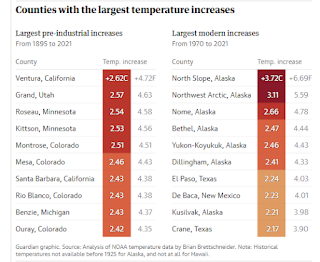
The Guardian has a chilling story, "A third of Americans are already facing above-average warming," about how many US counties (and the cities within) already are experiencing a warming of at least 1.5℃.
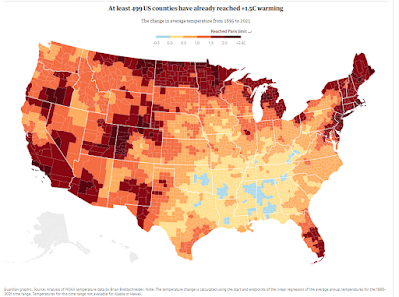
In the article, the map is interactive by county.

Hotter and colder temperatures, more virulent weather events, wildfires, flooding, drought conditions, sea level rise affecting coastal land, and an increase in heat- and cold-related deaths are all fallout from climate change.

Some cities are beginning to appoint "heat officers," creating positions within government to focus on climate change effects.  

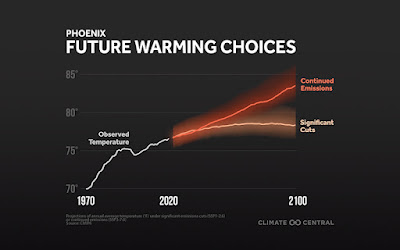
Apparently, Miami was the first city in the US to do so ("Miami’s first-ever chief heat officer on the climate issues that scare her the most—and what gives her hope," CNBC).  The Guardian has a recent story about the activities of the heat officer in Phoenix ("America’s hottest city is nearly unlivable in summer. Can cooling technologies save it?"), a city that tends to have the US's highest summer temperatures.  From the article:
Almost 200 people died from extreme heat in Phoenix in 2020 – the hottest, driest and deadliest summer on record with 53 days topping 110F (43C) compared with a previous high of 33 days. Last year there were fewer scorching days, but the death toll remained staggeringly high, with people experiencing homelessness and addictions dying disproportionately....

Last year, after another deadly summer, the mayor announced the region’s first dedicated unit to tackle the growing hazard of urban heat, which also threatens the city’s economic viability. ...
Hondula recently submitted the 2022 heat response plan to city hall, in an attempt to coordinate the existing patchwork of services. “I’m impressed by the number of programs but the death and illness numbers are moving in the wrong direction, so there’s a disconnect we need to address,” he said. “If we mean to take a hazard seriously, relying on good fortune, luck and happenstance is not the best model.”

Mitigation will be focused on trees and infrastructure, which will be led by an urban forester and a built environment expert who are yet to be hired.
-- "Planning for Extreme Heat: A National Survey of U.S. Planners," Journal of the American Planning Association 

I guess you can call them heat officers, but they are really climate change officers -- a few years ago the big term was "resilience."


For example, in Utah drought is a big issue, and Salt Lake City's efforts on reducing water consumption saved more than 2 billion gallons of water, according to the mayor ("Here’s how much water Salt Lake City residents saved this summer and what it means for next year," Salt Lake Tribune).

Although residential water use pales compared to agriculture and industrial use, and Utah in particular has few conservation systems in place for large scale water users ("Utah has a water dilemma," High Country News).  Some Utah communities have stopped approving residential building permits because they can't guarantee water supply to new housing ("First of many? Drought-stricken Utah town halts development," GreenWire).

A Climate Change Officer should be dealing with all of these effects, depending on what are the biggest problems in particular communities.

Citizenship culture in Bogota.  A previous mayor of Bogota, Andreas Mockus, initiated what he calls "citizenship culture." One of the examples was in a saving water campaign, he was filmed taking a shower with minimal water use ("Building "Citizenship Culture" in Bogota," Journal of International Affairs, 2012).  From "Academic turns city into a social experiment," Harvard Gazette:
When there was a water shortage, Mockus appeared on TV programs taking a shower and turning off the water as he soaped, asking his fellow citizens to do the same. In just two months people were using 14 percent less water, a savings that increased when people realized how much money they were also saving because of economic incentives approved by Mockus; water use is now 40 percent less than before the shortage.
Sustainability commissions as opportunities for rearticulating issues and increasing engagement.  10+ years ago, communities creating sustainability plans and citizen commissions to implement them were all the rage.  

While I am not sure how much progress has been made since, at the time I was impressed at how motivated citizens were to get involved in the issue, through commissions and other venues, and they were willing to think anew about issues that they had taken for granted, like solid waste, food waste, energy, and transportation impacts from automobility.

Labels: , , , , , ,

Tuesday, February 23, 2021

South Florida, Tulsa, and Santa Fe as examples of regulatory success and Texas as an example of regulatory failure

A bill from Griddy for a few days last week. 

Given the debacle in Texas last week, with more than 4 million out of electricity, wrecked water systems, four day electricity bills of as much as $16,000, 30+ dead people, and billions of dollars of damage to houses and businesses, it's clear that the State of Texas government--legislative, executive, and regulatory--built an electricity system for most of the state that accentuated risk, rather than reduced it.

-- "Talk and lying versus doing: The electricity crisis in Texas is produced by state regulatory failure"

In a comment on an article someone likened it to Florida and hurricanes, always looking for FEMA and the federal government for disaster relief afterwards.

South Florida.  I didn't think that was fair, because, I guess given the increasing examples of government failure, shockingly, after Hurricane Andrew devastated so many South Florida communities in 1992, recognizing poor building practices accentuated damage and destruction, they fortified South Florida's building regulations to provide better protection against hurricanes ("After Andrew, Florida Changed Its Approach to Hurricanes," New York Times).

Not only did they improve regulations on paper, they built the inspection and regulatory regime to ensure that buildings were actually constructed to be stronger ("Fla. Building Codes, Revamped Since Andrew, Still Being Worked," Insurance Journal, 2007).

Today though, with climate change, Florida is discovering that stronger requirements need to be extended across the state, whereas before they believed the worst storm effects would be concentrated in South Florida.  

And some firms are building beyond minimum requirements out of a recognition that codes are behind the reality of climate change and ever worsening and extreme weather ("Lessons of Resilience From Hurricane Michael," Engineering News-Record).

Now, while we think of Florida as being Republican, the fact is the stronger building codes were enacted during a period of Democratic leadership.  

It's more likely that strengthening of the codes in the face of worse storms, such as demonstrated by Hurricane Michael in 2018, which severely impacted North Florida, won't be happening going forward, because anti-science Republicans control the state government ("South Florida’s Hurricane Building Code is Strong—And North Florida’s Could Be Stronger," Weather Underground, "Toughen Florida's Building Codes," Tampa Bay Times, "Florida’s building code is tough, but Michael was tougher. Is it time for a rewrite?," Miami Herald).

Because it was built far stronger than required by the building codes, this elevated house that its owners call the Sand Palace, on 36th Street in Mexico Beach, came through Hurricane Michael almost unscathed. [Johnny Milano for the New York Times]

Tulsa.  Historically, Tulsa was prone to bad flooding, resulting in deaths and hundreds of millions of dollars of property damage. While the city had been engaging in floodwater management initiatives since the 1970s, in 1984, after flooding which resulted in 14 deaths, the city created a Department of Stormwater Management and developed a Citywide Flood and Stormwater Management Plan, which provides for specific improvements across the city ("In Tulsa, a National Blueprint for Managing Floods as Cities Grow and Climate Changes," NPR). 

-- From Roof Top to River: Tulsa's Approach to Floodplain and Stormwater Management, City of Tulsa

 The primary focus of the plan is removing buildings from the flood plain and converting these spaces to greenways and parks as a way to absorb flooding while minimizing damage. The plan has been frequently updated--the latest iteration was approved in 2017--and since 1990, no structure built before 1987 has been damaged by flooding.

Unlike Florida today or Texas, this process occurred under Republican Administrations.  

Santa Fe, New Mexico. The watershed of Santa Fe's source of drinking water is particularly susceptible to wildfire. 

After nearby Los Alamos experienced millions of dollars of wildfire-related damage to their water resources, Santa Fe figured it would make sense to be proactive ("For a Warming World, A New Strategy for Protecting Watersheds," Yale, "Fire and Rain: The One-Two Punch of Flooding After Blazes," National Geographic)

-- Municipal Watershed Management Program, City of Santa Fe

They created a watershed fire protection plan and a water fund to pay for various land protection initiatives. Originally, private and philanthropic donations paid for the program, now it's funded through dedicated taxes.

Conclusion.  It's possible for governments to react to disaster in ways that strengthen resiliency going forward.  (There are other positive and negative examples I could have included, from hardening buildings from earthquakes to ignoring coastal water rise and flooding.)

But Texas had two chances, in 1989 and 2011.  Now in 2021 there are 30+ deaths and $40 billion of damage which for the most part, could have been avoided had they responded like Florida after Hurricane Andrew, Tulsa after deathly floods in 1984, or Santa Fe, which acted proactively, after witnessing the devastating effects from fire on water resources in nearby Los Alamos, New Mexico.

Note that the US Government is taking a stronger position against construction in flood plains ("Climate Threats Could Mean Big Jumps in Insurance Costs This Year," New York Times), which has taken decades to come about, mostly as a result of legislative pushback.

Labels: , , , , ,




