Rebuilding Place in the Urban Space

"A community’s physical form, rather than its land uses, is its most intrinsic and enduring characteristic." [Katz, EPA] This blog focuses on place and placemaking and all that makes it work--historic preservation, urban design, transportation, asset-based community development, arts & cultural development, commercial district revitalization, tourism & destination development, and quality of life advocacy--along with doses of civic engagement and good governance watchdogging.

Wednesday, June 07, 2023

Yard sign, Person running for District Six Council in Salt Lake using traffic safety as a campaign issue

Some months ago, in my greater neighborhood a child walking home from school was killed crossing an intersection ("Salt Lake City girl struck, killed in crosswalk near elementary school," Salt Lake Tribune).  

Like some of the recent traffic deaths in DC ("A tragic crash shows the importance of enforcing the rules of the road," Washington Post), I surmise that this was 100% driver error.  

There were no design or visibility issues at the intersection.  The driver says he didn't see her, but in reality I think "I didn't see her/him" really means "I didn't bother looking."

In any case, the problem is negligent or reckless driving, less about road design.  In response to the death, apparently the city transportation department is going to do enhanced sidewalk crossings along one of the major arterials serving the elementary school.  But the real issue is how to prevent bad drivers from driving.

Anyway, I was surprised to see a challenger to the District 6 incumbent using traffic safety as a campaign issue, on yard signs and his website.  I just wonder how real the concern is.  Not that Taymour Semnani isn't interested, but will his focus be substantive?

Salt Lake City recently installed enhanced crosswalk crossings, using a brick motif, at a side street entrance on Westminster Avenue, serving Dilworth Elementary School.


Of course, to me, one of the biggest issues in Salt Lake is the failure to have a systematic "Safe Routes to School" program to encourage walking and biking to school.  

Salt Lake has open enrollment, so a lot of kids don't live near the schools they attend, and are driven.  On the other hand, a lot of schools, especially on the east side are well embedded in neighborhoods, and experience high rates of walking and cycling to school, even if it isn't formally supported.

So this increases the potential for conflict with motor vehicles, since the vast majority of trips here are completed by car.  The best way to address this is through SRTS programs.

Walk and Bike to School initiatives as a way to do urban design improvements in a neighborhood.  While I argue that transportation agencies should be planning for "walkable communities" not pedestrians ("Planning for place/urban design/neighborhoods versus planning for transportation modes: new 17th Street NW bike lanes | Walkable community planning versus "pedestrian" planning," ), the improvements that come from developing safe routes to schools also serve neighborhoods.

-- "Wednesday is National Walk and Roll to School Day," 2022 
-- "Why isn't walking/biking to school programming an option in Suburban Omaha? | Inadequacies in school transportation planning," 2022

Note that such programs should also address night time activities ("Night-time safety: rethinking lighting in the context of a walking community," 2014).

- School Walk and Bike Routes: A Guide for Planning and Improving Walk and Bike to School Options for Students, Washington State Department of Transportation
-- Safe Routes to School program, Washington State Department of Transportation
-- City of Tacoma SRTS program, including SRTS Action Plan.  

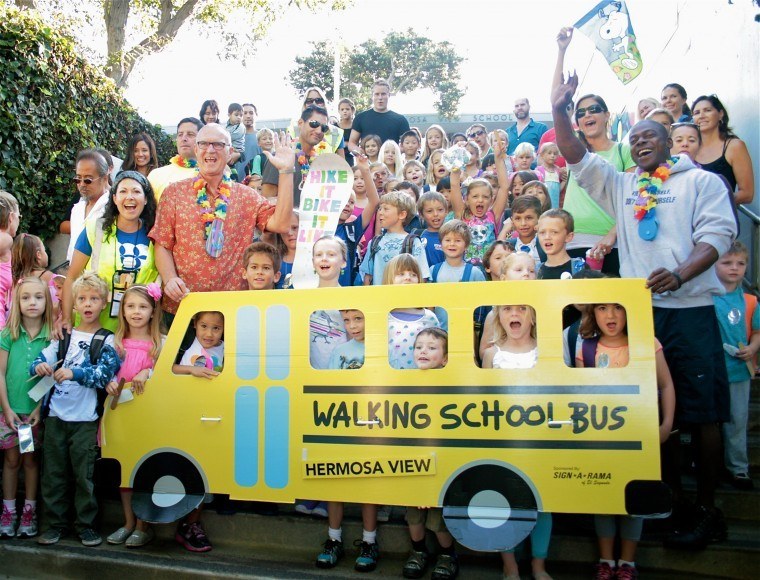
Walk and bike to school activities can also be a way to engage residents who don't have children, in supporting "bike buses" and "walking school buses."
But if kids aren't neighborhood residents, they aren't going to be walking or biking.

Bike bus at Rose Park Elementary.  Note that during Bike Month (last month, I didn't get around to writing about it), a parent on the city's west side organized a "bike bus" for her neighborhood school ("Salt Lake woman organizing ‘bike bus’ method as new transportation for school kids,"  Fox13, "Salt Lake woman organizing ‘bike bus’ method as new transportation for school kids," Utah Public Radio).

Mayor Erin Mendenhall joined them!

Labels: , , , ,

Wednesday, July 29, 2020

Side connection (easement) to Dilworth Elementary School and Park from Westminster Avenue, Salt Lake City

Side connection (easement) to Dilworth Elementary School and Park from Westminster Avenue

Dilworth Elementary School is located on a major street in Salt Lake City.  In my writings about "safe routes to schools," I do suggest that schools be located on major streets, to better accommodate transportation demand, rather than overtaxing neighborhood streets with school drop off and pick up traffic.

But main streets with lots of traffic can also be difficult places for pedestrians (although not in this particular instance).  Still, traffic is traffic, and the more traffic there is, the less willing people are to walk and bike.

I also recommend "school transportation demand management plans," but rarely are they developed.

-- "International Walk and Bike to School Day: Wednesday October 2nd, 2019," 2019

When I did a bike and pedestrian plan in 2010, the state Safe Routes to School coordinator suggested a way to improve connections to schools so that children wouldn't have to walk the long way around to access their school from their neighborhood was to buy strategically placed houses, install a sidewalk and incorporate an easement for it, and then put the house back on the market.

The auto industry has promoted drive to school for almost 100 years.
Drive children to school ad, Chevrolet, Saturday Evening Post, March 3, 1923
Drive children to school ad, Chevrolet, Saturday Evening Post Magazine, March 3, 1923.

I don't know if that's exactly what happened here, but it's an example of the concept.  (The school site was once exclusively a park, and many of the park functions remain, so it's possible this side access connection has existed for some time.)

Interestingly, they've furthered the "transportation demand management" element of this access point by setting up a "no parking school zone" on both sides of the access point, presumably for school pick up and drop off without having to go out to the main street.
Side connection (easement) to Dilworth Elementary School and Park from Westminster Avenue

(Although to best work, it'd need a small layby cul-de-sac like treatment so cars could easily turn around.)

I am not a big fan of the orange colored street crossing flags that people are supposed to wave so that drivers don't hit them, when they are crossing the street.

But some of the flags here are branded as being provided by the City Council, which I think is smart, as an example of branding and identity systems.
20200729_072332


The biggest problem with walk and bike to school planning is that for the most part, there isn't planning for it.  School districts typically are only required to plan for school bus transportation.

A few school districts, like Boulder Valley School District in Colorado, have planners in the transportation office dedicated to sustainable mobility. 

So it should be no surprise that some of the BVSD elementary schools have greater than 50% participation in walking and biking to school.

That's one of my biggest takeaways on this issue, require schools to do what I call balanced transportation planning, and you'll get a lot more walking and biking to school.

It'd be best to do this as part of state-level legislation, but individual school districts wouldn't be precluded from acting on their own.

A great resource is the State of Washington DOT manual, School Walk and Bike Routes: A Guide for Planning and Improving Walk and Bike to School Options for Students. One of its points is that improvements for walking and biking to school also contribute positively to neighborhood sustainable mobility goals and objectives.

The State of Washington doesn't exactly mandate balanced transportation planning for schools, but they come closest as possible with the "carrot" approach. First, they require all K-5 schools, public and private, provide walk to school maps. Second, they recommend but do not require the creation of school district traffic safety committees, involving school, streets, and police planners, along with parents. Third, they allow school districts to spend transportation monies on non-school bus forms of transportation.

You Only Live Once traffic safety campaign
Typically SRTS programs focus on elementary schools and sometimes middle schools, while high schools are not addressed.

Yet the number of adolescent injuries and deaths related to traffic safety remain persistently high. Therefore, SRTS and traffic safety programs need to be provided to all school aged populations, including high schools.

Only a few school districts seem to create walk to school maps for middle and senior high schools.Seattle does. So does the Palo Alto School District in California, and a few others.

Montgomery County, Maryland schools has a campaign targeting teens with pedestrian-positive messaging called You Only Live Once.


Labels: , , , , , , ,

Tuesday, December 23, 2014

Updated: Another example that school bus-based transportation is increasingly unsustainable

========
A query about the number used below, of "an average of $500 per student for annual bus transportation," which was a quote from the Indianapolis Star article, led me to make a more detailed inquiry.

According to the National Center for Education Statistics, the national average cost for bus transportation for one student in one year is $871, with data from 2009-2010, which is the most recent year available.
=========


One of the problems with moving away from a neighborhood-based elementary school planning and development paradigm is that school systems become dependent on buses for transporting students to school.

This is problematic for many reasons, including health and wellness--which has triggered the "Safe Routes to School" initiative.

But it's also problematic financially, especially as local government budgets become increasingly hard pressed, as communities reach the ceiling of what they can charge for property and other taxes. According to various studies, it typically costs at least $500 per year to bus one student to and from school.

During the recession, more school districts began enforcing regulations concerning access to bus transportation--with some exceptions, most districts won't provide bus service for students living within one mile of a school--and increasing the distance from school before bus transportation would be provided.

Some school districts have imposed transportation fees, which some residents have opposed as illegal.  There is a case pending before the Indiana Supreme Court ("Fair fees? Facing cuts, more schools charge for busing," USA Today) on this issue.  Also see the Indianapolis Star piece, "Indiana Supreme Court to hear case on school bus fees."

Missed in the discussion is how school systems developed on the sprawl land use paradigm end up being financially crushed by the financial implication--dependent on school buses, diesel gasoline, and drivers.

Buses need to be replaced at the end of their useful life, energy costs continually increase (with a current respite), and it becomes increasingly difficult for school systems to recruit and retain enough bus drivers, given the split shifts and difficulties inherent in the work.

Labels: , , , ,




