Greater New York Avenue Gateway revitalization organization (and the loss of industrially-zoned lands)
Received email from a new organization spearheading revitalization for New York Avenue in the Northeast quadrant of DC.
-- Greater New York Avenue Gateway Group
with an upcoming meeting on Thursday January 29th.
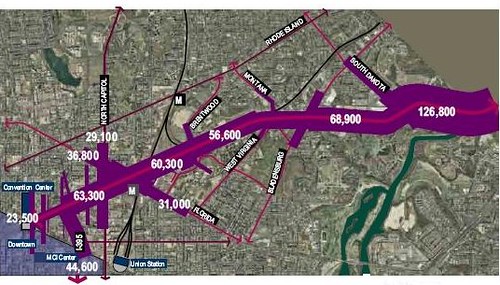 Traffic volumes on New York Avenue, circa 2000.
Generally, the corridor has been marked by the reality of its serving as a traffic-engorged entry in and out of the city, serving as a connection between the Baltimore-Washington Parkway, I-95, and Rte. 50 and I-395 in DC and Virginia.
That makes it pretty grim. Plus it's bracketed by train tracks and a major train yard on the north side. A Costco opened in the corridor a few years ago and does very well, but while satisfying consumer demands, doesn't make the corridor look any better.
In general, the New York Avenue corridor doesn't offer much in the way of high quality placemaking or entryway characteristics.
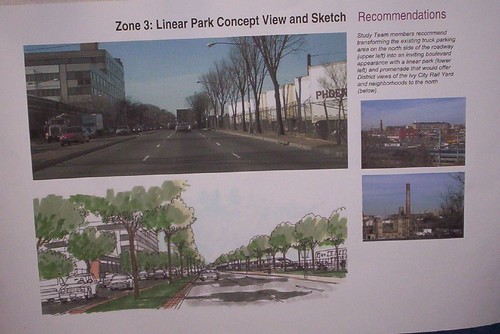
The city did a plan in the early part of the last decade that had some great ideas, and addressed the entirety of the corridor from the DC-Maryland line to where it joins I-395 around 3rd Street NW.
After this there was an attempt by Abdo Development to develop a big section of it, between Montana Avenue and Bladensburg Road, but that fell through after the 2008 real estate crash. Another plan for that section was for a Walmart-anchored shopping center, which also fell through.
Since then, the prominent local real estate development firm, Douglas Development, has made a big investment in buying the historically designated art deco Hecht's Warehouse and a lot of the adjoining properties, including the 17-acre section once controlled by Abdo Development. I don't know the exact amount, but it must be in excess of 50 acres.

-- Hecht Warehouse District, Douglas Development Company
-- Washington Business Journal article
I think they are somewhat "crazy" a/k/a "ahead of the market," because the area is somewhat of a no person's land, distant from quality transit and definitely not particularly "walkable" and automobile-dependent. That will change as more of the area gets repatterned.

And as residential development and activity increases, an idea I once saw as crazy, adding an infill MARC railroad station at Bladensburg Road ("McDuffie suggests a Bladensburg Rd MARC or Metro station," BeyondDC), starts to make sense. Especially if it were possible to provide a type of transit service using Diesel Motive Units, something Boston is pursuing for one of its city-serving lines ("MBTA to purchase new trains, open new Blue Hill station," Boston Globe). This would allow for more frequent service, treating the railroad line as a kind of more frequent subway line, providing a type of fixed rail transit service that the corridor doesn't enjoy now.
A MOM Organic Market opened in November 2014 and despite my questioning the likelihood of success ("Sometimes a bad idea is just so obvious: MOM organic grocery on New York Avenue NE") allegedly it is already one of their highest-performing stores.
Other retailers and restaurants are announcing plans to open there. Although my understanding is that retailers are getting sweetheart deals, which makes sense, because the retailers are taking big risks by locating there now, when the base of immediately located customers is low and most people will have to drop to shop there.
2. Interestingly, I would argue these plans are somewhat counter to the recently produced Ward 5 Industrial Land Transformation Study, which recommended that industrially zoned land in the ward be preserved to support provision of space for "production, distribution, and repair" businesses, as well as the development of the creative economy by providing access to flexible spaces and artisanal production of food and beverages, as well jobs preservation and development.
These projects subtract 5% to 10% of the ward's industrially-zoned land in one fell swoop.
Labels: commercial district revitalization planning, gateways-entryways, industrial lands, neighborhood revitalization, real estate development, transit service, zoning
posted by Richard Layman @ 5:35 AM&Permanent Link
Follow this blog
8 comments







