Rebuilding Place in the Urban Space

"A community’s physical form, rather than its land uses, is its most intrinsic and enduring characteristic." [Katz, EPA] This blog focuses on place and placemaking and all that makes it work--historic preservation, urban design, transportation, asset-based community development, arts & cultural development, commercial district revitalization, tourism & destination development, and quality of life advocacy--along with doses of civic engagement and good governance watchdogging.

Wednesday, December 14, 2011

The Gunbelt in DC...

I mentioned recently the book The Rise of the Gunbelt: The Military Remapping of Industrial America, published in 1991, in the context of economic comparisons of Montgomery County, Maryland to Fairfax County, Virginia, in the blog entry, "Montgomery County's real economic development problem: it's not part of the military economy."

While both counties are dependent on the federal government for their economic success, I credited the greater proportion of military-related economic activity in Fairfax County as a reason for the difference between the two. In fact, Virginia is heavily dependent on military spending, and if the U.S. does in fact reduce military spending, this could have a disproportionate impact across the State of Virginia, from military installations across the state, to the contractors clustered in Northern Virginia.

Interestingly, DC is staking the future of the redevelopment of the St. Elizabeth's Hospital east campus, around the "innovation economy" surrounding "homeland security."

See "St. Elizabeths: Deal close for Microsoft innovation center at St. E`s" from the Washington Business Journal and this presentation from the DC Deputy Mayor's Office for Planning and Economic Development, SAINT ELIZABETHS REDEVELOPMENT INITIATIVE: “The Chesapeake Crescent Region: The Emerging National Leader in Security Innovation”.

Slide from presentation about the redevelopment of St. Elizabeths East Campus, Washington DC

The WBJ article mentions that Microsoft may open a research center at the campus, and the city is trying to get General Dynamics to locate some of its functions there as well. Another recent WBJ article, "Northrop Grumman looked close at St. Elizabeths," mentioned a previous proposal to give the campus to Northrup-Grumman, when they were planning their headquarters move from California to the DC region.

I suppose when the most consistent source of federal spending, other than on social security and medicare, is the military, it makes sense for DC to try to get in on the action. But, it's still somewhat troubling.

Also see these past blog entries:

Labels: , ,

Sunday, September 04, 2011

Chicago examples that small/craft industry is still relevant to urban policy and employment

Two articles in the Chicago Sun-Times, "Alternative energy companies grow jobs, presence in Chicago area," and "Technology replaces brawn in Ravenswood corridor," discuss the presence of small industry in Chicago.

The first article is about small scale alternative energy industry in Illinois, not battery production for large scale car manufacturing but various energy saving technologies, such as geothermal power, and is drawn from this report, Clean Energy Supply Chain Reports: Wind, Solar & Geothermal (Illinois), released by the Environmental Law and Policy Center.

Chicago proper has about 5/12 of the region's wind, solar and geothermal technology companies, 86 companies, employing about 2,500 people.

The second article discusses how Chicago's Ravenswood industrial corridor is repositioning to support smaller, what we might call "craft" industrial operations, comparable to what I described is happening in the Central Eastside Industrial District in Portland. From the article:

The Ravenswood corridor has evolved into an informal technology incubator, as web-development startups sit side-by-side with fast-growing, established companies such as Guaranteed Rate, dubbed the Google of the mortgage industry, and NogginLabs, a custom-learning software developer.
The former industrial corridor, running along North Ravenswood, from Wellington to Peterson, sports redeveloped commercial space designed for entrepreneurs and companies whose work cultures require large, open loft spaces.

Joe Hayes, whose Hayes Properties is headquartered in the former Manz printing company building at 4043 N. Ravenswood, owns 750,000 square feet of commercial space in the corridor.

“No one had converted these industrial buildings to work for small, modern companies,” said Hayes, whose firm has reroofed, sandblasted and reconfigured the clock-towered warehouse-like plants into high-ceilinged, sunlit-filled, exposed-brick-walled and hardwood-floored lofts.

Technology-based companies occupy about one-third of Hayes’ holdings and employ about 450 people, based on average employees per square foot.


What would be useful is to have comparable data to that of Portland on the number of businesses and jobs in the corridor.

Labels: , , , , ,

Saturday, September 03, 2011

Industrial policy, manufacturing, and industrially zoned land are different issues

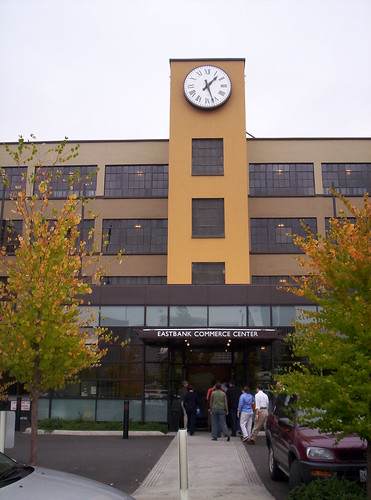
East Bank Commerce Center

Market Urbanism has a post on the failure of an electric battery company as an example of failed "industrial policy" and then goes on to discuss manufacturing in cities and industrially-zoned land in the same entry. See "Obama’s sprawl-promoting industrial policy: electric cars."

(I'd have probably just written a comment there but for some reason my Flash or other program isn't functioning and I can't write comments on my own blog and others depending on what commenting programs they use, like disqus).

The three separate issues are mixed up and conflated in the post which makes the discussion unuseful or noncontributing. (A fourth issue is a different kind of "industrial policy," supporting craft manufacturing at the local level.)

Plus, the electric battery thing yes is an example of supporting sprawl. Obviously. It's nothing new and nothing surprising. E.g., it reminds me of a post I wrote in 2005 about a different industrial policy supporting hydrogen energy for cars. I titled the post "Asphalt Nation: Next generation." Electric cars are merely Next Generation Asphalt Nation 3.0.

1. We can agree to disagree about industrial policy. Industrial policy, that is, supporting manufacturing and business development as part of national economic development, isn't a bad thing necessarily. Where it gets confusing is in the support of specific types of businesses and specific businesses vs. general support of industrial activity.

Support of new business is risky even in the best of circumstances. But I agree with Market Urbanism that when entrepreneurialism and the ability to get money is more about "who you know" (political entrepreneurialism) than the value of your ideas and technologies, that's a real problem. And note, speaking of political entrepreneurialism apparently this is a big problem with Gov. Rick Perry's "state industrial policy" in Texas, where the well-connected benefit disproportionately from such programs.

There are all kinds of f*ed up industrial policies now, ranging from agricultural subsidies to special oil depletion subsidies for oil companies, special tax treatment for ethanol production, which comes at the expense of higher food prices, that weird tax deduction paper manufacturers get for using a production byproduct that they use for fuel anyway as some sort of sustainable energy, to the mortgage interest tax deduction on houses, which drives both sprawl and the housing industry, to the special tax treatment of earnings by hedge funds, which supports the "industry" of "financial engineering." Battery manufacturing is just one more thing.

1b. Distinguishing between supporting specific companies and more general industrial policy

But I was really struck by something that I read in an interview with Alan Mullaly, the Chairman of Ford Motor ("Ford CEO sees good outlook for U.S., hot prospects abroad" from USA Today)

Q: You say this is a real manufacturing story. A lot of people worry, with India and China growing the way they are, what does the U.S. manufacture? Do you have any ideas in terms of creating new jobs in this country, not just for the auto sector, but throughout manufacturing?

A: We have to make manufacturing a priority. Seventy percent of all the research and development investment in the U.S. is associated with manufacturing. It's the foundation of everything associated with the economy. Everything needs to be looked at through that lens. How do we create an environment that allows manufacturing and business to grow? Our tax policies, our trade policies, our education policies, everything that we do needs to be looked at through the lens of competitive manufacturing worldwide, competing with the best in the world, and growing our economy.


This point, about treating manufacturing right in terms of tax, trade, and education policies really matters, because even at a reduced rate, manufacturing does matter in terms of economic competitiveness, balance of payments, and employment.

2. Anyway, then comes up in the entry the issue of manufacturing in cities. This isn't the issue that it appears.

Most large manufacturing no longer occurs in major cities and there is no campaign that I am aware of that is trying to change that.

Not that communities don't continue to recruit manufacturers interested in locating in the U.S. and/or expanding operations. It's just that the manufacturing companies, at least large operations, no longer construct comparatively compact multi-story buildings for their operations.

Instead, they tend to create large sprawling one story facilities over many acres. Therefore, they tend to locate on large pieces of land that aren't typically present in urban cores, even if for whatever reason the land happens to be located in the city, technically.

For example, in Chattanooga, which because it is a large enough city, had a large parcel of land (a former ammunition manufacturing complex) which they have been able to use for an industrial park for a VW plant ("Looking for public industrial park space in Chattanooga") and they have been fortunate in that Alstom is expanding operations that already exist on the waterfront.

But these aren't the kind of old time multi-story manufacturing buildings near waterfronts and in city industrial neighborhoods, cheek by jowl with neighborhoods and served by streetcars. That kind of manufacturing doesn't really exist anymore. (Although the Alstom plant is on the waterfront in Chattanooga, but not within a neighborhood, and not immediately proximate to downtown.)

3. The issue of maintaining some land as "industrial zoned" is another issue entirely.

The issue isn't preserving this kind of land for "manufacturing", especially for "large plants" or for "industrial policy political entrepreneurial operations" as much as it is for supporting what economic planners call PDR uses.

PDR stands for production, distribution, and repair and includes warehouses, auto repair, bus garages for transit authorities, and yes, manufacturing.

The Market Urbanism entry asks to look at the DC industrial lands study. But that is a function of the writer's own willingness to find and read the report. There are dozens of such reports on cities at this link, including DC's study.


I happened to be really impacted by a presentation I saw on this topic by the San Francisco Dept. of Planning at the American Planning Association meeting in DC in 2005. Of course, New York City has similar issues with regard to Brooklyn, and even the Garment District in Manhattan (see "Looking to the fashion district’s future" from Crains New York Business and this webpage on the Garment District issue from the Municipal Arts Society and "Long Live the Industrial City" from Wilson Quarterly). Baltimore did a similar study etc.

The point that the San Franciscans made, and this is an issue in DC to some extent, is that because SF has limited ways into the city that are significantly constrained (bridges especially), displacing PDR uses to East Bay like Oakland would increase traffic congestion, not to mention the employment and other impacts.

DC has less than 3 square miles of industrially zoned land.

Another problem, which DC refuses to deal with, is that the zoning regulation allows for schools and churches as matter of right use in this land category. Because these types of institutions can pay for land at prices higher than the economically viable use of operating businesses, plus they don't have to pay property taxes, PDR uses get outbid and displaced.

(I filed a proposed amendment to the Comp. Plan in 2009 to address this, but it was rejected.)

4. In terms of the "P" or production side of PDR for craft-based businesses, Portland has modified its zoning classification of industrial land to limit non-commercial users from using industrial zoned land in the "Central Eastside Industrial District). (Their report is in the above list. I happened to tour this area at the National Trust for Historic Preservation national conference in 2005) And it is focused on preserving this kind of use in order to support the development of artisan businesses, such as software, furniture, and clothing manufacturers, albeit in smaller quantities.

This is the basis of "creative" industrial production of usable goods, usually smaller production runs.

Portland's Central Eastside Industrial District comprises 681 acres. There are 1,122 businesses and 17,000 jobs there, about 25 jobs/acre.

The Portland example demonstrates how having this kind of industrially zoned land--which in DC is in danger of being fully converted to housing, churches, and schools--is important to the local economy, which in DC ought not to be comprised exclusively of government agencies, trade associations and law firms, if you want the "local" economy to be resilient and able to face change.

----
The issue of the right kinds of economic, financial, tax, land use and other policies to support this kind of business development and maintenance is deserving of consideration in its own right, and not being linked to other issues, like automobility and automobile electrification.

Labels: , , , , ,

Sunday, April 17, 2011

The USA as a gasoline monoculture

Oil Prices
AP photo by Seth Wenig. Gas prices are displayed in Wantagh, N.Y. , Tuesday, April 12, 2011. Gasoline pump prices continue to set new records for this time of year. The national average for a gallon of regular rose 2 cents on Tuesday to $3.79, according to AAA, Wright Express and Oil Price Information Service.

According to the AP article, "Newport, RI offers gas rebate to draw tourists," the Preservation Society of Newport County is offering a $5 rebate on gasoline, for people who buy two tickets ($14.50 to $31.50 each for adults) or a membership, and visit various sites in Providence, Rhode Island.

The fear of rising gasoline prices impacting the economy is shown elsewhere. According to "Rising price of gasoline sparks concern" from the Las Vegas Review-Journal:

Gasoline prices are soaring toward $4 a gallon, a threshold that some analysts say will damage the fragile economic recovery, maybe even in Las Vegas. Higher prices saddle businesses with higher transportation costs that they must swallow or pass along to already strapped customers. As gasoline costs rise, consumers are left with less money to spend elsewhere. And there is evidence that the hike at the pump is beginning to push drivers off the road.

The biggest danger to the local economy would come from Southern California, which has consistently been the home of one-fourth of the visitors, according to annual surveys by the Las Vegas Convention and Visitors Authority. California's average price per gallon for regular gasoline was $4.191 Friday, AAA said in its Daily Fuel Gauge Report.


What is obvious is that the kind of monocultural economy that we have, based on gasoline, is unsustainable and vulnerable to price increases not to mention availability.

So many of the "controversies" we have in planning really come down to building a land use and transportation paradigm that is resilient, one that is less dependent on external inputs.

So the kinds of issues we have with transportation and resource planning right now such as:

• "drill baby drill"
• forces across many states opposed to the development of high speed railroad passenger transportation (what happens when aviation gas spikes up price rise, long term)
• highway and transportation officials who want to build more roads for more cars but not "complete streets" that equally serve pedestrians and bicyclists (as well as transit riders)

are all different pieces of the same unwillingness to build a society and economy that is resilient and robust as opposed to one that is completely dependent on parameters concerning the access to and demand for oil never changing.

As people and as a nation, we are incredible vulnerable--socially, culturally, politically, and economically--as a result.

----

Monoculture is a term from agriculture, but more generally it is a term describing systems with limited diversity. Certainly, the Irish potato famine is an event from history that demonstrates reliance on one particular food crop can leave a community vulnerable if it fails. (This by the way is a big concern with regard to colony collapse disorder and bees, as bees are essential to the pollination/fertilization of plants, especially vegetables and fruits.)

In economic development, enclave development refers to a similar phenomenon, such as a country that makes most of its income from say copper mining or oil production, and how those operations typically are constructed and operated in a fashion whereby they contribute little to the further development of the local economy.

I use the term from time to time in discussing certain kinds of urban development, such as in this post, "Office Ghettos aren't quality economic development" from 2005, and "Enclave development won't "save" Anacostia" and "Speaking of enclave development (Washington Convention Center)," from 2006.

Labels: , ,