-- "
St. Louis: what would I recommend for a comprehensive revitalization program? | Part 1: Overview and Theoretical Foundations"
-- "
St. Louis: what would I recommend for a comprehensive revitalization program? | Part 2: Implementation Approach and Levers"
Forgot that I had most of this written, but was trying to read the ABCD report Leading by Stepping Back: A Guide for City Officials on Building Neighborhood Capacity, on creating ground up civic engagement programs in Savannah, Georgia, before publishing..
This post was spurred as a response to an article in the
Washington Post about Tishaura Jones, the recently elected progressive left St. Louis mayor, and thinking about what I would try to do were I in her shoes.
The first piece, published on August 2nd, suggested creating a program built on foundational points:
- Transformational Projects Action Planning
- Social Urbanism
- Poverty Reduction through equity planning, social infrastructure creation, and a focus on community economic development
- Civic Engagement
The second piece, this one, outlines a more specific program.
Implementation approaches and levers
1. City and county consolidation would reposition the city-county as the tenth largest city in the US, changing the conversation and focus away from St. Louis' constant population loss. (Other cities like Baltimore City and County, Detroit and Wayne County, and Pittsburgh and Allegheny County need to do this too.)
This would provide a consolidated and bigger tax base.
Although this will be extremely difficult to pull off, because St. Louis city is seen as an economic laggard along with race issues, among others (e.g., "CLAIMING IT WOULD “DIVIDE US”, STENGER OPPOSES NORTH-SOUTH RAIL TRANSIT," NextStL).
Successful consolidations in Louisville and Lexington, even Indianapolis are models that can be referenced.
Another problem is the politics of city and county. It could be that the county electorate which is larger than the city, is more conservative, and a city-county consolidation could merely be another way to oppress the city. Both Toronto, with Rob Ford, and London, with Boris Johnson, have had this occur in the recent past. (Plus, the County Council has 7 members, while the City Council has 28!)
The Next American City by Mick Cornett, former mayor of Oklahoma City, describes the Metropolitan Area Projects program.
[2. Some of the smaller communities in St. Louis County should consolidate into the city, like how there is an initiative in Wilkinsburg borough in Allegheny County to merge with Pittsburgh ("Wilkinsburg group seeking merger with Pittsburgh delays action," Pittsburgh Tribune-Review) although this wouldn't be an issue for the Mayor of St. Louis to pursue, but to support.]
3. Create a master community economic development plan incorporating the relevant initiatives cited below. Some measures were identified in the plan developed by Rollin Stanley (The future of shrinking cities: problems, patterns, and strategies of urban transformations in a global context, starting on page 127 (better formatted pdf version).
In the early 2000s, I came across an urban revitalization approach outlined in the Black Commentator website, called "Wanted: A Plan for Cities to Save Themselves," which was a more community-based approach counter to typical neoliberal approaches. It's been a long time since I've read it, but it would be a good document to start with.
--
Part 2 of this series. --
Part 3 of this series. --
Part 4 of this series. --
Part 5 of this series.
From the article:
The fact of the matter is, Black Americans defending and criticizing Ice Cube both have valid concerns. Neither major political party is working for Black Americans economically. The Black-white wealth gap is alarming, with white households holding 11.5 times more wealth than Black ones, and the gap continues to widen. Black homeownership is at a record low. More Black people are being imprisoned than in the 1960s. And both parties have contributed to these policy failures while letting big business off the hook for practices that exploit and harm our communities. This includes encouraging manufacturing jobs to leave for cheaper, deunionized labor in sectors that were disproportionately occupied by Black men; failing to adequately regulate big banks who profited from subprime mortgages targeted to Black communities; failing to assist Black Americans when the economy crashed on their backs; and enabling corporations to make astronomical profits off the disproportionately Black and Latino workers working in essential jobs during Covid.
Although, St. Louis city is about 45% black and 45% white, while St. Louis County is 68% white and 28% black. Still, these kinds of proposals need to be considered in the context of communities where clearly the ordinary ways of approaching community improvement aren't working.
4. (Re)Branding and identity. There are many ways to think about the city's brand and identity. This article, "How Treating Cities as Products Creates Real Change," points out that you don't "create" identity so much as burnish it, as a city's identity has been created by the sum total of its exchange. From the article:
City branding isn’t about inventing something new, it’s about discovering what’s already in the city. Cities are made of the ideas and the people that sculpt its identity and vibrancy. The brand of a city are the attributes that distinguish one place from another, placing a unique value and transforming the city from a location into a destination. An effective city brand strategy has to accommodate all of the stakeholders’ demands, from investors to officials to residents, in order to strengthen the city’s overall competitiveness. All in all, city branding is an emerging agent for urban socioeconomic development. A number of cities are already involved in creating a new brand or regenerating their existing one in aim to revitalize, secure, and make the city a more prominent place on the map.
Logo for the Lambert International Airport.5. Organize a St. Louis City and County Metropolitan Area Projects program. To implement a transformational projects action plan, a program on the scale of the Oklahoma City Metropolitan Area Projects should be developed.
Besides OKC, which although a city is as large as many counties, Hennepin County, Minnesota and Minneapolis is a pre-eminent model too. Consolidation would be great for tax harmonization and greater revenues
Money and program. If the city and county were economically intertwined, the county would be motivated, like Hennepin County was in the 1980s, faced with property tax revenue decline from a shrinking Minneapolis, to engage in a program of focused investment on infrastructure and quality of life improvements.
--"A County and Its Cities: the Impact of Hennepin Community Works," Journal of Urban Affairs 30:3, 2008
And like Oklahoma City's Metropolitan Area Projects program, they could use a sales tax add on (and other sources) to fund programs ("Change isn't usually that simple: The repatterning of Oklahoma City's Downtown Streetscape).
The City and County have passed various sales tax add ons to fund various projects, such as Proposition P in 2013, for parks and trails, for transit, and for economic development in 2017, among others.
This should be done at two scales: (1) at the city-county scale and (2) the neighborhood scale within St. Louis.
At the same time, based on the findings in Ferguson ("How municipalities in St. Louis County, Mo., profit from poverty," Washington Post) and knowing that there are other similarly positioned communities within St. Louis County, a similar revitalization program needs to be developed for St. Louis County, using the same approach.
Creating Knowledge Locations in Cities, full text pdf
6. Seed an innovation district to foster broad scale startup support and business development. Which is already happening ("A Core Commitment: What’s Next for the Downtown St. Louis Innovation District," EQ).
-- "Naturally occurring innovation districts | Technology districts and the tech sector"
-- "Developing creative quarters in cities: policy lessons from 'Art and design city' Arabianranta, Helsinki," Urban Research & Practice 6(2):211-218, 2013
-- "Helsinki as an example of creative industries driving urban revitalization programs"
Kansas City on the other side of the state, aims to develop around agrosciences and technology and biotechnology ("THE KC ANIMAL HEALTH CORRIDOR: LEADING THE WORLD IN ANIMAL HEALTH"). Certainly St. Louis has strengths of its own?
7. For St. Louis (and suburbs as needed but that isn't the job of the Mayor of St. Louis), Neighborhood and commercial district revitalization.
Residential. Although not every neighborhood can be revitalized, at least not all at once, neighborhood plans need to be created to outline a focused program for new investments should be developed, using the Elm Street approach for residential improvements, at first focusing on those areas that have the greatest potential velocity for improvement:
-- "The need for a "national" neighborhood stabilization program comparable to the Main Street program for commercial districts: Part I (Overall)"
-- "To be successful, local neighborhood stabilization programs need a packaged set of robust remedies: Part 2"
-- "Creating 'community safety partnership neighborhood management programs as a management and mitigation strategy for public nuisance programs: Part 3 (like homeless shelters)"
-- "A case in Gloucester, Massachusetts as an illustration of the need for systematic neighborhood monitoring and stabilization initiatives: Part 4 (the Curcuru Family)"
-- "Local neighborhood stabilization programs: Part 5 | Adding energy conservation programs, with the PUSH Buffalo Green Development Zone as a model"
And there needs to be a residential recruitment program, along the lines of
Live Baltimore, which along with the Healthy Neighborhoods program which invests in neighborhood improvements, helps to attract new residents to the city.
Commercial districts using the Main Street approach, focused on retention of historic buildings and the support and/or development of independent businesses:
-- "Basic planning building blocks for urban commercial district revitalization programs that most cities haven't packaged: Part 1 | The first six"
-- "Basic planning building blocks for urban commercial district revitalization programs that most cities haven't packaged: Part 2 | A neighborhood identity and marketing toolkit (kit of parts)"
-- "Basic planning building blocks for urban commercial district revitalization programs that most cities haven't packaged: Part 3 | The overarching approach, destination development/branding and identity, layering and daypart planning"
-- "Basic planning building blocks for "community" revitalization programs that most cities haven't packaged: Part 4 | Place evaluation tools"
Also see "The soft side of commercial district revitalization" (2006). There is an existing Main Street initiative in the Dutchtown neighborhood of St. Louis.
(Oakland County Michigan utilizes the Main Street model to work with communities across the county for commercial district revitalization. St. Louis County has a Great Streets program as part of the MPO. The Delaware Valley Regional Planning Commission had a program called Classic Towns that focused on suburban towns. The Northeast Ohio First Suburbs Consortium focuses on inner ring suburban revitalization.)
Along with urban design and placemaking improvements:
-- ("Walkable community planning versus pedestrian planning"
-- "Five examples of the failure to do parks and public space master planning in DC"
-- "Extending the "Signature Streets" concept to "Signature Streets and Spaces""
-- "Diversity Plaza, Queens, a pedestrian exclusive block"
Programs like Walk Boston, Walk Denver, Feet First in Seattle, and Starkville in Motion (Mississippi) are great examples of "walkable community planning" even though they wouldn't call it that--it's about using walking and biking as a way to better connect people to their communities while improving the quality of life in those places.
And Safe Routes to Schools program support urban design improvements that go beyond school children (School Walk and Bike Routes: A Guide for Planning and Improving Walk and Bike to School Options for Students, State of Washington DOT).
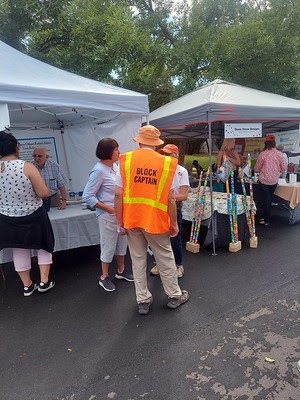
Festivals, house tours and special events. Communities should be supported with funding for the development and operation of community building events such as festivals, farmers markets ("
The layering effect: how the building blocks of an integrated public realm set the stage for community building and Silver Spring, Maryland as an example," 2012), community walking and bike tours, historic preservation house tours, cultural events like studio tours, arts walks, and coordinated "Open Doors" program ("
DC should create an annual city-wide Doors Open event," 2019).
Neighborhood elements within city-wide marketing and wayfinding systems. As part of overarching branding and identity systems, cities should be sure to include neighborhoods as an element within the system, and provide support for wayfinding signage, banner programs, bus shelter communication systems, community information kiosks, cultural and historic markers, residential and commercial district brochures, etc.
Tax increment financing as a funding source. An example of an opportunity for additional funding for neighborhood development would be the Minneapolis Neighborhood Revitalization Program, a 25 year long initiative, where tax increment financing bonds were sold to fund neighborhood improvements as developed by residents through consensus-based planning, working with the schools, parks, and other city and county agencies.
Although I would say that because so many of the districts are distressed, emerging, and at best early transitioning, 25 years isn't long enough, probably TIF as a funding stream needs to be a 40 year period.
8.
Entrepreneurship and Microenterprise development. The biggest reason why neighborhoods and their commercial districts are failing is that at the micro scale, their economies are failing.
Key points in Temali's book are developing the community workforce, creating good neighborhood-based jobs and microenterprise development as a way to create jobs.
A couple decades ago I read a paper on business plan contests, which said you need scale to succeed.
As part of entrepreneurship and microenterprise development, have an annual business plan competition, with technical assistance to the participants, with winners getting resources to open their businesses, including in the various neighborhood commercial districts.
Also see "Why ask why? Because" (2007) which discusses subsystems of retail business operation, "Independent retail business can succeed and thrive" (2008) about systematic approaches to business identity, and "Retail and Restaurant Check Up Surveys" (2009).
Also see the Baltimore Sun article, "Healthy Howard Row: 5 new Black-owned businesses take root on a single Baltimore block," about the development of a row of black-owned businesses on Howard Street. Coherent concentration of businesses is important for success.
Do this for other types of startups too. And for community investment and participation in local real estate development, such as that being piloted in Allentown ("Lesson from CNN story on Allentown, Pennsylvania").
More innovative forms of business organization (business cooperatives, social enterprise businesses run by nonprofits, market spaces as entrepreneurship spaces, etc.) may need to be created in order to seed success in neighborhoods with broken micro-economies ("In lower income neighborhoods, are businesses supposed to be "community organizations" first?," 2012, "Ground up commercial revitalization and the Skyland Town Center project" 2016).
An interesting approach is offered by the Maryland-based real estate development firm Structures Unlimited. In Cleveland, named the Madame C.J. Walker Center, they're creating a "community hub" with a credit union as the anchor, and adding a small grocery store and space for neighborhood shops ("New business center coming to Cleveland's Hough neighborhood," WKYC-TV) in a 16,000 s.f. building.
I think a business development space, like the shared workspaces of places like WeWork, but on a nonprofit basis, with partnerships with business development programming (banks, SCORE business consulting from the Small Business Administration, local universities, city, county and state economic development organizations, etc.) ought to be created as part of these initiatives. Paired with financing assistance.
Fortunately, the Metrolink system is in a rebranding process.
9. Transit, urban design, and sustainable mobility/Transit as economic development. St. Louis has an east-west light rail line that serves St. Louis, St. Louis County, and East Saint Louis and St. Clair County, Illinois.
In a full-blown revitalization program for the city and county, transit expansion should be prioritized.
As an example, light rail has been key to the revitalization of Minneapolis-St. Paul, although those cities are not consolidated with their respective counties.
Hennepin County used light rail as a key element of its economic revitalization planning, and Minnesota has tax harmonization measures in place which provide some of the benefits from city-county consolidation in other places.
But it needs to be a network rather than a couple lines, especially in St. Louis City in order to draw renewed business and residential interest. There are various expansion studies, in particular a North-South line adding stations within the city, but mostly north and south of the city in the County.
It's being looked at currently ("St. Louis plans to take hard look at north-south light-rail line," Railway Track & Structures), while 5 years ago, the County Executive was not favorable.
A big focus of such a program should be providing fixed rail transit service to more parts of St. Louis city, as a way to foster revitalization, development intensity, and recruitment of new residents, the way that in DC, the Metrorail system has worked in the core of the city.
A transit expansion program should also be accompanied by "smart city" initiatives incorporated by Kansas City in its streetcar program, including sensor networks, wifi service, and smart kiosks (Smart City Emerging Technology Initiative, "New Smart City links: Data ‘chatter’ in streetcar corridor creates connections," Kansas City Business Journal).
Image: St. Louis Business Journal.
With regard to sustainable mobility and urban design, St. Louis has a number of initiatives already, such as Design Downtown St. Louis, a St. Louis Great Streets program for the Metropolitan area, etc.
The most important thing is to integrate and coordinate the various transit initiatives into one integrated master plan.
10.
Schools revitalization. The second phase of the OKC MAP program was
MAPS4Kids. OKC is served by 20+ school districts, but the core of the city is in one district, which had been underfunded for decades and the schools were in bad shape.
The "bad schools" in the core of the city hurt the city's image and ability to recruit new business and residents. They decided to use the second iteration of the MAPS program to rebuild schools in the core--70% of the funding went to the core school district, and 30% to the other school districts serving the city. The total funding was $700 million.
This helped stabilize the core school district, and led to spillover improvements and economic development in the neighborhoods served by the schools. But a failure of the program was to focus on bricks and mortar improvements, and not programmatic transformation ("Maps for Kids wraps up," Daily Oklahoman). Academic improvement has lagged physical improvement.
A St. Louis City MAP4Kids program could be a way to position school improvement, combining physical improvements to schools with programmatic improvements.
While there have been many failures in urban school reform, there are a number of positive examples also ("Surprising gains in 5 school districts you’ve never heard of, plus Chicago," Washington Post), usually involving the use of AP and International Baccalaureate programs for high schools, and magnet and other programs for elementary and middle schools.
Additional resources for Title I Schools, Co-operative High School (one of my ideas), Summer School, Year Round School, Pre-K 3-5, etc., should also be included in transformational programmatic improvement ("Successful school programs in low income communities"). From the Washington Post article "America’s most accelerated math program blasts through pandemic":
The Pasadena public schools, where most students are from low-income families, have had a mediocre reputation for decades. But in recent years its administrators have created strong AP and International Baccalaureate programs with high levels of participation. It has established magnet schools and dual-language immersion classes.
The "Schools as Community Center" approach should also be used, whereby schools are expanded through the co-location of other civic assets such as libraries ("Update: Neighborhood libraries as nodes in a neighborhood and city-wide network of cultural assets"), public health clinics, etc. (In DC, Briya Charter Schools have a co-location agreement with Mary's Center clinics, a couple elementary schools in Salt Lake City have public health clinics.)
-- Cincinnati Public Schools Community Learning Centers approach
Note that like with urban revitalization, which takes decades, most school reform efforts are wrecked by short terms of office of leaders and political meddling ("How clueless principals and superintendents ruin great schools," Washington Post).
11.
Public safety and criminal justice. There are a lot of different issues concerning public safety. "Defund" is more about warrior policing and mass incarceration.
At the same time, crime is still a problem and we need police to address it. Although maybe the way we're using police resources to suppress crime isn't working. For example, we need a lot more resources put into investigation so that criminals can be apprehended.
At the same time, the Defund movement is raising important issues about the appropriateness of police as first responders to many types of incidents where they might not be the right approach ("The opportunity to rearticulate public safety delivery").
St. Louis has an opportunity to re-articulate public safety in a transformational way.
Better yet would be to do this at the scale of most if not all of the proposed consolidated city-county, and create a new "metropolitan" police department, not unlike what Camden, New Jersey did ("Camden, the city that really did abolish the police," Politico), at least to "hoover up" micro police departments like Ferguson's and to completely reposition and rebuild police service delivery.
Note there's plenty going on in terms of police reform in St. Louis City and County already and I wouldn't claim to be particularly informed about it ("Protesters Descend on St. Louis, and Police Respond: ‘We’re in Control’," NYT).
-- Forward Through Ferguson
-- "In homicides, there are two cities of St. Louis," MetroSTL
CPTED, Crime Prevention Through Environmental Design, and Community Safety Partnership approaches ("Creating 'community safety partnership neighborhood management programs as a management and mitigation strategy for public nuisance programs") should be part of the approach, as part of shifting mental health homelessness response away from police.
In To Protect and Serve: How to Fix America’s Police, former police chief Norm Stamper suggests citizen involvement in policing in a direct way. I haven't yet followed up with him to see what he means exactly, but it's definitely a way to rebuild the order and trust relationship within communities and with police.
12.
Civic engagement. After finding that top-down community improvement programs weren't successful in terms of retaining and attracting residents, in the late 1980s,
Savannah began developing an approach to community improvement that complemented city improvement and nuisance abatement programs by engaging citizens as "designers of neighborhood programs and producers of community change," assisted by financing, capacity building and technical support from the city government.
It's comparable to the point Rolf Goetze makes in Building Neighborhood Confidence, that the point of government assistance in revitalization isn't to foster dependence, but to provide the spark and help to get the community back to the point where it is (re)investing in itself.
This is the reverse of how many city governments approach community improvement, and it is recommended that St. Louis adopt a civic engagement centric approach to community revitalization as part of this proposed program.
What Savannah did is described in detail in Leading by Stepping Back: A Guide for City Officials on Building Neighborhood Capacity, published in 1999.
Ward Halls/Democracy House. St. Louis has 28(!) wards and an Alderman for each. I'd argue that given the population decline, they should shrink their Council.
This has been proposed for Cleveland ("What would Cleveland look like with nine wards? Dramatically larger wards with diminished neighborhood identities," Cleveland Plain Dealer). Imposed by the Province (political payback by someone who lost election for mayor but then became prime minister of the province), Toronto went from 47 wards to 25 in 2018. Baltimore reduced the number of City Councilmembers by 3 in 2002, moving from six 3 member districts to 14 districts with one councilmember each and a Council President elected city-wide ("Too many districts? Not enough? Another bill introduced to reshape Baltimore City Council," Baltimore Sun).
In any case, in "Outline for a proposed Ward-focused (DC) Councilmember campaign platform and agenda," calling it "Democracy House," I suggested that ward offices be created (not unlike ward/precinct halls in cities "back in the day") and that as part of the function, space and resources be provided to community groups involved in ward-specific activities. Ward Democracy Houses should also include at least one annual "community organization fair" which could also serve as a volunteer recruitment event.
Funds for small projects. A fund for small projects should be created for each ward, and the
Participatory Budgeting process should be used to allocate funds ("
An update on Participatory Budgeting practice in New York City," 2018).
Savannah's "Grants for Blocks" program was aimed at micro projects, providing micro grants ($500 was the maximum, today it would be about $1,000, with inflation), supporting house and community improvements without a great deal of bureaucracy.
Each year a "Neighborhood Convention" unveiled the projects to the community.
London has a similar grants program for sustainable mobility improvements. Toronto used to have a program providing small grants to "Bicycle User Groups" to promote cycling as transportation
Citizen engaged planning practice. (These are just some examples.) What distinguished the Minneapolis Neighborhood Revitalization Program program is that it was citizen-led.
Neighborhood groups had to come together to come up with and implement a program of community improvements. The city developed a capacity building and training infrastructure to support it.
In DC, a great example is community-initiated urban design improvement planning by the Bloomingdale Civic Association in their Bloomingdale Village Center Project, which stepped in amidst the failure of the DC Office of Planning and Department of Transportation to pursue transformational planning approaches despite the hundreds of thousands of dollars spent on community planning.
In Calgary, where neighborhood recreation centers are run by community organizations, the Federation of Calgary Communities provides technical support and an extensive schedule of training classes for community groups, including having urban planners on staff to assist neighborhoods dealing with difficult problems and new development ("Community association planning committees a hidden gem?," Calgary Herald)
The Seattle Department of Neighborhoods sponsors a variety of programs where citizens undertake community projects with financial and training support from the city. Unlike DC's "constituency service" programs by Councilmembers and the Mayor's Office, these initiatives are designed to support DIY self-help efforts driven independently of elected officials. While out of date in terms of current programs, the book Neighbor Power describes the first couple decades of the program.
Models for technical assistance and capacity development
- Decades ago, there was an organization called the Nonprofit Support Center, which provided training in a number of cities, including DC.
- Dallas Public Library has an Urban Information Center with special information and publications on urban issues.
- The Massachusetts Citizen Planner Training Collaborative is a statewide training program for members of planning and zoning boards, but this concept can be extended to civic engagement more generally
- The 1970-1980s Citizen Involvement Training Project at the University of Massachusetts Amherst produced training materials and workshops (not unlike the ABCD Institute
- The Project for Public Spaces produced a workbook, now in a second edition, called How to Turn A Place Around, which they also offered as a workshop. It's a great model for urban design focused workshops for neighborhoods that can also be used as civic engagement training.
- Community Design Centers were a 1960s and 1970s initiative to provide urban design assistance to neighborhoods. Funded by HUD, and typically based at universities, many communities still are served by such programs, as well as urban design studio programs for architecture and planning schools.
- The Chicago Bungalow Association is a great example of a historic preservation initiative focused on stabilizing neighborhoods through historic preservation.
- Park Pride, the city- and county-wide park support organization in Atlanta, sponsors an annual conference for park professionals and advocates (they need to do more to get park advocates to participate), which is a great way to communicate best practices and build the knowledge-base of the park community. They also have a small grant program for friends of parks groups.
Labels: building a local economy, civic engagement, creative economy, economic development, participatory democracy and empowered participation, urban design/placemaking, urban revitalization


.png)