Rebuilding Place in the Urban Space

"A community’s physical form, rather than its land uses, is its most intrinsic and enduring characteristic." [Katz, EPA] This blog focuses on place and placemaking and all that makes it work--historic preservation, urban design, transportation, asset-based community development, arts & cultural development, commercial district revitalization, tourism & destination development, and quality of life advocacy--along with doses of civic engagement and good governance watchdogging.

Thursday, December 10, 2020

Energy and technology policy and Alexander Gerschenkron

 In college, the first upper level political science course I took was about "political development" of nations and one of the papers we read was by Alexander Gerschenkron.  

About "the economic advantages of backwardness" it made the point that new entrants to markets had an advantage in not being wedded to legacy technologies.  Instead, they could adopt the newest technology, which typically came with greater outputs and lower costs.  From "Project 2001: Significant Works in Economic History: Economic Backwardness in Historical Perspective": 

The central notion is the positive role of relative economic backwardness in inducing systematic substitution for supposed prerequisites for industrial growth. State intervention could, and did, compensate for the inadequate supplies of capital, skilled labor, entrepreneurship and technological capacity encountered in follower countries seeking to modernize. England, the locus of the Industrial Revolution, could advance with free market guidance along the lines of Adam Smith. France, beginning later, would need greater intervention to compensate for its limitations. In Germany, the key innovation would be the formation of large banks to provide access to needed capital for industrialization, even as greater Russian backwardness required a larger and more direct state compensatory role.

This is still relevant "today."  Think about electric versus gasoline fueled cars, or coal power versus natural gas, or the impact of electric vehicles on gasoline consumption, a 100 year old automaker not wanting to junk their investment in internal combustion engines, an "oil" company being reticent about investment in alternative fuels, etc.

While I think he screwed up the company in many ways, Jack Welch of GE said that he only wanted to be in sectors where GE was #1 or #2.  That's why they sold off so many businesses that had been signature to the company, like appliances or light bulbs.  Those businesses had become commoditized and GE didn't really provide any competitive advantage or unique selling proposition in those fields.

Perhaps a better example is Corning, the glass products company that became well known for making housewares.  

In 1998 they sold off that division ("Corning to Sell Housewares Unit To KKR's Borden for $583 Million," Wall Street Journal), and refocused their attention to complex glass products, such as large sheets of glass suitable for large screen televisions or smartphone screens ("Apple invests $250 million in Corning for future iPhone glass research," c/net).

... and glass vials for pharmaceutical uses.  The company is the primary producer of the glass vials needed for the mRNA based coronavirus vaccine ("Covid-19 Vaccines Could Depend on the Strength of This Vial," WSJ).

A focus on "competitive advantage" and "core competencies" is a way for firms to not be lulled by large and legacy investments in technology and manufacturing practices.  That's why Corning sold off their housewares division, or GE its light bulbs.

But it's difficult to make hard choices.  And people wedded to legacy, like Corningware, aren't usually well positioned to make such difficult decisions.

The same is true of nations.

I was reading something that said that US politics, in particular Republican politics, and how it is focusing on privileging existing investments in fossil fuels and related technologies ("Trump administration to auction oil drilling rights in all federal lands of ANWR coastal plain," KTOO-radio/NPR; "Ohio bill would ban new large solar and wind projects for up to three years," Energy News Network, "As coal taxes decline, Republicans eye renewables," Billings Gazette) hurts the long term economic competitiveness of the US vis a vis China and other countries, which are heavily investing in alternative fuels technologies.

Although there is no question that changes in technologies have massive impacts on communities reliant on particular industries for jobs and tax revenue. From the Billings Gazette article:

Citing a need to “level the playing field” on energy taxes, Montana’s majority Republican Legislature will consider raising taxes on wind and solar developments as the coal industry struggles.  
The tax increase on renewables isn’t likely to replace all of the revenue lost to coal’s decline, but it would help, said state Sen. Duane Ankney, a Republican from Colstrip, home to a large, but struggling, coal-fired power plant and coal mine. 
“I see it as a backfill for a lot of failed revenue,” Ankney said. “It’s no more than any other energy pays. It’s not a special high tax for renewables, it’s comparable to any other energy tax except for the severance tax.” 
The plan is to eliminate especially low property tax terms that were created to encourage renewable energy projects more than 15 years ago. Now two decades in, renewable energy developments aren’t new, Ankney said. There’s no need for added incentive to develop renewable energy projects in Montana. 
Tax increases on renewables were outlined in a list of Montana House Republican priorities published this fall. Included on the list was a $1 per megawatt hour tax on renewable energy, that observers say would likely make Montana renewable energy uncompetitive for sale out of state.

The advantage China has, not only in its much larger market than the United States, is that it is less wedded to older technologies, even if its political environment is still marked by a form of cronyism similar to that of "crony capitalism" in the US.

Labels: ,

Friday, February 01, 2013

The "government" and the economy

I am incredulous about the quote from Sen. John Cornyn in yesterday's Post, in the article, "Economy shrinks as federal spending cuts trump private sector’s growth," about negative economic growth in the last quarter of 2012.

But Sen. John Cornyn (Tex.), the No. 2 Republican in the Senate, called the idea that economic growth relies on government spending “a Keynesian pipe dream.” The best thing Washington can do for the economy is to rein in the deficit, GOP leaders said.

The first reality is how much of the US economy is dependent on military spending. Military contractors have been in stasis out of concern that the "fiscal cliff" will be reached triggering sequestership and large cutbacks in military spending ("Joint Chiefs warn Congress that looming defense cuts would 'hollow' military" and "Contractors not fretting as sequestration threat looms" from the Post).

The second has to do with the impact of federal policy on the financial system, and how lack of predictability and stability (way more significantly than the current level of deficit spending) and stability.

Third, droughts and storms couldn't have helped the economy that much either.

Not to mention the ongoing downsizing of local governments. People out of work don't spend money. Etc.

Anyway, how's austerity policy working out for the UK? Also see "America’s fiscal policy is not in crisis: The urgent challenge is to promote economic recovery" from the Financial Times.

From the article:

The US confronts huge challenges, at home and abroad. Its fiscal position is not one of them. This is a highly controversial statement. If one judged by the debate in Washington, one would conclude that the federal government is close to bankruptcy. This view is false. Yes, the US does confront fiscal challenges in the long term. But these are largely caused by the soaring costs of its inefficient healthcare. Yes, the US is engaged in a fierce debate on fiscal policy. But this is due to philosophical disputes over the role of the state. Yes, the US has been running large fiscal deficits in the short run. But these are a result of the financial crisis. ...

This brings us to the philosophical dispute. One side of the political debate is strongly committed to the idea that taxes should fall. Some in this camp argue that all taxation is theft. Others believe taxes destroy incentives. Yet others argue that any state support saps self-reliance. Meanwhile, those on the other side of the debate believe, as strongly, in a safety net that covers risks related to health, ageing and unemployment. President Barack Obama defended this position, to my mind persuasively, in his inaugural speech. ...

In practice, political equilibrium tends to include the commitments to spending, but not the parallel commitments to revenue. In the long run, adjustments must be made. ...

The federal government is not on the verge of bankruptcy. If anything, the tightening has been too much and too fast. The fiscal position is also not the most urgent economic challenge. It is far more important to promote recovery. The challenges in the longer term are to raise revenue while curbing the cost of health. Meanwhile, people, just calm down.

Calm? I wish.

Labels: , , , ,

Thursday, November 17, 2011

Why the US, local, and global economic future may be more perilous than we think

New Zealand Grounded Ship, container ship
In this photo released by Maritime New Zealand, the Rena, grounded on the Astrolabe reef 14 miles (22 kilometers) from Tauranga Harbour on New Zealand's North Island, is seen Thursday, Oct. 20, 2011. After a three-day break due to bad weather and rough seas, the agency Maritime New Zealand says nine salvage workers reboarded the Rena and resumed pumping oil Thursday afternoon. The ship has been stuck on the Astrolabe reef near Tauranga harbor since Oct. 5 and has spilled about 350 tons of oil into the ocean.

-- Chinese TV Host Says Regime Nearly Bankrupt from the Epoch Times

I hadn't really thought of it so much, but the Chinese expansion bubble has been driven by the same kinds of factors that led to an economic bubble in the US--overbuilding, financial engineering, cheap credit, and as a special case, manufacturing expansion driven by selling cheap stuff to North American and European markets.

As the North American and European markets continue to experience recession/depression, demand will continue to drop. Relatedly, increases in cost of energy means that a bit more manufacturing is being relocated back to the US because of rises in transportation costs cancelling some of the cost benefits from lower production costs ("Bringing Manufacturing back to the United States" from Area Development Online).

So if China can't continue to run an export driven economy based on selling stuff to overseas markets, thereby generating massive funds surpluses which have in turn been used to prop up foreign markets through loans and currency purchases, what happens then?

Labels: , , ,

Thursday, October 27, 2011

The new and most effective U.S. politics may be local

Image: Ecobags® "Think Global, Act Local" tote bag.

Brookings Institution director of the Metropolitan Studies Program and Judith Rodin, ex-president of U of Pennsylvania and now president of the Rockefeller Foundation, have an essay in Time Magazine, "Forget Washington: America's Pragmatic Caucus is Creating Jobs," about what they call the "pragmatic" caucus of Mayors and state Governors focused on improving their local economies.

The piece makes the distinction between the relatively unoperative Congress and motivated local and state politicians. Note that it's not a new argument. Governing Magazine and people affiliated with it and the "reinventing government" have made that argument for 20+ years.

Still, when public opinion poll results about confidence in government and Congress in particular are at new lows, we can take solace in that some local and state governments are proactive and focused rather than reactive, dysfunctional, and immobile.

From the article:

Across the country, the Pragmatic Caucus is engaged in economic renewal.

While it took four years for Washington to finally pass a series of free trade agreements, metros such as Los Angeles, Minneapolis/St. Paul, Portland and Syracuse are reorienting their economic development strategies towards exports, foreign direct investment and skilled immigration.

While federal transport programs are in limbo, metros like Miami and Chicago, and states like Michigan, are restructuring and modernizing their air, rail and sea freight hubs to position themselves for an economy where growth is increasingly driven by global rather than just domestic demand.

While federal energy policy is in disarray, cities such as San Diego are building out their electric vehicle infrastructure, Seattle and Philadelphia are cementing niches in energy efficient technologies and the state of Connecticut is experimenting with Green Banks to help deploy clean technologies at scale.

What unites these disparate efforts is intentionality and purpose. After decades of pursuing fanciful illusions (becoming the next Silicon Valley) or engaging in copycat strategies, states and metros are deliberately and systematically analyzing, and then building, on their special assets, attributes and advantages using business planning techniques honed in the private sector.

Second, the Caucus has a distinct modus operandi. As Colorado Governor John Hickenlooper likes to say "collaboration is the new competition." Neighboring cities and metros, long divided by petty differences, are now coming together to engage forcibly in the global market. For example, Louisville and Lexington, Kentucky, once on opposite sides of a decades old college basketball rivalry, are now constructing a common platform for advanced manufacturing. In Northeast Ohio, the Fund for Our Economic Future, a non-profit intermediary, is leading a similar effort to retool and modernize small and medium sized manufacturing firms located across Akron, Canton, Cleveland and Youngstown.

The Pragmatic Caucus does not, of course, exist in all states and metropolitan communities. Many metros continue to be defined by division rather than unity. And, as Wisconsin's battles with its labor unions showed earlier this year, partisanship hasn't been repealed in states. But the dominant, driving trend at the state and local level is toward collaborative governance and no-nonsense results.


One of the local programs mentioned, the Fund for our Economic Future, invests in improvements in the manufacturing sector in Northeast Ohio.

Labels: , , , , , ,

Monday, October 17, 2011

Washington Examiner: Solyndra editorial and continued hypocrisy

Images: Solyndra solar power "tubes." Proposed Farmers Field football-entertainment complex, Los Angeles.

For a wide variety of reasons I would support a National Infrastructure Bank, and I have written about this before.

-- Resource page, NYU, Reinvesting in America

The issue of funding new technology ventures by governments is a different question than that of creating an infrastructure bank.

Currently, the government funds both--different funding sources. With regards to technology, it happens all the time. There are winners (e.g., what became "the Internet," figuring out the drug cocktail with regard to AIDs) and losers (Solyndra).

The idea of an infrastructure bank is to make it easier to fund infrastructure at the state and local level. Localities especially have limited funds and capacity to do such financing. Usually it happens on onerous terms. Hence the desire for a national bank to do it.

With regards to the failure of Solyndra (although as a letter writer to the Post commented: coverage of the $500 million loss at Solyndra has been far more rampant than reporting on the $30+ billion wasted on various ventures--not the presence of the military--in Afghanistan and Iraq), I don't think anyone at Solyndra or the Department of Energy wanted the company to fail. There is no question that government loans have to considered within the realm of the possibility of failure.

Anyway, the Examiner rails against this kind of funding in "Obama wants a government bank to fund more Solyndras," while at the same time the newspaper's owner still is asking for $195 million in lease bonds backed by the City of Los Angeles for an NFL football stadium. (Down from $300 million.) See "Questions for L.A.'s downtown stadium deal" from the Los Angeles Times.

Granted it's a request directed to a locality rather than the federal government, but the nature of the request is no different than getting government loans and grants to support technology development.

At least with the technology development and for general infrastructure, it generates more income and development over the future. A football team doesn't contribute all that much to local economic development success.

Maybe the Examiner is afraid that a National Infrastructure Bank would crowd out funding or raise interest rates for the deals its boss is looking for on stadium-entertainment complexes?

Labels: , , , , ,

Wednesday, September 14, 2011

When locally/regionally owned companies make a difference over national firms

The issue of a local economy is now more of a micro-business discussion, such as various local first/buy local campaigns or the locavore movement in food production.

The new book by Marc Levinson, THE GREAT A&P AND THE STRUGGLE FOR SMALL BUSINESS IN AMERICA, discusses the creation of one of the nation's first retail chains operational across the country, the A&P Supermarket. New York Times review; NPR story.

It has long since been the case that most business sectors in the U.S. have been reorganized from a local and regional operational scale to a national scale, accompanied by massive consolidation of smaller separate businesses into large companies.

This is true especially for banking.

Two of the biggest problems in the economy now are (1) the difficulty that banks are showing customers who need to refinance their mortgages in order to avert foreclosure; and (2) loans for small and medium sized businesses, because despite the billions in dollars of financial support received from the Federal Government, the nation's biggest banks aren't loaning money.

The Wall Street Journal has a fascinating story about Webster Bank, "For Lender, Foreclosure Is a Dirty Word." From the article:

Webster's small size makes it more nimble than bigger competitors. But its track record shows how focusing on customer service can pay off for banks and borrowers. Webster services $8 billion in mortgages and home-equity loans, a tiny fraction of Bank of America Corp.'s $2 trillion portfolio. Webster also owns 75% of the loans that it services, helping the bank call the shots. Just 1.84% of the mortgages serviced by Webster were at least 30 days past due but not in foreclosure as of June 30. The U.S. average is 8.15%, according to Lender Processing Services.

When it restructures a loan, Webster usually waives late fees, penalties and unpaid interest instead of adding them to the loan balance—and putting homeowners deeper in the hole. Borrowers don't have to make months of trial payments before the modification is made permanent.

A dozen employees in Webster's collection unit staff the front lines, prodding borrowers with hardships to apply for help and then send in required documents. Seven loan-modification specialists sit nearby. Employee bonuses are tied partly to the number of modifications. About 80% of the agreements hammered out with borrowers are approved by Webster's management without any changes. ...

Webster has completed 1,184 modifications, boosting reserves by $20 million to cover possible losses. As of March 31, 9.6% of borrowers whose loans were reworked in 2010 were at least 60 days past due on their payments nine months later. The re-default rate was 24.7% for modifications completed by the largest U.S. banks and thrifts in 2010, says the Office of the Comptroller of the Currency.


What a difference compared to the big national banks, like Bank of America.

In "Mr. banker, can you spare a dime?, Joe Nocera of the New York Times describes how a couple small businesses tried to get loans for their successful businesses, in order to expand. One couple was rejected by 14 banks before being funded by a local institution.

... On another note, while it has been discussed in the Washington City Paper and this blog in the past, the lease to manage the retail in DC's Union Station is held by a nationally active firm based in New York. They paid $160 million for an 84 year lease ("Ground lease for Union Station changes hands" from the Washington Business Journal).

They have been systematically eliminating locally owned retail and restaurant businesses in favor of national chains.

But they keep saying that they need to not pay local property taxes on their earnings, that it's a hardship because maintaining the building is expensive. First they asked for property tax abatement (see the blog entry "76 year tax abatement proposed for Union Station"). Now they are repudiating that the building should pay taxes, because the building, underlying, is owned by the federal government ("Union Station: Don't Tax Me, Bro from the Washington City Paper Housing Complex blog).

Why did the company pay $160 million for such an asset, if it were truly encumbered?

This is why I say the issues of "building a local economy" are more intricate than the typical "economic development" element that is present in Master and Comprehensive Land Use Plans. They need to be more fine tuned and nuanced and focused on the total net returns to the local economy from various actions.

WRT Union Station, I would argue that the retail space management operations don't necessarily justify any tax abatement whatsoever, because their management overall is reducing the dollars circulating in the local economy, because the economic multiplier of chains is significantly less than that of locally owned stores, even probably if there is somewhat higher dollar volume for the chain stores.

Labels: , , , , ,

Sunday, September 04, 2011

Chicago examples that small/craft industry is still relevant to urban policy and employment

Two articles in the Chicago Sun-Times, "Alternative energy companies grow jobs, presence in Chicago area," and "Technology replaces brawn in Ravenswood corridor," discuss the presence of small industry in Chicago.

The first article is about small scale alternative energy industry in Illinois, not battery production for large scale car manufacturing but various energy saving technologies, such as geothermal power, and is drawn from this report, Clean Energy Supply Chain Reports: Wind, Solar & Geothermal (Illinois), released by the Environmental Law and Policy Center.

Chicago proper has about 5/12 of the region's wind, solar and geothermal technology companies, 86 companies, employing about 2,500 people.

The second article discusses how Chicago's Ravenswood industrial corridor is repositioning to support smaller, what we might call "craft" industrial operations, comparable to what I described is happening in the Central Eastside Industrial District in Portland. From the article:

The Ravenswood corridor has evolved into an informal technology incubator, as web-development startups sit side-by-side with fast-growing, established companies such as Guaranteed Rate, dubbed the Google of the mortgage industry, and NogginLabs, a custom-learning software developer.
The former industrial corridor, running along North Ravenswood, from Wellington to Peterson, sports redeveloped commercial space designed for entrepreneurs and companies whose work cultures require large, open loft spaces.

Joe Hayes, whose Hayes Properties is headquartered in the former Manz printing company building at 4043 N. Ravenswood, owns 750,000 square feet of commercial space in the corridor.

“No one had converted these industrial buildings to work for small, modern companies,” said Hayes, whose firm has reroofed, sandblasted and reconfigured the clock-towered warehouse-like plants into high-ceilinged, sunlit-filled, exposed-brick-walled and hardwood-floored lofts.

Technology-based companies occupy about one-third of Hayes’ holdings and employ about 450 people, based on average employees per square foot.


What would be useful is to have comparable data to that of Portland on the number of businesses and jobs in the corridor.

Labels: , , , , ,

Saturday, September 03, 2011

Industrial policy, manufacturing, and industrially zoned land are different issues

East Bank Commerce Center

Market Urbanism has a post on the failure of an electric battery company as an example of failed "industrial policy" and then goes on to discuss manufacturing in cities and industrially-zoned land in the same entry. See "Obama’s sprawl-promoting industrial policy: electric cars."

(I'd have probably just written a comment there but for some reason my Flash or other program isn't functioning and I can't write comments on my own blog and others depending on what commenting programs they use, like disqus).

The three separate issues are mixed up and conflated in the post which makes the discussion unuseful or noncontributing. (A fourth issue is a different kind of "industrial policy," supporting craft manufacturing at the local level.)

Plus, the electric battery thing yes is an example of supporting sprawl. Obviously. It's nothing new and nothing surprising. E.g., it reminds me of a post I wrote in 2005 about a different industrial policy supporting hydrogen energy for cars. I titled the post "Asphalt Nation: Next generation." Electric cars are merely Next Generation Asphalt Nation 3.0.

1. We can agree to disagree about industrial policy. Industrial policy, that is, supporting manufacturing and business development as part of national economic development, isn't a bad thing necessarily. Where it gets confusing is in the support of specific types of businesses and specific businesses vs. general support of industrial activity.

Support of new business is risky even in the best of circumstances. But I agree with Market Urbanism that when entrepreneurialism and the ability to get money is more about "who you know" (political entrepreneurialism) than the value of your ideas and technologies, that's a real problem. And note, speaking of political entrepreneurialism apparently this is a big problem with Gov. Rick Perry's "state industrial policy" in Texas, where the well-connected benefit disproportionately from such programs.

There are all kinds of f*ed up industrial policies now, ranging from agricultural subsidies to special oil depletion subsidies for oil companies, special tax treatment for ethanol production, which comes at the expense of higher food prices, that weird tax deduction paper manufacturers get for using a production byproduct that they use for fuel anyway as some sort of sustainable energy, to the mortgage interest tax deduction on houses, which drives both sprawl and the housing industry, to the special tax treatment of earnings by hedge funds, which supports the "industry" of "financial engineering." Battery manufacturing is just one more thing.

1b. Distinguishing between supporting specific companies and more general industrial policy

But I was really struck by something that I read in an interview with Alan Mullaly, the Chairman of Ford Motor ("Ford CEO sees good outlook for U.S., hot prospects abroad" from USA Today)

Q: You say this is a real manufacturing story. A lot of people worry, with India and China growing the way they are, what does the U.S. manufacture? Do you have any ideas in terms of creating new jobs in this country, not just for the auto sector, but throughout manufacturing?

A: We have to make manufacturing a priority. Seventy percent of all the research and development investment in the U.S. is associated with manufacturing. It's the foundation of everything associated with the economy. Everything needs to be looked at through that lens. How do we create an environment that allows manufacturing and business to grow? Our tax policies, our trade policies, our education policies, everything that we do needs to be looked at through the lens of competitive manufacturing worldwide, competing with the best in the world, and growing our economy.


This point, about treating manufacturing right in terms of tax, trade, and education policies really matters, because even at a reduced rate, manufacturing does matter in terms of economic competitiveness, balance of payments, and employment.

2. Anyway, then comes up in the entry the issue of manufacturing in cities. This isn't the issue that it appears.

Most large manufacturing no longer occurs in major cities and there is no campaign that I am aware of that is trying to change that.

Not that communities don't continue to recruit manufacturers interested in locating in the U.S. and/or expanding operations. It's just that the manufacturing companies, at least large operations, no longer construct comparatively compact multi-story buildings for their operations.

Instead, they tend to create large sprawling one story facilities over many acres. Therefore, they tend to locate on large pieces of land that aren't typically present in urban cores, even if for whatever reason the land happens to be located in the city, technically.

For example, in Chattanooga, which because it is a large enough city, had a large parcel of land (a former ammunition manufacturing complex) which they have been able to use for an industrial park for a VW plant ("Looking for public industrial park space in Chattanooga") and they have been fortunate in that Alstom is expanding operations that already exist on the waterfront.

But these aren't the kind of old time multi-story manufacturing buildings near waterfronts and in city industrial neighborhoods, cheek by jowl with neighborhoods and served by streetcars. That kind of manufacturing doesn't really exist anymore. (Although the Alstom plant is on the waterfront in Chattanooga, but not within a neighborhood, and not immediately proximate to downtown.)

3. The issue of maintaining some land as "industrial zoned" is another issue entirely.

The issue isn't preserving this kind of land for "manufacturing", especially for "large plants" or for "industrial policy political entrepreneurial operations" as much as it is for supporting what economic planners call PDR uses.

PDR stands for production, distribution, and repair and includes warehouses, auto repair, bus garages for transit authorities, and yes, manufacturing.

The Market Urbanism entry asks to look at the DC industrial lands study. But that is a function of the writer's own willingness to find and read the report. There are dozens of such reports on cities at this link, including DC's study.


I happened to be really impacted by a presentation I saw on this topic by the San Francisco Dept. of Planning at the American Planning Association meeting in DC in 2005. Of course, New York City has similar issues with regard to Brooklyn, and even the Garment District in Manhattan (see "Looking to the fashion district’s future" from Crains New York Business and this webpage on the Garment District issue from the Municipal Arts Society and "Long Live the Industrial City" from Wilson Quarterly). Baltimore did a similar study etc.

The point that the San Franciscans made, and this is an issue in DC to some extent, is that because SF has limited ways into the city that are significantly constrained (bridges especially), displacing PDR uses to East Bay like Oakland would increase traffic congestion, not to mention the employment and other impacts.

DC has less than 3 square miles of industrially zoned land.

Another problem, which DC refuses to deal with, is that the zoning regulation allows for schools and churches as matter of right use in this land category. Because these types of institutions can pay for land at prices higher than the economically viable use of operating businesses, plus they don't have to pay property taxes, PDR uses get outbid and displaced.

(I filed a proposed amendment to the Comp. Plan in 2009 to address this, but it was rejected.)

4. In terms of the "P" or production side of PDR for craft-based businesses, Portland has modified its zoning classification of industrial land to limit non-commercial users from using industrial zoned land in the "Central Eastside Industrial District). (Their report is in the above list. I happened to tour this area at the National Trust for Historic Preservation national conference in 2005) And it is focused on preserving this kind of use in order to support the development of artisan businesses, such as software, furniture, and clothing manufacturers, albeit in smaller quantities.

This is the basis of "creative" industrial production of usable goods, usually smaller production runs.

Portland's Central Eastside Industrial District comprises 681 acres. There are 1,122 businesses and 17,000 jobs there, about 25 jobs/acre.

The Portland example demonstrates how having this kind of industrially zoned land--which in DC is in danger of being fully converted to housing, churches, and schools--is important to the local economy, which in DC ought not to be comprised exclusively of government agencies, trade associations and law firms, if you want the "local" economy to be resilient and able to face change.

----
The issue of the right kinds of economic, financial, tax, land use and other policies to support this kind of business development and maintenance is deserving of consideration in its own right, and not being linked to other issues, like automobility and automobile electrification.

Labels: , , , , ,

Thursday, June 02, 2011

Creative destruction and the American Economy

When you are in the middle of a paradigm change you have a hard time seeing it. Today's Post has a front page story on the sputtering American economy, "Discouraging news on the economy," which indicates that policy makers don't understand what's going on.

1. We are continuing to de-emphasize manufacturing in our economy.

2. But the manufacturing we have is increasingly capital and knowledge intensive, meaning that fewer people are needed to build more stuff.

3. We were overbuilt in retail and failures of many companies ranging from Circuit City to Linens n' Things to regional department store chains have cut jobs.

4. People funded overconsumption ("Retailers report muted sales in May as shoppers face bad weather, worry over rising prices " AP story) through using their houses as a bank and constantly rising home prices enabled refinancing and cashing out equity, which for most regions of the United States ("12 cities reach lowest levels in 4 years; home prices rising only in DC, Seattle " AP story) no longer exists, so consumption is down.

5. And most importantly, every time we go through a recession, companies that were on the cusp of failing due to changing business models actually do fail.

6. Especially if they can't continue to raise funds and financing (a/k/a "credit crunch") to operate their businesses.

7. Although new businesses continue to develop and open and with time, will add employment.

E.g., I was drawn into an online discussion about the economic potential of the waterfront in Cambridge, Maryland because there is an RFP out by the Maryland Port Administration and because I did a commercial district revitalization framework plan for the community.

One of the people criticized the points I made saying that I didn't care about maintaining maritime-related industry. Hey, I have no problem with maintaining and developing maritime-related industries, the problem is that it too is a shrinking industrial sector.

Shipbuilding firms are failing (although I think this initiative, the North Coast Marine Manufacturing Alliance, in the northern US is interesting, although it focuses on leisure crafts, not big ships like the shipyard in Philadelphia that goes in and out of success). Aquaculture is somewhat successful but doesn't require a lot of labor--there is an oyster farming operation in Dorchester County now--but even Phillips seafood sources most of its crab from Asia these days, and overharvesting of crabs, pollution, etc., has decimated the fishing-oyster-crabbing industries in the Chesapeake Bay anyway.

That's reality. And acting otherwise doesn't help anyone.

The same goes for the restructuring of the American economy more generally. Especially given that it is gasoline-dependent, and because of increased global demand, prices are trending upwards.

Labels: , ,

Thursday, March 04, 2010

Economic impact of arts-culture events vs. incentives for corporate headquarters vs. building a local economy

Baltimore City had a study done of the economic impact of some of the major events it supports, Artscape--a four day arts and crafts street festival; the book festival (which usually runs during the same time as the one in DC that appears on the National Mall); and a New Year's Festival in Inner Harbor, and found the economic impact of the three events to be $36 million.

See "Report points to city arts' economic impact" from the Baltimore Sun. From the article:

•Baltimore's 2009 Artscape festival cost $860,000 and returned $25.97 million in art and food sales, taxes collected, hotel bookings and other revenues.

•The 2009 Baltimore Book Festival cost $162,000 and had an economic impact of $4.51 million.

•The 2010 New Year's celebration at the Inner Harbor cost $150,000, all privately underwritten, and generated $6.9 million, even though crowds were smaller than usual due to rainy weather.

Interestingly enough, Steve Pearlstein, the Post business columnist, wrote yesterday, in "In scramble for Northrop, the usual foolishness," about why the dog and pony show of jurisdictions showering benefits onto relocating corporate headquarters, specifically writing about Northrop Grumman, which is relocating from Southern California.* He writes:

There's nothing quite like the prospect of landing a corporate headquarters to get the competitive juices flowing among local politicians and economic development officials. ... Never mind that virtually every credible study finds that using taxpayer subsidies to chase after corporate locations rarely pays off. These testosterone-filled contests are never really about money so much as pride and ego and political bragging rights. By the time the competition ends, the benefits from winning have been pretty much bargained away and everyone comes off looking rather silly. ...

For the District, which is looking at a $200 million budget shortfall next year, getting into this bidding war is particularly loony. Virginia and Maryland officials can argue at least that the winner of the headquarters sweepstakes would collect income taxes on all those highly compensated executives, even if they commute home elsewhere. That's the way the tax system works in most places, but not in the District, which is prevented by Congress from imposing an income tax on employees who commute in from Virginia, Maryland or any other state. Without that, it would take decades for the District to recoup the $24.5 million that the mayor and D.C. Council have offered Northrop over the next 10 years.

The reality is that most of the economic studies don't show a significant positive impact on the municipality from such largesse, and yes, with regard to DC, if the people don't live in DC, then the city doesn't generate much in the way of income, other than property tax and income tax only from work conducted in the city property.

Now, you're not going to get me to say that it's better straight up to have cultural events like Artscape with an amazing economic return, and not support business development.

But the real focus for an economic development strategy in DC ought to be figuring out how to leverage the innovation ecologies of the local universities, particularly their engineering, science, and technology departments. Many years ago I read an obituary of an engineering professor who taught at Catholic University. He had created many companies over the years, from technologies he studied and developed at CUA. But he lived in Columbia, Maryland, and that's where the businesses were based.

Blackboard, the software company that develops curriculum-teaching support programs that are used in many major universities, is an example of a company that developed in the city and still remains here. It would be interesting to see where the employees work, because as Pearlstein wrote about the kind of people who work at Northrop Grumman:

District officials are also kidding themselves if they think the accountants, engineers and retired generals who run the defense industry are going to give serious consideration to moving their headquarters to the still largely vacant neighborhood near the new baseball stadium. These are not hip, young, urban pioneers we're talking about -- and in any case, they're likely to be Dodger fans.

It becomes necessary to work to attract the kind of people and companies who see the city and all it has to offer as an asset, rather than as something to stay away from.

The point of the * is that the sad thing about the move of Northrop Grumman from the standpoint of innovation ecologies and clusters is that it demonstrates that now for companies like them, it's more important to be close to where the customer is--in this case the federal government, and it will be easier for the corporate bosses to lobby Congress on programs (Congresspeople like defense spending so long as it gets sprinkled around their various districts) as well as the executive branch agencies--rather than to be located close to the technologists, engineers, and scientists who develop the products.

Labels: , , , ,

Wednesday, April 22, 2009

Tear it down/Don't tear it down

Nigel sends us notice of an interesting article from the Schenectady Gazette, "Amsterdam: Development or demolition?," about plans for redeveloping an old manufacturing building (mill) into housing, in Amsterdam, in upstate New York. From the article:

The debate is not just about whether to tear down the building, it has become a divide between two factions of Amsterdam residents: those who believe change will come by adapting the city to attract new residents and private investment from the outside and those who want a good quality of life for the residents already living here.


Well, for one, I don't see how having an empty lot, and yet another loss of the region's architecture and history helps the quality of life of extant residents.

But this is in fact the number one conundrum of revitalization. The reason a community "needs" "revitalization" generally is because the local economy is defective/broken/declining. (In terms of cities and region, you can break this down according to submarkets/neighborhoods.)

The job of revitalizers is to work at fixing broken economies. The problem is that it is not a "one-strategy" kind of job. You have to apply many strategies and tactics simultaneously. And, if part of it has to do with working to reverse serious, often, multi-generational poverty, you are looking at extremely long time frames over which to measure success.

In regions that have been declining for decades--many Midwestern metropolitan areas have not grown much over the past 40 years and most cities in upstate New York continue to decline as well--you are more focused on stabilization, maybe you'd call it "running in place," or reducing the impact of shrinkage, rather than on real growth. In other words, relative improvement within a landscape of decline.

Right now I am reading the book Preserving New York: Winning a Right to Protect a City’s Landmarks, which is about the history of preservation there, leading up to the passage of NYC's local landmarks preservation law in 1965, and it is interesting in that the debates of the two different threads of preservation (patriotism, preserving the places where great historical events occurred vs. what the author calls "aesthetics" but what I also call the nexus of place, architecture, and people, a more "people's history") were present then, just as they are today, a long with the focus on "the new" and that by definition, "new" is always better. Maybe these debates will never be resolved.
Preserving New York: Winning a Right to Protect a City’s Landmarks -- book cover

The peak period of U.S. economic and manufacturing growth occurred during the creation of a mass market in the United States, and the period when U.S. manufacturers dominated the global scene. As the global economy further connects, manufacturing corporations in other countries have become economically competitive and ascendent if not dominant given the economic conditions of today.

The real problem, as far as revitalization is concerned, is that there aren't enough "good jobs" in the United States, especially for those with limited educational attainment, in the context of a global economy.

And that is something that no politician and no brilliant commercial district revitalization specialist can truly overcome.

Labels: , , , ,

Tuesday, January 27, 2009

The stimulus, planning, and the American Economy

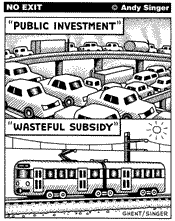
Andy SInger No Exit comic, public investment vs. wasteful subsidy
Andy Singer's No Exit comic.

Being a skeptic, I think that we are entering a "correction" of massive proportions where consumer spending could decrease somewhat significantly, reducing the overall size of the economy--people buying fewer cars, fewer clothes, making fewer discretionary purchases, saving more money, etc. will have an impact on the economy in many ways.

If you believe this, today's full page ad in the Washington Post by the American Automobile Association, calling for continued economic support of automobility seems to be asking to continue to "invest" limited federal monies in ways that look backward, rather than forward towards a new paradigm that links transportation and land use planning, and one that focuses on optimal mobility rather than automobility.

There is an article in National Journal about the failure of the finance industry and how it supports Hamiltonian-like industrial policy and heavier government involvement in the economy ("Washington's Sad Triumph"). I am torn about this because while I favor planning, at the same time i think that government, especially federal government tends toward stagnation, because the bureaucratic impulse is for system maintenance, not system improvement, and as special interest groups work to shape federal legislation in their favor.

What we need with government involvement is innovation and transformation. Sometimes we get it--the Internet is one example--but much of the time it is business as usual. (The "Growth Machine" theory about local political and economic elites focused on a joint agenda of local economic growth is easily extended to how industrial and other business sectors work in a similar fashion to shape national policy.)

The "stimulus" proposal gets me down because like most government "stimulus" plans, more than anything, it's a grab bag of programs, elements, and policies du jour. Meanwhile, for the first time in a long time, Americans support spending on infrastructure, and even spending more money in taxes on infrastructure, according to this op-ed, "Rebuilding effort" in yesterday's Baltimore Sun. From the op-ed:

Right now, 78 percent of Americans polled say government is responsible for the failure of America's infrastructure. They don't think the problems can be solved in the first 100 days of a new administration in Washington. Rather, they want ongoing strategic investments to improve America's standard of living and our individual quality of life. When more than 98 percent of Americans believe they have "the right to demand" that America's infrastructure is "efficient, convenient and modern," Washington better not fail.

Despite record transit ridership, virtually every system in the country, except maybe for Rochester, NY (see "Creativity Helps Rochester’s Transit System Turn a Profit" from the New York Times) faces big deficits, service cuts, layoffs, and/or fare increases. See "A mass transit dilemma: Ridership up, funds down" from the Los Angeles Times for a round up on this. (Of course, when the economy is in recession, tax receipts decline, and state and local governments, required to have balanced budgets, must cut services and staff, which is a policy that only deepens a recession.)
Transit usage
So the reason I get skeptical of government planning is because it often promotes stagnation, many government programs don't build value or increase return on investment. And building long term value is what I think government should be about, first and foremost.

So thinking about how Spain is reformulating its national transportation policy around high speed rail, makes me sad that the U.S. doesn't have a national transportation policy built around high speed rail in the corridors where it makes the most sense.

For example, in the Midwest, where Wisconsin State Governor Jim Doyle suggested that

Federal economic stimulus money could be used to build a Midwestern high-speed passenger rail system that would link Chicago to Minneapolis with stops at Milwaukee, Madison and even Green Bay

according to "Gov. Doyle pushes high-speed rail for stimulus funds" from the Milwaukee Journal-Sentinel.

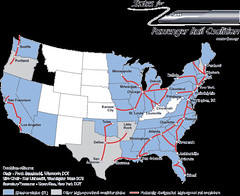
Just as the U.S. built (through economic subsidy or stimulus) a national railroad system in the 1860s, why not begin rebuilding our economy around reduction in oil use by doing the same for the 21st Century. A north-south east coast high speed rail corridor, along with the same along the west coast, and a upper and lower transcontinental high speed rail corridor would be the way to do this. Rebuilding U.S. railroad technology capacity would be a way to employ the hundreds of thousands of unemployed manufacturing workers, and would be a far better use of stimulus money that $80 million for new loading docks for the Philadelphia Museum of Art.
High Speed Rail map, States for Passenger Rail Coalition
The gaps in this map from the States for Passenger Rail Coalition shows the need for a national policy and plan...

Labels: , , , , , ,

Sunday, October 26, 2008

Speaking of funding infrastructure

If you work in planning, you see lots of community plans, with great ideas and vision.

Most communities have limited funding sources, mostly local property and sales taxes, supplemented by fees for permits and licenses, and maybe personal property taxes too--because local jurisdictions have limited revenue sources for the most part is the reasoning behind personal property taxes, although you could argue that annual taxing of automobiles provides funds that support maintenance of the road network, plus access to government funds from the county, state, and federal levels. (DC as a city is unique in the U.S., as it enjoys the revenue stream from 100% of local [equivalent to state] income taxes.)

There has been talk of a National Infrastructure Bank to help fund rehabilitation of roads, bridges, and other often decaying infrastructure. But the intent is for big projects that are regional in scope, justifying federal involvement.

I was reading a plan for Petersburg, Virginia, produced by the Regional Urban Design Assistance Team program of the American Institute of Architects, and it occurred to me that we need another kind of National Infrastructure Bank, one focused on assisting local jurisdictions in jumpstarting their revitalization.
PWA worksite, Washington, DC, 1933
PWA worksite, Washington, DC, 1933. FDR Library photo.

Just one of the more than one dozen projects in the Petersburg plan was projected to cost between $12 to $15 million.

How about the equivalent of a new fund (a la the Works Progress Administration and the Public Works Administration projects constructed for localities during the Depression) to support community revitalization projects at the town-city-county level? And transit too.

Virginia does have a model, the Governor's Fund, but I imagine the demand far exceeds the money available. (Just like with transit projects and the availability of federal government funding.)

Governor’s Fund—A statewide grant offered to communities, the Governor’s Fund can be used for a variety of uses including on-site utility improvements, site acquisition and development, and the construction or build-out of publicly-owned buildings. In order to receive the grant, the development must create a specified number of jobs as well as attain a certain amount of private assistance, a figure that is based upon population specifics. Funding amounts are determined by the governor of Virginia. The grant requires an application process submitted by the chief appointed official for the jurisdiction. (From the R/UDAT report.)
ADDITION Minnesota Bridge Collapse
Vehicles are scattered along the broken remains of the Interstate 35W bridge, which stretches between Minneapolis and St. Paul, after it collapsed into the Mississippi River during evening rush hour Wednesday, Aug. 1, 2007, sending vehicles, tons of concrete and twisted metal crashing into the water. (AP Photo/The Minnesota Daily, Stacy Bengs)

But why should we wait for absolute destruction before funding revitalization activities?

(Another idea I had, although I didn't get the project, at least that one, as part of revitalization activity for Takoma Park, Maryland (and the DC portion) would be to construct a streetcar line from Walter Reed on Georgia Avenue to Takoma Metro and from there to the New Hampshire Avenue-University Boulevard intersection in Langley Park, where there will be a Purple Line light rail station, to provide additional links to the subway system and the light rail system, and to connect the various Takoma commercial districts with a higher level of transit service. But the reality is, where would they get the funding to do something like this?)

Labels: , , ,

Tuesday, October 07, 2008

Urban green

Brandweek reports, in "U.S. Mayors Call for 'Green Revolution'" that

a new report from the U.S. Conference of Mayors calls for a "green revolution" and said if it takes place, 4.2 million new "green" jobs could be created in the country by 2038. ... "Creating green jobs is an investment we must continue to make."The forecast of more than 4 million new green jobs is based on the U.S. generating 40% of its electricity from alternative fuels (wind, solar, hydro, geothermal, biomass), 30% of fuel used in cars and light trucks coming from alternatives to gasoline and diesel that electricity use in existing buildings will drop by 35% by 2038.

The top 10 cities in the nation ranked by current green jobs and the potential number of green jobs they could have by 2038 are: New York (25,021/197,971), Washington (24,287/192,165), Houston (21,250/168,136), Los Angeles (20,136/159,321), Boston (19,799/156,660), Chicago (16,120/127,545), Philadelphia (14,379/113,772), San Francisco (13,848/109,570), San Diego (11,663/92,285) and Pittsburgh (9,627/76,174).

Report

Labels: , , ,

Wednesday, June 13, 2007

Talk is cheap but ideas are priceless

Canadian responses to a business group's report that the nation is a laggard in terms of innovation, and grappling with issues of the future, which sounds familiar to me, wrt governance in the U.S., and certain sectors of the economy, such as the U.S.-based automobile industry.

See "Canada a land of mediocrity, Conference Board says," (Globe and Mail) and "Mediocrity' threatens way of life: report card," (National Post) and not related, but a very interesting article "Talk is cheap, but ideas are priceless: Will Pecaut's city summit save Toronto?" about last February's Toronto City Summit Alliance and meeting. (I may have written about it back then, I seem to recall linking to or thinking about writing about the Summit, based on some Toronto Star coverage.)

Also see the website for the Toronto City Summit Alliance.
Canadian report card
Image from the National Post.

Labels: ,